
What Is India Stack? India’s Digital Public Infrastructure Explained
India Stack and Digital Governance in India
If you zoom out and look at India over the last decade, the shift feels almost abrupt. Not overnight, but close enough to make you do a double-take. A country where hundreds of millions of people once operated outside formal banking systems – no easy way to prove who they were, no reliable access to government services – now sits among the most digitally active economies in the world. At the centre of that shift is something you don’t really “see” unless you go looking for it: India Stack.
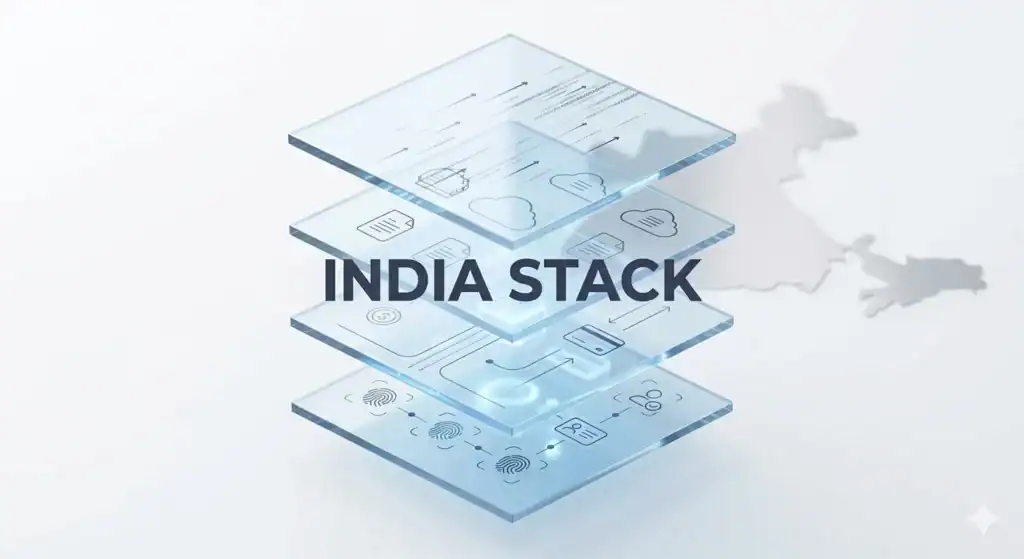
India Stack isn’t a single app you download or a website you log into. It’s more like a toolkit—an evolving collection of open Application Programming Interfaces (APIs) and digital public systems that quietly power everything from identity verification to payments to data sharing. The idea is simple, but the execution is anything but: build infrastructure once, make it open, and let everyone else- startups, banks, government departments- build on top of it.
People often describe it as “national plumbing,” which sounds a bit unglamorous, but it fits. You don’t think about pipes when you turn on a tap. Same here. Every time someone sends money through UPI, authenticates with Aadhaar, pulls a document from DigiLocker, or consents to share financial data, India Stack is there, underneath it all, doing the quiet work. Invisible, mostly and essential, completely.
There’s also a bit of confusion that tends to come up, especially in policy conversations: how is India Stack different from Digital Public Infrastructure (DPI)?
The easiest way to think about it is this – DPI is the idea, the category. It’s a global concept: shared digital systems that function like roads or electricity grids, available for everyone to use and build upon. Any country can adopt that philosophy.
India Stack, on the other hand, is India’s specific, working version of that idea. It’s what happens when DPI stops being theory and becomes actual systems people use every day. The term itself was pushed forward by iSPIRT, a volunteer-driven think tank made up of technology professionals who worked closely with the government to shape these systems. When people refer to India Stack, they’re talking about something concrete, deployed, scaled, and very much alive.
At a Glance: India Stack & Digital Governance (2026)
- What is India Stack?
A modular ecosystem of open APIs (Aadhaar, UPI, DigiLocker) enabling population-scale presence-less, paperless, and cashless services.- What are the 4 Key Layers?
The framework consists of Identity (Aadhaar), Payments (UPI), Paperless (DigiLocker/eSign), and Consent (Account Aggregators).- What is the 2026 UPI Impact?
In January 2026, UPI processed 21.70 billion transactions worth over ₹28.33 lakh crore, reinforcing its role as India’s digital backbone.- How many people use DigiLocker?
As of March 2026, 67.63 crore users have stored more than 950 crore digital documents on the platform.- Is India Stack Global?
Yes, India has signed agreements with 23 countries (as of February 2026) to share its Digital Public Infrastructure (DPI) model.
Architecture of India Stack: The Four-Layer Framework
Why India Stack Uses a Layered Architecture
At some point, almost everyone who tries to understand India Stack asks the same question: Okay, but how is it actually put together?
The answer isn’t a single system or a monolith. It’s layered and deliberately so.
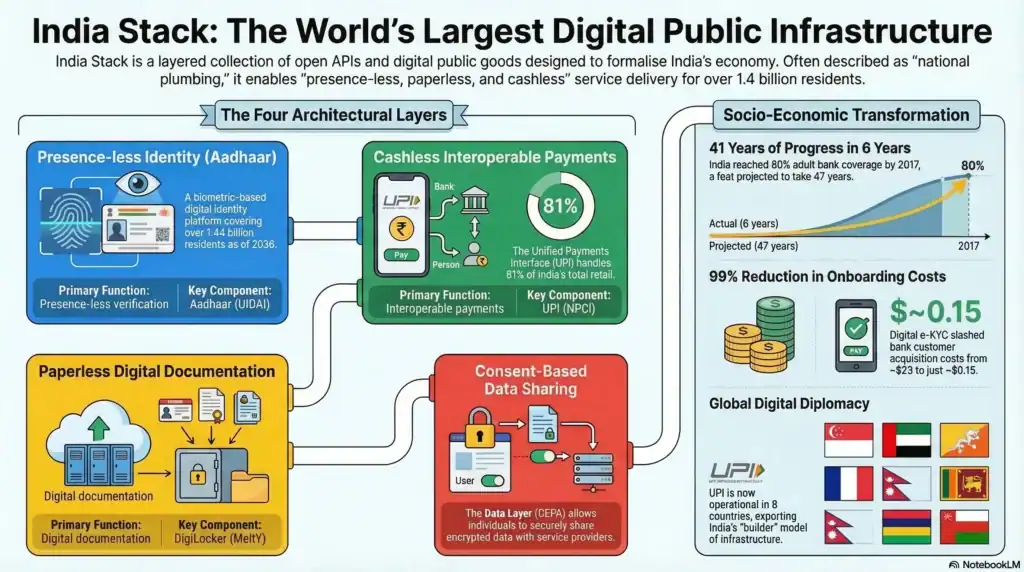
India Stack is built on four distinct layers, each with its own governing authority, its own regulatory logic and its own job to do. But here is the interesting part: they don’t operate in isolation. They’re designed to talk to each other smoothly, almost invisibly, so that from a user’s point of view, everything feels like one continuous experience. Identity flows into payments, payments into documentation, documentation into data sharing, all in a single interaction, often in seconds.
That separation-with-connection is doing a lot of heavy lifting. It means one layer can evolve without breaking the others. It also means innovation doesn’t get bottlenecked in one place.
The Four Layers of India Stack (Identity, Payments, Paperless, Data)
Identity Layer (Aadhaar and Presence-less Verification)
At the very bottom sits Aadhaar. Everything else leans on it, directly or indirectly.
It’s the world’s largest biometric ID system, run by the Unique Identification Authority of India (UIDAI). Each person gets a 12-digit number tied to fingerprints, iris scans, and a small set of demographic details. Simple in description, massive in scale.
What Aadhaar really changed is the idea of presence. Earlier, proving who you were meant physically showing up somewhere, documents in hand, waiting in line, and hoping nothing got rejected for a missing signature or a mismatch. Aadhaar flips that. Verification can happen remotely, almost instantly, often from a phone.
That’s what people mean when they say identity becomes “presence-less.” You don’t have to be there to be verified.
By 2025, the system will cover over 1.44 billion residents, which is hard to even visualize properly. It’s not just scale, but it’s near universality.
And for everyday use, people can check details, download IDs, or access services through the UIDAI portal itself.
Payments Layer (UPI, AePS, and Cashless Transactions)
If Aadhaar is the foundation, the payments layer is what most people actually feel day to day.
This is where India Stack becomes visible.
At the center is UPI, the Unified Payments Interface. It turned what used to be a clunky, multi-step process into something almost casual. You can send money from one bank account to another in seconds, using just a phone number or a UPI ID. No need to remember account numbers or IFSC codes anymore.
Then there’s AePS, which matters more in rural contexts than people often realize. It allows transactions through local agents using biometric authentication – no smartphone, no PIN required. And the Aadhaar Payment Bridge (APB) connects everything back to government transfers, making sure money actually reaches the intended person.
Taken together, these systems didn’t just digitize payments but they normalized them.
The scale is staggering. In a single year, UPI crossed 130 billion transactions. Not million but billion. At that point, it stops being a feature and starts looking like infrastructure.
Paperless Layer (DigiLocker and e-Sign for Digital Documents)
Paper used to be where everything slowed down or quietly broke.
Lost files, forged documents, endless photocopies, signatures that needed to be physically verified. The paperless layer tries to cut through all of that.
Two pieces anchor it: DigiLocker and e-Sign.
DigiLocker is essentially a government-backed digital vault. You can store official documents, licenses, certificates, insurance papers, and, more importantly, share them in a way that’s legally recognized. No need to carry originals or worry about attestation.
As for e-Sign, it complements that by removing the last physical step: signing. If your Aadhaar is linked, you can sign documents digitally in seconds. No dongles, no expensive certificates, no printing just to sign and scan again.
Together, they don’t just reduce paperwork, but they change the expectation. Documents are no longer something you carry. They’re something you access.
Data Layer (Account Aggregator and Consent-Based Data Sharing)
This last layer feels newer and, in some ways, more philosophical.
Because the problem it’s trying to solve isn’t speed or access, but control.
Traditionally, once your data entered a system – banking, insurance, government – you lost visibility over how it moved. The Account Aggregator framework, built under the Data Empowerment and Protection Architecture (DEPA), tries to reverse that dynamic.
Here, the individual is supposed to sit at the center.
You can allow a lender, for example, to access your financial data, but only for a specific purpose, for a defined time, and with full traceability. Consent isn’t a one-time checkbox buried in terms and conditions. It’s structured, revocable, and logged.
“The citizen is the owner; the institution is merely a guest.” That line comes up often and while reality can be messier, it captures the intent pretty well.
To make this work, the Reserve Bank of India has laid out detailed regulations for Account Aggregators, treating them as formal, supervised entities with clear responsibilities around data handling and user rights.
Sectoral Expansion of India Stack: ABDM, ONDC and FASTag
If the four layers of India Stack were the foundation, they were never meant to be the finished structure. More like the base of a city that hadn’t been built yet.
The real idea was always expansion – sector by sector, problem by problem.
What’s emerged over time are these “vertical stacks,” each applying the same underlying logic – open systems, interoperability, consent, digital identity – to specific domains. Some of them are still taking shape. A couple has already started to feel consequential.
Two that come up often are the Ayushman Bharat Digital Mission (ABDM) and the Open Network for Digital Commerce (ONDC).
ABDM takes the India Stack approach and drops it into healthcare, which is not a simple domain to digitize. The ambition here is pretty sweeping: give every citizen a Health ID (linked to Aadhaar), allow medical records to be stored digitally, and – this is the tricky part – make those records shareable across providers, but only with patient consent. In theory, that means you don’t have to carry files from one hospital to another, or repeat tests just because data isn’t accessible. Whether it fully plays out that way everywhere is still an open question, but the direction is clear.
ONDC, on the other hand, is trying to do something slightly more disruptive in e-commerce. Instead of a few dominant platforms controlling both buyers and sellers, ONDC proposes a network where any buyer app can connect to any seller, regardless of platform. It’s less about replacing existing marketplaces and more about loosening their grip, breaking that closed-loop ecosystem where everything has to happen within one company’s walls.
Then there’s a question people don’t always expect in this conversation: does FASTag count as part of India Stack?
Short answer is yes, in spirit and design.
FASTag is the RFID-based toll payment system used across national highways. You stick a tag on your vehicle, and tolls get deducted automatically as you pass through plazas. No stopping, no cash, no human exchange.
At first glance, it feels like a standalone transport solution. But look closer, and the pattern is familiar: a digital identifier (the tag linked to your vehicle), real-time cashless transactions, and infrastructure designed to reduce friction at scale. It’s the same DNA as the rest of India Stack, just applied to roads instead of banking or identity.
And honestly, if you’ve ever sat in a long toll queue pre-FASTag, the difference isn’t abstract. It’s very, very tangible.
By extending these principles into sectors like healthcare, commerce, and transportation, India Stack stops being just a “tech framework” and starts looking more like a template, a way of thinking about public infrastructure in the digital age.
JAM Trinity and Impact of India Stack on Financial Inclusion and DBT
India Stack didn’t just appear and start working in isolation. It needed something to stand on. Bome prior alignment that made large-scale adoption even possible.
That alignment is often referred to, somewhat neatly, as the JAM Trinity: Jan Dhan, Aadhaar, and Mobile.
Three pieces, and each one incomplete on its own. But, together, oddly powerful.
The Pradhan Mantri Jan Dhan Yojana (PMJDY), launched in 2014, focused on something very basic but historically difficult: getting bank accounts into the hands of every adult, especially those in rural or low-income settings. These were zero-balance accounts, which mattered more than it sounds, as no minimum balance meant fewer barriers to entry.
But opening accounts at that scale usually runs into a wall: documentation. Proof of identity, proof of address, things many people simply didn’t have in a formal sense. That’s where Aadhaar came in, acting as a kind of universal verification layer that made onboarding dramatically simpler.
Then came mobile connectivity. Not just phones, but affordable data, especially after the 4G expansion around 2016. Suddenly, those bank accounts weren’t just sitting there. They were reachable, usable and in a way alive.
Put those three together – bank account, identity, connectivity – and you get a system that can actually move.
The speed of what followed is still a little startling. India hit around 80% adult bank account coverage in about six years. Traditional models, including estimates from institutions like the World Bank, had projected something closer to four or five decades for that kind of reach. It’s not just faster but a different curve entirely.
Where this infrastructure really showed its teeth, though, was in Direct Benefit Transfers (DBT).
Before DBT, welfare distribution often passed through multiple layers, such as local officials, intermediaries, and paperwork-heavy processes. And somewhere along that chain, funds had a tendency to leak. Not always maliciously, but often enough to matter.
DBT cuts through that. Payments – subsidies, pensions, welfare benefits – go directly from the government into the bank accounts of verified individuals, using Aadhaar linkage as the bridge. No middle steps or at least, far fewer of them.
The cumulative impact is hard to ignore: ₹3.48 lakh crore saved by reducing leakage and fraud. That’s more than just efficiency but it’s structural correction. A redesign of how delivery works, rather than an attempt to police it after the fact.
There’s also a quieter layer of recognition behind all this. The Unique Identification Authority of India (UIDAI), which manages Aadhaar, received the Prime Minister’s Award for Excellence in Public Administration. Not just for building the system, but for what that system enabled—more accountable, traceable governance.
Still, it’s worth saying: systems like this don’t land evenly everywhere. The success is real, but so are the variations in how people experience it. Some find it seamless. Others still navigate friction. Both can be true at once.
India Stack Global: DPI Diplomacy and International Adoption
At some point, what India built stopped being just a domestic story.
Other countries started paying attention, not casually, but with a kind of sustained curiosity. Could this actually work elsewhere? Could you replicate something like India Stack in places with very different political systems, infrastructure gaps, or institutional constraints?
India, for its part, hasn’t kept this locked away. If anything, it’s leaned in—positioning its Digital Public Infrastructure model as something closer to a shared resource than a competitive advantage.
That intent shows up clearly in the India Stack Global platform, run by the Ministry of Electronics and Information Technology (MeitY). It’s essentially a showcase, but also a toolkit, laying out how these systems work, how they’re governed, and how other countries might adapt them. Notably, it’s available in all six official UN languages, which feels like a small detail until you realize it’s signalling something bigger: this is meant to travel.
And it has. So far, 24 countries have entered into cooperation agreements with India around DPI development. Some are exploring identity systems, others are payments, and others still are looking at the full-stack approach.
UPI, in particular, has become the most visible export. It’s already live in eight countries like France, Singapore, the UAE, Sri Lanka, and Mauritius, among others. For users, the experience is intentionally familiar: the same apps, the same flow, just in a different country. That continuity matters more than it might seem as it lowers friction not just technically, but psychologically.
There’s also a noticeable pattern in who’s showing the most interest. African nations, especially, have been active collaborators. The parallels are hard to miss: large unbanked populations, uneven legacy infrastructure, and a need to scale quickly without building everything from scratch. India’s approach – modular, relatively low-cost, and open – maps onto those challenges in a way that more rigid systems often don’t.
The broader validation, though, came on a global stage.
During India’s G20 presidency in 2023, the New Delhi Leaders’ Declaration explicitly recognized Digital Public Infrastructure as a key accelerator for achieving the UN Sustainable Development Goals. That might sound like standard diplomatic language, but it’s not insignificant. It effectively places DPI alongside more traditional development tools, giving it legitimacy in international policy circles.
Alongside that, platforms like dpi.global have emerged as shared knowledge hubs, places where countries can access frameworks, case studies, and technical documentation drawn from India’s experience. It’s less about copying and more about borrowing ideas, adapting them, remixing them.
Still, exporting a model is never straightforward. What works in one context doesn’t always translate cleanly into another. Regulations differ, political priorities shift, and infrastructure realities vary. So, the story here isn’t one of simple replication; it’s more experimental than that.
But the direction is clear enough: India Stack has moved from being a national infrastructure project to something closer to a global reference point. Not perfect, not universally applicable, but increasingly hard to ignore.
Challenges in India Stack: Digital Divide, Data Privacy, and Future Risks
Bridging the Digital Divide in India’s Digital Public Infrastructure
For all its scale and ambition, India Stack isn’t frictionless. It works, often impressively, but not evenly, not without tension. And at this size, even small gaps start to matter.
If there’s one issue that keeps resurfacing, it’s this: access isn’t uniform.
In cities, especially larger ones, digital services can feel almost second nature now: payments, identity checks, document sharing, all happening through a phone in seconds. But step outside that bubble, into more remote or economically fragile regions, and the picture shifts.
Connectivity is still inconsistent in parts of the country. Not absent, but unreliable enough to disrupt usage. And even when the infrastructure exists, digital literacy doesn’t always follow. Older adults, many women in rural areas, groups that were already on the margins of formal systems, can find themselves navigating interfaces that assume a level of familiarity they haven’t had the chance to build.
So, there’s this quiet risk: that a system designed to include could, unintentionally, deepen exclusion for those who can’t fully access it.
Some research points to exactly that tension. Gains in areas like education access and digital services are visible in urban and semi-urban regions, but the rural gap hasn’t closed at the same pace. It lingers, less visible than before, but still structural.
Bridging that gap isn’t just about laying more fibre or distributing more smartphones. It’s slower than that. It’s about trust, familiarity, repetition and people getting comfortable enough with systems to rely on them.
Data Privacy, DPDP Act 2023 and Citizen Data Rights
Then there’s the question that tends to sit underneath everything else: who controls the data?
India Stack moves a lot of it- identity, financial records, personal documents – through interconnected systems. This makes strong data protection less of a feature and more of a necessity.
The Digital Personal Data Protection (DPDP) Act, 2023, is India’s primary attempt to put guardrails in place. It defines individuals as “data principals,” lays out responsibilities for entities handling that data (data fiduciaries), and introduces mechanisms for consent and redress. On paper, it sketches a system where individuals retain meaningful control over their information.
But laws don’t operate in a vacuum. Their impact depends on enforcement, interpretation, and how they evolve alongside technology. The balance here is delicate, too rigid, and innovation slows; too loose, and trust erodes.
There’s also the Aadhaar Citizen Charter, which sets expectations around service standards and accountability. It’s a quieter document, but it plays a role in defining what citizens can reasonably demand from the system.
Still, the underlying tension doesn’t disappear. A system this integrated can empower, but it can also overreach if not carefully governed. That dual possibility never fully goes away.
Future of India Stack: AI, ABIS and Innovation Roadmap
Even with these challenges, the system isn’t standing still. If anything, it’s still expanding, sometimes in ways that feel incremental, sometimes in ways that hint at bigger shifts.
One example is AI-enabled face authentication within Aadhaar. It replaces fingerprint-based verification, which can fail for people whose fingerprints have worn down, like agricultural workers, with facial recognition that works through a smartphone camera. In theory, that removes another barrier. In practice, it opens up a new set of questions around accuracy, bias, and surveillance. Progress and discomfort, side by side.
Another development is the push for an indigenous Aadhaar Biometric Identification System (ABIS). Moving away from dependence on foreign vendors isn’t just about cost but it’s about control. Owning the core technology behind identity infrastructure has implications that go beyond efficiency, touching on security and long-term autonomy.
Externally, institutions have started studying this model more closely.
The Konrad Adenauer Stiftung (KAS), for instance, has highlighted India’s layered architecture – open standards, independent regulation across layers, and room for private participation- as something worth replicating, or at least learning from.
Harvard Business School has turned it into a case study, looking at how digital public infrastructure can enable forms of inclusive growth that markets alone often struggle to deliver.
The Observer Research Foundation places India Stack in a broader geopolitical context, suggesting it could become a kind of alternative pathway for countries, especially in the Global South, looking to avoid dependence on large, proprietary tech ecosystems.
All of which is to say: this isn’t a closed chapter. It’s still being written, with all the uncertainty that implies.
Common Questions: India Stack & Digital Public Infrastructure (2026)
India Stack solves the identity challenge through Aadhaar, a biometric ID system covering over 1.44 billion residents (as of March 2026). It enables presence-less authentication, allowing citizens to verify identity instantly via mobile devices without physical documents.
The India Stack framework consists of four interoperable layers: Identity (Aadhaar), Payments (UPI, AEPS, APB), Paperless (DigiLocker, e-Sign), and Consent (Account Aggregator framework for secure data sharing).
India has transferred over ₹49.09 lakh crore via DBT as of January 2026. By eliminating leakages and ghost beneficiaries, the government saved more than ₹4.31 lakh crore between 2015 and March 2024 alone.
As of February 2026, India has signed agreements with 23 countries, including Kenya, Brazil, Sri Lanka, and Vietnam. UPI is currently operational in 8+ countries, such as the UAE, Singapore, France, and Mauritius.
DigiLocker enables paperless governance with 67.63 crore users and over 950 crore documents issued by March 2026. Meanwhile, the UMANG app provides a single-window mobile interface for 2,400+ government services, recording over 723 crore transactions to date.
India Stack and the Vision of a Unified Digital Society
It’s tempting to think of India Stack as just another bundle of government services, but that framing misses something important.
It’s closer to infrastructure. Not the visible kind, but the kind everything else quietly depends on.
Think of it as rails. The identity layer gives people a way to exist, verifiably, in a digital system. The payments layer lets that identity participate economically. The paperless layer removes the small but persistent bureaucratic hurdles that used to slow everything down or stop it entirely. And the data layer, at least in intent, hands some control back to individuals over how their information moves.
None of these layers does much on its own. Together, they start to feel like a system.
The JAM Trinity – Jan Dhan, Aadhaar, Mobile – was what made this system reachable at scale. Without bank accounts, identity wouldn’t translate into financial access. Without mobile connectivity, none of it would be usable in everyday life. And without Aadhaar, the whole thing would struggle to verify itself.
Then came DBT, which was less about innovation and more about application. It showed that this infrastructure could actually do something tangible—deliver money directly, reduce leakages, cut out inefficiencies that had been baked into the system for years. Tens of billions saved isn’t just a statistic; it’s a signal that the architecture changed outcomes, not just processes.
What’s happened since then – international partnerships, UPI expanding into other countries, DPI being acknowledged at forums like the G20 – suggests that this isn’t staying local. There’s a growing sense, globally, that markets alone won’t close the digital divide. Some form of shared infrastructure is needed, and India’s model is one of the more developed examples on the table right now.
But it’s not frictionless. It never was.
Digital literacy gaps are still real. Rural connectivity isn’t uniformly reliable. Questions around data privacy and surveillance don’t disappear just because frameworks exist, they linger, and they evolve. These aren’t side notes; they shape how the system is experienced day to day.
Still, there’s a difference between a system that struggles because it’s failing and one that struggles because it’s expanding.
India Stack feels like the latter.
What stands out, more than anything, is the decision to build this as a public good. Not a closed platform, not something owned end-to-end by a single entity, but a shared base others can build on. That choice has a kind of compounding effect. Every new user, every new service, every new layer, it doesn’t just add value individually. It strengthens the system as a whole.
More people on Aadhaar make UPI more useful. More documents in DigiLocker make data-sharing frameworks more meaningful. It feeds into itself, but not in a monopolistic way, in a manner that (ideally) broadens participation.
And maybe that’s the more interesting shift.
This isn’t a finished system. It’s not even stable in the traditional sense. It’s evolving, adjusting, and occasionally stumbling. But it’s built with the assumption that more will be added, that future services, ones not fully imagined yet, will need something like this to stand on.
That, in itself, says something.
Not just about technology, but about intent. About building systems that people can plug into, rather than systems they have to work around.



Leave a Reply