
Jan Vishwas Bill 2026 Explained: Key Changes, Benefits & Impact on Businesses
Jan Vishwas Bill 2026 & India’s Shift to Trust-Based Governance
March 27, 2026, the date might not feel dramatic in the moment, but it could age into something significant. That’s when the Parliament saw the introduction of the Jan Vishwas (Amendment of Provisions) Bill, 2026. Jitin Prasada, the Minister of State for Commerce and Industry, brought it into the Lok Sabha after the Union Cabinet gave its nod.
On paper, the numbers are dense and almost overwhelming. Amendments to 784 provisions across 79 Central Acts, handled by 23 Ministries. Out of these, 717 provisions are set to be decriminalised, mainly to improve Ease of Doing Business, while 67 more are aimed at making everyday life a little less tangled for citizens.
But numbers don’t quite capture the shift here. This isn’t just legislative housekeeping.
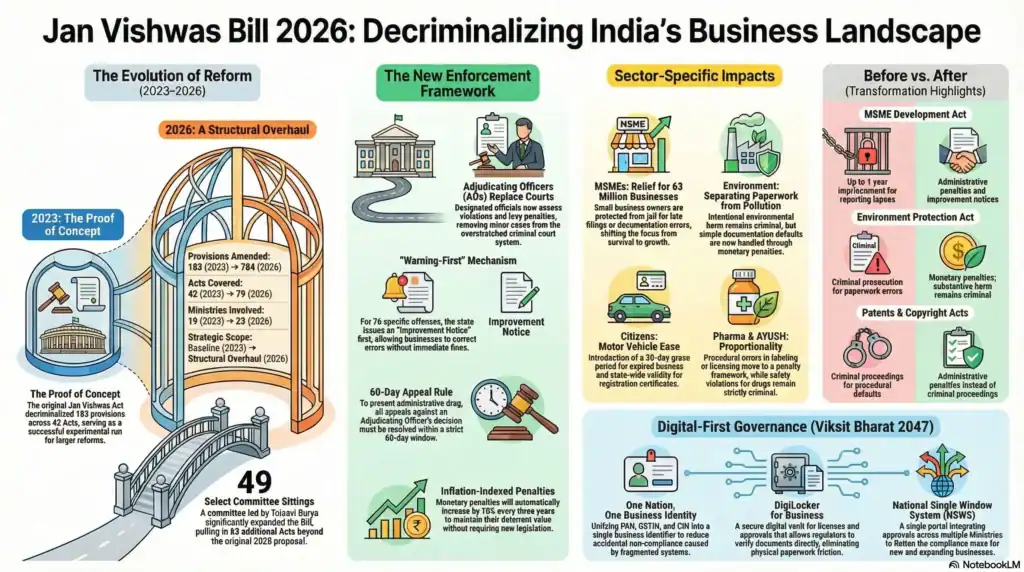
The Bill didn’t appear out of nowhere either. It’s part of a longer, slightly messy reform trail. Back in 2023, the first Jan Vishwas Act quietly tested the waters by decriminalising 183 provisions across 42 Acts. It was cautious and almost experimental.
Then came the 2025 version, which was introduced, debated, and eventually handed over to a Select Committee led by Tejasvi Surya. And this is where things got interesting. Over 49 sittings (which, if you’ve ever sat through even one long meeting, sounds exhausting), the Committee didn’t just review what was given to them; they significantly expanded it. Instead of sticking to the original 16 Acts, they pulled in 62 more. The result? The 2025 Bill was scrapped, and what we now have in 2026 is something far broader, almost reimagined.
And then there’s the name—Jan Vishwas, meaning public trust. It sounds simple, maybe even a bit idealistic. But it carries a quiet provocation: what if the State assumed you weren’t trying to break the law every time you made a small mistake?
Because that’s really the heart of this Bill. A shift, subtle but important, from a system that leans on fear (“comply or face jail”) to one that leans on proportion (“fix it, pay a penalty if needed, move on”). Ease of Doing Business and Ease of Living aren’t just policy buzzwords here; they’re trying to describe a different tone of governance. Less suspicion and more breathing room.
Whether it works as intended, that’s a separate question. But as a starting point, it does feel like a line has been crossed.
At a Glance: The Jan Vishwas (Amendment of Provisions) Bill, 2026
The Big Picture: A Paradigm Shift in Governance
- What it is: A monumental legislative overhaul that decriminalises 717 minor offences across 79 Central Acts, fundamentally shifting India’s regulatory landscape.
- The Core Philosophy: Moving from “Punitive Enforcement” (fear-based) to “Trust-based Governance” (compliance-based). It treats businesses as partners in nation-building rather than potential litigants.
- Strategic Vision: Directly aligns with the Viksit Bharat 2047 goal by synchronising Indian regulations with global “Ease of Doing Business” (EoDB) standards.
The Scale of Reform
- Legislative Breadth: Amends 784 specific provisions, making it the most extensive decriminalisation exercise in India’s history.
- Cross-Sector Impact: Touches diverse areas including Environment, Media, Agriculture, Health, and Finance, creating a unified and predictable legal environment.
Key Structural Changes
- Removal of Imprisonment: For 717 offences, jail terms are replaced by monetary penalties and administrative actions.
- Decriminalising Compliance: Minor technical lapses—such as late filings, documentation errors, or procedural delays—no longer carry the stigma or risk of a criminal record.
- Compounding of Offences: Allows for the “settlement” of disputes through fines, avoiding lengthy and expensive court trials.
The New Enforcement Framework
- Adjudicating Officers (AOs): Compliance issues shift from overcrowded Criminal Courts to specialized Administrative Officers for faster resolution.
- The Three-Step Model: Implements a Warning Correction Period Financial Penalty workflow, giving businesses a fair chance to rectify honest mistakes.
- Time-Bound Appeals: Introduces a strict 60-day timeline for appeals, ensuring legal certainty and preventing “litigation limbo.”
Who Benefits Most?
- MSMEs & Startups: Removes the “Inspector Raj” fear, allowing entrepreneurs to focus on innovation rather than legal defense.
- The Judicial System: De-clogs lower courts by offloading thousands of petty compliance cases, allowing the judiciary to focus on serious crimes.
- Global Investors: Signals a mature, business-friendly regulatory environment, reducing the “Cost of Compliance” in India.
The Safety Net: What Remains Criminal?
- Non-Negotiable Sectors: The Bill maintains strict criminal liability for serious offences that impact public safety. This includes Environmental Damage, Food Safety violations, and Spurious Drugs (Pharma).
- Proportionate Justice: While minor errors are forgiven, wilful and harmful negligence remains subject to the full force of criminal law.
Economic & Social Impact
- Investment Catalyst: By lowering “Legal Risk,” the Bill encourages domestic investment and Foreign Direct Investment (FDI).
- Ease of Living: Simplifies everyday compliance for citizens (e.g., motor vehicle rules), reducing unnecessary friction between the state and the individual.
What is the Jan Vishwas Bill 2026? Definition, Features & Key Facts
The Jan Vishwas (Amendment of Provisions) Bill, 2026, is a central legislation that replaces imprisonment clauses for minor, technical, and procedural violations across 79 Indian laws with monetary penalties and administrative warnings, while establishing Adjudicating Officers and Appellate Authorities for time-bound enforcement. Covering 784 provisions in total, it represents the most comprehensive single-step decriminalisation exercise in independent India’s legislative history.
If you strip away the legal density for a second, the idea is surprisingly straightforward. For years, a lot of minor compliance slip-ups, such as late filings, small documentation errors, and procedural oversights, could technically land someone in criminal trouble or even in jail in theory.
This Bill steps in and says: That’s excessive. Let’s recalibrate.
So instead of criminal prosecution, most of these cases shift into a different lane—penalties, warnings, administrative handling. Less courtroom drama, more paperwork (still paperwork, though, it seems that part never quite leaves).
What also stands out is the scale. Not a tweak here or there, but a wide sweep across 79 laws. It’s the kind of reform that tries to fix a pattern rather than patch individual holes.
| Metric | Detail |
| Introduction Date | March 27, 2026 |
| Introduced By | Jitin Prasada (MoS, Commerce & Industry) |
| Total Provisions Amended | 784 |
| Provisions Decriminalised (EoDB) | 717 |
| Amendments for Ease of Living (EoL) | 67 (NDMC Act + Motor Vehicles Act) |
| Acts Amended | 79 Central Acts |
| Ministries Involved | 23 |
| Offences Rationalised | 1,000+ |
| Select Committee Sittings | 49 |
| Committee Chair | Tejasvi Surya |
Tables like this can feel a bit clinical, but they do help anchor the scale. Seven hundred-plus provisions decriminalised; that’s not incremental change. That’s a structural shift, whether one agrees with every part of it or not.
For those keen on reading, the full Bill is available here and for those who like going straight to the source documents, here is another useful source.
Jan Vishwas 2023 vs 2025 vs 2026: Evolution of Decriminalisation in India
India’s path toward decriminalising its regulatory framework hasn’t been a single leap. It’s been more like a series of steps, each one testing how far the system is willing to go.
The 2023 Foundation of Decriminalisation Reforms
The Jan Vishwas (Amendment of Provisions) Act, 2023 was where this really began. It quietly acknowledged something policymakers had tiptoed around for years: too many laws were criminalising things that didn’t quite deserve that label.
That Act decriminalised 183 provisions across 42 Central Acts, touching 19 Ministries. A decent spread—agriculture, environment, intellectual property.
At the time, it felt cautious. Almost like a pilot run and in hindsight, that’s exactly what it was, a proof of concept. A way to see if removing jail terms for minor issues would break the system (it didn’t), or maybe even make it function better.
Select Committee’s Role in Expanding the Jan Vishwas Bill 2026
Then came the 2025 version, introduced, debated, and eventually handed over to a Select Committee led by Tejasvi Surya. And this is where things got interesting. Over 49 sittings (which, if you’ve ever sat through even one long meeting, sounds exhausting), the Committee didn’t just review what was given to them but they significantly expanded it. Instead of sticking to the original 16 Acts, they pulled in 62 more. The result? The 2025 Bill was scrapped, and what we now have in 2026 is something far broader, almost reimagined.
The Evolution of Jan Vishwas: 2023 vs. 2025 vs. 2026
| Parameter | Jan Vishwas Act, 2023 | Jan Vishwas Bill, 2025 | Jan Vishwas Bill, 2026 |
| Provisions Amended | 183 | 355 | 784 |
| Acts Covered | 42 | 16 | 79 |
| Ministries Involved | 19 | 10 | 23 |
| Legislative Stage | Enacted (Law) | Introduced; Withdrawn (March 17, 2026) | Introduced (March 27, 2026) |
| Key Architect | DPIIT | Piyush Goyal (MoC&I) | Jitin Prasada (MoS Commerce) |
| Scale of Reform | Baseline Decriminalisation | Intermediate Expansion | Structural Overhaul |
Looking at that progression, the pattern becomes hard to ignore. This isn’t just growth, it’s acceleration.
From 42 Acts to 79 and then from 183 provisions to 784. That’s not just scaling up; it’s a shift in confidence. The system is no longer testing whether decriminalisation works, but it’s acting on the assumption that it does.
And the reach has widened, too. What started with select sectors now touches everything from industrial licensing to municipal rules to traditional medicine. A bit of everything, really.
There’s something slightly revealing in that. Reforms rarely expand this way unless the earlier version didn’t just pass but was convincing.
Over-Criminalisation in India: Problems the Jan Vishwas Bill 2026 Solves
Before getting into what the Jan Vishwas Bill 2026 actually does, it helps to pause and look at the problem it’s trying to untangle. Because otherwise, the scale of the reform feels abstract.
Regulatory Burden and Criminalisation in Indian Laws
There’s a phrase that floats around policy circles, “regulatory cholesterol.” It sounds almost harmless, but it isn’t. It refers to the slow build-up of rules that clog the system over time.
The numbers here are telling. Research from the Vidhi Centre for Legal Policy found over 7,300 criminal offences scattered across 370 central laws. That’s not just a lot, but it’s dense.
And many of these weren’t about serious wrongdoing. They were lapses like missing a deadline, filing something incorrectly, or forgetting a disclosure. Things that, in everyday life, feel like mistakes but not crimes.
Yet legally, they could carry imprisonment.
The Observer Research Foundation once pointed out that nearly 38% of business-related compliance clauses in India had jail terms attached. Think about that for a second that is almost four out of ten.
At some point, the system stops distinguishing between error and intent. And that’s where things start to feel off.
Fear of Compliance: Impact on Businesses and MSMEs
What happens when the rules feel too heavy? People adapt, but not always in healthy ways.
Businesses, especially smaller ones, begin to operate defensively. Growth becomes secondary. The first instinct is survival—avoid risk, avoid scrutiny, avoid mistakes.
Some founders often describe compliance less as a process and more as a constant background anxiety. Like something you’re always slightly behind on.
Even the judiciary picked up on this. Former Chief Justice of India D.Y. Chandrachud referred to it as a “culture of fear.” And that phrase sticks, because it captures the mood more than the law itself.
When compliance feels existential, not administrative, people either overcompensate—or opt out entirely. The informal economy, in part, thrives in that gap.
Outdated and Archaic Legal Provisions in India
And then there are the laws that make you pause, but not because they’re complex, but because they feel oddly specific, almost out of time.
Milking a cow on a public street? Criminal offence, at least under certain older municipal provisions.
Failing to report the death of a draught animal within a fixed window? Also criminal.
These aren’t hypotheticals. They exist (or existed) in the legal framework.
It’s a bit like opening an old cupboard and finding things no one remembers putting there but they’re still technically in use. That’s what decades of layered lawmaking can do.
There’s a Latin principle – de minimis non curat lex- the law does not concern itself with trifles. In India’s case, that principle has often felt more aspirational than real.
The 2026 Bill, in a quiet way, is trying to realign practice with that idea.
Court Backlogs and Minor Compliance Cases in India
There’s also a more practical consequence to all this: the courts.
India’s judicial system is already stretched thin. And a non-trivial portion of that load comes from minor regulatory cases, things that arguably never needed to be in criminal courts to begin with.
When you route every small compliance issue through the same system meant for serious offences, delays are inevitable. Everything slows down.
By shifting these cases into administrative channels, handled by designated officers instead of courts, the Bill is not just easing business compliance. It’s quietly easing pressure on the judiciary too.
Not a flashy reform, but an important one.
Jan Vishwas Bill 2026 Enforcement Framework: From Jail to Monetary Penalties
At the heart of the Jan Vishwas Bill 2026 is a fairly fundamental swap. Not cosmetic but structural.
Instead of treating minor violations as criminal matters, the system moves toward administrative enforcement. Less courtroom, more process. And that shift rests on four key mechanisms.
- Adjudicating Officers (AOs)
Rather than dragging cases through criminal courts, designated officials – Assistant Commissioners, District Magistrates, and others – step in as Adjudicating Officers.
They’re the ones who assess the violation and decide the penalty.
In theory, this should make things quicker. Less procedural weight, fewer hearings, no looming criminal record for what might have been a simple compliance miss.
Of course, it also means a lot depends on these officers—their judgment, consistency, and how they interpret the line between “minor lapse” and something more serious. But the intent is clear: shift resolution closer to the ground, and speed it up.
- The 60-Day Appeal Rule
There’s a built-in safeguard here. Appeals against decisions made by Adjudicating Officers aren’t supposed to drift endlessly.
They must be resolved within 60 days.
It sounds straightforward, almost obvious, but anyone who has dealt with administrative systems knows timelines have a way of stretching. So, putting a firm cap on it matters. It signals that this new system isn’t meant to become just another slow-moving layer.
Whether it consistently holds that timeline in practice—that’s something only time will tell.
- The Warning-Correct-Penalise Model
This is probably the most telling piece of the framework, philosophically speaking.
For 76 offences across 10 Acts, the system doesn’t jump straight to punishment. Instead, it starts with a warning, an Improvement Notice.
You’re told what went wrong, given time to fix it, and only if you don’t comply (or repeat the mistake) do penalties kick in.
It’s a small shift in sequence, but a big shift in mindset. It assumes that many violations aren’t malicious but they’re messy, procedural, sometimes just confusing.
And honestly, anyone who’s dealt with complex compliance forms knows how easy it is to get something slightly wrong.
- Automatic Penalty Revision: Inflation Indexing
There’s also a practical tweak that might not grab headlines but quietly matters: penalties won’t stay static.
They’ll increase by 10% every three years.
It’s a way to keep fines meaningful over time without having to revisit the law constantly. Otherwise, what starts as a deterrent slowly becomes negligible—just another cost to absorb.
That said, a flat increase raises its own questions. A 10% bump means very different things to a small business versus a large corporation. Whether this mechanism stays proportionate across contexts that’s something policymakers may need to keep revisiting.
Sector-Specific Benefits of the Jan Vishwas Bill 2026
Big reforms always sound impressive in aggregate, hundreds of provisions, dozens of Acts, but the real test is simpler: what actually changes on the ground? Who feels it?
This section is where the Bill starts to get tangible.
MSMEs: The Biggest Beneficiaries
If there’s one group that’s likely to feel immediate relief, it’s MSMEs. Not in a dramatic, overnight way, but in the small, cumulative easing of pressure.
Small businesses don’t usually have in-house legal teams. Compliance isn’t a department; it’s often the owner staying up late trying to make sense of forms, deadlines, and shifting rules.
Under the older framework, even minor lapses, say, a delay in updating registration details, could technically escalate into criminal proceedings. That kind of risk hangs heavy, especially when margins are already thin.
The 2026 Bill softens that edge. Most of these defaults now lead to administrative penalties, not prosecution. And importantly, first-time violations often trigger an improvement notice instead of a fine straight away.
It’s not that compliance disappears, it just becomes less punishing, more navigable. For India’s 63 million MSMEs, that distinction matters more than it sounds on paper.
Motor Vehicles Act: Citizen-Facing Relief
This is where everyday life intersects with policy.
Two changes stand out, and both feel overdue.
First, the 30-day grace period for expired driving licences. Earlier, even a short lapse could technically expose you to penalties. Now, there’s breathing room, a buffer to renew without immediate consequences.
Second, registration certificates getting state-wide validity. Anyone who’s moved a vehicle across states for work or long stays knows the paperwork friction this used to create. Re-registration, documentation, follow-ups—it added up.
These changes don’t overhaul the system, but they smooth it. Less friction, fewer unnecessary penalties. And sometimes, that’s exactly the kind of reform people notice most.
Drugs, Cosmetics, and AYUSH: Proportionality for Traditional Medicine
This one is a bit more nuanced.
In sectors like AYUSH- Ayurvedic, Unani, Siddha, Homoeopathic – there’s always been a tension between regulation and accessibility. The laws didn’t always distinguish clearly between serious safety violations and procedural missteps.
So, a labelling error or licensing issue could, in some cases, carry criminal liability even when product safety wasn’t in question.
The 2026 Bill draws a line. Safety violations remain serious and criminal. But procedural errors move into the penalty framework.
It’s a small recalibration, but an important one for a sector that operates at both cultural and economic scale.
Environment Protection Act: Separating Paperwork from Pollution
This might be one of the most logically satisfying changes in the Bill.
Earlier, the law didn’t always differentiate between actual environmental harm and incomplete documentation. Both could trigger criminal consequences.
Which, if you think about it, blurs accountability. Because causing pollution and filing the wrong form are not the same thing, not even close.
The 2026 Bill makes that distinction explicit.
Procedural lapses? Monetary penalties. Actual environmental damage? Still criminal.
It sounds obvious when stated like that. But codifying it matters. It aligns enforcement with intent and impact—something regulatory systems don’t always get right.
NDMC Act: Rationalising Urban Governance
And then there’s the quieter, less visible layer—municipal governance.
The New Delhi Municipal Council Act amendments contribute 67 Ease of Living provisions. Many of these deal with older rules that, over time, became disproportionate.
Minor civic infractions, property tax issues, and outdated compliance requirements still carried criminal consequences.
The reforms trim that excess. They simplify how minor violations are handled and remove imprisonment clauses that never quite matched the severity of the offence.
It’s not the kind of change that makes headlines. But it’s the kind that reduces everyday friction, especially in dense urban systems where small rules can pile up quickly.
Digital-First Governance: One Nation, One Business Identity
The Jan Vishwas Bill 2026 doesn’t exist in a vacuum. It’s part of a broader shift, one that’s been quietly unfolding over the past decade, toward digitising how the State interacts with businesses.
Because, if you think about it, a lot of compliance failures don’t come from bad intent. They come from fragmentation. Too many systems, too many IDs, too many places where something can slip.
This section is really about fixing that underlying mess.
Unified Business Identifier: PAN + GSTIN + CIN
Right now, a business in India often juggles multiple identities. PAN for tax, GSTIN for indirect taxes, CIN for company registration. Each lives in its own system, its own logic.
And when these systems don’t talk to each other cleanly, which happens more often than one would hope, mistakes creep in. Not because someone is careless, but because the structure itself is fragmented.
The idea of a unified business identifier is, in a way, long overdue. Merge these identities, reduce duplication, and suddenly a whole category of accidental non-compliance just disappears.
It’s not flashy reform but it’s the kind that prevents problems before they even begin.
DigiLocker for Business Compliance
If you’ve ever scrambled to find a physical certificate at the wrong moment, this part feels instantly relatable.
Extending DigiLocker to business compliance is essentially about giving companies a secure, recognised digital vault for all their documents such as licences, registrations, and approvals.
No more relying on physical copies that can be misplaced, damaged, or just lost in the shuffle.
And more importantly, regulators can verify these documents directly, without back-and-forth requests. That alone cuts down a surprising amount of friction.
It also quietly removes one of the stranger risks under the old system, being penalised not for wrongdoing, but for not being able to produce the right paper at the right time.
National Single Window System (NSWS)
Then there’s the bigger picture, the entry point into the system itself.
The National Single Window System tries to do something ambitious but necessary: bring multiple approvals, across multiple Ministries, into one place.
Because earlier, starting or expanding a business often meant navigating a maze. Different portals, different timelines, different requirements but none of them particularly aligned.
NSWS attempts to flatten that maze into a single interface. One portal, integrated approvals, clearer timelines, and ideally fewer chances to miss a step along the way.
In the context of the Jan Vishwas Bill, this matters a lot. You can reduce penalties all you want, but if the system remains confusing, non-compliance will keep happening.
This is about addressing the cause, not just the consequence.
VIII. Before vs. After: Compliance Transformation (Master Table)
| Central Act | Old Law (Imprisonment / Penalty) | New 2026 Law (Monetary Penalty / Warning) |
| MSME Development Act, 2006 | Imprisonment up to 1 year / fine for registration or reporting lapses | Administrative monetary penalty; improvement notice for first-time violations |
| Motor Vehicles Act, 1988 | Criminal prosecution for expired driving licence or missing paperwork | 30-day grace period; state-wide licence validity; compoundable offence |
| Drugs and Cosmetics Act, 1940 | Imprisonment for procedural / labelling / licensing errors in AYUSH segment | Administrative penalty; warning-first mechanism for minor procedural defaults |
| Environment Protection Act, 1986 | Criminal prosecution for documentation or procedural errors | Monetary penalty for paperwork defaults; criminal liability retained for substantive harm |
| New Delhi Municipal Council Act, 1994 | Criminal proceedings for archaic municipal and property tax non-compliance | Administrative fine; simplified compounding of minor contraventions |
| Copyright Act, 1957 | Imprisonment for procedural or administrative copyright defaults | Monetary penalty levied by Adjudicating Officer; appeal within 60 days |
| Patents Act, 1970 | Criminal penalties for procedural defaults in patent filings | Administrative penalty; graduated enforcement; improvement notice |
| Information Technology Act, 2000 | Imprisonment for minor procedural or disclosure defaults | Monetary penalty; adjudication by designated officer |
| Food Safety and Standards Act, 2006 | Criminal prosecution for minor labelling or documentation errors | Graduated warning system; monetary penalty; criminal liability retained for adulteration |
Jan Vishwas Bill 2026: Frequently Asked Questions (FAQs)
The 2026 Bill is a massive expansion in scope, not just a revision.
While the 2025 version was a pilot draft covering 16 Acts and 355 provisions, the 2026 Bill covers 79 Central Acts and 784 provisions. This expansion followed a rigorous review by a Select Committee (chaired by Tejasvi Surya) across 49 sittings. Functionally, the 2026 Bill replaces the 2025 draft entirely, involving 23 Ministries instead of the original 10, making it the most comprehensive decriminalisation exercise in Indian history.
No. Criminality remains for actions causing substantive harm.
The Bill draws a sharp line between “procedural lapses” and “serious violations.”
Decriminalised: Technical errors, late filings, and documentation mistakes (now handled via monetary penalties).
Strictly Criminal: Offences involving Environmental Damage, Food Adulteration, and Spurious Drugs (Pharma) still carry imprisonment.
The objective is Proportionate Justice: ensuring the punishment fits the nature of the default without compromising public safety.
It acts as a “Cure Period” before any penalty is imposed.
For 76 specific offences across 10 Acts, the law now mandates a “Correction First” approach:
Notification: An Adjudicating Officer issues a formal Improvement Notice identifying the compliance gap.
Grace Period: The entity is given a defined window to rectify the error.
Resolution: If corrected, the matter is closed with no penalty.
Escalation: Financial fines are only triggered if the notice is ignored or the violation is repeated. This mechanism is designed specifically to protect MSMEs from “accidental” non-compliance.
The Bill provides a horizontal reform across four major industry “buckets”:
Business & IP: Significant changes to the Patents Act, Trademarks Act, and Geographical Indications of Goods Act.
Health & Safety: Modernises compliance for Food Safety (FSSAI), AYUSH systems, and the Drugs and Cosmetics Act.
Infrastructure & Tech: Major updates to the Information Technology (IT) Act, Motor Vehicles Act, and Environment Protection Act.
Daily Governance: Includes reforms in Agriculture, Municipal laws, and Media/Cinematograph regulations.
Note: For the full statutory list, refer to the official Ministry of Commerce & Industry schedule attached to the Bill text.
Decisions move from the Criminal Courts to Adjudicating Officers with a clear appeal path.
To reduce judicial backlog, the Bill empowers Adjudicating Officers (AOs) to levy penalties. To ensure fairness, the Bill mandates a 60-day appeal timeline, allowing businesses to challenge any administrative decision before a higher authority or tribunal, ensuring oversight remains intact.
If you’re looking for the complete, detailed list (and it is quite detailed), it’s available in the official Bill text here. There’s also a summary available on the Ministry of Parliamentary Affairs website.
Jan Vishwas Bill 2026 and the Vision of Viksit Bharat 2047
It’s tempting to look at the Jan Vishwas (Amendment of Provisions) Bill, 2026 purely as a technical reform—just another legislative clean-up exercise. But that framing feels a bit too narrow.
Because underneath all the clauses and numbers, this is really about recalibrating a relationship. The one between the State and everyone it regulates.
For a long time, that relationship has leaned toward suspicion. Not always overtly, but structurally—laws written with the assumption that non-compliance might be intentional, that enforcement needs to be sharp, even punitive, to be effective.
This Bill nudges that balance. Not dramatically, not all at once, but noticeably. It starts from a different premise: that most people, most of the time, aren’t trying to game the system. They’re trying to navigate it.
And that shift, small as it may sound, has ripple effects.
It ties quite directly into the broader idea of Viksit Bharat 2047. The ambition isn’t just economic growth in isolation, but a kind of maturity in how systems function. Predictable regulation, proportionate enforcement and a sense that the rules are there to guide, not just to penalise.
Because when businesses feel that the system is fair, and importantly, predictable, they tend to invest more confidently. Expand a bit faster. Take risks they might otherwise avoid.
And on the citizen side, when interactions with the State feel less adversarial, there’s less incentive to stay informal, to work around the system instead of within it.
Of course, none of this happens automatically. Laws don’t transform behaviour overnight. Sometimes they barely dent it at first. But they do set the direction.
There’s already talk of a Jan Vishwas 3.0, with a sharper focus on labour and agriculture—two areas where over-criminalisation has historically been sticky, difficult to unwind. If that happens, it suggests this isn’t a one-off reform but part of a longer arc.
And it’s not just the Centre experimenting here. States are beginning to echo the approach. Andhra Pradesh, for instance, has already passed its own version covering 12 state laws. Goa is moving in a similar direction.
That kind of replication usually signals something deeper: the idea has traction, that it resonates beyond a single policy cycle.
Step back, and the trajectory becomes clearer. Not perfectly linear, not without friction but steady.
A gradual move away from a system built on caution and control toward one that leans, at least a little more, on trust and proportionality.
Whether it fully gets there, that’s still unfolding.




Leave a Reply