
How to Close a Dormant Bank Account and Retrieve Remaining Funds

Understanding Dormant Bank Accounts and Unclaimed Funds
More than 10 crore bank accounts in India sit dormant, per RBI data cited by Ujjivan Small Finance Bank, which put the unclaimed balance in them at nearly ₹35,000 crore. More recent government figures put the total considerably higher, at close to ₹78,000 crore. Some of it is in a savings account opened for a first job and forgotten after the next one. Some is in a fixed deposit that matured years ago and was never renewed or withdrawn. A smaller share belonged to someone who has since died, and whose family had no idea the account existed. Herein comes the question of how to close a dormant bank account.
That money isn’t gone. Every rupee stays tracked by the bank that holds it. It keeps earning interest in most cases, and it stays legally the depositor’s, or their heir’s, to claim whenever they get around to it. Nothing in the rule sets a deadline. Only a small slice of those 10 crore-plus accounts gets sorted out each year. A government drive called Your Money, Your Right launched in October 2025 and returned nearly ₹2,000 crore to depositors in its first three months, a modest dent in the total that remains unclaimed.
RBI’s rules cover when an account gets treated as inoperative, how to trace unclaimed money through the UDGAM portal, what reactivating or closing an account and pulling out the balance actually involves, and what a legal heir needs once the account holder has died.
At A Glance: How to Close a Dormant Bank Account
Two-Year Inoperative Rule: An account becomes officially inoperative under RBI guidelines after two years without any customer-initiated transactions.
The 10-Year DEA Fund Transfer: Balances untouched for 10 years or more are transferred to the Depositor Education and Awareness (DEA) Fund, but they continue to earn interest and remain legally yours to claim at any time.
Trace Funds via UDGAM: Depositors can easily locate forgotten money across dozens of participating banks using the RBI’s free, centralized UDGAM portal.
Zero-Fee Reactivation: Reactivating a dormant account requires fresh KYC verification (including Video KYC), must be processed within three working days, and strictly cannot attract activation charges or minimum-balance penalties.
Legal Heir Retrievals: Families can claim a deceased holder’s funds by submitting a death certificate alongside a claim form for nominees, a legal heir certificate, or a court-issued succession certificate for larger balances.
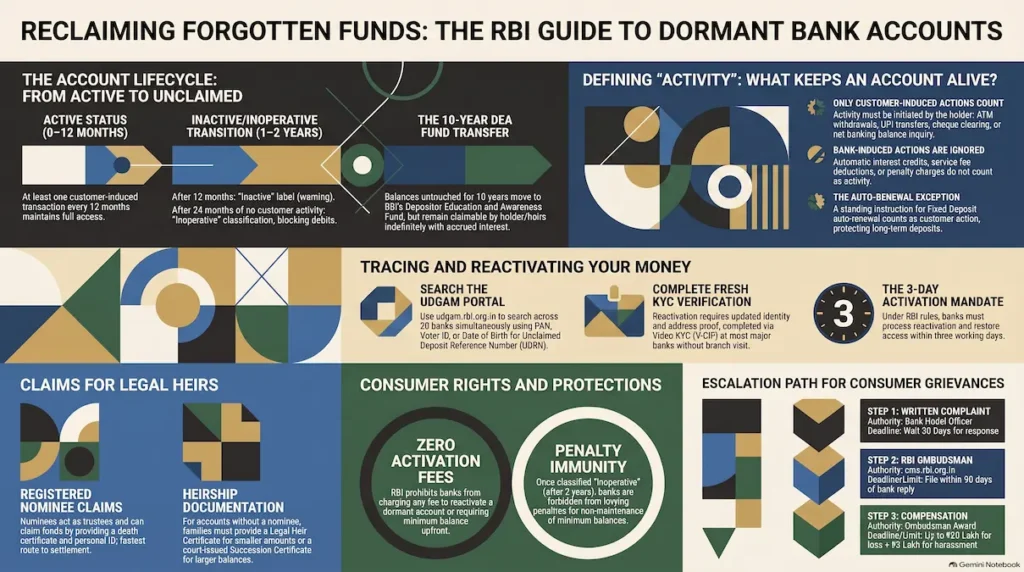
The Lifecycle of a Bank Account: From Active to Inoperative and Dormant
A bank account doesn’t go dormant overnight. RBI moves it through a defined set of stages, each with its own rights and restrictions attached. Individual banks then layer their own labels on top, inactive, dormant, frozen, and that’s usually where the confusion starts.
| Stage | When it applies | What it means |
| Active | Any customer-induced transaction within the last 12 months | Full access, no restrictions |
| Inactive (bank label) | No customer-induced transaction for roughly 1 year, threshold varies by bank | Early warning stage; not an RBI classification on its own |
| Inoperative (RBI term) | No customer-induced transaction for more than 2 years | Debits blocked until reactivated; no penalty charges or activation fees permitted |
| Transferred to the DEA Fund | No operation, or amount unclaimed, for 10 years or more | Balance and interest move to RBI’s Depositor Education and Awareness Fund; still claimable, no deadline |
What Constitutes Customer-Induced Activity?
RBI draws a hard line between two kinds of activity: transactions the customer initiates, and transactions the bank runs on its own. Only the first kind keeps an account active.
A customer-induced transaction is any financial or non-financial action the account holder, or someone acting on their behalf, actually carries out, and the Master Directions on Inoperative Accounts spell this out in detail.
On the financial side that covers ATM withdrawals and deposits, RTGS, NEFT, IMPS, UPI, and AePS transfers, internet and mobile banking transactions, debit card purchases, cheque clearing, remittance by demand draft, a standing instruction the customer has set up (including auto-renewal on a term deposit), NACH debits and credits, interest or maturity proceeds credited on a term deposit, and Direct Benefit Transfer credits from a government scheme.
Non-financial transactions count too, provided they run through a channel with two-factor authentication and leave an audit trail. A balance enquiry through net banking qualifies. So does a request for a new cheque book, a change to a transaction limit, or KYC updation completed in person or digitally.
What doesn’t count is anything the bank does on its own initiative. Interest credited automatically to a savings account, a charge deducted for a missed minimum balance, an annual card fee: none of that keeps an account active, even though each one turns up as a line item in the passbook. This is the detail that trips people up more than any other. Someone scanning a statement sees a regular interest credit and assumes the account is fine. They don’t realise RBI doesn’t count that credit as proof of activity at all.
One exception is worth remembering. If a customer has set up a recurring transfer or an auto-renewal mandate on a fixed deposit, and it executes on schedule with nothing else happening in the account, RBI still treats each execution as customer-induced. The mandate itself was the customer’s action, even if it now runs on autopilot every month.
The Two-Year Rule for Inoperative Status
A savings or current account becomes inoperative once it goes more than two years without a customer-induced transaction. That’s RBI’s national threshold, and it binds every commercial bank, regional rural bank, and cooperative bank in the country.
Banks add their own intermediate labels before that point. ICICI calls an account inactive after twelve months with no customer-initiated transaction, then dormant at twenty-four, which happens to line up with RBI’s own threshold.
Bank of Baroda uses similar language, marking an account inactive once it crosses the two-year point. (https://bankofbaroda.bank.in/banking-mantra/savings/articles/what-is-a-dormant-or-inactive-account) Axis Bank and most large private banks run the same inactive-then-dormant naming on top of the same RBI floor. None of these earlier labels are RBI classifications; they’re courtesy warnings a bank chooses to apply. The rights and restrictions covered here attach specifically to inoperative status, and that clock starts at two years, not one.
RBI requires banks to warn the account holder well before that. At least once a year, a bank has to review every account with no customer-induced transaction for more than a year and write to the holder, by letter, email, or SMS, warning that it will go inoperative unless a transaction happens within the next year. If that letter bounces back undelivered, or nobody responds, the bank has to start tracing the holder: first through any registered nominee or the person who originally introduced the account, then through periodic drives built specifically for inoperative accounts.
A holder who does respond, and gives a reason for the inactivity, buys the account one more year of operative status, an extended period during which at least one transaction is expected.
One category skips all of this. Zero-balance accounts opened for a government scholarship or a Direct Benefit Transfer scheme sit outside the two-year rule entirely. Banks have to segregate these in their core banking system so a beneficiary never loses access to a DBT credit just because the account went quiet for a couple of years.
RBI Guidelines on Unclaimed Deposits and the 10-Year Rule
Inoperative status isn’t the end of the road. It’s the start of a second, longer clock. Ten full years untouched, whether it’s the whole account or just one deposit inside it, and the money gets pulled out of the bank entirely and moved into a fund RBI maintains for exactly this purpose.
Understanding the Depositor Education and Awareness (DEA) Fund
The Depositor Education and Awareness Fund, usually shortened to the DEA Fund, is a scheme RBI set up under Section 26A of the Banking Regulation Act, 1949. It took effect on May 24, 2014, the date it was formally notified in the Official Gazette.
The rule casts a wide net. Any credit balance in a deposit account left unoperated for ten years or more, or any amount simply unclaimed for ten years, moves into the Fund: savings accounts, fixed and term deposits, recurring and cumulative deposits, current accounts, cash credit accounts, loan accounts once dues have been applied. It reaches places most depositors wouldn’t think to check too, like margin money held against a bank guarantee, unadjusted NEFT credits, unreconciled ATM transaction balances, undrawn prepaid card balances, and the rupee proceeds of a converted foreign currency deposit.
Banks have to make the transfer on the last working day of the month following the month an account crosses the ten-year mark. Cross that mark in April, and the transfer happens by the end of May. One citizen-guidance resource points to a further refinement that took effect October 1, 2025, narrowing that window to the last five working days of each month. Treat that as a procedural tweak on top of the ten-year rule, not a change to the rule itself.
Whatever the exact timing, the amount transferred always includes accrued interest up to the transfer date. It’s never just the principal. None of this changes who owns the money, either. The depositor, or a legal heir if the depositor has died, can walk into the bank at any point and claim it back. The bank repays the amount plus applicable interest, then recovers an equivalent sum from RBI separately. There’s no deadline anywhere in the Scheme for making that claim.
Does Your Money Stop Earning Interest in a Dormant Account?
No, it doesn’t. That’s one of the most common misconceptions about dormant accounts, and RBI’s Master Directions settle it directly: interest on a savings account gets credited on a regular basis whether or not the account is in operation. Dormancy restricts what the account holder can do with the account. It has nothing to do with what the bank owes them.
That protection holds even after the money leaves the bank’s active books and lands in the DEA Fund. The transfer carries principal plus accrued interest, and once a depositor files a claim, the bank pays out the interest on top of the principal before recovering an equivalent amount from RBI.
Fixed deposits work a bit differently in practice, mostly because FDs usually carry an auto-renewal mandate. A standing instruction to auto-renew counts as a customer-induced transaction every time it executes, which is why a matured FD can sit untouched for years without tripping into inoperative status even without a fresh deposit or withdrawal. Where a term deposit has genuinely matured with no renewal instruction and nothing else happening, banks still have to review the account every year rather than let it drift.
Access is a different story. An inoperative account can’t be debited until it’s reactivated through the proper channel, no matter how much interest has piled up in the meantime. (https://www.rbi.org.in/scripts/NotificationUser.aspx?Id=12589&Mode=0)
How to Trace Unclaimed Bank Deposits Using the UDGAM Portal
For years, anyone who suspected they had money sitting somewhere had no real way to check other than contacting every bank they’d ever used, one at a time. RBI closed that gap with UDGAM, the Unclaimed Deposits Gateway to Access inforMation, a single portal that searches across dozens of banks in one pass. It launched on August 17, 2023 with seven banks on board and grew to 30 by September 28 that same year. By April 1, 2026, more than 20 lakh users had registered on it, running over 44 lakh searches between them.
Registering on the Unclaimed Deposits Gateway to Access Information (UDGAM)
UDGAM is free, and RBI runs it directly at udgam.rbi.org.in. Registration itself takes only a few minutes. Open the portal, click Register on the login screen, and enter a name and mobile number. Complete the captcha, accept the disclaimer, and request an OTP. Enter the OTP once it arrives on that number, then set a password to finish.
That registration only happens once. Every visit after that needs just the mobile number, the password, and a fresh OTP.
The portal does one job and stops there. It can’t settle a claim, transfer money, or release funds. What it does is tell a user which bank, or banks, hold an unclaimed deposit that matches their details, and point them toward that bank’s own claim process. Nobody should ever pay to search UDGAM, or to “release” a dormant deposit found through it. Any agent, broker, or caller offering a paid recovery service is running a scam. Report it at cybercrime.gov.in.
The only legitimate address for this is udgam.rbi.org.in. Phishing sites on lookalike domains exist specifically to catch people searching for an old account, so that address is worth typing in directly rather than trusting a link forwarded over SMS or WhatsApp.
Searching Across Participating Banks with a UDRN
Once logged in, the individual search path is straightforward. Select the Individual tab for a personal account, or Non-Individual for a business or trust account, enter the account holder’s name exactly as it appears on the account, choose one or more banks from the dropdown, and provide at least one identifier: PAN, Voter ID, driving licence number, passport number, or date of birth. If none of those are on hand, the account holder’s address works instead. Click Search once that’s filled in.
A search on the non-individual side follows the same shape. It just swaps in the authorised signatory’s name, PAN, the entity’s Corporate Identification Number, or its date of incorporation, in place of the individual identifiers.
A successful search hands back the account holder’s name, the bank, the branch location, and a UDRN, the Unclaimed Deposit Reference Number. Each bank generates this through its own core banking system and assigns one to every unclaimed account transferred to the DEA Fund. That way, a branch can identify and process the right account without ever exposing the full account number or balance on the portal itself. Anyone whose search turns up a result should screenshot it right away, since the UDRN is exactly what the bank branch will ask for once the actual claim is filed.
The 30 banks on UDGAM right now include State Bank of India, HDFC Bank, ICICI Bank, Axis Bank, Bank of Baroda, Canara Bank, Punjab National Bank, and roughly two dozen others spanning public sector, private sector, regional rural, small finance, and cooperative categories, together holding close to 90 percent of unclaimed deposit value sitting in the DEA Fund.
An empty result doesn’t always mean there’s no unclaimed deposit out there. It might sit with a bank that hasn’t been onboarded yet, or the name on record might be spelled differently from how it was typed in. Trying a maiden name, an initial-based version, or a different identifier is worth the extra minute before giving up.
Step-by-Step Process to Reactivate a Dormant Bank Account
A UDGAM search only locates money. Getting it back, or simply bringing a quiet account back into everyday use, means dealing directly with the bank holding it. RBI has stripped a lot of the friction out on paper. Banks can’t charge a fee for reactivation, can’t insist on a fresh account being opened instead, and have to move within a fixed number of working days. The steps still need to happen in order, though.
Submitting the Written Reactivation Request
Reactivation starts with a written request to the branch. RBI requires banks to offer the KYC updation facility at every branch, not just the one where the account was originally opened. A request typically states the account holder’s name, account number, branch, and a current mobile number and email, plus a plain ask to activate the account once KYC is verified.
Most large banks now take this digitally too. At ICICI, a customer logs into net banking or the iMobile app, goes to Service Requests, and selects Activation of Inactive or Dormant Account, uploading documents from there instead of visiting a branch.
Kotak Mahindra runs an entirely paperless version through its website. It walks through mobile OTP and date-of-birth verification, a short set of questions about why the account went dormant and the current address, email verification, and an Aadhaar-based Video KYC step. Activation gets confirmed by SMS and email inside roughly 24 hours, without needing a branch visit at all.
Whatever channel gets used, RBI sets a firm outer limit of three working days from the date a complete application, with all supporting documents, is received. A branch that drags this out well past three working days, with no documented reason like a missing document, isn’t following the rule. That delay is grounds for a formal complaint later on.
Navigating KYC Revalidation and Identity Verification
An inoperative account can’t be reactivated without a fresh round of Know Your Customer verification, even when the original KYC was done properly years earlier. RBI requires banks to run full customer due diligence, identification, and risk categorisation before lifting the inoperative flag, under the same KYC Master Direction that governs a brand-new account. (https://www.rbi.org.in/scripts/NotificationUser.aspx?Id=12589&Mode=0)
For a resident Indian, that usually means an updated proof of identity (PAN, Aadhaar, passport, voter ID, or driving licence) and a current proof of address if the one on file has changed. Where an account was frozen under a court, tribunal, or law-enforcement order rather than plain inactivity, the same KYC-based reactivation kicks in once the freeze is lifted by whichever authority ordered it.
Video-based Customer Identification, or V-CIP, has become the default route at most banks for exactly this scenario. It lets a customer verify their identity over a live video call instead of visiting a branch. RBI’s original 2024 instructions told banks to offer V-CIP for inoperative-account activation “if requested,” which was a conditional standard at best. A June 2025 amendment tightened that to an instruction that banks must “endeavour to provide” V-CIP for this purpose, and added a second channel: an authorised Business Correspondent can now help activate an inoperative account in areas without a nearby branch.
Non-resident Indians face a heavier document list, since NRE and NRO accounts sit under FEMA rules on top of ordinary KYC. ICICI’s guidance for a dormant NRE or NRO account asks for the dormant-account activation form, a fresh KYC updation form, a valid passport, a valid visa or residence permit as proof of NRI status, a PAN card or Form 60 where PAN isn’t available, the tax identification number of the country of residence, and a FATCA or CRS self-declaration. Persons of Indian Origin or Overseas Citizens of India holding a foreign passport submit a PIO or OCI card instead, or a signed self-declaration that establishes their connection to India.
Kotak Mahindra’s process for a dormant NRE account runs on the same principle through a different channel. The customer emails a dormancy removal request, along with identity, signature, and address proof, to the bank’s NRI service desk, or submits the same documents at a branch, with activation completed in about three working days. One detail Kotak flags before starting: a dormant NRE account first gets converted back to merely inactive status, which still needs at least one debit or credit transaction before it’s fully active again.
For an NRI who can’t travel to India at all, two further routes tend to work. One is a document set attested by the nearest Indian embassy or consulate, at a fee typically running ₹240 to ₹500 depending on the mission. The other is submission through a family member holding a registered power of attorney that specifically authorises banking transactions.
Handling Outstanding Dormancy Charges and Minimum Balance Penalties
RBI’s rule here is blunt. Banks can’t levy penal charges for non-maintenance of minimum balance on any account classified as inoperative, and no charge of any kind can be levied for activating one.
That protection is narrower than most account holders assume, though. It only kicks in once an account has actually crossed into inoperative status at the two-year mark. Before that, while an account sits merely inactive under a bank’s own internal label, ordinary minimum-balance rules and their penalty charges can still apply, since the account hasn’t yet reached RBI’s protected classification.
Generic bank guidance makes the same point from the other side, flagging penalty charges as one of the more common costs of letting an account sit quiet in the first place, right up until inoperative protection takes over.
If a bank has applied a penalty after an account was already inoperative, that charge is worth challenging directly with the branch, in writing, citing the specific rule. A short letter usually does the job. It should ask the bank to reverse any activation charge or minimum-balance penalty levied after the account went inoperative, and it should cite RBI’s revised instructions on inoperative accounts as the basis for that reversal.
If the branch doesn’t resolve it, or misses the three-working-day activation window without explanation, the next stop is the bank’s own grievance officer or nodal officer, in writing, with a copy of the original request kept on file. Axis Bank’s own customer-facing reactivation guidance points to the same branch-first, grievance-officer-second sequence common across large banks.
Escalation ladder if the bank does not resolve the issue
| Step | Where | Timeline |
| 1. Written complaint | Branch or the bank’s grievance/nodal officer | Wait 30 days for a reply |
| 2. RBI Ombudsman complaint | cms.rbi.org.in, free, under the Reserve Bank – Integrated Ombudsman Scheme, 2026 | File within 90 days of the 30-day deadline expiring or the bank’s last reply |
| 3. Award and compensation | RBI Ombudsman or Deputy Ombudsman | Up to ₹30 lakh for consequential loss, plus up to ₹3 lakh for harassment, time, and expenses |
| 4. Appeal | Appellate Authority under the Scheme | 30 days from receipt of the Award, extendable by a further 30 days for sufficient cause |
The Reserve Bank – Integrated Ombudsman Scheme, 2026 replaced the 2021 scheme starting July 1, 2026, and it covers banks, most NBFCs, prepaid instrument issuers, and credit information companies. A complaint filed before that date continues under the 2021 scheme. Anything fresh, though, a dormant account, an unreactivated account, a wrongly charged penalty, falls under the 2026 scheme and its higher compensation limits now.
The Complete Procedure to Retrieve Funds and Close the Account
Not everyone wants a reactivated account back in regular use. Plenty just want the balance moved into whichever bank they actually rely on today, closing the old relationship for good. That’s a separate process from reactivation, and it usually runs in a fixed order: an inoperative or dormant account generally has to be activated first, even briefly, before a closure request against it goes anywhere.
Initiating the Account Closure Form at Your Home Branch
Most banks still want a closure request submitted at a branch, even for an account reactivated digitally, since closure typically needs an original signature checked against bank records, plus confirmation that no dues, standing instructions, or linked facilities remain outstanding. ICICI’s own NRI closure guidance states the sequencing plainly: an account currently marked inactive or dormant has to be activated before any closure request against it gets processed at all.
The closure form itself asks for the standard details: account number, branch, reason for closure, and instructions for where the remaining balance should go. For a joint account, most banks want every named holder to sign, or a specific mandate that authorises one holder to act for the others.
One thing worth doing before the branch visit: cancel or redirect any pending cheques, standing instructions, auto-debit mandates, or SIPs still linked to the account. A closure request submitted while a standing instruction is still active tends to get stuck at the branch level until that conflict clears, and that’s an extra round trip a five-minute check upfront would have avoided.
Transferring the Remaining Balance via NEFT/RTGS to an Active Account
Once the branch verifies the closure form and confirms no dues remain, the balance goes out one of a few ways: a demand draft, an electronic transfer through NEFT or RTGS into a nominated active account at another bank, or, for a small balance, cash collected in person.
NEFT and RTGS are the practical default for most closures. Both settle the same day, and neither needs a branch visit at the receiving end. NEFT handles any transfer amount and settles in batches through the day. RTGS is built for larger transfers, settles individually in real time, and generally carries a minimum threshold set by the bank. For a typical closure balance, NEFT usually ends up faster and cheaper, though the branch handling the closure will confirm which one applies depending on the amount.
Have the receiving account’s IFSC code and account number ready when the closure form goes in, since most banks process the transfer as part of the same paperwork rather than a separate follow-up later. A closure statement or final passbook entry that confirms the balance transferred out and the account closed is worth keeping on file too, especially for an account that was ever inoperative and could otherwise turn up again in a future UDGAM search against old records.
Surrendering Linked Debit Cards and Cheque Books
Any debit card, ATM card, or unused cheque leaf tied to a closed account should go back to the branch, or get destroyed with the branch’s confirmation. An unreturned card or cheque linked to a technically closed account is exactly the kind of loose end that turns into a fraud complaint later. RBI’s fraud-risk guidance for inoperative accounts flags unauthorised access specifically as a risk banks have to actively manage, which includes monitoring a reactivated account for several months after activation. Handing back physical instruments at closure is the account holder’s side of that same precaution.
Digital instruments need the same cleanup. Any UPI handle registered against the account, any NACH mandate still pointing at it, any third-party app linked to that account number, from a mutual fund SIP to a subscription service, should move to the new bank before or right after closure. A UPI ID left dangling against a closed account just fails on the next payment attempt: mildly annoying, nothing more. A NACH mandate tied to something like an insurance premium is different: if it fails silently for a few cycles, that can end in a lapsed policy.
Most banks note the card and cheque book surrender directly on the closure form, so this step usually folds into the same branch visit as the closure itself.
How Legal Heirs Can Claim Funds from a Deceased Depositor’s Account
A meaningful share of India’s unclaimed deposits sit in the accounts of people who have died, sometimes years earlier, with family members who never knew the account existed or assumed it had already been settled. The process for a legal heir differs from an ordinary reactivation in one key way: the claimant isn’t the account holder, so the bank’s documentation shifts toward proving both the death and the claimant’s legal right to the money. Exactly what paperwork is needed depends heavily on whether a nominee is registered, whether a will exists, and how large the balance is.
Essential Documentation: Death Certificates and Proof of Relationship
Every claim starts with the same foundation: an original or certified copy of the death certificate, issued by the municipal or local authority. Without it, no bank moves further on a deceased-account claim at all.
Documentation by claim scenario
| Scenario | What the bank typically asks for |
| Registered nominee | Death certificate, nominee’s identity and address proof, claim form; bank pays the nominee as trustee for the heirs |
| Joint account, either-or-survivor mandate | Death certificate for the deceased holder; account continues in the survivor’s name |
| No nominee, smaller balance | Death certificate, identity proof for each heir, proof of relationship, legal heir certificate, indemnity bond and affidavit |
| No nominee, larger or disputed balance | Death certificate, identity proof for each heir, a succession certificate issued by a civil court |
| Registered will exists | Death certificate, probate of the will, identity proof of the executor |
Where a nominee was registered, the process is comparatively straightforward. The nominee submits the death certificate, their own identity and address proof, and a claim form. The bank then pays out the balance to them as trustee for the legal heirs. Not every heir needs to be individually identified for this route to work. This is exactly why RBI’s Master Directions push banks to actively trace a registered nominee for an inoperative account before assuming the account holder is simply untraceable.
Where no nominee was registered, every legal heir generally has to be identified and brought into the claim, and that’s where the paperwork gets heavier: identity and address proof for each claimant, proof of relationship to the deceased through a family register or similar record, a legal heir certificate or succession certificate depending on the amount, and the account holder’s passbook or statement where available.
For a joint account carrying an either-or-survivor or former-or-survivor mandate, things are simpler still. The surviving holder typically only needs to submit the death certificate for the deceased co-holder, since the account just continues in the survivor’s name under the original mandate rather than going through a heirship claim at all.
Navigating Succession Certificates and Probate Requirements
Where multiple heirs exist, no nominee was registered, and no will settles the question, the bank needs court-recognised proof of who the legal heirs actually are, and in what shares. Three instruments cover most cases, and which one applies depends on the size of the account and whether the family already holds one of these documents for other reasons.
A legal heir certificate, issued by a Tahsildar or Sub-Divisional Magistrate, is the lighter option. Many banks accept it for smaller balances, usually bundled with an indemnity bond and affidavit signed by the heirs. The threshold below which a bank takes this simpler route instead of insisting on a court-issued succession certificate varies by bank, and commonly sits somewhere around ₹5 lakh, though that figure is a bank-level policy choice, not an RBI-mandated ceiling. It’s worth a phone call to confirm the exact number with the specific branch that’s handling the claim.
A succession certificate, issued by a civil court under the Indian Succession Act, is the heavier route, generally needed for larger balances or where heirs disagree about entitlement. It takes longer too. It runs through a court petition, a notice period, and a judicial order, but it settles who’s legally entitled to the deceased’s movable property, bank balances included, with a force the lighter documents simply don’t carry.
Probate only comes into play where the deceased left a registered will naming an executor. The executor petitions a court for probate of that will, and the probate order becomes what the bank relies on to release funds to the named beneficiaries. No will means probate isn’t the relevant instrument at all; a succession certificate or legal heir certificate takes its place instead.
Given how much this varies by bank policy, account balance, and whether a will exists, a family facing a genuinely contested or high-value claim is usually better off consulting a lawyer early, rather than assuming one document will work across every bank the deceased held an account with.
FAQ: How to Close a Dormant Bank Account
Most major banks now allow online reactivation through their net banking portals or official mobile apps. You will need to submit a digital reactivation request and complete Video KYC (V-CIP) by uploading an updated PAN and Aadhaar card. Under RBI guidelines, banks must process this request and restore full access within three working days.
No, your money is completely secure. Even if the account remains untouched for over 10 years and the funds are moved to the RBI’s Depositor Education and Awareness (DEA) Fund, the balance continues to earn regular interest. The money remains legally yours—or your legal heirs’—to claim at any point, with no expiry date.
Absolutely not. Strict RBI directives dictate that banks cannot levy penal charges for failing to maintain a minimum balance once the account is officially classified as inoperative (two years of no customer-induced activity). Additionally, banks cannot charge any activation fees to restore the account.
You can trace forgotten funds safely using the RBI’s official UDGAM portal (udgam.rbi.org.in). After completing a free registration, you can search across multiple banks simultaneously using your PAN, Voter ID, or Date of Birth. The portal will generate a specific Unclaimed Deposit Reference Number (UDRN), which you can take directly to the bank branch to initiate your claim.
Claimants must visit the bank branch with the original death certificate. If a nominee is registered, they act as a trustee and the payout is straightforward. If no nominee exists, the family must provide a legal heir certificate (for smaller amounts) or a succession certificate (for larger balances), alongside valid identity proofs.
Avoiding Future Dormancy: Best Practices for Account Maintenance
Reactivating an old account, or claiming one from the DEA Fund, is a one-time fix. Keeping the next account from going the same way takes a handful of small habits, most of them free and quick to set up.
Consolidating Multiple Salary Accounts
A salary account gets opened by an employer, usually at whichever bank runs its payroll, and most professionals rack up two, three, or more of these across a career without ever formally closing the earlier ones. Each one then sits quietly the moment its holder changes jobs. It drifts from active to inactive to inoperative on that same two-year clock covered earlier, simply because there’s no reason left to log back in.
The fix takes a deliberate decision right when someone leaves a job, not months later. Before or shortly after a job change, review every old salary account, check the balance, and actively choose one of two paths: convert it into an ordinary savings account if it still serves a purpose (a linked recurring deposit, a locker, a standing instruction), or close it outright and move the balance into whichever account is now primary. ICICI’s own guidance makes this exact recommendation. It calls consolidation the single most effective step against future dormancy.
A single primary account, checked regularly and used for most day-to-day transactions, is far less likely to slip into inoperative status than three or four accounts spread thin across old employers.
Automating Micro-Transactions to Maintain Active Status
RBI counts a customer-induced transaction of any size. There’s no minimum amount required to keep an account active. A single small transfer once every year or two is enough to reset the inactivity clock, which makes automation a genuinely cheap insurance policy against dormancy.
A standing instruction for a small recurring transfer, even something as minor as ₹100 moved between two of one’s own accounts on a fixed schedule, counts as a customer-induced transaction every time it executes, and keeps both accounts active without anyone having to remember a thing. Linking an account to a UPI app or a mobile wallet has the same effect, even for occasional use, since a UPI debit or credit routes through the linked bank account as a genuine transaction.
For an account expected to sit unused for a long stretch (an NRI’s resident account before a move abroad, say, or one kept open only for a specific future purpose), writing to the bank in advance and asking that it be flagged for continued monitoring is worth doing, even though it doesn’t exempt the account from the underlying two-year rule. At minimum, it puts the bank on notice that the holder knows about the account and intends to keep it active, which tends to make any eventual reactivation conversation a lot shorter.
Disclaimer
Rules, thresholds, and document requirements can change with a new RBI circular or a bank’s own internal policy update, and individual banks sometimes differ from the general position set out here. This piece is intended as general information, not legal, tax, or financial advice, and carries no official affiliation with RBI, any bank named in it, or any government scheme referenced in it. Anyone handling a large balance, a contested heirship claim, or an NRI account with FEMA implications should confirm the current requirements directly with the bank or a qualified professional before proceeding.




Leave a Reply