
Viksit Bharat G RAM G Act 2025 Explained: Why MGNREGA Was Repealed and What the 125-Day Rural Job Guarantee Means
What Is the Viksit Bharat G RAM G Act 2025 and Why It Replaces MGNREGA?
On December 21, 2025, something quietly seismic happened. There were no fireworks. No long queues outside Parliament. Just a presidential assent, a gazette notification, and a line drawn under a law that had shaped rural India for 20 years. With that assent, the Viksit Bharat – Guarantee for Rozgar and Ajeevika Mission (Gramin) Act 2025 (Viksit Bharat G RAM G Act 2025) came into force, formally repealing the Mahatma Gandhi National Rural Employment Guarantee Act-MGNREGA to millions who lived with it, worked under it, and fought for it.
For policy watchers, this wasn’t just another welfare tweak. It was the dismantling of a moral architecture.
MGNREGA was born in 2005 out of a particular anxiety, an India still scarred by agrarian distress, drought cycles, and chronic rural underemployment. It did something radical for its time: it told the poorest citizens that the state owed them work. Not charity. Not discretion. Work. And if the state failed, it owed compensation. That idea alone made MGNREGA globally unusual, almost rebellious.
For two decades, the scheme sat at the intersection of economics and dignity. It built roads that washed away. Dug ponds that sometimes dried up. Paid wages that arrived late. And yet, during droughts, floods, demonetisation, and the COVID shock, it was often the last standing employer in the village. The official MGNREGA portal still reads like a living archive of that era: numbers, muster rolls, names.
The G RAM G Act does not inherit that emotional lineage. It isn’t designed to.
How Is the G RAM G Act Different from MGNREGA?
From the outset, the new law situates itself inside a much bigger ambition: Viksit Bharat @2047, the government’s vision of a “developed India” by the centenary of independence. In that frame, rural employment is no longer imagined as a shield against distress. It is recast as a lever for transformation. Employment becomes a means, not an end.
The language of the Act reflects this shift. It speaks of missions, stacks, saturation plans, and convergence. Less about demand. More about delivery. Less about entitlement. More about outcomes. Government briefings and PIB explainers, such as this official release, frame the repeal not as withdrawal, but as evolution.
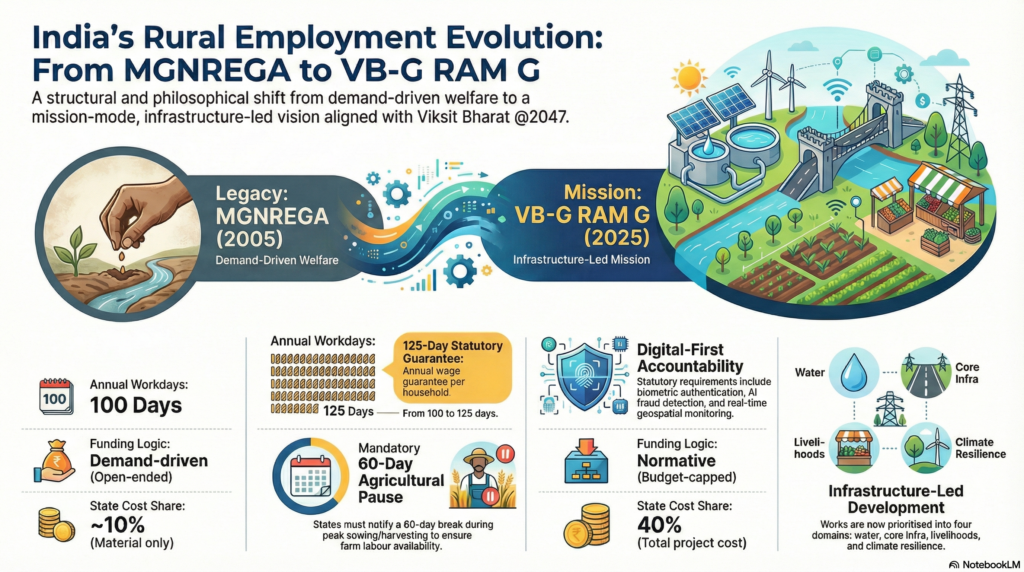
Even the headline reform sounds generous: the statutory work guarantee rises from 100 days to 125 days per household per year. On paper, that is progress. A quarter more work. A longer wage cushion.
But the real change lies beneath the arithmetic. The shift is philosophical. Structural. Irreversible.
What Does “Supply-Driven” Rural Employment Mean?
MGNREGA asked a simple question: Do you need work? G RAM G asks a different one: Is there a sanctioned project here right now? That difference, subtle on the surface, is where the entire debate begins.
Why Was MGNREGA Repealed? Policy Rationale Behind the Shift
The repeal of MGNREGA did not happen overnight. It had been coming, slowly, like a tide pulling back before something larger moves in.
Inside policy circles, the doubts had been simmering for years. Was a demand-driven employment guarantee still appropriate for a country claiming middle-income status? Was MGNREGA becoming a permanent fiscal commitment instead of a counter-cyclical tool? And perhaps most uncomfortably: had it outlived the rural economy it was designed for?
Did Falling Demand for MGNREGA Work Influence the Repeal?
Former NITI Aayog CEO Amitabh Kant has been among the most candid voices on this. In interviews and public statements, many of them widely reported, including this Business Today piece, Kant has argued that MGNREGA was designed for a 2005 India. A poorer India, which had a less diversified rural economy.
The data, policymakers say, backs this view. The Economic Survey 2025-26 recorded a sharp fall in demand for MGNREGA work, which fell 53 percent from the pandemic peak. That decline was not treated as a failure of the programme, but as evidence that distress employment needs had receded as the economy recovered. This interpretation was echoed in coverage by The Economic Times and Deccan Herald.
Add to this the World Bank’s estimate that extreme poverty in India had fallen to 5.3 per cent in 2022-23, and the official narrative becomes clearer. Rural India, the argument goes, needs ladders now, not nets.
But statistics don’t tell the whole story. MGNREGA’s problems were not just about relevance; they were about execution.
Was MGNREGA Considered Fiscally Unsustainable?
Year after year, social audit reports flagged the same issues. Ghost works. Inflated measurements. Funds siphoned off through contractor-politician nexuses. Wage payments were delayed so long that they lost meaning. The national recovery reports hosted on the official audit portal read, at times, like a looped script.
For administrators, this bred fatigue. For the Centre, it bred impatience. Incremental reform began to feel like pouring water into a cracked vessel.
Official explanations- such as those released by the Press Information Bureau make this explicit: MGNREGA, they argue, had become administratively heavy, fiscally expansive, and developmentally blunt.
The conclusion they reached was stark. Fixing it was not enough. It had to be replaced.
125-Day Job Guarantee Explained: Is It Truly a Legal Right?
The number is seductive. 125 days. It sounds like progress, and politically, it photographs well.
How Is the 125-Day Guarantee Different from MGNREGA’s 100 Days?
Under the G RAM G Act, every registered rural household is entitled on paper to up to 125 days of wage employment per financial year. That is a full 25 days more than MGNREGA ever promised. For a labouring household, that difference can mean school fees covered or debt deferred.
But here is where the fine print matters.
Is There an Unemployment Allowance Under G RAM G?
Under MGNREGA, the guarantee was demand-driven. A household applied for work, and the clock started ticking. After 15 days, if the work had not arrived, compensation was due. The mechanism was clunky, often violated, but the logic was clean. An obligation triggered by need was required.
The G RAM G framework breaks that chain.
Employment under the new Act is supply-driven. Work becomes available when an area is notified, when projects are approved, and when funds are released. There is no automatic legal trigger when a household demands work. No unemployment allowance if work doesn’t materialise.
Is the 125-Day Guarantee a Ceiling or a Minimum?
Policy analysts have been blunt about what this means. The 125 days function less like a guaranteed minimum and more like a maximum ceiling. You may receive up to 125 days, but only if the system aligns in your favour. This distinction has been widely discussed in explanatory pieces such as Outlook Business’s comparative analysis and India Today’s breakdown of the Act.
Supporters call this rationalisation. Critics call it rationing. Under stress due to factors like drought, crop failure, and market shocks, the scheme will not automatically expand. It will respond only if planners anticipate that stress months earlier and sanction projects accordingly. For households accustomed to MGNREGA as a fallback, this is not a small adjustment. It is a change in how vulnerability is managed.
The government’s answer to this is that planning leads to quality. Demand-led systems, they argue, produced assets that existed only to absorb labour. Mission-mode planning will ensure every workday builds something durable.
That may well be true. But durability does not feed a family in a bad month.
The real test of the 125-day promise will not be how it reads in legislation, but how often it materialises when households actually need it. And that answer, for now, remains unknowable.
What Is the 60-Day Agricultural Pause and How Does It Affect Rural Workers?
Of all the changes packed into the G RAM G Act, the agricultural pause is the one that has triggered the most visceral reactions in villages and not just in policy seminars.
Why Was the Agricultural Pause Introduced?
The rule itself is simple on paper. States must notify an aggregate 60-day pause during peak sowing and harvesting seasons when public works under the scheme will be suspended. This provision, clarified through official communications including this Press Information Bureau release, is now written into law, not left to administrative discretion.
Why does this matter so much? Because it openly acknowledges a tension that policymakers have tiptoed around for years: rural employment schemes and agriculture compete for the same labour and often at the same time.
Anyone who has spent even a single harvest season in a farming village knows this rhythm. When paddy needs transplanting, or wheat is ready for harvest, labour becomes precious overnight. Miss the window, and the loss isn’t marginal,l but it’s total. Crops don’t wait for administrative approvals.
Under MGNREGA, this conflict existed but was fuzzy. Officially, work could continue year-round. Unofficially, many states slowed down work during peak agricultural months, especially under pressure from farmer lobbies. The new Act removes ambiguity. It makes clear that agriculture comes first.
From a macro perspective, the logic is defensible. Policymakers argue that public works during peak seasons distort labour markets, pushing up wages beyond what small and marginal farmers can afford.
Some economists have long claimed that MGNREGA accelerated mechanisation not by design, but by making labour temporarily scarce. In food-producing regions, this could affect cropping intensity, yields, and ultimately food prices.
The pause is meant to neutralise that effect. By pulling the state out of the labour market during peak agricultural demand, the scheme steps aside and lets private farming absorb workers.
But here’s the uncomfortable part.
Does the 60-Day Pause Reduce Labour Bargaining Power?
For landless labourers, peak agricultural seasons are not periods of comfort. Yes, work is available. But so is vulnerability. Wages are negotiated under pressure. Working hours stretch, and often conditions worsen. Under MGNREGA, even the possibility of opting out gave workers leverage. Even a weak fallback option changes negotiations.
With the pause, that fallback disappears by design.
Critics argue that the pause protects farm productivity at the cost of labour security, and because the Act does not provide any compensatory mechanism, no alternative income support during blackout periods, the burden is pushed squarely onto workers. If agricultural employers exploit the moment, there is no statutory escape hatch.
Can States Decide When the Agricultural Pause Applies?
The flexibility given to states complicates matters further. Each state decides when its 60-day pause applies. In theory, this respects agro-climatic diversity, but in practice, it opens room for uneven application and political bargaining. A poorly timed pause can hit precisely when rural households are already stretched thin.
The agricultural pause reveals the deeper truth of the G RAM G Act. It is not designed to sit above the rural economy as a shock absorber but is designed to sit inside it, adjusting itself around production cycles. That is a strategic choice. Whether it is a humane one depends on how agricultural labour markets behave in the real world and not how they behave in policy models.
60:40 Cost Sharing Model: How the New Funding Formula Changes Federal Incentives
If the agricultural pause reshapes when work happens, the new funding model reshapes whether it happens at all.
Under MGNREGA, the financial architecture was straightforward, almost indulgent from a state’s point of view. The Centre paid 100 percent of wages and most of the material costs. States administered the scheme, claimed funds, and faced limited fiscal exposure. Politically, it was easy to expand, and financially, it was safe.
The G RAM G Act changes that equation sharply.
Which States Follow the 60:40 Funding Model?
For general category states, the cost-sharing ratio is now 60:40. The Centre pays 60 percent. States pay the remaining 40 percent. This restructuring is spelled out in legislative documents accessible through PRS India, including the bill text and the Act as passed.
Are There Exceptions for North-Eastern and Himalayan States?
There are exceptions, of course. North-Eastern and Himalayan states continue with a 90:10 model. Union Territories without legislatures receive full central funding, as detailed in Ministry of Rural Development notifications. These carve-outs acknowledge geography, security, and limited revenue capacity.
But for the majority of states, the shift is dramatic.
Will Poorer States Reduce Employment Spending Under G RAM G?
Policy analysts estimate that states will collectively need to find an additional ₹30,000 crore annually to sustain G RAM G at scale. That money has to come from somewhere. For wealthy states, the adjustment is uncomfortable but manageable. For poorer states, it is destabilising.
For instance, Bihar has a narrow tax base, high dependence on central transfers, and a massive rural workforce. A 40 percent obligation forces trade-offs that are not abstract. Every rupee spent on G RAM G is a rupee not spent elsewhere, including crucial sectors such as education, health, and roads.
Punjab’s situation is different but equally strained. Chronic fiscal stress, rising debt, and limited room to manoeuvre. Public statements from the state have already flagged concerns about absorbing the new burden.
Beyond balance sheets, the political incentives change, too. Under MGNREGA, expanding work carried little fiscal penalty for states. Under G RAM G, expansion costs real money. States now have a built-in reason to be cautious, selective, even restrictive.
Supporters argue this is precisely the point. When states pay, they plan better and monitor more closely. They also resist waste.
Critics see a darker possibility. Their apprehension is that employment will shrink not because demand falls, but because budgets tighten, and that the poorest states, the ones most in need of employment support, will be the first to pull back.
The 60:40 model transforms rural employment from a centrally guaranteed safety net into a co-funded development choice. In doing so, it makes employment contingent not just on need, but on fiscal health. That is a profound shift and one that will play out unevenly across India’s federal landscape.
National Rural Infrastructure Stack: What Projects Are Allowed Under G RAM G?
This is where the G RAM G Act stops pretending to be an employment scheme and openly declares what it wants to be instead.
It aims at infrastructure and not incidental assets, nor does it seek stopgap works to absorb labour. Infrastructure with intent, with alignment, with an Excel sheet somewhere that says output and impact in bold font.
Under MGNREGA, the list of permissible works was famously broad. Ponds, bunds, roads, plantations, sanitation pits, community buildings, many useful, many forgettable, some quietly abandoned. The flexibility was empowering, but it also led to chaos. Quality varied wildly, and assets often existed in isolation, disconnected from any larger development logic.
The G RAM G Act shuts that door and opens another, which is narrower, more controlled, more ambitious.
What Is the National Rural Infrastructure Stack?
Enter the National Rural Infrastructure Stack.
The Stack restricts permissible works to four tightly defined verticals, outlined in official notes such as this PIB explainer. The language is deliberate. This is not a menu but a blueprint.
Water security comes first, and not by accident. Watershed development, irrigation channels, rainwater harvesting, and community water systems are framed as foundational assets. In a country where monsoons arrive late, leave early, or don’t arrive at all, water infrastructure is no longer a rural add-on. It is survival economics.
Core infrastructure, such as rural roads, market linkages, storage facilities, and basic logistics, follows. This vertical is explicitly tied to PM Gati Shakti, the national infrastructure master plan. The clear message is that rural works must plug into larger economic corridors, not exist as disconnected village-level projects.
Then comes livelihood infrastructure– plantations, fisheries, livestock shelters, farm-based enterprises- which is perhaps the most conceptually interesting shift. Plantations, fisheries, livestock shelters, and farm-based enterprises. These assets are meant to generate income long after wage payments stop. Employment becomes seed capital for livelihoods, not just cash-for-work.
Finally, climate resilience, which includes afforestation, soil conservation, flood control, and climate adaptation, works. This is the quiet admission that rural distress is no longer cyclical alone but is structural, environmental, and accelerating.
How Do Viksit Gram Panchayat Plans (VGPPs) Work?
All of this is operationalised through Viksit Gram Panchayat Plans (VGPPs), which are five-year saturation plans prepared at the panchayat level. Unlike MGNREGA’s labour budgets, which aggregated household demand upward, VGPPs are top-down and bottom-up hybrids. They must align with district plans, state priorities, and national infrastructure strategies, as detailed in official legislative documents.
Supporters see coherence where there was once clutter. Critics see a thinning of local voice.
MGNREGA’s messiness came with participation. Gram sabhas debated works and demands surfaced organically. VGPPs, by contrast, are technical documents that privilege engineers, planners, and consultants. Without careful safeguards, planning risks drifting away from lived need and toward administratively “sound” projects that look good on dashboards.
Infrastructure 2.0 promises durability and scale. Whether it preserves ownership and relevance will depend on how much space remains for communities to argue, disagree, and reshape plans, and not just endorse them.
Biometrics, Geo-Tagging and AI Monitoring: How Technology Reshapes Rural Employment
If planning is the brain of the G RAM G Act, technology is its spine and sometimes, its choke point.
Is Biometric Attendance Mandatory Under G RAM G?
The new framework mandates a level of digitisation that MGNREGA flirted with but never fully enforced. According to official communications, including this PIB release, G RAM G is built on compulsory digital compliance.
No biometrics means no work.
Worker attendance now requires biometric authentication, fingerprint or iris, at worksites. The intention is obvious and, frankly, understandable. Ghost workers and proxy attendance were chronic under MGNREGA. Social audits documented them year after year. Technology promises finality, and presence becomes binary. You were there, or you weren’t.
How Does Geo-Tagging Improve Transparency?
Every project must also be geo-tagged, photographed, and timestamped at start, mid-point, and completion. Infrastructure becomes data. Roads have coordinates, and ponds have metadata. Auditors no longer need to travel; they scroll.
Can AI Monitoring Prevent Corruption in Rural Schemes?
Then comes the most ambitious layer: AI-driven fraud detection. Algorithms scan wage payments, timelines, measurements, and flag patterns humans miss. Identical dimensions across villages, along with impossible completion speeds. Payment clusters that don’t add up. In theory, corruption is caught before it settles in.
Add to this real-time dashboards, open data portals, and system-wide visibility. On paper, it’s a transparency revolution.
And sometimes, it works. Pilot implementations reduced wage delays. Leakages get narrowed, and payments become more predictable.
But technology does not land on neutral ground. Large parts of rural India still live with unstable electricity, patchy internet, and low digital literacy. A biometric system that fails gracefully in Delhi can fail catastrophically in a forest village.
Fingerprint scanners don’t like calloused hands, and iris scanners struggle with age. Networks drop, and servers go down. And when they do, the system doesn’t bend. A worker who cannot authenticate is simply absent, no matter how real their labour.
There’s a deeper concern, too. Technology replaces discretion, but it also replaces negotiation. Under MGNREGA, a worker could argue with a mate, a panchayat secretary, or a block official. Under G RAM G, the argument is with a machine, and machines do not listen.
Elderly workers, persons with disabilities, and tribal communities in remote areas are theoretically protected through special provisions, but theory does not upload photographs or sync databases.
In effect, access to employment now runs through digital infrastructure. Where that infrastructure is strong, the system hums. But where it is weak, exclusion becomes quiet, procedural, and hard to contest.
Technology, in the G RAM G Act, is not just a tool. It is a filter. And like all filters, it decides who passes through easily and who doesn’t.
Special Gramin Rozgar Guarantee Cards: Inclusion, Priority Groups and Women’s Participation
On paper, the G RAM G Act wants to be seen as kinder than it is often accused of being.
Buried beneath the language of missions, stacks, and saturation plans is a deliberate attempt to signal inclusion, an acknowledgement, perhaps, that a supply-driven framework risks leaving the weakest behind unless it overcorrects. This is where Special Gramin Rozgar Guarantee Cards enter the picture.
Who Qualifies for Special Gramin Rozgar Guarantee Cards?
These cards are not cosmetic, but they are colour-coded, category-specific, and meant to act as priority passes within the system. The categories themselves tell a story about who the state believes is most at risk of being invisible.
Are PVTGs and Transgender Persons Covered?
First, Particularly Vulnerable Tribal Groups (PVTGs) comprise 75 communities, roughly 2.8 million people. Often forest-dependent, geographically isolated, and administratively undercounted.
For decades, these groups slipped through welfare cracks not because schemes excluded them explicitly, but because access required literacy, proximity, and paperwork. The G RAM G Act promises priority work allocation and tailored livelihood assets for PVTGs, a recognition that uniform planning does not reach unequal starting points.
Then come single women such as widows, divorced, and separated. In rural India, marital status is economic destiny. Single women frequently lose access to land, networks, and informal employment. Their vulnerability is social as much as financial. Special cards are meant to bypass local gatekeeping, at least within the scheme.
The explicit inclusion of transgender persons is one of the Act’s most progressive departures from earlier rural employment frameworks. Legal recognition has existed for a while, but economic inclusion has not. By naming transgender persons as a priority group, the law attempts to convert visibility into livelihood, something previous schemes rarely attempted.
Elderly workers, too, are singled out. Anyone above 60 who remains economically active qualifies for priority consideration. This matters more than it sounds. In many villages, older adults work not by choice but necessity, yet face quiet discrimination in private labour markets. G RAM G attempts, at least on paper, to offset that bias.
There are also strengthened provisions for persons with disabilities: assistive devices, modified work norms, and priority registration. These address gaps that plagued MGNREGA implementation, where disability inclusion was often nominal rather than real.
Does the 33% Women’s Participation Rule Continue?
And importantly, the 33 percent mandatory participation for women is retained. Under MGNREGA, this clause reshaped rural labour markets. For millions of women, it was the first time their work was formally recognised, paid, and recorded. Retaining this floor under G RAM G is not incidental; it is a political signal that gender inclusion remains non-negotiable.
Yet here’s the uncomfortable truth. All of these entitlements sit inside a supply-driven framework within which priority means little if projects do not exist. A Special Card does not summon work into a panchayat that has not been notified. It does not override budget ceilings and is not a substitute for planning failures.
Policy commentators have warned that targeted inclusion without demand triggers risks of becoming symbolic. Analyses on platforms like The India Forum and Ideas for India repeatedly return to this tension.
Inclusion, under G RAM G, is no longer self-activating. It is conditional, and conditions, in welfare, have a way of hardening over time.
MGNREGA vs G RAM G: Demand-Driven Right or Supply-Driven Mission?
This is where the argument stops being technical and becomes moral.
What Is the Core Difference Between Demand-Driven and Supply-Driven Models?
MGNREGA rested on a simple, radical idea: the poor should not have to wait for the state’s convenience. If work was needed, it could be demanded. The law bent toward the citizen.
G RAM G reverses that posture. Employment now flows from plans, approvals, notifications, and budgets. Work exists because a project exists and not because a household asked for it.
Opposition leaders, most vocally Rahul Gandhi, have framed this as the hollowing out of the “right to work.” Media coverage in outlets like The Indian Express and BBC News captures this anxiety clearly: discretion has shifted upward.
Does G RAM G Dilute the Right to Work?
Policy analysts outline four core risks.
First, fiscal veto. Under a demand-driven system, distress automatically expanded spending. Under G RAM G, budgets cap response. If a state cannot afford its 40 percent share, employment simply doesn’t materialise.
Second, planning failure. VGPPs are only as good as the capacity behind them. Delays, technical errors, or weak convergence can leave entire regions idle and not because need is absent, but because paperwork is incomplete.
Third, political geography. Supply-driven schemes are easier to concentrate. Critics fear project density will mirror political incentives rather than unemployment patterns.
Fourth, timing mismatch. Rural distress is lumpy, irregular, and often sudden. Five-year plans are not. Without a demand trigger, responsiveness becomes guesswork.
How Does Budget Control Affect Employment Availability?
Defenders of the Act argue the old model failed in quieter ways. MGNREGA, they say, encouraged low-value works, poor asset quality, and fiscal leakage. Mission-mode planning, by contrast, promises productivity and permanence.
This argument finds support in academic and policy commentary from Victor Growth’s comparative overview to long-form reflections in Reflections. Live..
Ultimately, the debate is not about efficiency alone but about trust. Trust in planners over people and in foresight over fallback. Trust that growth has reached far enough that rights can be softened into missions.
History suggests that such trust should be cautious.
Will the Viksit Bharat G RAM G Act Deliver by 2047?
The Viksit Bharat G RAM G Act 2025 is a wager.
It is wagered that rural India is ready to move from protection to production, that safety nets can be thinned without tearing, and that infrastructure will substitute for entitlement. It assumes that planning can anticipate pain better than people can express it.
There is evidence to support this optimism. Rural economies have diversified, and extreme poverty has fallen. Infrastructure gaps now constrain growth as much as income gaps. The Act’s emphasis on water security, climate resilience, and livelihood assets is not misplaced.
But optimism, in public policy, is not a strategy.
Rural India still carries risk in its bones. Factors such as climate volatility, informal labour, debt cycles, and seasonal hunger do not disappear because a dashboard turns green.
What Conditions Will Determine the Success of G RAM G?
The success of G RAM G will hinge on a few fragile conditions.
Federal cooperation must hold. The 60:40 model only works if states can actually pay. If fiscally weaker states retreat, inequality will deepen.
Digital readiness must be real, not assumed. Without massive investment in connectivity and support, technology will be excluded quietly and efficiently.
Planning must listen. VGPPs cannot become sterile technical exercises. They must absorb disagreement, delay, and local knowledge or they will lose legitimacy fast.
Accountability must remain human. Algorithms can flag fraud, but they cannot hear grievances. If workers cannot contest exclusion, transparency becomes a façade.
What Are the Long-Term Risks and Trade-Offs?
As India marches toward Viksit Bharat 2047, the replacement of MGNREGA will be remembered not for its acronyms or dashboards, but for its outcomes. Did it build durable assets and preserve dignity? Did it modernise welfare without abandoning those who still needed it most?
The answer will not come from legislation. It will come from villages, quietly, unevenly, and often too late for easy correction.
That is the risk. And that is the moment India has chosen.




Leave a Reply