
India’s 4 New Labour Codes (2026): Salary, Leave, and Gig Worker Impact Guide

India’s New Labour Codes 2026 Explained
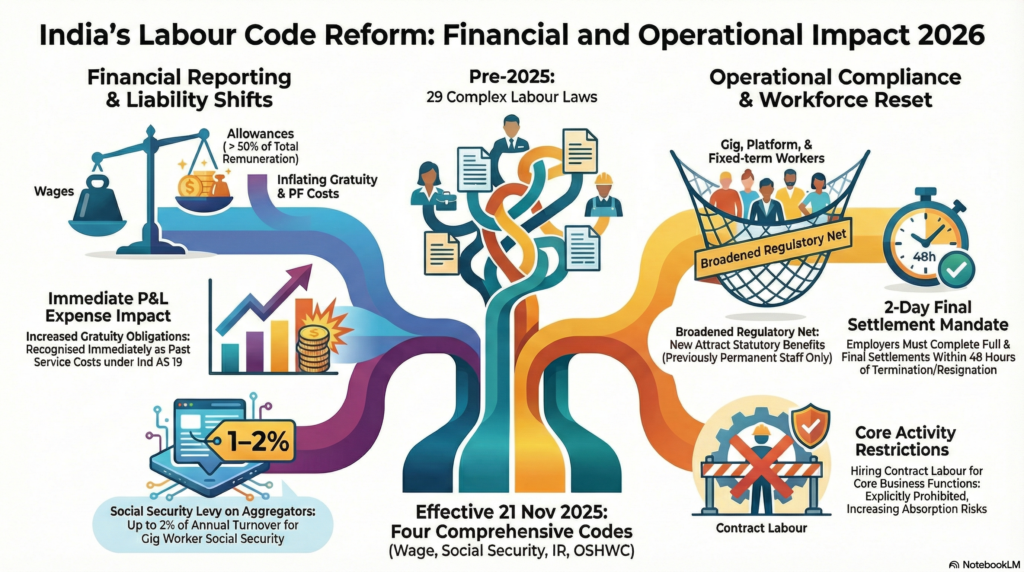
Consolidation of 29 Labour Laws into Four Codes
For anyone who has spent even a few years dealing with employment compliance in India – HR managers, founders, payroll consultants, in-house counsel-the old labour law landscape probably felt less like a system and more like an archaeological site. Layer upon layer of statutes. Twenty-nine central labour laws, many drafted in the post-Independence decades, some amended repeatedly, others barely touched at all. Different definitions for the same word. Different thresholds for the same obligation, and often different inspectors interpreting the same provision in entirely different ways. With the introduction of the four new Labour Codes, that era is now, decisively, coming to an end.
After years of deliberation, consultation with states, trade unions, industry bodies, and policy think tanks, India has consolidated those 29 central labour statutes into four unified labour codes. These codes formally came into force on 21 November 2025, a milestone that the Government of India itself has described as the “biggest labour reforms in independent India”. This framing is not rhetorical excess; it reflects the sheer scale of legal consolidation involved, as outlined in official government communications and summaries published on the India.gov portal in its spotlight on labour reforms:
The four labour codes are:
• The Code on Wages, 2019, which rationalises laws relating to minimum wages, payment of wages, bonus, and equal remuneration
• The Industrial Relations Code, 2020, which consolidates laws governing trade unions, standing orders, and industrial disputes
• The Social Security Code, 2020, which brings together provident fund, ESI, gratuity, maternity benefits, and, crucially, introduces a statutory framework for gig and platform workers
• The Occupational Safety, Health and Working Conditions Code, 2020, which standardises workplace safety, welfare, and working conditions across sectors
- The authoritative English compilation of these labour codes, as notified by the Ministry of Labour & Employment, is available here and serves as the baseline legal reference for employers and practitioners alike.
Central Notification vs State-Level Implementation (April 2026 Target)
While the central notification is already in effect, the practical reality is more layered. Labour is a concurrent subject under the Indian Constitution, meaning state governments must notify their own rules before the codes become fully operational on the ground. According to a report by The Hindu, the Centre has indicated that 1 April 2026 is the target date for full operationalisation across states, with draft rules to be pre-published to allow industry feedback.
This gap between central notification and state-level readiness is not just procedural trivia. It is the window in which businesses must prepare. Once state rules are notified, compliance obligations shift quickly from theoretical to enforceable.
Reform Objectives: Ease of Doing Business and Expanded Social Security
Importantly, these reforms are not framed merely as simplification. Government editorials published on MyGov position the labour codes as an attempt to align India’s labour ecosystem with “best international practices,” balancing employer flexibility with worker security:
That balance is also echoed in official Press Information Bureau (PIB) releases, which repeatedly emphasize two parallel goals:
- Ease of Doing Business, through simplification, digitisation, and reduced inspector raj
- Expansion of social security, particularly for informal, unorganised, and gig workers
Several PIB releases underscore this dual objective, including announcements on implementation progress, simplification of compliance, and international organisations welcoming the reforms:
International bodies have taken note. According to PIB summaries, multilateral institutions have publicly welcomed the reforms as a structural step toward formalisation and labour-market efficiency, especially in a country where informal employment has historically dominated.
But ambition alone does not guarantee success.
At stake here is more than legal housekeeping. If implemented effectively, the labour codes could unlock productivity gains, reduce litigation, improve workforce mobility, and support India’s long-term aspiration of becoming a developed nation, Viksit Bharat, by 2047. If implemented poorly, they risk creating a new layer of uncertainty: inconsistent state rules, uneven enforcement, digital systems that fail under scale, and employers unsure whether they are compliant or exposed.
This tension between reform on paper and reality on the ground runs through every provision of the four codes. It is why businesses cannot afford to treat them as distant legal texts. They are, instead, the new operating system for India’s labour market.
Understanding how they reshape wages, leave entitlements, social security, industrial relations, and workplace safety is no longer optional. It is foundational.
The 50% Wage Rule: How Salary Structures Will Change
Uniform Definition of “Wages” Under the Code on Wages, 2019
If there is one provision in the new labour codes that has forced CFOs, HR heads, and payroll teams to slow down and recheck their assumptions, it is what has come to be informally called the “50% Wage Rule.” The phrase itself doesn’t appear verbatim in the statute, but the financial consequences of the rule are very real and already reshaping compensation strategy discussions across corporate India.
As explained in detail in the Cyril Amarchand Mangaldas Guide to the Labour Codes, the Code on Wages, 2019 introduces a uniform and binding definition of “wages” across multiple statutes, something that Indian labour law had never fully achieved before
Under this definition, an employee’s basic pay, dearness allowance, and retaining allowance must together constitute at least 50% of the total Cost-to-Company (CTC). All other components-house rent allowance (HRA), conveyance allowance, travel reimbursements, special allowance, telephone allowance, meal vouchers, and similar heads- must fit within the remaining 50%.
This is a structural shift, not a cosmetic one.
Historically, many Indian employers deliberately kept basic pay low, often between 30% and 40% of CTC, to optimise take-home salary while managing statutory contributions. This approach was not illegal under earlier laws. In fact, it was widely considered best practice, especially in sectors competing aggressively for talent.
The new wage definition dismantles that model.
Impact on Provident Fund, Gratuity, and Take-Home Salary
Why? Because statutory contributions-Provident Fund (PF), gratuity, and certain bonus calculations-are directly linked to “wages” as now defined. When the wage base increases, the statutory outgo increases automatically, regardless of whether the overall CTC changes.
The Times of India, in its explainer on what the new labour codes mean for employees and employers, lays out the immediate trade-off clearly.
For many employees, this restructuring may result in a slightly lower monthly take-home salary, because a higher portion of compensation flows into PF contributions. But that reduction is paired with a long-term upside: higher retirement savings and significantly enhanced gratuity payouts.
A practical example makes this tangible.
Consider an employee earning ₹100,000 per month. Under a typical pre-code structure, basic pay might have been ₹35,000, with the balance spread across allowances. Under the new framework, basic pay must rise to at least ₹50,000. The employer’s PF contribution-12%-now applies to ₹50,000 instead of ₹35,000. That is an additional ₹1,800 per month flowing into the employee’s retirement corpus.
On its own, ₹1,800 doesn’t sound transformative. Over a 25-30-year career, compounded, it is anything but trivial.
Gratuity magnifies this effect further. Since gratuity is calculated using the formula (last drawn wages × 15/26 × years of service), a higher wage base significantly increases terminal benefits for long-tenured employees. In organisations with low attrition, this becomes a major wealth transfer mechanism.
Employer Cost Impact and 15–20% Labour Cost Increase Risk
From the employer’s perspective, however, the equation flips.
EY India, in its reporting insights and technical alerts following the nationwide implementation of the codes, warns that organisations with aggressively optimised salary structures could face 15% to 20% increases in total labour costs, depending on how far their existing wage architecture deviates from the new definition:
This impact is not evenly distributed. Companies that already maintain relatively high basic pay ratios will feel limited disruption. Those who leaned heavily on allowances, particularly in IT services, startups, and sales-driven roles, face difficult restructuring decisions.
CMS IndusLaw, in its analysis of labour code implications for transactions and deal strategy, notes that this wage restructuring has become a critical diligence issue in mergers and acquisitions.
Payroll models that looked efficient under earlier laws may now conceal substantial future liabilities. Buyers are increasingly demanding forensic payroll reviews to quantify the cost of bringing historical compensation structures into compliance.
48-Hour Full and Final (F and F) Settlement Rule Explained
And then there is the 48-hour Full and Final (F&F) settlement rule, a provision that often gets less attention than the wage definition but may prove equally disruptive in practice.
Under the new codes, when an employee exits-whether due to resignation, termination, retirement, or contract completion-the employer must settle all dues within 48 hours. This includes unpaid wages, leave encashment, gratuity, and any other statutory payments.
Previously, 30 to 60 days was common. Sometimes longer.
KPMG, in its Global Mobility Services flash alerts and India-specific commentary, flags this as a major operational risk area for employers relying on manual processes or fragmented HR systems.
Meeting a 48-hour deadline requires:
• Real-time leave balance accuracy
• Automated gratuity calculations
• Seamless coordination between HR, payroll, finance, and compliance teams
Legacy HRIS platforms and spreadsheet-driven payroll processes struggle under this requirement. Delays are no longer merely inconvenient; they are non-compliant.
Taken together, the 50% wage rule and the 48-hour settlement mandate signal something deeper than higher costs or tighter timelines. They reflect a philosophical shift in Indian labour regulation,away from flexible structuring and delayed settlements, and toward predictability, transparency, and worker financial security.
For employees, the benefits accrue slowly but meaningfully. For employers, the adjustment is immediate, technical, and unforgiving of poor systems.
And this is only the beginning. Salary reform under the labour codes does not exist in isolation. It directly feeds into leave policies, social security contributions, accounting treatment, and even transaction valuations, threads that become clearer as we move deeper into the remaining sections.
Leave Rules and Working Hours Under the New Labour Codes
Earned Leave Eligibility Reduced from 240 Days to 180 Days
If salary reform is where the labour codes hit spreadsheets, leave policy and working conditions are where they touch daily working life, and for many categories of workers, especially those on the margins, meaningfully.
One of the most practical changes introduced under the new framework relates to eligibility for earned annual leave. Under earlier laws, particularly the Factories Act, workers were required to complete 240 days of continuous service in a calendar year before qualifying for earned leave. That threshold excluded a vast number of workers whose employment was intermittent, seasonal, or contract-based.
The new labour codes reduce this requirement to 180 days, a shift highlighted in BDO India’s detailed compliance guide on the implementation of the codes.
On paper, this looks like a modest adjustment. In practice, it is not.
Contract workers in construction, logistics, hospitality, retail, and manufacturing often rotate between projects or locations. Seasonal workers may be employed intensively for part of the year and then released. Under the earlier 240-day rule, many narrowly missed eligibility, year after year. By lowering the bar to 180 days, the codes extend paid leave entitlements to millions who were previously excluded from what is arguably a basic workplace right.
This change also nudges India closer to international norms, where leave eligibility is rarely contingent on near-full-year attendance.
Mandatory Leave Encashment Beyond 30 Days
Another significant reform is the introduction of mandatory leave encashment limits. Under the new framework, employees cannot indefinitely accumulate earned leave. Any balance exceeding 30 days must be encashed at the end of the calendar year.
KPMG India describes this as a deliberate “use it or cash it” philosophy, one designed to serve two purposes simultaneously:
• Encourage employees to actually take time off, rather than hoarding leave
• Prevent employers from carrying large, unpredictable leave liabilities on their books
This approach is discussed in KPMG’s broader analysis of the transition from reform to reality under the labour codes.
In the past, it was not uncommon for long-tenured employees to accumulate massive leave balances, sometimes running into hundreds of days. These balances often surfaced only at the point of exit, creating sudden financial shocks for employers and frustrating delays for employees. The new encashment rule brings discipline and predictability to both sides.
8-Hour Workday, 48-Hour Week, and 12-Hour Shift Flexibility
On working hours, the codes largely preserve familiar boundaries. The standard remains an 8-hour workday and a 48-hour workweek. However, the new framework introduces a level of flexibility that older laws did not easily permit.
Employers may now structure 12-hour workdays, provided that total working hours do not exceed 48 hours in a given week or over a defined averaging period. This flexibility enables alternative scheduling models such as four-day workweeks or compressed shifts without requiring special exemptions from labour authorities.
For industries operating around the clock, such as manufacturing, warehousing, and logistics, this change is less about lifestyle experimentation and more about operational efficiency. It allows staffing models that better match production cycles while remaining legally compliant.
Mandatory Written Appointment Letters for All Workers
One of the most underestimated but far-reaching provisions in this section is the requirement that every worker must receive a written appointment letter.
This applies across sectors, employment types, and wage levels.
As highlighted in The Times of India’s broader analysis of the paradigm shift introduced by the new labour codes, this requirement has profound implications for India’s informal workforce.
For decades, a significant portion of India’s workforce has operated under verbal agreements without any written terms, clarity on wages, documented leave entitlements, and little proof of employment in the event of disputes. A mandatory appointment letter changes that dynamic. It creates a paper trail. It defines expectations. It gives workers something tangible they can rely on, not just in courtrooms, but in everyday life, whether applying for a loan, enrolling in social security schemes, or resolving workplace disagreements.
This provision also increases accountability for employers. Ambiguity becomes harder to defend when terms are written down.
Taken together, the leave and working-condition reforms under the labour codes reflect a shift toward standardisation without rigidity. The rules tighten whereworker welfare has historically been weak-leave access, documentation, predictable benefits-while relaxing where operational flexibility is necessary.
The success of these reforms, however, hinges on enforcement and awareness. Workers must know their entitlements. Employers must align internal policies, HR manuals, and payroll systems with the new thresholds and rules. Without that alignment, even well-designed provisions risk remaining theoretical.
And as the next section makes clear, nowhere is that risk and opportunity more visible than in the treatment of gig and platform workers.
Gig and Platform Workers: Social Security Under the 2026 Codes
Statutory Recognition of Gig Workers, Platform Workers, and Aggregators
If there is one area where India’s new labour codes clearly signal a break from the past, it is in how they address the gig and platform economy. For years, this segment of the workforce grew faster than the law that governed it. Food delivery partners, ride-hailing drivers, home-service professionals, freelance technicians, and millions of people earning livelihoods through digital platforms existed in a legal blind spot.
They were not employees in the traditional sense. They were not fully independent either. And most importantly, they were largely outside the formal social security system.
The Social Security Code, 2020, attempts to correct this imbalance.
As explained in detail by DD News in its analysis of what the new labour codes mean for gig and platform workers, the legislation formally acknowledges that the nature of work itself has changed.
For the first time in Indian labour law, the code introduces statutory definitions for:
- Gig workers – individuals who perform work outside a traditional employer-employee relationship
- Platform workers – those who access organisations or customers through online platforms
- Aggregators – digital intermediaries that connect service providers with users
This is more than definitional housekeeping. By creating these categories, the law deliberately moves away from the binary classification that has dominated global labour litigation: employee versus independent contractor.
Social Security Fund: 1–2% Aggregator Contribution Model
Fisher Phillips, in its analysis of the Indian labour code reforms, notes that India has effectively sidestepped this debate altogether by creating a third category of worker, with its own rights and protections, rather than forcing gig work into outdated legal boxes:
The centrepiece of this new framework is the Social Security Fund for unorganised workers, gig workers, and platform workers. Under the code, aggregators are required to contribute between 1% and 2% of their annual turnover to this fund, subject to a cap of 5% of the amount paid to gig and platform workers.
This is a crucial design choice. The contribution is linked to platform scale, not individual employment contracts, ensuring that large digital businesses participate meaningfully without converting every worker into a traditional employee.
According to research published by the IZA Institute of Labor Economics, the potential size of this fund is significant, with the capacity to generate billions of rupees annually to finance welfare schemes for a rapidly expanding workforce segment:
Benefits Coverage, Portability, and e-Shram Registration
So what does this fund actually provide?
The Social Security Code mandates coverage for:
• Life and disability insurance
• Health and maternity benefits
• Old-age protection
• Access to education, skilling, and upskilling programmes
One of the most important features of these benefits is portability. Benefits are tied to the worker, not the platform. A delivery partner who works with multiple apps, switches cities, or transitions between types of gig work does not lose accumulated social security coverage.
This portability is enabled through Aadhaar-linked Universal Account Numbers (UANs) and registration on the e-Shram portal, which serves as the central database for unorganised and gig workers. The intent is to allow continuity of benefits across platforms and over time, something traditional employment-linked social security systems struggle to offer.
Khaitan & Co, in its analysis of the government’s FAQs on the labour codes, points out that while the administrative machinery for delivering these benefits is still being built, the statutory foundation now clearly exists.
This distinction matters. Until now, discussions around gig worker welfare in India often stalled at the question of classification. The new code moves the conversation forward by focusing instead on coverage.
For gig and platform workers, estimated to number between 7 and 8 million today, and projected to grow rapidly, this represents a historic shift. Access to insurance, healthcare, and retirement-linked benefits has traditionally been limited to formal employment. The labour codes attempt, for the first time, to extend a version of that safety net to the digital economy.
For platforms, the implications are more complex.
On one hand, the codes impose a new and unavoidable cost. Contributions to the Social Security Fund are not optional, and compliance will require robust reporting systems. On the other hand, platforms gain long-sought regulatory clarity. Years of litigation over worker classification, particularly in international jurisdictions, have created uncertainty. India’s approach provides a clearer compliance pathway, even if it is not cost-free.
As Fisher Phillips notes in its broader guidance for multinational employers operating in India, this clarity may ultimately prove stabilising for the sector, allowing platforms to plan growth without the constant threat of reclassification risk.
Still, much depends on execution. Contribution rates, benefit delivery mechanisms, state-level rules, and digital infrastructure will determine whether this framework delivers meaningful protection or remains aspirational.
What is clear is that the labour codes no longer treat gig work as a peripheral anomaly. They recognise it as a permanent feature of India’s labour market and one that can no longer exist outside the social security system.
Industrial Relations Code 2020: Layoffs, Fixed-Term Employment & Strikes
Layoff and Retrenchment Threshold Increased to 300 Workers
Industrial relations have always been the most politically sensitive and operationally fraught part of India’s labour law framework. Striking a balance between worker protection and employer flexibility has historically been difficult, often resulting in rigid rules that discouraged scale while failing to fully protect workers from informalisation.
The Industrial Relations Code, 2020, attempts to recalibrate this balance.
One of the most widely discussed provisions under the new code is the increase in the threshold for requiring prior government permission for layoffs, retrenchments, and the closure of establishments. Previously, any industrial establishment employing 100 or more workers needed government approval before implementing such measures. In practice, this approval process could stretch for months or even years, creating a strong disincentive for firms to grow beyond a certain size.
Under the new framework, this threshold has been raised to 300 workers.
PwC India, in its implementation roadmap for the labour codes, identifies this change as one of the most significant steps toward improving labour market flexibility, particularly for medium-sized manufacturing and industrial enterprises.
The rationale is straightforward. Firms employing between 100 and 300 workers now have greater freedom to restructure operations in response to market conditions without navigating prolonged bureaucratic processes. At the same time, establishments above the 300-worker threshold continue to require government oversight, preserving protections for workers in larger units.
Trilegal’s analysis of the new labour law codes frames this as a competitiveness reform, one aimed at reducing the “missing middle” problem in Indian manufacturing, where firms remain artificially small to avoid regulatory thresholds.
Fixed-Term Employment (FTE) with Parity and Gratuity After One Year
Another major reform under the Industrial Relations Code is the formal recognition and legitimisation of Fixed-Term Employment (FTE).
Historically, Indian employers who needed workforce flexibility often relied on contract labour supplied through contractors, even for work that was not truly intermittent. This arrangement created a two-tier workforce—permanent employees on one side, contract workers with fewer protections on the other.
The new code allows employers to hire workers directly on fixed-term contracts, while mandating full parity with permanent employees on wages, working hours, allowances, and statutory benefits.
As outlined by Littler Mendelson in its snapshot of India’s labour law overhaul, this provision removes the artificial distinction that previously pushed employers toward contractor-based arrangements.
Fixed-term employment under the new framework also includes a notable worker-friendly provision: eligibility for gratuity after just one year of continuous service, instead of the usual five years required for permanent employees. This recognises the inherently temporary nature of such engagements and ensures that workers are not excluded from long-term benefits simply because their contracts are time-bound.
Worker Re-Skilling Fund and Strike Notice Requirements
Retrenchment, when it does occur, now carries an additional social obligation. Employers are required to contribute 15 days’ wages for every retrenched worker to a Worker Re-skilling Fund. According to KPMG’s analysis of workforce mobility and restructuring under the new codes, this fund is intended to finance retraining and upskilling programmes for displaced workers, easing transitions rather than leaving them unsupported.
Union recognition has also been restructured.
The code introduces the concept of a “Sole Negotiating Union.” If a trade union commands the support of at least 51% of the workers in an establishment, it becomes the exclusive body for collective bargaining. This replaces earlier systems where multiple unions could simultaneously negotiate, often leading to fragmented representation and prolonged disputes.
The intent is to create clearer accountability and more stable industrial relations. However, academic analysis from the Institute of South Asian Studies at the National University of Singapore (ISAS NUS) cautions that without adequate safeguards, minority worker voices could be marginalised.
The right to strike has not been eliminated, but it has been more tightly regulated. Workers in public utility services are now required to provide 14 days’ notice before commencing a strike, and strikes are prohibited during the pendency of conciliation proceedings. Proponents argue that this brings predictability and protects public interest. Critics contend that it weakens workers’ bargaining power.
Both arguments have merit. And both underscore a recurring theme of the new labour codes: rights remain, but they are increasingly structured around procedural discipline.
Taken together, the industrial relations reforms aim to reduce friction without removing protection to make workforce adjustment possible without making workers disposable. Whether this balance holds in practice will depend on how state governments frame their rules and how conciliation mechanisms function on the ground.
What is clear is that employer flexibility under the new codes is no longer informal or workaround-driven. It is formalised, conditional, and tied to explicit social responsibilities.
Occupational Safety Code 2020: Workplace Safety & Women’s Night Shifts
Universal Safety Standards and Annual Health Check-Ups
The Occupational Safety, Health and Working Conditions Code, 2020 is, in many ways, the quietest of the four labour codes, and also the one that affects the widest range of workers. It brings together provisions from multiple older laws and attempts to standardise safety, welfare, and working-condition norms across sectors that were previously regulated unevenly, or not at all.
One of the most important shifts introduced by this code is the move toward universal minimum standards. Earlier, coverage depended heavily on the type of establishment-factory, mine, plantation, shop, or office-and on headcount thresholds. As a result, workers performing similar tasks often enjoyed very different protections depending on where they worked.
That fragmentation is now significantly reduced.
EY India, in its technical alert following the nationwide notification of the labour codes, highlights a key preventive health requirement under the new framework: establishments engaging workers in hazardous or dangerous operations must provide free annual health check-ups for workers above the age of 40.
This provision reflects a growing recognition that occupational illnesses often emerge later in life and that early detection can dramatically reduce long-term health costs, absenteeism, and disability. It also shifts employer responsibility away from reactive compliance after accidents and toward proactive health management.
Women’s Night Shift Work with Consent and Safety Safeguards
For women workers, the code marks a particularly significant evolution.
Perhaps the most discussed reform is the permission for women to work night shifts, defined as work between 7:00 PM and 6:00 AM. Earlier labour laws, while framed as protective, effectively barred women from large segments of industries-manufacturing, logistics, BPOs, and continuous-process operations-where night work is unavoidable.
Under the new code, women may work night shifts with their consent, provided the employer ensures adequate safety measures.
Fisher Phillips, in its detailed guidance for multinational employers navigating India’s labour law reforms, outlines the practical compliance expectations associated with this change.
These safety measures are not symbolic. Employers are expected to provide secure transportation, well-lit workplaces, functional CCTV coverage, adequate security personnel, and robust internal mechanisms for reporting harassment or safety concerns. Consent must be meaningful, not coerced, and employers remain accountable for creating a safe working environment.
This shift represents a broader philosophical change. Instead of assuming that women need protection from certain types of work, the law increasingly focuses on ensuring protection within those environments while allowing women to make their own choices.
Crèche Facilities, Welfare Infrastructure, and Expanded “Family” Definition
The code also expands the definition of “family” for female employees in specific contexts, such as eligibility for dependent-related benefits and leave. Parents-in-law are now included within this definition, acknowledging the caregiving responsibilities that many women assume within extended family structures. While this change may appear modest, it reflects a more realistic understanding of social roles and domestic labour in India.
Welfare infrastructure requirements have also been rationalised and, in some cases, strengthened.
Establishments employing 50 or more workers are now required to provide crèche facilities, a reduction from higher thresholds that existed under certain earlier laws. This change brings childcare support within reach for employees in smaller establishments who were previously excluded.
In addition, provisions relating to canteens, restrooms, drinking water, and other basic amenities have been standardised across establishment types. Trilegal’s contract labour repository notes that these universalised standards extend protections to millions of workers who previously fell outside formal welfare regimes due to technical classifications.
Taken together, the occupational safety and welfare provisions of the new labour codes reflect a shift from selective coverage to baseline dignity at work. The emphasis is not only on preventing catastrophic accidents, but on improving everyday working conditions, covering health monitoring, sanitation, childcare access, and gender-inclusive participation.
As with other aspects of the labour codes, the real test lies in implementation. Safety audits, infrastructure upgrades, consent documentation, and grievance mechanisms require sustained attention, not one-time compliance.
Still, the direction is clear. The new framework treats workplace safety and women’s participation not as peripheral issues, but as central pillars of a modern labour market.
M&A, Accounting, and Strategic Compliance Under the New Labour Codes
50% Wage Rule and Ind AS 19: Balance Sheet Implications
For companies involved in mergers, acquisitions, spin-offs, or large-scale restructuring, the new labour codes fundamentally change the way labour law risk is assessed. What was once treated as a post-closing compliance exercise has now moved squarely into the core deal economics.
This shift is most visible in how the 50% wage rule interacts with valuation, liability estimation, and financial reporting.
CMS IndusLaw, in its analysis of labour code reforms and their implications for transactions and deal strategy, makes this point unambiguously: compensation structures that appear compliant under legacy laws may conceal material future liabilities under the new wage definition.
To understand why, consider a mid-sized target company employing 1,000 workers with an average annual CTC of ₹800,000. If basic pay has historically been structured at 35% of CTC, bringing compensation into alignment with the 50% wage rule could materially increase employer contributions to the provident fund and gratuity. Depending on workforce demographics and tenure, this adjustment alone could increase annual labour costs by ₹50–70 million.
These are not hypothetical numbers. They are the kind of adjustments that directly affect enterprise value.
What complicates matters further is the accounting treatment of these changes. Under Ind AS 19 (Employee Benefits), any increase in defined benefit obligations, such as gratuity, that arises from statutory changes must be recognised immediately in the profit and loss statement. Companies cannot amortise or defer the impact over future periods.
This means that for many organisations, the labour codes could trigger significant one-time expenses in the FY 2025-26 financial statements, potentially affecting reported profitability, earnings per share, and even compliance with debt covenants.
KPMG, in its workforce and global mobility commentary, estimates that gratuity liabilities alone could increase by 20% to 40% for companies with large, long-tenured employee bases, depending on existing wage structures and actuarial assumptions.
As a result, CFOs and financial controllers can no longer treat labour compliance as an HR-only issue. Actuaries must be engaged early to revalue gratuity obligations using the revised wage definition, and finance teams must be prepared to explain the impact to boards, auditors, and investors.
Contract Labour Restrictions and Core Activity Test
The labour codes also sharpen scrutiny around contract labour usage, another area of heightened risk in transactions.
Under the new framework, establishments are prohibited from engaging contract labour for “core activities”—work that is perennial in nature, central to the business, and ordinarily performed by regular employees. While the code provides certain exceptions, the underlying principle is clear: contract labour should not be used to systematically replace regular employment.
Trilegal’s contract labour repository highlights how this requirement forces businesses to re-examine workforce composition, especially in sectors that have historically relied heavily on contractors.
In practice, the distinction between core and non-core activities is not always obvious. Assembly-line workers in a manufacturing plant are almost certainly engaged in core activity. IT support staff in a software services company may not be. But there are many grey areas in between and misclassification carries consequences.
If contract workers are found to be engaged in prohibited core activities, they risk being reclassified as direct employees, with retrospective liability for wages, benefits, and social security contributions. In an M&A context, this can dramatically alter the risk profile of a target company.
Labour Due Diligence Checklist Under the Four Labour Codes
Recognising these risks, DLA Piper recommends that labour law due diligence under the new codes go beyond surface-level compliance checks. Their guidance suggests conducting forensic payroll and workforce audits to:
• Map existing wage structures against the 50% threshold
• Identify contract workers potentially engaged in core activities
• Quantify gratuity exposure for fixed-term employees
• Assess compliance with the 48-hour Full and Final settlement rule
• Verify registration, filings, and returns under all four labour codes
This approach is outlined in DLA Piper’s commentary on the new era of compliance ushered in by the labour codes.
What makes this particularly challenging is that compliance under the labour codes is not a one-time remediation exercise. Wage structures evolve. Workforce composition changes. Fixed-term contracts roll over. Gig engagements expand. Ongoing monitoring systems must be built into HR and finance operations to avoid drift.
For dealmakers, this means labour law risk now sits alongside tax, environmental, and data protection risks as a first-order diligence concern. For operating companies, it means that decisions made years ago-often for perfectly rational reasons at the time- can now have material financial consequences.
In short, the labour codes have turned workforce structure into a balance-sheet issue.
Preparing for India’s Labour Codes Implementation in 2026
Immediate Compliance Priorities for Employers
As India stands on the threshold of fully operationalising the new labour codes, the months leading up to 1 April 2026 are not a grace period but a countdown. With central notification already in force and state governments moving toward publishing draft and final rules, employers now have a narrow but critical window to shift from awareness to execution.
This transition is not optional. Once state rules are notified, enforcement follows quickly.
For most organisations, immediate priorities are tactical but unavoidable. These include conducting comprehensive payroll audits to map existing compensation structures against the 50% wage threshold and to quantify the real financial impact of restructuring allowances into basic pay. This exercise alone has surfaced uncomfortable truths for many employers, particularly those that optimised aggressively under earlier frameworks.
Equally urgent is the need to upgrade HRIS and payroll systems. The 48-hour Full and Final settlement requirement leaves little room for manual processes or loosely integrated systems. Leave balances must be accurate in real time. Gratuity calculations must be automated. Compliance reporting must be seamless. For organisations still relying on fragmented legacy platforms, this is not a minor upgrade; it is an operational overhaul.
Financial Reporting, Workforce Classification, and Contract Review
Workforce classification is another foundational step. Employers must clearly identify who falls into which category: permanent employees, fixed-term employees, contract workers (only where legally permissible), gig workers, and platform workers. Each category carries distinct documentation, benefits, and compliance obligations. Ambiguity here is no longer benign; it is risky.
This necessitates a thorough review and revision of appointment letters, employment contracts, and service agreements. Definitions, termination clauses, benefit descriptions, and working-condition provisions must align with the new statutory language across all four codes. Boilerplate documents that have not been revisited in years are unlikely to survive scrutiny under the new regime.
Training also matters. HR teams, payroll staff, line managers, and even business heads need a practical, scenario-based understanding of the new rules, particularly around women’s night work permissions, parity obligations for fixed-term employees, union recognition processes, and contract labour restrictions. Compliance failures are often not malicious; they are procedural. Education is preventive compliance.
From a financial reporting perspective, engaging actuaries early is essential. Revaluation of gratuity liabilities under the new wage definition can materially affect balance sheets and profit-and-loss statements. Under Ind AS 19, these impacts must be recognised promptly. Surprises here are costly, not just financially, but reputationally.
Implementation Risks and the “Inspector-cum-Facilitator” Model
Beyond checklists and compliance matrices, however, the labour codes signal a deeper cultural shift.
The government has articulated a move away from a purely punitive inspection regime toward an “Inspector-cum-Facilitator” model. In theory, labour authorities are meant to guide establishments toward compliance rather than merely penalise deviations. Whether this vision translates into practice will depend on training, incentives, and administrative capacity at the ground level.
Digital systems are meant to simplify filings and registrations. Conciliation mechanisms are meant to resolve disputes before they harden into litigation. If these systems work as intended, compliance could become less adversarial and more predictable.
For workers, the potential gains are substantial. Higher retirement savings through a broader wage base. Faster exit settlements that reduce financial stress during job transitions. Portable social security for gig and platform workers who have historically been excluded from formal protections. Safer workplaces. Greater participation of women in night-shift industries. Expanded welfare infrastructure.
Yet none of these gains are automatic.
As academic analysis from the Institute of South Asian Studies at the National University of Singapore (ISAS NUS) cautions, faithful implementation is the linchpin. Without consistent enforcement, adequate awareness, and administrative follow-through, even well-designed reforms risk remaining paper promises.
Ultimately, the success of India’s labour codes will not be measured by the elegance of their drafting or the ambition of their stated objectives. It will be measured on factory floors, in offices, across digital platforms, and within HR and payroll systems nationwide.
Can the codes genuinely balance flexibility for employers with security for workers?
Can they formalise gig and informal labour without suffocating innovation?
Can they simplify compliance while strengthening enforcement rather than weakening it?
These questions will define not just 2026, but the trajectory of India’s labour market for decades to come.
What is certain is that Indian labour law has entered a new era. Employers, workers, policymakers, and advisors must engage with these codes not as distant legal instruments, but as the new operating system for work in India.
For those seeking authoritative guidance, the Ministry of Labour & Employment continues to publish official codes, notifications, and updates.
In parallel, professional advisors from firms such as Cyril Amarchand Mangaldas, EY, KPMG, and PwC have released detailed analyses and implementation roadmaps to help organisations navigate the transition responsibly and strategically.
The journey from reform to reality has already begun. The only remaining question is how prepared each organisation and each worker is to meet it.




Leave a Reply