
UPI Charges / MDR Policy 2026: New 0.4% Rules, Caps, and Exemptions Explained
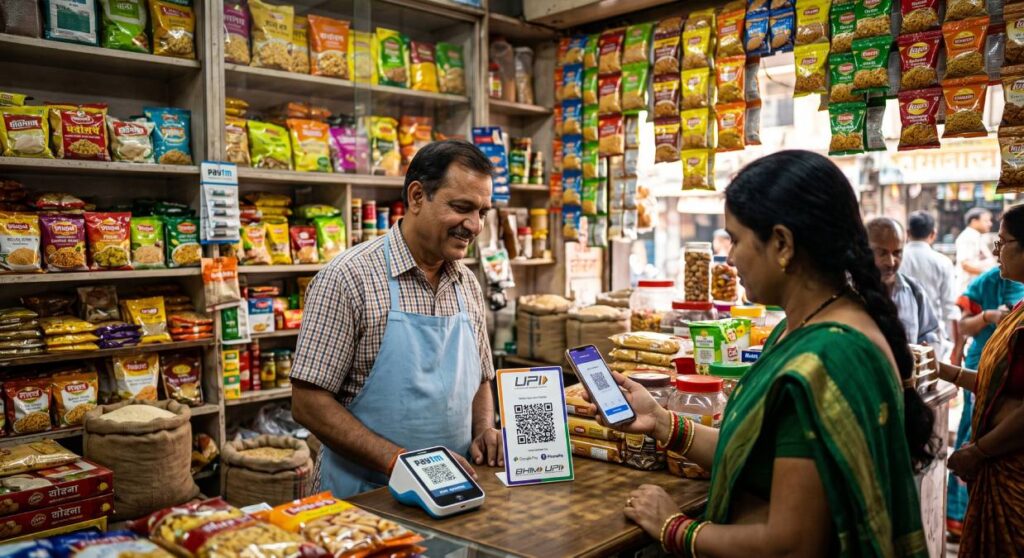
UPI Charges 2026: Who Pays the 0.4% Fee on Merchant Transactions?
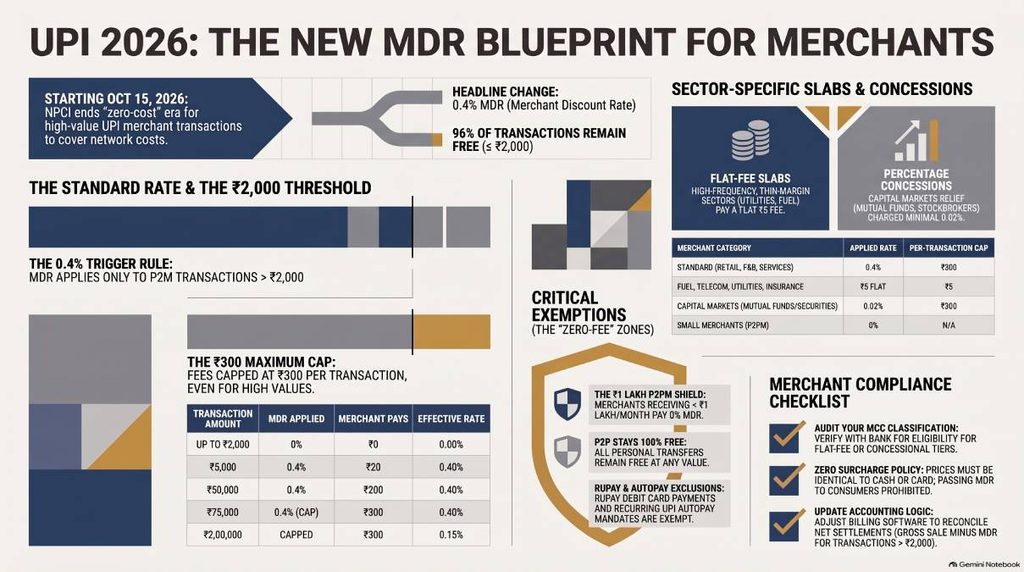
From October 15, 2026, a UPI payment above ₹2,000 made to a business can carry a fee for the first time since the National Payments Corporation of India made the rail free in January 2020. The fee is called the Merchant Discount Rate, MDR for short, and it sits at 0.4 per cent on standard person-to-merchant transactions, with a ceiling of ₹300 per transaction once the payment crosses ₹75,000. Six years of a zero-cost UPI rail for shopkeepers, e-commerce sites and service providers is ending. Only at the upper end of the value curve, though. The change does not touch how ordinary people use UPI. Herein, the issue of UPI Charges / MDR Policy, 2026 assumes significance.
Every person-to-person transfer stays free, at any amount. Every merchant payment of ₹2,000 or below stays free too. The government puts the share of merchant transactions left completely untouched at close to 96 per cent. That is what the rest of this piece works through: who actually pays the new fee, which sectors get a different rate, how small merchants stay exempt, and what a business running a UPI QR code needs to do before the middle of October.
UPI’s size is part of why the new rate card draws this much attention. The rail carried 24.51 billion transactions worth ₹29.82 lakh crore in August 2026 alone. The zero-MDR years were never entirely free of cost either. The government has run an incentive scheme reimbursing banks a small percentage, around 0.15 per cent, on low-value UPI transactions to keep the rail commercially viable for the banks running it. The new MDR shifts part of that cost away from the government’s budget and onto larger merchant transactions instead.
At A Glance: UPI Charges / MDR Policy 2026
- Effective October 15, 2026, a new 0.4% Merchant Discount Rate (MDR) applies to person-to-merchant (P2M) UPI transactions exceeding ₹2,000.
- The fee targets businesses only; person-to-person (P2P) transfers remain 100% free, regardless of transaction size.
- The standard MDR features a maximum cap of ₹300 per transaction, safeguarding large-ticket retail and B2B settlements above ₹75,000.
- Small businesses (P2PM) processing under ₹1 Lakh per month in UPI receipts are entirely exempt from the new fees.
- High-frequency sectors receive massive concessions: a ₹5 flat fee for fuel, utility, and telecom bills, and a 0.02% rate for mutual funds and capital markets.
- Merchants are strictly prohibited from applying UPI surcharges at checkout; consumers must see pricing parity with cash.
Will You Be Charged? Decoding the October 2026 NPCI Notification
On September 15, 2026, NPCI’s UPI and Services Steering Committee published the rate card that governs UPI pricing from next month. The change did not appear out of nowhere. Section 10A of the Payment and Settlement Systems Act, 2007 had barred any bank or payment provider from charging for UPI and RuPay debit card transactions since January 2020.
Parliament’s Taxation and Other Laws (Amendment) Act, 2026 rewrote that protection so it now covers only the payment modes the government specifically notifies, and a notification dated September 14, 2026 named UPI transactions up to ₹2,000, plus all RuPay debit card payments, as the modes that stay free by law.
Above that line, NPCI’s own rate card takes over. PIB’s official statement on the change also points to Parliament’s own prior recommendation as part of the reasoning: the new fee lines up with a suggestion from the Standing Committee on Finance’s 32nd Report, which had pushed for UPI to run on a viable revenue base rather than on subsidy alone. The Reserve Bank of India has backed the change too, describing it as a step toward keeping India’s digital payments system financially sound over the long run.
One scope note matters for businesses that also accept prepaid wallets over UPI. A payment made from a wallet linked to UPI, rather than directly from a bank account, already carried a separate interchange charge since 2023 and sits outside the rate card discussed here, which covers bank-account UPI specifically.
Personal vs. Merchant UPI Payments: P2P vs. P2M Explained
UPI carries two distinct kinds of transfers, and the new charge only touches one of them. A person-to-person transfer, sending rent to a flatmate or paying pocket money to a child, moves money between two individual bank accounts and stays completely free at any value. P2P transfers of this kind make up around 70 per cent of all UPI value moved, and none of it is affected by the new rules.
A person-to-merchant transfer is different. This is what happens the moment a UPI payment goes to a registered business rather than an individual, whether that is scanning a QR code at a kirana store, paying a food delivery app, or settling an invoice through a payment link. It is this second category, P2M, that the 0.4 per cent MDR applies to, and only above the ₹2,000 mark.
A few payment types sit outside both buckets and keep their existing treatment. RuPay debit card transactions stay free regardless of amount, protected by the retained part of Section 10A. Recurring UPI AutoPay mandates, the kind that renew an OTT subscription or pull a SIP instalment automatically, are treated separately from one-off P2M payments and are not charged the new rate. A merchant deciding how to price UPI acceptance needs to know which bucket a transaction falls into before assuming any fee applies at all.
The ₹2,000 Threshold: When the 0.4% Merchant Fee Triggers
The rule is simple to state. A P2M UPI payment of ₹2,000 or less carries no MDR, full stop. Cross that line and, for a standard merchant, 0.4 per cent of the transaction value becomes payable, up to a ceiling of ₹300 once the payment reaches ₹75,000.
| Transaction Amount | MDR Rate Applied | Amount Merchant Pays |
| ₹2,000 | Nil | ₹0 |
| ₹3,000 | 0.4% | ₹12 |
| ₹50,000 | 0.4% | ₹200 |
| ₹75,000 | 0.4% (cap reached) | ₹300 |
| ₹1,00,000 | Capped at ₹300 | ₹300 (effective 0.30%) |
| ₹2,00,000 | Capped at ₹300 | ₹300 (effective 0.15%) |
Worked examples per NPCI’s published FAQ.
Two numbers explain why the government frames this as a narrow charge. By NPCI’s own count, close to 96 per cent of P2M UPI transactions fall at or below the ₹2,000 mark and never see the MDR line at all. But that 96 per cent, measured by how many payments happen, is a different number from how much money moves. Transactions above ₹2,000 make up only around 4 per cent of P2M transactions by count, yet they account for close to two-thirds of the total value flowing through merchant UPI. The charge is narrow in how often it applies and wide in how much rupee value it eventually touches. A business should model its own exposure against its own ticket size, not against the headline percentage.
UPI’s own shape helps explain that design. The rail accounted for 85.5 per cent of India’s digital payment transactions by volume in the second half of 2025, but only 9.5 per cent of transaction value, since most UPI payments are small, everyday purchases rather than big-ticket ones. A rate card aimed at larger transactions was always going to touch a small slice of UPI’s enormous transaction count while still reaching a meaningful share of the money moving through it. The cap has no ceiling on transaction size either. A ₹10,00,000 UPI payment, for a large equipment purchase or a bulk B2B order, still attracts the same flat ₹300 as a ₹75,000 one, an effective rate of just 0.03 per cent.
The money at stake is not small for the industry either. At a 0.4 per cent rate, the payments industry could see up to ₹16,000 crore a year in additional revenue once the new rate card is fully running. Industry estimates of what it costs to keep UPI’s servers, fraud checks, and help desks running put that figure at roughly ₹20,000 crore a year, which is the gap NPCI says the new fee is meant to close.
Industry voices reading the notification see a mixed picture. Kunal Jhunjhunwala, founder of the payments company airpay, has pointed out that larger businesses will likely absorb the 0.4 per cent charge without much friction, while merchants running on thin margins may feel it more, and that fintech companies now have only a few weeks to explain the change to merchants and update their billing systems. Adhil Shetty, CEO of BankBazaar and chairman of FICCI’s Fintech Committee, has framed the new charge as a possible revenue line for fintechs, though one that on its own may not cover their costs, since the bulk of everyday UPI payments stays free.
Sector-Specific Slabs Under the UPI Charges / MDR Policy
The 0.4 per cent figure that dominates most headlines is the default rate for standard merchants. Several sectors get a different number entirely, and getting the classification wrong is the single most common way a business overestimates, or underestimates, its own cost.
NPCI’s reasoning for treating sectors differently comes down to margin. A 0.4 per cent charge barely registers for a business selling ₹50,000 laptops, but it changes the arithmetic for a petrol pump or an insurance agent working on thin per-transaction margins, which is why those categories get a flat, predictable fee instead of a percentage that scales with the bill.
Standard Retailers: The 0.4% Rate and ₹300 Maximum Cap
Most businesses, e-commerce sellers, restaurants, salons, and professional service providers fall into the standard tier: 0.4 per cent on P2M payments above ₹2,000, capped at ₹300 once a single transaction reaches ₹75,000. Below ₹75,000, the charge tracks the percentage exactly, so a ₹20,000 sale costs the merchant ₹80 and a ₹60,000 sale costs ₹240. Above that line, the cap holds, and the effective rate keeps falling as the ticket size grows. A ₹5,00,000 UPI settlement still costs the merchant only ₹300, an effective rate of 0.06 per cent.
For a typical e-commerce or D2C business, UPI usually makes up more than half of checkout volume, with domestic cards and EMI options filling most of the rest. Layering a 0.4 per cent network MDR onto what was previously a zero-cost UPI leg nudges the blended cost of accepting payments upward across the whole business, not only on the specific transactions crossing ₹2,000, since UPI’s share of the payment mix is usually the largest single piece.
A charge on merchant payments is not a new idea in Indian banking, only new to UPI. Debit cards have carried a regulated MDR since 2012, and the Reserve Bank of India rationalised that structure in December 2017, setting a cap of 0.40 per cent for small merchants and up to 0.90 per cent for larger ones, with banks barred even then from passing the cost onto customers. The UPI rate that starts on October 15 sits at the lower end of that historical range, and it carries the same no-pass-through rule debit cards have followed for close to a decade.
Not every merchant is comfortable with the new cost. A LocalCircles survey of more than 32,000 businesses across 242 districts, run in the days after the notification, found only 17 per cent of respondents willing to pay the full 0.4 per cent, while 41 per cent said they would not pay any MDR at all. Around 9 per cent of those surveyed said they do not accept UPI payments in the first place. A related report from the same publication noted that cash in circulation had already risen 12.5 per cent in August, ahead of the October date. A merchant who intends to keep UPI as the default checkout option should treat the new cost as a fixed line item to plan around, not something to pass silently onto customers, which the rules explicitly forbid.
Flat-Rate Exemptions: Fuel, Utilities, and Transportation (₹5 Cap)
A handful of thin-margin, high-frequency sectors get a flat ₹5 charge per transaction above ₹2,000 instead of the percentage rate. The government’s own list names railways, telecommunications, insurance, fuel, and agricultural inputs. Industry coverage of the underlying NPCI circular adds utility bill collection, electricity, water, and piped gas payments to the same flat-fee bucket.
- Railway ticket bookings on IRCTC and its authorised partners
- Mobile and broadband recharges, and telecom bill payments
- Insurance premium payments to IRDAI-regulated insurers
- Petrol, diesel, and CNG purchases at fuel stations
- Electricity, water, and piped natural gas bill payments
- Agricultural input purchases through registered dealers
The saving compounds with transaction size. A ₹5,000 electricity bill paid on UPI attracts ₹5 under this carve-out rather than ₹20 under the standard rate, and a ₹50,000 insurance premium costs the same flat ₹5 rather than ₹200. Education fee payments sit in a less settled position. Some coverage places school and university fees in the same flat-₹5 bucket, while other reporting describes a distinct concessional structure specific to education institutions rather than the flat ₹5 rate. A school or college collecting fees through UPI should confirm its own category with its acquiring bank rather than assume either treatment applies automatically.
A ₹4,000 fuel purchase shows the saving directly. At the standard rate, it would cost ₹16 in MDR. Under the flat-fee treatment, it costs ₹5, a difference that adds up at scale for a petrol pump processing hundreds of UPI payments a day. This flat-fee sector cluster carries outsized weight relative to how often it occurs, too. One detailed industry analysis of the notification puts this carve-out at around 17 per cent of P2M UPI transactions by count but closer to 46 per cent by value, meaning a large share of the money moving through merchant UPI sits outside the 0.4 per cent headline rate entirely. A business modelling its UPI cost purely off the standard rate, without checking whether it qualifies for one of these sectors, risks overstating its own exposure by a wide margin.
Capital Markets and Wealth Management: The 0.02% Relief Structure
Mutual fund purchases, securities trades, and payments to SEBI-registered stockbrokers and dealers get the lowest rate in the entire rate card: 0.02 per cent, capped at ₹300. The logic follows the ticket size. Capital market transactions run at far higher values than retail purchases, and a 0.4 per cent charge on a ₹5,00,000 stock settlement would run past ₹2,000 before any cap is applied. At 0.02 per cent, the same settlement costs ₹100, comfortably under the ₹300 ceiling.
A SIP contribution running on UPI AutoPay effectively sits outside the charge from two directions at once, the AutoPay exemption on one side and the 0.02 per cent capital-markets rate on the other. The government frames this combination as protecting continued retail participation in India’s formal financial markets. A stockbroker settling a ₹20,00,000 trade over UPI still hits the ₹300 cap in this tier too, once the raw 0.02 per cent calculation crosses that figure, so no capital-market transaction on UPI, no matter how large, currently costs more than ₹300 in network MDR.
Here is the complete rate card in one place, combining every tier covered above.
| Payment Category | MDR Rate | Per-Transaction Cap |
| Standard P2M above ₹2,000 | 0.4% | ₹300 |
| Railways, telecom, insurance, fuel, utilities, agri inputs | ₹5 flat | ₹5 |
| Capital markets (mutual funds, brokers, dealers) | 0.02% | ₹300 |
| P2PM small merchants (up to ₹1 lakh/month) | Nil | n/a |
| P2P transfers, any amount | Nil | n/a |
| RuPay debit cards | Nil | n/a |
| UPI AutoPay mandates | Nil | n/a |
Compiled from NPCI’s notified rate card.
How Small Businesses Can Avoid Fees (The P2PM Exemption)
A separate category, called P2PM, keeps small merchants entirely outside the new charge, regardless of what they sell or how large an individual transaction is.
The ₹1 Lakh Monthly Limit for Zero-Fee P2PM Status
A merchant receiving up to ₹1 lakh a month through UPI QR codes qualifies as P2PM and pays zero MDR on every credit, whatever the ticket size of an individual payment. The government built this specifically for street vendors, neighbourhood shops, and other small businesses that would otherwise feel the new cost hardest against their margins.
No GST registration is required to qualify. Eligibility runs purely on the monthly collection figure and how the merchant’s account is categorised, so a shopkeeper accepting payments on a personal or current account, with monthly inward UPI receipts staying under ₹1 lakh, keeps zero-MDR status whether a single sale is ₹50 or ₹20,000.
Picture a vegetable vendor collecting UPI payments averaging ₹150 a sale, forty to fifty times a day. Even at the upper end of that pattern, monthly inward UPI receipts land well under ₹1 lakh, so every one of those transactions clears at zero MDR under the P2PM category, with no separate paperwork required to claim it beyond the account already being open.
To fund wider UPI adoption among exactly this group, NPCI has set aside 5 percent of total MDR collections for a fund dedicated to small merchants, with particular focus on Tier III to Tier VI towns, the North-East, Jammu and Kashmir, and Ladakh. The operating details of that fund are still being worked out with the RBI.
How to Verify Your Merchant Category Code (MCC) with Acquiring Banks
Every merchant accepting card or UPI payments is assigned a Merchant Category Code by their acquiring bank, and that code decides which rate applies: standard 0.4 per cent, one of the flat-₹5 sectors, the 0.02 per cent capital-markets tier, or P2PM exemption. Getting the MCC wrong is a paperwork headache, and it is also a costly one: a business incorrectly classified under the standard tier, when it actually qualifies for a flat-fee sector, will overpay on every transaction above ₹2,000 until the mistake gets fixed.
The practical fix is direct. Ask the acquiring bank or payment aggregator to confirm, in writing, which MCC and which MDR tier the business sits under. This matters most for merchants near a category boundary, a fuel retailer that also runs a small convenience store, or a school that collects both tuition and hostel fees through the same UPI handle. Do not assume the flat rate applies just because the business feels like it should qualify. Get the classification confirmed before October 15, not after the first settlement cycle throws up a surprise.
Categories outside the obvious sectors matter here too. NGOs collecting donations, government fee collections, and institutional payments each carry their own MCC conventions, and a body wrongly bucketed into the general retail category could end up paying the standard 0.4 per cent when a lower, sector-specific rate was actually available. Payment gateway pricing in India generally has five layers regardless of the payment method: the MDR itself, a platform fee for dashboard and reporting tools, 18 per cent GST charged on the fee rather than the transaction value, any annual maintenance charge, and the often-overlooked cost of failed payments, which can outweigh the MDR itself if checkout success rates slip. Placing UPI’s new network MDR correctly inside that five-part structure, rather than treating it as the only cost in play, gives a more accurate read of what accepting UPI actually costs a given business.
Consumer Safeguards Against Hidden UPI Charges
Every rule discussed so far concerns what a merchant pays. For the person tapping their phone at checkout, the position is unambiguous: nothing changes.
Strict RBI Prohibition on Platform Fees and Passed-Down Charges
NPCI’s FAQ document draws a hard line here. UPI app providers, the consumer-facing apps that route a payment, are explicitly barred from charging users any platform fee for using UPI. This sits on top of the MDR rules themselves, which only ever touch the merchant side of a transaction.
The distinction that trips people up is the one between a network-level MDR, which is set by regulation and is not negotiable, and a commercial platform fee that a merchant separately pays its payment aggregator for services like dashboards, reconciliation files, and fraud checks. The new rules do not authorise a fresh charge on that second, commercial line either. What they do is put a positive network cost on UPI transactions above ₹2,000 for the first time, a cost that was zero before October 15 and sits somewhere above zero after it, borne entirely by the merchant.
On a ₹3,000 UPI purchase from a standard merchant, the customer’s bank account still shows a ₹3,000 debit, exactly as before. The merchant’s side is where the change shows up: the business receives a credit of ₹2,988, net of the ₹12 MDR, before any separate aggregator platform fee or GST on that fee is applied. Nothing about what the customer types into their UPI app, sees on their screen, or pays out of pocket changes because of a deduction happening one level down in the chain.
Ensuring Retail Prices Remain Unaffected by Merchant Processing Fees
Merchants are explicitly barred from adding an MDR surcharge to a bill or quoting a different price for UPI payments compared to cash. A customer paying by UPI should see exactly the same price as a customer paying by cash. A business that adds a line item for the new fee is acting against the rules NPCI has set, not exploiting a grey area.
This protection matters because customer behaviour already shows some sensitivity to the possibility of being charged. An earlier LocalCircles survey found that if merchants did pass MDR costs onto customers, 53 per cent of UPI users said they would move away from UPI for purchases above ₹3,000, with 27 per cent saying they would switch to credit cards, 14 per cent to debit cards, and 12 per cent to cash or bank transfer. The no-surcharge rule exists precisely to prevent that shift, keeping what a customer pays at UPI checkout identical to what it was before October 15, even as the merchant’s back-end cost changes.
This is not the first time the RBI has drawn this line either. When debit card MDR was rationalised in 2017, the central bank gave banks the same instruction it is repeating now for UPI: ensure merchants onboarded do not pass MDR charges on to customers. The rule that applies to UPI from October 15 is, in that sense, an extension of a principle Indian payment regulation has held for close to a decade.
Confusion around UPI charges is not new, either. Rumours about UPI turning chargeable have circulated periodically since 2023, and most of those earlier scares turned out to be false alarms. This time the notification is dated, published, and specific about its own limits. NPCI’s FAQ names consumers and P2P transfers as excluded on one side, and small vendors under the P2PM threshold as excluded on the other. Anyone reading conflicting claims online should treat NPCI’s FAQ and the Ministry of Finance’s own statements as the reference points, not forwarded messages or social media threads.
Also Read: How to Claim Unclaimed Bank Deposits (RBI UDGAM): The Complete 2026 Guide
4 Steps Merchants Must Take Before October 15 to Stay Compliant
A month is a short runway for a pricing change that touches every UPI settlement above ₹2,000. Four steps cover most of what a business needs in place.
Step 1: Audit Monthly Transaction Velocity for the ₹1 Lakh Limit
Pull the last six to twelve months of UPI QR settlements and check where monthly inward receipts land against the ₹1 lakh P2PM threshold. https://cajatinkarda.in/articles/upi-mdr-charges-october-2026 A business comfortably under that line has nothing to plan for on the MDR front. One running close to it, especially a business showing seasonal growth, should watch the trend rather than wait for a settlement cycle to spring a rate change on the business unannounced. At the same time, split UPI receipts at the ₹2,000 line. The share of value sitting above that mark, multiplied by 0.4 per cent, gives a first estimate of annual MDR exposure.
A business sitting close to the ₹1 lakh line, rather than comfortably under it, should set up a simple monthly tracker rather than wait to be told its status has changed. Aggregate UPI QR receipts across every VPA and account the business uses, since the ₹1 lakh figure applies to the business as a whole rather than to a single UPI handle in isolation.
Step 2: Update Accounting Software for the 0.4% Standard Deduction
From October 15, the amount settling into a business bank account on an affected UPI transaction will differ from the gross sale value for the first time. Billing and accounting systems that currently reconcile UPI credits at face value need to account for the new deduction, recording MDR as a payment-processing expense rather than a reduction of recognised revenue.
One item is still being settled and should not be assumed either way: whether GST applies to the network MDR itself, and at what rate. MDR on card transactions has historically been treated as a taxable supply of service, and an 18 per cent GST commonly applies to a payment gateway’s platform fee, calculated on the fee amount rather than the transaction value. Whether the same 18 per cent treatment, with input tax credit available to a registered merchant, extends to the new UPI network MDR specifically has not been spelt out in NPCI’s published FAQ. A business should confirm the position with its tax advisor and its acquiring bank rather than construct a cost model on an assumption.
Net settlement amounts arriving in the bank account will no longer equal the gross UPI collections shown in a point-of-sale or e-commerce dashboard on every affected transaction. Setting up a reconciliation habit before October 15, rather than after the first monthly statement looks unfamiliar, avoids a scramble during an otherwise normal accounting cycle. A short internal note explaining the new deduction to whoever handles the books, even a one-line explanation of what MDR is and why it now appears, saves a repeated round of questions once the first affected settlement lands.
Also Read: RBI FCNR(B) Deposit Scheme 2026: New Interest Rates and Deadlines Explained
Step 3: Reassess Aggregator Contracts (PhonePe, Paytm, BharatPe)
Whether UPI collections run through PhonePe, Paytm, BharatPe, or a payment gateway like Razorpay or Cashfree, two separate cost lines now sit on the same transaction: the notified network MDR, fixed by NPCI and not something a merchant can negotiate, and the aggregator’s own commercial platform fee, which is a matter of contract. Before October 15, only the second line existed on UPI. From that date, both are live at once.
Payment aggregators typically charge a platform fee in the range of roughly 1.95 to 2 per cent on domestic transactions across all instruments, a fee that already applied to UPI collections routed through a gateway even during the zero-MDR years. That commercial rate is genuinely negotiable, especially for higher-volume merchants, in a way the notified MDR is not.
The MDR itself, once collected, gets split among the issuing bank, the acquiring bank, the payment service provider bank, the UPI app, and NPCI. A business with meaningful UPI volume should use this transition as the moment to revisit its aggregator agreement, confirm exactly how the new network MDR will show up on settlement files as a line item separate from the platform fee, and check whether better volume-based terms are available at its scale.
Whether aggregators adjust their own platform fees in response to the new network MDR is still an open question. No major Indian payment aggregator had publicly announced a change to its UPI platform-fee pricing as of the notification date, and three outcomes are plausible: fees stay exactly as they are, fees come down to offset the new network cost, or the two lines get bundled into a single consolidated UPI fee that makes the split harder to audit. A merchant would do well to insist on a settlement file that itemises the two costs separately, whichever way pricing eventually moves.
Settlement cycles are worth checking alongside pricing while a contract is already open for discussion. Standard settlement into a merchant’s account typically runs on a T+1 or T+2 basis, with faster, same-day settlement usually available only as a paid add-on. Confirming settlement timing during the same renegotiation saves a second round of conversation later, since a delayed cash cycle affects working capital in a way the MDR percentage alone does not capture.
Step 4: Train Frontline Staff on Consumer Fee Protections
The person at the billing counter is the one who will field a customer’s question if a receipt looks unfamiliar, so staff need a short, accurate answer ready: UPI stays free for the customer, the shop absorbs the new cost, and no surcharge can legally be added at checkout.
A wrong answer here costs more than customer goodwill. A cashier who is unclear on the rule is the person most likely to accidentally add an ad hoc “UPI charge” line to a bill, which puts the business on the wrong side of NPCI’s no-surcharge rule and risks a complaint through the bank’s or the UPI app’s grievance channel. If a customer does raise a complaint about being charged, the correct path is that same grievance channel, not an ad hoc discount at the counter to make the complaint go away. A five-minute briefing before October 15, covering what changed and who pays for it, plus the one line to use if a customer asks, closes that gap at close to zero cost.
Frequently Asked Questions: UPI Charges / MDR Policy 2026
No. The new 0.4% UPI charge applies strictly to merchants, not consumers. The NPCI guidelines explicitly prohibit businesses from passing this Merchant Discount Rate (MDR) down to customers. You will pay the exact same price whether you use cash or UPI, and personal peer-to-peer (P2P) transfers remain 100% free.
The transaction remains completely free for the merchant. The 0.4% MDR fee only triggers on Person-to-Merchant (P2M) payments that strictly exceed ₹2,000. By NPCI estimates, nearly 96% of all merchant transactions fall below this threshold and will continue to incur zero network fees.
Small businesses, street vendors, and kirana stores are protected under the P2PM exemption category. If a merchant’s total inward UPI receipts stay under ₹1 Lakh per month, they pay zero MDR, regardless of individual transaction sizes. No separate GST registration is required to qualify for this exemption.
Yes. To protect businesses processing large-ticket items or B2B payments, the NPCI has implemented a maximum fee cap of ₹300 per transaction. This means that once a standard payment reaches ₹75,000, the fee stops scaling. A ₹5,00,000 UPI settlement will only cost the merchant ₹300.
No. Thin-margin sectors operate under a separate slab. Fuel stations, utility bill collections, insurance premiums, and telecom recharges are charged a flat ₹5 fee for transactions over ₹2,000, rather than the standard 0.4% percentage rate. Mutual funds and stockbrokers benefit from an even lower rate of 0.02%.



Leave a Reply