
Mandatory Appointment Letter in 2026: What Every Private Sector Employee in India Must Know

India’s New Labour Codes and Employment Formalization
For decades, a job in India’s private sector often began with a phone call or a one-line WhatsApp message. No signed contract followed it. No document spelled out working hours, leave, or what would happen at separation, and when a dispute did arrive, the worker had nothing on paper to point to. That gap between what was promised and what could be proven is now closing by law, not by an employer’s goodwill, as a mandatory appointment letter is now a legal requirement.
Four labour codes, the Code on Wages 2019, the Industrial Relations Code 2020, the Occupational Safety, Health and Working Conditions Code 2020, and the Code on Social Security 2020, took effect together on 21 November 2025. The Central Rules that give these codes their day-to-day teeth followed on 8 May 2026. Together, they turn the appointment letter from a courtesy some employers extended into a document every employer must hand over.
At A Glance: Mandatory Appointment Letter
· Universal Mandate: Under the OSH Rules 2026, issuing a formal appointment letter is a strict legal requirement for every private sector employer, eliminating the previous “minimum headcount” exemptions.
· Offer Letters Are Not Contracts: A standard offer letter is no longer legally sufficient. Employers must issue a legally binding appointment letter on or before the date of joining.
· 9 Mandatory Clauses: Every letter must explicitly document nine statutory elements, including exact designation, category (permanent/fixed-term), working hours, and notice periods.
· The 50% Wage Rule Impact: Allowances cannot exceed 50% of total remuneration; any excess automatically increases the basic wage base used for PF, gratuity, and overtime calculations.
· Clear Social Security Visibility: The document must clearly state the employee’s PF, ESI, and gratuity applicability, leaving no ambiguity about statutory benefits.
· Strict Non-Compliance Penalties: Employers failing to issue a compliant letter face fines up to ₹50,000 for a first offence, escalating to ₹2,00,000 for repeat violations.
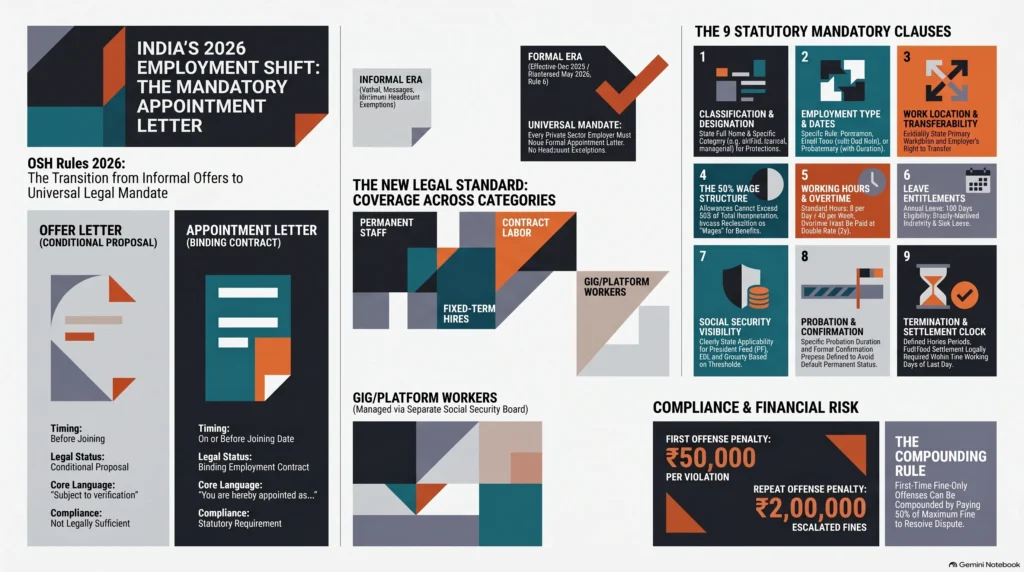
Overview of the Occupational Safety, Health and Working Conditions Rules, 2026
The OSH Code, 2020 folds 13 older central laws, among them the Factories Act 1948 and the Contract Labour Act 1970, into one statute. Under the earlier regime, 620 sections and 868 rules governed workplace conditions across those thirteen laws. The consolidated Code trims this down to 143 sections and 175 rules, replaces six separate registrations with one, and cuts twenty-one different returns into a single electronic filing
One duty sits near the top of the employer’s list under this Code: give every employee an appointment letter that states their designation, category, wages, and social security cover. That single duty, spelled out in far more detail in Rule 6 of the Central Rules notified under this Code, is what the rest of this guide walks through.
Why the Government Made Appointment Letters Mandatory for All
Before the codes, an unwritten job was legal across most of the private sector, whatever a worker had actually been promised at the interview. Standing Orders, the closest thing to a documentation requirement under the old Industrial Employment (Standing Orders) Act, 1946, applied only where 100 or more workers were on the rolls, a bar the new Industrial Relations Code has since raised to 300. Everyone below that line- daily wage earners, small shop staff, contract hands, and seasonal labour- had no paper to point to when a dispute arrived. The government’s own account of the OSH Code frames the fix in plain terms: appointment letters cut disputes over pay, hours, and job expectations, and they give a worker something concrete to hold when chasing benefits or contesting an unfair exit.
What is the Rule 6 Mandate? Demystifying the New Law
The End of the “Minimum Headcount” Exemption
Rule 6 of the Occupational Safety, Health and Working Conditions (Central) Rules, 2026 is the specific provision that makes appointment letters non-negotiable, and it applies with no minimum headcount at all. A business with a single employee owes that person the same written letter a listed company owes its five-thousandth hire. That closes a loophole that outlasted decades of smaller labour reform attempts. Other duties under the wider Code still carry thresholds of their own: ten employees for the general OSH registration requirement, twenty for provident fund coverage, twenty for a Grievance Redressal Committee, but the appointment letter itself answers to none of them.
Who is Covered? (Permanent, Fixed-Term, Contract, and Gig Workers)
The letter is owed to permanent staff, fixed-term hires, daily-wage workers, and contract labour supplied through a contractor alike; the Code draws no separate, lighter duty of care for contract or migrant workers. Fixed-term employees get their letter directly from the employer rather than through a staffing intermediary, and they now qualify for gratuity after a single year on the job instead of the old five-year.
Gig and platform workers sit outside this specific letter requirement. Their work runs through an app-mediated, task-by-task relationship rather than conventional employment, so the Code on Social Security instead builds them a separate safety net, funded by a cess of one to two percent on aggregator turnover and capped at five percent of what platforms pay out to workers. That distinction matters for anyone driving for a ride-hailing app or delivering for a food platform: the protection exists, but it arrives through a welfare board and a registered gig-worker ID, not through a letter with a designation and a probation clause on it.
How This Impacts Traditional, Informal, and Semi-Organized Sectors
Small workshops, retail counters, and family-run units that never issued paperwork now carry the same duty as a multinational’s Bengaluru office. A tailoring unit, a neighbourhood pharmacy, a three-person accounting practice, a roadside logistics desk: size no longer buys an exemption.
Businesses that scaled quickly on verbal hiring face the widest gap, since a template written for a ten-person team rarely holds once headcount triples without anyone revisiting the paperwork. Reviews built for the old, threshold-based system, the kind that let a nine-employee shop skip formal documentation entirely, need a full rewrite rather than a patch, because the letter itself, not the establishment’s size, is now what triggers the obligation.
Offer Letter vs. Appointment Letter: The 2026 Distinction
Why an Offer Letter is No Longer Legally Sufficient
An offer letter proposes a job. It states a CTC figure and a designation, with a start date attached, and it usually hedges everything with a line such as “subject to background verification.” None of that creates the binding relationship the law now requires. Courts and labour officers look to the appointment letter, issued once someone has actually joined, as the record of what employment terms were agreed. A company that only ever sent an offer email has, on paper, no employee at all, only a candidate who accepted a proposal.
The Legal Weight of the Formal Appointment Letter
Where an offer letter is a conditional proposal, the appointment letter is the contract itself, and its statutory terms hold regardless of what the document does or doesn’t say. Miss a clause the law requires, and the gap doesn’t excuse the employer; the statutory minimum simply fills it in, letter or no letter. In a dispute, an employer with no appointment letter has no evidentiary footing at all: no proof of what was promised, no probation clause to point to, no notice terms to rely on.
Transitioning from “Subject to Verification” to “Hereby Appointed”
The language itself gives the difference away. An offer letter hedges: “subject to,” “pending,” “conditional upon.” An appointment letter commits: “we hereby appoint you,” written in the present tense of an already-existing relationship rather than the future tense of a maybe. HR teams that still send a single hedged email and call the hiring done are, functionally, running pre-2025 hiring practice on a 2026 statute book.
| Parameter | Offer Letter | Appointment Letter |
| When it is issued | Before the candidate joins | On or after the date of joining |
| Legal status | A conditional proposal | A binding employment contract |
| Typical language | “Subject to background verification” | “You are hereby appointed as…” |
| What it must cover | CTC, designation, and start date | All nine mandatory clauses: wages, hours, leave, probation, notice, and social security |
| If it is the only document on file | Employer has no proof of agreed terms | Statutory minimums apply automatically either way |
The 9 Mandatory Clauses Every 2026 Appointment Letter Must Contain
Rule 6 does not leave the content of the letter to an employer’s discretion. Nine elements have to appear in writing, before or at the point of joining.
1. Employee Name, Designation, and Classification
The letter must carry the employee’s full legal name and exact designation, plus a classification- skilled, semi-skilled, unskilled, supervisory, managerial, or clerical- that decides which parts of the Code apply to them. Getting this wrong carries real cost: labelling a delivery coordinator a “consultant,” or a supervisor drawing under ₹18,000 a month “managerial,” to sidestep worker protections is misclassification, and it exposes the employer to penalty once discovered.
2. Date of Joining and Employment Type (Permanent, Probation, Fixed-Term)
The letter has to state exactly when employment starts and which category it falls under: permanent, fixed-term, or probationary. A fixed-term contract also needs a stated end date; an open-ended engagement without one defaults to permanent status in the eyes of a labour court, whatever the employer intended at hiring. If probation isn’t written down as its own category with its own duration, the worker is treated as confirmed from day one, which strips the employer of the shorter notice period probation would otherwise allow.
3. Primary Place of Work, Remote Work Policies, and Transferability
The base location has to be named, along with whether the company can transfer the employee elsewhere. Firms running hybrid or fully remote roles should say so directly rather than leave it implied, since a letter silent on remote work gives the employer no documented basis to later demand office attendance, or to refuse it. A transfer clause, where included, needs to be specific enough to survive a challenge, naming a city or region the company might move the employee to, rather than an open-ended “anywhere the company decides.”
4. The 50% Wage Rule: Breaking Down CTC, Basic Salary, and Allowances
This is the clause most templates still get wrong, largely because it carries language written before the codes existed. Under Section 2(y) of the Code on Wages 2019, where items such as house rent allowance, conveyance, and other allowances (excluding gratuity and retrenchment compensation) together exceed 50 percent of total remuneration, the excess is added back into “wages” for the purpose of calculating PF, gratuity, and overtime.
In practice, this pushes basic pay toward roughly half of gross salary or higher; a CTC built as 20 percent basic and 80 percent allowances no longer shrinks statutory dues the way it once did. Performance incentives, ESOPs, and reimbursements sit outside the wage definition and don’t count toward that 50 percent line
5. Working Hours, Shift Structures, and Overtime Compensation
Standard hours are eight a day and forty-eight a week. The Code allows compressed schedules, twelve-hour shifts across a four-day week, or 9.5-hour days across five, with the worker’s written consent. Any hour worked beyond the daily limit has to be paid at double the ordinary rate, not time-and-a-half, and a letter that quotes 1.5x for overtime is stating a figure the Factories Act and OSH Code both override the moment a dispute lands. Night work for women is permitted, with their consent and employer-arranged safety measures.
6. Statutory Leave Entitlements and Public Holidays
Paid annual leave now kicks in after 180 days worked in a calendar year, down from the older 240-day bar. The letter should list earned leave, casual leave, sick leave, and maternity leave (twenty-six weeks for eligible women employees under the Social Security Code) as separate lines, along with how many days carry over and whether unused leave is paid out at exit.
7. Social Security Coverage (PF, ESI, Gratuity, Maternity Benefits)
This clause should state plainly whether Provident Fund and ESI apply to a given employee, and at what rate, rather than leaving a new joiner to work it out once the first payslip lands. Where an establishment sits close to the twenty-employee line that triggers mandatory PF coverage, the letter should say so, since that headcount can shift within months of a new hire signing on. PF applies once an establishment crosses twenty employees, contributed at 12 percent of basic pay from each side in standard practice, split further into 8.33 percent toward the Employees’ Pension Scheme, capped at ₹1,250 a month, with the balance credited to the PF account itself. ESI applies at ten employees in most states, for anyone earning up to ₹21,000 a month gross, at a 0.75 percent employee share and a 3.25 percent employer share. Gratuity stays a five-year benefit for permanent staff but drops to a one-year, pro-rata entitlement for fixed-term employees.
8. Probation Period Terms and Confirmation Processes
State the exact length of probation, typically three to six months, the notice period that applies during it, and how confirmation gets communicated in writing rather than by default silence. This single clause decides real labour disputes: an employer with no written probation term loses the argument that a three-month exit was a probationary termination rather than the dismissal of an already-confirmed employee, and with it, the shorter notice and lighter compensation probation would have allowed.
9. Notice Period, Termination Rules, and Exit Formalities
The letter needs separate notice periods for probation and confirmed service, grounds for termination, and the disciplinary steps, a warning followed by a show-cause notice at minimum, that have to precede dismissal for misconduct. It should also name the settlement timeline: full and final dues, under Section 17 of the Code on Wages 2019, are due within two working days of the last working day, not the next payroll cycle. A letter that still promises “45 days” for settlement is quoting a rule the statute has already replaced.
Deep Dive into the 50% Wage Rule (Code on Wages 2019 Integration)
Understanding How Basic Pay Impacts Your CTC Under the New Codes
Take a package with a ₹46,250 gross monthly salary: ₹25,000 basic, ₹10,000 house rent allowance, and the remainder split across special and conveyance allowances. Basic sits at 54 percent of gross, which clears the bar. Now picture the same ₹46,250 structured as ₹18,000 basic with the rest in allowances: basic falls under 39 percent, allowances cross the 50 percent ceiling, and under Section 2(y) the excess gets added back into the wage base used to work out PF, gratuity, and overtime. The take-home figure on the offer sheet can look near-identical either way; what changes is the statutory floor sitting underneath it.
Why Employers Can No Longer Hide Pay in “Allowances”
For years, a common way to shrink PF and gratuity liability was to load a salary structure with special allowances and keep basic pay low, since PF runs on basic, not gross. That workaround is largely closed now. Once allowances cross the halfway mark of total pay, the excess counts as wages regardless of which line item it sits under on the payslip. Relabelling a slice of salary “special allowance” no longer moves it outside the reach of PF or gratuity arithmetic.
The Impact on Your PF Contributions and Final Gratuity
A higher wage base under the 50 percent rule raises PF contributions on both sides, and it raises gratuity accrual too, since gratuity runs on fifteen days’ wages for every completed year of service, capped at ₹20 lakh under the current notification. For an employee on ₹25,000 basic, that works out to roughly ₹14,400 in gratuity accrual for each year served. The math runs on the standard 4.81 percent accrual convention used across Indian payroll practice. Multiply that ₹14,400 across a workforce of any real size, and the shift from allowance-heavy to basic-heavy pay structures turns into a budgeted cost rather than a rounding error.
What Private Sector Employees Stand to Gain
Increased Transparency and Protection Against Exploitation
A written letter closes the gap between what a candidate was told at hiring and what an employer later claims was agreed. Wages, designation, hours, and social security coverage sit on record from day one, in the employee’s own hands rather than an HR file the employee never gets to see. That single change removes most of the room a bad-faith employer previously had to shift terms after the fact. It also matters for people applying for a personal loan, a rental agreement, or a visa, situations where a bank or landlord asks for proof of employment and a verbal job offer simply won’t do.
Clearer Dispute Resolution and Grievance Mechanisms
Establishments with 20 or more workers must run a Grievance Redressal Committee, with equal representation from workers and management and a women’s presence proportionate to the workforce, and the committee has to close out a complaint within thirty days of filing. That gives an employee a documented, time-bound internal route before any dispute has to reach a labour officer or a court at all. A worker who has never heard of the committee at their own workplace has grounds to ask HR to name it, since its existence is not optional once headcount clears twenty.
Guaranteed Visibility into Social Security and Healthcare (ESIC) Entitlements
The letter has to spell out ESI cover where it applies, and ESI itself carries six distinct benefit types: sickness pay, maternity benefit, disablement payments, a dependents’ benefit for an employee’s family after a fatal workplace injury, medical treatment, and funeral expenses. An employee who knows, in writing, that ESI applies to them is in a far stronger position to actually claim these benefits than one who only finds out during a medical emergency, when the last thing anyone wants to do is chase down paperwork.
Red Flags: What Shouldn’t Be in Your Appointment Letter
Vague Termination Clauses and Lack of Buyout Formulas
“Notice period as per company policy,” with no number attached, is not a notice period at all under ordinary contract principles; it is unenforceable for want of a specific term. Watch for the same vagueness around buyout: a letter should state the exact formula for paying salary in lieu of notice, not leave it to “management discretion” after the fact. If termination grounds are listed only as “any reason the company deems fit,” that phrase alone is worth a question before signing, since it strips out the disciplinary process the law otherwise requires before a dismissal for cause. A well-drafted letter names specific grounds, misconduct, poor performance following a documented review, redundancy, or a serious breach of policy, and sets out a specific procedure for each rather than one catch-all line.
Overly Broad or Unreasonable Non-Compete Clauses
A clause barring an employee from working anywhere in the same industry for two years after leaving is, under Section 27 of the Indian Contract Act, 1872, void the moment it is tested in court. Indian law treats restraint of trade after employment ends as unenforceable, full stop, regardless of how the clause is worded or what consideration the employer offered for it. Its presence in a letter isn’t itself illegal, but no one should be talked out of a job change by a clause that, if actually challenged, almost certainly wouldn’t survive.
Ambiguous Working Hours or Unpaid Overtime Expectations
A letter that states hours only as “as per business requirements,” with no daily or weekly cap named, leaves the door open to unpaid extra hours that the OSH Code’s eight-hour, forty-eight-hour standard exists to prevent. Overtime pay quoted at anything less than double the ordinary rate, or described as “compensatory time off only,” contradicts the statute outright. Either detail is worth raising with HR before the letter is signed, not after the first unpaid late night at the office.
Employer Non-Compliance: What Are the Penalties?
Fines and Legal Consequences for Failing to Issue a Compliant Letter
Under the OSH Code, a first offence for failing to issue a compliant appointment letter can draw a fine of up to ₹50,000; a repeat offence can reach ₹2,00,000. Many offences that once carried the threat of imprisonment have been decriminalised into civil penalties, and a first-time, fine-only violation can be compounded by paying half the maximum fine, while an offence carrying both fine and imprisonment can be compounded at 75 percent of the maximum. Where a violation causes serious injury or death, courts can direct that at least half of any fine imposed go to the victim or their family as compensation, on top of the penalty itself.
| Violation | Consequence |
| No appointment letter, first offence | Fine up to ₹50,000 under the OSH Code |
| No appointment letter, repeat offence | Fine up to ₹2,00,000 under the OSH Code |
| Fine-only offence, compounded | Payable at up to 50% of the maximum fine |
| Fine-or-imprisonment offence, compounded | Payable at up to 75% of the maximum fine |
| Serious injury or death from a violation | Court may direct 50% of the fine to the victim or family as compensation |
| Late PF remittance (a separate violation) | 12% annual interest under Section 7Q, plus tiered damages of 5–25% under Section 14B of the EPF Act |
State vs Central Rules: Navigating Different Jurisdictions
The Central Rules notified in May 2026 apply only where the central government is the “appropriate government,” broadly speaking, public sector undertakings, railways, mines, ports, banking, and insurance. For most private employers, factories, plantations, IT firms, retail chains, and hospitality businesses among them, it is the state government’s own rules that govern. States are legislating on their own timeline, and some have gone further than the Centre already has. Haryana’s Shops and Commercial Establishments Ordinance, in force since 12 November 2025, added its own Section 20A requiring an appointment letter that carries the employee’s photograph and a signed acknowledgment of receipt, on top of a separate mandatory identity card under Section 20B. An employer with offices in more than one state cannot assume that a single national template clears every state-level bar.
How to Report Non-Compliance or Demand a Statutory Appointment Letter
An employee who hasn’t received a letter can raise it directly with the establishment’s Inspector-cum-Facilitator, whose name and address the employer is separately required to display on the workplace notice board. Formal grievances against a government department or public employer can go through the Centralised Public Grievance Redress and Monitoring System at pgportal.gov.in, and a worker can separately use the National Career Service portal at ncs.gov.in to check registered establishments in their area. For anyone denied information about their own employment records, an RTI request filed at rtionline.gov.in remains an option against government and public-sector employers.
How to Review Your 2026 Appointment Letter Before Signing
A Step-by-Step Checklist for New Hires
Before signing, run the letter against a short list:
- Full name, designation, and category are what was discussed at the offer stage
- A specific date of joining and a named employment type: permanent, fixed-term with an end date, or probationary with a stated duration
- Basic salary at or near half of gross pay, not buried under a stack of allowances
- Working hours capped at eight a day and forty-eight a week, with overtime at double pay
- PF, ESI, and gratuity applicability stated in writing, not left for a new hire to discover once the first payslip lands
- A notice period expressed in a specific number of days, for both probation and confirmed service
- A full and final settlement timeline of two working days, not “next payroll cycle”
Verifying the Company Details (CIN, GSTIN, Registered Address)
A genuine appointment letter carries the employer’s Corporate Identification Number and registered address on the letterhead itself. The CIN can be checked at no cost on the Ministry of Corporate Affairs portal, which confirms whether the company is actually registered and active rather than dissolved or struck off. A GSTIN, where the employer is GST-registered, can be verified the same way through the GST portal. A letter with no CIN, no registered address, or a mismatch between the company name on the letter and the one that turns up in either search is worth a direct question before joining. The same check is worth running if the appointment letter names a different entity from the one that sent the original offer, which happens more often than most candidates expect at companies that hire through a holding structure or a separate payroll entity.
Understanding Confidentiality, NDA, and Intellectual Property Clauses
Confidentiality clauses hold up in Indian courts when they name specific categories of protected information, client lists, pricing, and trade secrets among them, rather than declaring everything about the company off-limits forever. An IP assignment clause, common in technology and creative roles, transfers ownership of work created during employment to the company; this is standard and enforceable under the Copyright Act 1957, and it’s worth confirming it doesn’t reach backward to personal projects built before joining. Non-solicitation clauses, unlike non-competes, do hold up in court when they’re narrow: tied to specific clients an employee actually worked with, and capped at around twelve months.
The Future of Indian Employment Contracts
Digital Onboarding and Electronic Signatures
A digitally signed appointment letter carries the same legal weight as a wet-ink one under the Information Technology Act, 2000, and an Aadhaar-based eSign or a Digital Signature Certificate satisfies the requirement. Email delivery with a digital signature is acceptable too, which matters for a company hiring across several cities without a single HR desk to process paper.
The Role of HR Tech in Maintaining Compliance
Payroll and HR software built after November 2025 increasingly checks the 50 percent basic rule the moment a salary structure is entered, flagging a package before it goes out rather than after an inspector finds it. The same tools tend to tie PF and ESI filing deadlines, both due by the 15th of the following month, to automatic reminders rather than a manager’s memory. For a growing company, this kind of tooling turns compliance from an annual scramble into a monthly habit that nobody has to remember to start.
Long-term Impacts on India’s Private Sector Workforce
A workforce with documented terms from day one changes the shape of labour disputes over time: fewer arguments over what was promised, more over whether what was promised was actually honoured. It also builds a paper trail that, over years, gives analysts and policymakers a clearer read on real wage structures and job categories across the informal and formal economy alike, something verbal hiring never allowed. Whether enforcement keeps pace with the rule, especially among the smallest employers with the least HR capacity to adapt, is the open question the next few years of rollout will answer. Most state labour departments are still hiring and training the inspectors who will actually check compliance on the ground, and that staffing gap, more than the wording of the law itself, is likely to decide how quickly the smallest workplaces fall in line.
Securing Your Professional Rights in 2026
Summary of the 2026 Employment Paradigm Shift
Four codes replaced twenty-nine older laws. Appointment letters moved from a courtesy to a Rule 6 obligation with no headcount floor. Wages gained a firm definition that closes the old allowance loophole, and full and final settlement moved from “whenever payroll gets to it” to a fixed two-day clock. Each of these lands on the same document: the appointment letter a worker holds from their first day on the job.
Final Advice for Job Seekers and Active Employees
Read the letter before signing it, not after. Check the nine clauses against what you were told at the offer stage, check the basic-to-gross ratio, and check that PF, ESI, gratuity, and notice terms are named rather than implied. If you’re already employed and never received one, you’re entitled to ask for it now; the obligation didn’t expire when your onboarding week ended, and neither did your right to a document with your name on it.
Frequently Asked Questions: Mandatory Appointment Letter
Yes, under Rule 6 of the OSH Rules 2026, issuing a formal appointment letter is legally mandatory for every employee. There is no minimum headcount exemption; whether a business employs one person or five thousand, the legal obligation remains exactly the same.
An offer letter is merely a conditional proposal typically issued before joining. Under the 2026 codes, it carries no binding legal weight. An appointment letter is the binding employment contract issued upon joining, which must legally contain nine mandatory statutory clauses outlining wages, probation, and social security.
Under the Code on Wages 2019, allowances (like HRA and conveyance) cannot exceed 50% of your total remuneration. If they do, the excess amount is automatically added back into your basic wage base. While this may slightly reduce monthly take-home pay, it significantly increases the employer’s mandatory Provident Fund (PF) and gratuity contributions, building long-term wealth.
Absolutely. Employers can execute these documents using a Digital Signature Certificate or a government-verified eSign. Under the Information Technology Act, 2000, electronic delivery carries the exact same legal weight as a traditional wet-ink signature.
Fixed-term and contract workers supplied through agencies are legally entitled to standard appointment letters detailing their specific terms. However, gig and platform workers are classified differently; they receive protections via a registered ID and welfare board under the Social Security Code, rather than a traditional employment letter.




Leave a Reply