
RBI FCNR(B) Deposit Scheme 2026: New Interest Rates and Deadlines Explained

Navigating the RBI FCNR(B) Deposit Scheme 2026 Deadline and Rate Changes
The Reserve Bank of India shut its FCNR(B) swap window 19 days early. Deposits mobilised under the special dollar-rupee facility had to land by August 31, 2026, not the original September 30 cutoff, after banks pulled in more than double the money the RBI had budgeted for inside two months. The same facility also covers external commercial borrowings and overseas foreign currency borrowings raised by banks, though those two legs stayed open on their original timeline; only the FCNR(B) deposit leg got cut short. Herein, the issue of the RBI FCNR(B) deposit scheme 2026 assumes significance.
For an NRI weighing a foreign-currency deposit right now, the practical questions are narrower than the policy story: what rate can you actually lock in today, does a bank still owe you the special-window terms if you book this week, and does the math survive once your home country taxes interest that India doesn’t. This piece works through the timeline, the current bank-by-bank rates, the rules attached to deposits opened inside the window, and the tax mechanics that follow the money home.
At A Glance: RBI FCNR(B) Deposit Scheme 2026
· Advanced RBI Deadline: The Reserve Bank of India abruptly pulled the special swap window deadline forward to August 31, 2026 (originally September 30), halting the zero-ceiling interest rate subsidy after a massive surge of $127.23 billion in FCNR(B) inflows.
· Revised Bank Interest Rates: Current 3-5 year USD FCNR(B) deposit rates vary drastically across lenders, with HDFC, ICICI, and Axis Bank offering 6.00%, smaller lenders like AU Small Finance Bank peaking at 7.10%, and SBI dropping as low as 3.35%.
· Strict Lock-In Rules & Penalties: All FCNR(B) accounts carry a mandatory 12-month lock-in period that yields zero interest if broken early; specific deposits booked during the special window may also face a flat 1% premature withdrawal penalty depending on the bank.
· Global NRI Tax Implications: While FCNR(B) interest is fully tax-exempt within India, US and UK NRIs are liable for global taxation in their resident countries and must strictly comply with mandatory FATCA and FBAR reporting requirements.
· FCNR(B) vs. NRE Deposits: Unlike NRE fixed deposits, FCNR(B) accounts are held in the original foreign currency (USD, GBP, EUR, AUD, etc.), offering long-term savers complete protection against rupee depreciation and currency exchange risk.
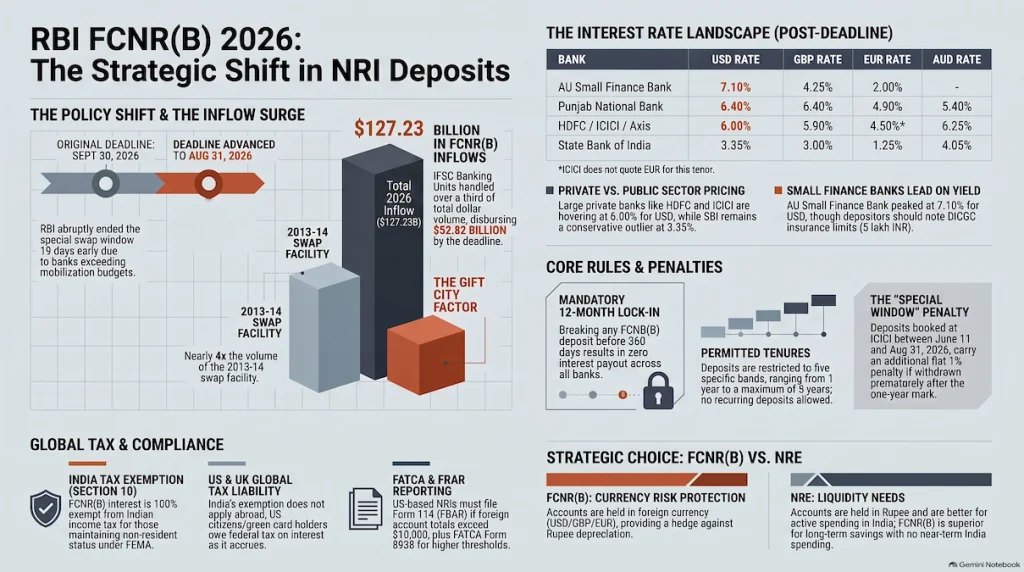
The Sudden Shift: Why RBI Advanced the FCNR(B) Deadline to August 2026
Two separate RBI moves sit inside this story, and mixing them up is the easiest way to misread the policy. One is the swap facility itself, a temporary window where the RBI takes on banks’ fresh FCNR(B) dollars in exchange for rupees. The other is a temporary lifting of the interest-rate ceiling that normally caps what banks can pay on that same class of deposit. Both were dated to end on September 30, 2026. Both got pulled forward to August 31.
The Original Purpose of the June 2026 Forex Swap Facility
The RBI Governor’s policy statement on June 5, 2026, first flagged the plan, and the RBI’s Financial Markets Operations Department made it formal three days later, through circular FMOD.MAOG.No.S-56/01.06.016/2026-27, better known by its notification number, RBI/2026-27/99, dated June 8, 2026. Banks could sell the RBI dollars raised through fresh FCNR(B) deposits, three-to-five-year tenors only, at a contracted rate, then buy them back at maturity. The stated aim, laid out to Parliament the same week, was to pull in stable foreign currency and cushion the balance of payments, taking some of the pressure off the rupee in the process.
The mechanics run through the RBI’s own balance sheet. As fresh FCNR(B) dollars get swapped for rupees in the first leg of each transaction, both the RBI’s forex reserves and banking-system liquidity rise together; the second leg unwinds that same amount when the swap matures. How large that temporary increase actually turns out to be depends entirely on how much foreign currency banks manage to mobilise during the window, which is exactly why the pace of inflows became the story that mattered. The government told Parliament it couldn’t put a fixed number on what the subsidy would end up costing the RBI, since that depends on the volume of dollars swapped, the tenor of each individual swap, and the exchange rate and forward premia in force at the moment each swap was struck.
A second lever moved alongside the swap itself. From June 17, 2026, the RBI temporarily lifted the interest-rate ceiling that otherwise caps FCNR(B) pricing on three-to-five-year deposits at the Overnight Alternative Reference Rate, or the relevant swap rate, plus 350 basis points, and it lifted a matching cap on three-year-plus NRE deposits. Both relaxations were written to expire on September 30, 2026. A third piece completed the package: banks got a Cash Reserve Ratio and Statutory Liquidity Ratio exemption on the same qualifying FCNR(B) deposits (from June 8) and NRE deposits (from June 19), which meant this fresh money didn’t sit locked up against the usual reserve requirements.
The Surge in Dollar Inflows and the Early Closure
By August 13, 2026, banks had reported $56.85 billion moving through the facility across all three eligible instruments, FCNR(B) deposits, external commercial borrowings and overseas foreign currency borrowings, of which FCNR(B) deposits alone accounted for $52.3 billion.
That was the trigger. On August 14, the RBI announced that, given “the encouraging response to the Swap Facility for FCNR(B) deposits and the resultant forex inflows,” the FCNR(B) leg would close for fresh mobilisation on August 31, 2026, nineteen days sooner than planned. Banks were given until September 11, 2026, to actually settle the swap with the RBI. The ECB and OFCB legs kept running to their original December 31, 2026 finish line.
| Reporting date | Total swap-facility inflow | Of which, FCNR(B) deposits |
| August 13, 2026 | $56.85 billion | $52.30 billion |
| August 31, 2026 (final) | $136.38 billion | $127.23 billion |
Provisional figures reported by Authorised Dealer banks under the Swap Facility. Source: RBI press releases dated August 14 and September 2, 2026.
The final tally, published September 2, showed $136.38 billion moving through the facility by August 31: $127.23 billion in FCNR(B) deposits, $5.26 billion in OFCBs and $3.89 billion in ECBs. GIFT City did a large share of the heavy lifting on the disbursement side. Twenty IFSC Banking Units had sanctioned $54.02 billion and disbursed roughly $52.82 billion by August 31, scaling up from $28.60 billion sanctioned on August 14 to $37.26 billion a week later, pulling capital in from the United Kingdom, the United States, Mexico, West Asia, Hong Kong, Singapore and several African jurisdictions. The Finance Minister had separately directed public-sector bank chiefs to route more of this business through GIFT City’s banking units, which goes a long way toward explaining why GIFT-based banking units alone ended up handling well over a third of the facility’s entire dollar volume.
Parliament’s own figures for the middle of the window show where that money came from. System-wide FCNR(B) balances at Authorised Dealer banks grew from $32.56 billion on June 5 to $60.55 billion by July 30, before the final surge. Standard Chartered went from a standing start of zero to $1.86 billion. ICICI Bank’s book very nearly tripled over the same stretch, from $2.37 billion to $6.06 billion, and HSBC did even better in percentage terms, climbing more than fiftyfold from a mere $120 million to $6.26 billion. SBI added the single largest absolute amount of any bank, $4.12 billion, taking its book from $9.70 billion to $13.82 billion.
The participation ran well beyond the handful of banks that usually dominate NRI banking headlines. Punjab National Bank’s book more than tripled, from $430.87 million to $1.40 billion. Indian Bank and RBL Bank posted similarly sharp jumps, the former rising from $509.54 million to $1.35 billion and the latter from $256.88 million to $813.56 million. Even niche and regional lenders, from Bank of Bahrain and Kuwait to smaller co-operative banks, show up in the RBI’s bank-wise breakdown, which suggests the window pulled in participation across the deposit-taking system rather than sitting concentrated at the five or six banks that dominate the rate comparisons below.
How the Hedging Cost Subsidy Worked for Banks
Foreign-currency deposits normally cost a bank something to hedge, roughly 2.8 to 3 percent in ordinary market conditions. The 2026 swap structure moved that cost onto the RBI’s books instead, and paired it with the CRR and SLR exemption described above. A bank taking in fresh FCNR(B) money under the window carried none of the usual hedging drag and didn’t have to lock a slice of it away against reserve requirements. Both savings had somewhere to go: straight into the rate offered to the depositor, which is the direct mechanical reason USD FCNR(B) pricing on three-to-five-year paper jumped toward six and seven percent at several banks within weeks.
A third incentive sat underneath the first two. Advances a bank funds against this fresh FCNR(B) or NRE money are excluded from the Adjusted Net Bank Credit base used to work out that bank’s priority-sector lending targets, the same treatment RBI applied to the equivalent 2013-14 swap deposits. That’s a smaller detail than the rate ceiling or the reserve-ratio exemption, but it meant banks had one less reason to treat this fresh foreign-currency money as a compliance burden while they were racing to book it.
RBI ran a version of this playbook once before, during the 2013 taper-tantrum currency crisis, when a similar swap facility pulled in $34 billion and added $12 billion to reserves even though banks still absorbed a hedging cost of roughly 3.5 percent under that older, capped subsidy. The 2026 window removed that friction outright. Banks kept the full benefit, which analysts point to as the working explanation for why 2026’s mobilisation ran to roughly four times the 2013 figure.
Impact on Depositors: Revised FCNR(B) Interest Rates (September 2026)
Every bank surveyed below still quotes USD FCNR(B) rates well above where they sat before June 2026, though how far above varies sharply by lender. The table sets out current three-to-four-year rates across four major currencies at a spread of banks, from the smallest to the largest FCNR(B) book in the country.
| Bank | USD | GBP | EUR | AUD |
| AU Small Finance Bank | 7.10% | 4.25% | 2.00% | – |
| Kotak Mahindra Bank | 6.00-6.15% | 3.45% | 1.90% | 3.85% |
| Punjab National Bank | 6.40% | 6.40% | 4.90% | 5.40% |
| HDFC Bank | 6.00% | 5.90% | 4.50% | 6.25% |
| ICICI Bank | 6.00% | 5.90% | – | 6.25% |
| Axis Bank | 6.00% | 5.90% | 4.50% | 6.25% |
| Bank of Baroda | 6.00% | 4.60% | 3.50% | 4.60% |
| State Bank of India | 3.35% | 3.00% | 1.25% | 4.05% |
Indicative rates for three-to-four-year tenors, effective from June 2026 onward. Rates vary by deposit size and change without notice; confirm directly with the bank before booking. Source: https://1finance.co.in/blog/special-fcnr-deposit-rates/
HDFC Bank’s Latest FCNR(B) Rates for 3-5 Year Tenures
HDFC Bank’s three-to-four-year USD rate sits at 6 percent, with 6.25 percent on AUD, 5.90 percent on GBP and 4.50 percent on EUR and CAD over the same tenor, among the higher rates on offer from a large private bank. The bank runs its FCNR(B) book across USD, GBP, EUR, AUD, CAD, JPY and SGD, with digital booking available to existing HDFC customers rather than a mandatory branch visit.
State Bank of India (SBI) Rate Cuts on USD Deposits
SBI is the outlier in the table above, and by a wide margin. Its own published schedule, effective mid-July 2026 and last updated September 1, prices three-to-four-year USD paper at just 3.35 percent, with four-to-five-year money even lower, at 2.95 percent, before ticking back up to 3.05 percent on a full five-year lock. That is roughly half what HDFC, ICICI, Axis and Bank of Baroda are quoting on the same three-to-four-year bucket, and less than half AU Small Finance Bank’s 7.10 percent.
The gap is notable given SBI’s scale. Its FCNR(B) book grew by $4.12 billion during the window’s middle stretch alone, the largest single-bank increase in Parliament’s own data, and it still runs the country’s biggest NRI deposit franchise by a wide margin. SBI simply chose not to pass the full ceiling relief through to three-to-five-year depositors the way its private-sector peers did. On premature withdrawal, SBI pays nothing if the deposit is broken before completing one year; after that, it pays whichever is lowest of the contracted rate, the rate that applied when the account was opened, or the rate currently in force, for the actual period the money stayed with the bank.
ICICI Bank and Axis Bank Adjustments Post-Deadline
ICICI and Axis both price three-to-four-year USD FCNR(B) at 6 percent, in line with HDFC, with Axis quoting a near-zero 0.01 percent on JPY, a reminder of how thin yen deposit returns run given ultra-low reference rates in that currency.
ICICI’s standard premature-withdrawal policy pays no interest before twelve months and, after that point, the contracted rate for the period held, with no separate penalty. Deposits booked specifically inside the special window, June 11 through August 31, 2026, at a three-to-five-year tenor, carry a different rule: a mandatory twelve-month lock-in, and a flat 1 percent penalty on top of the reduced-rate treatment if broken after that lock-in period ends. ICICI has also stopped booking fresh FCNR(B) deposits in Hong Kong dollars from September 1, 2026, and existing HKD deposits will not auto-renew from that point, a bank-specific wrinkle worth checking if that’s the currency in question.
How Smaller Banks are Responding to the RBI Directive
AU Small Finance Bank’s 7.10 percent USD rate is the highest in the comparison table, part of a broader pattern of small finance banks pricing more aggressively than the large private and public lenders to win NRI deposit share. The highest quoted rate isn’t automatically the right choice, though. DICGC deposit insurance covers only up to five lakh rupees per depositor per bank, all deposit types combined, so an FCNR(B) balance above that amount sitting with a smaller institution is an uninsured claim on the bank, not a government-backed guarantee, and that trade-off deserves as much weight as the extra percentage point on the rate card.
On the regulatory side, the deadline pull-forward wasn’t a commercial-bank-only edit. RBI issued near-identical Third Amendment Directions, dated August 25, 2026, across every category of deposit-taking institution: commercial banks, small finance banks, local area banks, regional rural banks and urban co-operative banks, plus a Second Amendment for rural co-operative banks. Each simply swapped “September 30, 2026” for “August 31, 2026” in that category’s 2025 Master Directions, using the same Section 35A powers under the Banking Regulation Act, 1949. Public Sector Banks weren’t uniformly conservative either. Punjab National Bank’s 6.40 percent USD rate actually beats what HDFC, ICICI and Axis are quoting, which cuts against any assumption that the biggest rate cuts came only from the biggest private banks, or that state-owned banks automatically price more cautiously than their private peers on this particular product.
Small finance banks and co-operative banks moved on exactly the same day as the largest commercial lenders, which is why a small player like AU could still be quoting special-window pricing right up to the same August 31 cutoff as SBI or HDFC. The one variation in the batch: rural co-operative banks received only a Second Amendment on August 25, not a Third like every other category, since their Master Directions had one fewer prior revision to begin with. The substance of the change, pulling the date from September 30 to August 31, was identical across every category.
Also Read: How to Claim Unclaimed Bank Deposits (RBI UDGAM): 2026 Guide
Understanding the FCNR(B) Scheme Rules and Regulations in 2026
Away from the headline rates, FCNR(B) runs on a fairly rigid rulebook, most of it unchanged by the 2026 window and worth knowing before any money moves.
Eligible Currencies and Permitted Tenures
An FCNR(B) deposit holds a depositor’s money in its original foreign currency for the full term, with no rupee conversion at any point, which is the feature that sets it apart from an NRE or NRO account. Currency availability varies by bank; across the lenders surveyed here, USD, GBP, EUR, AUD, CAD, JPY and SGD all show up on at least one bank’s list.
RBI’s Master Directions split the permitted term into five tenor bands: one year up to less than two, two up to less than three, three up to less than four, four up to less than five, and a flat five-year option. No bank may accept an FCNR(B) deposit beyond five years, and the scheme doesn’t allow a recurring-deposit version at all. The special zero-ceiling treatment applied specifically to the three-to-five-year buckets, since that’s exactly the band where the RBI lifted the Overnight Alternative Reference Rate-plus-350-basis-point cap. One-to-three-year FCNR(B) paper kept its ordinary ceiling, ARR or swap plus 250 basis points, throughout. Interest compounds every 180 days on a 360-day-year convention, except on one-year paper, which pays simple interest.
RBI’s rules also fence in how banks can compete for this money. No bank may dangle a lottery, prize draw or free trip to win FCNR(B) business, gifts at account opening are capped at 250 rupees, and any advertisement touting a compounded annualised yield has to state the underlying simple annual rate alongside it. That last rule matters when reading rate tables from different banks: an eye-catching “annualised yield” figure is always built from a lower flat rate, and the two numbers aren’t interchangeable when comparing offers.
The Mandatory One-Year Lock-in Period for Special Window Deposits
FCNR(B) carries a hard floor regardless of bank or window: break it before completing twelve months and the bank pays zero interest. That rule sits in RBI’s own Master Directions and shows up identically at SBI and ICICI.
Deposits booked specifically inside the special window carry an extra layer at some banks. ICICI’s terms attach a mandatory twelve-month lock-in to any FCNR(B) deposit booked between June 11 and August 31, 2026 at a three-to-five-year tenor, and a flat 1 percent penalty applies if the deposit is broken after that lock-in but before maturity, on top of the reduced-rate treatment that already applies to early withdrawals. That penalty doesn’t apply to ICICI’s ordinary, non-window FCNR(B) book.
Premature Withdrawal Penalties and Conditions
Two layers apply once the one-year floor has been cleared. RBI’s own rules leave banks discretion to recover their swap cost through a penalty on early withdrawal, but block any penalty where a returning NRI converts the deposit into a Resident Foreign Currency or resident rupee account.
Individual banks fill that discretion differently. SBI pays the lowest of three figures, the contracted rate, the rate in force when the account opened, or the rate currently in force, for the actual period held, with no separate cash penalty on top. ICICI pays the contracted rate for the period held, again without a separate penalty, except for the special-window cohort described above. A loan or overdraft against the FCNR(B) balance is a standard workaround at most banks, letting a depositor raise cash without breaking the deposit at all; the loan-to-value ceiling is bank-specific and worth confirming before relying on it.
Renewal follows its own arithmetic. If a depositor renews within fourteen days of maturity, the bank applies whichever rate was in force on the maturity date or on the renewal request date, whichever is lower. Wait longer than that and the gap between maturity and renewal gets treated as an overdue period, priced separately from the fresh term that follows. On a depositor’s death, the bank pays the contracted rate right through to maturity; if the claim is settled after that date, it adds simple interest at the rate applicable on the maturity date for however long the money sat unclaimed.
Tax Implications: Are FCNR(B) Deposits Truly Tax-Free?
Tax Exemption Status within India (Income Tax Act)
Interest on an FCNR(B) deposit is fully exempt from Indian income tax under Section 10(15)(iv)(fa) of the Income Tax Act, for as long as the holder qualifies as a person resident outside India under FEMA, and regardless of deposit size. No tax is withheld on this interest in India for the same reason.
That status isn’t permanent once residency changes. RBI’s Master Directions let a returning NRI keep an existing FCNR(B) deposit running at its contracted rate until maturity if the bank agrees, but the account is treated as a resident deposit from the date of return, and converts into a resident rupee account or an RFC account once the deposit matures.
The exemption also travels with the account holder’s status, not with the deposit slip itself. It’s the depositor’s residency under FEMA that determines whether the interest stays out of the Indian tax net, which is why the Master Directions build the return-to-India conversion rules around the date of return rather than around the deposit’s own maturity date. A depositor who moves back to India mid-tenor doesn’t lose the exemption retroactively on interest already earned, but the clock on tax-free treatment for that specific account effectively stops running from the day residency changes.
Global Taxation: Calculating After-Tax Yields for US and UK NRIs
India’s exemption stops at India’s border. A US person, meaning a citizen or green-card holder wherever they actually live, owes US federal tax on FCNR(B) interest as it accrues, because the US taxes worldwide income regardless of where it’s earned or how a foreign government treats it.
One worked comparison shows the gap: $100,000 moved out of a three-year US Treasury note yielding roughly 4.5 percent and into a five-year FCNR(B) deposit at HDFC’s current 6 percent rate earns about $1,500 more a year before tax. At a 24 percent federal bracket, US tax narrows that edge to roughly $1,140 a year, still a real gap, though the precise number moves with the depositor’s bracket and state of residence. https://indiamacroindicators.co.in/resources/blogs/fcnr-deposit-rates-2026
A UK-resident NRI runs a parallel calculation under different rules. Whether FCNR(B) interest gets taxed as it arises, or can sit outside UK tax under the remittance basis available to some non-domiciled residents, depends on domicile status and how the funds are used, a question that needs a UK tax adviser rather than a general answer. None of this is tax advice. Run the actual numbers with a chartered accountant who knows both India’s rules and the rules where the depositor actually lives before booking on the strength of the headline rate alone.
FATCA and FBAR Reporting Requirements for FCNR Accounts
An FCNR(B) deposit counts as a foreign financial account for US reporting purposes, exactly like an NRE or NRO account. Once the combined value of a person’s foreign accounts crosses $10,000 at any point in the year, FBAR reporting to FinCEN, via Form 114, becomes mandatory, and FATCA adds a second filing, Form 8938, on top for balances above separate, higher thresholds that vary by filing status and residence.
Missing either isn’t a paperwork slip with a token fine attached. Non-willful FBAR penalties alone can run into thousands of dollars per account per year, and considerably more where the omission is found to be willful. Most other countries of residence run some equivalent foreign-asset disclosure regime; the form and threshold shift by jurisdiction, but the underlying obligation, that opening an FCNR(B) account creates a reporting duty abroad the moment it exists, holds everywhere.
This is separate from, and in addition to, whatever India-side reporting a depositor’s bank already handles. A bank issues an interest certificate confirming the exemption for Indian tax-filing purposes on request, but that certificate has no bearing on a depositor’s obligations at home; the two filing systems don’t talk to each other, and a clean record with one carries no weight with the other.
FCNR(B) vs. Alternative Investment Options for NRIs
FCNR(B) vs. NRE Fixed Deposits in the Current Climate
| Feature | FCNR(B) | NRE | NRO |
| Currency risk | None, held in original currency | High, rupee-denominated | High, rupee-denominated |
| Taxation in India | Fully exempt | Fully exempt | Taxable at slab rate |
| Repatriability | Full and free | Full and free | Restricted, needs documentation |
| Best suited for | Long-term saving with no rupee exposure | Active liquidity for India spending | Managing India-sourced income |
NRE and FCNR(B) both sit outside Indian tax and both repatriate freely, but they solve different problems. NRE holds rupees, so a depositor carries currency risk on the way in and again on the way out, which suits someone actively spending, or planning to spend, in India. FCNR(B) never touches rupees at all, which is the entire point for someone parking savings with no near-term India spending planned.
With USD FCNR(B) rates pushed toward six and seven percent at several banks under the special window, the yield gap between a rupee NRE deposit and a dollar FCNR(B) deposit narrowed enough, at some banks, that the currency protection now comes close to free rather than costing a real rate concession the way it usually does.
NRO sits in a different category altogether and rarely competes directly with the other two for a depositor’s savings. It exists to hold India-sourced income, rent, dividends, a pension, and every rupee in it is taxable at the account holder’s slab rate, with restricted repatriation that needs supporting documentation before funds can move abroad. Someone choosing between FCNR(B) and NRE for genuine savings, rather than managing India-side income, is really choosing between currency protection and rupee liquidity, not between two versions of the same product.
Comparing Indian FCNR Rates to US Treasury Yields
Reduce it to three steps and the arithmetic gets simple: gross FCNR(B) yield, minus India tax, which is zero, minus whatever the depositor’s home country charges, equals the actual return that matters. At the special window’s higher rates, FCNR(B) cleared the after-tax return on a comparable-maturity US Treasury note in the modelled scenario above, though that gap shifts with the depositor’s tax bracket, home state and the path interest rates take over the holding period.
That the comparison landed in FCNR(B)’s favour at all wasn’t an accident of market timing. The government told Parliament that the scheme’s design had weighed interest-rate differentials and expected investor returns against banks’ hedging costs and compliance requirements, meaning the higher rate was built to beat safe-haven dollar alternatives, at least for the length of the window, rather than happening to land there by chance.
Should You Lock In Current Rates or Wait for Future Hikes?
The case for booking now rests on where the higher rate actually came from: a regulatory subsidy tied to a window that has already closed. Deposits booked after August 31, 2026 don’t get the zero-ceiling treatment, so whatever a bank quotes on new bookings is its ordinary, capped FCNR(B) pricing, not the special-window level.
The case for waiting is just as real. A three-to-five-year FCNR(B) deposit locks the exact contracted rate for the entire term with no mid-course repricing in either direction, so the trade is genuinely about a view on where dollar interest rates head over the next several years, not a question with one correct answer.
One thing the decision doesn’t need to weigh is whether the scheme itself carries systemic risk for India. The RBI told Parliament it runs standard risk-identification and mitigation processes around its foreign-exchange reserves regardless of any single scheme, and structured this window as fully temporary rather than open-ended, which is a separate question from whether locking in today’s rate suits an individual depositor’s own plans. This isn’t investment advice, and the right call depends on a depositor’s full financial picture. Work through it with a financial adviser who knows both the India side and the home-country side before acting on a headline number.
Step-by-Step: How to Open or Renew an FCNR(B) Deposit Today
The special window has closed, but FCNR(B) itself hasn’t gone anywhere. Opening one now follows the same standard process banks have always used, just at the ordinary, capped rates described above rather than the window’s terms.
Required Documentation for NRIs and OCIs
The core document set is broadly consistent across banks, though the exact list, and which documents need attestation, shifts by bank and by country of residence:
- A valid passport
- Current visa, work or residence permit, or an OCI or PIO card establishing NRI status
- Proof of overseas address
- PAN card, or a Form 60 declaration where the depositor doesn’t hold a PAN
- Passport-size photographs and the bank’s standard KYC form for a first-time account
Confirm the specific list with the chosen bank before starting; a document accepted for a US-resident NRI opening an account isn’t always the same set a bank asks of someone resident in the Gulf or Southeast Asia. OCI holders typically need the OCI card alongside the older foreign passport it’s linked to, not one document in place of the other, and banks generally ask for either an existing NRE or NRO relationship, or agree to open one alongside the FCNR(B) deposit itself, since a standalone FCNR(B) account without any linked rupee account is uncommon in practice.
The Online Application Process for Major Indian Banks
Most large banks now let an existing NRE or NRO account holder book an FCNR(B) deposit digitally, without a branch visit. SBI runs a dedicated digital NRI account channel, and ICICI lets an existing savings-account customer open an FCNR(B) deposit instantly through net banking, distinct from the separate process for someone opening a first account with the bank. Someone without an existing relationship at the bank typically still completes identity verification through a video KYC call, or through an overseas branch or representative office, before the deposit itself gets booked.
FAQ: RBI FCNR(B) Deposit Scheme 2026
The Reserve Bank of India (RBI) advanced the cutoff date for the special FCNR(B) forex swap facility to August 31, 2026, moving it up from the originally planned September 30 deadline. This early closure was triggered on August 14 after banks mobilised over $127.23 billion in FCNR(B) deposits, vastly exceeding initial forex inflow expectations.
Following the closure of the zero-ceiling subsidy, banks adjusted their rates for 3-to-4-year USD terms. Currently, HDFC Bank, ICICI Bank, and Axis Bank offer up to 6.00%, while AU Small Finance Bank quotes a high of 7.10%. In contrast, State Bank of India (SBI) offers a significantly lower rate of 3.35%.
Interest earned on FCNR(B) accounts is 100% exempt from Indian income tax under Section 10(15)(iv)(fa) of the Income Tax Act for non-residents. However, this exemption does not apply globally; the interest is taxable in your home country of residence (such as the US or UK) and mandates strict FATCA and FBAR reporting compliance.
All FCNR(B) deposits carry a mandatory 12-month lock-in period. If you break the deposit before completing one full year, you will receive zero interest payout. For withdrawals made after one year, banks apply a reduced rate, and special-window accounts (like those at ICICI) may incur an additional flat 1% penalty fee.
An FCNR(B) account is maintained in foreign currency (USD, GBP, EUR), which fully protects your principal from rupee depreciation risk. In contrast, an NRE deposit is converted into Indian Rupees, making it better suited for active local liquidity and spending within India despite carrying currency exchange risk.
Funding Your Account: Best Practices for Remitting Foreign Currency
Fund the deposit with an inward wire sent directly in the same currency as the deposit itself. Routing the transfer through an intermediary currency on the way in adds a conversion spread that quietly eats into the eventual yield, one that direct same-currency funding avoids entirely. Confirm the bank’s SWIFT and routing details before initiating the wire, and keep the remittance purpose code and source-of-funds paperwork the bank asks for on hand, since inward remittances into an NRI account get reported under FEMA regardless of the amount involved. Renewing an existing FCNR(B) deposit is simpler than opening a fresh one, since the bank already holds the KYC paperwork on file. Most banks let an existing customer set standing instructions to auto-renew at maturity into a chosen tenor, or renew manually online within the fourteen-day window that determines which rate applies. Whichever route is used, it’s worth checking the currently quoted rate for the new tenor before letting a deposit roll over automatically, since a renewal is a fresh booking at whatever the bank is offering that day, not a continuation of the old contracted rate.
Disclaimer
The information provided in this article regarding the Reserve Bank of India’s (RBI) Foreign Currency Non-Resident (Bank) [FCNR(B)] Deposit Scheme, interest rates, and associated tax implications is for general informational and educational purposes only. It does not constitute professional financial, investment, legal, or tax advice. While every effort has been made to ensure the accuracy and timeliness of the data presented, regulatory frameworks, bank-specific interest rates, and tax laws in India and foreign jurisdictions (including the United States and the United Kingdom) are subject to frequent change without prior notice. The author and publisher of this content disclaim any liability for financial losses, penalties, or damages incurred directly or indirectly from decisions made based on this material. Readers are strongly advised to consult with certified financial advisors, qualified cross-border tax professionals, and their respective banking institutions before making any investment or repatriation decisions.




Discussion (1)
Leave a Reply