
How to Convert Physical Shares into Demat Format: Complete SEBI Special Window Guide

The 2027 SEBI Special Window: Your Last Chance to Convert Legacy Physical Shares
A share certificate printed on paper cannot be sold or pledged anymore. Handing it down to an heir does not work cleanly either. SEBI closed that door on 1 April 2019, when physical-mode transfers were banned outright. Anyone who bought or sold shares before then and never finished the paperwork has been stuck since. They hold a certificate that confirms ownership. None of the rights that come with it actually work. This is not a small population of holdouts. Listed Indian companies have carried unresolved physical transfers on their books for years, some tracing back to trades from the 1990s, and this is the third special window SEBI has opened to work through that backlog since the original 2019 ban. That alone says something about how persistent the problem is. Herein comes the question of how to convert physical shares into demat format.
SEBI’s Circular No. HO/38/13/11(2)2026-MIRSD-POD/I/3750/2026, dated 30 January 2026, opened a one-year fix for this exact problem. Investors get until 4 February 2027 to complete a transfer-cum-dematerialisation for deeds executed before the 2019 cutoff. Miss it, and there is no telling when another window opens, or whether one does at all. This guide sets out who qualifies and what the paperwork actually requires, then walks through how the process runs end to end.
At A Glance: How to Convert Physical Shares into Demat Format
- SEBI’s Special Window: Open from 5 February 2026 to 4 February 2027 for converting physical shares with transfer deeds executed before 1 April 2019.
- Required Documents: You must submit the original share certificate, transfer deed, valid KYC (Form ISR-1 or ISR-2), attested Client Master List (CML), and an Undertaking-cum-Indemnity bond.
- Mandatory Lock-In: Shares converted under this route are subject to a one-year lock-in period from the date of registration, during which they cannot be sold or pledged.
- 70-Day Processing Timeline: RTAs must process a complete application within 70 days; filing incomplete paperwork restarts this clock and risks missing the 2027 deadline.
- IEPF Risk: Missing the deadline could result in shares being permanently frozen or transferred to the Investor Education and Protection Fund (IEPF) if dividends remain unclaimed for seven years.
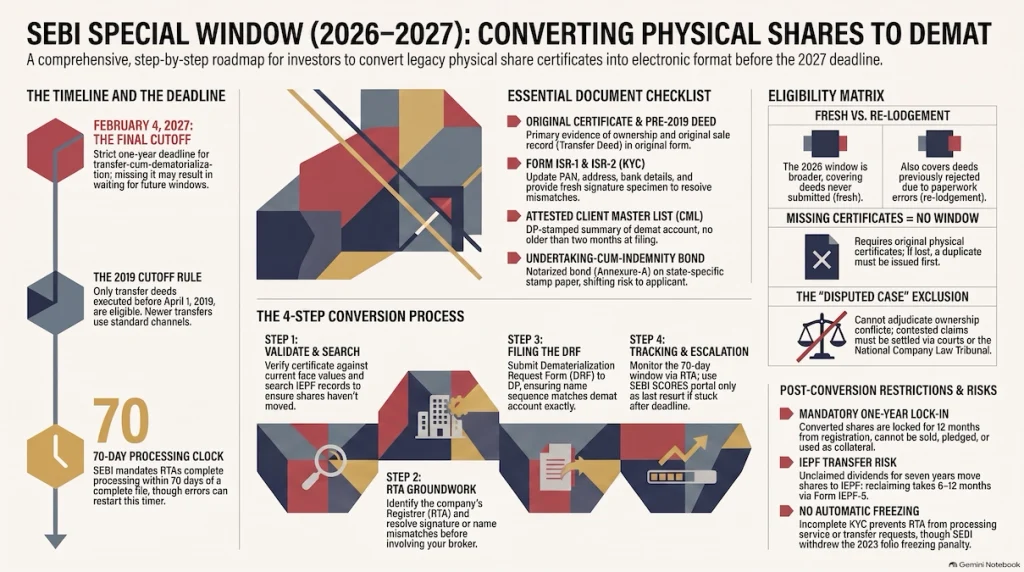
Understanding the SEBI Special Window for Physical Shares (2026–2027)
Three separate SEBI interventions sit behind the window now open, and working through them in order makes the current rules far easier to place.
What is the Transfer-cum-Dematerialisation Framework?
Physical transfers ended on 1 April 2019. From that date, every transfer of listed securities had to happen through a demat account. Investors who had already executed a transfer deed before the cutoff, and lodged it with the company or its registrar, found themselves stranded when that lodgement came back rejected or returned, if it drew any response at all; plenty of others simply sat there, never processed. The seller had moved on. The buyer had already paid, with no route left to finish what had been agreed.
SEBI’s reasoning for the 2019 ban was straightforward. Paper certificates were slow to transfer and easy to counterfeit. Tracing one back to a real, verified owner was not always simple either, and that combination made the physical-holding system a genuine soft spot for the kind of shell-company and benami-holding abuse regulators had spent years chasing. Moving everything into demat form closed that gap. Every completed transfer now sits in a single electronic record that regulators, tax authorities, and companies can all see, rather than in paperwork scattered across thousands of individual registrar files.
A rejected lodgement in that era usually failed for a narrow set of reasons. The signature on the transfer deed did not agree with what the company had on file. A name was spelled differently across the certificate and the buyer’s own identity documents. The certificate itself came back mutilated, or was missing a stamp the RTA needed. None of these were disputes over who actually owned what. They were paperwork failures, and paperwork failures do not resolve themselves; someone has to go back and fix the specific defect that caused the rejection in the first place.
SEBI has opened three windows to fix this, each broader or narrower than the last. A second, narrower window ran from 7 July 2025 to 6 January 2026 under Circular No. SEBI/HO/MIRSD/MIRSD-PoD/P/CIR/2025/97, limited to re-lodgement of deeds that had already failed once.
Also Read: How to Claim Unclaimed Bank Deposits (RBI UDGAM): The Complete 2026 Guide
| Window | Dates | Scope |
| First window | Closed 31 March 2021 | Re-lodgement of deeds rejected or returned before the cutoff |
| Second window | 7 July 2025 to 6 January 2026 | Re-lodgement only, under Circular SEBI/HO/MIRSD/MIRSD-PoD/P/CIR/2025/97 |
| Current window | 5 February 2026 to 4 February 2027 | Re-lodgement and fresh lodgement, under Circular HO/38/13/11(2)2026-MIRSD-POD/I/3750/2026 |
The current window is the broadest of the three. It covers fresh lodgement as well as re-lodgement: transfer deeds executed before April 2019 that were never submitted at all. SEBI’s circular carves out a narrow exception to the demat-only transfer rule for exactly this situation, provided the underlying deed predates April 2019. Shares move directly into the transferee’s demat account under this route; there is no intermediate physical reissue at any point.
The mechanics run through the same two participants as ordinary dematerialisation. A Depository Participant receives the paperwork. The company’s Registrar and Transfer Agent verifies it against the shareholder register. What differs is the extra documentation this window demands, and the fact that the transfer itself has to be registered, in addition to the demat conversion. Both get covered further down.
The February 4, 2027 Deadline Explained
The date is exact: 4 February 2027, one year to the day after the window opened. The 2025 window ran six months. This one runs a full twelve, double the runway its immediate predecessor gave investors.
What happens after that date is the part most coverage skips. Nobody at SEBI has committed to a fourth window. The pattern so far explains why that matters: the first window closed in March 2021, and nothing replaced it until July 2025, a gap running past four years. The second window closed in January 2026, and the current one opened barely a month later. There is no formula behind the timing, no promise of continuity. A regulator reopens the door when it decides to, on its own schedule.
That unpredictability is the real argument for filing now rather than waiting. The 70-day processing clock, covered under Step 4 below, only starts once your paperwork is complete. The one-year lock-in that follows only starts once the transfer is actually registered. File in December 2026 with a file that still needs fixing, and by the time everything clears, gets processed, and finishes its lock-in, 2028 has arrived before the shares are genuinely yours to sell.
Put dates on it, and the arithmetic gets concrete. A genuinely complete application filed in March 2026 could be registered within about ten weeks, sometime in May, with the one-year lock-in then running out around May 2027. File in December 2026 instead, close to the deadline, and the 70-day clock alone can push registration into February or March 2027, after the window has already shut, with the lock-in then stretching on into 2028. The window only decides how long you have to file. It says nothing about how long the shares stay locked once you do, and that second clock only gets longer the closer to 4 February 2027 the filing happens. What happens to a timely filing whose processing slips past the deadline is not something SEBI’s circular addresses directly either, which is one more reason not to test it.
Also Read: RBI’s New Ban on Loan Bundling 2026: Your Rights When Banks Demand Insurance
Eligibility Criteria for Dematerialising Physical Certificates
Two conditions decide whether a holding qualifies, and a third rules it out no matter what the first two say.
Pre-April 2019 Transfer Deeds
The transfer deed itself, the physical document recording the sale from one party to another, has to have been executed before 1 April 2019. A deed signed after that date has no path through this window. That transfer should have gone through demat channels from the start, and if it did not, the fix lies somewhere else entirely.
KFintech’s published eligibility matrix for the window lays out four scenarios, set out below.
| Deed executed before 1 April 2019 | Already lodged and rejected earlier | Original certificate available | Eligible under this window |
| Yes | No, this is a fresh lodgement | Yes | Eligible |
| Yes | Yes | Yes | Eligible |
| Yes | Either | No | Not eligible until a duplicate certificate is issued |
| No | Not applicable | Not applicable | Not eligible under this window |
Proof of purchase helps where an investor still has it: a contract note, a payment record, correspondence with the seller. It is not always available for transactions this old, and SEBI’s own documentation list treats it as useful backup rather than a strict precondition.
Previously Rejected or Returned Transfer Requests
Most investors filing under this window are not filing for the first time. They tried once, sometimes twice, and the request came back. A signature that no longer agrees with the specimen on file. A name that reads differently on the certificate than in current identity documents. A transferor who has since died, which turns the case into a transmission rather than a transfer. KYC details on the folio that were never completed in the first place. These are the reasons that show up again and again in registrar rejections.
Re-lodging the same file in the same condition produces the same rejection, only with less time left before February 2027. The fix has to address whatever caused the original bounce. Where the defect was specifically a signature mismatch, Form ISR-2 is the document that resolves it. The shareholder’s own bank confirms the current signature against its records, and the RTA gets a specimen that is current and verifiable, not one that may be decades old. Other cases call for a gazette notification or marriage certificate to explain a changed name, updated KYC filed on Form ISR-1, or a fresh duplicate certificate where the original genuinely cannot be traced.
Cases where the transferor cannot be located follow a distinct route under SEBI’s circular: the company publishes a notice in an English-language daily and a regional-language daily at the transferor’s last known address, then waits 30 days for an objection before the transfer can proceed.
Disputed cases sit outside the window altogether. Where the transferor and transferee disagree about the underlying sale, SEBI’s position is that courts or the National Company Law Tribunal settle it first. No RTA and no DP can adjudicate a contested claim on an investor’s behalf.
Also Read: Mandatory e-KYC for Ration Cards: Online Update Guide and PDS Integration
Essential Documents Required for the Conversion Process
The special window asks for more than an ordinary dematerialisation request. Six items make up the mandatory file, drawn from SEBI’s own circular and confirmed by the registrar notices issued under it.
| Document | What it is |
| Original security certificate(s) | The physical share certificate being surrendered for transfer and demat |
| Transfer deed | Executed before 1 April 2019, submitted in original |
| Proof of purchase | Contract note or payment record, where the investor still has one |
| KYC documents | PAN, address proof, and specimen signature, filed on the relevant ISR form |
| Client Master List (CML) | The transferee’s demat account summary, not older than two months, attested by the DP |
| Undertaking-cum-Indemnity | A bond in the format set out in Annexure-A of SEBI’s circular |
Original Share Certificates and Executed Transfer Deeds
Investors holding certificates from more than one company have to run the whole process separately for each. One Undertaking-cum-Indemnity bond, one DRF, and one CML cover a single company’s holding. A second company means a second, complete set of paperwork, not a shared filing.
Without the physical certificate, the window simply does not apply. SEBI has published no workaround for a missing certificate; getting a duplicate issued is its own separate application, one that has to clear before anything in this guide can start. The certificate also needs defacing before submission: the words “SURRENDERED FOR DEMATERIALISATION” get written across its face, a step the DP typically handles at the point of surrender.
The transfer deed sits alongside it. This is the document recording the original sale: names of transferor and transferee, the consideration paid, and the execution date, which has to fall before 1 April 2019 for the window to apply at all. Where the deed itself has gone missing but the certificate survives, the case usually gets treated as a fresh lodgement rather than a re-lodgement, though the facts of the original sale still need to be evidenced some other way, typically through the proof-of-purchase document where one exists.
None of this comes free. Most DPs charge per certificate for the dematerialisation itself, add a courier fee for sending the physical file on to the RTA, and apply 18% GST on top of both. Zerodha’s published tariff, as one example, runs to ₹150 per certificate and ₹100 courier per request before tax. Exact figures vary by DP, so checking the specific tariff sheet before filing avoids a surprise deduction later.
Valid KYC Documents and Attested Client Master List (CML)
KYC here means PAN, current address, bank account details, and a specimen signature on file with the DP or the RTA, updated through Form ISR-1 wherever any of it has changed or was never filed at all. A folio with gaps in this record was, until November 2023, liable to be frozen outright under an earlier SEBI circular. That specific penalty has since been withdrawn, a point covered in more detail under the risks section further down, though the underlying requirement to furnish the details has not gone anywhere.
The Client Master List is a different document from ordinary KYC. Your DP generates it on request, and it shows the exact current state of your demat account: account number, holder names in their registered order, linked bank details, nominee, all of it. For this window, SEBI wants a CML no older than two months. It has to carry the DP’s attestation: a stamp and signature that confirm the document is current and genuine. Most DPs turn this around within a day or two, through an online portal or a branch visit, so pulling a fresh one is worth the small effort rather than reusing whatever is sitting in an old email folder.
A CML pulled six months ago will not do. RTAs check the issue date against the same two-month window SEBI specifies, and a stale one gets treated the same as a missing one: the file goes back, and the 70-day clock covered under Step 4 never starts.
The Undertaking-cum-Indemnity Bond Requirement
This is the one document unique to the special window, and the one investors are least likely to have encountered before. Annexure-A of SEBI’s January 2026 circular sets out its exact wording. In it, the transferee undertakes that everything stated in the application is true, and indemnifies the company, the RTA, and the depository against any loss if that later turns out not to be the case, most obviously if a third party surfaces afterward with a competing claim to the same shares.
The logic makes sense once you look at it from the RTA’s side of the table. They are being asked to register a transfer years after the fact, on paperwork that already failed scrutiny once in a large share of these cases, without the benefit of the verification process that would have applied back in 2019. The bond shifts the risk of a bad transfer back onto the person requesting it, in return for letting the paperwork through at all. It typically has to be executed on stamp paper at a value set by the relevant state’s stamp duty rules, then notarised. Requirements vary enough by state that a quick check with the specific RTA before executing it saves a rejected bond and a second trip to the notary.
Step-by-Step Guide: How to Convert Physical Shares to Demat
The order matters more than most guides let on. Filing with a DP before the groundwork is done at the RTA end is the single most common reason applications bounce back. The four steps below follow the sequence that actually holds up.
Step 1: Recovering and Validating Legacy Share Certificates
Start with what you physically hold. Pull the certificate and, for a re-lodgement, the transfer deed and any paperwork from the original rejected attempt. The objection memo from that first attempt is worth digging out specifically: it states exactly what went wrong the first time.
Check the face value printed on the certificate against the company’s current registered face value, searchable on the NSE or BSE website. A stock split or consolidation since the certificate was issued means the two figures will not line up, and the RTA will reject the request until a replacement certificate reflecting the current structure comes through. This single mismatch accounts for a disproportionate share of first-time rejections on genuinely old holdings.
Before anything else, search the IEPF Authority’s records with the folio number or the names on the certificate. The search itself is simple: a company name plus either a folio number or the investor’s name returns a hit if the shares or dividend already made the move. A blank result is a good sign but not absolute proof, since the transfer happens at the company’s end and the online record can lag behind it. Still, it is the fastest first check available before committing real time to anything else.
If the underlying shares have already moved to the Investor Education and Protection Fund because dividends sat unclaimed for seven straight years, the special window does not touch them at all; that becomes a separate claim under Form IEPF-5, covered under the risks section below. Confirming this first saves weeks down a route that was never going to work in the first place.
Step 2: Identifying and Contacting the Registrar and Transfer Agent (RTA)
The RTA, not the DP, is who actually verifies a claim against the company’s shareholder records. KFin Technologies, Link Intime, and CAMS handle the RTA function for most listed Indian companies between them, and the certificate itself sometimes names the one that applies to a given holding.
Companies merge and change registrars, occasionally more than once across a few decades, so a certificate printed in the 1990s may point toward an RTA that no longer exists under that name. Tracing the current one is, by most accounts, the single hardest part of resolving an old holding. A company’s investor-relations page usually lists its current RTA. Where the company itself has been renamed or folded into another entity, NSDL and CDSL each maintain a searchable list of admitted securities alongside the RTA currently on record for each, and cross-checking a company name there tends to move faster than calling the company’s own switchboard.
Once the right RTA is identified, the window-specific groundwork happens here, before a DP gets involved at all. KYC needs confirming as current. Any signature mismatch against the specimen on file needs resolving. The investor needs written confirmation of exactly which documents this particular case requires, and the CML and indemnity paperwork need squaring away too. Skipping straight to a DP with none of that settled is what produces the rejections that make people give up on the whole process.
Step 3: Filing the Dematerialisation Request Form (DRF)
With the RTA groundwork done, the DRF itself is comparatively simple. Open a demat account if one does not already exist, in the exact name and, for joint holdings, the exact order of names printed on the certificate. A mismatch in sequence needs a Transposition-cum-Demat form rather than a plain DRF. Opening an account, where none exists, needs the usual PAN and address proof, plus a signed agreement with the DP covering fees and terms. An investor who already holds other shares in demat form can generally use that same account rather than opening a fresh one, provided the name and holding pattern correspond to what is printed on the physical certificate.
Fill out the DRF at the DP. It asks for the ISIN, the folio number from the certificate, and the exact share count. Deface the certificate, writing “SURRENDERED FOR DEMATERIALISATION” across it, and submit it along with the transfer deed, KYC documents, the attested CML, and the executed Undertaking-cum-Indemnity bond. Locked-in shares and free shares cannot share a single DRF; a holding that includes both needs a separate filing for each.
The DP’s own check runs through a fixed list before anything moves further: the signature against the specimen on record, the ISIN, the paid-up status of the shares, whether a lock-in already applies for some other reason, and the certificate’s distinctive numbers against what the company’s own register shows. Once that clears, a Dematerialisation Request Number gets generated and punched onto the certificate itself, carefully enough to avoid damaging the printed text, before the whole file goes to the RTA.
Step 4: Tracking the 70-Day SEBI Processing Timeline
SEBI has directed listed companies and their RTAs to complete processing within 70 days of receiving a complete file. The word doing the real work in that sentence is complete. A submission missing the CML, or carrying an unexecuted indemnity bond, does not start the clock. It sits until fixed, and the 70 days begins only once the RTA has everything it needs in hand.
A rejected file at this stage comes back with an objection memo spelling out the specific defect, and the standard rule under ordinary dematerialisation gives 15 days to fix it and resubmit before the RTA can close the request outright. Nothing in SEBI’s special-window circular relaxes that clock, so a defect discovered late inside the 70-day window can eat into time the filing did not have to spare.
Where a signature is missing or looks different from the specimen on record, verification runs through the process laid out under Schedule VII of SEBI’s LODR Regulations. Where the transferor cannot be located, the 30-day newspaper-notice period described earlier runs alongside this 70-day window rather than replacing it, so an untraceable-transferor case realistically takes longer than a straightforward one.
Track the file through the RTA with the reference number issued at submission. SCORES is the last resort, not the first move: the usual order runs from the DP, to the depository if the DP cannot resolve it, and only then to SEBI’s SCORES portal if the file is still stuck. If 70 days pass on a genuinely complete file with no movement, that portal is the formal escalation route. At the end of the process, nothing physical comes back. The shares appear directly in the demat account, and the certificate that was surrendered is cancelled for good.
Mandatory Lock-in Periods and Post-Conversion Restrictions
Getting shares into a demat account is not the same as being free to do anything with them.
The One-Year Lock-in Rule for Transferred Shares
Every transfer completed through this window carries a mandatory lock-in of one year. That year starts from the date the transfer is registered, not the date the DRF was filed. Registration itself can take most of the 70-day processing window, so the practical gap between filing and genuinely free-and-clear ownership regularly runs past a year and a half.
The rationale is not hard to follow. A transfer completed years after the underlying sale, on the strength of an indemnity bond rather than the verification that would have applied at the time, is exactly the kind of transaction someone with a competing claim might contest. A year gives that possibility time to surface before the new holder can sell the shares on to someone else, at which point unwinding the transaction gets considerably harder for everyone involved, the company included.
Timing matters more here than almost anywhere else in this process. File early in 2026, and the lock-in clears well before the special window itself shuts. File in the closing weeks before 4 February 2027, and the shares stay locked into 2028, long after the window that created them has already closed. There is no way to shorten a lock-in once registration happens. The only lever an investor actually controls is when they file, nothing after that.
One further complication: where fraud is suspected in a given transfer, the lock-in does not simply lapse after a year. It continues until the matter is resolved by the competent authority, however long that takes.
Restrictions on Pledging and Lien-Marking
During the lock-in year, shares cannot be transferred, pledged, or lien-marked. That rules them out as collateral for a loan or a margin facility during that period. For an investor who converted specifically hoping to unlock liquidity, this is worth sitting with. The shares exist electronically now. They show up on the demat statement. But for twelve months they behave almost exactly like the paper certificate did: present, and going nowhere.
The restriction lifts automatically once the lock-in period runs out; no separate application is needed to pledge or sell once the year has passed. Ordinary dematerialisation outside this special window carries no such lock-in, unless the underlying shares were already subject to one for some other reason. Promoter holdings under a listing agreement are the obvious example. This restriction belongs specifically to transfers completed through this route. It is not a general feature of demat conversion.
Risks of Missing the Demat Conversion Deadline
Freezing of Folios and Loss of Liquidity
A lot of what circulates about physical shares getting “frozen” is out of date, and even official-looking registrar notices sometimes still repeat it. SEBI did mandate exactly that once: a March 2023 circular required PAN, KYC, and nomination details on every physical folio by a set deadline, with non-compliant folios frozen by the RTA and, if still frozen by the end of 2025, referred on to authorities under the Benami Transactions Act and anti-money-laundering law. Investor and registrar pushback followed almost immediately. SEBI withdrew the entire freezing mechanism, referral included, later that same year. Missing a KYC update today does not, on its own, freeze a folio the way it briefly threatened to in 2023.
What did not change is the underlying requirement itself. PAN, address, bank details, and a signature specimen still have to be on file for an RTA to process a service request without friction, and turning up with an incomplete KYC record alongside a special-window application is one more avoidable way to add delay to a process that is already running against a fixed clock.
What actually happens if the 4 February 2027 deadline is missed is quieter, and arguably worse. The transfer was never legally completed. The shares stay registered in the transferor’s name, which means the person who paid for them and holds the certificate has no enforceable route to sell or pledge them, and dematerialising them through the ordinary channel is not available either, because that channel requires being the registered holder already, and this unfinished transfer never made that true. This is not SEBI locking an account from the outside. It is a title problem with no scheduled fix, and given that the gap between the last two special windows ran to almost four years, waiting for the next one is a bet with no fixed odds attached.
Transfer of Shares to the Investor Education and Protection Fund (IEPF)
A separate, better-documented risk applies even to shares that are already correctly registered and need no transfer at all. Under the Companies Act, if dividends on a holding go unclaimed for seven consecutive years, the company is legally obligated to move both the unclaimed dividend and the underlying shares to the Investor Education and Protection Fund, a body under the Ministry of Corporate Affairs. This is not framed as a penalty. The shares remain legally the investor’s, held in trust until a claim is filed.
Physical folios are disproportionately exposed to this. An address gone stale and a dividend warrant that keeps bouncing back are exactly the kind of gaps that let seven years pass unnoticed, and paper-era holdings, without a linked bank mandate or an updated contact record, carry those gaps far more often than an active demat account does.
Reclaiming shares once they reach the IEPF takes longer than dematerialisation ever would have. It starts with a search on the IEPF Authority’s records to confirm the transfer happened, then a demat account, since IEPF credits shares electronically only, then Form IEPF-5 filed online through the MCA portal with the company’s CIN and the relevant folio details Filing generates a Service Request Number. After that, physical documents get couriered to the company’s Nodal Officer within a set window: the acknowledgement, an indemnity bond, an advance receipt, PAN and Aadhaar copies, a cancelled cheque, and a Client Master List. The Nodal Officer verifies the claim and forwards it on to the IEPF Authority, which approves the credit. Filing itself costs nothing. The timeline is the real cost: officially three to six months, though claims backlogged at the Authority commonly stretch to six to twelve months or beyond. Progress can be tracked through the MCA’s tracking portal with the Service Request Number as reference.
The special window covered throughout this guide does not reach shares already sitting with the IEPF; Form IEPF-5 is the only route back for those (https://www.sharesrecover.com/blog/how-to-file-an-iepf-claim-in-2026-a-step-by-step-guide/). That is one more reason the 4 February 2027 deadline is worth treating as real. Shares still held privately, still short of demat form, sit one missed KYC cycle away from joining the ones that already need the longer, harder claim to get back.
None of this is difficult to head off. A demat account with a linked, active bank mandate collects dividends automatically and never accumulates the seven years of silence that triggers a transfer in the first place. That, as much as the deadline itself, is the practical case for converting sooner rather than later.
FAQ: How to Convert Physical Shares into Demat Format
Yes, you can. While regular physical transfers were banned in 2019, SEBI has opened a special window to convert physical share certificates into demat format, provided the original transfer deed was executed before April 1, 2019.
Under the current SEBI guidelines, the final deadline to complete the transfer and dematerialisation through this special window is February 4, 2027.
To list them, you must surrender the original physical certificates and submit a Dematerialisation Request Form (DRF) to your Depository Participant (DP). The DP sends these to the company’s Registrar and Transfer Agent (RTA) for verification before crediting the shares electronically.
You cannot complete the entire process purely online. Because physical share certificates must be verified and physically defaced (marked “Surrendered for Dematerialisation”), you must courier or physically submit the original hard copies to your broker or DP. However, the initial DRF forms can often be downloaded online.
Brokers typically charge between ₹150 to ₹400 per physical share certificate, plus courier charges (around ₹100) and applicable GST. Check your specific DP’s tariff sheet for exact fees.
This requires a process called Transmission-cum-Dematerialisation. You must first contact the RTA to update the ownership records by submitting a notarised death certificate and legal heir documents. Once the name change is approved, the surviving heirs can submit the DRF to their DP.




Discussion (1)
Leave a Reply