
IRDAI’s Insurance 2.0 Reforms: How Holding Company Mergers Will Simplify Your Policy
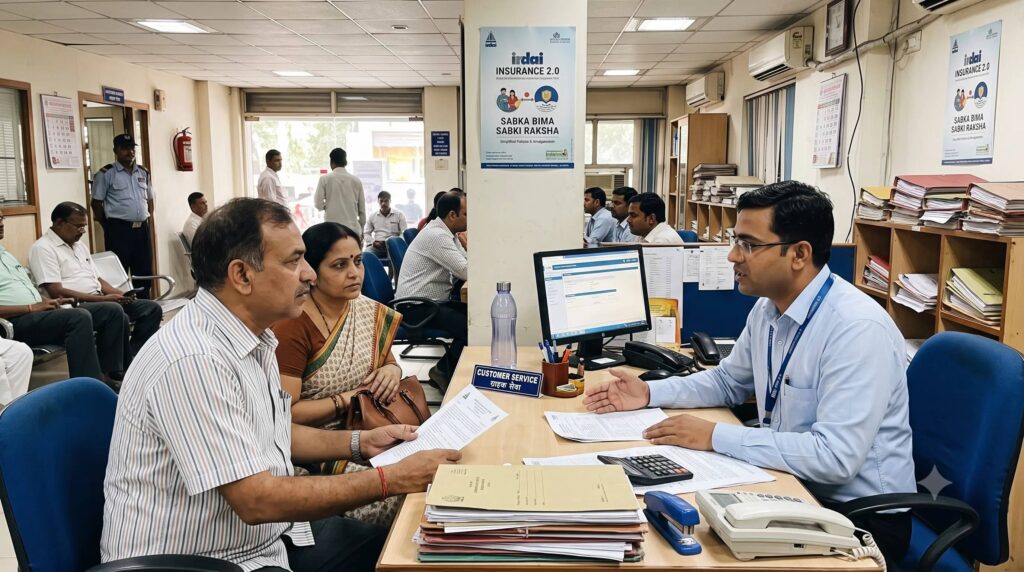
Breaking the Corporate Wall: The Real-World Impact of the Sabka Bima Sabki Raksha Act
Max Financial Services owns close to 80 percent of Axis Max Life Insurance, yet for years that stake sat inside a separate listed holding company, unable to combine with the operating insurer without running into Section 35 of the Insurance Act, 1938. Analysts at Mirae Asset Sharekhan called the pending reverse merger “a key catalyst” for the stock, contingent on Parliament amending that law. That amendment has arrived.
The Sabka Bima Sabki Raksha Act 2025 lets an insurance company merge directly with the non-insurance entity that owns it. That collapses a corporate wall Indian regulators spent close to nine decades keeping in place. The change reaches further than boardrooms and stock tickers. It touches the fee structure behind your premium and the speed of your claim, and it changes who answers for your cover once a merger happens.
This piece goes through the Act step by step: the legal history that made mergers so hard, what changes for a policyholder, the new consumer protection layer, the FDI and licensing shift, the fee and approval reforms meant to speed deals up, and what still needs IRDAI’s own follow-up rules before any of it becomes usable.
Article at a Glance: IRDAI’s Insurance 2.0 Reforms
- Holding Company Mergers Approved: The Sabka Bima Sabki Raksha Act 2025 overrides the historical limits of Section 35, allowing insurance companies to merge directly with their non-insurance parent entities to unlock trapped capital.
- Seamless Policy Continuity: Your existing policies, premiums, and claim processes are ring-fenced; solvency ratio mandates ensure your coverage remains completely secure during any corporate amalgamation.
- Stricter Consumer Protections: The newly established Policyholders’ Education and Protection Fund (PEPF) streamlines the recovery of unclaimed insurance money, while mandatory salesperson tagging aims to eliminate mis-selling.
- 100% FDI and Composite Licenses: Foreign Direct Investment is now uncapped at 100%, paving the way for global competitors and future composite licenses that could bundle life, health, and general insurance into a single policy.
- Faster Regulatory Approvals: To improve the ease of doing business, IRDAI has introduced perpetual registration for intermediaries, slashed amalgamation fees, and relaxed share transfer approvals from 1% to 5%
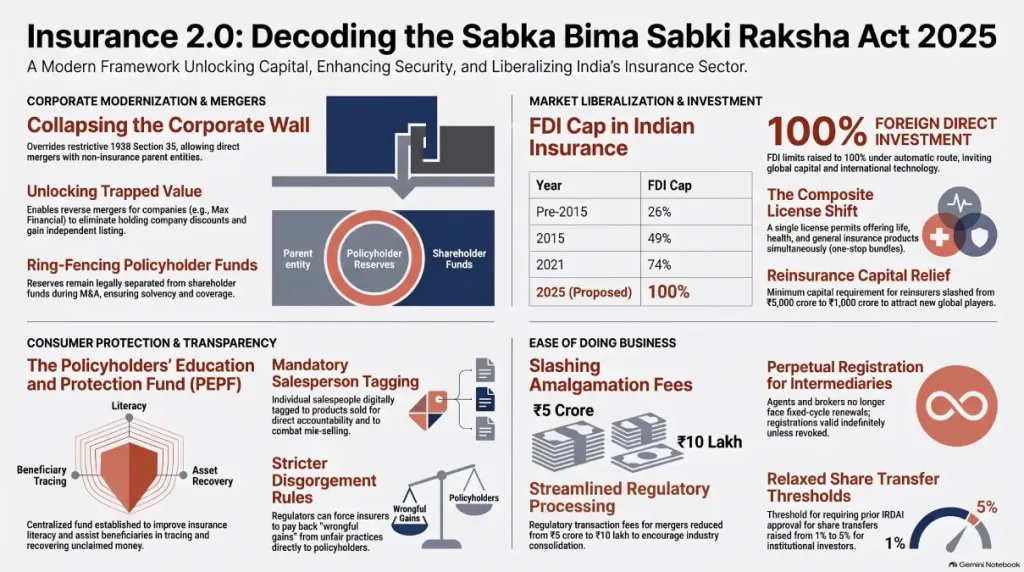
The Dawn of Insurance 2.0: Decoding the Sabka Bima Sabki Raksha Act 2025
From Stagnation to Agility: The Legislative Journey of the Amendment Bill
This bill did not appear overnight. Insurance executives were already discussing an “Insurance Laws (Amendment) Bill 2022,” expecting it to open the door to composite licensing and lighter capital rules, as far back as January 2024. Tapan Singhel, managing director and chief executive of Bajaj Allianz General Insurance, described the regulator’s own 2023 agenda as resting on three separate goals: a stronger base for the industry, wider reach into underserved markets, and better protection for the policyholder at claim time (same source). None of that talk moved on the timeline the industry expected.
The proposal sat for close to two years. It finally reached the floor of the Lok Sabha in December 2025, renamed Sabka Bima Sabki Raksha, carrying provisions on mergers, foreign investment, and licensing that insurers had asked for since well before this reform cycle began. Reinsurers got a headline change of their own buried in the same bill: the minimum capital requirement for a reinsurer drops from Rs 5,000 crore to Rs 1,000 crore, a cut Angel One expects will pull in new entrants and squeeze established players such as GIC Re (same source).
The Core Philosophy: “Insurance for All, Protection for All”
IRDAI has repeated one number so often it now reads like a mission statement: insurance cover for every Indian by 2047, the year the country marks its first century of independence. Three linked initiatives already sit under that promise: Bima Sugam, an online one-stop insurance marketplace; Bima Vahak, a women-led rural distribution force; and Bima Vistaar, an affordable composite product. IRDAI describes all three together as the industry’s path toward that 2047 target. Star Health chairman Anand Roy tied the same promise directly to the pending law in an April 2025 interview, noting that the insurance Amendment Act needs to get passed before his company could even consider a composite license, and that IRDAI would then need further months to fix the capital rules. That single sentence captures how this entire reform works. Parliament sets the direction. IRDAI writes the fine print afterward, in stages.
Moving Away from Restrictive Frameworks of the Insurance Act, 1938
The Insurance Act dates to 1938, drafted for a market of undercapitalised regional insurers long before India had a regulator powerful enough to police cross-holdings between banks, NBFCs, and insurers. Section 35 of that Act required IRDAI’s prior approval before two insurance companies could merge, but it never anticipated a listed non-insurance holding company wanting to fold itself into the insurer it already controlled. That exact gap surfaced in a March 2025 ruling out of NCLAT Chennai, which took up the question of whether IRDAI approval under Section 35 was even required for an amalgamation between an insurance company and a non-insurance one. A 1938 statute was never going to answer that question cleanly. The new Act closes the gap directly rather than leaving it to case law worked out decades later.
Demystifying Holding Company Mergers in the Insurance Sector
The Historical Roadblock: Section 35 of the Insurance Act
When HDFC Ltd and HDFC Bank announced their merger in 2022, the deal needed sign-off from five regulators running in parallel: the Reserve Bank of India, the stock exchanges, IRDAI, SEBI, and the Competition Commission of India. Two of those approvals existed purely because HDFC Ltd carried life and general insurance subsidiaries inside its structure. PrimeInvestor’s analysis at the time named the exact tension: in the past RBI has objected to direct holdings by banks in life insurance and general insurance subsidiaries, and forced divestiture stayed a live risk right up to completion (same source). IndiaInfoline’s coverage of the same deal spelled out the alternative nobody wanted: keep the insurance units under a separate holding company and absorb the cost, because that route was simply too expensive in terms of taxes. Every large financial group that also owned an insurer eventually ran into some version of this wall.
The HDFC deal itself shows how long that wall could hold a transaction up. The boards approved a share swap of 42 HDFC Bank shares for every 25 HDFC Ltd shares in April 2022, yet PrimeInvestor’s own analysis expected the deal to close only by the second or third quarter of FY24, roughly eighteen months later, precisely because of the regulatory queue running through RBI, IRDAI, SEBI, and the CCI at once. A wait of that length is exactly what Sabka Bima Sabki Raksha aims to shorten for insurance-linked mergers going forward.
What the New Non-Insurance Merger Rules Actually Mean
Sabka Bima Sabki Raksha lets an insurer merge with the non-insurance company that owns it, something Section 35 effectively blocked for close to nine decades. Angel One’s coverage of the bill’s tabling put it in plain terms: the bill allows insurance companies to merge with non-insurance entities, and it names Max Financial Services as the clearest early beneficiary, since the change may let Max Life Insurance merge into its own parent company and remove the holding company discount overhang that has weighed on the stock.
A June 2025 equity research note on Max Financial Services confirms the company is awaiting IRDAI approval for the reverse merger, describing it as a move that would give Axis Max Life a separate listing, remove the holding company discount, and unlock the value trapped inside the current two-tier structure. The insurer’s licence does not disappear in a deal like this. The corporate shell wrapped around it does.
The Mechanics of Collapsing Complex Corporate Structures
Collapsing a holding structure is not paperwork alone, and Aditya Birla Capital’s 2024 restructuring shows the mechanics involved. Aditya Birla Finance, an unlisted NBFC subsidiary, needed to merge into its listed parent mainly because RBI’s scale-based regulations required certain “upper layer” NBFCs to list independently within three years of being classified as such, with the deadline falling on September 30, 2025. Rather than run a separate listing process for the subsidiary, the group folded it into the parent instead, converting Aditya Birla Capital from a pure holding company into a listed operating NBFC and bringing its leverage ratio down from roughly 5.9 times to about 4.15 times, all without issuing a single new share (same source). Insurance mergers under the new Act should follow a similar shape: a share swap at an agreed exchange ratio, no fresh equity raised specifically for the deal, and months of work reconciling two boards, two sets of financial statements, and overlapping regulatory filings into one entity.
Case Study Context: Lessons from Recent Industry Amalgamations
Three deals explain why this reform took so long to reach Parliament. Shriram Life Insurance Holdings merged into Shriram Life Insurance Company in a deal the Competition Commission of India cleared within weeks in January 2024, calling it pure intra-group restructuring involving shareholders such as Piramal Enterprises and TPG India Investments, with no meaningful change to the market’s competitive shape.
IDFC’s 2017 attempt to combine Shriram Group’s lending businesses into a single banking entity ran into a sharper problem, since RBI does not allow a non-operative financial holding company to house both a bank and an NBFC doing the same kind of lending under one roof, and the plan needed clearances from RBI, IRDAI, SEBI, and the CCI all at once before momentum stalled.
HDFC Ltd’s 2022 merger into HDFC Bank is the deal every insurer watched most closely, since it dragged HDFC Life and HDFC Ergo along with it and forced regulators, in real time, to decide how much insurance ownership a bank could be allowed to carry. Each case chipped away at the assumption that an insurer must always stay legally separate from the company that owns it.
The numbers behind these deals explain why regulators moved carefully. The Competition Commission’s order on Shriram Life Insurance Holdings noted the combined market share of Shriram Life and its co-shareholder Pramerica in the life segment came to less than 1 percent, and the distribution-side overlap tied to TPG’s affiliates stayed under 2 percent, which is exactly why the deal cleared without objection.
The IDFC-Shriram proposal carried far higher stakes: Shriram Group’s finance businesses alone carried a loan book above Rs 80,000 crore, against IDFC and its banking arm’s combined book of about Rs 60,000 crore, a scale that made regulators far more cautious about handing control of a bank-sized balance sheet to a restructured holding company. Size has always shaped how fast IRDAI and its co-regulators move, and it will likely keep doing so even after this reform.
| Merger | Regulators Cleared | What It Shows |
| Shriram Life Insurance Holdings into Shriram Life Insurance Co. (2024) | Competition Commission of India | Intra-group insurer restructuring can clear quickly when ownership does not change |
| Aditya Birla Finance into Aditya Birla Capital (2024-25) | RBI scale-based NBFC rules | A holding company can become an operating entity without issuing new shares |
| HDFC Ltd into HDFC Bank (2022-23) | RBI, IRDAI, SEBI, CCI, exchanges | Bank ownership of insurance subsidiaries was the single hardest sticking point |
Direct Impact on Policyholders: Does a Holding Company Merger Change Your Coverage?
The Ring-Fencing of Policyholder Funds During Amalgamation
Nothing in IRDAI’s rulebook suggests policyholder money gets pooled with a parent company’s general funds during a merger. The Protection of Policyholders’ Interests, Operations and Allied Matters of Insurers Regulations, 2024 already draws a hard line between shareholder funds and policyholder funds even outside merger scenarios: where an insurer’s foreign branch office runs into a loss, the rule requires the shortfall to come from shareholders’ funds beyond the solvency margin, and it explicitly bars policyholder funds from covering that gap. A holding company merger sits inside the same regulatory logic. The operating insurer, its licence, its reserves, and its solvency obligations continue exactly as before. Only the ownership layer above it changes.
Seamless Transition of Policies, Terms, and Conditions
A merger changes who owns the shares of the company that owns your insurer. It does not touch the contract between you and that insurer. Your policy number, sum assured, premium due date, and nominee details stay with the same underwriting entity, because Section 35 approval, still required and simply applied to a new kind of transaction now, exists precisely to confirm that a merger will not disturb existing contracts. IRDAI’s 2024 servicing rules already require an insurer to give policyholders at least two months’ advance notice before it even relocates a single branch office. A holding company restructuring, being a bigger event, should draw more disclosure from the insurer, not less.
Solvency Ratio Mandates: Ensuring Financial Stability Post-Merger
IRDAI sets a minimum control level of solvency for every insurer, and that number does not pause for a corporate restructuring. ICICI Lombard’s own 2025 shareholder filings show what continuous oversight looks like in practice even during ordinary governance decisions: the board sought members’ approval for a revised remuneration package for managing director and chief executive Sanjeev Mantri, but that package still needed separate IRDAI sign-off before it could take effect, right down to the number of stock options granted. The same filing discloses a 5 percent cap on the insurer’s investment exposure to promoter-group entities in aggregate, a limit written into the Actuarial, Finance and Investment Functions of Insurers Regulations 2024 specifically to stop a parent company from draining an insurer’s balance sheet through related-party dealing (same source). A merged entity inherits that same cap. If anything, it faces closer scrutiny, since regulators now watch one combined balance sheet where they used to watch two separate ones.
How Operational Synergies Could Translate to Reduced Premiums
Whether a merger actually lowers what you pay depends on cost discipline, not intention. Aditya Birla Capital’s post-merger numbers give a rough sense of the scale involved: cutting leverage from 5.9 times to about 4.15 times freed up balance sheet room without adding new share capital, money a group can choose to redeploy into pricing, distribution, or reserves. For a life insurer such as Max Life, sitting inside one listed entity instead of a two-tier structure removes duplicate board costs, duplicate compliance filings, and the valuation drag analysts call the holding company discount, the exact reason Mirae Asset Sharekhan gave for calling Max Financial’s pending merger “a key catalyst” for the stock . None of that guarantees a cheaper premium at your next renewal. It removes one underlying cost that eventually shows up somewhere in the group’s pricing decisions.
If your insurer’s parent company announces a merger under this Act, four things are worth checking before you do anything else with your policy.
- the insurer’s IRDAI registration number on your policy document, which should stay unchanged through the merger
- any renewal notice or endorsement the insurer sends explaining the change, since the 2024 servicing rules require clear communication around any restructuring that affects service
- the solvency ratio the insurer reports in its next annual filing, to confirm it still clears IRDAI’s minimum control level
- whether your grievance redressal channel, including the option to approach the Insurance Ombudsman, still lists the same contact details
Enhanced Consumer Protection and Transparency Mechanisms
Mandatory Tagging of Authorized Salespersons to Prevent Mis-Selling
IRDAI’s definition of mis-selling is already broad and specific. Any sale built on undue influence, a false or misleading statement, a hidden exclusion, or a failure to check whether a policy actually suits the buyer counts as mis-selling under the 2024 regulations, whether the insurer or the distribution channel carried it out. Every insurer already runs a board-approved policy meant to guard against this type of selling, and every distribution channel must follow a specified code of conduct (same source). Sabka Bima Sabki Raksha is expected to tighten this further, tying individual salespeople more directly to the products they sell. IRDAI has not yet published the operational detail of that tagging system, and, going by how the regulator handled the last round of reforms, it will likely arrive through a separate circular rather than the Act’s own text.
The Policyholders’ Education and Protection Fund (PEPF) Explained
A dedicated fund for policyholder education is not a new idea among India’s financial regulators. IRDAI’s 2024 rules already require every insurer to set up a mechanism to create Insurance Awareness on an ongoing basis so that prospects and policyholders know what a product covers, what it pays out, and what rights they hold. The Policyholders’ Education and Protection Fund folds that obligation into a formal, centrally administered pool, in keeping with the general direction IRDAI has already signalled toward closing India’s protection gap. IRDAI has not yet notified the fund’s exact contribution formula or spending mandate at the time of writing, so treat any specific figure quoted elsewhere with caution until the regulator issues that circular.
Tracing and Recovering Unclaimed Insurance Money
Life insurance money goes unclaimed every year, mostly maturity benefits and death claims that never reach a beneficiary because the nominee details on file went stale. The 2024 servicing regulations attack part of this problem directly: insurers must collect a policyholder’s bank account details at the proposal stage specifically to enable electronic transfer of any refund or claim payment. That cuts out the paper cheques that used to go undelivered. Every life insurer must also write to policyholders once a year with the exact bonus accrued on a participating policy, so unclaimed value does not simply sit unnoticed (same source). Sabka Bima Sabki Raksha builds a more organised tracing system on top of these existing rules, though IRDAI has not yet published how claimants will be able to search across insurers for a policy they did not know existed.
Stricter Disgorgement Rules for Insurer Wrongful Gains
Disgorgement, in plain terms, means an insurer or intermediary that profits from breaking a rule has to hand that profit back, on top of whatever separate penalty IRDAI imposes. IRDAI’s existing rulebook already leans this way without using the word: the regulator can direct an insurer to shut down a foreign branch office and fully divest its stake if that branch’s operations run against Indian policyholders’ interests, after giving the insurer a chance to be heard. Sabka Bima Sabki Raksha is expected to extend a comparable power to a wider set of violations inside India. That would force gains earned through mis-selling or unfair claim denial back toward policyholders, instead of letting an insurer keep them after paying a fine. The exact threshold and calculation method for this had not been notified at the time of writing, so treat any specific percentage or rupee figure circulating in secondary coverage as provisional until IRDAI issues the operating rule.
100% FDI and Composite Licenses: The Broader Policy Shift
Foreign Direct Investment Reaching 100%: Capitalizing the Sector
FDI in Indian insurance moved from 26 percent to 49 percent in 2015 and on to 74 percent in 2021, and Sabka Bima Sabki Raksha now proposes taking that ceiling all the way to 100 percent. Angel One’s read on the change is direct: full foreign ownership may attract new players, especially in health insurance, putting pricing pressure on established names such as Star Health (same source). Whether the capital actually shows up is a separate question. One 2024 industry commentary noted that India received barely Rs 3,500 crore in cumulative FDI across the insurance sector over 23 years of earlier liberalisation, despite repeated increases to the FDI cap, a record worth remembering before assuming 100 percent FDI alone changes the capital picture overnight.
| Year | FDI Cap in Indian Insurance |
| Pre-2015 | 26% |
| 2015 | 49% |
| 2021 | 74% |
| Proposed under Sabka Bima Sabki Raksha | 100% |
Redefining the “Foreign Promoter” and “Indian Promoter”
Raising the FDI ceiling to 100 percent forces a related, quieter change: the Insurance Act’s own definitions of “Indian promoter” and “foreign promoter” need updating too, since the old definitions were written for a world where foreign ownership stopped at 74 percent and an Indian promoter was always assumed to hold effective control. That assumption cannot survive a rule that allows a foreign investor to own the whole company outright. IRDAI had not published the revised definitions at the time of writing, and this is one of the more consequential gaps in the Act’s current text, since a joint venture insurer such as Axis Max Life or HDFC Life depends entirely on how the revised rule treats an Indian promoter that no longer needs to hold a majority stake to remain “in control” for regulatory purposes. Insurers already running Indian-foreign joint ventures should watch for a separate notification spelling out exactly how control, voting rights, and board seats get allocated once that requirement disappears.
The Shift Toward Composite Insurance Licenses (One Policy, Total Coverage)
A composite license would let one insurer sell life, health, and general insurance products under a single corporate roof, something Indian law has never allowed. Star Health chairman Anand Roy has been open about waiting on exactly this change. Life insurance, he said in an April 2025 interview, is an interest area for us, and Star Health would consider acquiring a life insurer once composite licensing becomes available, though he stressed the company would wait to see the actual capital rules before committing to anything. The same report noted LIC had been exploring a stake in a health insurer under the same anticipated regime, a claim Roy denied applied to his own company specifically. Composite licensing is the single provision that reshapes competitive lines the most. It lets HDFC Life or LIC move into health cover and lets a health specialist such as Star Health move into life cover, all without setting up a second licensed entity.
Roy also gave a rare look at how a large insurer prepares for a shift like this well before it lands. Star Health engaged Boston Consulting Group specifically to work out its diversification strategy in advance, describing the plan as already sitting ready inside the company, waiting only on the capital, technology, and product decisions that make sense once the composite licence rules are final and board approval can follow. Expect other large listed insurers to be running a similar playbook quietly through 2026: strategy finished, board briefed, everyone waiting on the same signature from IRDAI.
Allowing Insurers to Offer Value-Added and Ancillary Services
Composite licensing opens a second, quieter change: insurers bundling non-insurance services around a core policy. IRDAI’s existing outsourcing rules already let an insurer contract out non-core functions to third parties once the arrangement clears a materiality test, defined as any outsourcing contract expected to run above 5 percent of the insurer’s total annual outsourcing spend, which then triggers board-level risk review through a dedicated Outsourcing Committee that must include the insurer’s chief risk officer, chief financial officer, and head of operations. Bundled extras such as roadside assistance with motor cover, teleconsultation with health cover, or wellness tracking with life cover sit inside this same regulatory logic once composite licensing removes the product-line barrier between them.
Ease of Doing Business: Lower Amalgamation Fees and Transfer Thresholds
Slashing Transaction Fees from ₹5 Crore to ₹10 Lakh
One recurring complaint from insurers pursuing any merger or amalgamation has been the flat transaction fee IRDAI charges to process the application, a cost that fell just as heavily on a small regional insurer as on a national one. Sabka Bima Sabki Raksha is expected to cut this fee sharply, part of a broader ease-of-doing-business push that has run through IRDAI’s agenda since at least 2023, when the regulator started moving from a rule-based approach toward a principle-based one specifically to lighten the compliance load on insurer. The revised fee schedule had not been formally notified at the time of writing, so insurers planning a merger should confirm the applicable figure directly with IRDAI rather than assume one in advance.
Share Transfer Approvals Relaxed from 1% to 5%
Buying into an Indian insurer has always meant clearing a shareholding threshold that triggers IRDAI’s prior approval, a rule that slows down routine portfolio investment by mutual funds and foreign institutional investors. A 2023 review of shareholding rules across insurance regulators by the Bank for International Settlements confirms that cumulative shareholding above 5 percent already requires IRDAI’s prior clearance in India, a threshold the review set alongside China’s similarly strict 5 percent rule and Hong Kong’s looser 15 percent rule. Industry commentary around Sabka Bima Sabki Raksha describes this as a relaxation from a considerably stricter earlier threshold, intended to cut paperwork for routine, non-controlling holdings while leaving IRDAI’s power to vet anyone taking real control of an insurer fully intact.
Perpetual Registration for Intermediaries to Reduce Red Tape
IRDAI has loosened entry rules for years without much public notice. Insurance agents, brokers, and other intermediaries currently renew their registration on a fixed cycle, repeating paperwork that rarely changes from one year to the next. The regulator’s broader shift toward principle-based supervision already produced one comparable simplification: in 2023, IRDAI expanded its Use and File procedure, previously limited to general insurance, to cover individual and group-linked life insurance products too, cutting the time a new product needed before it could reach the market. Perpetual registration for intermediaries follows the same logic, swapping a repeat-renewal cycle for a one-time registration that stays valid unless IRDAI specifically revokes it. For an industry that added close to two lakh new agents in a single year during the last growth cycle, a renewal step removed from every agent’s calendar adds up to a meaningful amount of paperwork taken off both the insurer’s desk and the regulator’s.
Delegation of Subsidiary Instructions to IRDAI Members for Faster Approvals
Every approval an insurer needs currently traces back, at least on paper, to IRDAI’s chairperson or a specific committee the chairperson names for that purpose. The 2024 policyholder protection regulations already define this “Competent Authority” as either the chairperson personally, or a whole-time member, or a committee of members, that the chairperson designates Sabka Bima Sabki Raksha is expected to push this delegation further down IRDAI’s own structure, letting individual whole-time members clear routine subsidiary and amalgamation approvals without waiting for the full authority to convene, a change aimed at approval delays like those that stretched deals such as the IDFC-Shriram proposal and the HDFC-HDFC Bank merger out to many months of regulatory review.
The Future of the Indian Insurance Market Under IRDAI’s New Regime
Anticipated Consolidation and Market Expansion
Expect more deals shaped like Max Financial’s, not fewer. Once a listed holding company can fold its insurer into itself without the regulatory friction that dogged HDFC Ltd’s merger into HDFC Bank, the incentive to unwind a holding structure becomes hard to ignore for any group still carrying one. Angel One’s reading of the bill names the affected companies directly: Max Financial has the most to gain from the merger provision, while HDFC Life, LIC, and Star Health face a different kind of pressure from the FDI and composite-license changes, needing to defend market share against better-capitalised entrants rather than restructure their own ownership. The non-life insurance market these players are competing over is already sizeable and still growing: gross direct premium crossed Rs 3.08 lakh crore in FY25, up 6.2 percent on the year, with standalone health insurers posting almost 16 percent growth even as general insurers slowed.
Not every large insurer benefits equally from consolidation itself. Angel One points out that the bill does not let agents sell products across competing insurers the way a more open distribution model would, and that omission actually helps LIC and SBI Life, both of which lean heavily on their own individual agent networks and would rather not compete for those agents’ loyalty against every other insurer in the market (https://www.angelone.in/news/stocks/max-lic-sbi-life-star-health-how-will-sabka-bima-sabki-raksha-bill). So the reform’s winners split into two groups: companies like Max Financial gaining from the merger provision specifically, and companies like LIC and SBI Life gaining mainly from what the bill chose to leave unchanged.
Fostering Innovation Through Start-up Investments
IRDAI has already put in place one clear incentive for insurers to spend on new technology, and by extension on the start-ups building it: insurers may count up to 5 percent of their allowable expenses of management toward insurtech spending specifically, a carve-out meant to widen customer reach without breaching the overall cost ceiling A Boston Consulting Group study covered in an April 2025 industry newsletter found generative AI already delivering productivity gains above 30 percent in underwriting and claims handling among insurers willing to move past pilot projects. A simpler ownership structure, freed from an extra holding-company layer, gives an insurer one less approval step to clear before it commits real money to a start-up partnership or an in-house technology bet.
FAQ: IRDAI’s Insurance 2.0 Reforms
The Sabka Bima Sabki Raksha Act, 2025, is a landmark legislative reform designed to achieve IRDAI’s vision of “Insurance for All by 2047.” It modernizes the original Insurance Act of 1938 by allowing 100% Foreign Direct Investment (FDI), permitting holding company mergers, and establishing new regulatory frameworks to boost consumer protection, capital influx, and ease of doing business.
A reverse merger between an insurer and its non-insurance parent company does not alter your existing policy terms. Your premiums, sum assured, and claim processes remain untouched. IRDAI enforces strict solvency ratio mandates and ring-fencing rules, ensuring that policyholder funds are legally protected and completely separated from shareholder liabilities during any corporate amalgamation.
By raising the FDI cap from 74% to 100% under the automatic route, the Indian market is now fully open to global insurers. For policyholders, this influx of foreign capital and expertise translates to highly competitive premium pricing, innovative insurance products, and faster claim settlements driven by advanced international technology.
The PEPF is a newly mandated central fund established by the government to protect consumer interests and improve insurance literacy. A primary function of this initiative is to help beneficiaries trace and recover unclaimed insurance money while creating strict regulatory mechanisms to penalize the mis-selling of insurance policies.
Anticipated under the new reforms, a composite insurance license will allow a single company to underwrite life, health, and general insurance simultaneously. For the consumer, this introduces the massive convenience of a comprehensive, single-policy bundle that covers all your primary risks under one premium payment and a unified customer service dashboard.
While the Act does not mandate price cuts, it drastically lowers operational costs for insurers. By slashing amalgamation fees, relaxing share transfer approvals from 1% to 5%, and eliminating holding company discounts, insurers free up significant capital. In a highly competitive market, these operational savings are expected to be passed onto consumers in the form of cheaper, more affordable coverage.
The Timeline for Full Implementation and Final Rule Notifications
Passing a bill and running a market under it are two different timelines. Every source close to this reform points to the same gap: the Act sets the direction, and IRDAI needs a separate window, likely several months, to notify capital requirements, fee schedules, and licensing rules before insurers can act on the headline changes. Star Health’s Anand Roy put a rough number on that gap in April 2025, guessing at 3-4 quarters before his own company could act on composite licensing once the rules were actually defined. Expect a similarly staggered rollout for holding company mergers, FDI approvals, and fee reductions.
The law exists now. The paperwork that makes it usable is still being written, and a policyholder’s practical job in the meantime is narrow: watch your own insurer’s disclosures, not the headlines about the Act, since every change that actually reaches your policy will show up there first, in a renewal notice, an annual filing, or a circular IRDAI publishes on its own website long before any financial news outlet gets around to explaining what it means.
Disclaimer
This explainer blog post is provided for informational and educational purposes only and does not constitute professional financial, legal, investment, or insurance advice. While we strive to present accurate and updated explanations of the Sabka Bima Sabki Raksha Act 2025 and the Insurance 2.0 reforms, the insurance sector is highly regulated and subject to continuous legal amendments, official notifications, and ongoing structural changes. This blog is not a substitute for professional counsel. We are not licensed insurance brokers, financial advisors, or legal practitioners. The interpretations of holding company mergers, foreign direct investment limits, and policyholder protections reflect general understandings of the proposed policies, not formal research or binding legal analysis. Readers must not base any personal, corporate, or financial decisions solely on this content. Always consult a certified financial planner, legal counsel, or official IRDAI documentation before making any decisions regarding your insurance coverage or related corporate investment actions whatsoever.




Leave a Reply