
Tax Audit Report Due Date 21 October 2026: Who Gets the Extension and Who Does Not (AY 2026-27)

CBDT Circular 07/2026, dated 28 September 2026, moves the tax audit report due date for AY 2026-27 from 30 September to 21 October 2026. The extension covers only the persons at Sl. No. 2 of the Table below Explanation 2 to Section 139(1): companies and assessees with audited accounts, partners of audited firms included. Every case where Section 92E (transfer pricing) applies stays out. The Q2 TDS statement date did not move and stays at 31 October 2026.
If your report is due tomorrow, settle one fact first, whether Section 92E applies to the entity. If it does, the new date is not yours, and your own dates are later anyway. A company with no Section 92E report has until 21 October, and so does a non-company assessee with audited accounts. Both file the return a month later, on 21 November 2026.
The circular is a single paragraph. It says nothing about interest, TDS, GST or company law, and that silence is where most of the confusion online starts. Where a point below rests on commentary and not on the circular itself, the text says so.
Find your entity in this list before reading further:
- Company with no Section 92E report: audit report 21 October, return 21 November.
- Non-company assessee with audited accounts and no Section 92E report: the same two dates.
- Any case where Section 92E applies: audit report 31 October, return 30 November.
- Salaried individuals and other non-audit cases: no change, as TaxGuru’s relief explainer notes.
At a Glance: Tax Audit Report Due Date 21 October 2026
- The tax audit report due date for AY 2026-27 is 21 October 2026, moved from 30 September by CBDT Circular 07/2026 dated 28 September 2026.
- The ITR due date moves by the same 21 days, from 31 October to 21 November 2026.
- Coverage is limited to Sl. No. 2 of the Table below Explanation 2 to Section 139(1): companies and non-company assessees with audited accounts. Partners of audited firms and Section 5A spouses get the new return date only. Section 92E cases are out.
- Transfer pricing cases keep their later dates: audit report and Form 3CEB by 31 October, return by 30 November 2026.
- Salaried individuals and other non-audit filers see no change.
- Q2 TDS and TCS statements stay due on 31 October 2026. GST and Companies Act dates did not move either.
- Missing the date draws a Section 271B penalty of 0.5% of turnover, capped at Rs 1,50,000. The circular says nothing on interest, so pay self-assessment tax by 31 October.
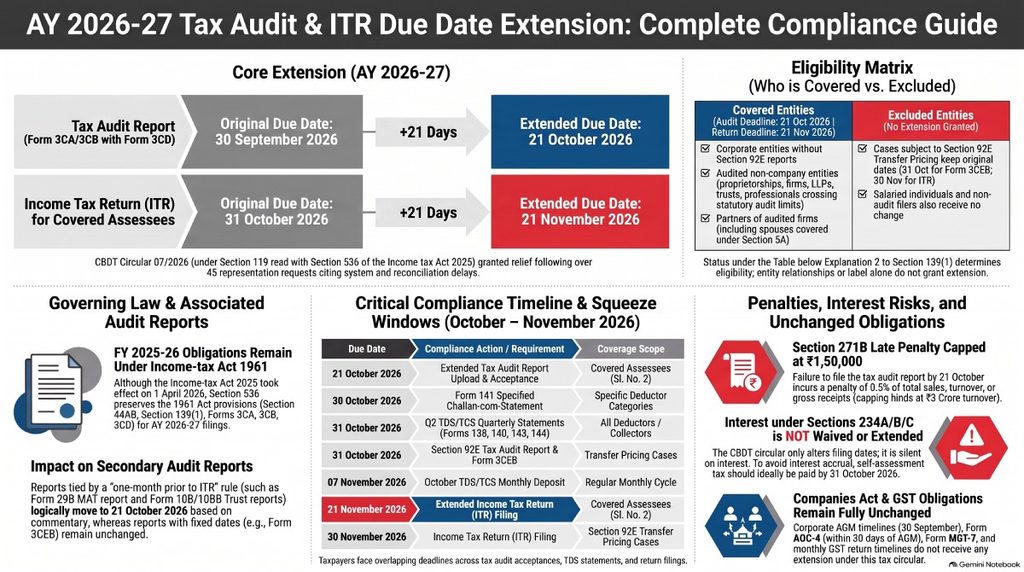
Revised tax audit and ITR due dates for AY 2026-27
Two dates moved, each by 21 days. The sources are CBDT Circular 07/2026 (F. No. 225/128/2026/ITA-II) and the CBDT press release, both dated 28 September 2026.
| Compliance (AY 2026-27) | Old date | New date |
| Tax audit report (Form 3CA or 3CB, with Form 3CD) | 30 September 2026 | 21 October 2026 |
| Return of income for covered assessees | 31 October 2026 | 21 November 2026 |
The circular acts under Section 119 of the Income-tax Act 1961, read with Section 536 of the Income-tax Act 2025. It first extends the return date for the persons at Sl. No. 2. The audit report follows from that: the specified date moves to 21 October 2026 in terms of clause (ii) of the Explanation to Section 44AB. A formal order would follow separately, the press release adds. All India Radio’s report carries the same two dates.
Mercurius & Associates says CBDT acted two days before the original audit deadline. More than 45 organisations had asked for relief, according to SAG Infotech’s account. The same account lists their grounds: the reconciliation workload, trouble downloading AIS and TIS data, login and digital signature problems, and overlap with MCA and GST dates.
Check the arithmetic once, since it is the fastest test of any claim you read. From 30 September to 21 October is 21 days. From 31 October to 21 November is also 21 days. A post that gives one new date and a different shift for the other has the pair wrong.
Not everyone with a return to file gets the extended return date. It belongs to the persons at Sl. No. 2 and nobody else. Salaried individuals and other non-audit filers sit outside it, which is why TaxGuru’s relief explainer tells them nothing changed.
Also Read: IT Refund Stuck? A Practical Guide to Responding to Defective Return Notice
Why the tax audit date moved with the ITR date
Section 44AB asks for the audit report by a “specified date”, and that date sits one month before the return date under Section 139(1). The old pair was 30 September for the report and 31 October for the return. The new pair keeps the gap: 21 October and 21 November. Kunal Darwani & Company notes that the new gap mirrors the usual one-month gap, and TaxGuru’s FAQ on Forms 3CA, 3CB and 3CD ties the audit date to the return date in the same way.
The circular gave auditors no separate relief. It moved the return date for one row of a Table, and the audit date followed by arithmetic. Two things come out of that.
First, the audit date moves only for people whose return date moved. A taxpayer outside Sl. No. 2 gets no audit relief, no matter how close the case looks to the covered row.
Second, the sequence survives: the report is signed first and accepted on the portal, and the return comes after.
Income-tax Act 1961 or 2025: which law applies to this audit
FY 2025-26 stays under the Income-tax Act 1961. The Income-tax Act 2025 took effect on 1 April 2026, but the familiar sections and forms still apply to this audit: Section 44AB, Section 139(1), Section 271B, Section 92E, and Forms 3CA, 3CB and 3CD under Rule 6G of the Income-tax Rules 1962. TaxGuru’s Forms FAQ sets this out.
Kunal Darwani names Section 536 of the 2025 Act as the provision that preserves this position, and the circular cites that section next to Section 119 of the old Act. TaxGuru’s statutory compliance calendar draws the same line: obligations for PY 2025-26 and AY 2026-27 run under the 1961 Act, while current-period items can fall under the 2025 Act and the Income-tax Rules 2026.
Both Acts operate inside the same month. The audit report follows the 1961 Act, while the Q2 TDS statements (covered later in this post) use form numbers from the 2026 Rules. Cite the 1961 provisions in client letters and working papers for this audit.
The position flips next year. Kunal Darwani says audits for tax year 2026-27 will fall under the 2025 Act, where the tax audit provision is Section 63.
Also Read: Form 67 for NRIs: Who must file and how to claim foreign tax credit (AY 2026-27)
Who gets the extension: Sl. No. 2 under Explanation 2 to Section 139(1)
The circular extends only Sl. No. 2 of the Table below Explanation 2 to Section 139(1). It names the row by number without listing the people in it, and TaxGuru’s summary of the press release fills the gap. Where Section 92E does not apply, the row holds a company, a non-company assessee whose accounts must be audited under the Act or any other law, a partner of a firm whose accounts must be audited, and that partner’s spouse where Section 5A applies.
| Who | Condition | What moved |
| A company | Section 92E does not apply | Return to 21 November; Form 3CA audit report to 21 October |
| A non-company assessee | Accounts must be audited under the Income-tax Act or any other law; Section 92E does not apply | Return to 21 November; Form 3CA or 3CB audit report to 21 October |
| A partner of a firm | Firm’s accounts must be audited; no Section 92E report for the firm | Return to 21 November |
| Spouse of such a partner | Section 5A applies | Return to 21 November |
Taxmann’s ITR FAQ for AY 2025-26 shows last year’s version of the same split: transfer pricing rows at 30 November, audit rows at 31 October. The circular now edits that structure for AY 2026-27. For any borderline case, confirm the current Table text on the e-filing portal, because the circular refers to the row and never reproduces it.
Coverage depends on the row, and the label “audit case” decides nothing. An entity that shares a group or a partner with someone in the other row keeps its own row’s dates, and so does one that shares a client.
Four short cases show the row at work, each with no Section 92E report.
A sole proprietor has turnover above the Section 44AB limit, and no other law requires an audit. Section 44AB is the trigger, so the proprietor files Form 3CB with Form 3CD by 21 October and the return by 21 November.
A private company has a statutory auditor under the Companies Act 2013. Status puts it in the row, and the audit under company law leads to Form 3CA, with the same dates: 21 October and 21 November.
A registered charitable trust must have its accounts audited, which puts it in the non-company limb of the row. Its Form 10B or 10BB report follows the one-month rule discussed in a later section.
A salaried individual with no business income has no audit and no place in the row. Nothing moved for that person.
Companies and the extended tax audit date
A company is covered because it is a company. The row lists “a company” with no audit condition attached, so Section 44AB does not settle the question. In practice the point has little bite, since a company’s accounts are ordinarily audited under company law anyway, a position TaxGuru’s Forms FAQ records when it explains Form 3CA. TaxFetch words the row more loosely, as companies “required to undergo audit”, but the row itself keys on status.
For a company with no Section 92E report, two dates move: the return goes to 21 November 2026, and the Form 3CA audit report, filed with Form 3CD, goes to 21 October 2026. Form 3CA is the form used where accounts are audited under another law, such as the Companies Act 2013, according to Mercurius.
One clock does not move, and that is the Companies Act. TaxGuru’s explainer calls it the most common mix-up. The AGM falls within six months of the year-end, which for FY 2025-26 meant 30 September 2026. Form AOC-4 follows within 30 days of the AGM and Form MGT-7 within 60. The income tax circular touches none of these, and CAC lists company law dates among the items it leaves alone.
On TaxGuru’s reading, a company’s book-profit audit report under Section 115JB also moves; the section on other audit reports below covers it. A company with international transactions or specified domestic transactions leaves the covered row altogether, whatever its audit position.
Also Read: ITR 2026 Filing: Investment Taxation Under the Income Tax Act 2025 Guide
Proprietors, firms, LLPs, trusts and professionals with audited accounts
This is the largest group. A non-company assessee enters the covered row in one of two ways: Section 44AB requires the audit, or another law requires the accounts to be audited. According to TaxGuru’s summary of the row and TaxFetch, the phrase “any other law” in the row is what pulls in entities audited for reasons that have nothing to do with tax.
Section 44AB sets different limits for business and for profession, and the business limit has a higher tier tied to cash transactions. The figures are in TaxGuru’s Forms 3CA, 3CB and 3CD FAQ; check them against the Act itself before relying on a borderline case. A person who opted for presumptive taxation but declared a lower profit can also land in audit, a route Mercurius flags.
The sources name these groups as falling in the row:
- Proprietorships, partnership firms, LLPs and similar non-company bodies whose accounts must be audited, per TaxFetch.
- Professionals such as doctors and architects whose receipts cross the audit limit, per Mercurius.
- Trusts whose accounts must be audited, per TaxGuru’s explainer.
- Companies, covered in the previous section.
The report takes one of two forms. Form 3CA applies where another law already requires an audit, and Form 3CB where Section 44AB is the only trigger. Form 3CD goes with either, and the date is the same for both.
A chartered accountant prepares the report and uploads it on the e-filing portal, and the assessee then logs in and accepts it. Kunal Darwani and TaxFetch both describe that two-step flow.
The extension does not rescue an assessee who has not started. The penalty under Section 271B bites on two failures: not getting the accounts audited and not furnishing the report by the specified date.
Partners of audited firms and the Section 5A spouse
The covered row also takes in a partner of a firm whose accounts must be audited, and the spouse of that partner where Section 5A applies. Section 5A deals with apportionment of income between spouses, and the ITR form-selection table in Taxmann’s ITR FAQ lists such apportionment as a trigger for ITR-2 or ITR-3.
For a partner, the date that moves is the return date: 21 November 2026. The audit report date belongs to the firm, which furnishes its report by 21 October. A partner with no audit of her own has no report to file, so only the return date applies to her.
The label “working partner” needs care. TaxGuru’s relief explainer uses it in its summary, but the circular does not. The circular refers only to Sl. No. 2, and TaxGuru’s own summary of that row speaks of a partner of a firm. Treat the statutory description as the test, and do not add a working-partner condition that the circular never states.
The firm’s own position decides the partner’s row. Last year’s Table, as Taxmann reproduces it, placed a partner of a firm required to furnish a transfer pricing report, and the spouse under Section 5A, at 30 November.
Take a firm with audited accounts and no Section 92E report. It furnishes Form 3CB with Form 3CD by 21 October, and each partner, plus any spouse covered by Section 5A, files the return by 21 November. Give the same firm a Form 3CEB report and it moves to the 31 October and 30 November pair, with its partners following the transfer pricing row on last year’s pattern.
Transfer pricing cases (Section 92E) keep 31 October and 30 November
The circular names Sl. No. 2 and nothing else. Sl. No. 1, the row for assessees to whom Section 92E applies, keeps its dates: audit report and accountant’s report at 31 October 2026, return at 30 November 2026. TaxGuru’s statutory calendar lists the Section 92E tax audit report and Form 3CEB at 31 October, and Mercurius puts the return for these cases at 30 November. TaxGuru’s relief explainer says transfer pricing cases continue on their own timeline. None of the sources reports an extension for them.
Section 92E calls for the accountant’s report on international transactions and specified domestic transactions, filed in Form 3CEB. Where that report is due, the case sits outside the extension, even if the same entity also files Form 3CA or 3CB with Form 3CD.
Exclusion costs these assessees nothing. Their dates were already later than the old covered dates and remain later than the new ones: 31 October is ten days after 21 October, and 30 November is nine days after 21 November. The danger lies in the opposite direction. An entity that assumes it is a transfer pricing case, with no Form 3CEB behind that belief, will plan to 31 October and miss 21 October. Wrongly assuming exclusion is the expensive mistake.
A group with mixed entities should map each entity to its row before drawing up any calendar. The table below shows one possible group.
| Entity | Facts | Row | Audit report | Return |
| Company A | No international or specified domestic transactions | Sl. No. 2 | 21 October | 21 November |
| Company B | International transactions; Form 3CEB required | Sl. No. 1 | 31 October | 30 November |
| LLP C | Audited accounts; no Section 92E report | Sl. No. 2 | 21 October | 21 November |
| Firm D | Audited accounts; Form 3CEB required | Sl. No. 1 | 31 October | 30 November |
Several other reports are tied to the November return date for transfer pricing cases. TaxGuru’s calendar mentions Forms 3CE, 3CEJA, 10DA and 66 among them, where applicable. Each depends on the entity and the provision, so check them one by one.
Do Form 29B, Form 10B and other audit reports also move to 21 October 2026?
The circular moves one thing by name: the specified date under clause (ii) of the Explanation to Section 44AB. It lists no other report and no form number. Commentary extends the move to reports whose own provisions fix their date at one month before the return date. The reading is reasonable, but it remains a reading.
| Report | Provision | Form | Position for covered cases |
| Tax audit report | Section 44AB | Form 3CA or 3CB with Form 3CD | 21 October, by the circular’s own terms |
| Book-profit (MAT) audit report | Section 115JB | Form 29B | 21 October, per TaxGuru |
| Trust audit report | Registered trusts and approved institutions | Form 10B or 10BB | 21 October on the one-month rule, per TaxGuru |
| Report for additional employee cost deduction | Section 80JJAA | Form 10DA | Date not stated for covered cases |
| Report for deduction on specified undertakings | Section 80-IA | Not given in the sources | Date not stated |
TaxGuru’s explainer is the source for the first three rows below the header. It says the book-profit report in Form 29B under Section 115JB is due one month before the return date, so it also moves to 21 October. For charitable and religious trusts under Section 12A or 12AB, and for institutions approved under Section 10(23C), it says the Form 10B or 10BB report is due one month before the return and “should also move” on that basis. The hedge belongs to TaxGuru.
The last two rows rest on thinner ground. TaxGuru’s October calendar lists Form 10DA, the report for the Section 80JJAA deduction, among the reports tied to the 30 November return category in its transfer pricing section. By the same one-month logic, covered cases should sit a month before 21 November, but no listed source says so. No listed source gives a form number or a date for the Section 80-IA report either. Ask the auditor in writing which date applies.
The circular lists none of these forms, so the form numbers above come from commentary. Verify them before relying on them. A report filed on 21 October cannot be late under any of these readings, which makes the earlier date the safe working date.
Hold the table to one rule. The circular itself fixes the date for the Section 44AB report and nothing more. Every other row is a reading, and a reading can be wrong. If a client’s trust report or deduction report affects a refund or a carry forward, get the auditor’s view in writing and keep it with the file.
TaxGuru’s October calendar adds a warning: the extension is no blanket move for every audit report or certificate, and reports with their own fixed dates, such as Form 3CEB, are untouched.
What the extension does not change: TDS, TCS, interest and penalty
The circular edits one row of the Section 139(1) Table and the Section 44AB formula. TDS and TCS dates sit under separate provisions, so they stayed where they were. CAC lists what the circular leaves alone: the payment dates for TDS and TCS, their statement dates, GST return dates, and company law dates such as the AGM. TaxGuru’s October calendar says it in plain words: 21 October is the audit report deadline, not the ITR deadline.
The sequence creates a squeeze: the auditor signs by 21 October, and the Q2 TDS statements fall due ten days later. TDS and TCS compliance is reported in Form 3CD under Clause 34, and Kunal Darwani notes that disallowances for non-deduction flow into the report. The deduction and deposit position has to be settled in the books before the statements go in.
A late deposit or a short deduction found while preparing the Q2 statement can change a Clause 34 entry that the auditor signed off days earlier, so give the TDS ledger a final look before the report is uploaded. A deductor who is also an audit client has two separate clocks running in the same fortnight, which is why one calendar for the entity is worth drawing up.
Q2 TDS and TCS statement due date: 31 October 2026
Q2 means the July to September 2026 quarter, and statements for it remain due on 31 October 2026. TaxGuru’s calendar says the Income Tax Department identifies 31 October as the Q2 date for Forms 140 and 144.
Monthly deposits run on a separate cycle. Per the same calendar, tax deducted or collected in September was due by 7 October 2026. The ordinary rule puts the deposit for October deductions at 7 November, with special rules for government deductors.
The calendar gives these form numbers for the Q2 statements under the Income-tax Rules 2026:
| Form | Statement |
| Form 138 | Salary and pension related TDS |
| Form 140 | TDS on non-salary payments to residents |
| Form 144 | TDS on payments to non-residents |
| Form 143 | Quarterly TCS statement |
These numbers come from one secondary source. Confirm them against the Income-tax Rules 2026 and the filing utility before filing.
The same window holds other dates the circular leaves alone. The calendar lists Form 141, the specified challan-cum-statement, at 30 October 2026, and category-specific statements at 15 October. They matter only to deductors in those categories.
Section 271B penalty and interest for a missed tax audit date
Missing 21 October attracts the Section 271B penalty: 0.5 per cent of total sales, turnover or gross receipts, capped at Rs 1,50,000. Kunal Darwani and Mercurius give this formula, as does TaxGuru’s Forms FAQ. Section 273B removes the penalty where reasonable cause is established, but Mercurius adds that the call is made case by case, so it is no basis for planning.
At Rs 2 crore of turnover the penalty is Rs 1,00,000. At Rs 6 crore the formula gives Rs 3,00,000 and the cap cuts it to Rs 1,50,000, a ceiling that starts to bind at Rs 3 crore. Treat both turnover figures as sample inputs to the formula; neither is an audit threshold.
Interest is a separate matter, and the circular is silent on it: it deals with dates only and does not address Sections 234A, 234B or 234C. Kunal Darwani and Mercurius both make the point. TaxGuru’s explainer draws a practical lesson: pay self-assessment tax by 31 October 2026 and use the extra days only for filing.
No listed source says how the department will compute Section 234A interest on returns filed between 1 and 21 November, so do not assume the interest is waived. The safest working position is the one TaxGuru gives: treat 31 October as the payment date for any tax due and the extra three weeks as filing time only.
A return filed after the extended date also draws the Section 234F fee. Kunal Darwani puts it at Rs 5,000, or Rs 1,000 where total income does not exceed Rs 5 lakh.
Last-day checklist for filing the tax audit report by 21 October 2026
The order below follows what blocks filing first. Books must agree with external records before anyone signs, and the report must be uploaded and accepted before the return opens. The November plan comes after that.
Hours matter on the last day, so the order of work matters more than the length of the list. Anything that needs a second person comes first, such as a client’s confirmation of a balance or a director’s sign-off on a related party list. A bank statement that has not arrived belongs in the same pile. The portal step takes minutes. The missing paper takes the day.
Reconcile books with Form 26AS, AIS, TIS and GST returns
The sources name a handful of places where the books and outside records have to agree before anyone signs. Kunal Darwani asks for books to be reconciled with Form 26AS, AIS and TIS, and for GST turnover in GSTR-1 and GSTR-3B to agree with the turnover in the books and the report. Mercurius says the same about TDS credits.
| Area | Books should agree with | Form 3CD link |
| TDS credits | Form 26AS and AIS | Return preparation, after the report |
| Turnover and gross receipts | GST returns, AIS, audited accounts | Reported turnover |
| TDS and TCS compliance | Challans and statements | Clause 34 |
| Payments to micro and small suppliers | Invoice and payment dates | Clause 22; Section 43B(h) |
| Loans, deposits and specified advances | Journal entries as well as cash entries | Clause 31 |
| Expenditure by supplier GST status | Ledger and vendor master | Clause 44 |
TaxGuru’s Forms FAQ explains why the last four rows get attention. Notification No. 23/2025 changed Form 3CD for FY 2025-26. Clause 22 now asks for detailed reporting on amounts payable to micro and small enterprises and the portion paid inside the permitted time, while Clause 31 uses transaction-mode codes that reach journal entries and asset or liability transfers as well as cash. A new Clause 36B covers share buybacks, and Clauses 28 and 29 are gone. The FAQ advises working from the current utility and not carrying last year’s papers forward.
Kunal Darwani adds the Section 43B(h) point: unpaid dues to micro and small suppliers past the period the MSMED Act allows affect the deduction for those payments, so a vendor-wise list counts for more than a year-end creditors total.
Turnover differences tend to surface late. The figure in the books and the figure in the GST returns or AIS can each be right for its own purpose, and the auditor needs a written bridge between them before signing.
How to file Form 3CA or 3CB with Form 3CD on the e-filing portal
Pick the form first. Form 3CA goes with accounts audited under another law and Form 3CB with a Section 44AB audit that stands alone. Form 3CD travels with either.
TaxGuru’s Forms FAQ lists the e-filing steps:
- The taxpayer assigns the chartered accountant on the e-filing portal for the form and assessment year.
- The accountant prepares the report on the current utility and uploads it with a digital signature where the process requires one.
- The report then appears in the taxpayer’s account.
- The taxpayer reviews and accepts it.
- The accepted report and acknowledgement go into the audit file.
In an audit case the report must be uploaded and accepted before the return can be filed. Kunal Darwani puts it plainly: the return cannot be filed until the taxpayer accepts the report, so acceptance should follow upload without delay.
No listed source says whether acceptance, and not upload alone, must land by 21 October for the date to count as met. Treat both steps as due on the day.
Mercurius warns that the portal tends to get busy in the last days before any deadline. Upload early in the day and keep the acknowledgement.
A workable sequence for 21 October: freeze the figures in the books before the utility is opened, then fill Form 3CD clause by clause with the reconciliations beside it. Run the utility’s own validation. Have the chartered accountant upload with the digital signature, ask the client to log in and accept at once, and save the acknowledgement into the audit file with a time stamp. This sequence is practice, not a rule from any listed source.
A report can be revised in one situation. Rule 6G(3) allows a revised report where a later payment forces a recalculation of a Section 40 or Section 43B disallowance, and the revised report is due before the end of the assessment year, per TaxGuru’s FAQ.
ITR due date 21 November 2026 and the dates around it
A return filed by 21 November counts as timely under Section 139(1). That bears on carrying forward business and capital losses, which Kunal Darwani says generally need a return filed within the due date. A later return is belated, and TaxGuru’s explainer adds that a belated return keeps interest running and puts certain benefits, including loss carry forward, at risk.
Form choice follows status. Last year’s Taxmann form table assigned ITR-6 to companies and ITR-5 to firms and LLPs. Confirm both against the AY 2026-27 utility.
21 November 2026 falls on a Saturday. Treat 20 November as the working deadline and file before the portal gets crowded.
The month looks like this for covered assessees, with the transfer pricing dates alongside:
| Date | Item |
| 21 October 2026 | Audit report for covered assessees |
| 30 October 2026 | Form 141 specified challan-cum-statements |
| 31 October 2026 | Q2 TDS and TCS statements; audit report and Form 3CEB for Section 92E cases |
| 7 November 2026 | TDS and TCS deposit for October deductions, on the ordinary rule |
| 21 November 2026 | Return for covered assessees |
| 30 November 2026 | Return for Section 92E cases |
Pay the self-assessment tax early. The circular does not touch interest, and the 31 October date that TaxGuru recommends falls well before 21 November.
FAQs: Tax Audit Report Due Date 21 October 2026
21 October 2026, moved from 30 September. CBDT Circular 07/2026, dated 28 September 2026, made the change for companies and non-company assessees with audited accounts where Section 92E does not apply.
No. 21 October is the audit report date. The ITR due date for covered assessees is 21 November 2026, one month later, per Circular 07/2026.
Persons at Sl. No. 2 of the Table below Explanation 2 to Section 139(1), where Section 92E does not apply: companies, non-company assessees whose accounts must be audited, partners of audited firms and the Section 5A spouse of such a partner. Partners and spouses get the new return date only, since the audit report belongs to the firm, per TaxGuru’s summary.
No. Section 92E cases stay at 31 October 2026 for the audit report and Form 3CEB, and 30 November 2026 for the return, per TaxGuru’s calendar. Their dates were already later than the new covered dates.
No. Q2 TDS and TCS statements remain due on 31 October 2026, and monthly deposits stay on the 7th, per TaxGuru’s October calendar.
Section 271B imposes 0.5 per cent of turnover or gross receipts, capped at Rs 1,50,000. Section 273B removes it where reasonable cause is shown, but the call is made case by case, per Kunal Darwani.
The circular does not say so. It deals with dates only. The safest position, as TaxGuru’s explainer puts it, is to pay self-assessment tax by 31 October 2026 and treat the extra days as filing time.
Only on commentary. The circular names just the Section 44AB date. TaxGuru reads the book-profit report (Form 29B) and the trust report (Form 10B or 10BB) as moving on the one-month-before-return rule. Get the auditor’s view in writing before relying on it.
No. FY 2025-26 stays under the Income-tax Act 1961, so Section 44AB and Forms 3CA, 3CB and 3CD apply. Section 536 of the 2025 Act preserves that position, per Kunal Darwani.
One month. The report is due on 21 October and the return on 21 November 2026. Both dates moved 21 days, so the old gap between 30 September and 31 October holds.




Leave a Reply