
Home Loan EMI After Repo Rate Hike: What Changes and What to Ask Your Bank

Why Your Home Loan EMI Hasn’t Changed After the Repo Rate Hike
Your home loan EMI after the repo rate hike did not change on 7 October 2026, even though the RBI raised the repo rate by 25 bps to 5.50% that day.
That gap is what rattles borrowers. The repo rate changed in an afternoon, but your loan changes only on the reset date written into its contract, and until that date nothing happens. Then a message arrives from the bank saying the EMI has gone up, or that the tenure has quietly grown by a year, and the choice has already been made for you.
BankBazaar’s myth-busting piece says banks generally extend the tenure to keep the EMI unchanged. Say nothing and you’ve still made a decision: to pay interest for longer.
Absorb the hike through a higher EMI. That is the firm position here, and one condition overrides it: whether your monthly budget can carry the extra payment. On a ₹50 lakh loan with 20 years left, a 25 bps rise adds roughly ₹775 a month. Below, that loan goes through both choices, and you’ll find where the reset clause sits in your sanction letter and what to ask your lender before the date arrives.
Home Loan EMI After Repo Rate Hike: At a Glance
- The RBI raised the repo rate by 25 bps to 5.50% on 7 October 2026, in a 6-0 vote. The stance moved to calibrated tightening (4-2), so rate cuts are off the table for now. The next MPC meeting runs 2 to 4 December 2026.
- Your EMI did not change that day. Your loan reprices on the reset date in your contract, and for an EBLR loan the RBI caps that wait at three months.
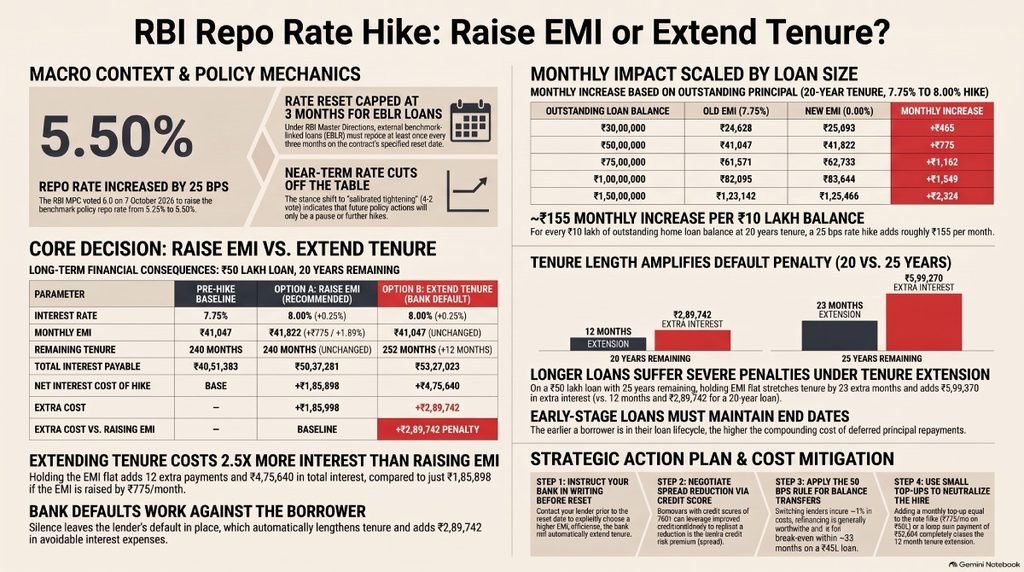
- On a ₹50 lakh loan with 20 years left, the hike adds about ₹775 a month, taking the EMI from ₹41,047 to ₹41,822. Each ₹10 lakh of balance adds roughly ₹155.
- Many banks hold the EMI flat and stretch the tenure instead. On the same loan that adds 12 months and ₹2,89,742 more interest than raising the EMI (₹4,75,640 extra against ₹1,85,898).
- Raise the EMI if your budget carries it. If the higher payment would push you onto a credit card balance or a personal loan, extend the tenure for now and prepay later. Tell the bank in writing before the reset date, because silence leaves the default in place.
- To cut the cost further, ask for a lower spread (credit risk premium), move your loan only if the new rate is 50 bps or more lower, and use part payments. A ₹775 monthly top-up restores the original 240 months.
RBI Repo Rate Hike on 7 October 2026: What the MPC Decided
The Monetary Policy Committee met from 5 to 7 October 2026 and announced its decision on the last day. Four facts matter to a borrower: the new rate, the date, the direction and what the committee said about its next move. The full text is in the RBI’s resolution of the Monetary Policy Committee.
- Decision date: 7 October 2026, at the close of a meeting held 5 to 7 October
- Repo rate: raised by 25 bps, from 5.25% to 5.50%
- Vote on the rate: 6-0 in favour
- Stance: changed to calibrated tightening, with two members preferring neutral
The same day’s statement on developmental and regulatory policies dealt with how customers share financial data through Account Aggregators and with the creation of a consultative committee for financial markets. Home loans, reset rules and prepayment rules did not feature in it, so the borrower protections that applied before 7 October still apply.
Repo rate raised 25 bps to 5.50% in a 6-0 vote
All six members voted for the hike. The policy repo rate moved from 5.25% to 5.50%, and the corridor now sits 25 bps either side of it.
| Rate | Level after 7 October 2026 | What it means for you |
| Policy repo rate | 5.50% | The benchmark that EBLR-linked loans follow |
| Standing deposit facility (SDF) rate | 5.25% | Floor of the corridor |
| Marginal standing facility (MSF) rate | 5.75% | Ceiling of the corridor |
| Bank Rate | 5.75% | Set at the MSF level |
It is the first increase since February 2023, and it undoes only a slice of the easing that came before. The RBI’s Monetary Policy Report of October 2026 records a cumulative 125 bps of repo cuts between February 2025 and August 2026, so 25 bps hands back one-fifth of that. The same report puts the fall in lending rates on existing rupee loans at 91 bps over the cycle. Borrowers keep most of the relief they got.
Calibrated tightening: what the 4-2 stance vote means for rate cuts
The hike was unanimous. The stance was not: the committee moved from neutral to calibrated tightening, and paragraph 15 of the resolution names Dr. Nagesh Kumar and Prof. Ram Singh as the two members who held that the stance should stay neutral. The other four backed the change, which makes the 4-2 split.
Paragraph 14 matters more than the split, because it tells borrowers what to expect. The change in stance takes rate cuts off the table in the near term, so the next policy action can only be another hike or a pause. How far and how long the cycle runs depends on incoming growth and inflation data. The committee is watching underlying inflation, how widely price pressures spread, second-round effects of the supply shock and demand conditions.
Read that as the end of cut expectations, and nothing beyond it, because it forecasts nothing about further hikes. Plan around the EMI you will pay after this hike and count any later relief as a bonus. On timing, Deputy Governor Swaminathan J said at the post-policy press conference that transmission typically takes about a couple of quarters.
Also Read: Viksit Bharat 2047: Analyzing the Strategic Policy Roadmap for a $30 Trillion Economy
How Much Will Your Home Loan EMI Rise After a 25 bps Repo Rate Hike?
On a ₹50 lakh loan with 20 years left, a 25 bps rise adds about ₹775 a month to the EMI. If you ask the bank to hold the EMI instead, the loan runs 12 months longer and costs ₹2.9 lakh more in interest than the higher-EMI route. The assumptions come first.
Worked example: a ₹50 lakh loan with 20 years left
- Principal balance: ₹50,00,000
- Remaining tenure: 240 months, with the first revised EMI due in November 2026
- Rate before the reset: 7.75% (repo 5.25% plus a spread of 2.50 percentage points)
- Rate after the reset: 8.00% (repo 5.50% plus the same spread)
- Interest compounds monthly on a reducing balance, and the EMI falls due at the end of each month
The 2.50-point spread is illustrative. It falls inside the 2.09 to 2.69 percentage point range that the Monetary Policy Report records for EBLR-linked housing loans across bank groups in August 2026. Swap in the spread from your own sanction letter to rerun the maths.
EMI raised or EMI held: total interest and end date
The EMI follows EMI = P × r × (1 + r)^n ÷ ((1 + r)^n − 1), where r is the annual rate divided by 12 and n is the number of months. To find the tenor that a fixed EMI implies at the new rate, solve n = −ln(1 − P × r ÷ EMI) ÷ ln(1 + r). Each figure below comes from these formulas and was checked against a month-by-month repayment schedule.
| Before the hike | After: EMI raised | After: EMI held | |
| Rate | 7.75% | 8.00% | 8.00% |
| EMI | ₹41,047 | ₹41,822 | ₹41,047 |
| Remaining tenor | 240 months | 240 months | 252 months |
| Last instalment | October 2046 | October 2046 | October 2047 |
| Total interest | ₹48,51,383 | ₹50,37,281 | ₹53,27,023 |
| Total repaid | ₹98,51,383 | ₹1,00,37,281 | ₹1,03,27,023 |
The EMI rises by ₹775, or 1.89%. Hold it at ₹41,047 and the loan needs 251.6 months, which a bank rounds up to 252 instalments with a small final payment. That adds a full year of payments.
Month one shows why. At 7.75%, the first month’s interest on ₹50 lakh is ₹32,292, which leaves ₹8,756 of the ₹41,047 EMI to repay principal. At 8.00% the interest is ₹33,333 and the principal repayment drops to ₹7,714, so the hike takes 11.9% out of your first month’s principal repayment. With less principal repaid each month, the road to zero gets longer, and the gap compounds.
Raising the EMI adds ₹1,85,898 in interest against the pre-hike loan. Holding the EMI adds ₹4,75,640, about two and a half times as much. The default option feels cheaper every month and costs more in total.
Home loan EMI increase by loan size
The monthly hit scales with the loan: each ₹10 lakh of balance adds about ₹155 a month at this tenor and rate.
| Loan balance | EMI at 7.75% | EMI at 8.00% | Monthly increase |
| ₹30,00,000 | ₹24,628 | ₹25,093 | ₹465 |
| ₹50,00,000 | ₹41,047 | ₹41,822 | ₹775 |
| ₹75,00,000 | ₹61,571 | ₹62,733 | ₹1,162 |
| ₹1,00,00,000 | ₹82,095 | ₹83,644 | ₹1,549 |
| ₹1,50,00,000 | ₹1,23,142 | ₹1,25,466 | ₹2,324 |
How to calculate your new EMI after the hike
To rerun the example with your own loan:
- Take the principal balance from your latest loan statement
- Note your current rate, and add 0.25 percentage points if the full hike reaches you
- Count the months remaining on the same statement
- Run the EMI once at the old rate and once at the new rate, and read the difference
- Hold the old EMI, apply the tenor formula at the new rate, and read the extra months
Every row of the table above assumes 240 months remaining. A bank’s home loan EMI calculator will reproduce the figures if you enter your balance, tenure, old rate and new rate. Banks round EMIs to the nearest rupee, so their totals can differ from these by a few hundred rupees.
Also Read: The 2026 Guide to PF Contribution Calculation Under New Labour Codes: A Complete Explainer
How the Repo Rate Hike Reaches Your Home Loan: Benchmark Plus Spread
Your loan rate is a benchmark plus a spread, and only the benchmark moves with the repo rate. HDFC’s home loan interest rate page prices floating loans as the policy repo rate plus a spread and gives the current repo rate as 5.50%. You can look up the benchmark. The spread is the part you can argue about, and a later section covers that.
From here the work is practical, and it starts with reading your own sanction letter.
EBLR vs MCLR: which benchmark is your home loan linked to?
An EBLR (external benchmark lending rate) loan follows an external benchmark such as the repo rate, so a repo rate change passes straight into the benchmark. An MCLR loan follows the bank’s own marginal cost of funds. It reprices once the bank revises its MCLR and your contract’s MCLR reset tenor, which is one year or less, comes round.
Most borrowers are in the first group. The Monetary Policy Report puts EBLR-linked loans at 68.2% of floating-rate loans at scheduled commercial banks at the end of June 2026 and MCLR-linked loans at 29.6%.
| EBLR-linked loan | MCLR-linked loan | |
| Benchmark set by | An external source such as the repo rate | The bank’s own marginal cost of funds |
| Effect of the 7 October hike | Passes into the benchmark directly | Depends on whether the bank raises its MCLR |
| Reset interval | At least once every three months | The reset tenor in your contract, one year or less |
| Who controls the lag | The reset date in your contract | The bank’s MCLR revision plus your reset tenor |
Open the sanction letter, the loan agreement and the Key Facts Statement issued at sanction. According to the Vinod Kothari FAQ on the RBI reset circular, the Key Facts Statement should state the annualised rate and the possible effect of benchmark changes. Look for four items:
- The benchmark’s name and its current level
- The spread, written as a percentage over the benchmark
- The reset clause (a date or a frequency)
- The line on charges for switching or changing loan terms
If the documents name an MCLR, your loan is not EBLR-linked, and the hike reaches you only after the bank revises its MCLR and your reset tenor comes round. If the letter is vague, ask the branch to confirm the benchmark and the reset date in writing.
EBLR reset date: when your home loan rate changes after 7 October
The repo rate changed on 7 October, but your loan reprices on the reset date in its contract. That gap is why you haven’t seen the new EMI yet.
The RBI sets the outer limit. Section 9(ii) of its Master Direction on Interest Rate on Advances says the interest rate under an external benchmark “shall be reset at least once in three months”. So the wait after any repo move cannot run past the next quarterly reset, though a lender may reset more often. Your contract states which applies.
| Your reset cycle | First reset after 7 October 2026 |
| Monthly, on the 1st | 1 November 2026 |
| Quarterly: January, April, July, October | 1 January 2027 |
| Quarterly: February, May, August, November | 1 November 2026 |
| Quarterly: March, June, September, December | 1 December 2026 |
These dates are illustrations and assume resets fall on the 1st. Banks choose their own cycle, and yours is in the loan agreement.
Expect the bank’s notice close to the reset date. ICICI Bank’s rate reset page, written for its education loans, says customers are told before the reset date, and the RBI’s 2023 rules require lenders to communicate benchmark changes. Find your date now, because the choices described next have to be made before it.
Work out your own wait. On a quarterly cycle, a reset that fell on 1 October leaves a full quarter before the new rate arrives, so your EMI won’t feel the hike until 1 January. A reset in early August brings it in early November. The quickest cross-check is your latest quarterly loan statement: the Kothari FAQ says lenders must show the annualised rate and the number of EMIs left at each quarter end, and that online access to the statement is enough. Read the rate on it, then ask the branch which reset date comes next.
Also Read: Ration Card e-KYC Online (October 2026): Last Dates and How to Complete It
Higher EMI or Longer Tenure After a Repo Rate Hike: Which Costs Less?
Raise the EMI. On the ₹50 lakh loan, the higher payment adds ₹1.9 lakh in interest and the default of a longer tenor adds ₹4.8 lakh. One condition overrides that answer, and it is the budget. If the household cannot carry the higher EMI without borrowing elsewhere or skipping bills, extend the tenure for now and plan to reverse it.
Most banks make this choice for you. The BankBazaar myth-busting piece says banks generally extend the tenure to keep the EMI unchanged, and the Kothari FAQ notes that lenders may set tenor elongation as the default when a borrower does not respond. Only a response from you changes that default.
RBI reset rules: what your lender must offer at reset
The rule is the RBI’s circular of 18 August 2023 on the reset of floating interest rates for EMI-based personal loans, which ICICI’s reset page cites as RBI/2023-24/55. The Kothari FAQ lists floating-rate home loans as covered, and the circular applies to banks as well as housing finance companies and other NBFCs. Ask your lender to confirm in writing that your loan falls under it.
Two limits apply. First, the circular covers only EMI-based floating-rate loans to individuals for non-business purposes, so fixed-rate loans and business loans sit outside it. Second, the Kothari FAQ notes that lenders may set operational rules in the loan documents, such as a cap on part prepayments per year or a window for foreclosure, so read those clauses too.
At reset, you can choose from these:
- A higher EMI, which holds the end date
- A longer tenor, which holds the EMI
- A mix of the two
- Partial or full prepayment, which stays available alongside the other options
- A switch to a fixed rate, if the lender offers one
The last option changed in 2025. The RBI’s amendment of 29 September 2025, in force from 1 October 2025, made the fixed-rate switch optional for lenders. A lender that offers it follows its Board-approved policy, which may cap how many times you can switch, and your bank may not offer it at all. Ask.
Disclosure rules run alongside these choices. The Key Facts Statement at sanction must state the annualised rate and the possible effect of benchmark changes, and the sanction letter must disclose charges for switching from floating to fixed. Each quarter the lender must give you a statement with the principal and interest recovered to date, the EMI, the number of EMIs left and the annualised rate (online access satisfies that). When the benchmark changes, the lender must tell you.
ICICI’s page applies the circular to its education loans and shows how a lender runs the process. Customers are told before the reset. A borrower who makes no request gets the reset applied under the agreed terms and hears about it afterwards.
When the notice arrives, check four things: the new rate, the date it applies from, the revised EMI and tenor, and the deadline for choosing another option. If the notice shows a tenor you did not choose, reply in writing and ask for the option form, because silence leaves the default in place.
Extending the tenure: the extra interest on a ₹50 lakh loan
Go back to the ₹50 lakh loan. If the EMI stays at ₹41,047 after the hike, the loan stretches from 240 to 252 months and the last payment moves from October 2046 to October 2047.
The cost is in the interest line. Total interest rises from ₹48,51,383 to ₹53,27,023, an increase of ₹4,75,640. The higher-EMI route adds only ₹1,85,898, so extending adds another ₹2,89,742 on top.
The arithmetic is simple enough. Holding the EMI saves ₹775 a month, which adds up to ₹1,85,898 over 240 months. The tail of extra instalments, about 11.6 of them at ₹41,047, costs ₹4,75,640. That leaves a net loss of ₹2,89,742.
BankBazaar’s older worked example uses a ₹30 lakh loan at 9% over 15 years, from a different rate cycle, and reaches the same ranking. After a 1% rise it puts the total cost of raising the EMI at about ₹57.84 lakh, against about ₹62.39 lakh for extending the tenor.
An extension is a loan at the loan’s own rate. Every rupee you decline to pay now accrues interest at 8.00% until the end date, which is why ₹775 a month of relief costs ₹2.9 lakh. BankBazaar’s myths piece argues that surplus cash can work harder invested than in an early close, but its return figures date from 2016 and do not describe 2026. Retiring debt earns a certain 8.00%, and few investments beat that without risk.
The damage grows with the remaining tenure: the scenario at the end of this section has a 25-year loan losing almost two years and close to ₹6 lakh to the default.
Raising the EMI: when it is the cheaper choice
Raise the EMI when the extra payment fits your budget, which for most loans it will. The increase runs from ₹465 on a ₹30 lakh loan to ₹2,324 on a ₹1.5 crore loan at 20 years. A higher EMI keeps your original end date and keeps principal falling at the pace you planned. On the worked loan it also cuts total interest by ₹2,89,742 against the extension.
Add up every payment you cannot skip: your current EMI, other loan EMIs, insurance premiums, school fees and household bills. Subtract the total from your take-home pay. If what remains still covers the increase and leaves your emergency fund intact, raise the EMI.
The advice stops where that test fails. If paying the higher EMI means carrying a credit card balance or a personal loan, or skipping an insurance premium to find the money, extend the tenure. Extending costs interest. A missed EMI costs money as well and damages your credit score, and a lower score weakens the spread negotiation described later.
Keep the increase in proportion. The ₹775 is a 1.9% rise in a payment you already make. A 2% raise on a take-home pay of ₹1,00,000 would add ₹2,000 a month, more than twice that.
Treat any extension as temporary. Make part payments when your income rises, or ask the bank to move you to the higher EMI later. The 2023 reset rules keep prepayment available alongside the other options.
20-year vs 25-year home loan: how remaining tenure changes the cost
Two borrowers owe ₹50,00,000 each and face the same hike. Borrower A has 20 years left and Borrower B has 25. Both move from 7.75% to 8.00%, both have the first revised EMI due in November 2026, and interest compounds monthly on the reducing balance.
| Borrower A: 20 years left | Borrower B: 25 years left | |
| EMI before the hike | ₹41,047 | ₹37,766 |
| EMI after the hike | ₹41,822 | ₹38,591 |
| EMI increase | ₹775 | ₹824 |
| Total interest before the hike | ₹48,51,383 | ₹63,29,931 |
| Total interest, EMI raised | ₹50,37,281 | ₹65,77,243 |
| Extra interest, EMI raised | ₹1,85,898 | ₹2,47,312 |
| Tenor if the old EMI is held | 252 months | 323 months |
| Total interest, EMI held | ₹53,27,023 | ₹71,76,613 |
| Extra interest, EMI held vs EMI raised | ₹2,89,742 | ₹5,99,370 |
| Last instalment, EMI raised | October 2046 | October 2051 |
| Last instalment, EMI held | October 2047 | September 2053 |
Borrower B’s EMI rises by ₹824, only ₹49 more than Borrower A’s rise. The cost of the default is a different story: 23 extra months and ₹5,99,370, against 12 months and ₹2,89,742 for Borrower A. The longer the remaining tenor, the more each deferred rupee of EMI costs. If you are early in a long loan, hold the end date.
A split is also allowed, because the reset rules let you combine a higher EMI with a longer tenor. Borrower A could raise the EMI by half the gap, to ₹41,435, and accept a 246-month loan ending in April 2047. The extra interest against the full raise comes to ₹1,40,269, about half the cost of holding the EMI. On the same split, Borrower B pays ₹38,179, finishes after 311 months and owes ₹2,83,786 of extra interest against the full raise.
Questions to Ask Your Bank and Ways to Offset the Home Loan Rate Hike
Contact the lender before the reset date and put every request in writing. This is the script:
- “What are my benchmark, my spread and my next reset date?”
- “What will my new rate and EMI be after the 7 October hike, and from which instalment?”
- “Which reset options will you offer in writing, and do you offer a fixed-rate switch? What does it cost?”
- “What happens if I do not respond before the reset date?”
- “Can you reduce my spread, and what would it take?”
- “What is the minimum part payment on my loan, and what charge applies?”
How to negotiate a lower home loan spread (credit risk premium)
Your rate is the benchmark plus a spread. The market and the contract fix the benchmark, which leaves the spread as your only lever.
The rules set how much room you have. Under section 8(e) of the Master Direction, banks are free to decide the spread over an external benchmark. The credit risk premium inside it may change only when the borrower’s credit assessment undergoes a substantial change, as the loan contract provides. Other components, such as operating cost, can change once in three years, though since 1 October 2025 the RBI amendment lets banks cut them sooner for customer retention.
BankBazaar’s markup explainer says the same in plain terms: the markup stays fixed for the loan’s life, and the RBI allows banks to raise it only if the borrower’s credit score declines. The more creditworthy you are, the lower it sits.
That gives you your lever. A better credit profile gives you grounds to ask for a lower premium, and the bank’s retention latitude lets it say yes. BankBazaar’s guide to home loan spreads says borrowers with a high score and stable income get the lowest spreads, and its home loan tips say a score of 750 or more with stable income gives a good chance at the lowest rates. HDFC’s rate page agrees that a higher score often earns a more favourable rate.
The bank is not obliged to cut the premium when your score rises, since the Direction says only when it may change. A credible alternative offer is what moves it. HDFC’s rate page quotes spreads from 2.50% to 7.95% over the repo rate across its rate card, which shows how far a borrower’s profile moves the price. For reference points, the Monetary Policy Report records average spreads over repo on EBLR-linked housing loans in August 2026 of 2.09 percentage points at public sector banks and 2.69 at private banks.
Put the request in one sentence the branch cannot misread: “My credit score was X at sanction and is Y today. My spread is Z percentage points over the benchmark, so please review my credit risk premium and confirm in writing whether you will reduce it.”
What to do this week:
- Pull your latest credit score report
- Read the spread off your sanction letter
- If your score has risen since sanction and your spread sits above the averages above, write to the bank asking for a credit risk premium review and a spread reduction
- State that you are weighing a transfer, and keep the bank’s reply
Home loan balance transfer: the 50 bps break-even rule
A balance transfer is worth it when the monthly saving repays the switching cost inside the time you will keep the loan.
BankBazaar’s home loan tips put a move to another lender at about 1% of the loan, with more paperwork, and say it makes sense mostly when the new rate is ideally 50 bps or more lower. Its spread guide names the processing fee and the legal fee as extra costs of refinancing, and adds MOD charges to the bill.
Suppose the balance is ₹45,00,000 with 216 months left at 8.00%, and the switching cost is 1%, or ₹45,000.
| New rate | EMI | Monthly saving | Break-even | Net saving over the remaining term |
| 8.00% (current) | ₹39,373 | None | None | None |
| 7.75% (25 bps lower) | ₹38,696 | ₹678 | 66 months | ₹1,01,370 |
| 7.50% (50 bps lower) | ₹38,024 | ₹1,350 | 33 months | ₹2,46,496 |
| 7.25% (75 bps lower) | ₹37,358 | ₹2,016 | 22 months | ₹3,90,363 |
| 7.00% (100 bps lower) | ₹36,698 | ₹2,676 | 17 months | ₹5,32,956 |
A 25 bps gap takes more than five years to repay the fee, while a 50 bps gap takes under three. That arithmetic is behind the 50 bps rule of thumb, and it assumes you keep the loan well past the break-even date.
Ask your current bank first. BankBazaar says staying with your lender and moving to a repo-linked rate usually takes a branch visit and a small processing fee, and its spread guide advises asking your existing lender to refinance to the lowest rate it offers. Take the new lender’s written offer along to that conversation.
Check the exit charge on your current loan before you sign anything. The next section covers what this guide could confirm about prepayment charges.
Home loan prepayment: what a lump sum or monthly top-up saves
Prepayment goes after the part of the hike that hurts most: the extra months. The same ₹50 lakh loan shows how much.
A one-time payment of ₹92,604 made with the first revised EMI erases the 12-month extension even if you keep the old EMI. Larger sums and small monthly extras do more.
| Action, with the old EMI of ₹41,047 kept | Months to close | Months saved vs 252 | Interest saved vs the default |
| ₹92,604 lump sum | 240 | 12 | ₹3,83,036 |
| ₹2,00,000 lump sum | 228 | 24 | ₹7,84,906 |
| ₹5,00,000 lump sum | 198 | 54 | ₹17,18,680 |
| ₹2,000 extra every month | 225 | 27 | ₹6,82,144 |
| ₹5,000 extra every month | 194 | 58 | ₹14,08,208 |
These lump sums land on day one, which is the best case. A lump sum paid in year five saves less, because interest on the early balance has already been paid.
A monthly top-up of ₹775, the exact size of the EMI rise, restores the original 240 months. It does the job of the higher EMI, with one difference: you can skip it in a lean month.
Check the charge before you pay. As the Kothari FAQ reads the NBFC and housing finance company directions, prepayment penalties on floating-rate loans to individuals for non-business purposes are barred, partial prepayment included. ICICI’s reset page says part payments on its education loans carry no part-payment charge, with a minimum of one EMI. For banks, this guide could not confirm the equivalent rule from the RBI texts it relies on, so ask your bank for its charge in writing.
This week, pick one move: set a standing instruction for a monthly extra at least as large as your EMI increase, or decide the lump sum you can pay from savings or a bonus and ask the bank for the part-payment form.
Home Loan EMI After Repo Rate Hike: FAQs
Your rate rises automatically on the reset date, but the EMI may not. BankBazaar notes that many banks extend the tenor to hold it steady. That default costs more than a higher EMI: on the worked ₹50 lakh loan it adds ₹2,89,742 in interest. Tell the bank your choice before the reset date.
On the next reset date in your loan contract. For an EBLR loan, the RBI’s Master Direction caps that gap at three months. An MCLR loan waits for the bank’s next MCLR revision and its own reset tenor. Your sanction letter gives the date.
Raise the EMI if your budget carries it. On the worked loan the higher EMI costs ₹1,85,898 in extra interest and the longer tenor costs ₹4,75,640. Extend only if the higher payment would push you into a credit card balance or a personal loan, and reverse the extension through part payments when you can.
At 7.75% rising to 8.00% with 20 years left, the EMI on a ₹1 crore home loan goes from ₹82,095 to ₹83,644, an increase of ₹1,549. Each ₹10 lakh of loan balance adds about ₹155 a month. The loan-size table above gives other balances.
The resolution says only that the next move is a hike or a pause and that cuts are off the table for now (paragraph 14 of the MPC resolution). The next MPC meeting runs from 2 to 4 December 2026, and any forecast of its outcome is a guess.
Only if your lender offers it. Since 1 October 2025 the switch has been optional for lenders under the RBI amendment, and the lender’s policy may limit how many times you can switch. Ask for the fixed rate and the switching charge in writing. The sanction letter should already list the charge.
Not during the fixed period. BankBazaar notes that most banks fix the rate for only three to five years, after which the loan becomes floating. Check when yours converts, because the reset rules in this guide apply from that date.
Only if the new rate is about 50 bps lower or more and you keep the loan for at least three years. On a ₹45 lakh balance, a 50 bps gap saves ₹1,350 a month and repays a 1% switching cost in 33 months. Ask your current bank for a spread cut first.
It depends on the lender. NBFC and housing finance company rules bar penalties on floating-rate loans to individuals, according to the Kothari FAQ, and ICICI levies no part-payment charge on its education loans. For a bank home loan, ask for the charge in writing.
The reset applies under your loan’s agreed terms, and the lender’s default usually lengthens the tenor, as the Kothari FAQ and ICICI’s reset page describe. The bank tells you afterwards. On the worked loan that means 12 extra months and ₹2,89,742 more interest than the higher-EMI route.
What to Do Before Your Reset Date
Write to your lender before your reset date and instruct it to raise the EMI to the new figure and keep the original end date. Do it this week, with your sanction letter open beside you. The reset date is the one deadline in this process, and the bank will not move it.
India Policy Hub tracks each RBI move and what it does to household loans, and its newsletter follows the next MPC decision, due at the close of the 2 to 4 December meeting.




Leave a Reply