
How to Change Life Insurance Policy Nominee (Online & Offline Processes)

Why You Need to Update Your Life Insurance Nominee
A life insurance nominee is not something you set once and forget. A marriage, a new child, a relationship that ends while another begins: none of it updates a policy record by itself, and the wrong name can be left sitting there. When a claim comes in, the insurer pays whoever the record names, not whoever the policyholder actually meant to protect. Hence, knowing how to change life insurance policy nominee becomes crucial.
Changing that name sounds like a five-minute task. For some insurers, it nearly is. For LIC, which still holds the largest share of policies in India, it isn’t, and pretending otherwise wastes a policyholder’s afternoon. Private insurers offer a portal-based process; LIC still requires a branch visit, and underneath both sits the law that decides who actually owns the money once it’s paid out.
At A Glance: How to Change Life Insurance Policy Nominee
- Online vs. Offline Reality: While private insurers (like HDFC and ICICI) allow OTP-based portal updates, LIC still strictly requires a physical branch visit to process a change.
- The Beneficial Nominee Law: Following the 2015 Amendment to Section 39, naming a spouse, child, or parent grants them absolute ownership of the payout, protecting the money from other legal heirs.
- LIC Requirements: To change an LIC nominee, you must submit Form 3750 along with the original policy bond at the specific branch that services your policy.
- Minor Nominees: If you name a child under 18, you must legally designate an adult appointee to manage the funds until they come of age.
- Creditor Protection: A standard nomination does not protect the payout from your creditors; only policies registered under the Married Women’s Property (MWP) Act offer this legal shield.
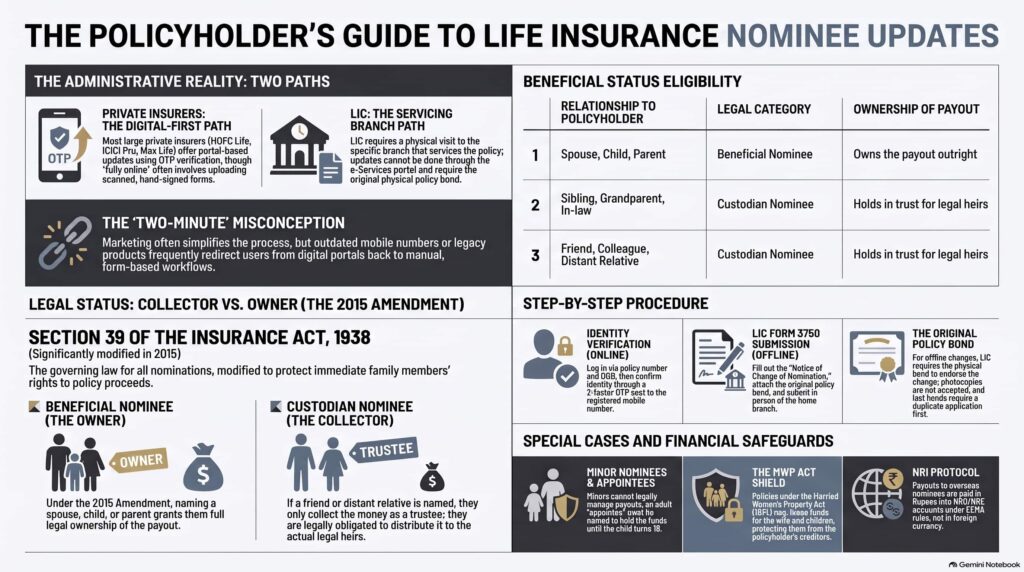
The Administrative Reality: Why “Fully Online” is a Misconception
Insurer marketing calls nominee updates a two-minute online task. For a slice of the process, that’s fair. For the rest, it’s optimistic.
Take HDFC Life. Its own customer FAQ guide walks a policyholder through changing beneficiary details under the Married Women’s Property Act, and the actual mechanism is: download a form, fill it out by hand, and email the signed copy back as a soft copy. That’s digital in the sense that no paper crosses a counter. It isn’t self-service in any real sense: someone at the insurer still opens the email and checks the signature before keying the change in by hand.
LIC doesn’t pretend otherwise. Its own e-Services portal lets a policyholder view nominee details, track a policy, and pay premiums, but the corporation says plainly that nomination changes don’t go through that portal. PayBima’s walkthrough backs this up: the online facility is there for viewing information, not for changing a nominee. Policybazaar adds a detail worth knowing before anyone drives to a branch: the change can only be filed at the specific LIC branch servicing the policy, not whichever one happens to be closest.
Axis Max Life runs its nominee change through a dedicated help-center page, framed as a quick account-level update. That framing holds up for a policyholder who bought through the same digital channel and kept their KYC current. It holds up less well for anyone whose policy predates the insurer’s current portal, whose registered mobile number has since changed, or whose specific product wasn’t built with self-service in mind. In those cases, the same “change nominee” link quietly redirects to a downloadable form instead.
The honest picture: a handful of private insurers, mostly the larger digital-first ones, have built portals where routine nominee edits go through in a login-OTP-confirm sequence. Everyone else, LIC included, still routes the request through a signed form, a document upload, or a branch counter, with a staff member acting on it before anything changes. Knowing which bucket a policy falls into before starting saves a wasted afternoon.
The Policy Shift: Section 39 and the Concept of the “Beneficial Nominee”
Every nomination in an Indian life insurance policy runs through one section of a law that is now close to ninety years old: Section 39 of the Insurance Act, 1938. It gives a policyholder the right to name someone to collect the payout. For decades, that was the whole of it: a nominee collected the money, and nothing in the law said the money was theirs to keep. The 2015 amendment changed that outcome for most Indian families, and it is worth getting straight before anyone fills in a name.
How the Insurance Laws (Amendment) Act, 2015 Changed Wealth Transfer
Before 2015, a nominee’s job began and ended with collecting the cheque. If the policyholder had other legal heirs, a spouse, children, parents, siblings, whoever the law recognised, those heirs could still stake a claim to the money the nominee had just picked up. The nominee held it, in effect, for someone else.
The Insurance Laws (Amendment) Act, 2015 rewrote that default, though only for a specific group of people. Under the amended Section 39, a spouse, child, or parent named as nominee now counts as a beneficial nominee: someone who gets full legal rights over the payout instead of just holding it for others. For that category, the money is theirs outright the moment the claim settles.
The amendment did not touch every nomination equally. A friend, a distant relative, a colleague named as nominee still collects the payout as a custodian, holding it until it reaches whoever the law or a will says should have it. Insurers know this, which is why naming someone outside the immediate family often triggers extra paperwork. HDFC Life, for instance, requires a moral hazard questionnaire when the nominee is not a first-degree relative, precisely because the beneficial-nominee protection does not extend that far.
Also Read: Hidden Charges In Insurance Policy? How to File an IRDAI Grievance Successfully
The Distinction Between a “Collector” and an “Owner” of the Payout
Nominee, beneficiary, and beneficial nominee get used loosely in everyday conversation, and that loose usage is exactly what causes confusion at claim time. Insurers and courts draw the line differently.
A nominee is whoever the policyholder names on the form to receive the payout first. That is a procedural role, and it says nothing about who actually gets to keep the money.
A beneficial nominee is a nominee who also falls into the protected category the 2015 amendment created: spouse, child, or parent, unless the policy was assigned away or falls under a scheme like the Married Women’s Property Act, where different rules apply entirely. This person owns the payout outright.
Everyone else who receives the money without qualifying for beneficial status collects it as a trustee for the actual legal heirs, decided either by succession law or by a will. They cannot spend the payout freely the moment it lands, and if a dispute comes up later, they may have to account for how they used it.
Also Read: Health Insurance Claim Rejected? How to Escalate to the Insurance Ombudsman
Which Family Members Qualify for Beneficial Status?
The 2015 amendment names three relationships and stops there: spouse, children, and parents of the policyholder. Ditto’s breakdown of nominee rules calls these the preferred nominees, precisely because they carry full rights over the payout under the amended law rather than just holding funds for other heirs.
Grandparents do not qualify, nor do siblings, nor in-laws, not even a spouse’s parents. Naming any of them still works as a nomination. It just does not carry the automatic ownership protection that a spouse, child, or parent gets.
One thing to flag here: a policy nominated under Section 6 of the Married Women’s Property Act, 1874 sits outside these rules entirely. Under an MWP Act policy, the wife and children become beneficiaries by law, and Section 39’s usual provisions, beneficial nominee included, do not apply. HDFC Life’s customer FAQ confirms a nominee can also serve as the trustee under this arrangement, and setting it up means downloading the MWPA form and emailing the signed copy back to the insurer.
| Term | Who qualifies | Rights over the payout |
| Nominee | Anyone the policyholder names on the form | Receives the payout first; no automatic ownership |
| Beneficial nominee | Spouse, child, or parent named as nominee | Owns the payout outright once it’s paid |
| Custodian nominee | Any other nominee, such as a sibling or friend | Holds the payout for the legal heirs; doesn’t own it |
| Legal heir | Determined by succession law or a valid will | Entitled to a share whenever the nominee isn’t beneficial |
Nominee vs. Legal Heir: Resolving the Ultimate Financial Conflict
A beneficial nominee settles most disputes before they start. Everyone else who collects a payout as a custodian eventually runs into the harder question: who actually inherits it?
The Intersection of Insurance Law and the Hindu Succession Act
When a nominee collects money as a custodian rather than an owner, the next question is who the actual heirs are, and that question gets answered by succession law, not insurance law. For a Hindu, Buddhist, Jain, or Sikh policyholder who dies without a will, the Hindu Succession Act decides how the estate splits among the surviving family. Section 39 never overrides that split; it only decides who physically receives the cheque first.
This is where families run into trouble. A father names his eldest son as nominee out of habit, assuming the money will get shared with his other children informally, without ever writing that down. If the son is not also a beneficial nominee, and there is no will, the succession law’s division applies regardless of what the father assumed, and the son is legally on the hook to account for the other heirs’ shares. Naming a beneficial nominee, or naming multiple nominees with set percentages, avoids the ambiguity entirely.
Also Read: The 2026 Guide to 100% FDI in the Indian Insurance Sector: A Complete Policyholder Impact Analysis
Landmark Supreme Court Rulings on Insurance Payout Disputes
Indian courts spent decades ruling on the same underlying question before Parliament stepped in: does naming a nominee transfer ownership, or just the right to collect? For policies outside the beneficial-nominee categories, the consistent judicial answer was collection only. A nominee who was not also a legal heir held the payout in trust and could be compelled to hand over shares to whoever succession law actually recognised.
The 2015 amendment can be read as Parliament turning that judicial default into a statutory shortcut for one group of nominees (spouse, child, parent) so those families would not need a court to confirm what everyone already assumed. Outside that group, the older principle still holds. Courts continue to treat a non-beneficial nominee as someone who received money on behalf of the estate, not someone who owns it free and clear. Anyone contesting a payout where the nominee is not a beneficial one is, in effect, invoking a decades-old principle rather than making a new argument.
How a Registered Will Interacts with an Insurance Nomination
A will and a nomination can point to different people, and when they do, the nomination usually wins for the narrow purpose of who the insurer pays first. LIC’s own process for offline nominee changes allows a registered will to specify or modify a nominee, as long as LIC is informed through the standard endorsement process.
That is a narrower power than it sounds. A will can name a new nominee, which functions the same as filing a change of nomination, but it does not override a beneficial nominee’s ownership once the amendment applies. Where the two documents genuinely conflict, and a family is willing to litigate over it, the outcome depends on whether the recipient qualifies as beneficial, what the will actually specifies, and the same succession principles courts have applied for decades. The simpler fix sits outside the legal theory entirely: update the nomination form directly instead of leaning on a will to do that job.
Step-by-Step Procedure: Executing a Nominee Change Online (Private Insurers)
Private insurers have built the closest thing to a genuinely self-service nominee change, and the process looks broadly similar from one company to the next even though the branding differs.
- Log in to the insurer’s customer portal with the policy number or registered email, plus the date of birth
- Confirm identity through an OTP sent to the registered mobile number
- Open the nominee or beneficiary details section and enter the new nominee’s information
- Upload identity proof, and an appointee’s details if the nominee is a minor
- Submit the request and save whatever confirmation or acknowledgment the portal generates
Navigating Customer Portals (HDFC Life, ICICI Pru, SBI Life)
Every private insurer with a genuine self-service portal follows roughly the same shape: log in, find the policy, open a nominee or beneficiary details section, submit the change, wait for confirmation.
HDFC Life runs its policy management through a dedicated customer account portal for issued policies, alongside a broader customer assistance guide that covers the login and application-tracking steps in detail. Bandhan Life’s version of the same idea is a portal called iAssist, where a customer logs in with a registered mobile number and a one-time password, selects the relevant policy, and edits the nominee details.
Axis Max Life runs a comparable flow through its own customer portal. Once logged in, a policyholder can update nominee or contact information without a branch visit. SBI Life keeps a dedicated policy servicing forms directory on its site, for cases where the digital route is not available or a physical form is still required for a specific product.
ICICI Prudential runs a similar portal-based structure to its peers, though the exact screens and menu labels vary from company to company. The safest approach with any given insurer is to open its own customer portal and look for a “nominee,” “beneficiary,” or “policy servicing” section, rather than assume a menu name carries over from one insurer to the next.
Two-Factor Authentication and OTP Verification Workflows
The identity check behind these portals almost always comes down to the same two layers: something the policyholder knows, a password or date of birth, and something they have, a phone that receives a one-time code. HDFC Life uses exactly this pattern in its online application flow: it sends an OTP to the registered mobile number and confirms identity before letting the process continue. Bandhan Life’s iAssist portal works the same way for existing policyholders logging in to make servicing changes.
This matters more than it looks. A nominee change redirects a potentially large sum of money, so insurers treat identity verification here at least as strictly as a login to online banking. If the registered mobile number is outdated, the OTP goes nowhere, and the change cannot proceed until the contact details are fixed first, usually through a separate, slower request of its own. Keeping a policy’s registered phone number current turns out to be a precondition for using any of these self-service tools at all.
Digital Document Uploads and KYC Compliance
Even a fully online nominee change usually asks for at least one supporting document: identity proof for the new nominee, and sometimes proof of their relationship to the policyholder. HDFC Life’s documentation table lists Aadhaar, PAN, passport, voter ID, and driving licence among the accepted identity documents, and separately requires a PAN card or Form 60 from every applicant regardless of premium size, something the insurer flags as following a recent regulatory change.
For a minor nominee, the paperwork grows. An appointee has to be named alongside the child, with their own identity proof and a stated relationship to the minor. For a non-family nominee, some insurers add a moral hazard questionnaire explaining why that person was chosen, since the insurer needs to satisfy itself there is a genuine insurable interest at work, not just a stranger with a claim on someone else’s policy.
None of this is unique to nominee changes. It is the same KYC discipline that runs across an insurer’s other digital services. What changes is the stakes: get a KYC document wrong on a nominee record, and the mistake surfaces at the worst possible moment, when a family is trying to file a death claim.
The Offline Workflow: Changing a Nominee with LIC and Legacy Institutions
LIC’s process runs on paper by design, and getting the sequence right the first time saves a second trip to the branch.
Procuring and Formatting the Notice of Change of Nomination
The “notice of change of nomination” is not a letter a policyholder drafts from scratch. It is LIC’s own Form 3750, sometimes called the Nomination Change Form, available at any LIC branch. LIC’s official marketing and service forms directory also lists downloadable service forms online, though the actual submission still has to happen through the servicing branch rather than the download page itself.
Filling in the notice correctly means entering the policy number, the existing nominee’s details, and the new nominee’s full name, date of birth, address, and relationship to the policyholder, exactly as they appear on that person’s official identity documents. Ditto’s walkthrough of the LIC process is blunt about why this matters: a mismatch between the form and the nominee’s actual ID, even something as small as a spelling difference, is one of the most common reasons a later claim gets delayed.
Filling Out Form 3750 (Step-by-Step Walkthrough)
Ditto, PayBima, and Policybazaar each describe close to the same five-step sequence for the offline route, and lining them up gives a checklist that holds across all three:
- Collect Form 3750 from the branch that services the policy, or through LIC’s official forms resources
- Fill in the new nominee’s name, relationship, date of birth, and address, along with the existing policy number
- Attach identity proof for the new nominee, such as Aadhaar, PAN, voter ID, or a passport, plus the original policy bond
- Submit the form in person at the servicing branch; LIC does not currently process this specific change through its e-Services portal.
- Collect a written acknowledgment once the branch endorses the change on the policy record, since the update only becomes valid from that point.
There is a cost attached beyond the first change. Ditto’s breakdown of LIC’s fee structure puts it at up to fifty rupees for an electronic policy and up to a hundred rupees for a physical one, tax included, a fee IRDAI caps rather than one LIC sets on its own. PayBima’s guide arrives at the same figures.
Submission Protocols Involving the Original Policy Bond
LIC wants the actual policy bond in hand before it endorses a change, not a photocopy sitting at home in a drawer. That single requirement explains most of why this process resists going digital. An endorsement is a physical mark on a physical document, and the corporation is not willing to update its records without seeing the bond the change applies to.
Policyholders who have misplaced the original bond face an extra step before they can even start: applying for a duplicate policy document, which typically comes with its own indemnity paperwork and a separate fee, before the nomination change can move forward at all. PayBima’s process breakdown lists the original policy document, alongside Form 3750 and identity proof, among the non-negotiable pieces of the submission. Once the branch has verified the bond, endorsed the change, and returned an acknowledgment, the policyholder should keep that acknowledgment together with the bond. Until LIC’s own records catch up, it is the only proof the update ever happened.
| Document | Why LIC asks for it |
| Form 3750 (Nomination Change Form) | Formal notice of the change of nomination |
| Original policy bond | Required for endorsement; LIC won’t accept a photocopy |
| New nominee’s ID proof (Aadhaar, PAN, passport, or voter ID) | Confirms identity and heads off claim disputes later |
| Appointee details, if the nominee is a minor | Names the adult who manages the payout until the minor turns eighteen |
| Signed endorsement request, or a copy of the will | Needed only when the change is being made through a registered will |
Structural Edge Cases in Insurance Nominations
Four situations account for most of the confusion policyholders run into once they move past a simple nominee swap.
Appointing a Guardian: Rules for Minor Nominees
A minor can be named as a nominee. What a minor cannot do is legally receive or manage the payout, so every policy naming a child requires a second name alongside it: the appointee, an adult who collects and manages the money until the child turns eighteen. HDFC Life’s customer FAQ states the same requirement directly: an appointee is mandatory whenever the nominee is under eighteen, and the insurer suggests naming an immediate family member or legal guardian for the role.
The appointee is not a rubber stamp. They are accountable for using the money in the child’s interest, and if a family disagrees later about how those funds were spent, that accountability can end up contested in court, much like any guardianship arrangement.
Other countries handle the same problem differently, which is useful context even though the mechanics do not carry over to an Indian policy. Singapore’s insurance law, for instance, lets a policyholder formally appoint a trustee to hold policy money for named beneficiaries, with the trustee’s powers and limits spelled out in a specific form lodged with the insurer. The underlying goal matches India’s appointee rule: protecting money meant for someone too young to manage it. The legal machinery used to get there does not.
Successive Nominations (Multiple Nominees and Percentage Allocations)
Section 39 does not require a policyholder to pick exactly one nominee. Multiple names can sit on the same policy, each with a specified share of the payout, and if the shares are not spelled out, insurers default to splitting the money equally among whoever survives to claim it.
Bandhan Life’s guide to term insurance nominees describes a related but separate idea: a primary and contingent nominee structure, where a backup name only becomes relevant if the first nominee is no longer alive when a claim is filed. That is not the same as splitting a payout between two people who are both alive at claim time. It is a fallback chain, where one name only takes over if the one ahead of it cannot collect.
Percentages need to add up cleanly. PayBima’s guide notes that unclear or missing percentage allocations are a common reason nomination requests get flagged or delayed, since the insurer cannot process an ambiguous split. Naming three children as nominees at forty, thirty, and thirty percent works fine. Leaving the split blank and hoping the insurer guesses correctly does not.
NRI Protocols: Changing Nominations from Outside India
Living abroad does not exempt a policyholder from the same online-versus-offline split described earlier. It just adds a layer of document handling on top of it. HDFC Life’s FAQ guide lists a specific NRI documentation set for its processes: a FATCA declaration, an NRI questionnaire, and, if the applicant does not hold a PAN, a formal declaration in lieu of one. Most insurers apply comparable requirements to servicing requests filed from outside India, not just to new applications.
Payouts carry their own restriction. Ditto’s nominee guide points out that Indian insurers pay NRI nominees in rupees, into an NRO or NRE account, under FEMA and RBI rules, rather than sending funds abroad in foreign currency. A nominee living overseas should have one of those accounts open and linked before a claim is filed, not after, since setting one up under time pressure adds weeks to a process that is already slower than the domestic version.
For the nomination change itself, insurers with a dedicated NRI service channel generally still expect a signed form and identity documents sent by email or post, the same soft-copy pattern already common for domestic servicing requests. HDFC Life runs a separate NRI service email and phone line specifically for this kind of request, a better starting point than guessing an insurer’s exact NRI paperwork rules in advance.
What Happens if the Nominee Predeceases the Policyholder?
Two different scenarios get lumped together under this question, and they resolve differently.
If the nominee dies before the policyholder and the nomination is never updated, the nomination effectively lapses. PayBima’s FAQ on the point is direct: the nomination becomes void, and the policyholder can and should file a fresh one. If no new nominee gets named before the policyholder also dies, the payout routes through the succession process instead, going to legal heirs rather than a named nominee, which is exactly the outcome a nomination exists to prevent.
If the nominee dies after the policyholder, but before the claim is actually paid, the money does not default back to the policyholder’s other family members. It goes to the deceased nominee’s own legal heirs, treated as part of that nominee’s. Bajaj Life’s guide to choosing a term insurance nominee describes a related safeguard some policies include for exactly this gap: naming a second, contingent nominee who steps in only if the first one is unavailable when the claim is filed.
Both scenarios point to the same fix: treat a marriage, a birth, or a death in the family as the trigger for a nominee review, rather than waiting for a form to land on a policyholder’s desk.
The Financial Consequences of Nomination Failures
Getting a nomination wrong does not just create paperwork. It can lock money away from a family for years, or hand a tax bill to someone who was never supposed to see one.
The Anatomy of an Unclaimed Claim: Why Billions Sit in Insurance Escrow
Money does not sit unclaimed because families do not want it. It sits unclaimed because nobody who is alive knows it exists, or because the person who does know cannot show they are entitled to it.
The same pattern shows up across every source that discusses claims. A nominee who was never told about the policy has no reason to file one. Outdated address or contact details mean an insurer’s own attempts to reach a family go nowhere. A misspelled name or wrong date of birth on the nomination form, the same error PayBima and Ditto both flag as routine, is enough to stall a legitimate claim while the mismatch gets sorted out. A lost original policy bond, especially with LIC, can mean starting the claim process only after first obtaining a duplicate document.
None of these are exotic failures. They are the ordinary kind: an old address on file, a name nobody double-checked against an ID, a policy nobody ever told the family about. IndiaFirst Life’s guidance for nominees after a death spends much of its advice on exactly this, locating the policy, the policy number, and the paperwork before a claim can even be filed, because grief already makes people forget where things are kept. Every one of these gaps has the same fix: tell the nominee the policy exists, where the documents live, and how to reach the insurer, well before any of it becomes urgent.
Tax Implications for the Nominee Upon Payout Receipt
The payout itself is, in the overwhelming majority of cases, tax free in the nominee’s hands. Section 10(10D) of the Income Tax Act exempts the death benefit paid out under a life insurance policy, and Ditto’s nominee guide confirms this applies whether the recipient is a beneficial nominee or a custodian passing funds on to legal heirs.
That exemption covers the death benefit itself, and stops there. Interest that accrues if an insurer delays payment is a separate item, typically treated as income in the year it is received. Any return the nominee later earns by investing the payout, in a fixed deposit, mutual fund, or elsewhere, is taxed under the ordinary rules for that kind of income, entirely separate from the tax-free lump sum that generated it. Families sometimes assume every rupee touched by the original payout stays exempt forever. It does not.
There is one more point that applies specifically to delayed claims. Ditto’s guide notes that LIC and other insurers owe interest on a death claim once it runs past the standard settlement window, calculated at two percentage points above the prevailing bank rate from the date the last required document was received. That interest, unlike the underlying death benefit, counts as ordinary taxable income.
FAQ: How to Change Life Insurance Policy Nominee
Can I change my LIC policy nominee online?
Despite the push for digital services, LIC does not currently offer a fully online nominee change facility. While you can view policy details on the e-Services portal, you are required to submit a physical Form 3750 and the original policy bond at your specific servicing branch to legally endorse the change.
To successfully update your life insurance beneficiary, you will need the insurer’s official nomination change form (such as Form 3750 for LIC), the original policy document for physical endorsement, and valid KYC documents (like Aadhaar, PAN, or Passport) establishing the identity of the new nominee.
Yes. You can appoint multiple nominees and assign a specific percentage of the payout to each individual. If you do not explicitly state the percentage share, insurers will typically divide the death benefit equally among the surviving nominees.
You can name a minor as your nominee, but you must legally designate an adult “appointee”. The appointee will receive and manage the policy funds on the child’s behalf until the minor reaches 18 years of age.
Following the 2015 amendment to Section 39, only the policyholder’s spouse, children, or parents qualify as beneficial nominees. This status grants them absolute legal ownership of the death benefit, protecting the funds from being claimed by other legal heirs under standard succession laws.
Protecting Your Policy Proceeds from Creditors and Debt Attachments
Life insurance proceeds are not automatically shielded from a policyholder’s creditors. What can shield them is a specific, deliberate legal structure: a policy written under Section 6 of the Married Women’s Property Act, 1874.
An MWP Act policy sets the payout aside for the wife and children as beneficiaries by law, outside the reach of the policyholder’s general creditors and outside the normal Section 39 nomination rules entirely. It has to be set up deliberately, at the time the arrangement is created, through the insurer’s own MWPA form. HDFC Life’s process for this is a soft-copy submission: download the form, fill it out, and email the signed copy back for processing.
An MWP Act structure is the exception, not the rule. Without it, or a similar trust arrangement, ordinary policy proceeds paid to a legal heir or custodian nominee can, in principle, be reached by that individual’s own creditors once the money lands in their hands, since at that point it is simply an asset they own. The protection an MWP Act policy offers applies to the proceeds themselves, ring-fenced for the named beneficiaries, not to whatever the family does with the money afterward. Anyone weighing this route seriously, especially a self-employed policyholder carrying business debt, is better off raising it directly with the insurer or a lawyer than assuming a standard nomination offers protection it was never built to provide.
Tata AIA’s own guidance for new term policyholders makes a related point from a different angle: reviewing the nominee alongside the coverage amount is one of five things it recommends doing right after a policy is issued, not years into it. A policy bought at twenty-five, before marriage or children, is still carrying a nominee decision made for a completely different life. Whether the update happens through a portal login or a signed form at a branch counter, it is fifteen minutes deciding who actually receives the money, and how quickly.
Disclaimer
This article is for general informational purposes only and does not constitute legal, financial, or tax advice. Insurance regulations and nomination laws vary by individual and are subject to change. Please consult a qualified professional and verify specific procedures directly with your insurer before updating your policy. The publisher assumes no liability for any actions taken based on this information.




Discussion (1)
Leave a Reply