
RBI’s New Ban on Loan Bundling 2026: Your Rights When Banks Demand Insurance
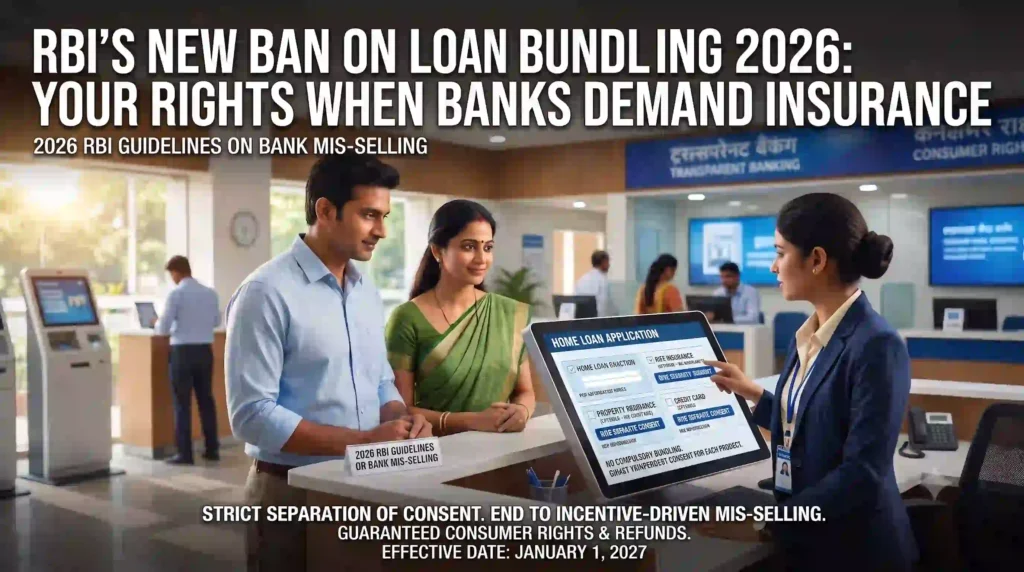
2026 RBI GUIDELINES ON BANK MIS-SELLING
A bank telling a home loan applicant that approval depends on buying a life insurance policy from its preferred partner used to be routine. Here comes the RBI’s new ban on loan bundling, as under its newly finalised rules, that specific practice now has a name and a ban: compulsory bundling.
For years, banks and NBFCs turned a loan sanction into an opening to sell something else in the same breath, a credit card, perhaps, or a mutual fund, or an insurance policy sized to match the loan.
Sometimes that extra product was disclosed clearly. More often it got folded into the paperwork with little explanation, deducted from the loan account before the borrower had worked out what they were actually paying for. Complaints piled up through 2025, in banking ombudsman filings and parliamentary questions, and just as loudly on personal finance forums, until the regulator could no longer treat the volume as background noise.
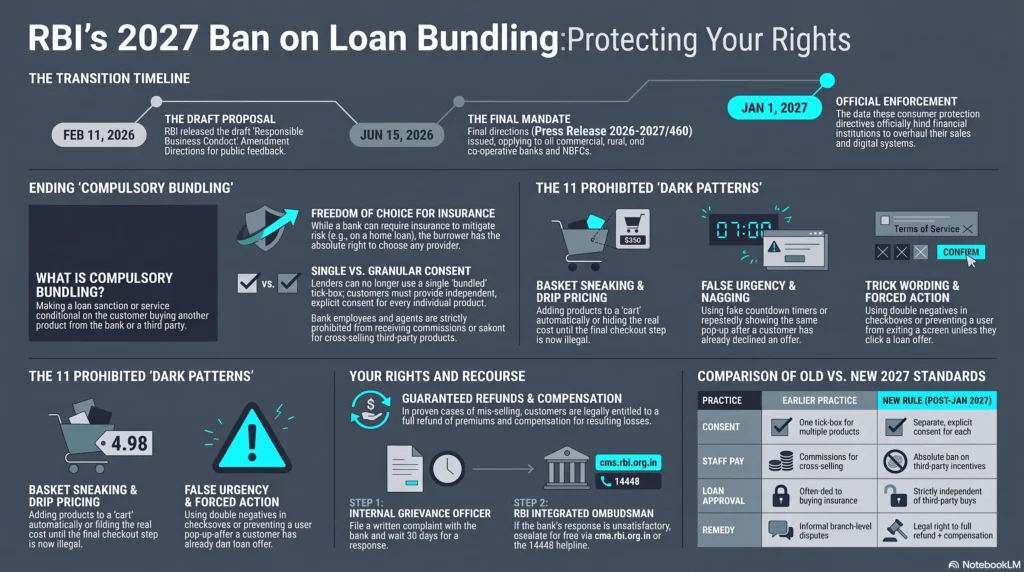
That pressure produced a rule in two stages. On February 11, 2026, the RBI released the Draft Reserve Bank of India (Commercial Banks – Responsible Business Conduct) Amendment Directions, 2026, for public comment.
The Reserve Bank weighed the feedback it received and issued the final Amendment Directions on June 15, 2026, through a Press Release. Those final directions carry only minor changes from the draft, and they apply across commercial banks, small finance banks, payments banks, regional rural banks, urban and rural co-operative banks, all-India financial institutions, NBFCs, and housing finance companies.
The amendment does not start from a blank page. It modifies the Reserve Bank of India (Commercial Banks – Responsible Business Conduct) Directions, 2025, the base conduct rulebook already in force for banks, by inserting an entirely new section on advertising, marketing, and sale of financial products, not by replacing what is already there.
Parallel amendment directions cover small finance banks, payments banks, regional rural banks, co-operative banks, all-India financial institutions, NBFCs, and housing finance companies, so the same bundling ban applies whichever type of regulated lender is involved.
At A Glance: RBI’s New Ban on Loan Bundling 2026
- Ban on Compulsory Bundling: The RBI strictly prohibits banks and NBFCs from making a loan sanction conditional on the purchase of third-party products like life or property insurance.
- January 1, 2027 Effective Date: The new consumer protection directives officially take effect at the start of 2027, requiring all financial institutions to overhaul their sales and digital onboarding systems.
- Strict Separation of Consent: Customers must now provide independent, explicit consent for each individual product. Lenders can no longer use a single, bundled tick-box to attach insurance to a loan application.
- End to Incentive-Driven Mis-Selling: Bank employees and Direct Selling Agents (DSAs) are strictly banned from receiving commissions or target-based incentives for cross-selling third-party financial products.
- Protection Against Dark Patterns: The new rules explicitly outlaw eleven manipulative sales tactics, including false urgency, basket sneaking, forced actions, and trick wording.
- Guaranteed Consumer Rights & Refunds: Borrowers retain the absolute freedom to choose their own insurance provider. In proven cases of mis-selling, customers are legally entitled to a full refund and compensation for any resulting losses.
- Clear Escalation Path: Victims of forced cross-selling have a defined grievance redressal ladder, allowing them to escalate unresolved complaints directly to the RBI Integrated Ombudsman.
The Core Issue: Forced Insurance and Financial Product Bundling
The amendment introduces a formal definition of compulsory bundling: a bank making one product or service conditional on a customer also buying another, whether that second product belongs to the bank itself or to a third party.
A package only escapes the definition if the customer agreed to it voluntarily and it comes at no extra direct or indirect cost, say a zero-balance account bundled with a free debit card and cashback, not a loan bundled with a policy nobody asked for.
The home loan shows most clearly why this matters. Answering a question in the Lok Sabha on July 27, 2026, the Minister of State for Finance confirmed that banks have been told not to make investment products, insurance, or deposits a condition for sanctioning the bank’s own products, home loans named specifically among them.
Where insurance genuinely protects against risk on a secured loan, the customer must still be free to buy it from any provider, not just the bank’s tied partner.
A genuinely voluntary package looks different in practice. A bank offering a zero-balance savings account bundled with a free debit card and UPI cashback, at no extra cost either way, sits on the allowed side of the line. Accepting one product never requires accepting the other, and turning down the free extras does not put the account itself at risk.
A home loan where insurance from a specific partner has to be bought before disbursal sits on the banned side of that same line, even when a loan officer dresses it up as a recommendation instead of a requirement. The practical effect on the customer is identical either way.
Also Read: Ration Card E-KYC Mismatch? A Step-by-Step Guide to Correcting Your Data Online
January 1, 2027: The Implementation Timeline for the New Directives
The effective date moved during the drafting process, and it’s worth tracking closely, because a fair amount of published commentary still points to the earlier one. The February 2026 draft proposed an effective date of July 1, 2026).
Analysts writing about the draft in its first weeks naturally used that date. The final Amendment Directions issued in June pushed it out to January 1, 2027 instead.
That gives regulated entities a longer runway before the rules bind them, time to redesign consent flows and retrain sales staff, and separately, to get digital onboarding rebuilt end to end. Treat this as a general rule for any RBI deadline: check it against the notification itself, not against news coverage written back when only the draft existed.
UNDERSTANDING LOAN BUNDLING AND THE PROFIT MOTIVE
Why Banks Aggressively Cross-Sell Third-Party Products
Selling a second product alongside a loan was never incidental income for a bank. One industry estimate puts compulsory bundling arrangements at a fifth to nearly a third of some banks’ cross-selling revenue historically, income booked as commission from an insurer or asset manager, not as interest.
The same incentive reaches down to individual staff too. A bank employee who hits a cross-sell target gets rewarded for it, and a Direct Selling Agent or Direct Marketing Agent working on commission earns more from a customer who says yes to the extra product than one who says no.
The new directions go after that incentive structure directly, not only the sales script. Banks must ensure that no employee, and no DSA or DMA, receives any direct or indirect payment from a third party for marketing or selling that party’s product, and internal contests or monthly quotas built around pushing particular products are no longer permitted. That targets the incentive to bundle at its root, not simply the moment a customer is asked to sign.
Also Read: What is the PF Ceiling Limit for 2026? A Complete Guide to the ₹25,000 Shift
Common Psychological Tactics Used in Mis-Selling Insurance
The amendment does something unusual for a banking regulation: it names eleven specific manipulation techniques individually and bans each by description, in an annexure devoted entirely to what it calls dark patterns. Several of them show up constantly in reader complaints and in the industry’s own write-ups of the rule.
False urgency is the countdown timer or the “offer ends today” message attached to a loan or insurance product with no real deadline, meant to force a decision before the customer can compare alternatives. Basket sneaking adds something to the purchase automatically, a loan protection policy tacked onto a personal loan application without a separate yes or no.
Confirm shaming punishes the customer for declining, framing a plain “I don’t want extra security for my account” as an admission of carelessness instead of a legitimate choice. A subscription trap makes signing up easy and cancelling deliberately hard, burying the cancel link several screens deep.
Drip pricing hides the real cost until the last possible step, advertising a loan at one rate and revealing the processing fee only at checkout. Interface interference shows up as a bright, prominent “Yes” button next to a barely visible “No,” and disguised advertisements dress up a cross-sell as an urgent account alert.
Trick wording relies on a double negative: a checkbox worded so that leaving it unchecked signs the customer up, and checking it would opt them out. Forced action is a pop-up that will not close unless the customer clicks through to a loan or insurance offer page, sometimes reappearing the moment the customer tries to exit.
Bait and switch means advertising one interest rate and revealing a higher one only once the customer has actually applied, often alongside processing fees that were never mentioned upfront.
Simplest of all is nagging: the same prompt to add a product appears every time the customer opens the app, regardless of how many times they have already declined it.
None of this is theoretical for the people who have lived through it. One long-time bank customer wrote to a personal finance publication describing insurance quietly added to his SBI home loan back in 2008, with a certificate issued afterward and no conversation about whether he wanted the cover at all.
Another described a business loan where the firm had already arranged its own insurance and shown the policy to the bank, only to have the bank buy a second policy anyway and quietly deduct the premium, with interest, from the loan account, These are exactly the patterns the new annexure is written to catch.
Old practice versus new rule
| Earlier Practice | Now |
| A single consent screen once covered the loan and an attached insurance policy together. | Consent must be captured separately for each product, never bundled into one tick box. |
| Insurance used to be added to a home or car loan as a stated condition of approval. | The customer must be free to buy the cover from any provider, or decline it, without the loan being conditioned on that choice. |
| Bank staff and DSAs used to earn a commission tied to how many customers accepted the bundled product. | No employee or DSA may now receive any direct or indirect payment from a third party for selling that party’s product. |
| A mis-sold product could once be disputed only informally, through the branch. | A proven case of mis-selling now entitles the customer to a full refund plus compensation for any resulting loss. |
KEY HIGHLIGHTS OF THE RBI’S NEW RESTRICTIONS
The Strict Separation of Agency Business and Referral Arrangements
Alongside the Responsible Business Conduct amendment, the RBI issued a parallel amendment to the Reserve Bank of India (Undertaking of Financial Services) Directions, 2025. This one tightens the rules specifically for agency business and referral arrangements, the contractual structure that lets a bank sell an insurer’s or asset manager’s product under its own roof.
Under the amended rules, any agent or representative of a third party selling inside a bank branch has to be clearly distinguishable from the bank’s own staff, with visible on-person identification. That way a customer always knows whether they’re speaking to a bank employee or to someone selling on behalf of an outside company.
Banks must also keep an up to date list of every DSA and DMA they use published on their website, and put each one under a written Code of Conduct before any selling begins on the bank’s behalf.
The 2025 base rules being amended already drew a distinction between a bank’s ordinary business and its agency business, selling insurance or investment products as an agent for someone else, precisely because the incentives in the two lines of work pull in different directions .
The June 2026 amendment sharpens that separation instead of inventing it from scratch, adding the identification, disclosure, and incentive rules described above on top of what was already there.
The Absolute Ban on Commissions and Incentive-Linked Payouts for Referrals
This point is worth stating on its own because it closes the loophole that made earlier disclosure rules easy to work around. It is no longer enough for a bank to disclose that a DSA earns a commission. The commission itself cannot be structured to reward pushing one product over another, and no bank employee may receive money, directly or through any indirect route, from the company whose product they are selling. Sales contests, monthly quotas tied to a specific insurance product, days of the month earmarked for pushing one scheme over another: these are exactly the incentive structures the rule is written to eliminate.
Mandatory Upfront Disclosures and Transparency Mandates
Every financial product now needs its own separate application form, clearly labelled by type, so a customer cannot end up uncertain about whether they signed up for insurance, a mutual fund, or a hybrid product bundling the two. Documents must be available in the customer’s own regional language, not only in English. Where a sale goes through a DSA, the DSA has to disclose upfront exactly how the fees or interest rate differ from what the customer would get dealing with the bank directly.
Once a sale involving a third-party product is complete, the bank must confirm it by SMS or email and provide a signed copy of the terms within a reasonable time. That gives the customer a second, calmer moment to notice anything that does not match what they thought they had agreed to. Banks must also let a customer flag themselves as “do not disturb” for further sales calls. Staff or DSAs contacting customers about products already sold are required to redirect them to ordinary customer service instead of reopening a sales conversation.
Staff conduct is regulated almost as tightly as the paperwork. Employees and DSAs are expected to call or visit customers only between 9 am and 6 pm, unless the customer has specifically asked for contact outside that window, and they must give their supervisor’s name and number if a customer asks for it. Feedback is not left to chance either. Banks must run a feedback exercise within 30 days of any sale, drawing customers at random for a call-back or survey conducted by a part of the bank that had no role in the original sale, and the results feed into a half-yearly review of the bank’s own products and sales practices.
The DPDP Act intersection is not incidental here. India’s Digital Personal Data Protection Act, 2025, sets its own, separately enforced standard for consent to the processing of personal data.
Compliance analysts have pointed out that a bank still relying on one bundled tick-box now risks falling short of both regimes at once, not just the banking one (privybyidfy.com/blog/rbi-draft-dpdp-act-a-complete-guide-to-rbi-compliance-for-banks-and-nbfcs-before-july-2026). A consent screen built to satisfy the RBI’s granularity requirement will, in most cases, also land closer to what the DPDP Act expects.
HOW THE NEW RULES PROTECT SPECIFIC CLASSES OF BORROWERS
Home Loan Borrowers: Freedom to Choose Property Insurance Voluntarily
Home loans are the clearest test case, because the sums involved are large, and the insurance attached to them, life cover, property cover, or both, has historically been one of the more lucrative bundles for a lender to arrange. Say a bank requires insurance as a genuine condition of the loan, reasonably enough, as a risk mitigant against the property or the borrower’s life. The customer must still be given the choice to buy that cover from any insurer, not exclusively from the bank’s own tied partner.
The July 2026 Lok Sabha answer makes the government’s position explicit, naming home loans directly as an example of the bank’s own product that cannot be conditioned on a bundled purchase.
Personal and Car Loan Borrowers: Relief from Credit Life Insurance Pressures
The same principle covers personal loans and car loans, where credit life insurance, cover that pays off the remaining balance if the borrower dies or is disabled, has often been presented to borrowers as something they had no real choice about. Under the amended directions, a bank cannot make disbursal of a personal or car loan conditional on buying that cover from its own tied partner.
The choice belongs to the borrower alone, and it has to be recorded as a choice, not assumed: decline the cover altogether, arrange it independently through any insurer, or take it through the bank.
A common version of this pressure looks like a personal loan approved in principle, disbursal held back until the borrower agrees to a credit life policy priced as a share of the loan amount and folded into what gets repaid.
The real cost of borrowing goes up quietly; the headline interest rate never moves. The new rules treat that kind of hold-back as exactly the compulsory bundling they prohibit, whether the loan is unsecured or secured against a vehicle.
MSME and Business Loan Applicants: Eliminating Forced Cross-Selling Hurdles
Small business borrowers have reported a particular version of this problem. A firm that has already insured its stock and premises, say, discovers the bank has added its own policy on top anyway, without asking, and deducted the premium straight from the loan disbursement. One reader account describes precisely this happening on a business loan from a nationalised bank: the firm noticed only a month later and needed sustained effort afterward to get the charge reversed.
The new rules apply the same explicit-consent and no-bundling requirements to MSME and business lending as to retail loans. A business borrower has the same right to say no in advance, and the same right to a refund if a policy gets added without consent after the fact. An unwanted premium folded quietly into a loan disbursement also tends to matter more to an MSME than to a large corporate, since MSMEs typically work with thinner margins, even though it’s the same underlying practice the rule targets either way.
YOUR CONSUMER RIGHTS UNDER THE NEW RBI DIRECTIVES
The Legal Right to Reject Unwanted Third-Party Financial Products
Consent for each product must now be sought separately, never bundled into a single tick box covering several products or purposes at once. A customer interface can’t be built to auto-accept terms and conditions before the customer has actually gone through them. In practical terms, a borrower can decline a specific product without that refusal being treated, formally or informally, as grounds to deny or delay the loan itself, since making one conditional on the other is precisely the practice the amendment bans.
The Right to Transparent Fee Structures and Unbiased Explanations
Before selling anything, a bank must assess whether the product actually suits the customer’s income, age, financial literacy, and appetite for risk, and that assessment has to happen whether or not the customer has already agreed to buy it.
Explicit consent does not retroactively make an unsuitable product acceptable under the new definition of mis-selling. A customer is entitled to a plain explanation of what a product costs and what it covers, weighed against what buying the same thing outside the bank would cost, before money changes hands, not after the paperwork is signed.
The Right to Full Refunds and Compensation for Proven Mis-Selling
Where mis-selling is established, whatever the specific product involved, the bank must refund the full amount the customer paid, cancel the sale where relevant, and compensate for any additional loss the mis-selling caused, under its own approved policy.
Customers have a defined window in which to complain in the first place, whatever timeline the relevant sector regulator has set, or 30 days from receiving the signed terms and conditions if no specific timeline applies to that product.
STEP-BY-STEP GUIDE: WHAT TO DO IF A BANK DEMANDS INSURANCE
Identifying Restrictive Practices During the Loan Application Phase
The test is simple to state even when the practice itself is not always easy to spot in the moment: is the product optional in substance, not only in name. Each of the following maps directly onto one of the eleven dark patterns the amendment now prohibits by name.
- A loan officer implying that sanction is unlikely without the additional purchase
- A single consent screen covering the loan and an insurance policy together
- A countdown timer attached to an “exclusive” offer that never seems to actually expire
- A default setting where declining the extra product takes noticeably more clicks than accepting it
Drafting a Formal Refusal for Bundled Products Without Risking Loan Rejection
A written refusal carries more weight than a verbal one, and it does not need to be elaborate. State plainly that the loan and the third-party product are being treated as separate decisions, that consent to the loan is not consent to the additional product, and that the loan is expected to be processed on its own merits. Keep a copy of the loan sanction letter, the application form for every product involved, and any message in which a bank representative suggested the two were linked.
If a bank representative insists a bundled product remains compulsory after a written refusal like this, that insistence becomes evidence for a complaint, not a reason to give in.
Citing the specific rule by name can help. Paragraph 85V of the Responsible Business Conduct Directions is the clause banning compulsory bundling and requiring a bank to let a customer buy a linked product from any provider, and naming it directly signals that the request is grounded in regulation, not just a preference the bank might otherwise try to talk the customer out of.
Escalating Complaints to the Bank’s Grievance Redressal Officer and the Banking Ombudsman
The escalation path has a fixed order, and skipping a step is the single most common reason complaints get rejected before they are even properly considered.
Complaint escalation ladder
- Bank or NBFC Grievance Officer: File a written complaint by email and registered post, and keep proof of the date it was received. Wait 30 days for a reply before escalating.
- Internal Ombudsman: Larger banks and NBFCs route an unresolved complaint here automatically, as an apex internal stage before RBI. The timeframe is set by the entity’s own policy.
- RBI Integrated Ombudsman: File free of charge at cms.rbi.org.in, or call the toll-free helpline 14448, once the bank’s reply is unsatisfactory or absent. This commonly takes 60 to 90 days.
- Consumer forum or civil court: for claims outside the Ombudsman’s scope, or above whatever compensation ceiling applies. This can take months to years.
The Reserve Bank’s general complaints page, links out to the specific channel for each type of grievance, which matters because not every RBI-adjacent problem goes through the Ombudsman.
| Issue | Where to Report |
| Cyber fraud or phishing | the Cyber Crime helpline 1930 and cybercrime.gov.in. |
| An unauthorised digital debit | Report to the bank first under the RBI’s Zero Liability rules, and escalate to the Ombudsman only if the bank fails to reverse it within its own timelines. |
| An unregistered lending app that is not an RBI-regulated entity | The Sachet portal, not the Ombudsman, since that only covers entities RBI actually regulates . |
| Frequent unsolicited sales calls or messages about loans and insurance | The Sanchar Saathi complaint facility, since bank calls are already restricted to the hours between 9 am and 6 pm unless the customer has asked otherwise. |
None of this should be confused with UDGAM, a separate RBI portal built specifically for tracing unclaimed bank deposits, not for mis-selling complaints of any kind. The Reserve Bank runs several dedicated portals, and the real trick is finding the one built for the specific problem instead of assuming a single system covers everything.
If a complaint is upheld, the Ombudsman can direct a refund plus compensation for the customer’s loss, time, and any mental agony caused. The exact ceiling is worth confirming at the time of filing, not assumed in advance: guides published on the current scheme cite noticeably different figures for the same category of compensation, ranging from one lakh rupees to thirty lakh rupees.
The Reserve Bank’s own Integrated Ombudsman Scheme document, is the place to verify the current number directly instead of relying on any secondary summary of it. Once an award is accepted, the entity generally has 30 days to comply, and a complaint must usually reach the RBI within one year of the bank’s final reply.
An Ombudsman decision is not automatically the final word either. If an award feels wrong, or a complaint was rejected without what looks like a proper reason, the complainant can appeal to the Appellate Authority, typically the Executive Director in charge of the RBI’s Consumer Education and Protection Department, within 30 days of receiving the order.The same CMS portal used to file the original complaint also handles the appeal, so there is no separate system to learn for this step.
THE ROLE OF IRDAI AND SEBI UNDER THE NEW RULES
Regulatory Coordination Between the RBI, IRDAI, and SEBI
The Responsible Business Conduct amendment is explicit that RBI’s rules sit alongside, not instead of, whatever IRDAI, SEBI, and the Pension Fund Regulatory and Development Authority already require for products within their own domains.
In practice, a mis-sold insurance policy attached to a loan can involve two regulators at once: the RBI, because a bank sold it, and IRDAI, because it remains an insurance product. IRDAI runs its own grievance portal, Bima Bharosa, and SEBI’s equivalent channel for investment products is SCORES.
A borrower unsure which regulator technically applies does not need to get it exactly right on the first attempt. Filing with the RBI’s CMS portal for a bank-sold product remains the sensible starting point, since the bank stays answerable for how it sold the product regardless of which regulator governs that product.
Pension products sold alongside a loan, though less common than insurance, fall under the same logic once the Pension Fund Regulatory and Development Authority is the relevant sector regulator instead of IRDAI or SEBI. The RBI’s own directions do not try to duplicate PFRDA’s rulebook. They simply require the bank selling the product to follow whatever suitability, consent, and disclosure standard PFRDA has already set, on top of the bank-specific rules on bundling and incentives.
Ensuring Insurance Premiums Go Directly to Insurers, Not Banks
The agency and referral structure behind bancassurance means that when a bank sells an insurance policy on an insurer’s behalf, the bank is acting as a distribution channel, not as the risk carrier. The obligation to pay a claim sits with the insurer named on the policy, not the bank that sold it. That’s exactly why the disclosure rules insist a bank clarify its role instead of advertising a third-party product as though it were the bank’s own.
The amendment adds a related safeguard on the money itself: a bank cannot fund the purchase of any product, its own or a third party’s, out of a loan it has sanctioned, unless the customer has separately and explicitly agreed to that specific arrangement. Put simply, a bank cannot quietly increase a loan amount to cover an insurance premium and then treat the loan application itself as consent for that premium too.
FUTURE OUTLOOK FOR THE INDIAN LENDING AND INSURANCE MARKETS
The Immediate Impact on Bank Fee Incomes and Target-Driven Cultures
Institutions that leaned heavily on bundled sales have the most to redesign before January 2027. Analysts covering the amendment expect insurers with heavy dependence on bank distribution, bancassurance in industry shorthand, to see a dip in new business in the first year after the rule binds, before volumes settle around purchases that are genuinely voluntary.
For NBFCs specifically, one governance-focused analysis frames the shift bluntly as a move from a sales-first approach to a customer-outcomes-first one. Product suitability, consent design, and DSA oversight become board-level concerns now, not items left to a compliance checklist.
The bundling ban is also only one thread in an unusually active regulatory year for the Reserve Bank, which has separately been reworking its draft rules on foreign investment in the financial sector, even though that particular overhaul sits well outside retail conduct and won’t directly affect how a bank sells a loan.
The Necessary Shift Toward Truly Voluntary Credit Protection Products
None of this bans credit-linked insurance outright. For many borrowers, some form of cover against death, disability, or job loss genuinely reduces risk to their family or their credit record. What changes is that the choice has to be real, not assumed. A customer who wants cover can still buy it through the bank, through the insurer directly, or through an independent agent.
Existing voluntary government-backed schemes, Pradhan Mantri Jeevan Jyoti Bima Yojana and Pradhan Mantri Suraksha Bima Yojana among them, remain available as low-cost options that were never designed to be bundled into a loan in the first place. The National Centre for Financial Education, jointly promoted by the RBI, SEBI, IRDAI, and PFRDA, continues to run public literacy campaigns aimed at helping customers tell these products apart before they are asked to sign anything.
FAQ: RBI’s New Ban on Loan Bundling 2026
No. Under the RBI’s 2026 directions on responsible business conduct, banks are strictly prohibited from compulsory bundling. While a lender can require insurance to protect the asset, you have the absolute right to buy that policy from any external provider. They cannot condition your loan approval on buying from their specific partner.
The new regulations officially come into force on January 1, 2027. This gives financial institutions time to overhaul their digital onboarding and sales incentives. However, borrowers can cite these finalised guidelines now to push back against aggressive cross-selling.
If a bank added a product without your explicit, separate consent, you are entitled to a full refund of the premium paid, plus compensation for any financial loss. The RBI categorizes this as mis-selling, especially if they used dark patterns like pre-ticked boxes or basket sneaking.
First, submit a written complaint to the bank’s internal Grievance Redressal Officer. If they do not resolve the issue within 30 days, or if you are unsatisfied with their response, you can escalate the case for free to the RBI Integrated Ombudsman via the CMS portal (cms.rbi.org.in).
No. The RBI has instituted an absolute ban on direct or indirect incentive-linked payouts for bank staff and Direct Selling Agents (DSAs). Bank employees can no longer receive commissions from third parties for pushing specific insurance or mutual fund products.
A FAIRER AND MORE TRANSPARENT WAY TO BORROW
The core change is straightforward even though the rulebook behind it runs to many clauses: a loan and an insurance policy are two separate decisions, and a bank cannot use its control over one to force an answer on the other.
Borrowers gain a clearer set of things to expect: individual consent for every product, upfront disclosure of costs and roles, a full refund if mis-selling is proven, and a defined path to the RBI Ombudsman if a bank will not resolve a complaint on its own. Banks and NBFCs gain a longer runway than the earliest draft suggested: the rules take effect January 1, 2027, not the mid-2026 date first proposed.
Between now and then, the most useful habit a borrower can build is treating every loan conversation that turns into an insurance or investment pitch as two conversations, not one. Any refusal to bundle belongs in writing. Memory is not enough.
DISCLAIMER
This piece draws on the RBI’s draft and final directions, its press releases, and the July 2026 Lok Sabha answer, all linked above. It’s general information, not legal or financial advice, and since rules, deadlines, and compensation figures can change after publication, confirm the current position with the RBI or a qualified advisor before acting on anything here.




Discussion (2)
Leave a Reply