
How to Apply for Income Certificate Online for Scholarship Eligibility (All States Guide)
Why Your Scholarship Application Depends on a Valid Income Certificate
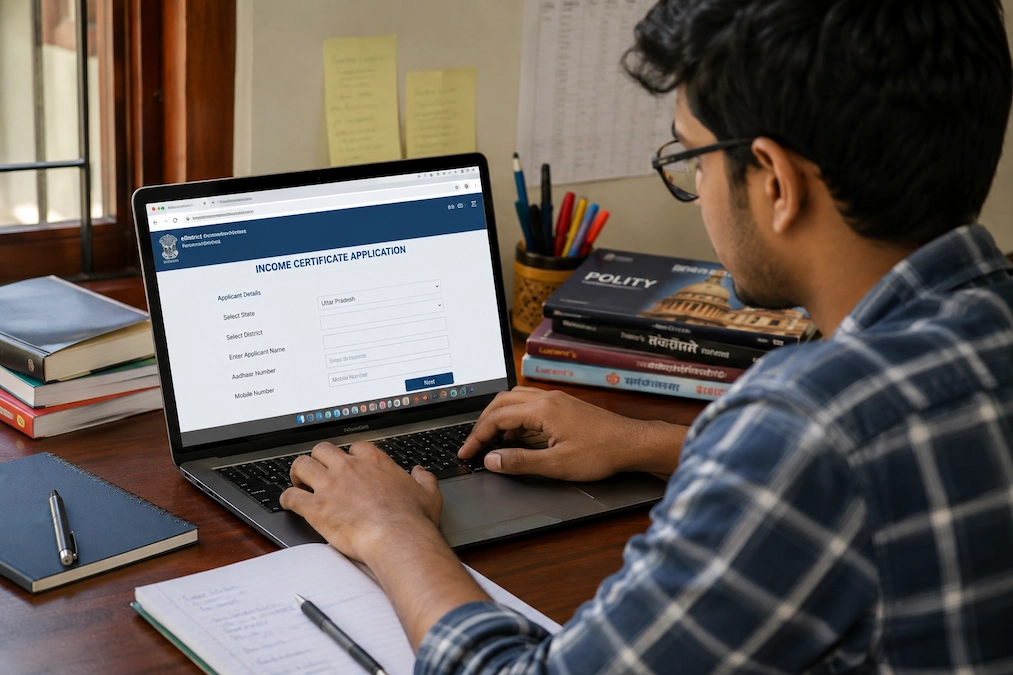
A scholarship file gets rejected before anyone reads the marksheet if one document is missing: the income certificate. Every major scheme routed through the National Scholarship Portal, and dozens of state-run programs outside it, rely on this single paper to decide who counts as economically eligible. It fixes a rupee ceiling, names an issuing officer, and gives the whole application a shelf life. Get any one of those three wrong: a mismatched ceiling, an unauthorised signature, an expired date, and a certificate that took two weeks to obtain is worthless on submission day. The sections below walk through what the certificate verifies, who is legally allowed to sign one, which income counts toward the family total and which doesn’t, the documents worth gathering before you start, the application sequence that repeats across nearly every state portal, where each state’s own portal actually sits, and what to do when a nodal officer rejects the file. In this guide, we will walk you through how to apply for income certificate online for scholarship eligibility
At A Glance: How to Apply for Income Certificate Online
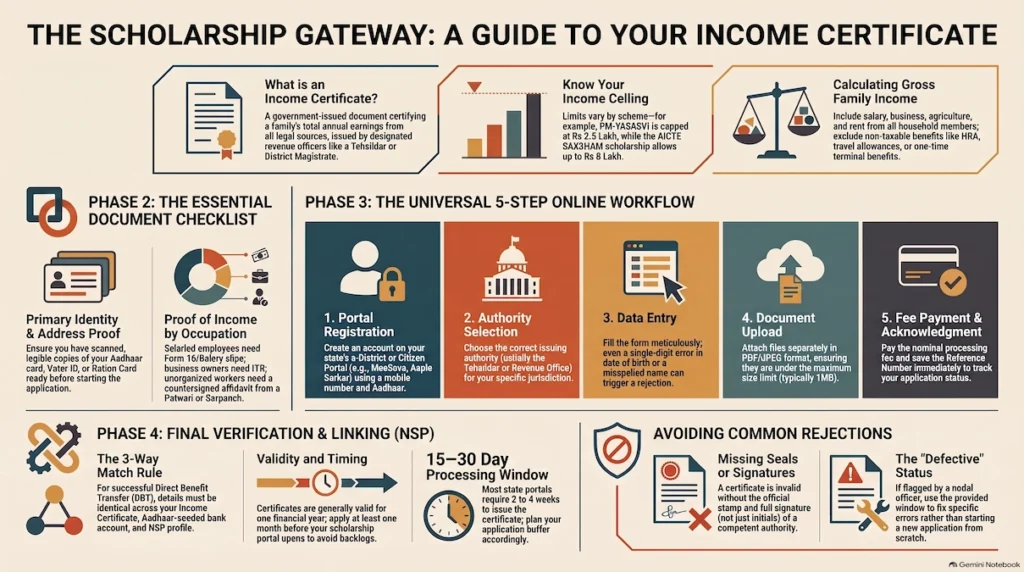
- Mandatory Requirement: An officially signed income certificate is the deciding document for economic eligibility across state schemes and the National Scholarship Portal (NSP).
- Scheme-Specific Ceilings: Gross family income limits vary entirely by scheme—ranging from Rs 2.5 lakh to Rs 8 lakh per year. Always check your target scholarship’s exact guidelines.
- Calculating Family Income: The calculation includes earnings from all household members (salary, business, agriculture) but excludes non-taxable allowances (like HRA) and one-time benefits.
- Required Documents: Gather primary identity/address proofs (e.g., Aadhaar, Voter ID) and occupation-specific income proofs (e.g., ITR, Form 16, salary slip, or a VRO-countersigned affidavit for daily wage earners).
- Online Application Process: Most states use a standard 5-step process through their e-District or citizen portals (e.g., e-District UP, MeeSeva, Aaple Sarkar).
- Issuing Authority: The certificate must carry the seal of a designated revenue officer, such as a Tehsildar, District Magistrate, or Block Development Officer.
- NSP Alignment: For successful Direct Benefit Transfer (DBT), your details must match exactly across your income certificate, Aadhaar-seeded bank account, and NSP profile.
- Validity Period: Certificates typically expire after one financial year. Apply for a fresh certificate at least a month before your scholarship portal opens.
Understanding Income Certificates and Their Role in Scholarship Eligibility
Whether a scholarship application clears its first checkpoint comes down to what the certificate is, why a scheme demands it, and how high the income bar sits. Each state answers these questions in its own way, though the underlying logic repeats everywhere. Learn it once, and a second state’s paperwork rarely trips up the same student, even after the family relocates mid-course.
What is an Income Certificate and Who Issues It?
An income certificate is a government-issued document that certifies a person’s income and the legal sources behind it. Odisha’s Revenue & Disaster Management Department describes it the same way: an official record of an individual’s or a family’s total income, built from name, address, occupation, and annual earnings.
Nobody self-certifies this. The signature has to belong to a designated revenue functionary, and under the AICTE SAKSHAM scholarship’s own rejection criteria, a certificate only counts if it carries the seal of a Tehsildar, a District Magistrate, a Revenue Officer, or a Block Development Officer.
Uttar Pradesh hands the job to its Department of Revenue, issued through the Tehsil office or the state’s e-District portal. The department’s name changes state to state. The rule underneath it doesn’t: a certificate without a competent officer’s seal isn’t a certificate, however accurate the numbers on it are.
Why Income Certificates Are Mandatory for State and Central Scholarships
Scholarship money is rationed by need, and an income certificate is the only document a nodal officer can check that number against. Chhattisgarh’s own guidance lists the certificate’s core uses: tax relaxations, fee concessions and scholarships in education, welfare provisions for SC and ST applicants, and access to state or central welfare schemes generally.
Uttar Pradesh’s list runs longer still, covering subsidised ration, healthcare access, EWS reservation in colleges and government jobs, and free legal aid alongside the education-specific uses. It isn’t a formality collected once and filed away. Scholarship money moves through Direct Benefit Transfer straight into a bank account, so the income figure on this one document is what a scheme’s back end checks before it ever authorises a payment.
On the National Scholarship Portal itself, eligibility hinges on family income falling under a ceiling that differs from scheme to scheme, not one number that covers all of NSP. That ceiling is set scheme by scheme, which is why a student first has to work out which ceiling their own scheme actually uses.
Gross Family Income Limits for Major Scholarship Schemes (NSP, Post-Matric, Pre-Matric)
NSP hosts dozens of schemes, and each one writes its own income cutoff into its own guidelines, not into the portal itself. Three examples show how wide that range runs.
| Scheme | Administering Body | Family Income Ceiling |
| AICTE SAKSHAM Scholarship (degree and diploma, differently-abled students) | AICTE, applied through NSP | Below Rs 8,00,000 per year |
| National Overseas Scholarship for SC, denotified/nomadic tribe, landless labourer, and traditional artisan candidates | Ministry of Social Justice and Empowerment | Up to Rs 8,00,000 per year |
| PM-YASASVI Top Class School Scholarship (OBC, EBC, DNT students, Classes 9 and 11 entry) | Department of Social Justice and Empowerment | Up to Rs 2,50,000 per year |
The pattern in that table isn’t random. Schemes aimed at a broad OBC and EBC population set a tighter Rs 2.5 lakh bar. Schemes built around a narrower category, SC students bound for overseas study, or students with disabilities, run closer to Rs 8 lakh, because a smaller applicant pool can absorb a wider income window without blowing the scheme’s budget. The Ministry of Tribal Affairs runs its own Post-Matric and Pre-Matric schemes for ST students on the same logic: funds move by Direct Benefit Transfer once a state verifies the applicant against its scheme norms, and the rupee ceiling for each track sits inside that scheme’s own guideline document, not one figure that covers every state. Before spending a week chasing a Tehsildar’s signature, an applicant should confirm the exact ceiling their target scheme uses. A Rs 8 lakh certificate is worthless for a scheme capped at Rs 2.5 lakh.
Key Rules for Calculating Family Income for Scholarship Applications
Family income isn’t the same arithmetic as taxable income. Certificate rules pull in some things the Income Tax Department ignores, and leave out things that show up on a payslip.
Included Income Sources: Salary, Business, Agriculture, and Rent
Chhattisgarh’s rules count the earnings of every family member living together, including unmarried brothers and sisters, and fold in business income, the earnings of an NRI family member, income from property, income from labour, and rental income on top of salary. That household definition matters as much as the income list itself. Two working siblings living under one roof before either marries count as a single family unit for the calculation.
That’s why the certificate asks for a self-declaration covering everyone at that address instead of one individual’s payslip, and why the standard document set spans salary slips, income tax returns, and agricultural income records instead of a single document.
A household living off a shop’s takings and a rented-out second floor declares both. Leave out whichever one doesn’t show up on a bank statement, and a verification check catches the gap later.
Excluded Income Components: HRA, Travel Allowances, and Non-Taxable Benefits
Some money that lands in a bank account never enters the family-income figure. Chhattisgarh’s rules specifically exclude family pension, the income of widows, surrender leave salary, terminal benefits, and festival allowance from the calculation.
Look at what those five have in common: none of them are steady, recurring earnings. A festival allowance is a one-time payment. Terminal benefits arrive once, at the end of a career. House rent allowance and conveyance or travel allowance follow the same logic in most state formats, because both exist to offset a cost the employee is already carrying, not to add spendable income on top of a salary.
A certificate that inflates the family figure by counting reimbursement-style payments as income can push a genuinely eligible household over a scheme’s ceiling on paper alone. This cuts both ways. Leave out rental or agricultural income, and the mismatch shows up the moment a scholarship’s verification team cross-checks against a family’s ITR. Fold in a one-off terminal benefit, and an otherwise eligible household can drop out of contention for nothing.
Rules for Unorganized Sector Workers, Daily Wage Earners, and Single Parents
Not every household has a Form 16 to hand over. For applicants without a fixed employer or a payslip trail, Chhattisgarh’s process substitutes a self-declaration affidavit, countersigned by a Patwari, Sarpanch, or ward councillor for rural applicants, in place of salary documentation. That signature is what turns a household’s own statement of its earnings into something a Tehsildar can act on, and it’s why AICTE’s rejection list treats a missing signature or an unnamed authority as an automatic disqualifier, not a minor slip.
Without the signature, the affidavit is just a claim. Daily wage earners face the same documentation gap as informal traders, and the fix is identical: the affidavit stands in for a payslip because a Tehsildar’s countersignature, not a company’s letterhead, is what the certificate actually depends on. The standard family-income certificate format is built to record whichever parent is actually present in the household. AICTE’s own certificate template asks for the student’s name against either “Shri” or “Smt.” as the parent on record, so a single-parent household simply declares under that one parent’s name instead of needing a separate category of form.
Complete Document Checklist Required for Online Application
Every state portal asks for some combination of the same three things: proof of who you are, proof of where you live, and proof of what the family earns. Gathering all three before opening the portal saves a second login.
Primary Identity and Address Proofs (Aadhaar, Voter ID, Ration Card)
For identity, Odisha’s checklist accepts an Aadhaar card, voter ID, or PAN card, and for residence it takes a ration card, an electricity bill, or a passport.
Uttar Pradesh’s list runs almost identically: Aadhaar, PAN, or passport for identity, and Aadhaar, voter ID, or ration card for residence. A passport-size photograph rides along in both checklists, and a caste certificate joins the pile whenever the applicant belongs to a reserved category. Scanned copies need to be legible enough that a verifying clerk can read every digit on the first look. A blurred Aadhaar number is one of the quieter reasons an otherwise complete file sits in a queue longer than it should.
Income Proof Documents by Occupation (ITR, Form 16, Salary Slip, Pension Passbook)
| Applicant’s Occupation | Primary Income Proof |
| Salaried, organized sector | Form 16, the latest salary slip, or an employer-issued income certificate |
| Self-employed or business owner | Income tax return for the relevant year |
| Agricultural income | Land records or agricultural income documents accepted by the revenue office |
| Unorganized sector, daily wage, no fixed payslip | Self-declaration affidavit countersigned by a Patwari, Sarpanch, or ward councillor |
| Retired, drawing a pension | Pension passbook or PPO number issued by the disbursing bank |
A household mixing two of these categories, a salaried parent and a self-employed one, submits both documents instead of picking whichever looks stronger. The certificate is meant to reflect the combined family figure, not the higher or lower individual income. Where a family genuinely spans three or more of these rows, a salaried parent, a self-employed sibling, and a pensioned grandparent under one roof, every applicable document goes in together. Nobody gets to choose which relative’s income to report.
Self-Declaration Forms, Stamp Paper Affidavits, and Village Revenue Officer (VRO) Reports
The affidavit route deserves its own line because it carries the whole weight of an application that has no payslip behind it. Chhattisgarh requires the applicant’s self-declaration alongside a rural certifying signature before the Tehsil office will act on the file, and AICTE’s certificate template shows what that finished document has to look like: dated, sealed, and signed in full, name and designation both. An initial alone won’t do.
Andhra Pradesh and Telangana route the same function through a Village Revenue Officer instead of a Patwari. The title changes at the state border. The underlying job doesn’t. Skip the seal and the affidavit is paper. Get it, and it carries the same weight as a salary slip.
Universal 5-Step Online Application Workflow
Strip away each state’s branding and the same five moves show up on Chhattisgarh’s e-District portal, Odisha’s, Uttar Pradesh’s, and Telangana’s MeeSeva. Learn this sequence once and every state portal becomes a matter of finding the right menu label.
Step 1: Registering on Your State’s Official e-District / Citizen Portal
New-user registration asks for broadly the same fields everywhere: a username, full name, password, district, a security question and answer, mobile number, email, and an Aadhaar number.
Odisha’s version adds mobile and email verification before the account activates, and Telangana’s MeeSeva portal builds a full citizen profile at registration, capturing address, city, and pin code alongside the login credentials. An OTP to the registered mobile number is what finally activates the account on most of these portals. Applicants who already hold an account for a different state service, a ration card update or a birth certificate request, should check whether that same login covers the income certificate too. Most e-District platforms consolidate multiple certificate types under one citizen profile instead of issuing a fresh account per document.
Step 2: Selecting the Issuing Authority (Tehsildar / Sub-Divisional Magistrate / Revenue Officer)
Once logged in, the applicant has to pick who the request goes to. AICTE’s competent-authority list names Tehsildar, Magistrate, Revenue Officer, and Block Development Officer as the valid signatories, and Chhattisgarh’s offline route sends the same form to a Tehsil office or a sub-divisional magistrate’s office depending on where the applicant lives.
On Odisha’s e-District portal this step is a category click: “Revenue & Disaster Management,” then “Income Certificate” from the service list underneath it. Picking the wrong office at this stage is a common reason a file sits untouched for weeks before anyone flags it. Where a portal lists more than one office for a single address, a Tehsil-level office and a district-level one, rural applicants generally should route through the smaller office first and escalate only if it turns out to lack jurisdiction over the specific scheme in question.
Step 3: Filling the Online Application Form with Accurate Family Details
The form itself asks for personal details, residential address, age, and qualification, followed by a separate block for employment details and income details. Odisha’s form structure runs the same way: personal information first, income-related information after. Small mismatches here, a middle name dropped, a date of birth off by a digit, cause more rejections downstream than any missing document does. This step is worth a second read before hitting submit. Compare every field against the identity and residence documents already gathered instead of typing from memory. The form rarely allows an in-place correction once it moves to the issuing officer’s queue.
Step 4: Formatting and Uploading Required Supporting Documents
Each document from the checklist gets attached against its own upload field, not bundled into one file. Odisha’s portal walks through this as a distinct step after the form: review, attach, and confirm before the application moves forward, and Uttar Pradesh’s e-District portal follows an identical upload-then-submit sequence. Scanned copies that are cropped, rotated, or below the size threshold a portal specifies often stall quietly in verification instead of getting rejected outright. Most portals also specify a maximum file size well under a megabyte per document and accept only PDF or JPEG formats. Scanning everything at a moderate resolution before starting the form saves a second trip back to a scanner mid-application.
Step 5: Paying Application Fees, Submitting, and Saving the Application Reference Number
Chhattisgarh charges Rs 30 for the certificate, and most state portals keep their fee in that same nominal range, payable through net banking, a debit or credit card, cash, cheque, or demand draft depending on the portal. Submission produces an acknowledgment slip carrying an application or reference number, and that number is the only thing standing between an applicant and a support call three weeks later when they can’t remember which Tehsil office they applied through. Screenshot it. Write it down. Don’t rely on an SMS you might delete.
State-Wise Online Application Portals and Portal-Specific Instructions
Every state runs its own portal under its own name, even though the underlying five-step sequence barely changes. What follows is a state-by-state map of where to actually go, built from each portal’s own listing.
Uttar Pradesh: Applying via e-District UP
Uttar Pradesh’s income certificate sits with the Department of Revenue, issued online through edistrict.up.gov.in or offline at the nearest Tehsil. Processing typically runs 15 to 30 days, and the finished certificate stays valid for twelve months from the date of issue. The same e-District portal also handles caste, residence, birth, and death certificates under one login, so returning applicants don’t need a second account for a different document.
Maharashtra: Navigating the Aaple Sarkar Portal
Maharashtra’s income certificate runs through Aaple Sarkar. The registration-to-download sequence follows the same shape as Chhattisgarh’s and Odisha’s: create an account, select the income certificate service, fill the family-income form, attach the document set, and pay the portal’s processing fee before submitting. Aaple Sarkar consolidates income, caste, domicile, and several other revenue certificates under one dashboard. An applicant who has requested any of those before will find the income certificate service listed as one more option inside an account they already have, not a fresh registration altogether.
Online Application through Nadakacheri (AJSK)
Karnataka’s revenue certificates, income included, are issued through Nadakacheri, the state’s Atalji Janasnehi Kendra network. Applicants without home internet can walk into an AJSK centre and have an operator run the same online form on their behalf, which makes Nadakacheri one of the more accessible portals for households in smaller towns.
Tamil Nadu: Process on the e-Sevai / TNeGA Portal
Tamil Nadu routes the certificate through its e-Sevai portal, run under the Tamil Nadu e-Governance Agency. As with Karnataka’s centre network, a Common Service Centre can complete the online application for applicants who would rather not do it themselves, though the underlying form and document set stay the same either way. Tamil Nadu’s e-Sevai centres are especially dense in rural taluks, so the assisted-application route is more common there than the fully self-service path most north Indian portals assume by default.
West Bengal: Step-by-Step on WB e-District
West Bengal lists its income certificate service in its related official portal, and the same service is catalogued on the National Portal of India’s West Bengal listing. The state follows the standard registration, form, upload, and submission sequence, with the Block Development Officer typically named as the issuing authority in rural areas.
Delhi: Applying on e-District Delhi Portal
Delhi’s income certificate is issued through the e-District Delhi portal, which sits under the same registration and family-details workflow common to every other state covered here. As in Uttar Pradesh, a single e-District login covers multiple certificate types, so a family that has already registered for one Delhi government service can usually reuse the same account for the income certificate application. Applicants outside the National Capital Territory who need a Delhi-issued certificate, a student who has since moved for college elsewhere but whose family still lives in Delhi, should apply against the family’s Delhi residential address, not their own current one. The certificate verifies household income at a fixed address, not the applicant’s present location.
Rajasthan: Using e-Mitra and Jan Soochna Portals
Rajasthan’s application channel is e-Mitra, at emitra.rajasthan.gov.in, either self-served online or through an e-Mitra kiosk operator for a small service charge. The state’s Jan Soochna Portal sits alongside it as a transparency tool, useful for checking scheme eligibility rules and scholarship income ceilings before an applicant starts the e-Mitra form. It isn’t the application portal itself.
Bihar: Process on RTPS Bihar Portal
Bihar issues the certificate under its Right to Public Service rules, through its official portal. The RTPS structure attaches a statutory service-delivery deadline to the application once it’s submitted. That’s part of why Bihar’s applicants can escalate a delayed file to a designated public-service officer instead of a generic help desk. It’s Bihar’s biggest practical advantage over states without an RTPS-style guarantee: a file that blows past its notified processing time becomes grounds for a formal complaint instead of just a longer wait.
Madhya Pradesh: Applying via MP e-District
Madhya Pradesh’s certificate services, income included, run through its official portal, the state’s e-District portal listed on the National Portal of India as well. MP Online doubles as the state’s broader citizen-services gateway, so the same login handles utility payments and exam applications alongside the income certificate request. That breadth explains the fee structure too: MP Online’s income certificate fee sits bundled with a small portal service charge on top of the government fee itself, a pattern common to states that route certificate applications through a broader citizen-services vendor instead of a dedicated revenue-department site.
Gujarat: Step-by-Step on Digital Gujarat
Gujarat’s applicants apply through Digital Gujarat, at digitalgujarat.gov.in. The portal follows the same registration-to-acknowledgment sequence as every other state covered here, and a Digital Gujarat account, once created, stays usable for the state’s other citizen-services requests. The portal’s design leans heavily on a single unified dashboard, so an applicant chasing an income certificate alongside a ration card correction can often track both requests from the same screen instead of juggling two separate logins.
Andhra Pradesh & Telangana: Meeseva Portal Application Steps
Both Telugu-speaking states run their revenue certificates through MeeSeva, a Government-to-Citizen platform with separate portal for Andhra Pradesh and tg.meeseva.gov.in for Telangana. Registration collects a login ID, password, security question, contact details, and an Aadhaar number. Once logged in, the applicant pays through net banking, a card, cash, cheque, or demand draft, tracks the file by entering the transaction ID under the status-check section, and downloads a digitally signed certificate once approval comes through. Andhra Pradesh’s Village Revenue Officer typically signs off on rural applications routed this way, mirroring the Patwari’s role further north.
Kerala, Odisha, Punjab, and Other State Portals Directory
Odisha’s Revenue & Disaster Management Department issues the certificate through its dedicated portal, with identity, residence, and income proof plus a caste certificate where relevant, a 15-to-30-day processing window, and roughly one year of validity from issue. Kerala’s portal and Punjab’s citizen-services gateway, both following the same registration-through-download sequence already covered above. The remaining states and union territories each maintain their own e-District-style portal:
| State / Union Territory | Application Portal |
| Chhattisgarh | edistrict.cgstate.gov.in |
| Himachal Pradesh | edistrict.hp.gov.in |
| Assam | assam.gov.in |
| Arunachal Pradesh | arunachalpradesh.gov.in |
| Goa | goaonline.gov.in |
| Haryana | edisha.gov.in |
| Jharkhand | jharsewa.jharkhand.gov.in |
| Manipur | manipur.gov.in |
| Meghalaya | megedistrict.gov.in |
| Mizoram | megedistrict.gov.in |
| Nagaland | edistrict.nagaland.gov.in |
| Sikkim | edistrict.sikkim.gov.in |
| Tripura | edistrict.tripura.gov.in |
| Uttarakhand | edistrict.uk.gov.in |
Portal interfaces get redesigned more often than the underlying rules do, so treat every URL in this section as a starting point to verify on the day of application, not a permanent one.
Linking Income Certificate to National Scholarship Portal (NSP 2026 Rules)
A correctly issued income certificate is wasted if it never gets tied to a working NSP profile. Getting a scheme application through means the Aadhaar seeding is done, the certificate is uploaded correctly, and every record across the certificate, Aadhaar, and bank account lines up.
Mandatory Aadhaar Seeding and One-Time Registration (OTR) Requirements
NSP requires a One-Time Registration before any scheme application opens. The sequence runs through scholarships.gov.in/otrapplication: accept the guidelines, verify a mobile number by OTP, verify an Aadhaar number by a second OTP, agree to the consent form, and finish by entering the remaining personal details. A reference number appears on screen at the end, but registration isn’t complete yet.
The applicant still has to download the NSP OTR mobile app and complete a face-authentication step to actually generate the OTR. Skipping that app step is one of the most common reasons a completed-looking registration never turns into a working OTR ID. The consent form step matters more than it looks. It’s what authorises NSP to pull income and category verification data from linked government databases automatically, cutting down on the documents a student has to re-upload for every scheme they apply to in a given year.
Correct Way to Upload Income Certificate Details on the NSP Dashboard
Once the OTR is active, logging in asks for the applicant ID, password, and a captcha, followed by an OTP to the registered mobile number before the dashboard opens. From there, “Application Form” is where the income certificate gets uploaded alongside the Aadhaar card, education documents, and bank passbook that make up NSP’s standard document set. The certificate should be uploaded exactly as issued, unedited and unresized beyond what the portal’s file-size limit requires. NSP’s verification step checks it against the applicant’s declared details, not a summary.
Applicants renewing an existing scholarship for a second or third year go through a shorter version of this same screen, uploading a promotion certificate from their institution alongside the refreshed income certificate instead of re-entering every personal detail from scratch.
Ensuring Alignment Between Income Certificate, Aadhaar, and Bank Account Details
Every field across the certificate, the Aadhaar card, and the bank account has to read identically, because AICTE’s own eligibility rule makes an Aadhaar-seeded bank account mandatory for disbursal, with joint, minor, or frill accounts explicitly rejected. Payment status is checkable independently through the PFMS portal’s “Know Your Payments” tool, using the Aadhaar number, bank details, or the NSP application ID itself, and that same three-way match is what PFMS checks before releasing funds.
A name spelled one way on the income certificate and another way on the Aadhaar card is enough to stall a payment that has already cleared every other verification step. The safest sequence is to update the weaker record first. If the bank account predates a recent Aadhaar name correction, re-seed the account before applying for the certificate. Don’t request the certificate first and find out about the mismatch only when NSP’s automated check flags it weeks later.
Validity Period, Renewal Timelines, and Expiry Rules
An income certificate isn’t a one-time document. It expires, and scholarship deadlines rarely wait for a fresh one to clear a Tehsildar’s desk.
Standard Financial Year Validity vs. Scheme-Specific Rules
Chhattisgarh’s certificate is valid for one year from issue, and Odisha and Uttar Pradesh both run the same twelve-month clock. A renewed certificate carries the identical validity window once reissued. Individual scholarship schemes can still ask for a certificate dated within a narrower window than the twelve months the certificate itself allows, so the certificate’s own expiry date is a ceiling, not a guarantee that any given scheme will accept it right up to that date. A scholarship that opens its portal in July but sets its income-verification cutoff to the previous March, for instance, can reject a certificate issued in June even though that certificate won’t technically expire until the following May.
When to Apply for a Fresh Certificate vs. Renewing an Existing One
Renewal only applies when the underlying numbers haven’t moved. The eligibility rule is specific: the applicant needs an existing certificate that is near or past expiry, and their income status has to be unchanged since the last certificate was issued. A real change in income calls for a fresh certificate, not a renewal of the old.
The renewal authority is typically the same Tehsildar or District Magistrate who issued the original, and the document set for renewal mirrors the original application: the existing certificate, identity proof, residential proof, a recent photograph, and updated income proof A family whose primary earner switched from a salaried job to running a small business mid-year falls squarely into the fresh-certificate category, even if the total rupee figure barely moved. The income source itself changed, and the old certificate’s documentation trail no longer matches the new one.
Buffer Time Management: Applying Ahead of Scholarship Application Deadlines
Processing windows across the portals covered in this guide run 15 to 30 days. That’s the best case, assuming no document gets flagged and no field mismatches trigger a query back to the applicant. A scholarship portal that opens applications on a fixed date, with no extension for a certificate still sitting in a Tehsildar’s queue, punishes late starters specifically. Applying for the income certificate a full month before a scholarship’s opening date, not its closing date, is the margin that keeps a documentation delay from becoming a missed scholarship cycle entirely. Building that month of slack in also absorbs the one delay nobody can plan around: a Tehsildar’s office temporarily backlogged by an unrelated verification drive, a common enough occurrence during peak scholarship season when thousands of families across a district file for the same certificate within the same few weeks.
Resolving Application Errors, Delays, and Rejections
Most rejections trace back to one of a handful of repeat causes, and every one of them is fixable without starting the application over from scratch.
Common Reasons for Income Certificate Rejection by Nodal Officers or Tehsildars
AICTE’s scheme guidelines list four specific reasons an income certificate gets thrown out: it isn’t for the current financial year, it isn’t in the applicant’s or a family member’s name, it was signed by someone outside the competent-authority list, or it’s missing a signature or stamp altogether. Odisha’s broader rejection list adds incomplete or inaccurate information, missing supporting documents, discrepancies in the declared income figure, and mismatched personal details. Uttar Pradesh’s list goes further still, naming invalid proof of residence and failed Aadhaar biometric authentication as standalone rejection triggers separate from any paperwork issue. None of these categories, AICTE’s, Odisha’s, or Uttar Pradesh’s, treat a rejection as final. Every one is a specific, nameable defect. That’s what makes a rejected application fixable instead of something to restart from zero.
How to Fix Name, Date of Birth, or Address Mismatches Between Documents
A mismatch has one real fix: make every document agree, then resubmit. Uttar Pradesh’s authentication failures usually trace to a biometric or demographic mismatch against the Aadhaar record, which means the correction often has to start at the Aadhaar end, through a UIDAI update, before the certificate application will clear on a second attempt. Where AICTE flags a certificate as not carrying the applicant’s or a family member’s name, the fix sits with the issuing Tehsildar’s office directly. Request a corrected certificate instead of trying to argue the discrepancy away on the scholarship portal itself. Keep a dated copy of whatever correction request goes to UIDAI or the Tehsildar’s office. A second rejection for the same already-flagged issue is far harder to appeal than a first one where the applicant can show the fix was already in motion.
Steps to File an Appeal or Resubmit Re-evaluated Applications
NSP marks a flawed application “Defective” instead of rejecting it outright. That status comes with an explanation from the nodal officer and a window to fix the problem before the correction deadline closes. Reading that explanation carefully before resubmitting matters more than resubmitting quickly. A second attempt that repeats the same error burns through the correction window without getting any closer to approval. State e-District portals generally follow the same pattern at the certificate-issuing stage: a query gets raised against the specific field that failed, and the application only needs that one field corrected, not the entire form rebuilt from zero. Where a portal offers no visible “Defective” status and simply shows “Rejected” instead, the practical equivalent is a fresh application referencing the old application number in any remarks field available, so the nodal officer reviewing it can see this isn’t a first attempt.
FAQ: How to Apply for Income Certificate Online
An income certificate is the primary document used by the National Scholarship Portal (NSP) and state-level schemes to confirm economic eligibility. It verifies your family’s gross annual income against the specific financial ceiling set by the scholarship program, which typically ranges from ₹2.5 lakh to ₹8 lakh.
For salaried individuals, a Form 16, recent salary slip, or employer-issued certificate is required. Self-employed parents or business owners must submit their latest Income Tax Return (ITR). If your family relies on daily wages or the unorganized sector, you can submit a self-declaration affidavit countersigned by a local revenue authority, such as a Patwari, Sarpanch, or Village Revenue Officer (VRO).
An income certificate is generally valid for one financial year (12 months) from the date of issue. Because scholarship verification windows can be strict, you should apply for a fresh certificate at least one month before your target scholarship portal opens to ensure the document remains valid throughout the application process.
Common rejection triggers include: submitting an expired certificate, lacking the official seal of a competent authority (like a Tehsildar or Magistrate), declaring an income that exceeds the scheme’s specific limit, or having name mismatches between the certificate, your Aadhaar card, and your bank account.
You can apply directly through your state’s official e-District or citizen services portal (such as MeeSeva, Aaple Sarkar, or e-District UP). The standard 5-step process involves registering an account, selecting your local issuing authority, filling out family income details, uploading supporting documents, and paying a nominal processing fee.
Tracking Online Application Status and Escalating Processing Delays
Every portal covered in this guide supports status tracking by application or reference number: Chhattisgarh’s SMS-plus-portal tracking, Odisha’s “Track Application Status” section, and Uttar Pradesh’s equivalent “Application Status” page. On NSP itself, that same tracking logic covers the scholarship application as much as it covers the certificate: log in, open “Application Status,” and check the stage-by-stage history alongside any nodal officer’s remarks. Payment status specifically runs through PFMS’s separate tracking tool. A file that shows no movement past its portal’s usual processing window is worth escalating directly to the issuing Tehsil or district office. Waiting for a status update won’t help. A stalled file will never produce one on its own.
Disclaimer
This article is for general informational purposes only and does not constitute legal, financial, or professional advice. Government rules, eligibility criteria, fees, procedures, and portal requirements may change. Readers should verify all information with the relevant official government authority or portal before taking any action. IndiaPolicyHub.in does not guarantee the accuracy, completeness, or outcome of any application and accepts no liability for any loss arising from reliance on this information.




Leave a Reply