
EPFO IW Portal Explained: Compliance, CoC Generation, and PF Rules for International Workers
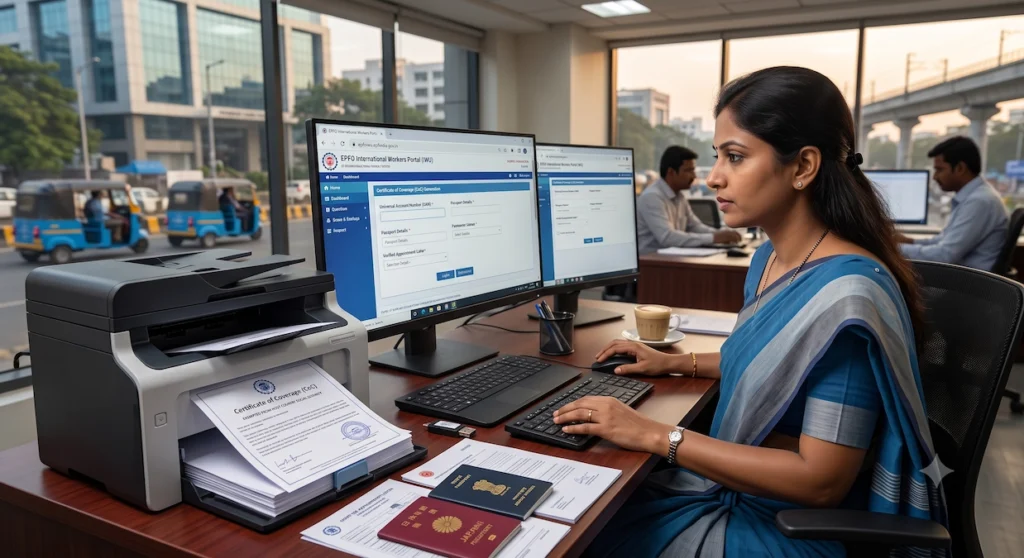
Understanding the 2026 EPFO Framework for International Workers
Every multinational employer with foreign staff in India, and every Indian professional posted abroad under a bilateral treaty, eventually runs into the same portal: epfoiwu.epfindia.gov.in. The EPFO IW portal is where a Certificate of Coverage gets requested, tracked, and finally issued. Skip it, or fumble the paperwork behind it, and an international worker ends up paying provident fund twice: once in India, once at home.
The rules underneath that portal are not settled. A Karnataka High Court ruling in April 2024 briefly upended the entire system for computing PF contributions from international workers, only for the Delhi High Court to reverse course in November 2025 and reinstate it. A new set of EPF, EPS, and EDLI schemes took effect from 29 June 2026, replacing the 1952-era scheme that had governed provident fund since before most of today’s expatriate workforce was born. This guide walks through the mechanics of the IW Portal, who actually counts as an International Worker, what compliance demands from payroll teams, how Social Security Agreements change the math, and what happens when a foreign employee tries to get their money out.
None of this is a niche corner of Indian employment law anymore. Global Capability Centres have pulled thousands of foreign specialists into Indian entities over the past few years, and outbound secondments have grown alongside them as Indian firms send engineers, consultants, and managers on assignments across a widening list of treaty partners. A payroll team that gets the International Worker rules wrong is not making a rounding error. It is exposing the establishment to damages, penal interest, and, in the worst cases, prosecution, over a category of employee that is often a small fraction of headcount but a disproportionate share of compliance risk.
At A Glance: EPFO IW Portal
· EPFO IW Portal Purpose: The mandatory system to generate a Certificate of Coverage (CoC), designed to prevent International Workers (IWs) from paying dual provident fund (PF) contributions.
· 2026 Legal & Compliance Updates: Governed by the new EPF schemes effective June 29, 2026, with the uncapped full-salary PF calculation formally reinstated by a November 2025 Delhi High Court ruling.
· International Worker Classification: Automatically applies to foreign passport holders in EPF-covered Indian establishments, as well as Indian citizens on overseas deputation to countries with active Social Security Agreements (SSAs).
· The Full-Salary Rule: Unlike domestic staff capped at ₹15,000, both PF and Pension Fund (EPS) contributions for IWs are calculated on their total remuneration, mandating strict monthly compliance via Form IW-1.
· SSA Protections & New UK Treaty: Holding a valid CoC under an SSA prevents double taxation. The newest UK-India SSA (active July 15, 2026) introduces new prerequisites, though employers must diligently track all CoC expiry dates to maintain excluded status.
· Fund Withdrawal & Repatriation: IWs from SSA-partner countries benefit from streamlined overseas bank settlements upon exit, whereas non-SSA expatriates (such as US citizens) face a mandatory fund lock-in until age 58.
Step-by-Step Navigation of the EPFO IW Portal for CoC Generation
The portal itself is unglamorous. Getting it wrong is not.
Accessing the International Workers Portal (IWU) and Prerequisites
The IWU portal in is EPFO’s dedicated system for online Certificate of Coverage generation, having replaced the physical application route the organisation discontinued in 2017. Before an employer or employee submits anything through it, a handful of prerequisites need to already be in place:
- An active Universal Account Number for the worker, issued under the EPF Scheme, since the CoC application draws directly on it.
- The establishment’s own registered login, the same one used for filing the Electronic Challan-cum-Return, because the system checks establishment code against contribution history before letting an application through.
- A digital signature certificate held by the authorised signatory and registered against that specific establishment code.
- Passport details, the SSA-partner country of posting, expected assignment dates, and confirmation that Indian PF contributions are current up to the point of departure.
None of this can be assembled the morning an assignment starts. HR teams that leave CoC requests until the visa is already stamped routinely end up paying double contributions for the first month or two, simply because the Indian-side paperwork is still working through the queue. Plan for at least two to three weeks.
The IWU cell itself operates out of EPFO’s Head Office in New Delhi, with regional offices handling case-by-case review before a request ever reaches Delhi for sign-off. That layered structure catches fraudulent applications reasonably well, and it is also why timelines stretch whenever volumes spike around the typical April to June assignment season.
Initiating Online CoC Applications (Employee & Employer Roles)
Two people, at minimum, touch a CoC application before EPFO ever sees it: the employee going abroad, and the employer’s designated signatory. Their roles do not overlap much, and the split matters for anyone trying to speed the process along.
The employee’s part is filling in personal and assignment details: UAN, passport number, home and host establishment names, posting dates, and the specific SSA under which detachment is being claimed. This portion can usually be completed in an afternoon, assuming the person actually has their assignment letter in hand.
The employer’s part is where most delays originate. A designated signatory has to verify the employee’s contribution history, confirm the establishment’s own ECR filings are current (an establishment with pending dues cannot sponsor a CoC application), and digitally sign off before the request moves forward. Establishments that outsource payroll sometimes discover, mid-application, that their vendor never updated the authorised signatory’s digital certificate after a change in company secretary. That single oversight can stall an application for weeks.
Extension requests work differently, and they matter more than first-time applicants usually expect, because most SSAs cap the standard detachment period well short of a typical multi-year assignment. Where a posting runs longer than the agreement’s default window, a joint application from employee and employer goes to the Regional Office with jurisdiction over the sending establishment; that office reviews the case and forwards its recommendation to the IWU cell at Head Office, which approves or rejects the extension in consultation with the counterpart authority in the host country. The RPFC-I heading the IWU cell is the designated nodal officer for that cross-border coordination, which is precisely why extension requests routed outside the standard channel tend to disappear into the gap between two countries’ record systems.
Uploading Signed Physical CoC Documents and Tracking Status
The online application generates a document. It does not, by itself, finish the job.
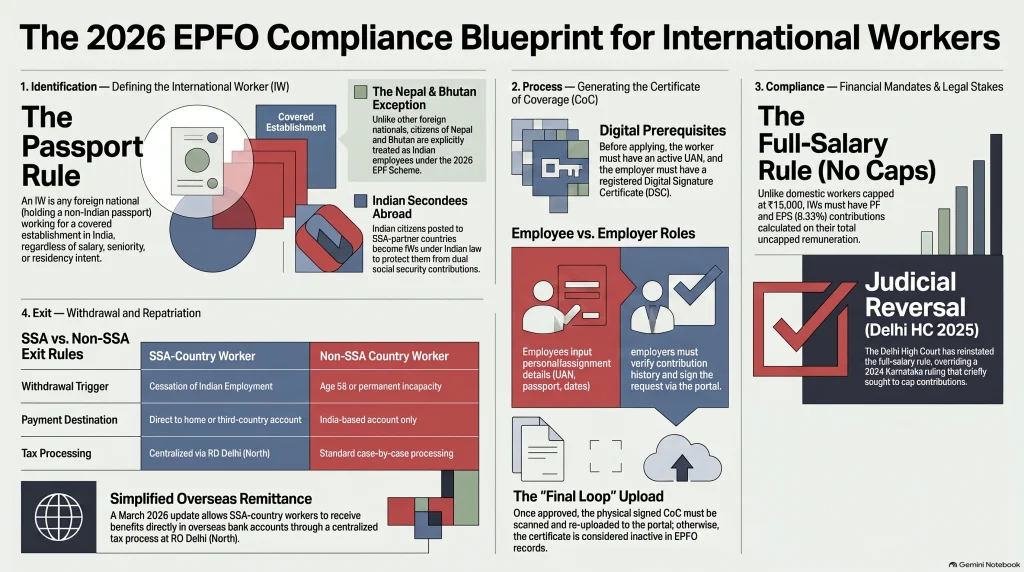
Once EPFO approves a CoC request, the system produces a certificate that still needs a physical signature from the competent authority, or, for cases covered under a simplified administrative arrangement, a digitally signed equivalent. Employers are required to retain this signed document and upload a scanned copy back into the portal to close the loop and mark the certificate active in EPFO’s records. Certificates that never reach this final upload step have, in practice, been treated by field offices as if they were never issued. That leaves the worker without proof of detachment if a host-country authority ever asks.
Tracking an application’s status runs through the same login used to submit it; the portal shows whether a request sits with the Regional Office, has moved to Head Office for extension review, or has been finalised and is awaiting the signed-document upload. There is no separate tracking number or helpline query system outside this login, a source of ongoing frustration for smaller employers unfamiliar with EPFO’s establishment-code-based access model.
A few things go wrong with predictable regularity. Someone names the wrong SSA country. A digital certificate expires mid-review. An establishment lets its own ECR compliance lapse after filing but before the case clears. Any one of these can freeze a request indefinitely, and none of them trigger an automatic notification to the employer. A manual thirty-day check-in on HR’s own calendar, rather than waiting on the portal to flag a problem, remains the surest safeguard against a CoC quietly stalling for months.
Defining International Workers (IW) and Excluded Employee Status
Not every foreign employee is an International Worker. Not every International Worker pays uncapped PF.
Foreign Nationals on Assignment vs. Local Hires
Paragraph 83 of the erstwhile EPF Scheme, 1952, and its successor provision under the EPF Scheme, 2026, define an International Worker in two ways, and only one concerns foreign nationals directly. A person holding a passport other than an Indian one, working for an establishment in India to which the EPF Act applies, is an International Worker from the day they join. Nationality alone decides it. Salary level, seniority, job title, and length of assignment do not.
This is where confusion with ordinary local hires sets in. A foreign national who has taken up permanent residence in India, married an Indian citizen, and has no intention of ever leaving is still classified as an International Worker under the Scheme’s wording, because the definition looks at passport, not intent or residency status. The only route out of that classification is Indian citizenship or a valid Certificate of Coverage, and neither changes on its own with time spent in the country.
Two exceptions exist, both narrow. Nepalese and Bhutanese nationals working in India continue to be treated as Indian employees rather than International Workers, a carve-out the EPF Scheme, 2026, preserves explicitly. And an employee whose foreign passport comes from a country with a Comprehensive Economic Agreement containing a social security clause signed before 1 October 2008 may also fall outside the standard contribution rules, though this second exception covers a small number of legacy arrangements rather than any current SSA partner.
Employers frequently misclassify short-term business visitors on ninety-day assignments, with no local payroll registration, as falling under this rule. They generally do not. The EPF Act’s coverage threshold, an establishment employing twenty or more persons or one that has voluntarily registered, has to apply to the Indian entity in the first place before the International Worker question even arises.
Indian Employees on Overseas Deputation
The second category runs in the opposite direction: an Indian citizen working in a country with which India has signed a Social Security Agreement becomes an International Worker under Indian law the moment they take up that overseas post, provided they are eligible for benefits under the host country’s social security programme.
The classification sounds punitive but exists for a protective reason. Without it, an Indian professional posted to Germany or Japan could end up paying into two social security systems for the same years of work. Neither country would credit the other for time served. The whole point of the SSA, and the classification that comes with it, is to stop exactly that.
What trips employers up is what happens after the posting ends. EPFO has clarified, through circulars addressing a recurring compliance error, that an Indian employee who resumes domestic employment after completing an overseas assignment reverts to being an ordinary employee under the EPF Act, not an International Worker, from the day they resume work in India. Some regional offices, working off outdated internal guidance, kept applying International Worker contribution rules to returning employees for years after this clarification, which meant PF got calculated on full salary long after the actual overseas assignment had ended. Payroll teams processing a returning secondee should confirm the employee’s reverted status in writing from the regional PF office, rather than assuming the system updates itself.
There is a narrower wrinkle too. An Indian employee who never obtained a Certificate of Coverage for the overseas leg of their career, and so never actually claimed exemption abroad, may not meet the International Worker definition’s eligibility test at all, since that test asks whether someone is eligible for benefits under the host country’s scheme, and simply having worked there does not satisfy it.
Qualifying as an Excluded Employee via Valid CoC Protection
An excluded employee is not simply someone who falls outside the International Worker definition. It is a narrower, specific status: an International Worker who would otherwise owe uncapped PF contributions in India, but who is exempted because they hold a valid Certificate of Coverage from an SSA partner country and are contributing to that country’s own social security system during a period the agreement recognises as detachment.
Two conditions both have to hold. First, a reciprocal SSA has to actually be in force, since a CoC issued outside a valid agreement carries no exemption weight whatsoever. Second, the detachment period has to fall within whatever window the specific SSA allows, and this varies agreement by agreement. Some run thirty-six months with a possible extension; others, like the recent Brazil agreement, allow considerably longer stretches for negotiated categories of worker.
The verification EPFO expects from an employer claiming excluded-employee status for a worker follows a format the organisation has maintained since a circular issued during the 2009-10 compliance cycle. That circular requires confirmation of the worker’s home-country contribution record alongside the CoC itself. Employers who submit a CoC without this accompanying verification, assuming the certificate speaks for itself, frequently find the exemption challenged at the next compliance inspection.
Losing excluded-employee status is rarely dramatic in the moment. It happens automatically the day a CoC expires without a corresponding extension approval. That converts the worker straight back into a fully-contributing International Worker, and some field offices have applied the conversion retroactively to the expiry date, though EPFO’s own guidance on retroactive liability has been inconsistent across regions. Establishments running multi-year secondments would do well to calendar CoC expiry dates independently of EPFO’s own tracking; the portal generates no advance warning before a certificate lapses.
It is worth separating this status from the underlying SSA itself, because the two lapse on different clocks. An SSA between India and a partner country stays in force indefinitely once it takes effect; it is the individual CoC, tied to one worker and one assignment, that carries the expiry date employers actually need to track. A company can have a valid, decades-old SSA with Germany and still lose the exemption on a specific German employee simply because nobody renewed that person’s certificate before the posting ran past its original window.
Critical Compliance Mandates for International Workers
This is the section employers get wrong most often, and most expensively.
The Full-Salary Rule: Bypassing the Standard Wage Ceiling
Domestic employees in India face a statutory wage ceiling of ₹15,000 a month for mandatory PF coverage; anyone earning above that figure is, technically, free to opt out unless employer and employee jointly choose to contribute anyway. International workers get no such ceiling. Since Paragraph 83 was introduced in October 2008, and carried forward into the EPF Scheme, 2026, an employer must calculate PF contributions on an International Worker’s entire salary, whatever that figure is, with no cap at ₹15,000 or anywhere else. A foreign employee drawing five lakh rupees a month generates an employer PF contribution of roughly sixty thousand rupees monthly on that salary alone, a cost domestic hiring at the same grade simply does not carry.
Whether this rule survives constitutional challenge has genuinely been an open question for the better part of two years, and the answer has flipped more than once.
In April 2024, the Karnataka High Court, ruling on Stone Hill Education Foundation v. Union of India, struck the entire provision down as arbitrary and violative of Article 14’s equality guarantee, reasoning that a ₹15,000 ceiling for Indian workers alongside no ceiling at all for foreign nationals doing comparable work could not stand.
The Bombay High Court, in Sachin Vijay Desai v. Union of India, reached the opposite conclusion around the same period, holding that Indian workers abroad and foreign nationals working in India are not, in fact, a comparable class at all. Then, in November 2025, the Delhi High Court weighed in directly, in SpiceJet Ltd. v. Union of India and the related LG Electronics petition, and rejected the Karnataka reasoning outright, holding the classification survives Article 14 scrutiny because foreign employees typically work in India for two to five years rather than an entire career, and the economic burden of uncapped contributions falls differently across the two groups on that basis. The Delhi High Court went further, stating in terms that leave little room for ambiguity that Stone Hill cannot be treated as binding precedent in later cases.
For payroll purposes today, the practical answer is to keep calculating on full salary. The Delhi High Court ruling is the most recent word from a High Court on the question, Karnataka’s earlier decision has been expressly disagreed with rather than followed, and no Supreme Court ruling has settled the split between the High Courts. Establishments in Karnataka specifically, where the single-judge ruling technically still stands unless overturned on appeal, may want separate legal advice given that jurisdictional wrinkle. Everywhere else, the uncapped rule remains the operative one.
Employers who paused or reversed International Worker contributions after the 2024 Karnataka ruling, on the assumption the wage ceiling now applied to their foreign staff, should treat the Delhi High Court’s intervention as a prompt to revisit that decision rather than a footnote. Contributions that were reduced during the intervening period could attract a demand for the shortfall, plus interest, once a field office catches up with the current judicial position, and that reconciliation is considerably cheaper to run voluntarily than to have it imposed during an inspection.
Pension Fund (EPS) Allocations on Total Remuneration
The ₹15,000 ceiling that caps how much of a domestic employee’s salary counts toward the Employees’ Pension Scheme does not apply to International Workers either, and this detail gets missed even by employers who have already internalised the full-salary PF rule.
For a domestic employee, only ₹15,000 of monthly wage counts as pensionable salary, however much the employee actually earns; the employer’s 8.33 percent pension contribution comes to a flat ₹1,250 a month regardless of whether the employee earns twenty thousand rupees or two lakh. International Workers get no such cap. The entire 8.33 percent slice of the employer’s contribution is calculated on full salary. That means a foreign employee on a substantial package can generate a monthly EPS allocation many multiples higher than what a domestic employee at the same firm receives.
This matters beyond the immediate cost line. EPS benefits are calculated off contribution history, and an International Worker accumulating pension contributions on an uncapped salary is, in principle, building toward a materially larger monthly pension than a domestic colleague on the same wage, assuming they complete the ten years of contributory service the scheme requires to draw a monthly pension at all. Most do not stay that long. An assignment lasting two to five years, the window courts have repeatedly cited, falls well short of pension eligibility, which means the EPS contribution effectively becomes a lump-sum withdrawal benefit tied to years of service rather than a monthly annuity. Employers modelling total cost of employment for expatriate hires should treat this EPS allocation as a genuine cash cost rather than a deferred, discountable one, since for most International Workers it converts to an immediate lump-sum liability, not a long-dated pension obligation.
Mandatory Filing of Form IW-1 and Monthly ECR Alignment
Employers with even one International Worker on the payroll carry a reporting obligation that runs on a separate track from the standard monthly PF return. A consolidated return that covers all International Workers has to reach EPFO within fifteen days of an establishment first taking one on, and a further monthly return, commonly known by its form name, IW-1, has to follow every month after that, filed through the Employer e-Sewa portal alongside the standard Electronic Challan-cum-Return.
The IW-1 return has to itemise, for each International Worker individually and matched against that month’s ECR:
- Basic wage
- Dearness allowance
- Retaining allowance, where applicable
- The cash value of any food concession
Establishments with genuinely zero International Workers in a given month are not excused from filing. A Nil return still has to go in, and EPFO has, in past compliance drives, specifically flagged establishments that simply stopped filing rather than confirming they had no International Workers to report.
Reconciliation between the IW-1 return and the standard monthly ECR is where inspections tend to concentrate. An ECR that shows PF contributed on a capped ₹15,000 basic wage for someone the IW-1 return simultaneously identifies as an International Worker is close to a self-reported violation of the full-salary rule, and EPFO’s compliance officers know exactly what that pattern looks like. The Standard Operating Procedure EPFO’s inspecting authorities work from specifically directs field offices to cross-reference IW-related filings against wage records during routine inspections rather than waiting for a complaint to prompt a closer look.
Late or inaccurate filing carries the same enforcement exposure as any other EPF compliance failure: damages under Section 14B of the EPF Act, penal interest under Section 7Q, and, in cases treated as wilful, prosecution under Section 14. None of these penalties are specific to International Workers, but filings involving them, precisely because they involve larger sums and higher-profile employees, tend to draw disproportionate attention once an inspection begins.
Social Security Agreements (SSAs) and Exemption Mechanics
An SSA is the only mechanism that gets an International Worker out from under the uncapped rule.
Bilateral Treaties and Preventing Dual Contributions
A Social Security Agreement is, at its core, a treaty between India and one other country that agrees not to double-tax the same period of work for social security purposes. Without one, a worker posted abroad, or a foreign national posted to India, can end up contributing to two countries’ retirement systems for the identical stretch of employment. Neither system credits the years toward eligibility in the other.
Several mechanisms typically sit inside an SSA, and each matters for how a Certificate of Coverage actually functions in practice. Detachment lets a worker on a genuinely temporary assignment, generally capped at thirty-six months though several agreements permit negotiated extensions well beyond that window, remain solely under home-country social security law rather than contributing in both places. Totalisation adds together periods of contribution across both countries when determining whether a worker has met the minimum service required to draw a pension at all, which matters enormously for anyone whose career genuinely splits between two systems and would otherwise fall short of either country’s vesting threshold. And exportability, discussed far less often but arguably just as consequential, allows benefits earned in one country to actually be paid out to a beneficiary living in the other, rather than trapping a pension in a jurisdiction the worker has since left.
None of this happens automatically simply because a treaty exists on paper. A worker still has to apply for and hold a valid Certificate of Coverage that covers the specific period of detachment; the SSA provides the legal basis for exemption, but the CoC is the document that actually makes it work at the payroll level. Agreements that are freshly signed but not yet in force extend none of these protections until the ratification and entry-into-force process actually finishes, and the UK agreement is the clearest current example of that gap.
Overview of India’s Active SSA Partner Network
India’s SSA network has grown steadily since the earliest agreements with European partners. It now covers more than twenty countries across Western Europe, East Asia, and, more recently, Latin America. The bulk of the network sits in Western Europe: Germany, France, Belgium, the Netherlands, Switzerland, Austria, Luxembourg, Denmark, Sweden, Norway, Finland, and the Czech Republic all have agreements in force, alongside Canada, Australia, Japan, and South Korea outside Europe.
Two additions in recent years show the network’s direction of travel. Brazil’s SSA with India entered into force on 1 January 2024, the first such agreement India has signed with a Latin American country, and it permits a detachment period that runs up to sixty months for postings between the two countries, well beyond the thirty-six-month window typical of the older European agreements. Portugal’s agreement, signed back in 2013, only entered into force on 8 May 2017, a reminder that the gap between signing and actual operation can run years.
The United Kingdom is the network’s newest, and for Indian employers with UK-linked operations, most consequential addition. India and the UK signed a Double Contribution Convention on 10 February 2026, alongside the wider Comprehensive Economic and Trade Agreement, and the agreement entered into force on 15 July 2026 . Its terms depart from the older template in specific ways: a worker needs at least thirty days of home-country coverage before an assignment starts to qualify for a Certificate of Coverage at all, a six-month cooling-off period applies before someone can claim a fresh CoC for a repeat assignment to the same host country, and workers already mid-assignment on the date the agreement took effect do not get retroactive coverage under it.
| Country | Status | Notes |
| Germany, France, Belgium | Active | Among India’s earliest SSA partners |
| Netherlands, Switzerland, Austria | Active | Standard detachment terms |
| Canada, Australia, Japan, South Korea | Active | Japan has a simplified extension procedure for long postings |
| Brazil | Active from 1 Jan 2024 | Up to a 60-month detachment window |
| Portugal | Active from 8 May 2017 | Signed in 2013 |
| United Kingdom | Active from 15 Jul 2026 | 30-day home-coverage rule; 6-month cooling-off period |
The United States, which hosts one of the largest single populations of Indian professionals abroad, has no agreement with India yet, though negotiations have been publicly acknowledged by the Labour Ministry. Until one exists, Indian employees deputed to the US remain outside the International Worker exemption route altogether: no CoC is available, no detachment relief applies, and contributions in both countries run in parallel for the length of the assignment, exactly the double-payment problem the wider SSA network exists to prevent.
EPF Withdrawal and Repatriation Rules for Foreign Nationals
Getting money into the fund is compliance. Getting it back out is where International Workers actually feel the difference, and where SSA membership stops being an abstract legal status and starts changing what a departing employee can actually do with their own savings.
| Feature | Worker from an SSA country | Worker from a non-SSA country |
| Withdrawal trigger | Cessation of Indian employment | Age 58, or permanent total incapacity |
| Payment destination | India, home country, or a third country, per the SSA | India-based account only |
| Tax paperwork | Centralised through RO Delhi (North) | Standard, case-by-case |
Simplified Overseas Bank Settlements for SSA Country Workers
For years, an International Worker from an SSA country leaving India could have PF benefits released to their own bank account or their employer’s, but only after the regional office and the worker jointly worked through tax paperwork that assumed the recipient still lived in India. Form 15CA and Form 15CB, filed to certify tax treatment on payments made to a non-resident, turned every settlement into a minor cross-border tax exercise on its own.
A circular dated 18 March 2026 replaced that process with something considerably more direct for workers from SSA countries. Benefits can now go straight to an overseas bank account, in India, the worker’s home country, or a third country, according to whatever choice the relevant SSA permits, without the employer independently managing tax certification case by case. Bank details are verified through a passbook or bank statement attested by the employer or the competent institution under the SSA, no notarisation required, and claims still get processed at the concerned regional office, which now enters the overseas account details directly into the claim settlement software.
The tax certification burden has not disappeared. It has been centralised instead. Regional Office, Delhi (North), now acts as the sole nodal office that handles Form 15CA and Form 15CB for every International Worker settlement nationwide. A dedicated chartered accountant has been engaged specifically for this function, and separate control registers get reconciled monthly between the originating regional office and Delhi (North). EPFO has also designated three specific State Bank of India accounts, one each for EPF, EPS, and EDLI benefits, through which these overseas remittances are routed.
Eligibility for this simplified path is narrow by design. Only workers from countries with an SSA actually in force with India qualify. A foreign national from a non-SSA country leaving India still faces the older, more restrictive withdrawal rules, regardless of how smoothly the payment mechanics themselves have become for everyone else.
FAQ: EPFO IW Portal
An International Worker is any foreign national working in India for an establishment covered under the EPF Act, regardless of their seniority or job title. The classification also applies to Indian citizens deputed abroad to a country that has an active Social Security Agreement (SSA) with India.
A Certificate of Coverage (CoC) is an official document generated via the EPFO IW Portal. It acts as proof of detachment, which prevents dual social security taxation. With a valid CoC, an employee continues contributing to their home country’s system and is exempt from contributing to the host country’s pension scheme.
No. Unlike domestic Indian employees who have a standard ₹15,000 wage ceiling, there is no salary cap for International Workers. Employers are mandated to calculate both EPF (Provident Fund) and EPS (Pension Scheme) contributions based on the employee’s total, uncapped remuneration.
Form IW-1 is a mandatory monthly return that employers must file through the EPFO portal. It details the wage components of each International Worker and must be reconciled with the standard monthly ECR to ensure compliance and avoid severe penal damages.
The withdrawal rules depend entirely on the worker’s home country. Expatriates from SSA-partner countries can have their final PF settlement credited directly to an overseas bank account upon finishing their Indian assignment. However, foreign nationals from non-SSA countries (such as the US) face strict restrictions; their PF funds are subject to a mandatory lock-in until age 58, unless they suffer permanent total incapacity.
The Age 58 Lock-in Mandate for Non-SSA Expatriates
For an International Worker whose home country has no Social Security Agreement with India, leaving a job in India does not, by itself, unlock the PF balance. Full withdrawal is available in only two circumstances: retirement after attaining 58 years of age, or permanent and total incapacity for work certified by a medical officer. Neither condition has anything to do with whether the assignment in India has actually ended.
This is the single most consequential difference between how India treats domestic employees and how it treats non-SSA International Workers on exit. A domestic employee who ceases employment can access PF benefits within a defined window regardless of age. An International Worker with no SSA covering the assignment can complete a five-year posting, return home permanently, and still find their accumulated PF, employer and employee contributions both, locked in India until they turn 58. For a mid-career expatriate who arrived in their thirties, that can mean waiting two decades or more to touch money mandatorily deducted from a salary earned entirely outside any pension expectation tied to India.
The rule traces to Paragraph 69 of the erstwhile EPF Scheme, amended alongside the original 2008 introduction of International Worker status, and it carries forward largely unchanged into the EPF Scheme, 2026: complete withdrawal for International Workers remains tied to age 58, permanent incapacity, or whatever an applicable SSA separately permits, even as the withdrawal age for domestic employees under the new scheme has shifted to 55. Inoperative-account rules, which stop crediting interest on unclaimed balances after a set period, do not apply to International Workers in the same way, though a genuinely inaccessible fund sitting untouched for years is not obviously better than an inoperative one.
Employers negotiating assignment terms with expatriate candidates from non-SSA countries would do well to flag this explicitly during offer discussions. It surfaces as a grievance only once the assignment has already ended and the employee has already left the country, and by that point there is very little anyone in India can do to speed up access.
Disclaimer
The information provided on this website, specifically within the article “EPFO IW Portal: International Workers Compliance Guide” is for general informational and educational purposes only. It does not constitute professional legal, financial, or tax advice. While we strive to ensure the accuracy and currency of the content regarding Employees’ Provident Fund Organisation (EPFO) regulations and International Worker (IW) compliance, statutory guidelines and social security agreements are subject to frequent amendments by the Government of India. We make no representations or warranties, express or implied, regarding the completeness, validity, or reliability of the information contained herein. Any reliance you place on such information is strictly at your own risk. Readers are strongly advised to consult with a qualified legal professional, a certified chartered accountant, or official EPFO authorities before making any compliance decisions. The publishers disclaim all liability for any direct, indirect, or consequential loss or damage incurred from the use of this content.




Leave a Reply