
LIC Bima Platinum Plan 770: Full Details, Benefits, and Premium Calculator Guide (2026)

What is the LIC Bima Platinum Plan 770?
LIC’s Bima Platinum Plan 770 reached the market on September 1, 2026, the same day the Life Insurance Corporation of India marked its 70th anniversary. Chairman and Managing Director R. Doraiswamy launched it alongside a second product, LIC’s Jeevan Raksha (Plan 894), a pure-risk cover with no savings component attached. Bima Platinum carries the plan number 770 and the UIN 512N397V01. Sales open on September 7, 2026.
At a Glance: LIC Bima Platinum Plan 770
- Plan Overview: LIC Bima Platinum Plan 770 is a non-linked, non-participating, guaranteed savings life insurance policy designed for absolute income certainty.
- Limited Availability: This is a close-ended product, available exclusively for purchase between September 7, 2026, and March 31, 2027.
- Triple Payout Structure: Policyholders receive a Regular Income Benefit (10% of Basic Sum Assured annually), a one-time Booster Income Benefit (70% of Basic Sum Assured), and a final Maturity Benefit.
- Guaranteed Additions: Accrues wealth at a base rate of ₹70 per ₹1,000 of annualized premium during the premium paying phase, with bonus enhancements for online purchases and high sum assureds.
- Flexible Premium Terms: Choose a Premium Paying Term (PPT) of 7, 10, 12, 15, or 18 years, paired with total policy terms ranging from 17 to 40 years.
- Eligibility Limits: The minimum Basic Sum Assured is ₹3,00,000. Entry age ranges from 30 days to 55 years, heavily depending on the chosen premium paying term.
- Expected Returns: Ideal for risk-averse buyers seeking a fixed retirement income floor, offering an estimated internal rate of return (IRR) of roughly 5.27% per annum.
- Tax Benefits: Payouts are generally tax-free under Section 10(10D), provided the total annual premium across all non-ULIP policies stays below the ₹5,00,000 threshold.
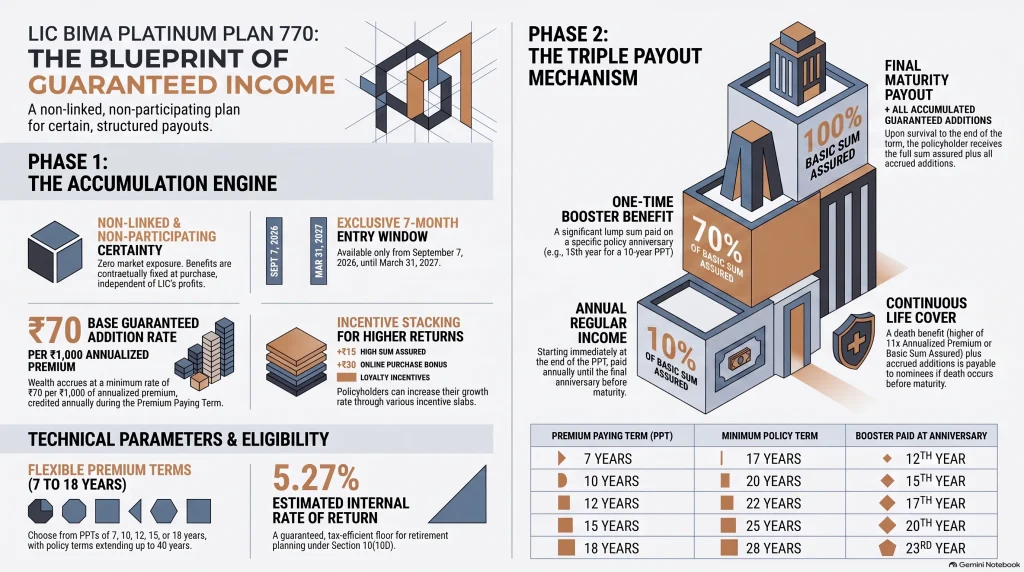
Overview of LIC’s New Non-Linked, Non-Participating Savings Plan
Bima Platinum sits in LIC’s non-linked, non-participating category, and that label carries two consequences a buyer should register before anything else. First, none of the money moves with equity or debt markets. Every rupee promised under the policy is fixed at the time of purchase, subject to the policyholder keeping premiums current. Second, the plan earns no share of LIC’s profits: no bonus, no Final Additional Bonus, nothing tied to how the insurer’s investment book performs in a given year. What the brochure states is what the policy pays.
The plan pairs a life cover with three separate payout streams: a yearly Regular Income Benefit, a one-time Booster Income Benefit, and a lump sum Maturity Benefit. Premiums stop after a chosen number of years, the Premium Paying Term or PPT, but the policy itself runs much longer, so buyers get years of guaranteed income after they’ve finished paying for it. A plain endowment plan doesn’t work this way; there, the only payout on survival is the maturity lump sum.
Also Read: How to Change Life Insurance Policy Nominee (Online & Offline Processes)
Close-Ended Availability (September 7, 2026 – March 31, 2027)
Bima Platinum will not stay on sale indefinitely. LIC has scheduled it as a close-ended product, open for new business between September 7, 2026 and March 31, 2027.
Anyone weighing this plan against alternatives has about seven months to decide, apply, and complete underwriting before the window shuts. After March 31, 2027, LIC may stop accepting fresh proposals under Plan 770 altogether, but existing policyholders will keep receiving every benefit promised at the time of purchase.
A close-ended window changes the calculation for prospective buyers less than it might first appear. The premium rates, Guaranteed Addition rates, and benefit structure fixed for policies bought this year won’t shift for those policyholders even after the sales window closes. What does change over time are the two variable interest figures built into the plan: the accumulation rate for deferred income, and the instalment rate for settlement options. Both reset every twelve months, from May 1 to April 30, based on government securities yields. A policy bought in December 2026 and one bought in February 2027 could end up with marginally different rates on those two specific features, even though the core Guaranteed Addition and income percentages stay the same across the entire sales window.
Why Choose a Guaranteed Income Life Insurance Plan?
Retail buyers gravitating toward LIC’s guaranteed plans usually want one thing above growth: certainty over the rupee amount and the date it arrives. A market-linked ULIP or a mutual fund SIP can end up delivering more money over twenty years than an insurance endowment ever will, but neither promises a fixed number today for a payout fifteen years away. Bima Platinum does. The Regular Income Benefit, the Booster Income Benefit, and the base Maturity Benefit are all fixed the day the policy is issued.
That certainty comes at a cost. Financial planners who reviewed the plan’s own sample illustration put the effective yield at roughly 5.27% a year, well below what equity markets have historically delivered over similar holding periods.
This plan suits buyers who want a fixed, contractual income stream in retirement, or who simply can’t tolerate the swings of a market-linked product. Buyers chasing wealth creation over a working lifetime have other tools better built for that job.
Core Features and Eligibility Criteria for LIC Plan 770
Every LIC product comes with a matrix of age, term, and sum assured rules that decide whether a given buyer even qualifies. Bima Platinum’s matrix runs denser than most because five different Premium Paying Terms each carry their own entry-age ceiling and minimum policy term.
Minimum and Maximum Age at Entry
The absolute floor is 30 days of age, but only for the 18-year PPT. Every other PPT option carries a higher minimum entry age, because LIC needs the policy term, and therefore the payout period, to fit within its overall maturity-age ceiling.
| Premium Paying Term | Minimum Entry Age | Maximum Entry Age (nearer birthday) |
| 7 years | 11 years (last birthday) | 55 years |
| 10 years | 8 years (last birthday) | 55 years |
| 12 years | 6 years (last birthday) | 53 years |
| 15 years | 3 years (last birthday) | 50 years |
| 18 years | 30 days (completed) | 47 years |
Source: LIC Bima Platinum sales brochure.
A 45-year-old cannot buy the 18-year PPT version of this plan; the maximum entry age for that term tops out at 47, leaving almost no room. Anyone in their mid-forties wanting Bima Platinum will need to pick one of the shorter PPT options instead. The minimum age at maturity is fixed at 28 years completed regardless of which PPT is chosen, and the maximum age at maturity is 75 years nearer birthday for policies bought through the standard channels. Buyers who purchase through a Point of Sales Person or a Common Public Service Centre face a tighter ceiling: 65 years at maturity and a maximum 20-year policy term.
Children can be insured under this plan too. If the age at entry is below 8 years, the actual life cover does not start on day one. Risk commences either two years after the policy begins or on the policy anniversary nearest the child turning 8, whichever comes first. If a minor dies before risk has commenced, the family gets back the premiums paid, without interest, rather than the full sum assured. Once the child turns 18, the policy automatically vests in their name and becomes a contract directly between them and LIC.
Minimum and Maximum Basic Sum Assured Parameters
The floor for the Basic Sum Assured is ₹3,00,000. LIC has not stated a ceiling; the maximum any individual can buy depends on the Corporation’s underwriting decision at the time of application, which in turn depends on income, existing cover, and medical history. Whatever figure a buyer settles on, it has to land on a multiple of ₹10,000, so ₹3,25,000 works but ₹3,27,500 does not.
The Basic Sum Assured chosen at the outset does two jobs at once. It sets the size of both the Regular Income Benefit and the Booster Income Benefit, since both are calculated as a percentage of it, and it also decides which slab a buyer falls into for the High Sum Assured incentive on Guaranteed Additions, covered later in this guide. Buyers who can stretch their sum assured past ₹7,00,000 or ₹10,00,000 pick up a materially higher Guaranteed Addition rate, so the sum assured decision carries effects well beyond the death cover figure.
Premium Paying Terms (PPT) Options (7, 10, 12, 15, or 18 Years)
Five PPT choices exist: 7, 10, 12, 15, and 18 years. None of these can be adjusted mid-policy; the PPT is locked in at purchase and drives almost every other date in the contract, including when Regular Income starts, when the Booster arrives, and how long Guaranteed Additions keep accruing.
A shorter PPT front-loads the premium into fewer years but starts the income stream sooner. An 18-year PPT spreads the same total outlay over a longer stretch, which can suit a buyer with a steadier but lower monthly cash flow, though it also pushes both Regular Income and the Booster further into the future. Neither choice is objectively better. The right one depends on when a buyer actually needs the income to begin.
Correlating Your PPT to the Total Policy Term (17 to 40 Years)
The policy term cannot be chosen freely once a PPT is picked. LIC ties a minimum policy term to each PPT, and the ceiling across all five options is 40 years, subject always to the maximum maturity age of 75.
| PPT | Minimum Policy Term | Maximum Policy Term* | Payout Period at Minimum Term |
| 7 years | 17 years | 40 years | 10 years |
| 10 years | 20 years | 40 years | 10 years |
| 12 years | 22 years | 40 years | 10 years |
| 15 years | 25 years | 40 years | 10 years |
| 18 years | 28 years | 40 years | 10 years |
*Subject to the maximum maturity age of 75 years; 20 years for POSP-LI/CPSC-SPV channel policies. Source: LIC Bima Platinum sales brochure.
Notice the pattern: at the minimum permitted policy term for each PPT, the payout period, the stretch during which Regular Income actually gets paid, always works out to exactly 10 years. A buyer wanting a longer income stream simply extends the policy term beyond that minimum. A 12-year PPT combined with a 30-year policy term, for instance, produces an 18-year payout period instead of the minimum 10.
Comprehensive Guide to LIC Bima Platinum Benefits
Four separate benefits sit inside this one policy: a yearly income stream, a one-time booster, a maturity lump sum, and a death benefit. Each has its own trigger date and its own formula.
Regular Income Benefit: Securing 10% of Basic Sum Assured Annually
Regular Income equals 10% of the Basic Sum Assured, paid once a year. The first payment lands at the end of the Premium Paying Term itself, not after some additional waiting period, and continues every year after that until either the Life Assured stops surviving or the policy reaches its final anniversary before maturity.
Take a ₹10,00,000 Basic Sum Assured with a 10-year PPT and a 20-year policy term. Regular Income of ₹1,00,000 starts at the end of year 10 and repeats every year through year 19, ten payments in total, for ₹10,00,000 received across the payout period before the maturity payout even arrives.
Extend the same policy to a 25-year term instead, and the payout period stretches to 15 years: fifteen payments of ₹1,00,000 rather than ten.
Booster Income Benefit: The 70% One-Time Payout Mechanism
Five years after the Premium Paying Term ends, a single lump sum equal to 70% of the Basic Sum Assured arrives alongside that year’s Regular Income payment. LIC ties this date to specific policy anniversaries depending on the PPT chosen.
| Premium Paying Term | Policy Anniversary When Booster Is Paid |
| 7 years | 12th |
| 10 years | 15th |
| 12 years | 17th |
| 15 years | 20th |
| 18 years | 23rd |
Source: LIC Bima Platinum sales brochure.
For a ₹10,00,000 Basic Sum Assured with a 12-year PPT, the Booster arrives at the 17th policy anniversary and equals ₹7,00,000, on top of that year’s ₹1,00,000 Regular Income. The policyholder receives ₹8,00,000 in that single year alone.
Nothing about receiving the Booster reduces what arrives later at maturity. The Basic Sum Assured owed at the end of the policy term stays untouched by either the Regular Income or the Booster paid out along the way.
Maturity Benefit: Receiving Your Full Sum Assured Plus Additions
On surviving to the end of the policy term, with the policy in force, the payout equals the full Basic Sum Assured plus whatever Guaranteed Additions have piled up since the start of the policy.
In LIC’s own sample benefit illustration, a 35-year-old buying a ₹10,00,000 Basic Sum Assured policy with a 12-year PPT and a 25-year term ends up with a Maturity Benefit of ₹19,15,096, made up of the ₹10,00,000 sum assured plus ₹9,15,096 in accumulated Guaranteed Additions.
That maturity figure arrives on top of the ₹13,00,000 already collected as Regular Income and the ₹7,00,000 Booster, both received earlier in the same illustration.
Death Benefit Calculation: Ensuring Financial Security for Nominees
If the Life Assured dies while the policy is in force, after risk has commenced but before maturity, the nominee receives the Sum Assured on Death plus accrued Guaranteed Additions. Sum Assured on Death itself is defined as whichever is larger: 11 times the Annualized Premium, or the Basic Sum Assured.
Three floors protect the nominee regardless of how that calculation plays out. The payout can never fall below 105% of total premiums paid up to the date of death. It can never fall below the surrender value calculated as of that date either. And for a policy bought on the life of a minor under 8 years, if death occurs before risk has even commenced, the family simply gets back the premiums paid, without interest, since the actual life cover had not yet activated.
A worked example makes the mechanics concrete. Take the earlier ₹10,00,000 sum assured, 10-year PPT, ₹1,83,300 annualized premium case. Eleven times that premium works out to ₹20,16,300, comfortably above the ₹10,00,000 Basic Sum Assured, so ₹20,16,300 becomes the Sum Assured on Death. Add accrued Guaranteed Additions of roughly ₹2,17,211 at the five-year mark and the death benefit comes to around ₹22,33,511.
Nominees also have the option to receive this amount in instalments spread across 5, 10, or 15 years rather than as a single payment, a choice covered in detail further down this guide.
Mastering the Guaranteed Additions System
Guaranteed Additions form the second-biggest driver of what a Bima Platinum policyholder eventually collects, after the Basic Sum Assured itself. The mechanism catches people off guard because it’s calculated on premium paid, not on the sum assured, which flips the usual intuition about how these additions work.
How the Base Rate of ₹70 per ₹1,000 Annualized Premium Works
Every policy year during the Premium Paying Term, LIC adds ₹70 for every ₹1,000 of Total Annualized Premium the policyholder has paid that year, at minimum. This is not applied once to the total premium paid over the policy’s life; it applies afresh, each policy year, to the cumulative annualized premium paid to date.
Picture an annualized premium of ₹1,83,300 with no incentive enhancements. Year one delivers a Guaranteed Addition of ₹1,83,300 × 70 ÷ 1,000, or ₹12,831. By year ten, with ten years of cumulative annualized premium now on the books (₹18,33,000), that same year’s addition works out to ₹18,33,000 × 70 ÷ 1,000, or ₹1,28,310.
The yearly addition keeps climbing throughout the PPT because the base it’s calculated against keeps climbing too.
Accrual Period: When Do Guaranteed Additions Stop?
Additions accrue only through the Premium Paying Term, at the end of each completed policy year. Once the PPT ends, no matter how many more years the policy has left to run before maturity, no further Guaranteed Additions get added.
What has already accrued does not disappear. It simply stops growing and sits on the policy until maturity, death, or surrender triggers its payout. If death occurs during the PPT itself, the addition for that particular policy year is still credited in full, calculated as though the whole year’s premium had been paid, rather than pro-rated down to the month of death.
High Sum Assured Incentive Slabs and Extra Additions
The base ₹70 rate rises for buyers who choose a bigger Basic Sum Assured. LIC breaks this into four slabs and five PPT bands, expressed as additional rupees per ₹1,000 of Total Annualized Premium.
| PPT | ₹3L to <₹5L | ₹5L to <₹7L | ₹7L to <₹10L | ₹10L and above |
| 7 years | Nil | +3.00 | +6.00 | +8.00 |
| 10 years | Nil | +4.00 | +7.00 | +9.00 |
| 12 years | Nil | +5.00 | +8.00 | +10.00 |
| 15 years | Nil | +6.00 | +10.00 | +12.00 |
| 18 years | Nil | +7.00 | +12.00 | +15.00 |
Source: LIC Bima Platinum sales brochure.
A buyer with a ₹10,00,000 Basic Sum Assured and a 12-year PPT picks up an extra ₹10 per ₹1,000, taking the applicable rate from ₹70 to ₹80. Someone at exactly ₹3,00,000, the minimum entry point, gets no enhancement at all until they cross ₹5,00,000. The gap in outcome between the smallest and largest sum assured bands runs wide, especially at the longer PPT options: an 18-year PPT buyer above ₹10,00,000 earns almost double the addition rate of a buyer at the ₹3,00,000 floor.
Additional Enhancements for Online Buyers and Existing Policyholders
Two more incentives sit on top of the High Sum Assured slab, and a buyer can generally claim both if eligible. Anyone who completes the proposal online, with no agent or intermediary assistance, earns an extra addition ranging from 20 per ₹1,000 (at the 18-year PPT) to 30 per ₹1,000 (at the 7-year and 10-year PPTs).
That’s a considerably larger boost than the High Sum Assured slabs offer, and it applies regardless of how much sum assured the buyer picks. A separate, smaller incentive rewards existing LIC customers, along with the nominee or beneficiary of a policyholder who died within the past year, and anyone whose own LIC policy matured within the past year. That enhancement ranges from 1.00 to 2.00 per ₹1,000, rising with the PPT length.
Stack the High Sum Assured enhancement, the online-purchase enhancement, and the existing-policyholder enhancement together, and a well-qualified buyer at a ₹10,00,000-plus sum assured with a 10-year PPT can push the effective Guaranteed Addition rate to roughly ₹70 + ₹9 + ₹30 + ₹1.25, or around ₹110 per ₹1,000, close to one and a half times the base rate.
LIC Bima Platinum Premium Calculator Guide
Working out the premium for this plan by hand is possible but tedious, since LIC’s tabular rates vary by age, PPT, and sum assured at the same time. A calculator, whether LIC’s own or a third-party version, shortcuts the process, but knowing what feeds into that calculation matters before trusting any output.
Step-by-Step Premium Calculation Process
Start with age nearer birthday and the desired Basic Sum Assured. LIC’s tabular premium rate, expressed as rupees per ₹1,000 of sum assured, depends on both of those inputs together with the chosen PPT. A 35-year-old and a 45-year-old buying the identical sum assured and PPT will see different rates because mortality risk rises with age.
Multiply the tabular rate by the sum assured, divided by 1,000, to reach the base annualized premium. A tabular rate of ₹183.30 per ₹1,000 against a ₹10,00,000 sum assured produces ₹1,83,300 as the yearly premium.
Add any rider premiums the buyer selects, plus underwriting extra premiums if medical or occupational factors call for them, plus applicable GST, and the true out-of-pocket figure emerges. GST currently sits at zero for these products, though LIC notes that rate is subject to change by the government.
Buyers paying anything other than yearly need one more step: multiply the yearly premium by a conversion factor before dividing by the number of instalments in a year.
Buyers paying anything other than yearly need one more step: multiply the yearly premium by a conversion factor before dividing by the number of instalments in a year.
Sample Premium Illustration for a ₹10,00,000 Sum Assured
LIC’s brochure publishes standard offline rates for a ₹3,00,000 sum assured over a 30-year term. Scaling those figures to ₹10,00,000 gives a working estimate, though buyers should treat this as indicative rather than a final quote.
| Age (Nearer Birthday) | 7-yr PPT | 10-yr PPT | 12-yr PPT | 15-yr PPT | 18-yr PPT |
| 15 | ₹2,72,700 | ₹1,82,450 | ₹1,43,400 | ₹1,07,150 | ₹83,300 |
| 25 | ₹2,77,150 | ₹1,84,250 | ₹1,44,300 | ₹1,07,400 | ₹83,350 |
| 35 | ₹2,91,650 | ₹1,90,050 | ₹1,47,200 | ₹1,08,150 | ₹83,350 |
| 45 | ₹3,34,550 | ₹2,06,750 | ₹1,55,900 | ₹1,11,550 | ₹84,750 |
Scaled from LIC’s ₹3,00,000 sum assured, 30-year term, offline sample rates. Actual premium at ₹10,00,000 sum assured may differ once underwriting incentives and slab adjustments apply. Source: LIC Bima Platinum sales brochure.
The pattern across every age band stays consistent: stretching the PPT from 7 years to 18 years cuts the annual premium down to roughly a third, since the same total outlay gets spread across more payment years. The trade-off is that the buyer pays for longer before the income stream starts.
Impact of Premium Payment Modes (Yearly vs. Monthly e-NACH)
Paying yearly is the cheapest way to fund this policy over its life, because LIC’s conversion factors build in a small loading for anyone who wants to pay in smaller, more frequent instalments. The factors are fixed at 1.0000 for yearly, 0.5090 for half-yearly, 0.2568 for quarterly, and 0.0861 for monthly.
Multiply a yearly premium of ₹1,83,300 by the monthly factor and then by 12 to see the effect: 1,83,300 × 0.0861 × 12 works out to about ₹1,89,378 a year, roughly ₹6,000 more than paying the same policy yearly. Monthly premiums can only be paid through e-NACH, NACH, or salary deductions under LIC’s Salary Savings Scheme; cash or cheque monthly payments are not an option under this plan.
Grace Periods and Lapsed Policy Revival Guidelines
Miss a premium and LIC still treats the policy as in force for a while. The grace period runs 30 days for yearly, half-yearly, and quarterly modes, and 15 days for monthly mode, counted from the date of the first unpaid premium.
Let that window close without paying and the policy lapses, though what happens next depends on payment history: fewer than one full year’s premiums paid means the policy simply ends with nothing payable, while at least one full year paid means the policy continues as paid-up, at reduced benefit levels.
A lapsed or paid-up policy is not necessarily gone for good. Revival remains possible for up to five consecutive years from the date of the first unpaid premium, provided it happens before the maturity date, by paying all arrears plus interest and satisfying LIC on continued insurability. For loans and revivals processed between May 1, 2026 and April 30, 2027, that interest rate sits at 9.50% per annum, compounding half-yearly. LIC reviews and can change this rate every twelve months.
Customizing Your Policy: Riders and Settlement Options
Bima Platinum’s base structure covers death, income, and maturity, but LIC layers five optional riders and several payout-timing choices on top for buyers who want more from the contract.
Adding Optional Riders for Enhanced Protection
Five riders are available, each requiring an additional premium on top of the base policy. The Accidental Death and Disability Benefit Rider pays an extra lump sum on accidental death within 180 days of the accident, and spreads a matching amount over 120 monthly instalments in the case of permanent disability, while also waiving certain future premiums. The Accident Benefit Rider covers only the accidental-death portion, with cover generally lapsing at the end of the base PPT rather than continuing for the full policy term. Only one of these two accident riders can be chosen, never both together.
The New Term Assurance Rider adds a flat extra death benefit and must be selected at the very start of the policy; it cannot be added later. The Premium Waiver Benefit Rider only makes sense on a minor’s policy, since it’s taken on the proposer’s, typically a parent’s, life and waives future base premiums if that proposer dies during the rider term. The Critical Illness Health Rider offers a choice between coverage for 15 or 40 major illnesses, the latter including a monthly Assisted Living Benefit for select conditions.
Two caps apply across all riders combined. The Critical Illness rider’s premium alone cannot exceed 100% of the base policy premium. Every other life-insurance rider added together cannot exceed 30% of the base premium. No rider of any kind is available if the policy is bought through a Point of Sales Person or a Common Public Service Centre.
Structuring Maturity and Death Benefits in Installments
Neither the Maturity Benefit nor the Death Benefit has to arrive as a single lump sum. A policyholder, or the Life Assured once past age 18, can request either amount be paid across 5, 10, or 15 years instead. The choice can cover the entire claim or just part of it, specified either as a fixed rupee figure or as a percentage.
Minimum instalment sizes apply depending on frequency: ₹5,000 for monthly, ₹15,000 for quarterly, ₹25,000 for half-yearly, and ₹50,000 for yearly payouts. If the total claim is too small to meet even the minimum for the chosen frequency, LIC pays it all as a single lump sum instead.
For the twelve months from May 1, 2026 to April 30, 2027, the interest rate used to calculate each instalment sits at 5.11% per annum. Anyone who later wants to commute the remaining instalments into one final payment can do so, at a discount rate capped at 7.11% per annum for options started in that same period.
Rules for Deferring Regular and Booster Income Benefits
Not every policyholder wants their Regular Income or Booster Income the moment it becomes due. LIC allows either benefit, or both together, to be deferred and left to accumulate instead of being paid out on schedule.
A written request has to reach LIC at least three months before the relevant due date, and the policy must carry no unpaid loan when the deferral begins. Deferred amounts accumulate at a rate LIC sets annually, tied to five-year government securities yields minus one percentage point; for benefits falling due between May 1, 2026 and April 30, 2027, that works out to 5.78% per annum.
The policyholder can withdraw the entire accumulated amount at any point before maturity, though only in full; partial withdrawal is not on offer. Taking a policy loan automatically cancels any active deferral request, and any income falling due afterward gets applied first against the unpaid loan before the balance, if any, reaches the policyholder.
Liquidity, Contingencies, and Exit Strategies
Long-duration policies like this one inevitably run into buyers who need cash before maturity, whether through a temporary shortfall or a permanent change of plan. Bima Platinum builds in a loan facility and a formal surrender process for exactly that reason.
Applying for a Loan Against Your LIC Bima Platinum Policy
A loan becomes available once the first policy year is complete and at least one full year’s premium has been paid, and it is always capped against the policy’s current surrender value rather than against the sum assured.
During the Premium Paying Term, the ceiling depends on both the policy’s status and how many years of premium have been paid: 50% of surrender value for an in-force policy with fewer than two years of premiums, rising to 75% once two full years are paid; 40% and 65% respectively for a paid-up policy. After the PPT ends, the maximum loan drops to 65% of surrender value, with an added rule that the yearly interest on the loan cannot exceed 50% of the Regular Income Benefit the policy would otherwise pay. For loans sanctioned between May 1, 2026 and April 30, 2027, the interest rate is 9.50% per annum, compounding half-yearly.
Any unpaid loan and its interest get recovered first from Regular Income or Booster Income payments as they fall due, even if the policyholder had previously chosen to defer them, and then from whatever claim proceeds eventually become payable. Left unchecked, if the loan balance grows past the surrender value and any accumulated deferred income, LIC can foreclose the policy outright.
Surrender Value: Guaranteed vs. Special Surrender Value
Surrendering is possible after the first policy year, once one full year’s premium has cleared. LIC then pays whichever is higher between the Guaranteed Surrender Value and the Special Surrender Value.
The Guaranteed Surrender Value only becomes payable after two consecutive years of premiums, and it’s calculated as total premiums paid multiplied by a factor that depends on both the policy term and the specific year of surrender, with any Regular or Booster Income already paid subtracted out. These factors start as low as 30% in the second policy year and can climb past 60% by the tenth or eleventh year on shorter policy terms, though they run considerably lower for policies with much longer terms surrendered early. The Special Surrender Value, by contrast, is reviewed annually by LIC under IRDAI’s Master Circular on Life Insurance Products and can shift from year to year based on the insurer’s own assessment.
Surrendering early carries a real cost. In the first policy year the Guaranteed Surrender Value factor is zero, meaning nothing is payable at all if a buyer exits before completing one full year, and even in years two and three the factor sits well below what has actually been paid in. Anyone weighing an early exit should request an official surrender quotation from LIC before deciding, rather than relying on the published factor tables alone.
Understanding the Reduced Paid-Up Value Mechanism
A policyholder who stops paying premiums after at least one full year, but before completing the PPT, does not lose the policy outright. It converts to paid-up status instead, and every major benefit shrinks in proportion to how much of the PPT was actually funded.
The governing ratio is simple: premiums paid divided by premiums originally payable. Apply that ratio to the Regular Income Benefit, the Booster Income Benefit, the Basic Sum Assured at maturity, and the Sum Assured on Death, and the reduced paid-up figures emerge. A policyholder who pays 5 of 10 scheduled premiums on a 10-year PPT policy ends up with exactly half the original Regular Income, half the Booster, and half the Basic Sum Assured at maturity, plus whatever paid-up Guaranteed Additions the policy has separately accrued.
Guaranteed Additions already locked in for completed years remain attached to the policy even after it goes paid-up; only future additions during the remaining PPT accrue at a reduced, paid-up-specific rate rather than the full in-force rate.
Strategic Analysis: Is LIC Bima Platinum 770 Right for You?
Every guaranteed-return product deserves a hard look at the actual numbers behind the marketing, rather than the headline percentages LIC prints on the brochure cover.
Tax Implications and Benefits Under Current Tax Laws
Premiums paid toward Bima Platinum may qualify for deduction under Section 80C, but only for taxpayers who remain on the old tax regime, and only within the overall ₹1,50,000 combined 80C ceiling that also covers PF, ELSS, and several other instruments. Someone already at the 80C limit through other avenues will not gain any additional deduction room from this policy’s premium.
The bigger question for most buyers is whether the Regular Income, Booster Income, and Maturity Benefit come out tax-free under Section 10(10D). They generally do, but a rule introduced for non-ULIP life policies issued on or after April 1, 2023 caps that exemption: if the annual premium across all such policies held by one person crosses ₹5,00,000, the proceeds lose their blanket tax-free status and get taxed as income instead, with Section 194DA requiring a 2% TDS deduction at source on the taxable portion.
A buyer with a ₹10,00,000 sum assured and a PPT under 12 years, whose annualized premium runs past ₹1,45,000 as seen in LIC’s own illustration, sits comfortably under that ₹5,00,000 threshold on its own, but anyone stacking several large-premium policies together should add up the total before assuming the exemption applies. Death benefits keep their tax-free status under Section 10(10D) regardless of how large the premium was, since the high-premium rule only touches maturity and survival payouts. Tax rules of this kind can shift over a policy’s decades-long life, so this section should not substitute for advice from a qualified tax professional at the time of purchase.
Comparing Plan 770 with Alternative Guaranteed Income Plans
Bima Platinum does not sit alone on LIC’s shelf of non-participating savings products; plans such as Jeevan Umang, Jeevan Labh, Bima Jyoti, and Nav Jeevan Shree occupy adjacent space, each with its own mix of income timing, whole-life cover, or single-premium structure.
Weighing Plan 770 against any of those requires the same benefit-illustration exercise, run against the specific age, sum assured, and term a buyer actually wants, since headline percentages rarely translate cleanly across products with different payout schedules.
What matters more than product-to-product comparison, according to one independent review of LIC’s sample illustration, is setting the plan’s effective yield against entirely different asset classes. That review calculated an internal rate of return of roughly 5.27% per annum for the standard illustration, a ₹10,00,000 sum assured, 12-year PPT, 25-year term case where ₹17,59,800 is paid in over the PPT against ₹39,15,096 eventually received.
The Public Provident Fund and diversified mutual funds were flagged as the more relevant benchmarks for long-term wealth building, with a standalone term plan suggested as the more efficient route for buyers whose real priority is maximizing life cover per rupee of premium.
FAQ: Bima Platinum Plan 770
If your primary objective is aggressive wealth creation, market-linked ULIPs like LIC Index Plus typically offer significantly higher returns by investing directly in equities. However, if you prioritize absolute financial certainty and zero market risk, Plan 770 is highly competitive within the non-linked segment. It provides a fixed internal rate of return (IRR) of approximately 5.27%. This plan is strategically designed to establish a dependable income floor for retirement, deliberately trading high market growth for guaranteed safety.
To verify your exact accrued payout status, you can log directly into the LIC Customer Portal using your registered user ID and navigate to the “Policy Status” section. Alternatively, you can use your phone to send an SMS formatted as “ASKLIC STAT” to 56767877 from your officially registered mobile number. Because Bima Platinum 770 is a non-participating policy, your exact maturity amount is explicitly mathematically fixed on your policy bond from day one, unlike older participating plans that rely heavily on variable annual bonuses.
When investors ask about a “10-year policy,” they are almost always referring to the Premium Paying Term (PPT) rather than the total duration of the insurance contract. In the Bima Platinum plan, selecting a 10-year PPT specifically means you permanently stop paying premiums after exactly a decade, but the actual policy term must legally continue for at least 20 years in total. This structure ensures your life cover and guaranteed additions remain active and compounding long after your annual out-of-pocket premium payments have completely ceased.
Final Verdict: Aligning the Plan with Your Long-Term Wealth Goals
Bima Platinum earns its place for a fairly specific buyer profile: someone who wants a fixed, contractually guaranteed income arriving on a known date, who can commit to the full Premium Paying Term without needing that money back early, and who treats the roughly 5% effective return as an acceptable price for certainty rather than a disappointment against market benchmarks. Retirees or near-retirees planning around a known income floor, and buyers who have already secured adequate term cover and health insurance separately, fit that description best.
It fits less well for anyone chasing higher long-term growth, anyone who might need the capital back within the first several years, or anyone whose main goal is maximum life cover at the lowest possible premium. The move before applying is running LIC’s official benefit illustration against the exact age, sum assured, PPT, and term a buyer intends to choose. The incentive slabs and enhancement rates covered throughout this guide change the final numbers meaningfully from one combination to the next.
Disclaimer
The information provided in this guide regarding the LIC Bima Platinum Plan 770 is for general educational and informational purposes only. It does not constitute professional financial, investment, insurance, or tax advice. While we strive to ensure the accuracy of the details presented, life insurance products, premium structures, guaranteed additions, and tax regulations are subject to continuous updates by the Life Insurance Corporation of India (LIC) and the Government of India.
The premium calculations, return estimates, and benefit illustrations provided herein are strictly indicative and meant for conceptual understanding. Actual premiums and final maturity benefits will vary based on individual underwriting, entry age, and the specific policy terms chosen. We make no representations or warranties regarding the completeness, validity, or reliability of this content. Readers are strongly encouraged to consult a certified financial planner, a qualified tax professional, or an official LIC representative before making any purchasing decisions. The publishers explicitly disclaim all liability for any direct, indirect, or consequential financial loss incurred from relying on this content.




Leave a Reply