
50% Wage Rule Calculator: See Your Salary Under the New Labour Code

A 50% wage rule calculator tells you something your offer letter will not: your CTC stays put, but the base your PF and gratuity run on may not. Under Section 2(y) of the Code on Wages, 2019, any part of your excluded allowances above half of your total remuneration counts as wages and joins that base (Taxmann).
The four Labour Codes came into force on 21 November 2025 (PIB). If basic pay is a small slice of your package, your employer’s PF bill rises, your own PF deduction rises, and the cash reaching your bank account falls. Your retirement balance and your gratuity rise by the same amount that left your pay.
Four facts to hold onto:
- The Codes are in force from 21 November 2025, and the Central Rules were notified on 8 May 2026 (Astravise Services).
- The test weighs payments under clauses (a) to (i) of Section 2(y) against one-half of total remuneration.
- Your contract need not change. The statutory wage base is recomputed whatever the offer letter says.
- If basic pay already sits at or above half of the package, nothing moves.
At A Glance: 50% Wage Rule Calculator
- Section 2(y) of the Code on Wages, 2019 adds any excluded allowances above 50% of total remuneration to your wages. Only the excess moves across.
- PF and gratuity run on the revised statutory wage base. Both rise when basic pay sits below half of your package, while CTC stays flat.
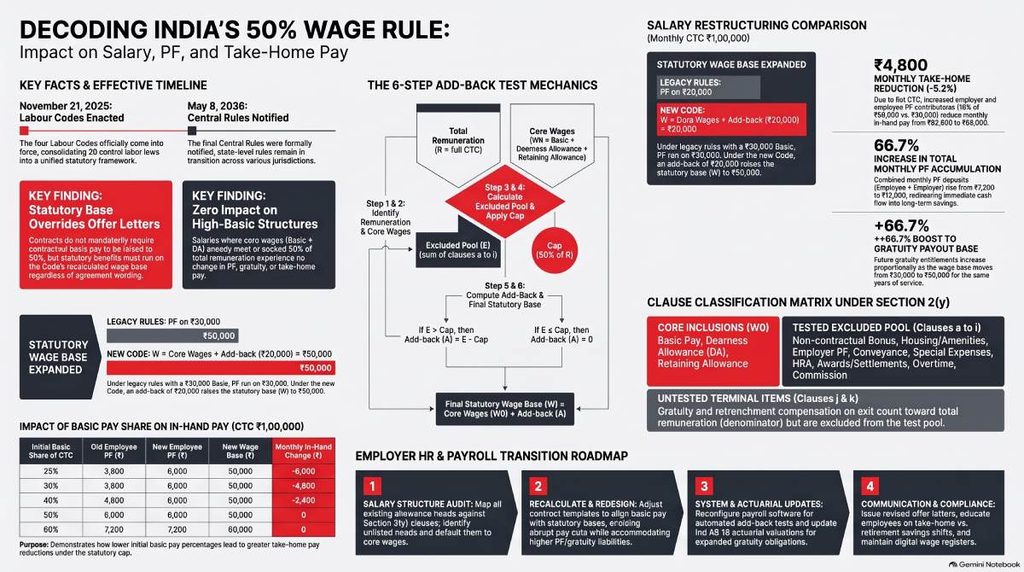
- On a ₹1,00,000 CTC, moving from ₹30,000 basic to a ₹50,000 wage base cuts in-hand pay by ₹4,800 a month (5.2%). The same ₹4,800 lands in your PF account. This assumes PF on the full wage base with no ceiling.
- The law does not require basic to be 50% of CTC. If basic already sits at or above half, nothing changes on your payslip.
- The Codes took effect on 21 November 2025 and the Central Rules were notified on 8 May 2026. Fixed-term employees now qualify for gratuity after one year.
50% Wage Rule Calculator
Work with one month of pay. Every figure below is monthly and in rupees.
| Step | What you enter or calculate | How |
| 1 | Total remuneration (R) | Monthly CTC with every pay head included |
| 2 | Core wages (W0) | Basic pay + dearness allowance + retaining allowance, if you have one |
| 3 | Excluded pool (E) | Sum of payments under clauses (a) to (i) of Section 2(y): bonus outside the contract, amenities, employer PF, conveyance, special-expense payments, HRA, award or settlement pay, overtime, commission |
| 4 | Cap | 50% of R |
| 5 | Add-back (A) | The larger of 0 and (E minus Cap) |
| 6 | Statutory wage base (W) | W0 + A |
The wage base W then drives everything downstream. If A comes out as zero, the rule does nothing to you. If A is positive, W is larger than your basic, and every figure in the next table grows with it.
| Output | Formula |
| Employee PF | 12% of W |
| Employer PF | 12% of W |
| In-hand pay before tax | CTC, less employer PF, less employee PF |
| Gratuity uplift | New W divided by the old base, minus 1 |
The PF rate comes from Husys. Two inputs decide whether your answer is right.
The first is R. Husys reports that the Ministry reads total remuneration as the full CTC. Gratuity and retrenchment items under clauses (j) and (k) belong in R but never enter E, which is how the government’s own example ends up with a wage base well under half of the package (shown further down).
The second is E. Clauses (a) to (i) name specific heads. A generic special allowance is not one of them. Payroll advisers and some of the sources here treat such allowances as part of the excluded pool (Husys and India Policy Hub), while the statute lists its exclusions one by one (Taxmann). Classify each head against the clause list and get your employer to confirm the treatment.
When every head other than core wages falls in clauses (a) to (i), the answer collapses to a single line: W is the larger of W0 and half of R. A CTC of ₹1,00,000 with basic of ₹30,000 gives a W of ₹50,000. Basic of ₹60,000 gives ₹60,000.
Worked Example: Old vs New Salary Structure
Assumptions for the example:
- Monthly CTC of ₹1,00,000, with employer PF inside it.
- PF at 12% from each side on the full wage base. None of the sources describes a ceiling, so if your employer contributes on a capped base, your figures will be smaller.
- Income tax and professional tax left out.
- Every head other than basic treated as an excluded payment under clauses (a) to (i).
- CTC held flat, with the extra employer PF recovered from gross pay.
The two structures:
| Component | Old (₹/month) | New (₹/month) |
| Basic | 30,000 | 50,000 |
| HRA | 15,000 | 20,000 |
| Other allowances in the excluded pool | 51,400 | 24,000 |
| Employer PF (12% of basic) | 3,600 | 6,000 |
| Total CTC | 1,00,000 | 1,00,000 |
The add-back test on each:
| Line | Old | New |
| Core wages (W0) | 30,000 | 50,000 |
| Excluded pool (E) | 70,000 | 50,000 |
| Cap (50% of 1,00,000) | 50,000 | 50,000 |
| Add-back (A) | 20,000 | 0 |
| Statutory wage base (W) | 50,000 | 50,000 |
Left untouched, the old structure fails the test. Its pool is 70% of the package, ₹20,000 above the cap, so the statutory wage base is ₹50,000 whatever the offer letter says. The restructured version lands exactly on the line and needs no add-back.
What reaches you, set beside the pre-Code position where PF ran on basic alone:
| Line | Old (PF on ₹30,000) | New (PF on ₹50,000) |
| Gross monthly pay (CTC less employer PF) | 96,400 | 94,000 |
| Employee PF at 12% | 3,600 | 6,000 |
| In-hand before tax | 92,800 | 88,000 |
| Employer PF at 12% | 3,600 | 6,000 |
| Total PF credited each month | 7,200 | 12,000 |
| Change in in-hand pay | n/a | minus 4,800 (5.2%) |
In-hand pay falls ₹4,800 a month, or ₹57,600 a year. The money is not gone. The same ₹4,800 lands in the PF account, which is why the monthly PF credit climbs from ₹7,200 to ₹12,000.
Gratuity moves with the base. A base of ₹50,000 against ₹30,000 is a rise of 66.7% for the same years of service. An employer who protects gross pay instead absorbs the extra ₹2,400 of employer PF and the larger gratuity accrual.
How to Apply the Test to Your Own Offer Letter
Your offer letter and your last payslip hold everything the test needs. Work with monthly figures.
Start with the total. Add every pay head, employer PF included, because Husys reports that the Ministry reads total remuneration as the full CTC. Gratuity and retrenchment-type items under clauses (j) and (k) belong in this total too, though they never enter the test.
Sort each head into one of two piles. Basic pay, dearness allowance and any retaining allowance are core wages. HRA, conveyance, employer PF, overtime, commission and the other heads named in clauses (a) to (i) form the excluded pool. The statute lists its exclusions one by one (Taxmann), so a head that no clause names is not part of the pool. A generic special allowance is the usual case. Wages is the default bucket, and counting an unlisted allowance as wages is the safer treatment.
Then set the pool against half of the total. If the pool is at or below half, your wage base is your core wages and the Code changes nothing for you. If it is above half, the excess joins core wages, and the sum is the base on which PF and gratuity now run. The tables earlier in this post show the arithmetic on a CTC of ₹1,00,000.
A quick case shows how the check reads in practice. Take a CTC of ₹1,00,000 with basic of ₹40,000 and every other head in the pool. The pool is ₹60,000 against a cap of ₹50,000, so ₹10,000 is added back and the wage base is ₹50,000. A payslip showing employee PF of ₹4,800 means payroll is still on basic, since 4,800 divided by 0.12 is 40,000. A payslip showing ₹6,000 means the add-back is in. The difference of ₹1,200 a month on each side of PF is what the Code moves.
Your payslip gives you a cross-check. Divide your employee PF line by 0.12. If the answer equals your basic, PF is still running on core wages alone and a catch-up is possible. If it equals the base you just worked out, the add-back is already in your payroll. Anything else deserves a question to payroll, since it means your employer has classified a head differently from you.
A structure that fails the test usually gets fixed in one direction. Corrida Legal advises raising basic and DA, trimming allowances, avoiding abrupt changes, and not cutting agreed total pay unless the contract allows it. Husys gives the reason to act: left alone, the structure leaves a mismatch between the CTC on paper and the wage base in payroll (Husys).
Your result is an estimate. Your employer’s classification of each head, and your payroll system, decide the real deduction.
What Is the 50% Rule in the New Labour Code?
Section 2(y) defines wages as all remuneration payable for employment, in money or capable of being expressed in money. It names three inclusions: basic pay, dearness allowance and retaining allowance. Eleven categories sit outside the definition (Taxmann).
Four older definitions once ran side by side: Section 2(vi) of the Payment of Wages Act, 1936, Section 2(h) of the Minimum Wages Act, 1948, Section 2(21) of the Payment of Bonus Act, 1965 and Section 2(g) of the Equal Remuneration Act, 1976. One clause replaces all of them, and the government’s FAQ, as Taxmann reports it, says the single definition applies across the four Codes. The Ministry’s year-end review also lists uniform definitions across the Codes as a common provision.
The eleven exclusions, with the ones that feed the 50% test marked:
| Clause | Excluded payment | In the 50% test |
| (a) | Bonus payable under law that is not part of contractual remuneration | Yes |
| (b) | Value of housing, light, water, medical attendance or other amenities and services notified by government | Yes |
| (c) | Employer contribution to a pension or provident fund, and interest on it | Yes |
| (d) | Conveyance allowance or value of a travelling concession | Yes |
| (e) | Sums paid for special expenses of the job | Yes |
| (f) | House rent allowance | Yes |
| (g) | Pay under an award, settlement or court or tribunal order | Yes |
| (h) | Overtime allowance | Yes |
| (i) | Commission | Yes |
| (j) | Gratuity payable on termination | No |
| (k) | Retrenchment compensation, retirement benefit or ex gratia on termination | No |
The first proviso supplies the rule. When payments under clauses (a) to (i) exceed one-half of all remuneration, or any other percentage the Central Government notifies, the excess is deemed remuneration and joins wages (Taxmann). Only the excess crosses over. One-half is a default, so any estimate of your own should treat it as a figure that can change.
The aim is plain. Before the Codes, employers held basic pay low and stacked allowances to keep PF and gratuity down, and the proviso closes that route (Corrida Legal). The Ministry says the uniform wage definition exists to lift wage-linked benefits such as gratuity and maternity benefit (PIB year-end review).
The rule has critics. A 2026 paper in Economic and Political Weekly argues that the classification in the first proviso has no clear rational basis, may treat similar employees unequally and raises an Article 14 question, while adding uncertainty for employers (EPW).
How the Add-Back Test Works
Add up the payments in clauses (a) to (i). Set that sum against half of total remuneration. Only the part above the line moves into wages.
The government’s own worked example, as reproduced by Taxmann:
| Line | ₹/month |
| Total remuneration | 76,000 |
| Basic pay + dearness allowance | 20,000 |
| Allowances tested (clauses a to i) | 40,000 |
| Gratuity and retrenchment compensation (clauses j and k) | 16,000 |
| Cap (50% of total remuneration) | 38,000 |
| Excess over the cap | 2,000 |
| Revised wages for statutory purposes | 22,000 |
The published table also shows a line of ₹56,000 labelled total allowance paid. That is what the employer pays across all heads, and it is not the figure the proviso tests. Read as the tested figure, it produces an excess of ₹18,000 and the wrong answer. The tested figure is the ₹40,000 of allowances, and the ₹16,000 of terminal items sits in the denominator only.
The lesson for the shorthand: wages in this example are ₹22,000 out of ₹76,000, or 28.9% of total remuneration. The popular line that basic must be at least 50% of CTC overshoots whenever the package carries terminal-benefit items.
A second proviso adds a wrinkle. For equal pay across genders and for payment of wages, clauses (d), (f), (g) and (h) are counted in full, with no 50% test. Conveyance, HRA, award-based pay and overtime all count. For minimum wages and bonus they stay excluded, subject only to the add-back (Taxmann). An explanation to the clause also lets remuneration in kind count as wages up to 15% of total wages payable.
50% Basic Salary Rule Effective Date
| Date | Event |
| 21 November 2025 | Four Labour Codes take effect, rationalising 29 central laws |
| 30 December 2025 | Draft Central Rules published for comment |
| 8 May 2026 | Final Central Rules notified, effective the same day |
| August 2026 | Most states still at draft stage on their own rules |
The first date comes from the Press Information Bureau. The remaining three come from an Astravise note.
The Central Rules bind only where the Centre is the appropriate government, which is not the case for most private employers. State rules carry the detail, and most states had not finalised them by August 2026. The wage definition, the gratuity qualifying period and the social security thresholds sit in the Codes themselves and bind now. Astravise’s advice for multi-state employers is to pay under the Codes and file under the states.
The Ministry said at launch that the relevant provisions of the older laws would keep operating through the transition (PIB). The safe course for payroll is to compute the wage base on the Code’s definition from 21 November 2025 and treat state formats as a separate filing question (Corrida Legal).
Is It Mandatory to Keep Basic at 50% of CTC?
No. The law does not fix your contractual basic at half of CTC. It fixes the base on which statutory benefits are computed.
Astravise calls the proviso a deeming provision and not a design instruction: an employer who keeps basic low is not breaking a rule, because the law treats the excess as wages anyway (Astravise Services). Husys makes the same point and adds that the 50% threshold governs how wages are computed for PF, gratuity and retrenchment, and does not dictate the contractual breakup.
Several summaries, including the March explainer on this site, state the rule as basic plus DA of at least 50% of CTC (India Policy Hub). That shorthand holds when the whole package outside core wages falls in clauses (a) to (i). The statute is narrower and works as an add-back.
| Situation | Add-back | Result |
| Excluded pool at or below 50% of remuneration | None | Wage base equals core wages |
| Excluded pool above 50% | The excess | Wage base equals core wages plus the excess |
| Employer lifts basic to half of the package or more | None | Contract and statute agree |
| Commission and bonus push the pool above half | The excess | Same as row two |
Most employers restructure anyway. Husys notes that because the Ministry reads total remuneration as full CTC, leaving the contract unchanged creates a mismatch between the CTC on paper and the wage base in payroll. Corrida Legal advises raising basic and DA, trimming allowances and avoiding abrupt changes: restructure going forward, and do not cut agreed total pay unless the contract allows it (Corrida Legal).
Can You Pay 50% Basic and 50% Benefits?
Yes. Exactly half sits on the line and passes, because the proviso bites only when the pool exceeds one-half.
| Component | ₹/month | Share of CTC |
| Basic | 50,000 | 50% |
| HRA | 20,000 | 20% |
| Conveyance and other excluded allowances | 24,000 | 24% |
| Employer PF | 6,000 | 6% |
| Total | 1,00,000 | 100% |
The pool here is HRA, allowances and employer PF, together ₹50,000. No add-back. Four conditions decide whether the split holds up:
- Every head in the benefits half must belong to clauses (a) to (i). A head outside the list is wages from the start, which lifts the base above half.
- Bonus and performance pay written into the terms of employment count as wages. Clause (a) excludes only bonus that is not part of contractual remuneration (Taxmann).
- Remuneration in kind counts as wages up to 15% of total wages payable.
- HRA and conveyance count in full when pay parity across genders and wage payment are tested.
At 50% basic, employer PF is ₹6,000 on a ₹1,00,000 package. That is the same figure as at a 30% basic, because the add-back would have taken the base to ₹50,000 in any case. The 50/50 split changes the paperwork. It does not change the PF bill.
How Will the New Labour Code Affect My Salary?
The effect depends on how big your basic is. The table holds a CTC of ₹1,00,000 and treats everything outside core wages as excluded.
| Basic share of CTC | Statutory wage base | Employee PF before | Employee PF now | In-hand change |
| 25% | 50,000 | 3,000 | 6,000 | minus 6,000 |
| 30% | 50,000 | 3,600 | 6,000 | minus 4,800 |
| 40% | 50,000 | 4,800 | 6,000 | minus 2,400 |
| 50% | 50,000 | 6,000 | 6,000 | 0 |
| 60% | 60,000 | 7,200 | 7,200 | 0 |
The in-hand change counts both sides of PF. At a 25% basic, your own PF rises ₹3,000 and the employer’s rises ₹3,000, and the employer recovers its share from gross pay because CTC is flat.
Why In-Hand Pay Can Fall While CTC Stays Flat
Employer PF sits inside CTC. Employee PF comes out of gross pay. When the wage base rises, both climb, and the two together are paid for out of a package that did not grow.
Corrida Legal expects take-home to fall marginally in some cases, offset by higher retirement savings and gratuity. The India Policy Hub explainer from March reaches the same conclusion for the many employees whose EPF is calculated on basic.
A payslip check takes two minutes. Find your employee PF line and divide it by 0.12. The answer is the wage base your employer is using. If it equals your basic, the Code’s definition has not reached your payroll yet, and a catch-up in later months is possible. If it equals half of your CTC, the add-back is already in.
Who Sees No Change
- Employees whose basic plus DA already sits at or above half of remuneration. Astravise notes that such an employer may see almost no change in cost.
- Employees whose excluded pool is already at or under the cap.
- Employees in establishments that settle wages through industry agreements with a large basic and DA. The India Policy Hub piece expects manufacturing to face less disruption on this rule.
- Employees whose employer absorbs the extra employer PF and leaves gross pay untouched. Here the cost lands on the company.
A short case makes the first bullet concrete. On a CTC of ₹1,00,000 with basic of ₹55,000, the pool is at most ₹45,000, which sits under the ₹50,000 cap. Wages are ₹55,000, PF runs at ₹6,600 on each side, and the Code changes nothing about the payslip.
HRA and Special Allowance Adjustments
HRA is a clause (f) head, so it sits in the excluded pool. Special allowance is where most legacy packages park the balance. In a restructure, employers usually move rupees out of those two heads and into basic, as in the worked example where basic goes from ₹30,000 to ₹50,000 while HRA and other allowances shrink.
Two cautions apply. For minimum wages and bonus, HRA stays excluded subject to the add-back. For equal pay and wage payment it counts in full (Taxmann).
On the tax side, a lower HRA share can reduce the HRA exemption for a renter in a metro city, because the exemption depends on the HRA actually received (India Policy Hub). That explainer cites Section 10(13A) of the 1961 Act. The Income-tax Act, 2025 replaced that Act from 1 April 2026 (Husys), so check the current provision before you rely on it.
PF and Gratuity on the Revised Wage Base
Both benefits are computed on wages. When the wage base rises from basic alone to basic plus the add-back, both rise with it. Astravise names this widened base as the main cost driver across all four Codes.
Cost estimates disagree. Husys puts the increase in employer PF and gratuity at 2% to 5% of CTC for staff whose basic sat well below half. The India Policy Hub explainer relays a KPMG-attributed range of 15% to 20% for high-allowance sectors. Astravise says any single percentage quoted without a payroll file is a guess. Run your own file.
Employee and Employer PF Contributions
| Item | Rule |
| Contribution rate | 12% of basic plus DA from the employee and 12% from the employer |
| Employer split | 3.67% to the EPF account and 8.33% to the pension scheme |
| Registration | Mandatory for establishments with 20 or more employees |
| Monthly deposit | By the 15th of the following month through the ECR |
| Late deposit | Interest at 12% a year |
The first four rows of detail come from Husys. Astravise adds that the Code applies EPF to all establishments with 20 or more employees regardless of industry, removing the older schedule of listed industries.
Contributions in the tables above run at 12% on the full wage base. None of the sources describes a wage ceiling for mandatory contributions. If your employer pays on a capped base, expect smaller changes than the tables in this post show.
Gratuity Formula and Fixed-Term Employees
Gratuity pays 15 days’ wages for each completed year of service, computed on the last drawn wage (India Policy Hub). Permanent staff qualify after five years. Fixed-term employees now qualify after one year on a proportionate basis, under Section 53 of the Code on Social Security (Astravise Services and PIB year-end review).
Because the payout is a multiple of the last wage, the wage base alone fixes the uplift.
| Completed years (permanent staff) | Days of wages payable |
| 5 | 75 |
| 10 | 150 |
| 20 | 300 |
Move the wage base from ₹30,000 to ₹50,000 and every row in that table pays 66.7% more in rupees. The conversion from days to rupees follows your payroll’s own convention, and the ratio holds under any of them.
Gratuity must be paid within 30 days of becoming payable. The separate rule on final settlement of wages after exit runs on two working days under Section 17(2) of the Code on Wages, so a gratuity calculation should not hold up the rest of the settlement (India Policy Hub).
Employer Compliance and Payroll Restructuring
The wage definition is one cost line among several. Astravise lists the heads that belong in a labour-code budget:
| Cost head | Driver |
| Provident fund | Employer contribution on a wage base that rises where the pool exceeds half |
| Gratuity accrual | Same base, applied to accrued and future liability |
| Fixed-term gratuity | Qualifying period cut from five years to one, proportionate |
| EPF coverage | All establishments with 20 or more employees |
| Crèche | Establishments with 50 or more employees, or an allowance of at least ₹500 a month per child for up to two children |
| Overtime | Twice the wage rate on a wider base, capped at 144 hours a quarter |
Source: Astravise Services. Labour is a concurrent subject, so an employer in three states can face three rule positions under one central law.
Penalties for Non-Compliance
No source describes a standalone penalty for breaching the 50% rule. The exposure comes from what an inspector does with a salary structure. Inspectors can review the structure, reclassify components and demand differential contributions. The consequences listed by Corrida Legal are monetary penalties, backdated PF and gratuity liability, and claims from employees.
Other penalties sit near the rule:
- Late PF deposits carry interest at 12% a year (Husys).
- ESIC damages are a flat 1% a month on the amount payable, down from a ceiling of 25% a year (PIB year-end review).
- For late or short payment of wages, the India Policy Hub explainer reports a fine of up to ₹50,000 for a first offence, and up to ₹1 lakh with imprisonment of up to three months for a repeat within five years. The official Code text is the place to confirm those figures.
- Contractors who work as full-time staff can be reclassified, with retroactive PF, ESI and gratuity liability from day one (Husys).
The Codes also change how enforcement looks. Inspectors become Inspector-cum-Facilitators who guide compliance. First-time offences draw civil penalties and not imprisonment, and compounding of offences is available (PIB year-end review). Critics see the shift as a softening of enforcement (EPW).
Payroll Transition Steps for HR Teams
Corrida Legal sets out the core transition steps, and the other sources add to them:
- Audit every salary structure. Measure basic against allowances for each employee category and tag each head to a clause of Section 2(y).
- Flag heads that risk reclassification: allowances above half of remuneration, heavy reliance on discretionary pay, and patterns that look designed to keep PF or gratuity low.
- Recompute wage and exclusion ratios per employee, using the Ministry’s reading of remuneration as full CTC (Husys).
- Redesign the structure. Raise basic, trim allowances, avoid splitting pay into many small heads, and do not reduce agreed total pay unless the contract allows it.
- Cost the change with finance: employer PF, gratuity provisioning and bonus. Gratuity is a defined benefit under Ind AS 19, so the larger wage base calls for a revised actuarial valuation (India Policy Hub).
- Update payroll software to carry the revised definition and to run the 50% test automatically.
- Write down how each head was classified and how the threshold was computed, because that file is what an inspector will ask for.
- Reissue offer letters and contracts in the statutory terms, keep documents and payroll records consistent, and explain the change to staff before the first reduced payslip.
- Phase it in. Corrida Legal suggests new hires first, existing staff at appraisal time.
- Keep wage registers and payroll records in digital form. Husys lists a seven-year retention period and the India Policy Hub explainer points to the Shram Suvidha portal for filings (Husys and India Policy Hub).
FAQ: 50% Wage Rule Calculator
The Code on Wages came into force on 21 November 2025 with the other three Codes (PIB). Central Rules followed on 8 May 2026, and most states were still at draft stage in August 2026 (Astravise Services). The definition itself sits in the Code, so it binds without waiting for a state.
Yes, on a proportionate basis. Section 53 of the Code on Social Security cut the qualifying period for fixed-term employees from five years to one (Astravise Services). The Ministry confirms it in its year-end review. Permanent staff still need five years.
No. Pay falls only when your old basic sat below half of the package and your employer holds CTC flat. At 50% or above, nothing moves. An employer can also absorb the extra employer PF and leave gross pay alone. When pay does fall, the same amount lands in your PF account. A smaller bank credit and a larger PF balance are the same money in two places.
Disclaimer
This article and the calculator are published by India Policy Hub for general information only. They are not legal, tax or financial advice, and no professional relationship arises from your use of them. The figures are illustrative and rest on stated assumptions, including PF at 12% on the full wage base, no wage ceiling, and income tax excluded. Your actual pay, PF and gratuity depend on your contract, your employer’s classification of each pay head and the rules for your establishment. The Codes and state rules are still changing. This article reflects the law as of [publication date]. Confirm current rules with official sources. Third-party links are cited for reference, and India Policy Hub is not responsible for their content. To the fullest extent permitted by law, India Policy Hub and its editors exclude liability for any loss arising from reliance on this page. Consult a qualified professional before you act.




Leave a Reply