
Revised vs. Updated Return (ITR-U): How to Correct Your Tax Errors After the Deadline

The Basics of ITR Corrections: Revised vs. Updated Return
A revised return fixes a return you already filed, and it works only while the revision window for that year is open. An updated return (ITR-U) reopens a year after that window has shut, at the cost of extra tax. Choose the wrong one and you either forfeit a refund claim or pay a charge you could have avoided. Herein comes the significance of Revised vs. Updated Return (ITR-U).
Today is 1 October 2026. For Assessment Year (AY) 2026-27, the revision window runs to 31 March 2027, so a mistake in a return filed this summer still has the cheaper fix. For AY 2025-26 and every earlier year, the revised return is gone and the ITR-U is all that remains.
The figures below come from the Income Tax Department’s tutorial and its e-filing help pages. Some adviser pages still quote the old 24-month window and the old 25 and 50 per cent rates, which no longer apply.
Locate your situation in the table below before reading on.
| Your situation | Route | What it costs |
| Return for AY 2026-27 filed, error spotted before 31 March 2027 | Revised return, Section 139(5) | Nothing extra up to 31 December 2026. A Section 234-I fee after that date |
| No return filed for AY 2026-27, and 31 December 2026 has not passed | Belated return, Section 139(4) | Interest under Section 234A and a late fee under Section 234F |
| No return filed for AY 2026-27, and 31 December 2026 has passed | ITR-U under Section 139(8A) | 25% additional tax on tax plus interest, if filed within 12 months of the end of the AY |
| Income left out of an AY 2025-26 return | ITR-U | 25% if filed by 31 March 2027, 50% after that date |
| Income left out of an AY 2023-24 return | ITR-U | 60% if filed by 31 March 2027, 70% until 31 March 2028 |
| A refund (or a larger refund) wanted for a closed year | Condonation request under Section 119(2)(b), not an ITR-U | No additional tax, but a senior tax authority decides whether to admit the claim |
At a Glance: Revised vs. Updated Return (ITR-U)
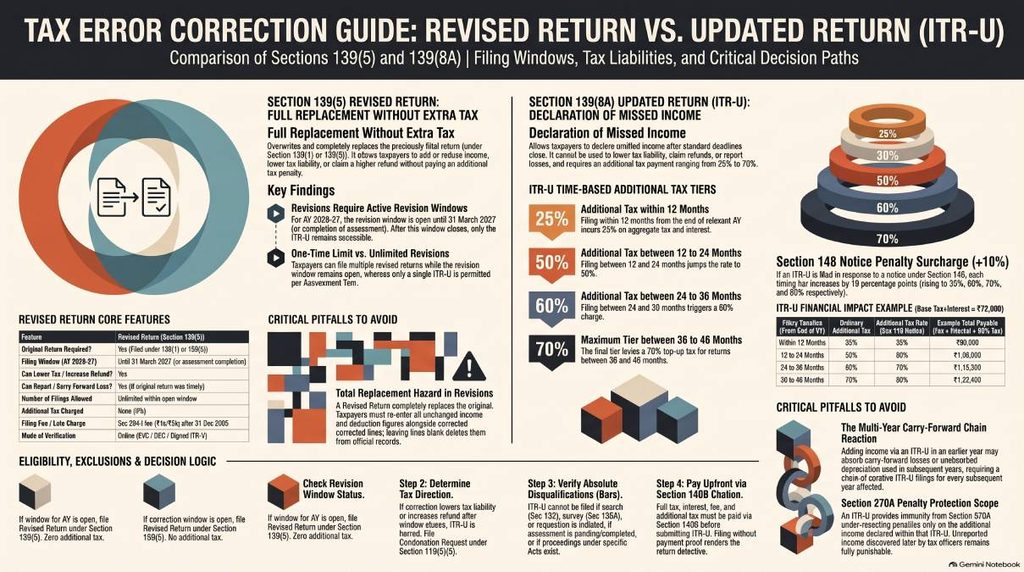
- A Revised Return (Section 139(5)) allows taxpayers to fix omissions or incorrect statements on a previously filed return without paying any extra tax .
- For Assessment Year 2026-27, the revision window remains open until 31 March 2027 or before the assessment is completed, whichever happens first .
- Filing a revised return after 31 December 2026 will attract a Section 234-I fee, but it remains the only correction method that can successfully lower your tax or increase your refund .
- An Updated Return (ITR-U under Section 139(8A)) allows you to declare missed income after all standard deadlines have closed, remaining accessible for 48 months from the end of the Assessment Year .
- Filing an ITR-U triggers an additional tax ranging from 25% to 70% calculated on the aggregate of tax and interest, with the percentage stepping up based on how late the return is filed .
- You cannot use an ITR-U to claim a larger refund, reduce your tax liability, or report a loss (except in narrow cases where the ITR-U reduces the previously reported loss) .
- If you need to claim a refund for a year where the revision window is closed, you must file a condonation request under Section 119(2)(b) instead of an ITR-U .
- When filing an ITR-U, the normal tax, additional tax, interest, and fees must be paid upfront via a Section 140B challan, as failing to provide this payment proof renders the return defective .
Understanding the Basics: What Are Tax Return Corrections?
A filed return records the facts as you knew them on the day you filed, and facts change. A broker statement turns up in August, or a donation gets claimed twice. The Income-tax Act, 1961 gives you set routes to repair the record, each with its own gate and its own price.
Two routes repair a return that already exists, the revised return and the updated return. A belated return covers a year in which nothing was filed, and a fourth route, condonation of delay under Section 119(2)(b), handles refund claims that no return can carry any more. This guide deals with the first two. The other two come up only where they affect a decision.
The Income-tax Act, 2025 came into force on 1 April 2026 and governs Tax Year 2026-27 onward. Every year discussed here, AY 2026-27 and earlier, stays under the 1961 Act, a carry-over the Department records on its e-filing help page.
Also Read: IT Refund Stuck? A Practical Guide to Responding to Defective Return Notice
What is a Revised Return under Section 139(5)?
A revised return replaces the return you filed earlier. Once it is accepted, the revised version becomes the return of record for that year and the original falls away. No Assessing Officer has to approve it. The law lets you revise when you discover an omission or a wrong statement in the original, and unlike an ITR-U, a revision needs no extra tax payment to be valid. You can revise more than once while the window is open.
Only a return filed under Section 139(1) (on time) or Section 139(4) (belated) can be revised. A return filed in answer to a notice under Section 142(1) cannot. The Department’s tutorial at https://www.incometaxindia.gov.in/w/return-of-income-2 sets out the rule.
The window moved in 2026. Before Finance Act 2026, a revised return had to be in by 31 December of the AY, three months before the year ended. The new rule runs to 12 months from the end of the relevant previous year, or until assessment is completed, whichever comes first, so the cut-off for AY 2026-27 is 31 March 2027. Taxmann’s note covers the change, and the portal FAQ says a revised return for AY 2026-27 can be filed before 31 March 2027 or before assessment, whichever is earlier.
A revised return filed after nine months from the end of the relevant previous year now attracts a Section 234-I fee, which for AY 2026-27 means any filing after 31 December 2026. The fee is ₹1,000 where total income is ₹5 lakh or less and ₹5,000 for everyone else.
A revised return can correct:
- income figures entered wrongly or left out
- deductions and exemptions claimed in error, or missed
- TDS and advance tax credits picked up incorrectly
- a refund bank account that is closed or wrong
A revised return can also cut your tax or raise your refund. The ITR-U cannot, so use the revised route while it lasts.
Two limits apply. A revision laid over an original that was itself late stays a belated return, so the bar on carrying forward most losses continues. The portal FAQ also states that revised and belated returns for AY 2025-26 and earlier years cannot be filed after 1 April 2026, which leaves only the ITR-U for those years.
What is an Updated Return (ITR-U) under Section 139(8A)?
The ITR-U arrived with Finance Act 2022, from 1 April 2022. It lets you declare income after every other window has closed, in return for a top-up payment. The first version allowed 24 months from the end of the AY; Finance Act 2025 stretched that to 48 months and added two higher tiers of additional tax. The Department’s tutorial lists the current rates.
Anyone can file one, whether or not they filed an original, belated or revised return for the year, but only one ITR-U is allowed per AY. You file it on the ITR form for your category (ITR-1 to ITR-7), with two added schedules: Part A Gen_139(8A) and Part B ATI. It can be filed online only.
An ITR-U cannot cut your tax or enlarge a refund, and it cannot report a loss either. In exchange for the extra tax you get protection from a penalty under Section 270A on the additional income you declare through it, as the SMFG India Credit explainer notes.
Typical triggers for an ITR-U:
- a return never filed for the year, with the belated window gone
- income left out of the original return
- income reported under the wrong head, or capital gains misreported
- deduction claims that were too high
The Department has used the route in practice. In March 2024 the Tamil Nadu and Puducherry income tax charge flagged unusually large claims under Sections 80G, 80E and 80GGC for AY 2021-22 to AY 2023-24, some above 80% of gross total income, and invited taxpayers to correct them through an ITR-U.
Excess deduction claims make the cleanest ITR-U case. The filing is voluntary, and the additional tax sits on a base you can calculate to the rupee before you file, since the corrected figure only raises tax.
If the Department has flagged a claim of yours, correct it before an officer follows up.
Also Read: Who Can File ITR Till August 31: ITR Due Date for Non-Audit Cases 2026
Key Differences: Revised Return vs. Updated Return
Both routes fix a filed return, but they differ in what they allow and in what they charge. The table below puts the two next to each other.
| Feature | Revised return (Section 139(5)) | Updated return (Section 139(8A)) |
| Original return needed | Yes, filed under Section 139(1) or 139(4) | No. Open even if nothing was filed |
| Approval | None | None |
| Number of filings | Unlimited inside the window | One per AY |
| Window for AY 2026-27 | To 31 March 2027, or until assessment, whichever is earlier | To 31 March 2031 (48 months from the end of the AY) |
| Can lower tax or raise a refund | Yes | No |
| Can show a loss | Yes, if the original was filed on time | No, apart from narrow cases (see below) |
| Extra tax | None | 25%, 50%, 60% or 70% of tax plus interest |
| Fee | Section 234-I after 31 December 2026 | Section 234F, unless already paid on an earlier return |
| Form | The ITR form you used or should have used | The ITR form for your category, with Part A Gen_139(8A) and Part B ATI |
| Mode | Online | Online only |
Eligibility: Who is Allowed to File Which Return?
Eligibility depends on what you filed first and on what the correction does to your tax.
| Where you stand | Revised return | Updated return |
| Filed on time under Section 139(1) | Yes, within the window | Yes, within 48 months, if no bar applies |
| Filed late under Section 139(4) | Yes, within the window | Yes, within 48 months, if no bar applies |
| Already revised once | Yes, again, within the window | Yes, within 48 months, if no bar applies |
| Filed nothing for the year | No. Use the belated return while it lasts | Yes, within 48 months |
| Filed a return of loss under Section 139(3) | Yes | Only if the ITR-U shows income or reduces the loss |
| Filed in reply to a Section 142(1) notice | No | Check the bars in the section on exclusions below |
The second test is the direction of the change. A correction that lowers tax or raises a refund can go only on a revised return, and only while the window is open. A correction that adds tax can go on an ITR-U once the window has gone.
For AY 2026-27, both routes are open right now. A revised return can carry any correction, up or down, and costs no additional tax. An ITR-U adds 25% on top and cannot lower anything. Where a revised return can do the job, it is always cheaper. The ITR-U makes sense only for years whose revision window has closed, or for a year in which you filed nothing and the belated window has also closed.
The signing rules differ as well. Companies and political parties must sign an ITR-U with a digital signature certificate (DSC), and so must anyone whose accounts need an audit under Section 44AB, except under ITR-7. Everyone else can verify with a DSC or an electronic verification code.
Also Read: Revised Children’s Education & Hostel Allowance 2026: Tax-Free Limits & Rules
Time Limits and Filing Deadlines for 2026
Every later date for AY 2026-27 hangs off the original deadlines, which the Taxmann note lists.
| Taxpayer category | Original due date, AY 2026-27 |
| Most individuals and others not needing an audit | 31 July 2026 |
| Non-audit business or profession, and partners of non-audit firms (Finance Act 2026) | 31 August 2026 |
| Taxpayers whose accounts need an audit | 31 October 2026 |
| Transfer pricing cases | 30 November 2026 |
CBDT Circular 07/2026, dated 28 September 2026, moved the audit date for one category to 21 November 2026 and the audit report date from 30 September to 21 October 2026.
For AY 2026-27, the correction routes close on these dates.
| Route | Last date | Source of the date |
| Belated return, Section 139(4) | 31 December 2026 | Taxmann due-date note |
| Revised return, Section 139(5) | 31 March 2027 | Portal FAQ and Taxmann |
| ITR-U at 25% | Within 12 months of 31 March 2027 | Section 139(8A) tiers |
| ITR-U at the final 70% tier | 31 March 2031 (the last day of the 48 months) | Calculated from the 48-month rule |
The last line is arithmetic, not a quoted date: forty-eight months from the end of AY 2026-27 lands on 31 March 2031.
Two dates in the table matter more than the rest. The first is 31 December 2026. Until then, a person who never filed for AY 2026-27 can file a belated return and keep the option to revise, at the cost of interest under Section 234A and a late fee under Section 234F. After that date the only way to file for the year is an ITR-U at 25% or more. The second is 31 March 2027, when the revised return for AY 2026-27 closes and the ITR-U tiers for the older years all step up together.
For earlier years, the tier depends on the date you file, not the date you found the error. The table below applies to an ITR-U filed between 1 April 2026 and 31 March 2027. Taxmann publishes the same split in its FAQ.
| Assessment year | Additional tax if filed in FY 2026-27 | Last date to file an ITR-U |
| AY 2025-26 | 25% | 31 March 2030 |
| AY 2024-25 | 50% | 31 March 2029 |
| AY 2023-24 | 60% | 31 March 2028 |
| AY 2022-23 | 70% | 31 March 2027 |
| AY 2021-22 | Closed | 31 March 2026 |
The last dates in the right-hand column come from the SMFG India Credit table. The Department’s own tutorial confirms that only AY 2022-23 to AY 2025-26 remain open in FY 2026-27.
The tier changes on 1 April each year, always upward. An ITR-U for AY 2025-26 costs 25% on 31 March 2027 and 50% on 1 April 2027. One day of delay can add a quarter of the base.
Penalty Structures and Additional Tax Liabilities
The two routes carry different charges, and those charges combine with interest in different ways.
| Charge | Revised return | Belated return | Updated return |
| Additional tax | None | None | 25% to 70% of tax plus interest |
| Late filing fee, Section 234F | Not applicable | ₹5,000, or ₹1,000 if total income is ₹5 lakh or less | Charged only if not already paid on an earlier return |
| Section 234-I fee | ₹1,000 or ₹5,000 after 31 December 2026 for AY 2026-27 | Not applicable | Not applicable |
| Interest, Section 234A | Only if the original was late | 1% a month from the due date | Not charged if an earlier return exists |
| Interest, Sections 234B and 234C | On the corrected tax | On the tax shown | Charged, with 234C working off the income in the ITR-U |
| Penalty, Section 270A | Applies to under-reported income | Applies to under-reported income | Does not apply to the additional income declared |
The additional tax is computed on tax plus interest, less any interest already paid on an earlier return. No interest runs on the additional tax itself, and Sections 234A and 234B do not apply to it.
A refund you have already received comes back into the sum. Section 140B(2)(b) adds the refund issued on the earlier return, along with any interest paid on it under Section 244A, to the tax computed for the ITR-U. Someone who claimed ₹10 lakh back on a return that left out income will find that refund in the calculation.
Older years carry a long interest tail. Section 234B interest runs at 1% a month from 1 April of the AY until you pay, so a year that has been closed for three years has three years of that interest in the base before the 70% rate is applied.
Filing also restarts the assessment clock: an officer can assess an updated return at any time before nine months from the end of the financial year in which you file it.
Take the same error under both routes. Suppose the tax shortfall is ₹60,000 and the interest is ₹12,000, the figures used in the worked example later in this guide. A revised return filed before 31 December 2026 costs ₹72,000. An ITR-U filed within 12 months of the end of the AY costs ₹90,000. The ₹18,000 difference is what you pay for letting the revision window close.
If the ITR-U is filed in reply to a notice under Section 148, each tier rises by ten percentage points.
| Period from end of the AY | Ordinary ITR-U | ITR-U filed in reply to a Section 148 notice |
| Within 12 months | 25% | 35% |
| 12 to 24 months | 50% | 60% |
| 24 to 36 months | 60% | 70% |
| 36 to 48 months | 70% | 80% |
The Department’s tutorial says the Section 148 route opened on 1 March 2026 under Finance Act 2026.
How to File a Revised Return: Step-by-Step Guide
A revised return is a fresh return that overwrites the old one, so every figure goes in again. That covers the lines you are leaving alone as well as the ones you are changing.
- Confirm the window. For AY 2026-27 you have until 31 March 2027. Check whether an assessment has already been completed, because that closes the window early.
- Gather the corrected facts. Pull up your tax credit statements and your income records, and settle exactly which numbers were wrong in the original.
- Work out the corrected tax. Add interest under Sections 234B and 234C where tax was short, and under Section 234A if the original return was late.
- Pay any shortfall before you file, as self-assessment tax. Keep the challan details, because the return asks for them.
- Log in to the e-filing portal, open the return filing section, select the AY, and choose the revised option under Section 139(5). The portal asks for the acknowledgement number and the filing date of the return you are replacing.
- Complete the whole return. Re-enter income and deductions in full, add every tax credit again, and confirm the refund bank account.
- Pay the Section 234-I fee if you file after 31 December 2026, then submit.
An unverified return is treated as invalid, so submission is not the end of the process. Verify within 30 days of filing, either electronically (Aadhaar OTP, net banking, a DSC or another prescribed mode) or by posting a signed ITR-V to the Centralised Processing Centre in Bengaluru. The Department’s help page records that electronic modes continue under the new Act.
File as soon as you have the corrected figures. The window is long, but the Section 234-I fee starts after 31 December 2026, and an assessment completed in the meantime closes the window early.
If the Centralised Processing Centre flags a defect under Section 139(9), you have 15 days to cure it, and an officer can extend that period. An uncured return is treated as invalid, so a revision meant to rescue a year can leave you with no valid return at all. The Department’s page covers the defective return rule.
How to File an Updated Return (ITR-U): The Complete Process
The ITR-U runs on the same portal and the same forms as an ordinary return, with two differences. You check the bars before anything else, and you pay the additional tax before you file, because the payment proof travels with the return.
- Check the bars. If any bar in the next section applies to the AY, stop. An ITR-U for that year will not be valid.
- Find your tier. Count months from the end of the AY to the day you plan to file. The count sets the rate at 25%, 50%, 60% or 70%.
- Compute the full liability. Take the tax on the corrected income, subtract advance tax, TDS, TCS and credits already given, add interest and the fee, then add the additional tax.
- Pay it all through a challan under Section 140B, and keep the payment details.
- Choose the ITR form for your category, select the updated return filing type, and fill Part A Gen_139(8A) and Part B ATI.
- Verify the return within the prescribed time through the same electronic modes or a DSC.
The Department’s tutorial states the consequence of skipping step 4: an updated return must carry proof of payment of normal tax, additional tax, interest and fee under Section 140B, and without it the return is treated as defective.
Prerequisites and Required Documents for ITR-U
Assemble these before you open the portal:
- your PAN and the credentials for your e-filing account
- the acknowledgement number and date of any earlier return for the AY, if one exists
- records of the income being added: bank statements, sale deeds, broker contract notes or invoices, depending on the source
- tax credit statements for the AY, so that TDS and advance tax are counted correctly
- the Section 140B challan for the payment, with its BSR code, date and serial number
- a digital signature certificate if you are a company or a political party, or if your accounts need an audit under Section 44AB (ITR-7 filers are excused)
Anyone else can verify with an electronic verification code.
Interest under Section 234A and Section 234B keeps running until the day you file, so pay the challan and file the ITR-U on the same day. A challan paid in week one and a return filed in week six leaves five weeks of interest unpaid, and the additional tax is computed on that interest too.
Paper filing is not an option.
Calculating the Additional Tax Payment (25% vs. 50%)
The additional tax is a percentage of one number: the aggregate of tax and interest payable on the updated return. The tax includes surcharge and cess, and interest already paid on an earlier return is deducted. Everything else is arithmetic.
Timing alone sets the tier.
| Filing period (from end of the AY) | Additional tax |
| Within 12 months | 25% |
| 12 to 24 months | 50% |
| 24 to 36 months | 60% |
| 36 to 48 months | 70% |
The jump from the first tier to the second hurts most. Take invented figures: omitted income adds ₹60,000 of tax (surcharge and cess included), and interest under Sections 234A, 234B and 234C comes to ₹12,000. The aggregate is ₹72,000.
| Tier | Additional tax | Total payable (tax, interest and additional tax) |
| 25% | ₹18,000 | ₹90,000 |
| 50% | ₹36,000 | ₹1,08,000 |
| 60% | ₹43,200 | ₹1,15,200 |
| 70% | ₹50,400 | ₹1,22,400 |
Filing in month 11 instead of month 13 saves ₹18,000 on a ₹60,000 tax bill. The same delay on a bigger omission costs more, and interest keeps growing underneath.
A second example, from the Taxmann opinion piece at https://www.taxmann.com/post/blog/opinion-seeking-full-interest-on-tax-refunds-after-updating-returns-justified-or-not?amp, shows the refund add-back at work. A taxpayer had omitted ₹1,00,000 of income and had already received a refund of ₹10,03,820 on the original return. Tax payable on the updated return worked out to ₹88,020. Additional tax at 50% came to ₹44,010, which made the payment due ₹1,32,030. The refund and the interest paid on it formed part of the base.
Where the ITR-U answers a Section 148 notice, add ten percentage points to the rate, as the table in the penalty section shows.
Section 234A interest runs from the day after the original due date to the day you file the ITR-U, and it does not apply when an earlier return already exists. Section 234B runs on assessed tax from 1 April of the AY, and Section 234C works off the income as returned in the ITR-U. The Department’s tutorial states that Sections 234A and 234B do not apply to the additional tax itself.
The additional tax has a fixed rate and a fixed base, and neither the Department’s tutorial nor the Taxmann FAQ mentions any waiver.
When You Cannot Use an Updated Return (ITR-U)
The ITR-U is a concession, and the law limits it. Check every bar below before you compute anything. The Department’s tutorial and the Taxmann FAQ list them.
| Bar | Detail |
| The ITR-U would be a return of loss | Barred, with the narrow exceptions described after this table |
| The ITR-U would lower tax or raise a refund | Barred. Only a revised return, or a condonation request, can carry that claim |
| Search under Section 132 | Barred for the year of the search and the earlier years it covers |
| Requisition under Section 132A | Barred on the same footing |
| Survey under Section 133A | Barred, except for TDS or TCS surveys |
| Seizure or requisition in another person’s case | Barred if the seized material relates to you |
| An ITR-U already filed for the AY | Only one is allowed |
| Assessment or reassessment pending or completed | Barred, but a reply to a Section 148 notice is allowed |
| Officer holds information under the Prevention of Money Laundering Act, the Black Money Act, the Benami Act or SAFEMA | Barred |
| Information received under a double taxation avoidance agreement or a tax information exchange agreement | Barred |
| Prosecution proceedings started | Barred |
| Show-cause notice under Section 148A issued after 36 months | Barred, unless the Section 148A(3) order finds the case unfit for reassessment |
| Classes of persons notified by the CBDT | Barred |
Read the pending-assessment line twice. If an officer has an open assessment on that AY, or has already finished one, the ITR-U door is shut. The one way through is a reply to a Section 148 notice, which costs ten percentage points more.
An ITR-U cannot report a loss for the year, and it cannot enlarge a refund claim. Two exceptions exist, and one of them is new.
Someone who filed a return of loss under Section 139(3) can still file an ITR-U, provided the ITR-U shows income or reduces the loss. Finance Act 2026 widened this: a loss-reducing ITR-U is now open where the loss return was filed by the Section 139(1) due date and the update reduces the loss or turns it into income. A loss return filed late does not qualify.
An ITR-U for one year can break another. If your corrected income uses up a loss or unabsorbed depreciation, or a MAT or AMT credit, that you had carried forward into later years, the later returns are now wrong. The Department’s tutorial gives the example of Mr. A, who showed ₹80 lakh of business income for AY 2023-24 and ₹10 lakh for AY 2022-23, with a ₹20 lakh loss carried forward from AY 2021-22. An ITR-U for AY 2022-23 that added ₹25 lakh of income absorbed the whole loss, so AY 2023-24 needed its own curative ITR-U to record the smaller carry-forward.
Each year gets its own ITR-U and its own additional tax, at whatever tier its filing date falls in. Budget for the whole chain before you file the first link.
An ITR-U filed in a barred year is not a valid return, so do not try to force it through. The routes that remain depend on what you were after.
If the aim was a refund or a lower tax bill for a closed year, apply for condonation of delay under Section 119(2)(b). The application has to reach the authority within five years from the end of the AY. Claims up to ₹1 crore go to the Principal Commissioner or Commissioner. The Chief Commissioner takes claims from ₹1 crore to ₹3 crore, and the Principal Chief Commissioner anything above that. A decision is due within six months from the end of the month in which the application arrives. The Taxmann FAQ covers the process. Approval is discretionary, and nothing in the Act guarantees it.
If an officer has opened an assessment, the correction happens inside it: reply to the notice with the true figures. Where the notice is under Section 148, an ITR-U is the one filing the law lets you make, at the ten-point higher rate.
A four-step check settles most cases before any money moves:
- Is the revision window still open for that AY? If yes, revise, and stop reading.
- Does any bar in the table apply? If yes, an ITR-U is off the table for that year.
- Does the correction add tax? If it lowers tax or raises a refund and the revision window has closed, condonation under Section 119(2)(b) is the only door left.
- Which tier does today’s date fall in? Pay and file before the next boundary, not after it.
FAQ: Revised vs. Updated Return (ITR-U)
No, you cannot use an Updated Return (ITR-U) to claim a refund or increase a refund amount. Section 139(8A) strictly prohibits filings that lower your total tax liability. If you missed claiming a legitimate refund and the revision window has closed, your only alternative is to submit a condonation of delay request under Section 119(2)(b) to the tax authorities.
Filing an ITR-U requires paying an additional tax ranging from 25% to 70% on your aggregate tax and interest due, depending on your filing date. For Assessment Year 2026-27, filing within 12 months from the end of the AY incurs a 25% additional tax. This scales up to 50% within 24 months, 60% within 36 months, and 70% within 48 months.
Yes, you are eligible to file an ITR-U even if you missed filing your original or belated return. However, you must pay the standard late filing fee under Section 234F alongside any applicable interest and the additional ITR-U tax percentage before submission.
Yes, a valid revised return completely overwrites and replaces your original filing. Once successfully submitted and verified, the Income Tax Department treats the revised version as your final return of record. Therefore, you must re-enter all your income and deduction details accurately, not just the specific fields you are correcting.
Yes, there is no legal limit on the number of times you can revise your return, provided you do so within the permitted window. For AY 2026-27, this window closes on 31 March 2027 or before the assessment is completed, whichever comes first.
Common Mistakes to Avoid When Correcting Your ITR
Most losses here come from bad timing or from picking the wrong form of correction, and nine patterns recur.
- Filing an ITR-U for AY 2026-27 when a revised return is still open. The revised route costs nothing until 31 December 2026 and a small fee after that. The ITR-U costs 25% of tax plus interest and cannot cut your tax.
- Letting a tier boundary pass. The rate steps up on the first day after 12, 24 and 36 months. A return filed on the last day of a tier costs 10 to 25 percentage points of the base less than the same return filed a day later.
- Using an ITR-U to claim a refund. The law bars it, and the Department can treat the filing as invalid.
- Filing without the Section 140B payment proof. The return becomes defective, and the 15-day cure period under Section 139(9) will not fix a payment you never made.
- Not verifying. Whether the return is revised or updated, it counts only once verified within the prescribed time.
- Revising with partial data. A revised return replaces the old one in full. If you re-enter only the corrected lines, everything you leave out is gone from the record.
- Forgetting the later years. A carried-forward loss or credit that the corrected income absorbs needs its own curative ITR-U for each year affected.
- Trusting a stale source. Several adviser pages still say 24 months and 25% or 50%. The current rule is 48 months and four tiers. So check any figure against the Department before you pay on it.
- Skipping the shortfall payment on a revised return. The portal accepts the revision, but interest under Sections 234B and 234C keeps building on any unpaid tax, and the bill grows until you clear it.
One more risk sits outside the list. An ITR-U works only on facts you can document, and if an officer later finds income beyond what you disclosed, the protection from Section 270A covers only the income you declared.
The Income-tax Act, 2025 carries the same machinery forward under new numbers. Section 263(4) allows a belated return within nine months and Section 263(5) a revised return within 12 months. Section 263(6) allows an updated return within 48 months from the end of the financial year following the tax year, with the additional tax charged under Section 267. The portal FAQ marks the 12-month revision window in Section 263(5) as proposed in the Finance Bill 2026, so read the final text when you reach Tax Year 2026-27 returns. Until then, every year in this guide stays under the 1961 Act by virtue of Section 536(2)(c) of the 2025 Act.
Disclaimer
This blog post is for informational and educational purposes only and does not constitute professional financial, tax, or legal advice. Tax laws, including the Income-tax Act, 1961, and the provisions of the Income-tax Act, 2025, are complex and subject to frequent amendments, notifications, and official departmental interpretations. While every effort has been made to ensure the accuracy of the deadlines, penalty tiers, and filing procedures discussed herein, readers must independently verify all facts with the official Income Tax Department portal or consult a certified Chartered Accountant (CA) before making any financial decisions or filing a return. The author and publisher disclaim any liability for financial loss, penalties, or defective return notices resulting from the use or misinterpretation of this information. Reliance on any content, calculations, or timelines provided in this policy explainer is solely at your own risk.




Leave a Reply