
ITR Filing 2026: Navigating the ₹4 Lakh Basic Exemption Limit
Decoding the Key Thresholds: The ₹4 Lakh Exemption vs. ₹12 Lakh Tax-Free Limit
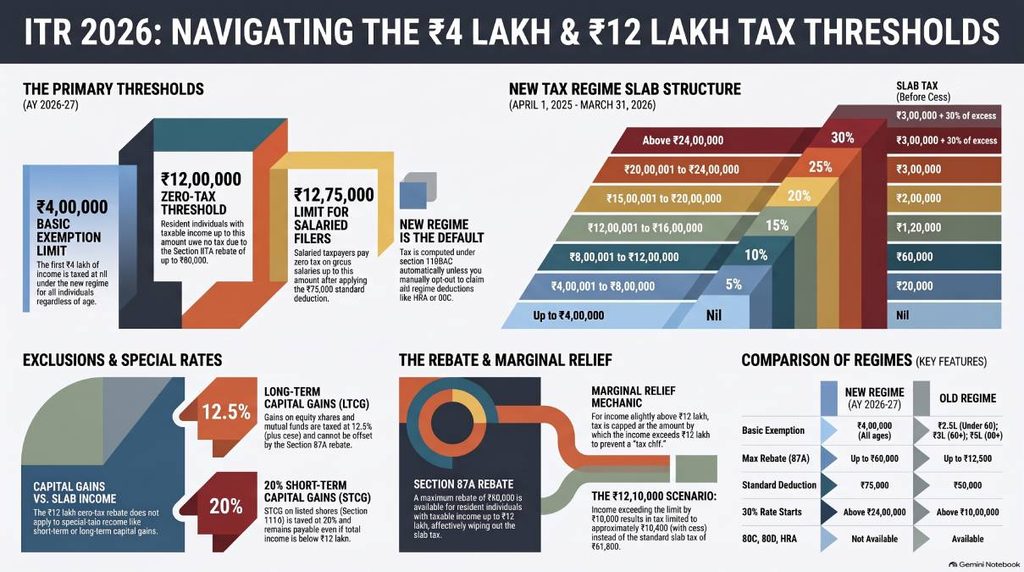
The first ₹4 lakh of income is taxed at nil under the new tax regime for AY 2026-27. Most returns filed this season turn on that line, and on a second number sitting directly above it.
That second number is ₹12 lakh. A resident individual with taxable income up to that figure pays no income tax, because the section 87A rebate of up to ₹60,000 cancels whatever slab tax the ₹4 lakh structure produces. The Budget 2025-26 announcement put it as no tax up to ₹12 lakh, “other than special rate income such as capital gains”, and up to ₹12.75 lakh for salaried taxpayers once the ₹75,000 standard deduction is taken.
The gap between the two numbers is where filers go wrong.
Five figures carry most of the weight in a 2026 return:
- ₹4,00,000: the nil slab under section 115BAC for income earned in FY 2025-26 (AY 2026-27).
- ₹12,00,000: the taxable income up to which a resident individual owes no tax after the section 87A rebate.
- ₹12,75,000: the salary or pension figure that clears the same test once the standard deduction is subtracted.
- ₹2,50,000: the basic exemption limit that survives in the old regime for anyone under 60 (₹3 lakh for senior citizens, ₹5 lakh for super senior citizens).
- ₹1,25,000: the ceiling on long-term capital gains under section 112A for filers who want to stay on ITR-1 or ITR-4.
Every calculation below uses the slabs notified for AY 2026-27, the return year for income earned between 1 April 2025 and 31 March 2026. Tax figures include 4% cess unless a line says otherwise. Section 115BAC becomes section 202 under the Income Tax Act 2025, but the department’s return pages for AY 2026-27 still cite the 1961 Act, and this post follows them.
At A Glance: ₹4 Lakh Basic Exemption Limit
- ₹4 Lakh Basic Exemption: Income up to ₹4,00,000 is entirely tax-free for all individuals under the new tax regime for AY 2026-27, regardless of age.
- The ₹12 Lakh Zero-Tax Threshold: Resident individuals with a total taxable income up to ₹12,00,000 owe no tax, thanks to a maximum Section 87A rebate of ₹60,000.
- ₹12.75 Lakh Limit for Salaried Filers: When factoring in the ₹75,000 standard deduction, salaried employees effectively pay zero income tax on a gross salary of up to ₹12,75,000.
- Capital Gains Exclusion: The ₹12 lakh zero-tax rule does not apply to special-rate income. Short-term and long-term capital gains remain taxable and cannot be offset by the Section 87A rebate.
- Default Tax Regime: The new tax regime is the default setting for AY 2026-27. You must manually opt out in your return if you intend to claim old-regime deductions like Section 80C, 80D, or HRA.
What is the ₹4 Lakh Basic Exemption Limit for AY 2026-27?
A basic exemption limit is the band of income on which the slab rate is zero. Under the new regime, the department’s slab list for AY 2026-27 opens with “up to ₹4,00,000: nil”.
Nothing changes abruptly at the line. Earn ₹4,50,000 and only the ₹50,000 above it is taxed, at 5%.
Age changes nothing here. ClearTax puts the tax-free limit under the new regime at ₹4 lakh “irrespective of the age of the taxpayer”. Residents and non-residents start from the same ₹4 lakh, as do HUFs, and that is where the similarity ends. The section 87A rebate belongs to resident individuals alone, and the ITR-2 FAQ says a HUF or firm cannot claim it. A non-resident gets the ₹4 lakh band and the same slabs, without the rebate.
Residency decides who gets the rebate, and the department’s page for non-residents gives the tests. An individual is resident for the year if either condition holds:
- Presence in India for 182 days or more during the year.
- Presence for 60 days or more during the year and 365 days or more across the four years before it.
The 60-day limit stretches to 182 days for an Indian citizen or person of Indian origin visiting India, and to 120 days where such a person’s Indian income, excluding foreign-source income, exceeds ₹15 lakh. An Indian citizen with more than ₹15 lakh of such income who is not liable to tax in any country is deemed resident.
So “no tax up to ₹12 lakh” carries a residency condition. It also leaves out special-rate income such as capital gains, which comes up again below.
Take a resident who earns ₹6 lakh a year from rent and interest, with no salary involved. The first ₹4 lakh is nil, the next ₹2 lakh is taxed at 5%, and slab tax comes to ₹10,000. The rebate wipes out all of it. Tax due: nil.
The new regime is the default. Since AY 2024-25, tax has been computed under section 115BAC unless the taxpayer opts out. A salaried taxpayer with no business income who does nothing lands here.
Also Read: ITR e-Filing 2026: A Step-by-Step Guide for AY 2026-27 (New Rules)
Key Changes in the New Tax Regime Slabs
Budget 2025-26 replaced the entire slab ladder. Under the FY 2024-25 structure the first ₹3 lakh was nil and the 30% rate began above ₹15 lakh, per ClearTax’s slab history. The new one has seven bands, and 30% now starts at ₹24 lakh.
Slabs for AY 2026-27 under section 115BAC, as listed by the Press Information Bureau and reproduced by ClearTax :
| Taxable income | Rate | Slab tax at top of band (before cess) |
| Up to ₹4,00,000 | Nil | Nil |
| ₹4,00,001 to ₹8,00,000 | 5% | ₹20,000 |
| ₹8,00,001 to ₹12,00,000 | 10% | ₹60,000 |
| ₹12,00,001 to ₹16,00,000 | 15% | ₹1,20,000 |
| ₹16,00,001 to ₹20,00,000 | 20% | ₹2,00,000 |
| ₹20,00,001 to ₹24,00,000 | 25% | ₹3,00,000 |
| Above ₹24,00,000 | 30% | ₹3,00,000 plus 30% of the excess |
The slab redraw came with other changes, and one trap sits in the department’s own FAQ pages.
The rebate under section 87A rose from ₹25,000 to ₹60,000, and the income ceiling for claiming it moved from ₹7 lakh to ₹12 lakh from AY 2026-27 onwards. Salaried taxpayers and pensioners get a ₹75,000 standard deduction, and family pension carries a ₹25,000 deduction. Marginal relief stops the rebate from working like a cliff edge, and the salary section further down covers it.
The department’s FAQ on the new versus old regime still carries AY 2024-25 numbers: a ₹7 lakh rebate limit and a ₹50,000 standard deduction. Discard those figures if you are reading it for AY 2026-27.
The same Budget adjusted a few thresholds that touch filers directly:
- TDS on interest for senior citizens doubled from ₹50,000 to ₹1 lakh.
- The annual limit for TDS on rent rose from ₹2.4 lakh to ₹6 lakh.
- The threshold for tax collected at source on remittances under the Liberalised Remittance Scheme went from ₹7 lakh to ₹10 lakh.
- Higher TDS rates now apply only where the deductee has not furnished a PAN.
What the changes are worth depends on where you sit. The table below reruns the FY 2024-25 slabs and the FY 2025-26 slabs on the same taxable income, cess included. The FY 2024-25 slab history comes from ClearTax (https://cleartax.in/s/income-tax-slabs); the arithmetic is ours.
| Taxable income | Tax on FY 2024-25 slabs | Tax on FY 2025-26 slabs | Saving |
| ₹8,00,000 | ₹31,200 | Nil | ₹31,200 |
| ₹10,00,000 | ₹52,000 | Nil | ₹52,000 |
| ₹12,00,000 | ₹83,200 | Nil | ₹83,200 |
| ₹15,00,000 | ₹1,45,600 | ₹1,09,200 | ₹36,400 |
| ₹20,00,000 | ₹3,01,600 | ₹2,08,000 | ₹93,600 |
| ₹24,00,000 | ₹4,26,400 | ₹3,12,000 | ₹1,14,400 |
| ₹30,00,000 | ₹6,13,600 | ₹4,99,200 | ₹1,14,400 |
The pattern looks odd at first glance. Someone at ₹12 lakh saves ₹83,200, and someone at ₹15 lakh saves less than half that. The rebate explains it: below ₹12 lakh it wipes out the whole bill, so the saving equals the entire old tax. Above that line, only the slab redraw is doing any work, and the gain stops growing at ₹24 lakh.
Also Read: Who Can File ITR Till August 31: ITR Due Date for Non-Audit Cases 2026
How the ₹4 Lakh Limit Differs from the Old Regime
The old regime keeps its own ladder. The basic exemption limit is ₹2,50,000 for individuals below 60. Those aged 60 to below 80 get ₹3,00,000, and those aged 80 and above get ₹5,00,000. Above the exemption come rates of 5%, 20% and 30%.
| Old regime rate | Below 60 | Age 60 to below 80 | Age 80 and above |
| Nil | Up to ₹2,50,000 | Up to ₹3,00,000 | Up to ₹5,00,000 |
| 5% | ₹2,50,001 to ₹5,00,000 | ₹3,00,001 to ₹5,00,000 | Not applicable |
| 20% | ₹5,00,001 to ₹10,00,000 | ₹5,00,001 to ₹10,00,000 | ₹5,00,001 to ₹10,00,000 |
| 30% | Above ₹10,00,000 | Above ₹10,00,000 | Above ₹10,00,000 |
The new regime has no age tiers. A 65-year-old and a 25-year-old see the same ₹4 lakh band. For a super senior citizen (₹5 lakh in the old regime) that means a slightly smaller nominal exemption. The rebate erases the difference for any resident who stays under ₹12 lakh, since the old regime’s own rebate stops at ₹5 lakh (₹12,500 maximum). Non-residents lose the age-based old-regime slabs entirely, because those apply to resident individuals only.
Take a resident super senior citizen whose income is ₹9 lakh of interest. Under the old regime the first ₹5 lakh is nil and the remaining ₹4 lakh is taxed at 20%, which is ₹80,000 (₹83,200 with cess), and the ₹12,500 rebate is out of reach because income exceeds ₹5 lakh. Under the new regime, slab tax on ₹9 lakh is ₹30,000 and the rebate cancels it. The bill is nil. Deductions of roughly ₹4 lakh would be needed in the old regime to reach the same place.
A separate rule helps the oldest filers. Resident senior citizens aged 75 or more whose income is only pension and interest from the same bank can skip the return if they file a declaration with the bank and it deducts tax under section 194P .
Slabs explain only part of the gap. What each regime lets you subtract explains the rest:
| Feature | New regime (section 115BAC) | Old regime |
| Basic exemption | ₹4,00,000 for all ages | ₹2,50,000; ₹3,00,000 (60+); ₹5,00,000 (80+) |
| Rebate under section 87A | Up to ₹60,000, for taxable income up to ₹12,00,000 | Up to ₹12,500, for income up to ₹5,00,000 |
| 30% rate begins | Above ₹24,00,000 | Above ₹10,00,000 |
| Standard deduction | ₹75,000 | ₹50,000 |
| Highest surcharge | 25% | 37% |
| HRA exemption | Not available | Available |
| Section 80C, 80D, 80DD, 80G deductions | Not available | Available |
| Interest on a self-occupied home loan | Not available | Available |
| Employer NPS contribution (80CCD(2)) | Available, up to 14% of salary | Available |
| Default for salaried taxpayers | Yes | Only if selected in the return |
The table draws on the department’s regime FAQ and salaried-returns page , plus ClearTax’s 115BAC summary. The 37% surcharge tier applies above ₹5 crore, and the new regime caps at 25%.
Claiming the old regime’s deductions takes paperwork. The new regime asks for almost none and pays off through lower rates.
Also Read: ITR 2026 Filing: Investment Taxation Under the Income Tax Act 2025 Guide
How the ₹4 Lakh Exemption Impacts Your Income Tax Calculation
Tax under the new regime runs in a fixed order. Skip a step and the result is wrong by lakhs.
- Add up income under each head: salary or pension, house property, business or profession, capital gains, other sources.
- Subtract the exemptions and deductions the new regime allows. The ₹75,000 standard deduction comes first.
- Separate special-rate income (short-term gains under section 111A, long-term gains, lottery winnings, virtual digital assets) from slab income.
- Apply the slabs to the slab income. The first ₹4 lakh costs nothing.
- Subtract the section 87A rebate if the taxable income is ₹12 lakh or less, or apply marginal relief if it is only slightly above.
- Add tax on special-rate income, then surcharge where it applies, then 4% cess.
- Subtract TDS, TCS and advance tax already paid. What remains is the balance payable or the refund.
The ₹4 lakh band applies at step 4, and the rebate arrives only at step 5. Most filing-season confusion comes from treating the two as one thing.
Salary Deductions and the ₹12.75 Lakh Tax-Free Threshold
The ₹12.75 lakh figure is arithmetic. ₹12,00,000 of taxable income plus the ₹75,000 standard deduction gives ₹12,75,000 of salary. The standard deduction is the lower of ₹75,000 and the salary itself, so it cannot push income below zero.
Slab tax below is computed on salary less ₹75,000, and the last column includes cess.
| Gross salary | Taxable income | Slab tax | Tax payable |
| ₹8,00,000 | ₹7,25,000 | ₹16,250 | Nil (rebate) |
| ₹12,75,000 | ₹12,00,000 | ₹60,000 | Nil (rebate) |
| ₹13,00,000 | ₹12,25,000 | ₹63,750 | ₹26,000 (marginal relief) |
| ₹13,50,000 | ₹12,75,000 | ₹71,250 | ₹74,100 |
| ₹15,00,000 | ₹14,25,000 | ₹93,750 | ₹97,500 |
| ₹20,00,000 | ₹19,25,000 | ₹1,85,000 | ₹1,92,400 |
| ₹25,00,000 | ₹24,25,000 | ₹3,07,500 | ₹3,19,800 |
The ₹15 lakh and ₹25 lakh rows agree with the worked cases in ClearTax’s slab guide and its 115BAC explainer, which land on ₹97,500 and ₹3,19,800.
The ₹13 lakh row needs a word. Without marginal relief, a taxable income of ₹12,00,001 would lose the entire ₹60,000 rebate and owe ₹60,000 of tax on a single extra rupee. Marginal relief caps the tax at the amount by which income exceeds ₹12 lakh. ClearTax’s example: taxable income of ₹12,10,000 exceeds the limit by ₹10,000, so tax is limited to ₹10,000 (₹10,400 with cess) instead of the ₹61,500 the slabs would produce.
The relief runs out where slab tax equals the excess over ₹12 lakh. That happens at roughly ₹12.71 lakh of taxable income, which is about ₹13.46 lakh of salary. Past that point plain slab tax is already lower than the excess, and the ₹13.5 lakh row shows no relief at all.
The ₹12.75 lakh figure also assumes salary is the only income. Add ₹30,000 of bank interest to a ₹12.75 lakh salary and taxable income becomes ₹12,30,000. Slab tax is ₹64,500, marginal relief limits the bill to the ₹30,000 excess, and the taxpayer pays ₹31,200 with cess. A single interest certificate turns a nil return into a paying one.
The new regime still allows some deductions, though the list is short:
- The standard deduction of ₹75,000.
- The deduction for the employer’s contribution to the employee’s NPS account under section 80CCD(2), up to 14% of salary.
- A deduction of ₹25,000 against family pension.
- Interest on a home loan for a let-out property (section 24), which is allowed, unlike interest on a self-occupied house.
- Contributions to the Agniveer Corpus Fund (section 80CCH).
- Retirement-linked exemptions: leave encashment up to ₹25 lakh under section 10(10AA) for non-government employees, gratuity under section 10(10), and voluntary retirement compensation under section 10(10C).
- Allowances and perquisites given for official purposes, transport allowance for persons with disabilities, and gifts up to ₹50,000.
The list comes from ClearTax’s new-regime FAQ and the department’s ITR-1 guidance.
Gone are HRA under section 10(13A), the Chapter VI-A deductions (80C, 80D, 80DD, 80G and the rest) and interest on a home loan for a self-occupied property. Claiming that interest means selecting the old regime in the return.
Employers work out TDS on salary under section 115BAC unless the employee tells them otherwise. The department’s FAQ adds a wrinkle: telling the employer you prefer the old regime does not count as opting out for filing purposes. That has to be done again in the return itself, before the due date under section 139(1).
A pensioner or salaried taxpayer at ₹12.75 lakh with zero investments owes nothing. A colleague at the same salary in the old regime would need ₹7.25 lakh of deductions beyond the standard deduction to reach zero, since the old rebate stops at ₹5 lakh of taxable income. That gap explains most of the new regime’s appeal.
Calculating Tax on Capital Gains and Special Rate Incomes
The ₹4 lakh band and the ₹12 lakh zero-tax result describe slab income only. The Budget language says so in as many words: no tax up to ₹12 lakh, other than special rate income such as capital gains.
ClearTax lists the special rates in its slab guide . The guide shows long-term gains at 13%, which equals 12.5% plus cess, whereas the other rows exclude cess. The table uses the 12.5% rate from ClearTax’s long-term gains guide and leaves cess out of every row:
| Income type | Rate |
| Short-term capital gains (section 111A) | 20% |
| Long-term capital gains | 12.5% |
| Lottery or game show winnings | 30% |
| Crypto or other virtual digital assets | 30% |
Two consequences follow, and the same guide states the first outright. The section 87A rebate cannot be used against tax on capital gains, betting, lottery, gambling or crypto income, since those are charged at special rates. The enhanced surcharge of 25% or 37% does not apply to income under sections 111A, 112 or 112A, or to dividends, so the surcharge on those is capped at 15%.
A case shows the split. A salaried taxpayer earns ₹10 lakh and books ₹2 lakh of short-term gains on listed shares.
- Salary less ₹75,000 leaves ₹9,25,000 of slab income. Slab tax is ₹32,500, and the rebate covers all of it.
- The ₹2,00,000 of short-term gains is taxed at 20%: ₹40,000.
- Cess at 4% is ₹1,600.
- Total payable: ₹41,600, despite total income sitting below ₹12 lakh.
Long-term gains under section 112A behave differently for the first ₹1.25 lakh. The department’s ITR-1 and ITR-4 guidance treats gains up to that amount as reportable in those forms, and Tax2win lists a long-term capital gains exemption up to ₹1.25 lakh among the items allowed under section 115BAC. On ₹1.5 lakh of gains, the taxable part is ₹25,000, and at the 12.5% rate listed above that costs ₹3,125, or ₹3,250 with cess.
Form choice changes as soon as capital gains show up:
- Short-term gains rule out ITR-1 and ITR-4.
- Long-term gains above ₹1.25 lakh under section 112A rule them out too.
- A return filed on the wrong form is treated as defective, and the taxpayer has to file a revised return on the right one.
- Capital losses can be carried forward only if the return is filed before the due date.
- Interest on fixed deposits and savings accounts is different again. It counts as slab income, so it eats into the ₹4 lakh band and the ₹12 lakh limit like salary does. A resident whose total income stays below the basic exemption limit can submit Form 15G (or Form 15H for those aged 60 and above) to the bank to stop TDS on that interest.
Step-by-Step Guide to ITR Filing 2026 Under the New Rules
Filing takes an afternoon when the paperwork is ready and a week when it is not. The steps run in this order:
- Gather Form 16, Form 16A, Form 26AS and the Annual Information Statement (AIS), plus statements for capital gains and interest.
- Pick the correct ITR form. The wrong one makes the return defective.
- Decide the regime. This is a choice made inside the return for most salaried filers.
- Fill the schedules, and check each income figure against AIS and Form 26AS before it goes in.
- Work out tax, subtract TDS and advance tax, and pay any balance before submitting.
- Submit and e-verify. An unverified return is not a filed return.
The department’s own precautions list backs up the fourth and sixth steps: link Aadhaar and PAN, pre-validate the bank account that will receive the refund, choose the correct form, file within the timelines and verify the return, with e-verification named as the easiest way.
Form choice is the step that trips people most. The table follows the department’s AY 2026-27 pages for salaried individuals and for those with business or professional income.
| Form | Who it suits | Watch for |
| ITR-1 (Sahaj) | Resident individuals (other than not ordinarily resident) with total income up to ₹50 lakh from salary or pension, one house property, other sources, agricultural income up to ₹5,000 and long-term gains under section 112A up to ₹1.25 lakh | Ineligible if you are a company director, hold unlisted shares, own foreign assets, have brought-forward losses or have short-term gains |
| ITR-2 | Individuals and HUFs with no business or professional income who cannot use ITR-1, at any income level | Covers capital gains of any size, income from more than one house property and residents or non-residents alike |
| ITR-3 | Individuals and HUFs with business or professional income who cannot use ITR-4 | Takes business income on actuals, alongside salary, house property, capital gains and other sources |
| ITR-4 (Sugam) | Resident individuals, HUFs and firms (other than LLPs) with presumptive income under sections 44AD, 44ADA or 44AE | Same exclusions as ITR-1 for directors, unlisted shares, short-term gains and foreign assets |
The table gives eligibility at a glance. The department’s pages call themselves general guidance, so read the detailed conditions before choosing. The Budget also extended the nil annual value for self-occupied property to two houses, without conditions.
Tax already deducted is a separate matter. TDS on salary, and on interest where a bank cut it, can only come back as a refund through a filed return. A taxpayer whose liability is nil after the rebate can still have money sitting with the department, which is why ClearTax’s list of reasons to file starts with the refund itself.
Low income is no excuse to skip the return. Even below the basic exemption limit, ClearTax lists filing triggers that include deposits of ₹1 crore or more in current accounts, more than ₹50 lakh in savings accounts, more than ₹2 lakh spent on foreign travel, electricity bills above ₹1 lakh a year, TDS and TCS of ₹25,000 or more (₹50,000 for senior citizens), business turnover above ₹60 lakh and professional receipts above ₹10 lakh. The same page lists reasons to file voluntarily: claiming a refund, holding foreign assets, applying for a visa or a loan, and carrying forward losses.
Non-audit individuals filing ITR-1 or ITR-2 had until 31 July 2026 for AY 2026-27, and non-audit business cases filing ITR-3 or ITR-4 had until 31 August 2026. Anyone who missed those dates can still file a belated return until 31 December 2026, with a late fee. ClearTax puts the fee at ₹5,000, reduced to ₹1,000 where total income is ₹5 lakh or less. A newer charge under section 234-I applies to a revised return filed after 31 December of the assessment year: ₹1,000 for total income up to ₹5 lakh and ₹5,000 above it. For AY 2026-27 that starts on 1 January 2027.
Budget 2025-26 also stretched the window for updated returns from two years to four. Treat it as a fallback.
Choosing Between the Old and New Tax Regimes Before Filing
The rules depend on the income you earn.
- Salaried taxpayers and others with no business or professional income pick a regime in the return, every year. The choice in one year does not bind the next.
- Anyone with business or professional income who wants the old regime must file Form 10-IEA on or before the due date under section 139(1). Once filed for an assessment year, it cannot be withdrawn in that same year.
- Withdrawing from the old-regime option later also goes through Form 10-IEA, and past choices do not carry forward. From AY 2025-26 you must file it again if you want the old regime.
- An opt-out sent to the employer is not enough. The department’s FAQ treats only the choice made in the return (or Form 10-IEA for business income) as the formal option.
Which regime costs less is a matter of arithmetic. The new regime wins whenever your old-regime deductions are smaller than a breakeven figure that rises with income. The table below finds that breakeven for a salaried taxpayer: how much you need in old-regime deductions and exemptions (beyond the ₹50,000 standard deduction) for the old regime to cost the same as the new one. Both sides use cess, no surcharge and no other income. The slabs come from the sources cited above; the breakevens are our calculation.
| Gross salary | New regime tax | Extra deductions the old regime needs to break even |
| ₹12,75,000 | Nil | ₹7,25,000 |
| ₹15,00,000 | ₹97,500 | About ₹5,44,000 |
| ₹20,00,000 | ₹1,92,400 | About ₹7,08,000 |
| ₹25,00,000 | ₹3,19,800 | ₹8,00,000 |
| ₹30,00,000 | ₹4,75,800 | ₹8,00,000 |
Read the table against your own paperwork. HRA exemption, section 80C investments, health insurance premiums and home loan interest on a self-occupied house all count toward the old-regime figure. A taxpayer at ₹25 lakh whose combined claims reach ₹8 lakh is indifferent. Below that, the new regime is cheaper. Above it, the old regime wins.
The breakeven leaves out surcharge, which starts once income passes ₹50 lakh. The rates are 10% from ₹50 lakh to ₹1 crore, 15% to ₹2 crore and 25% beyond that in both regimes, but only the old regime climbs to 37% above ₹5. At the top end, that 25% cap tilts things further toward the new regime.
ClearTax’s worked cases bear this out. Its FY 2025-26 example shows ₹3,19,800 under the new regime against ₹3,90,000 under the old , and a separate ₹25 lakh case in its 115BAC guide puts it at ₹3,19,800 against ₹5,69,400. The gap depends entirely on how much the person claims.
Four groups deserve a closer look before defaulting to the new regime:
- Senior and super senior citizens with large medical claims and interest income. The new regime removes age-based slabs.
- Taxpayers with a home loan on a self-occupied house and a high rent-paying HRA claim.
- Business-income filers, since a wrong choice locks the year.
- Taxpayers with heavy claims for health insurance under section 80D or donations under section 80G.
For everyone else, especially the large share of salaried filers at or below ₹12.75 lakh, the new regime is not close.
Important Documents Needed for AY 2026-27 Returns
The Income Tax Department’s ITR-2 FAQ lists what a filer needs on the desk before starting. The list applies well beyond ITR-2.
- Form 16 from the employer, for salary income.
- Form 16A from banks or other deductors, where TDS was cut on interest.
- Form 26AS and AIS, both downloadable from the e-Filing portal, to check TDS on salary and on other income.
- Rent receipts for HRA, if they were not submitted to the employer.
- A profit and loss or capital gains statement for shares and securities.
- Bank passbooks and fixed deposit receipts, to work out interest.
- Tenant details, local tax payments and interest on borrowed capital, for rented property.
- Documents proving any loss to be claimed this year, and a copy of the earlier return or acknowledgement for losses brought forward.
- Proofs for 80C, 80D, 80G and 80GG claims not already reflected in Form 16, which apply only to those choosing the old regime.
Two extras help. Form 12BB, on which an employee tells the employer about claims and deductions for TDS purposes, matters if you are claiming anything through payroll. And Form 10-IEA has to be in hand for anyone with business income who chooses the old regime.
AIS deserves more than a glance. It shows TDS and TCS, financial transaction reporting from banks and brokers, tax payments, demand and refund, and information from foreign governments, well beyond what Form 26AS carries. A mismatch between AIS and the return is the fastest route to a notice.
FAQ: ₹4 Lakh Basic Exemption Limit
Yes. Under the new tax regime for AY 2026-27, the ₹4 lakh basic exemption limit applies uniformly to all taxpayers, regardless of age. Unlike the old regime, there are no separate exemption thresholds for senior or super senior citizens.
Yes, for resident individuals, a net taxable income of up to ₹12 lakh is completely tax-free. This is achieved through the Section 87A rebate, which directly offsets up to ₹60,000 in tax liability. If you are a salaried employee, the ₹75,000 standard deduction pushes this tax-free threshold to a gross salary of ₹12.75 lakh.
Yes, ITR filing is mandatory if your gross total income (before deductions and rebates) exceeds the basic exemption limit of ₹4 lakh. Even if the Section 87A rebate reduces your final tax bill to zero, you must legally file your return to claim that rebate.
It depends. The rebate can offset tax on Short-Term Capital Gains (STCG). However, the law explicitly states that the Section 87A rebate cannot be used against Long-Term Capital Gains (LTCG) under Section 112A (such as equity shares and mutual funds), nor can it offset special-rate income like crypto or lottery winnings.
If your taxable income barely crosses the ₹12 lakh threshold (e.g., ₹12.1 lakh), marginal relief ensures your tax penalty doesn’t exceed your excess income. The government restricts your maximum tax liability to exactly the amount you earned above the ₹12 lakh limit, preventing a massive tax cliff for earning just a few extra rupees.
Common Mistakes to Avoid with the ₹4 Lakh Basic Exemption
Most errors start with treating the ₹4 lakh and ₹12 lakh figures as unconditional.
The mildest version is reading ₹4 lakh as “income up to ₹4 lakh is exempt, above it everything is taxed”. The slab taxes only the excess. The expensive mistake runs the other way: assuming a ₹12 lakh income costs nothing when part of it comes from capital gains. The ₹41,600 example earlier shows why.
Others that keep recurring:
- Reading ₹12 lakh as gross salary. The threshold is taxable income. For a salaried person the matching figure is ₹12.75 lakh, and only if there is no other income.
- Applying the rebate to an HUF, firm or non-resident. Section 87A is for resident individuals.
- Forgetting marginal relief. A ₹13 lakh salary owes ₹26,000, not ₹63,750 plus cess, and a filing tool that ignores relief will overstate the bill by about ₹40,000.
- Using AY 2024-25 figures. The department’s regime FAQ page still carries the old ₹7 lakh rebate limit and ₹50,000 standard deduction, and it remains live.
- Claiming old-regime deductions in the new regime. HRA, 80C and 80D claims are not allowed under section 115BAC.
- Assuming the employer’s TDS choice settles the regime. It does not. The formal option is made in the return, or in Form 10-IEA for business income.
- Filing ITR-1 with short-term gains, foreign assets or brought-forward losses. The return is treated as defective.
- Adding up salary and forgetting the rest. Fixed deposit interest, rent and dividends stack on top of salary and count toward the ₹12 lakh limit.
- Submitting Form 15G or Form 15H to a bank when total income will cross the basic exemption limit. The department describes those declarations for income below that limit.
- Skipping the return because income is below ₹4 lakh, when a filing trigger (foreign travel, high deposits, TDS of ₹25,000 or more) applies.
- Ignoring AIS and Form 26AS. Interest and dividend income missing from the return shows up in the department’s data first.
- Quoting Income Tax Act 2025 section numbers on an AY 2026-27 return. The department’s pages for this year still cite the 1961 Act, with sections 115BAC and 87A intact.
One habit prevents most of these. Compute tax twice, once under each regime, before opening the utility. The department’s regime FAQ says as much and points to the Income and Tax Calculator on its portal for a rough. Ten minutes there costs less than a revised return.




Leave a Reply