
How to withdraw PF amount online in 2026: Step-by-step under the new EPF Scheme
How to withdraw PF amount online has a new answer since the Employees’ Provident Funds Scheme, 2026 replaced the 1952 Scheme on 29 June 2026. A member who files by the old rules (five or seven years of service for an advance, two months after leaving a job for a full settlement) files a claim the new Scheme no longer allows, and the claim comes back rejected.
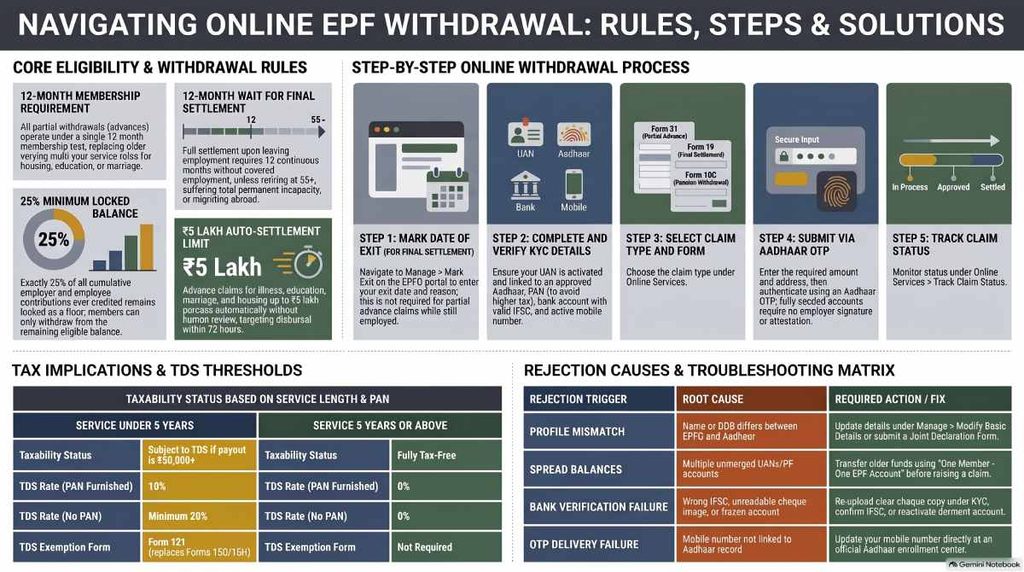
Three facts decide most claims. A partial withdrawal needs 12 months of membership and leaves 25% of everything credited to the account locked. A full settlement needs 12 months with no covered employment.
How to withdraw PF amount online at a glance
To withdraw PF amount online, keep your UAN active and your KYC verified, then raise the claim on the EPFO member portal or the UMANG app with an Aadhaar OTP. Which claim you can file depends on how long you have been a member and whether you still work for a covered employer. For an Aadhaar-seeded account, no employer signature is needed.
- A partial withdrawal needs 12 months of membership, with one exception for members who leave earlier (paragraph 46(5)).
- 25% of all contributions ever credited stays locked, and you can draw only the eligible member balance above that floor.
- Advance claims for illness, education, marriage and housing settle automatically up to ₹5 lakh. That is a processing ceiling, not an entitlement.
- A final settlement with under five years of service attracts TDS at 10% with PAN and at least 20% without, once the payment reaches ₹50,000.
PF withdrawal eligibility under the EPF Scheme 2026
The rules sit in the Employees’ Provident Funds Scheme, 2026, notified as G.S.R. 525(E) in the Gazette of India dated 29 June 2026, under section 15(1)(a) of the Code on Social Security, 2020. It supersedes the 1952 Scheme. Paragraph 1(2) brings it into force “on the date of its publication in the Official Gazette”, and the issue is dated 29 June 2026, so 29 June 2026 is the start date used here.
Some commentary prints 1 July 2026. The eGazette identifier reads CG-DL-E-01072026-273957, which may be the source of that date. Paragraph 1(2) ties commencement to publication, though, and the issue (No. 473) is dated Monday, 29 June 2026.
Your PF balance and UAN carry over. Paragraph 9 keeps members of the 1952 Scheme as members. Only the conditions for taking money out changed.
Also Read: EPFO IW Portal Explained: Compliance, CoC Generation, and PF Rules for International Workers
Partial withdrawal vs final settlement: which PF claim to file
A partial withdrawal falls under paragraph 46: you take part of the balance and stay a member. A final settlement falls under paragraph 49, where you take the whole PF balance and leave the fund.
| Route | Paragraph | Membership afterwards | Form label in published guides |
| Partial withdrawal (advance) | 46 | Continues | Form 31 |
| Final settlement | 49 | Ends | Form 19 |
ClearTax lists Form 19 for full settlement and Form 31 for partial withdrawal, and Form 10C covers pension withdrawal, with Form 10D as the monthly pension label. The Scheme prescribes no form numbers. Paragraph 54(1) says only that a member files a claim application on the designated portal, which makes the labels portal and guide usage. Pension withdrawal under the Employees’ Pension Scheme is a separate claim, covered below.
A third path skips withdrawal altogether. If you are changing jobs, a transfer keeps your service continuous, which matters for the five-year tax test. Bandhan Life points to Form 13 for the older paper route.
Paragraph 49(3) carries a catch. A member who withdraws the full amount under paragraph 49(2) and later takes a covered job must qualify for membership again and is treated as a fresh member, so the earlier service history does not carry forward for the 12-month test.
PF withdrawal rules 2026: the 12-month membership condition
Every partial withdrawal now runs on one service test: 12 months of membership. The 1952 Scheme used a different clock for each purpose. Paragraph 68B asked for five years of membership for housing, and paragraph 68K asked for seven for marriage and education. Both paragraphs are gone, so a single 12-month clock applies.
Parts of the ClearTax and Sansa Legal guides still carry the older wage-multiple limits. Where a commercial page and the gazette disagree, the gazette wins.
Paragraph 46(5) softens the rule: a member who exits before completing 12 months can still take a partial withdrawal, up to the eligible member balance. Paragraph 47 counts earlier service under the same employer before the Scheme applied and past periods of membership of the Fund, as well as periods in an exempted private fund, provided the member did not sever membership by withdrawing the fund in between.
Also Read: PF Transfer Pending for Months? How to Use the EPF Grievance Portal to Unblock Your Funds
25% PF minimum balance and how much you can withdraw
Paragraph 46 sets a floor. The minimum balance is 25% of the aggregate contributions credited to your account up to the date of withdrawal, which includes both the employee and employer shares plus interest. Your eligible member balance is the current PF balance minus that floor. The floor must remain in the account after any withdrawal, and each withdrawal must be at least ₹1,000.
The floor follows what has been credited, so it ignores what is left. A withdrawal never lowers it, and every new contribution or interest credit raises it.
A worked example, assuming no earlier withdrawals:
| Step | Figure |
| Aggregate credited to date (employee share, employer share, interest) | ₹8,00,000 |
| Minimum balance (25% of ₹8,00,000) | ₹2,00,000 |
| Eligible member balance (₹8,00,000 minus ₹2,00,000) | ₹6,00,000 |
| Balance after you withdraw ₹2,00,000 | ₹6,00,000 |
| Minimum balance after the withdrawal | ₹2,00,000 |
| Eligible member balance after the withdrawal | ₹4,00,000 |
Fresh credits change the second and last rows. If ₹40,000 more is credited, the floor moves to ₹2,10,000.
Full PF withdrawal after resignation: when the whole balance is payable
Paragraph 49(2) sets the default. The Commissioner or an authorised officer may permit full withdrawal on ceasing to be an employee, provided the member has not worked in any establishment covered by the Code for 12 continuous months immediately before applying. The old wait was two months. The Ministry flagged the change in its clarification of 15 October 2025, headlined “Premature final settlement period extended to 12 months”. EPFO’s own FAQ still carries the old two-month wording, so any page that cites it is out of date.
Paragraph 49(1) lists cases where the wait does not apply:
- retirement at 55 or older (a member under 55 at termination who turns 55 before payment is authorised also qualifies)
- retirement on permanent and total incapacity, medically certified (tuberculosis, leprosy and cancer are deemed to qualify)
- migration from India for permanent settlement or employment abroad
- termination through mass or individual retrenchment
- termination under a voluntary retirement scheme agreed by employer and employee
- a woman member resigning to marry (the second proviso to 49(2))
Paragraph 49(1)(vi) adds closure and transfer cases and discharge with retrenchment compensation under the Code on Industrial Relations, 2020. Each is payable only after two continuous months.
Resign on 1 August 2026 and take no covered job, and the earliest final settlement falls around August 2027. Until then you can still draw money: a member who has left can take a partial withdrawal up to the eligible balance under paragraph 46(5). The same ministry release describes the split as 75% withdrawable at any time without documentation and the remaining 25% after one year.
The pension component runs on a longer clock. Under the Employees’ Pension Scheme, 2026 (G.S.R. 527(E), also dated 29 June 2026), a member who exits before superannuation becomes eligible for the withdrawal benefit only after 36 months from the date the last contribution became due, or on reaching superannuation age if that comes first. That wording is quoted by Upstox from the proviso to paragraph 13(1), and the Ministry’s October 2025 release says pension accumulation can be withdrawn “after 36 months instead of 2 months”. The 36 months run from the last contribution and do not depend on length of service. The claim is Form 10C.
KYC and documents required for online PF withdrawal: UAN, Aadhaar, PAN and bank account
Paragraph 25(1) asks members to furnish an Aadhaar number, an Aadhaar-seeded bank account in a scheduled or co-operative bank, a PAN and a UAN. In practice the portal needs four things before it lets a claim through: an activated UAN, Aadhaar linked to it, a bank account with a valid IFSC, and a mobile number linked to Aadhaar for the OTP.
PAN matters most for a final settlement when service is under five years, because it fixes the TDS rate. A member with no PAN on record should add it under Manage, then KYC, before claiming.
If you have lost your UAN, the member portal’s “Know your UAN” option, in the links panel of the home page, asks for your mobile number, then name, date of birth and one of Aadhaar, PAN or member ID, as Scripbox describes.
PF partial withdrawal reasons and limits under paragraph 46
The 1952 Scheme had 13 separate withdrawal provisions. The Central Board of Trustees approved merging them on 13 October 2025. The PIB release of that date describes merging the 13 provisions into one rule, with minimum service “uniformly reduced to only 12 months for all partial withdrawals”. The Scheme notified on 29 June 2026 carries that design into paragraph 46, but the change itself dates from the Board’s October 2025 decision, and calling it a 2026-27 change misdates it.
Each category draws on the eligible member balance, up to 100% of it. The category you pick decides which count gets used up, so file under the one that fits the reason, whatever room another has left.
| Category | Paragraph | Limit on number of claims |
| Illness | 46(2) | No limit stated |
| Education | 46(2) | 10 |
| Marriage | 46(2) | 5 |
| Housing | 46(3) | 5, across all housing purposes |
| Special circumstances | 46(4) | 2 in a financial year |
PF withdrawal for illness, education and marriage
The text allows illness, education and marriage withdrawals for self and family members. It sets no limit on the number of illness claims. Education can be claimed up to ten times and marriage up to five, each after 12 months of membership and each up to 100% of the eligible member balance.
PF withdrawal for housing and home loan repayment
Paragraph 46(3) covers five housing purposes: purchase of a flat or house, a site for construction, construction, repayment of a home loan taken for any of those, and additions, alterations, renovations or improvements to an existing house or flat. The limit is five claims in total across all of them, each after 12 months of membership.
PF withdrawal without a reason: special circumstances claims
Paragraph 46(4) is the category for needs that fit none of the named purposes, and it is the route readers search for as PF withdrawal without a reason. The limit is two claims in a financial year, each up to 100% of the eligible member balance.
Paragraph 46(6) restarts every count from the commencement of the Scheme. Withdrawals you made under the 1952 Scheme do not count against these limits.
PF auto-settlement limit of ₹5 lakh and how long claims take
On 24 June 2025 the Ministry of Labour and Employment announced “increasing the auto-settlement limit for advance claims from existing ₹1 lakh to ₹5 lakhs”. The PIB release extends it to “advance claims for illness, education, marriage, and housing purposes” and promises processing “within three days of submission”. A ministerial post embedded in it says disbursal is now “within 72 hours”.
The release speaks only of advance claims. It says nothing about final settlement, so treat a final settlement as outside auto mode.
Treat ₹5 lakh as a ceiling on what the system will process without human review. It gives you no right to ₹5 lakh, because your amount is still capped by the eligible member balance. A member with a ₹3,00,000 eligible balance cannot draw more than that, whatever the ceiling.
Why a PF claim goes to manual review instead of auto-settlement
A claim stays in auto mode only when the machine finds nothing to question, and three days is a target that a flagged claim will miss.
These causes push a claim into manual review:
- name or date of birth on the UAN differing from Aadhaar
- Aadhaar not seeded, or the mobile number not linked to it
- a bank account that is unverified or carries a wrong IFSC
- a claim amount above ₹5 lakh
- an unmerged older UAN, or a missing exit date on a final settlement
- the wrong claim type for the reason chosen
The Scheme’s own clock is longer. Paragraph 54(7) requires a complete claim to be settled within 20 days, and 54(8) requires any deficiency to be communicated within the same period. Paragraph 54(9) says penal interest of 12% a year may be charged on the benefit amount, recovered from the Commissioner’s salary, where the delay is without sufficient cause. The wording is “may”, so the interest is a discretion and no automatic payout. Clean KYC is what separates a three-day claim from a twenty-day one.
How to withdraw PF online on the EPFO member portal, step by step
Sign in at the EPFO member portal with your UAN and password, then work through five steps in the order the portal asks for things. Menu labels change between portal updates, so follow the wording on your screen.
Step 1: Mark your date of exit for a final settlement or transfer
A final settlement or a transfer needs an exit date against your last employer. An advance claimed while you are still working does not.
Members still working can skip to Step 2. Everyone else starts here: go to Manage, then Mark Exit, and select the PF account. Enter the date of exit and the reason for leaving, then request an OTP, which goes to your Aadhaar-linked mobile. Enter it, tick the declaration box and select Update. Bandhan Life lists the same sequence. Afterwards, open View, then Service History, and check that the date sits against the right employer.
EPFO’s FAQ says the date of exit can be updated only after two months of leaving a job, through Manage, then Mark Exit. That is a portal rule, separate from the 12-month eligibility test in paragraph 49(2), which runs from the same exit date. Marking exit early does not shorten the wait. The FAQ predates the 2026 Scheme, so test the window on the live portal.
Step 2: Complete KYC by verifying Aadhaar, PAN, bank account and mobile number
Open Manage, then KYC. The page lists the documents tied to your UAN, and each one needs to show as approved before a claim is worth starting.
- Aadhaar: the number must be seeded and show approved. An unapproved Aadhaar is the usual reason the verification step fails later.
- PAN: needed for a final settlement with under five years of service. Without it the TDS rate doubles.
- Bank account: the account number and IFSC must be on file and approved. Cheque images that cannot be read are a named cause of rejection on ClearTax.
- Mobile number: the code goes to the number linked to Aadhaar, not to whichever number you prefer.
If a field shows pending, fix it first. A claim filed over a pending field stalls or leaves auto mode.
Step 3: Select the PF claim type and form (31, 19, 10C or 10D)
Under Online Services, select Claim (Form-31, 19, 10C & 10D). The menu label still carries the old form numbers. Published guides, including HROne’s procedure, use them as the claim names. The Scheme prescribes no form numbers, so treat them as portal labels. The old paragraphs 68B and 68K no longer exist, so the purposes in the dropdown may differ from what a pre-June guide lists.
| Claim | Form label | When it applies |
| Advance (partial withdrawal) | Form 31 | You are a member and want part of the eligible balance |
| Final settlement | Form 19 | You have left covered employment and the 12-month wait is met, or an exception applies |
| Pension withdrawal | Form 10C | You want the Employees’ Pension Scheme withdrawal benefit |
| Monthly pension | Form 10D | You qualify for a monthly pension instead of a lump sum |
Then, in order:
- Confirm the member details shown on screen.
- Re-enter your bank account number and select Verify.
- Choose Yes on the undertaking and select Proceed for Online Claim.
- Pick the claim type from the dropdown.
A composite claim form combines the final settlement and pension claims in one filing. The Aadhaar version needs no attestation. The non-Aadhaar version does.
Step 4: Submit the claim with an Aadhaar OTP and no employer attestation
Fill in the purpose, the amount and the address the form asks for. Then:
- Select Get Aadhaar OTP and enter the code sent to your Aadhaar-linked mobile.
- Select Submit.
The portal returns a claim reference number. Keep it, because tracking asks for it.
You do not need your employer’s signature for this. EPFO’s press release of 21 February 2017 says the Composite Claim Form (Aadhaar) “can be submitted without the attestation of employers”, and the non-Aadhaar form is submitted with it. The underlying order is dated 20 February 2017, and it recites an earlier order of 1 December 2015 that prescribed UAN-based Forms 19, 10C and 31. Legal 500 traces the same history. Treat it as settled practice for members with an activated UAN and Aadhaar seeding.
Three cases still reach the employer. Paragraph 54(3) lets a claimant who cannot file online for technical reasons forward a physical claim to the employer, who must pass it to the Commissioner after verification and attestation within five days. A non-Aadhaar composite claim needs attestation, as the 2017 release says and Tata Capital’s troubleshooting notes repeat. And if the Mark Exit window has not opened or the portal refuses your exit date, the employer has to record it in the employer interface before your claim can go through.
Step 5: Track your PF claim status online
Go to Online Services, then Track Claim Status, and enter the details it asks for. Bandhan Life describes the result as in process, approved or settled. On UMANG the path is EPFO Services, then Track Claim.
- In process: the claim is queued or under review. A claim that sits here past three days has probably left auto mode.
- Approved: the officer or the system has cleared the amount, and payment follows.
- Settled: money has been sent to the bank account on file.
- Rejected: the status carries a reason. Section “PF claim rejected or stuck: causes and fixes” below covers each one.
One more case is easy to miss. ClearTax lists “settled but returned”, where the payment bounces because the account is dormant or frozen or the bank details are wrong. The claim looks done, but the money never arrives.
How to withdraw PF through the UMANG app
UMANG handles the same claims on a phone. These screens come from Payrupik’s walkthrough, published in May 2026 and so written before the notification, so screen labels in the current app may differ.
Link your UAN on the UMANG app
Download UMANG from the Play Store or the App Store, register with your mobile number and verify it with an OTP. You can set a login PIN for later. Search for EPFO in the app, open Employee Centric Services, and enter your UAN. A code goes to your registered mobile to confirm it.
A member with no active UAN can generate and activate one on UMANG. PIB’s release of 9 April 2025 describes UAN generation and activation through Aadhaar Face Authentication Technology on the app. Press reports of an EPFO circular dated 30 July 2025 say face authentication became the only route for new UAN generation on UMANG from 1 August 2025.
Raise a PF withdrawal claim on the UMANG app
Inside Employee Centric Services, select Raise Claim. The app shows your Aadhaar, bank and employment details. Check them, because wrong details delay the claim. Then choose the claim type. Payrupik lists Form 19, Form 31 and Form 10C, so the app handles final settlement and advance claims as well as pension withdrawal.
Enter the amount and reason, confirm the declaration and submit with an OTP. Tracking sits under EPFO Services, then Track Claim.
Finright notes that NRIs can use the same two channels. The guides describe exit-date marking, profile corrections and transfer requests only on the member portal, so do those first.
How to withdraw PF offline with the Composite Claim Form
The form you pick decides who signs an offline claim. ClearTax says the Composite Claim Form (Aadhaar) goes to the jurisdictional EPFO office without the employer’s attestation, for members whose Aadhaar and bank details are seeded on an activated UAN. The Non-Aadhaar form goes to the same office with the employer’s attestation.
EPFO’s FAQ adds that the Manager of the bank holding your savings account can attest the form when the employer’s attestation is hard to get. That FAQ predates the 2026 Scheme, so confirm with the field office that it still accepts bank attestation.
PF withdrawal for a deceased member: Form 20 and Form 10D
A nominee or legal heir claims a deceased member’s PF balance by submitting Form 20 to the PF office, and the EPS pension amount through Form 10D, as ClearTax describes it.
EPFO’s FAQ says a beneficiary can apply online only when the member had filed an e-nomination. Without one, the claim goes in on paper, attested by the employer with the necessary documents. The same FAQ says a composite form replaced the old Forms 20, 10D and 5-IF, so labels on the live portal may differ. Both sources predate the 2026 Scheme, so confirm the form with the PF office before filing.
PF withdrawal through UPI and ATM under EPFO 3.0: what works today
EPFO 3.0 is the label for the digital overhaul, and the merger of 13 provisions into three categories belongs to it. The part you can use today is the claim route, which means the member portal or UMANG.
Several commercial pages, including Sansa Legal, say UPI and ATM withdrawal has arrived. The record so far shows a promise, then testing. Labour Minister Mansukh Mandaviya said in December 2025 that ATM and UPI options would arrive before March 2026, and that deadline has passed. On 19 May 2026 he said testing of UPI withdrawal was complete. Outlook Money reported on 8 October 2026 that the UPI process was still in the testing phase and likely to launch by the end of the year, and an NRS Associates note of 15 September 2026 found no public EPFO launch notice.
Whatever channel opens later, paragraph 46 still governs the amount, so a UPI or ATM route would draw only on the eligible member balance. Until EPFO announces a launch on its own channels, file through the portal or the app.
Tax and TDS on PF withdrawal in 2026
Tax on a PF withdrawal depends on how long you served as well as the amount. One rule change sits underneath it all: Section 192A of the Income-tax Act, 1961 became Section 392(7) of the Income-tax Act, 2025 from 1 April 2026, and the exemption now sits in Part A of Schedule XI. The new section still names the trustees of the 1952 Scheme, which the 2026 Scheme superseded. EPFO continues to deduct.
TDS on PF withdrawal: which claims attract it
TDS targets a premature final settlement, meaning a payout of the accumulated balance with under five years of continuous service. Section 392(7) obliges EPFO to deduct 10% where the payment is ₹50,000 or more and the balance is includible in total income under paragraph 8 of Part A of Schedule XI. The Canara HSBC Life guide and the Axis Max Life guide frame it the same way.
A partial withdrawal is a different case. EPFO’s FAQ lists payment of an advance among the cases where no TDS is deducted, but no CBDT circular addressing partial withdrawals under Section 392(7) had appeared as of 13 September 2026. That is EPFO’s practice and its reading of the provision, with no circular behind it. Check your TDS certificate (Form 16A) after the money lands to see whether anything was cut.
Is PF withdrawal tax free after five years of service?
Five years is the line. With five years of continuous service, the accumulated balance is generally left out of total income, and the payout is tax-free. The exclusion sits in paragraph 8 of Part A of Schedule XI of the Income-tax Act, 2025, which applies where the employee has rendered continuous service for five years or more. ClearTax sets out the same split: service of five years or more is tax-free, and anything shorter can attract TDS.
Paragraph 8 also counts service with earlier employers when the balances were transferred to your current account, which is the reason to merge old accounts before withdrawing and not after. A balance left in a stray PF account does not reset your clock, but it stays out of the continuous total.
TDS rate on PF withdrawal with and without PAN
The duty to deduct under Section 392(7) arises where “the aggregate amount of such payment is ₹ 50000 or more”. A payment of exactly ₹50,000 is covered. Pages that print “above ₹50,000” or “₹50,000 or less is exempt” misstate the threshold.
| Payment | PAN furnished | PAN not furnished |
| Below ₹50,000 | No TDS | No TDS |
| ₹50,000 | 10%, ₹5,000 | At least 20%, ₹10,000 |
| ₹1,00,000 | 10%, ₹10,000 | At least 20%, ₹20,000 |
Without a valid PAN, Section 397(2) of the Income-tax Act, 2025 applies in place of the old Section 206AA. The Income Tax Department’s FAQ on higher TDS under Section 397 says tax is deducted at the highest of the rate in the relevant provision, the rate or rates in force, or 20% (5% in the cases it names under Section 393(1)). For a PF payout taxed at 10%, that makes 20% the floor.
Sources split on the ceiling. EPFO’s own FAQ, written under the old Act, still prints the maximum marginal rate of about 34.6% for deduction without PAN. Some commercial pages print 30%, and one says no TDS applies. The minimum used here is 20%, so read the deduction on your statement before you rely on a figure.
TDS is a deduction on account, not the final bill. If your slab rate is lower, you claim the difference back when you file.
Form 121 for PF withdrawal: the replacement for Forms 15G and 15H
From tax year 2026-27, Form 121 replaces Forms 15G and 15H as the declaration that stops TDS. EPFO’s circular No. WSU/TDS Issues/E-772040/2026-27/11 of 13 April 2026, reproduced by StaffNews and listed on EPFO’s circulars page, directs field offices to use Form 121 in place of the old forms from 1 April 2026. Claims already filed with Form 15G or 15H after that date are not to be returned. The office collects a Form 121 from the member instead. Sansa Legal records the same replacement.
Form 121 is a declaration of nil tax liability. It does not make a withdrawal tax-free, and it does not decide whether the balance is taxable. The declarant must be a resident who expects nil final tax liability for the year, and filing is optional for anyone who does not want TDS stopped. File it with the claim, before the payment is released.
PF claim rejected or stuck: causes and fixes
Most rejections trace to a mismatch between records. Open Track Claim Status first and read the reason attached to the rejection, because the cause decides which of the four fixes applies. A claim rejected for a bank problem will not clear by correcting a name. The first two causes follow ClearTax’s rejection list are the base for the first two, and none of the fixes could be tested on the live portal.
Paragraph 25(1) requires an Aadhaar-seeded bank account, and the fixes under those two headings are practical advice, not official procedure.
PF claim rejected for name or date of birth mismatch
Cause: the name or date of birth in the EPFO database differs from Aadhaar or the bank record. It is the commonest automated rejection.
Correction: first decide which record is wrong. If Aadhaar carries the correct name, correct the EPFO record to agree with it. Request the change under Manage, then Modify Basic Details, and wait for it to show as approved before refiling. When the portal blocks self-correction, submit a Joint Declaration Form, the route ClearTax names for a name mismatch. EPFO’s Joint Declaration process is set out in its circulars of 11 March 2024 and 1 August 2024. All India Radio reported in January 2025 that members whose UAN was validated through Aadhaar can update their profile themselves without uploading documents, while a UAN obtained before 1 October 2017 needs employer certification. Refile only after the corrected record appears.
Multiple UANs: merge old PF accounts before claiming
Cause: an older job left a second UAN or member ID holding part of your balance, so the claim sees only a fragment. A member who changed jobs three times with a new UAN each time can end up with balances spread across several PF accounts, and none of them shows the full service history.
Correction: find the older account first. The Know your UAN option accepts name, date of birth and Aadhaar, PAN or member ID, and View, then Service History lists past employers. Then go to Online Services, then One Member – One EPF Account (Transfer Request), enter the previous account details and submit with an Aadhaar OTP. The menu label comes from published guides. PTI reported in January 2025 that members with fully compliant e-KYC accounts can file transfer claims with an Aadhaar OTP directly with EPFO, without employer intervention, and paragraph 43 of the 2026 Scheme lets a member apply for transfer on the designated portal. It lets the Commissioner automate transfers once identity and account ownership are confirmed, with the employer forwarding the application where identity cannot be confirmed online. Check whether yours has already happened before filing a new one. Claim after the balance lands. If the transfer is still pending, the claim runs on a partial PF balance.
Aadhaar OTP not received: mobile number not linked to Aadhaar
The claim code goes to the mobile number linked to Aadhaar, so a number that was changed or never linked stops the claim at the last step. Update the number in your Aadhaar record at an Aadhaar centre, then submit the claim again once the change shows.
Bank account not verified for the PF claim
Cause: the account number or IFSC on file is wrong, the cheque image is unreadable, or the account is dormant or frozen.
Correction: a verified account appears under Manage, then KYC with the bank name, account number and IFSC and an approved status, and the claim page accepts the account number you re-enter. If it fails that check, correct the bank details under KYC, upload a clear cheque image where the portal asks for one, and wait for the status to turn approved. For a dormant account, reactivate it with the bank before you refile.
EPFO grievance portal and helpline 14470 for a stuck PF claim
If a claim stays stuck after you fix the cause, lodge a grievance. EPFO’s FAQ says a complainant can do this online at epfigms.gov.in, entering a UAN, establishment or PPO number so the grievance reaches the linked PF office, and that a unique registration number is generated once it is lodged. ClearTax lists 14470 as the PF toll-free number.
How to withdraw PF amount online FAQs
An auto-settled advance claim is targeted for 3 days, per the Ministry’s June 2025 release. A claim that goes to manual review takes longer, and the Scheme’s outer limit for a complete claim is 20 days under paragraph 54.
Yes. With an activated UAN and Aadhaar seeding, the claim goes through on an Aadhaar OTP with no attestation. A non-Aadhaar form, or a paper claim under paragraph 54(3), still goes through the employer.
The portal asks for four things before it lets a claim through: an activated UAN, Aadhaar linked to it, a bank account with a valid IFSC, and the mobile number linked to Aadhaar for the OTP. A PAN fixes the TDS rate on a premature final settlement.
Paragraph 25(1) asks members to furnish a PAN, and it matters most for a premature final settlement. On a payment of ₹50,000 or more, TDS runs at 10% with PAN and at least 20% without. A member with no PAN on record should add it under Manage, then KYC, before claiming.
Up to the eligible member balance, which is your balance minus the 25% minimum balance, after 12 months of membership. Each withdrawal must be at least ₹1,000, and each purpose has its own count.
Not after five years of continuous service. Below that, a final settlement of ₹50,000 or more attracts TDS at 10% with PAN and at least 20% without. Form 121 can stop the deduction if your income is below the taxable limit.
Not usually. A final settlement needs 12 continuous months out of covered employment, unless an exception such as retirement at 55 applies. Meanwhile, you can take a partial withdrawal up to the eligible member balance.
Not yet, on the evidence found as of 29 October 2026. UPI withdrawal has been announced and tested, not launched. File on the member portal or UMANG, and treat any page claiming a live route with caution until EPFO confirms it.
Disclaimer
India Policy Hub is an independent publication. It is not affiliated with or endorsed by the Employees’ Provident Fund Organisation, the Ministry of Labour and Employment or any government body. This article gives general information on the EPF Scheme, 2026 and related rules as of 29 October 2026. It is not legal, tax or financial advice, and reading it creates no professional relationship with the publisher or author. Rules, forms, portal screens, TDS rates and processing times change, and EPFO may apply them differently than described here. Check the current position on the EPFO member portal, in the Gazette of India or with the Income Tax Department before you file a claim. To the fullest extent permitted by law, India Policy Hub and its author accept no liability for any loss, rejected claim, tax deduction or delay arising from reliance on this article or on third-party sites linked in it.




Leave a Reply