
Dearness Allowance Delay July 2026: DA Hike Status and Expected Date
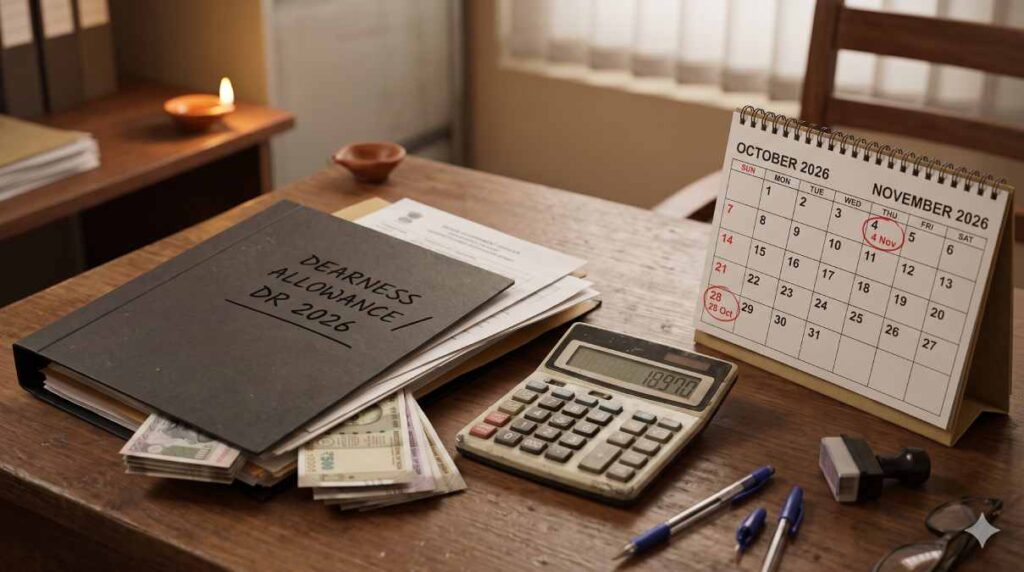
Dearness Allowance Delay July 2026 stands at 113 days on 22 October: DA is still 60%; the instalment due from 1 July has no Cabinet approval and no order, and the Cabinet meetings of 14 October and 21 October both ended without it. Pay slips and pension slips still show the January rate, and Dussehra on 20 October, the date many employees had marked for good news, has come and gone.
No source names a decision date, but the record gives a window. Every July instalment from 2022 to 2025 cleared the Cabinet between 28 September and 18 October, according to Indian Pay Calculator’s approval history. By recent standards, this year is already late. Two Wednesdays remain before Diwali on 8 November: 28 October and 4 November.
Arrears are easier to pin down than the date. Suppose the projected 3-point rise to 63% is approved from 1 July. The amount owed is then basic pay × 3% × months pending, which comes to ₹2,160 after four months for an employee on ₹18,000 basic and ₹6,732 for one on ₹56,100.
| Item | Position on 22 October 2026 |
| DA and DR rate in force | 60% of basic pay and pension, from 1 January 2026 |
| July 2026 revision | Due from 1 July 2026; no Cabinet approval, no order |
| Projected new rate | 63% (+3 points); a projection, not a decision |
| Next Cabinet Wednesdays | 28 October and 4 November |
| Arrears if approved | Basic pay × 3% × months pending |
Every rupee figure below depends on an order that has not been issued yet. Each one is labelled as conditional.
Dearness Allowance Delay July 2026 at a Glance
- The dearness allowance rate is 60% of basic pay and basic pension, in force since 1 January 2026.
- The July 2026 DA hike is due from 1 July, and as of 22 October there is no Cabinet approval and no Department of Expenditure order. The wait stands at 113 days, longer than any July wait from 2021 to 2025.
- The projected new rate is 63%, a 3-point rise based on AICPI-IW data. Some outlets expect 64%. Both are projections, not decisions.
- No date is confirmed. The next likely Cabinet sittings are 28 October and 4 November, the last before Diwali on 8 November.
- DA arrears would run from 1 July 2026: basic pay × 3% × months pending, or ₹2,160 on ₹18,000 basic over four months.
- Pensioners get dearness relief at the same percentage from the same decision, and about 50.46 lakh employees and 68.27 lakh pensioners were covered by the January 2026 note.
July 2026 DA Hike Status: What Is Confirmed and What Is Not
The July revision is due from 1 July 2026 and has no official announcement. Indian Pay Calculator’s status report found no Cabinet approval and no Department of Expenditure order for DA or DR from that date, and ICOT’s update of 22 October says the same. The rate in force is 60%, fixed from 1 January 2026.
That is the whole of what is confirmed.
- Dearness allowance and dearness relief stand at 60% of basic pay and basic pension.
- The July 2026 DA hike pending status means no Cabinet decision exists for the instalment due from 1 July.
- No Department of Expenditure office memorandum has been issued for it.
- No source this post draws on gives a date for the decision.
Reports that put the rise at 3 points or at 4 points are projections. Both appear in later sections and carry that label.
As of 22 October, this is what is settled and what is only expected.
| Claim | Status on 22 October 2026 |
| DA and DR are 60% | Confirmed; in force since 1 January 2026 |
| The July revision is due from 1 July 2026 | Confirmed; set by the twice-yearly cycle |
| No Cabinet decision or Department of Expenditure order exists | Confirmed by Indian Pay Calculator and ICOT |
| The delay is procedural | Expert view reported by Moneycontrol; no official reason given |
| The new rate will be 63% | Projection from AICPI-IW data |
| The new rate could be 64% | Projection; needs a 4-point rise |
| The Cabinet will decide on 28 October or 4 November | Expectation; no date announced |
| Arrears will run from 1 July | Expectation based on every earlier July instalment |
| DR will follow the DA order by a few days | Expectation based on ICOT’s description of past practice |
The 60% rate comes at the end of a long climb. It stood at 34% before the July 2022 revision and has gone up at every revision since: 38%, 42%, 46%, 50%, 53%, 55%, 58% and then 60%. Each step took effect from 1 January or 1 July and was approved weeks or months later. The July 2026 step would be the ninth in that run, and it is still waiting.
Also Read: Tax Audit Report Due Date 21 October 2026: Who Gets the Extension and Who Does Not (AY 2026-27)
DA Hike Timeline: From the 18 April Approval to 21 October
The January 2026 instalment gives a template for this year’s wait. It added 2 points to the existing 58% and took DA to 60% from 1 January 2026. The Cabinet approved it on 18 April 2026, 107 days after the effective date, and the Department of Expenditure order followed on 22 April, as Indian Pay Calculator’s approval history records. A wait of that length has already happened once this year.
The release also gave a cost: ₹6,791.24 crore a year for the January rise, DA and DR together. A separate order of 22 April covered employees who still draw pay on 6th Pay Commission scales, a group with its own percentages.
The July clock started on 1 July, and August and September passed with nothing. Upstox reports that the Cabinet took no DA decision at its 14 October meeting either. That day it cleared a 78-day Performance Linked Bonus for Railway employees, capped at ₹17,951, and renamed the national social assistance programme and several pension schemes. The DA hike did not come with them.
The next date on the calendar was 21 October. Mint and the Economic Times both ran headlines pointing to it as a possible day for the announcement. Moneycontrol reports that the Cabinet met on Wednesday, 21 October, and passed without announcing it, and that attention has moved to the next meeting, likely on Wednesday, 28 October. (The Mint and Economic Times pages could not be opened for this post, so only their headlines are cited.)
The government has given no official reason for the wait, though experts have offered one. Moneycontrol quotes pension experts who put the January wait down to administrative sequencing and the move to the 8th Central Pay Commission, which requires revised pay structures to be tied to inflation data. They call the current delay procedural, not a change to how DA works: revisions stay tied to inflation, and payouts stay predictable even when the announcement slips. That is an expert reading, not a government statement.
Employee bodies have filled the silence with letters and protest. The Confederation of Central Government Employees and Workers served notice on the Cabinet Secretary of a lunch-hour demonstration on 16 October, two days after the Cabinet met without acting on DA.
| Date | Event |
| 18 April 2026 | Cabinet clears the January 2026 instalment (+2 points, DA to 60%) |
| 22 April 2026 | Department of Expenditure order issued |
| 1 July 2026 | July instalment falls due; rate stays at 60% |
| 14 October 2026 | Cabinet meets; clears railway bonus and scheme renaming; no DA decision |
| 20 October 2026 | Dussehra passes without an announcement |
| 21 October 2026 | Cabinet meets again; no DA announcement |
| 22 October 2026 | No order; rate still 60% |
How Many Central Employees and Pensioners Are Waiting
The Cabinet note for the January 2026 instalment put the beneficiaries at about 50.46 lakh central government employees and 68.27 lakh pensioners, as Indian Pay Calculator’s status report quotes it. Together that is 118.73 lakh people, or about 1.19 crore, and Mint’s headline rounds the group to 1.2 crore.
| Group | Beneficiaries (January 2026 Cabinet note) |
| Central government employees | About 50.46 lakh |
| Pensioners and family pensioners | About 68.27 lakh |
| Combined | About 118.73 lakh, or 1.19 crore |
| Yearly cost of the January rise, DA and DR | ₹6,791.24 crore |
Pensioners outnumber serving staff by about 17.8 lakh. Central government employees’ dearness allowance and pensioners’ dearness relief move on one formula and one Cabinet decision, so the two groups wait together.
Some groups sit outside this order. State governments set dearness allowance for their own staff on their own timetable. Outlook Money’s coverage of a Himachal Pradesh instalment tied to Diwali is one example. Central public sector enterprises follow a separate Industrial DA track, which Indian Pay Calculator lists at 55.7% with its own order pending. Employees on 6th Pay Commission scales draw different percentages through different orders.
Pressure on the Finance Ministry has come through letters. The Confederation wrote to the Cabinet Secretary on 24 September asking for early release of the July 2026 instalment. The People’s Board reports that the same body wrote to the Secretary of the Department of Expenditure seeking early notification of the DA and DR revision, so that arrears reach pay slips before the festive window. It adds that employee unions formally urged the Finance Ministry and the Cabinet Secretary to clear the revision before Dussehra, and ties that push to a second demand on the festival bonus ceiling. Mint also reported an employee body urging an early decision.
No source cited here records a public reply to any of them.
Also Read: PM Viksit Bharat Rozgar Yojana (PMVBRY) 2026: The Complete Guide
Projected DA Rise to 63%: What the AICPI-IW Data Shows
The 63% estimate is a projection. Nothing in this section is a decision, and every number stays provisional until a Cabinet order exists.
The People’s Board reports that, on AICPI-IW data up to May 2026, the July revision is expected to add 3 percentage points and lift DA from 60% to about 63%. ICOT’s 22 October explainer says the June 2026 index leaves the result near 63%, so most people expect a 3% rise. A News18 J&K video description mentions 64% if a 4% hike is approved. Upstox says calculations on the 7th Pay Commission formula point to a 3% hike.
ICOT puts the open question plainly: many people think the rise may be 3% or 4%, which would make DA 63% or 64%, and if the government approves it the new rate counts from 1 July 2026. Moneycontrol puts the next six-monthly revision at 3% to 4%, which would take DA from 60% to 63% or 64%. The sources agree on a 3-point central case. Whether DA lands on 63% or 64% turns on a decimal, and the next two sections work it out.
DA Calculation Formula: How AICPI-IW Sets the Percentage
AICPI-IW is the All India Consumer Price Index for Industrial Workers, the inflation measure that feeds the DA formula. The Labour Bureau publishes it monthly on a 2016=100 base, and its website carries the releases. Indian Pay Calculator notes that the index arrives with a one-month lag, so a cycle’s data is complete only a month after its last reading.
The DA calculation formula under the 7th Pay Commission turns the 12-month average into a percentage:
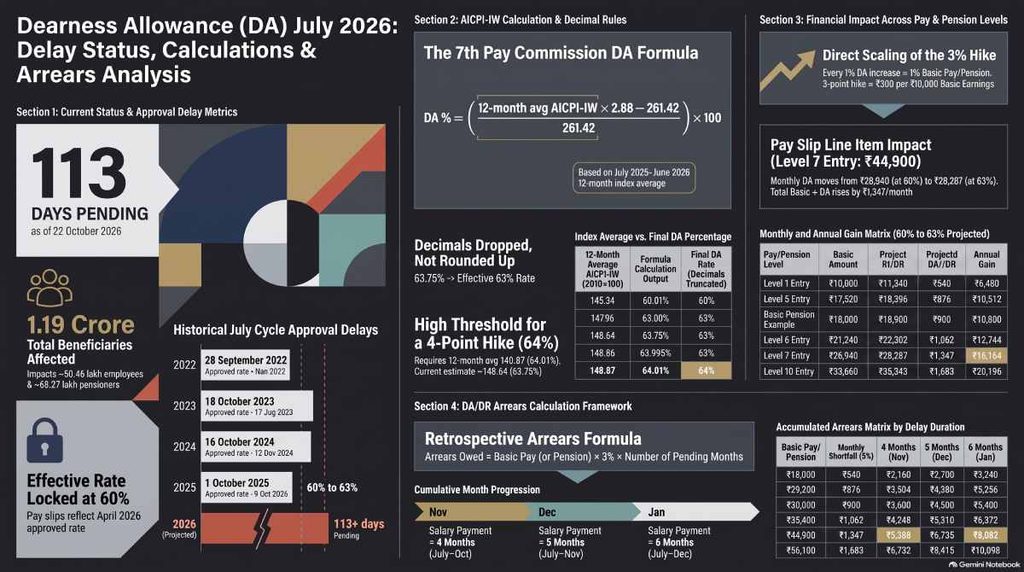
DA % = ((12-month average AICPI-IW × 2.88 − 261.42) / 261.42) × 100
The 2.88 lifts the 2016-base average back to the older 2001 scale, which is the scale the 261.42 benchmark sits on. The output is the DA rate for the cycle.
The window matters. For the July cycle, the AICPI-IW 12-month average runs from July of the previous year to June of the current year, as the approval history explains. This year that is July 2025 to June 2026. The January cycle averages the previous calendar year instead.
The June 2026 index is the last reading in the July window, and ICOT already cites it, so the projection uses all 12 months. The arithmetic is not waiting on data. Moneycontrol says the same: the index figures for all 12 months behind the July 2026 revision are already complete.
The July 2026 and August 2026 readings stay out of the July calculation and feed the January 2027 cycle. The News18 J&K description puts the index at 153.2 for July 2026 and 154.4 for August, both of which belong to the next revision.
The government drops the decimals and does not round up. ICOT uses 63.75% becoming 63% as its example. Working the formula backwards gives the 12-month averages that decide each outcome:
| 12-month average AICPI-IW (2016=100) | Formula result | DA after decimals are dropped |
| 145.24 | 60.01% | 60% |
| 147.96 | 63.00% | 63% |
| 148.64 | 63.75% | 63% |
| 148.86 | 63.995% | 63% |
| 148.87 | 64.01% | 64% |
The table is worked backwards from the formula and stays a projection until the Cabinet acts. The margin is thin: an average of 148.86 still gives 63%, and 148.87 gives 64%. The twelve monthly readings from July 2025 to June 2026 are public, so anyone with the Labour Bureau’s releases can test the 63.75% estimate directly. It needs an average near 148.64.
Take the 148.64 case step by step. Multiply 148.64 by 2.88 and the product is 428.08. Subtract 261.42 and 166.66 is left. Divide by 261.42 to get 0.6375, and multiply by 100 to reach 63.75%. Drop the decimals and DA is 63%.
The same chain shows why a 4-point rise is harder than it sounds. Going from 63.75% to 64% needs the average to climb by about 0.22 index points, and a 12-month average moves slowly because each new month replaces only one of the twelve.
DA at 63% vs 60%: Monthly Pay Change by Basic Pay Level
The projection rests on a figure of 63.75%, which becomes 63% once the decimals go. That makes the step from 60% to 63%, or 3 points. Some outlets say 63 to 64%, and the table above shows where that comes from: a 64% result needs an average of 148.87, about 0.23 above the level behind the 63.75% estimate. Rounding 63.75% up to 64% is not how the revision has been applied.
Moneycontrol works the range for a 2% to 3% rise: about ₹360 to ₹540 a month on ₹18,000 basic and ₹584 to ₹876 on ₹29,200. The upper ends are the 3-point case used here.
DA is a percentage of basic pay, so each point is worth 1% of basic. At Level 1 of the 7th Pay Commission pay matrix, with entry basic pay of ₹18,000, one point adds ₹180 a month and three points add ₹540. At ₹56,100, the entry basic at Level 10, the same three-point step adds ₹1,683. The DA hike basic pay effect scales in a straight line.
Run the two examples in full. On ₹18,000 basic, DA is ₹10,800 at 60% and ₹11,340 at a projected 63%, a rise of ₹540 a month. On ₹56,100 basic, DA moves from ₹33,660 to ₹35,343, a rise of ₹1,683. ICOT’s example uses ₹50,000 basic and lands on ₹1,500 a month.
| Basic pay | DA at 60% | DA at 63% (projected) | Monthly rise |
| ₹18,000 (Level 1 entry) | ₹10,800 | ₹11,340 | ₹540 |
| ₹29,200 (Level 5 entry) | ₹17,520 | ₹18,396 | ₹876 |
| ₹35,400 (Level 6 entry) | ₹21,240 | ₹22,302 | ₹1,062 |
| ₹44,900 (Level 7 entry) | ₹26,940 | ₹28,287 | ₹1,347 |
| ₹50,000 (ICOT’s example) | ₹30,000 | ₹31,500 | ₹1,500 |
| ₹56,100 (Level 10 entry) | ₹33,660 | ₹35,343 | ₹1,683 |
On a pay slip, the change shows up in one line. An employee at Level 7 entry with ₹44,900 basic sees DA of ₹26,940 today. Under the projection it would read ₹28,287, a monthly movement of ₹1,347.
| Pay slip line (₹44,900 basic) | Today at 60% | After a 63% order (projected) |
| Basic pay | ₹44,900 | ₹44,900 |
| Dearness allowance | ₹26,940 | ₹28,287 |
| Basic plus DA | ₹71,840 | ₹73,187 |
Over a full year, the same step adds up to more than the monthly figure suggests. At a projected 63%, the yearly gain is ₹6,480 on ₹18,000 basic, ₹10,512 on ₹29,200, ₹12,744 on ₹35,400, ₹16,164 on ₹44,900 and ₹20,196 on ₹56,100. Those gains count from the first revised salary onward. The back months arrive separately, as arrears, and a later section covers them.
Expected DA Hike Announcement Date and the Diwali Window
No source confirms a date, so every date in this section is an expectation. ICOT says directly that no date is confirmed. Upstox notes that the government usually makes the second DA announcement of the year, along with arrears, during or at the start of the festive season, and Virender Singh Kadian’s 4 October report calls an announcement around the festive season widely expected.
Dussehra is behind us, and the DA hike Diwali question is now the live one.
Festival money and DA are separate files, and it is easy to blur them. The bonus track moved first this year, when the Cabinet cleared the 78-day railway bonus on 14 October. The ceiling used to calculate the bonus for other central staff is a different dispute. The People’s Board reports that the staff side wrote to the Cabinet Secretary on 27 August asking for the ceiling to go from ₹7,000 to ₹21,000, and that the Official Side had said the demand could be considered only after a formal revision of the ceiling under the Payment of Bonus Act. None of that touches the DA percentage. A bonus order would not release the July DA instalment, and a DA order would not change the bonus ceiling.
Past July DA Approval Dates, 2021 to 2025
The dates below follow the Cabinet releases that the Press Information Bureau (PIB) publishes, such as the release for the January 2025 instalment, as tabulated in Indian Pay Calculator’s approval history. The rate changes come from Outlook Money.
| July cycle | Rate change | Cabinet approval | Days after 1 July | Department of Expenditure order |
| 2022 | 34% to 38% | 28 September 2022 | 89 | Not listed |
| 2023 | 42% to 46% | 18 October 2023 | 109 | Not listed |
| 2024 | 50% to 53% | 16 October 2024 | 107 | Not listed |
| 2025 | 55% to 58% | 1 October 2025 | 92 | 6 October 2025 |
| 2026 | 60% to 63% (projected) | Pending | 113 so far | None |
The DA hike history is consistent: one revision cleared in late September and the other three in October. Outlook Money adds that 2021 cleared on 21 October, a 3-point rise from 28% to 31%, and that all five revisions took effect from 1 July of their own year even though the announcements came later.
The five July waits from 2021 to 2025 ran 112, 89, 109, 107 and 92 days, an average of about 102. At 113 days, this year has already outlasted every one of them, including the longest, 112 days in 2021.
One claim in circulation needs a caution. The People’s Board says the DA notification and the festival bonus order are typically issued the week before Dussehra. The approval table does not bear that out every year: the 2024 approval came on 16 October, after that year’s Dussehra on 12 October (a date taken from outside the source list). Treat the festival as a rough marker, not a deadline.
The January instalments drift the same way, and the later ones run longer.
| January cycle | Cabinet approval | Weekday | Days after 1 January |
| 2023 | 24 March 2023 | Friday | 82 |
| 2024 | 7 March 2024 | Thursday | 66 |
| 2025 | 28 March 2025 | Friday | 86 |
| 2026 | 18 April 2026 | Saturday | 107 |
The January wait has stretched from 66 days in 2024 to 107 in 2026. The July wait has been steadier but sits higher. Neither run guarantees the 2026 July instalment will follow the same curve, and no source says it will.
Diwali falls on Sunday, 8 November 2026. A few festival calendar pages still list 20 October, which was the 2025 date and should not be used. The festival date comes from outside the source list for this post, so verify it before you plan around it. A Cabinet decision before the festival would need to come on 28 October or 4 November.
Outlook Money gives the span of past July announcements as 18 September to 21 October, but the earliest July approval in the table above is 28 September 2022, so this post uses the later start. The July DA announcement October pattern is real, and 2026 is now the first of six years to run past 21 October.
Next Union Cabinet Meeting Dates for the Decision
The Union Cabinet usually meets on Wednesdays, and all four July approvals from 2022 to 2025 fell on one. Moneycontrol adds that sessions can be moved to other days or held more than once a week. January approvals are less regular: the four above landed on a Friday, a Thursday, a Friday and a Saturday. No schedule is published, so every date here is a likely sitting day, not a confirmed one.
The 14 October meeting was a Wednesday and passed without a decision. The Cabinet met again on Wednesday, 21 October, and Moneycontrol reports that it too passed without an announcement. That leaves 28 October and 4 November as the next two sittings. The 4 November meeting is the last before Diwali, and the first after the festival is 11 November.
The Department of Expenditure order follows the Cabinet decision, and it is the order that lets pay and pension bills be drawn at the new rate. Where the approval history lists an order date, the gap ran from 4 to 10 days: 10 for the January 2023 instalment, 5 for January 2025, 5 for July 2025 and 4 for January 2026.
| Step | Who acts | Typical gap |
| Cabinet approves the instalment | Union Cabinet | Release the same day |
| DA order issued | Department of Expenditure | 4 to 10 days after the Cabinet |
| DR order issued | Pension authorities | A few days after the DA order |
| New rate and arrears paid | Pay and accounts offices | Next payroll cycle |
Applied to the open Wednesdays, those gaps give three cases for the Union Cabinet meeting DA outcome.
| If the Cabinet meets on | Days since 1 July | Order window (expectation) |
| 28 October | 119 | 1 to 7 November |
| 4 November | 126 | 8 to 14 November |
| 11 November | 133 | 15 to 21 November |
Each Wednesday costs the person waiting something different. A decision on 28 October would end a wait of 119 days, longer than any July wait in these tables, and would leave four months of arrears if the new rate arrives with the November salary. A decision on 4 November would stretch the wait to 126 days and push the first revised salary towards December, which makes five months of arrears. Miss both dates and the matter runs past Diwali into the 11 November sitting, where the count only grows.
These windows are arithmetic from past gaps, not announcements. ICOT adds that most departments prepare salary from the 15th to the 15th. A late order may miss October pay and reach the November salary along with the July arrears. ICOT calls that an expectation, and so does this post. The DA approval date has no official confirmation anywhere.
Four signals will settle the question when they appear:
- A Cabinet release on PIB approving the additional instalment of DA and DR.
- A Department of Expenditure office memorandum carrying the new percentage.
- The follow-on DR order for pensioners.
- A pay slip or pension slip that shows the new rate.
DA Arrears From 1 July 2026: Effective Date and Back Pay
The order has not been issued, so every arrears figure in this section is conditional. The effective date of 1 July 2026 comes from the revision cycle, not from the approval date. Outlook Money records that every July revision from 2021 to 2025 took effect from 1 July of its own year, whatever date the announcement carried. DA arrears July 2026 would follow the same logic if the order does.
Why the Hike Applies From 1 July Even After a Delay
Retrospective dearness allowance means the new rate applies from a date before the order. The pay slip keeps showing 60% until the order is acted on, and the first salary at the new rate then carries the difference for every month that has already passed. Indian Pay Calculator says the same of past instalments: because the rate always applies from a back date, the first salary after each order usually carries arrears for the months already gone.
The arrears cover the months between 1 July and the first salary at the new rate. Each month of delay adds one more month to the count, and none of it is lost. Two cases mark the range:
- If the revised rate reaches the November salary, arrears cover July, August, September and October: four months.
- If it slips to the December salary, November joins them: five months.
A month-by-month ledger for Level 7 entry pay of ₹44,900 shows how the sum accumulates. It assumes a first revised salary in November and the projected 63% in force.
| Month | DA paid at 60% | DA owed at 63% (projected) | Shortfall carried as arrears |
| July 2026 | ₹26,940 | ₹28,287 | ₹1,347 |
| August 2026 | ₹26,940 | ₹28,287 | ₹1,347 |
| September 2026 | ₹26,940 | ₹28,287 | ₹1,347 |
| October 2026 | ₹26,940 | ₹28,287 | ₹1,347 |
| Total arrears | ₹5,388 |
The November salary would then carry ₹28,287 of DA for the month plus the ₹5,388 shortfall from the four months behind it. Every month the order slips adds another ₹1,347 row to this table.
Months before 1 July are not touched, because the instalment starts on that date. The amount depends on the months pending, not on the day the Cabinet meets, which is why the unions asked for early notification. The People’s Board says the Confederation wanted arrears to appear in pay slips before the festive window, which closed on Dussehra.
Keep DA arrears apart from any 8th Pay Commission arrears. Kadian’s report notes that the commission’s formal structure has not been notified, with 1 January 2026 only broadly expected as its baseline, and that employees are asking whether pay hikes and allowance revisions will be calculated retrospectively. The July DA arrears here come from the existing 7th Pay Commission formula and need no commission to report first.
DA Arrears Calculation: Formula and Examples by Basic Pay
The DA arrears formula does not depend on the month of payment. It needs only three inputs, and the first two never change:
DA arrears = Basic pay × 3% × number of months pending
A DA arrears calculator done by hand runs in four steps:
- Take your basic pay from the latest pay slip.
- Multiply it by 3%, the projected rise, to get the monthly difference.
- Count the months from July to the month before your first salary at the new rate.
- Multiply the monthly difference by that count.
Take the four-month case as the working example. On ₹18,000 basic, the monthly difference is ₹540 and four months give ₹2,160. On ₹56,100, the difference is ₹1,683 and four months give ₹6,732. If payment slips to December, the count rises to five months and the same two examples become ₹2,700 and ₹8,415. A January 2027 payment would make it six.
| Basic pay | Monthly difference (3%) | Four months | Five months | Six months |
| ₹18,000 | ₹540 | ₹2,160 | ₹2,700 | ₹3,240 |
| ₹29,200 | ₹876 | ₹3,504 | ₹4,380 | ₹5,256 |
| ₹35,400 | ₹1,062 | ₹4,248 | ₹5,310 | ₹6,372 |
| ₹44,900 | ₹1,347 | ₹5,388 | ₹6,735 | ₹8,082 |
| ₹56,100 | ₹1,683 | ₹6,732 | ₹8,415 | ₹10,098 |
ICOT’s table runs the same arithmetic for ₹50,000 basic: ₹1,500 a month and ₹6,000 for July to October. All of these are projections. If the Cabinet approves a different rate, replace 3% with the approved rise and keep the rest.
Dearness Relief (DR) for Pensioners: Expected Rise From July 2026
Pensioners receive dearness relief in place of DA, at the same percentage on basic pension. Outlook Money describes it as the pensioner counterpart of DA, paid on the same basis. The DR hike pensioners are waiting for comes out of the decision employees are waiting for, and it has no formula of its own.
Will Pensioners Get DR With the DA Hike?
Dearness allowance and dearness relief come out of one Cabinet approval. The January 2026 release covered employees and pensioners together, as Indian Pay Calculator’s status report states, and the DA and DR same order logic applies to July. The Department of Expenditure order covers DA, and ICOT says the DR order mostly comes a few days after the DA order. Pensioners and family pensioners get DR at the same percentage employees get as DA.
Pensioners are not in a separate queue. When the Cabinet clears the instalment, both groups clear together, and the pensioners DR July 2026 arrears run from the same date as the employee arrears, 1 July 2026. About 68.27 lakh pensioners sit in that group, on the Cabinet note figure for the January instalment.
The few days between the two orders can matter at the pension counter. An employee’s salary may carry the new rate as soon as the DA order is acted on, while a pension slip may follow the DR order by a short margin. A pensioner who sees the employee rate change first should not read that as a miss. The DR order governs the pension slip.
The same limits apply as for employees. Pensioners of state governments follow their own state’s orders and sit outside the central DR decision.
How to Calculate Revised Pension With DR at 63%
The pension calculation DR follows the same steps as the DA calculation, with basic pension in place of basic pay.
- Take your basic pension from the pension slip, before any relief is added.
- Multiply it by 60% to get the DR you receive now.
- Multiply it by 63% to get the projected DR.
- Subtract the first result from the second to get the monthly rise.
On a basic pension of ₹30,000, DR is ₹18,000 now and ₹18,900 at a projected 63%, a rise of ₹900 a month. Pension plus DR moves from ₹48,000 to ₹48,900. In arrears terms, the revised pension DR 63% figure applies from 1 July, so four months of pending relief come to ₹3,600 and five months to ₹4,500. All of it depends on the order.
| Basic pension | DR at 60% | DR at 63% (projected) | Monthly rise | Four months | Five months |
| ₹15,000 | ₹9,000 | ₹9,450 | ₹450 | ₹1,800 | ₹2,250 |
| ₹30,000 | ₹18,000 | ₹18,900 | ₹900 | ₹3,600 | ₹4,500 |
| ₹40,000 | ₹24,000 | ₹25,200 | ₹1,200 | ₹4,800 | ₹6,000 |
| ₹50,000 | ₹30,000 | ₹31,500 | ₹1,500 | ₹6,000 | ₹7,500 |
If the Cabinet approves a rate other than 63%, swap the figure in step 3 and repeat the sums.
Dearness Allowance Delay July 2026: Frequently Asked Questions
No date has been announced, and no source confirms one. The next Wednesday Cabinet windows are 28 October and 4 November, the last before Diwali on 8 November.
The dearness allowance rate in force is 60% of basic pay and pension, set from 1 January 2026 after the Cabinet cleared it on 18 April. The July 2026 revision has no order, so pay slips stay at that rate.
If the order carries the usual 1 July effective date, arrears will cover the months from July until your first salary at the new rate. At the projected 3-point rise that is basic pay × 3% × months, or ₹2,160 for ₹18,000 basic over four months.
No, and it stays unconfirmed until a Cabinet approval and a Department of Expenditure order exist. The figure is a projection from AICPI-IW data, and some outlets expect 64%.
Disclaimer
This post is for general information only. India Policy Hub is an independent publication and is not affiliated with the Government of India, the Union Cabinet, the Department of Expenditure or any other body named here. The post is current as of 22 October 2026. The July 2026 dearness allowance revision had not been approved or ordered on that date. The 63% and 64% rates, expected Cabinet dates and all arrears and pay figures are projections or worked examples, not decisions, and final terms may differ. This post is not legal, tax, financial or payroll advice. Before acting on any figure, check the official order or ask your pay and accounts office. Linked sources are not endorsed. To the fullest extent permitted by law, India Policy Hub and its editors exclude liability for loss arising from reliance on this post. This disclaimer is governed by the laws of India. That is exactly 150 words. The docx still has the longer version, so say the word if you want this one swapped in.




Leave a Reply