
Scholarship 2027: NSP’s New Rule on Merit and Welfare Schemes, and How to Apply

Students applying for Scholarship 2027 on the National Scholarship Portal (NSP) are working under a new rule. From academic year 2026-27, a student can apply for one merit-based scholarship scheme and one or more welfare-based schemes on NSP, as per each scheme’s eligibility criteria. The rule sits in an announcement on the NSP homepage, and it overturns advice that has circulated for years.
Anyone told that a welfare scholarship blocks a merit one is working from outdated advice, at least for this pairing. The clock has not moved. The NSP scholarship last date for students under several central schemes is 31 October 2026, so the form for many of them shuts within days.
The 2026-27 cycle opened on NSP on 1 June 2026. For the PM-USP Central Sector Scheme of Scholarship for College and University Students (CSSS), NSP’s announcement sets 31 October 2026 as the student deadline. Institute verification closes on 15 November 2026 and L2 verification on 30 November 2026. All three dates cover renewal applications under that scheme.
Other schemes in the Scholarship 2027 cycle keep their own calendars. Sentpo’s roundup gives 31 October as the student deadline for several more. Buddy4Study says some schemes closed earlier, around 30 September.
Read the rule narrowly. It lets you apply to more than one scheme, and that is all it does. No second award is promised. Income, category, marks and course level still get checked scheme by scheme.
Scholarship 2027 on NSP At A Glance
From academic year 2026-27, a student on the National Scholarship Portal (NSP) can apply for one merit-based scholarship scheme and one or more welfare-based schemes, as per each scheme’s eligibility criteria. Two merit schemes stay off the table, and no second award is promised. The NSP scholarship last date for CSSS renewals is 31 October 2026.
- Registration comes first: a 14-digit OTR number, issued on an Aadhaar number or Aadhaar Enrolment ID through face authentication, stays valid for the student’s whole academic career and is not repeated each year or for each scheme.
- Every scheme sets its own tests. Income, category, marks and course level still get checked scheme by scheme, and family income limits are set per scheme, such as Rs 3,50,000 a year for NMMSS and Rs 2,50,000 a year for the Pre-Matric Scholarship for SC students, Component 1.
- The student application for CSSS renewals closes on 31 October 2026, institute verification on 15 November 2026 and L2 verification on 30 November 2026. Pre-matric schemes and some renewal windows closed around 30 September 2026.
- Keep the income certificate (family income from all sources, unexpired on the day you apply), the caste or disability certificate where the scheme asks for one, a bonafide certificate, the fee receipt, the last marksheet and an Aadhaar-seeded bank account ready before you open the form.
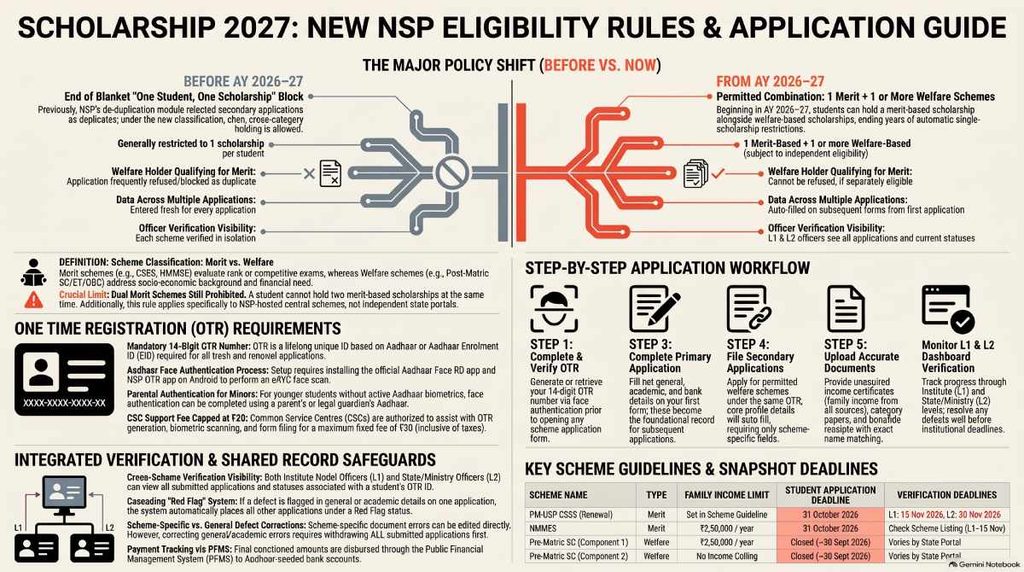
NSP scholarship rules 2026-27: What changed
In one sentence: a student on NSP may hold one merit-based scholarship alongside one or more welfare-based scholarships, provided the student qualifies for each on its own terms.
Nobody gets multiple scholarships automatically. PW’s report on the revised guidelines says so plainly, and Buddy4Study adds that eligibility is still assessed scheme by scheme. The blanket block fell away. Every scheme-level condition stayed in place: income ceilings, category certificates, minimum marks and course-level criteria.
The change landed mid-cycle, and Buddy4Study traces it to a review of how NSP’s de-duplication module behaved in 2024-25. Buddy4Study also reports that CBSE sent the revised rules to schools on 31 August 2026, after a government order of November 2025. PW adds that CBSE asked affiliated schools to circulate the rules among eligible students and parents. iCBSE, in a report dated 22 September 2026, says the board told all affiliated schools and asked school heads to pass the word to eligible students and parents as well as other stakeholders; it describes the update as following a Cabinet Secretariat decision. Shiksha’s report of 23 September 2026 carries the same news under a headline saying students can now get merit and welfare scholarships together.
Many NSP scholarship schemes feel the change. Buddy4Study counts 18 major schemes on NSP for 2026-27, spread across ministries that include social justice, tribal affairs, labour, home affairs and railways. Each keeps its own guideline, so the rule sits on top of scheme eligibility and replaces none of it. Fresh NSP scholarship applications for 2026-27 have been open since 1 June 2026, so the rule arrived with the cycle already running.
Also Read: Scholarship Money Not Received? How to Track Your DBT Status in 2026
One Student, One Scholarship: How the old rule worked
Until this cycle, the working rule was One Student, One Scholarship. The portal’s de-duplication module treated scholarships as mutually exclusive. Apply under two schemes and the second application could be declined as a duplicate, whatever each scheme was meant to reward.
Official communication said the same. A September 2025 Ministry of Education release records officials being told to steer students toward NMMSS alone, because a student cannot avail two scholarships at once and the portal declines the second application as a duplicate.
The machinery behind the block was One Time Registration. A July 2024 PIB release explained that the system keeps no more than one application ID active against an OTR ID at any point in time. An August 2025 release says NSP introduced OTR in 2024-25 to avoid duplication of scholarship benefits to the same students.
The block also caught people it should not have. Buddy4Study reports that the module flagged genuine beneficiaries as duplicates in 2024-25. Two departments, School Education and Literacy on one side and the social justice department on the other, ran overlapping schemes, and the word scholarship got applied loosely to stipends and incentives along with other aid. A student entitled to one award for merit and another for need could lose the second.
Old pages keep repeating the rule because it was true for years and web pages do not expire. Guides written before the revision tell students they cannot hold two central scholarships, and plenty of them are still online. The 2025 PIB release above reads that way today. One quick test: if a page never mentions 2026-27 or the split between merit-based and welfare-based schemes, it describes the old system.
Also Read: How to Apply for Income Certificate Online for Scholarship Eligibility (All States Guide)
Merit-based vs welfare-based scholarships: What the new rule allows
The rule rests on a sorting exercise. Per Buddy4Study, the Cabinet Secretariat classified all government scholarship schemes on NSP into two categories for de-duplication and harmonisation: merit-based and welfare-based. The table puts the old position beside the new one.
| Question | Before 2026-27 | From 2026-27 |
| Combining scholarships | Generally one per student | One merit-based plus one or more welfare-based, subject to eligibility |
| Welfare holder who also qualifies for a merit scheme | Could be refused | Cannot be refused, if separately eligible |
| Merit holder who also qualifies for a welfare scheme | Could be refused | Cannot be refused, if separately eligible |
| Details across applications | Entered fresh each time | Kept and filled in automatically on later applications |
| Who sees what at verification | Each scheme in its own silo | L1 and L2 nodal officers can see all of a student’s applications and their status |
The table draws on Buddy4Study’s summary of the revised rules. iCBSE’s report gives the same account of data reuse and of L1 and L2 visibility.
Merit-based means selection turns on academic performance, shown through a rank or a qualifying exam. The government memorandum names NMMSS and INSPIRE as examples, and NSP’s own announcement tags the PM-USP Central Sector Scheme (CSSS) as merit-based. Welfare-based schemes go to students from identified communities or categories, or from set income groups, and they exist to ease financial hardship. The cited examples are pre-matric and post-matric scholarships for SC, ST, OBC and minority students, plus the AICTE Swanath and Saksham schemes.
Now the limits. The permitted mix is one merit scheme plus one or more welfare schemes. Two merit schemes stay off the table, and Buddy4Study’s FAQ adds that a student cannot claim a scheme without qualifying for it independently. More than one does not mean unlimited. Each welfare scheme still has to meet its own eligibility criteria.
Per Sentpo, schemes still check six kinds of condition, though any one scheme may use only some of them:
- Education level: school, undergraduate, postgraduate or an eligible professional course.
- Academic performance: minimum marks, a merit ranking or a qualifying exam.
- Family income below the scheme’s limit, where one applies.
- Category or special eligibility, such as disability, community or a parent’s service background.
- Enrolment in an eligible institution and an approved course.
- Renewal conditions, such as academic progress for existing beneficiaries.
Clearing one condition does not make you eligible. Read the full guideline for every scheme you plan to apply for.
In practice the rule removes one barrier, the duplicate flag, and leaves the six conditions above in place. A student who earns a merit award on marks still needs the income certificate for a welfare scheme and, where one is asked for, the category paper. The enrolment record has to agree with Aadhaar as well. Treat each scheme as its own application with its own pass mark. All the new rule does is stop the portal from pitting them against each other.
Direction no longer matters. A student holding a welfare scholarship who later qualifies for a merit one cannot be refused for that reason, and PW says the reverse holds too.
State portals are a separate matter. NSP hosts some state schemes, as PIB noted in 2024, while state governments run others on their own portals. The NSP announcement and the reports cited here speak only about schemes on NSP, and none of them extends the merit-and-welfare rule to state portals. Treat state conditions as their own until your state portal says otherwise.
Centrally sponsored schemes add a wrinkle. The Post-Matric Scholarship Scheme for SC students runs through state governments, and a December 2025 PIB reply in Lok Sabha says the states define the modalities for inviting applications and for processing and verifying them. The state’s process governs the application. The central share is released only after the state shares its paid data with NSP.
Holding a merit and a welfare scheme together: A worked example
Take a pairing from opposite sides of the line. PM-USP CSSS carries the tag Merit Based Scheme in NSP’s announcement. The Post-Matric Scholarship Scheme for SC students sits on the welfare side, since post-matric scholarships for SC, ST, OBC and minority students are the standard welfare example in both Buddy4Study and PW. Confirm each scheme’s tag on its listing in the NSP scheme directory before applying, because the whole rule turns on which side a scheme falls.
Picture a second-year undergraduate from a Scheduled Caste family. She already holds the CSSS and meets the post-matric scheme’s income ceiling. This is a sketch, not a promise that any student qualifies. The 2026-27 workflow handles her case like this:
- She renews the CSSS on NSP before the student deadline of 31 October. The open window for that scheme covers renewals, so a first-year who wants the CSSS has to check whether a fresh window exists at all.
- She applies for the welfare scheme under the same OTR. Her general, academic, institute and course details carry over from the first application, so she fills only scheme-specific fields and uploads scheme-specific documents, such as the caste and income certificates.
- At L1, her institute’s nodal officer sees both applications and their status. Fee details entered for the first verified application fill in on the second.
- At L2, the officers handling either application can see the other and its status, so a merit and a welfare application from the same student get read together.
- If a deficiency turns up in general or academic details, iCBSE reports that her other applications are put under the Red Flag category too.
Two practical notes. The welfare half of this pairing runs through state governments, so check how your state invites applications before assuming one NSP form covers both. And do not try the reverse trick of applying to two merit schemes and hoping one slips through. The rule does not allow it.
Buddy4Study’s action plan for students who hold or want both types boils down to this order of work:
- Complete or verify your OTR first, since no application proceeds without it.
- Find each scheme’s category on its NSP listing, merit or welfare, because that decides what it can sit beside.
- Check what you already receive. Holding one type no longer bars you from applying for the other.
- Read each scheme’s eligibility conditions. Income ceilings, category certificates, minimum marks and course rules are assessed one scheme at a time.
- Apply, expecting only scheme-specific fields on the later forms, and spend your care on the scheme-specific documents.
- Track verification on the dashboard and watch for any general or academic deficiency, which can force withdrawal of your other applications.
Scholarship 2027 eligibility on NSP: Checks before you apply
Two checks come before any NSP scholarship form. OTR is the first, because no application moves without it. The scheme’s own limits come second: income, category, marks, course and institute. Fail either and the rest of the paperwork stops mattering.
The public menu of the National Scholarship Portal also carries a Scholarship Eligibility page, which is worth a quick look before you open the full guidelines.
Eligibility has a time dimension as well. A student can qualify for a scheme and still meet a closed or renewal-only window, or a scheme with no fresh intake this year. Netasampark makes the underlying point: NSP is a common platform, and the eligibility rules belong to each individual scheme. The deadline table later in this guide matters as much as the income limits.
With several possible schemes, work in this order: list every scheme you might qualify for, tag each as merit or welfare, drop any second merit scheme, and rank what is left by closing date. The scheme that closes first gets your documents first.
NSP OTR registration: The 14-digit ID and face authentication
OTR stands for One Time Registration. It is a unique 14-digit number issued on the basis of an Aadhaar number or Aadhaar Enrolment ID (EID), and it stays valid for the student’s whole academic career. You do not repeat it each year or for each scheme. NSP’s homepage states that OTR is required to apply for scholarships from AY 2024-25, and the Netasampark guide confirms it is mandatory in 2026-27.
OTR generation runs through face authentication. PIB’s July 2024 release spells out the route, and the steps go in this order:
- Install the Aadhaar Face RD app on an Android device.
- Install the NSP OTR app from Google Play.
- Open the NSP OTR app.
- Pick the eKYC with FaceAuth option and complete the face scan.
Students who hold only a Reference Number from 2023-24, because they finished OTP-based eKYC but skipped face authentication, need that step to get an OTR number. If the OTR SMS never arrived, the number can be retrieved through the Know your OTR option on NSP.
A parent can authenticate for a younger student. NSP’s announcement refers to face authentication of the student, parent or legal guardian, and PIB’s 2025 release notes that NMMSS students sign up with their own Aadhaar or either parent’s.
A Common Service Centre can handle the process for students who want hands-on help. NSP fixes the charge for the entire activity at Rs 30, taxes included. That covers the reference number, biometric authentication, OTR generation and filing of the complete application form. Find a centre through the CSC locator.
NSP’s own advisories name two technical snags. Error 904 during face authentication means the UIDAI AadhaarFaceRD app needs an update. Face authentication also fails when the Aadhaar holder has locked biometrics, so check the lock status on the myAadhaar portal or the mAadhaar app and switch it to Unlocked before retrying.
A data mismatch costs more time than either snag. Aadhaar says one thing, the school or college record says another, and the name or date of birth disagrees. PIB has told state nodal officers more than once to have parents record the child’s and parents’ full names with identical spelling in school records and the Aadhaar registry, so that no mismatch turns up on NSP later (2024 workshop, March 2024 workshop).
One OTR login on the National Scholarship Portal covers every scheme, and that is what makes the new rule workable for a student. All applications hang off a single ID and password, so losing that login mid-cycle strands every form at once. Keep the OTR number and password together with the registered mobile number, and test the login a few days before the deadline instead of on the final evening.
Fix the source record before you start. NSP’s student menu links an Aadhaar Seva Kendra locator (Bhuvan map), and the institute can correct its own file. Netasampark’s checklist covers name, date of birth, category, bank details and institute details, in that order, and all of it comes before submission.
Scholarship income limit and category rules by scheme
There is no universal number. Each scheme sets its own ceiling, defines income from all sources in its own way and names its own category conditions. The table lists only the limits that could be confirmed against official releases. For every other scheme, the limit lives in the guideline.
| Scheme | Type | Family income limit | Other conditions in the source |
| NMMSS | Merit | Rs 3,50,000 a year from all sources | 55% in Class VII to sit the state selection test, relaxed by 5% for SC and ST students. The scholarship amount is Rs 12,000 a year. Renewal needs 60% and promotion, per PIB. Government and government-aided schools only, with KVS and NVS excluded. |
| Pre-Matric Scholarship for SC students, Component 1 | Welfare | Rs 2,50,000 a year from all sources | Class IX and X, full time, Scheduled Caste. Applications open on NSP each April and then move to state portals. The scholarship amount is Rs 3,500 a year for day scholars and Rs 7,000 for hostellers. |
| Pre-Matric Scholarship, Component 2 | Welfare | No income ceiling | Classes I to X. Parent or guardian engaged in manual scavenging, tanning and flaying, waste picking or hazardous cleaning, with a certificate from the designated officer. |
| PM-USP CSSS and the remaining schemes | As tagged on NSP | Set in the scheme guideline | Each NSP listing links the scheme’s specification and FAQ. |
Read the scheme’s guideline PDF, not a summary, and that includes this one. Summaries drop conditions. The Pre-Matric ST guideline PDF is an example of the document to open, and the NSP scheme directory is where each scheme’s own version sits. Netasampark describes the directory as the place that shows opening and closing dates and links to specifications and FAQs.
Two more checks save a rejection. The income certificate has to cover the family’s income from all sources, the wording both PIB and the Social Justice ministry use, and it has to be unexpired on the day you apply. Category schemes want a caste certificate. Disability schemes want disability documentation, and the portal asks disabled students to consent to sharing UDID details through the UDID portal before they submit.
Wording matters here. The Social Justice ministry words the pre-matric test as the income of the parent or guardian from all sources, while PIB describes the NMMSS test as family income from all sources. Read how your scheme defines the earner before you ask an issuing office for the income certificate. Renewal adds its own bar. NMMSS students move up a class on 60% marks, per PIB’s August 2025 release, and Sentpo lists renewal conditions among the checks existing beneficiaries must clear. Keep last year’s marksheet and fee receipt close at hand.
How to apply for Scholarship 2027 on NSP, step by step
Applying online for an NSP scholarship on scholarships.gov.in takes a short sequence of steps. The waiting that follows is the long part.
- Complete OTR with face authentication and keep the 14-digit number and password somewhere safe.
- Log in on the NSP application page with the OTR ID and password. PIB’s 2024 workshop release notes that one OTR login lets a student apply to any scheme or withdraw from one without collecting several NSP IDs.
- Pick the scheme. Read its merit or welfare tag, whether the window is fresh or renewal, and the closing date in the scheme directory.
- Fill in the application form and upload the documents the scheme asks for. Students with a disability first log in to the UDID portal and consent to share their UDID details, as Sentpo and Netasampark both report.
- Check every screen, then press final submit. Save the acknowledgement and the application ID.
- Wait for institute verification at L1 and then L2, and check your application status on the dashboard.
Submitted is not approved. Netasampark lays out the usual path: student application, defective-application verification, institute verification, district, state or ministry-level verification, then sanction and payment. Plenty of students stop watching at stage one. Payment tracking sits on PFMS, which NSP links for that purpose.
When a sanction arrives and the money does not, stop treating it as an application problem. Netasampark advises checking payment status through the PFMS tracking facility, then the bank account status, Aadhaar seeding, account number and IFSC, and whether the payment bounced. Save the status screen and quote the exact message in any complaint.
Between them, Sentpo and Netasampark name the errors that get an NSP application rejected:
- Waiting for the last day to sign up or submit.
- Picking a scheme without reading its eligibility.
- Entering wrong personal, academic or bank details, or uploading unclear files.
- Treating submission as approval and ignoring verification requests.
- Handing the login to an agent who promises guaranteed approval.
The last one deserves its own line. Sentpo warns against paying unofficial agents. Netasampark adds that NSP itself tells users not to type an Aadhaar number, bank account number, password, PIN or OTP into its chatbot, and says the student should keep control of the login even when a CSC or a cafe helps with the online application. Sit beside the operator and check each screen before submitting.
Documents required for NSP scholarship applications
Document trouble is the avoidable kind of NSP scholarship rejection. The scheme can be right and the student eligible, and the file still stalls on a certificate that disagrees with Aadhaar. Gather the required documents before opening the NSP scholarship application form:
- Caste or disability certificate, where the scheme asks for one.
- Income certificate covering family income from all sources, unexpired on the day you apply.
- Bonafide certificate or admission proof from the institute.
- Fee receipt, since fee details feed into L1 verification.
- Marksheet of the last exam passed.
- Active bank account that is seeded with Aadhaar.
Treat the list as a starting point. Sentpo and Netasampark both say the exact checklist belongs to the scheme’s specification and FAQ.
Names must agree across Aadhaar, the bank record and the institute’s record. Netasampark’s example: a marksheet that reads Rahul Kumar, a bank account that reads Rahul K. Kumar and another paper that reads Rahul Kumar Singh. One person, weeks of explaining. Fix the spelling at source before uploading anything.
The table below lists where a mismatch tends to start and what to check.
| Record | What to check | Where to fix it |
| Aadhaar | Name spelling and date of birth against the school or college file | Aadhaar Seva Kendra, found through the Bhuvan locator, or the myAadhaar portal |
| Bank account | Name as printed, Aadhaar seeding status, account number and IFSC | The bank branch, then the seeding lookup on myAadhaar |
| Institute record | Student name, category, course and fee details | The institute’s nodal officer, before the application goes to L1 |
| Certificates | Name, category or income wording, and expiry on the day you apply | The issuing office, using the scheme’s own wording of income |
Check seeding well before the payment stage. The myAadhaar portal lets you look up bank-account seeding status, and NSP carries that link on its student menu. Several schemes pay through the Aadhaar Payment Bridge, which needs a seeded account. PIB says so for the Labour Ministry’s scheme for wards of beedi, limestone, dolomite and cine workers, and for NMMSS, where the money goes to a seeded account of the student or a parent (PIB).
The fee receipt and the bonafide certificate are on the list for a reason: both feed the institute’s side. Fee details entered at L1 on the first application fill in on later ones, so a wrong figure travels from form to form. Ask the institute for both papers together, and check the figures against the receipt before you upload.
Scholarship 2027 last date: NSP deadlines by scheme
Dates differ by scheme, so no single NSP scholarship last date exists. The table lists what official and reported sources confirm as of 24 October 2026.
| Scheme or group | Student application | Institute verification | L2 verification | Source and note |
| PM-USP CSSS (renewal) | 31 October 2026 | 15 November 2026 | 30 November 2026 | NSP announcement. Tagged merit-based. |
| PM USP Special Scholarship Scheme for Jammu Kashmir and Ladakh (renewal) | 31 October 2026 | 15 November 2026 | 30 November 2026 | NSP announcement. Tagged merit-based. |
| Several other central schemes, including NMMSS and the disability schemes | 31 October 2026 | Shown as 15 November for several. Check each listing. | Check the scheme listing | Sentpo and Netasampark |
| Pre-matric schemes and some renewal windows | Around 30 September 2026 | Check the scheme listing | Check the scheme listing | Buddy4Study and Netasampark. Already past. |
Two points sit behind the table. NSP gives the CSSS dates for renewal applications, and Sentpo warns against reading a renewal deadline as a fresh-application deadline. The institute verification date counts as much as the student date. Netasampark notes that several schemes with student applications closing on 31 October keep institute verification open until 15 November, and a form that sits unverified goes nowhere.
Pre-matric schemes and some renewals ran earlier, around 30 September. Dates differ by scheme, so read the closing date on the scheme’s own listing before assuming anything. The directory shows each scheme’s opening and closing timeline beside its specification and FAQ.
Treat this section as a snapshot, last checked on 24 October 2026. The 31 October, 15 November and 30 November dates will pass in turn, and any extension would appear in the NSP homepage announcements and on the scheme listing before it shows up in a blog post, this one included. Open the listing on the day you act.
If you start a week out from 31 October, a plan beats a worry:
- First two days: confirm the OTR, or finish face authentication if the OTR number never arrived.
- Next two days: collect the income, category and bonafide papers, and fix any name mismatch with the institute.
- Day five: fill in and submit the forms, then save the acknowledgements.
- Last two days: write to the institute nodal officer with the application ID, and keep the 15 November verification date in view.
NSP verification: how L1 and L2 checks work for students with several schemes
Behind the headline rule sits a backend change, and it decides whether a second application survives. Buddy4Study, PW and iCBSE all describe it and tie it to the CBSE notice to schools. None of them links the circular or gives its number. CBSE’s website is where it would sit, and only Buddy4Study dates it, at 31 August 2026. iCBSE’s report came out on 22 September 2026.
At the application stage, details from a first application are kept and reused, so a student applying for another scheme provides scheme-specific information and documents. If an application is marked defective, the student can edit only the scheme-specific details flagged. Fixing general, academic, institute or course details means withdrawing every submitted application first and correcting the details afterward.
At L1, tuition fee, admission fee and other non-refundable fee details entered during verification of the first application fill in automatically on later ones. The institute nodal officer (INO) sees every application the student has submitted, with each status. Deficiencies are sorted into two groups, scheme-specific and general or academic, so the officer can see what kind of error needs fixing.
At L2, the officers handling the case see all of the student’s applications across every scheme. PW gives the example of a student who applies to a welfare scheme and a merit scheme: the L2 officers can see the other application and where it stands. The revised workflow also adds a Red Flag category for deficiencies in general or academic details, and iCBSE reports that every other application from that student then goes under the Red Flag category automatically.
Buddy4Study reads the whole change as a move from isolated applications to one connected record per student. That connection makes the multiple-scholarship rule enforceable, and it does so without the duplicate-beneficiary problem of 2024-25.
The table below shows who holds the file at each stage and what the student does there.
| Stage | Who sees it | What the student does |
| Application | The student, under one OTR login | Fills scheme-specific fields only on later forms, uploads scheme-specific documents and saves each application ID |
| L1 | Institute nodal officer, with every application of the student and its status | Gets fee details and the bonafide certificate right, and asks the officer to confirm each application is visible |
| L2 | Officers handling the schemes, with cross-scheme visibility | Keeps general and academic details identical so no Red Flag attaches to the other application |
| Defective | Flagged back to the student | Edits scheme-specific details alone. Withdraws all submitted applications before changing general details |
A concrete case shows the stakes. A student holds a CSSS application and a welfare application, and the institute spots a wrong course name on the first. That counts as a general or academic deficiency, so the student has to withdraw every submitted application and correct the course detail. Per iCBSE, the welfare application goes under a Red Flag automatically. A wrong certificate upload on the welfare form is different. It is scheme-specific and can be edited alone.
Four habits protect an applicant with several schemes:
- Keep general, academic and bank details identical across every application. One wrong entry in a shared field can drag several applications down.
- Check the application status on your dashboard after each submission and read whether a deficiency remark is scheme-specific or general. Netasampark advises reading the exact remark and fixing the cause, not re-uploading the same file.
- Correct general details early. A fix to them means withdrawing every submitted application first, which is a bad position to be in on the last day.
- Chase the institute before L1 closes, which for the CSSS means before 15 November 2026. Netasampark suggests asking the nodal officer whether the application is visible in the institute login, quoting the application ID, and keeping written copies of every request.
If the institute stays silent, NSP’s public menu lists a grievance registration facility. PIB’s 2024 workshop release says NSP introduced a Grievance Redressal Mechanism that nodal officers were urged to use.
Scholarship 2027 FAQs on NSP
Yes, from academic year (AY) 2026-27. On the National Scholarship Portal (NSP), a student can apply for one merit-based scheme plus one or more welfare-based schemes, provided the student meets each scheme’s own eligibility criteria. Two merit-based scholarships are still not allowed, and permission to apply is not selection. Income, category, marks and course conditions get checked separately for every scheme you choose.
Yes. NSP states that One Time Registration (OTR) is required to apply for scholarships from AY 2024-25, and PIB describes it as required for fresh and renewal applications alike. The 14-digit OTR number stays valid for the whole academic career, so a renewal applicant logs in with the OTR ID and password already held and does not generate a new number.
No notice cited here extends the rule to state scholarships. The announcement and the reports describe the merit and welfare split for schemes hosted on NSP. State governments set their own conditions and often run their own portals, so read the rules on your state portal before combining two state schemes or mixing state and central ones.
The sources cited here do not state a fallback, so treat an unverified application as at risk. Verification windows are fixed per scheme, and 15 November 2026 is the institute verification date for the CSSS. Write to the institute nodal officer early with your application ID and keep written proof of every request. If the silence continues, use NSP’s grievance facility.
Disclaimer
India Policy Hub is an independent publication. It has no affiliation with, and is not endorsed by, the Government of India, the Ministry of Education, the National Scholarship Portal (NSP), UIDAI or any scholarship-awarding ministry or department. This post offers general information and is not legal, financial, educational or other professional advice. Reading it creates no advisor-client relationship. Eligibility rules, deadlines and verification dates are set by each scheme and can change without notice. The post reflects the sources cited as of the last-checked date shown above, so confirm current requirements on scholarships.gov.in and in the relevant scheme guideline before you apply. Third-party links are given for reference only, and India Policy Hub does not control or endorse their content. To the fullest extent permitted by law, India Policy Hub and its authors disclaim liability for any loss, rejected application, missed deadline or other damage arising from reliance on this post.




Leave a Reply