
How to Claim Unclaimed Bank Deposits (RBI UDGAM): The Complete 2026 Guide
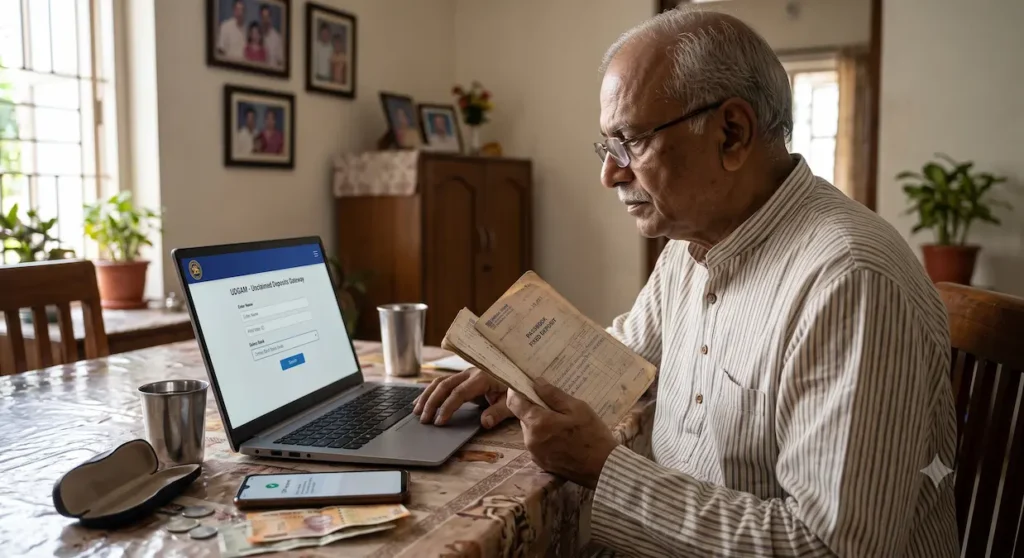
Navigating Unclaimed Bank Deposits in India
Banks across India are sitting on more than Rs 60,000 crore that belong to someone who simply lost track of it. A savings account opened before a job change. A fixed deposit from a relative who never came back to close it. An old passbook tucked into a drawer somewhere. Money like this does not vanish; it gets swept into a fund the Reserve Bank of India controls directly. The solution lies in the answer to the question: How to claim unclaimed bank deposits using RBI’s UDGAM.
For years, finding it meant writing to every bank you could remember and waiting for a reply that might never come. That changed in 2023, when a single search portal went live. By 2026, the numbers behind it had grown, the transfer rule has tightened, and a second, wider portal now sits alongside it. None of it changes the basic promise RBI has made from the start: the money is never gone, only waiting for the right search and the right bank branch.
At A Glance: How to Claim Unclaimed Bank Deposits (RBI UDGAM)
Centralized Search Gateway: The official RBI UDGAM portal (udgam.rbi.org.in) allows users to search for unclaimed bank deposits across 30 participating banks covering ~90% of total DEA Fund balances.
10-Year Transfer Rule: Bank accounts, fixed deposits, and unpaid balances inactive for 10 consecutive years are transferred to the RBI’s Depositor Education and Awareness (DEA) Fund.
Required Search Identifiers: Finding lost deposits requires the account holder’s full name alongside at least one valid identifier, such as a PAN, Voter ID, Passport, Driving Licence, or registered address.
Unclaimed Deposit Reference Number (UDRN): Each matching record generates a unique UDRN, a secure tracking code required by bank branches to locate and initiate the physical claim.
Search vs. Settlement Rule: The UDGAM portal is purely a search-and-discovery platform; final verification, document submission, and money payout occur directly at the originating bank branch.
Deceased & Legal Heir Claims: Settling accounts of deceased family members requires an official death certificate, legal heir paperwork, and compliance with bank-specific indemnity limits (e.g., ₹15 lakh for PNB, ₹25 lakh for ICICI).
What Are Unclaimed Bank Deposits?
A deposit becomes unclaimed under Indian banking rules once 10 years pass without the account holder touching it. That covers a wider list than most people expect: savings accounts, current accounts, fixed and recurring deposits, cash credit balances, even unadjusted NEFT credits and old demand drafts sitting in a bank’s suspense ledger.
The 10-year clock starts from the last transaction the customer actually made, or, for a fixed deposit, from the maturity date if nobody comes to collect it. Interest credits and service charges the bank applies on its own do not reset that clock. Only something the customer does, a deposit, a withdrawal, a balance check through net banking, keeps an account active.
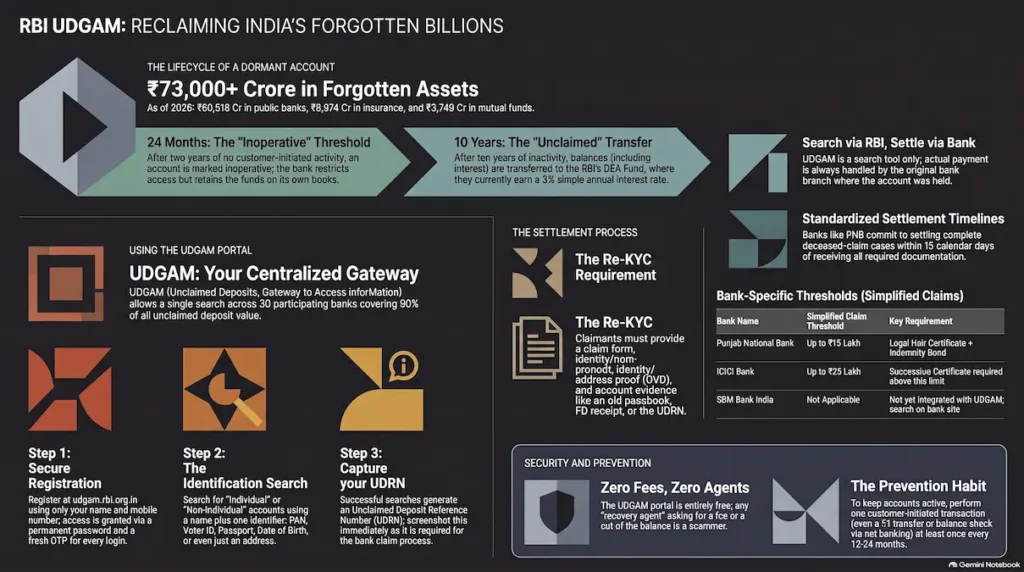
Two different thresholds get confused constantly. An account is marked ‘inoperative’ after just 24 months of no customer-initiated activity, at which point the bank restricts it but keeps it on its own books. It only becomes a true unclaimed deposit, transferred out of the bank entirely, once that inactivity stretches to a full ten years.
Understanding the Depositor Education and Awareness (DEA) Fund
The DEA Fund is where this money actually lives once a bank lets it go. RBI set it up under Section 26A of the Banking Regulation Act, 1949, and the scheme took effect on May 24, 2014.
Every bank operating in India, public, private, or cooperative, must hand over the full balance from a qualifying account, interest included, and stop counting it as its own liability.
Banks used to make this transfer on one fixed day each month. Under a revised rule that took hold from October 1, 2025, they now move the money during the last five working days of the month in which an account crosses the ten-year mark.
The balance keeps earning interest inside the Fund, too. RBI set a flat 3 percent simple annual rate on savings and term deposits from May 11, 2021 onward, down from 3.5 percent that applied between mid-2018 and that date; current accounts earn nothing, since they never did.
None of this changes your right to the money. Whether the transfer happened last week or a decade ago, there is no deadline for a depositor or their legal heir to come forward through the bank.
Why the Reserve Bank of India (RBI) Created the UDGAM Portal
Before August 2023, tracing an old account meant contacting banks one at a time, often without knowing which of them still held anything. Each bank published its own list of dormant accounts, buried somewhere in a corner of its website, a practice RBI itself had flagged as far back as July 2022, and cross-checking thirty or more of these lists by hand was not realistic for most people.
RBI launched UDGAM on August 17, 2023 to close that gap. It started with seven banks. By September 28 of the same year, coverage had expanded to thirty, together holding roughly 90 percent of all unclaimed deposit value inside the DEA Fund. RBI paired the portal with a parallel push called ‘100 Days 100 Pays,’ asking every bank to trace and settle its top 100 unclaimed accounts in each district within a hundred-day window. The portal did not create any new right to the money; depositors could always claim it. What it removed was the guesswork of figuring out where to look.
The Scope of the Problem: Thousands of Crores in Dormant Accounts
The number keeps climbing. An RTI disclosure around the time UDGAM launched put total unclaimed bank deposits near ₹48,000 crore, with State Bank of India’s own share estimated at roughly ₹8,952 crore. Totals this size tend to cluster around a handful of the largest lenders.
By January 31, 2026, public sector banks alone had transferred ₹60,518 crore to the DEA Fund, according to figures the Finance Ministry placed before Parliament that March. Add roughly ₹8,974 crore sitting unclaimed with insurers and ₹3,749 crore in unclaimed mutual fund units tracked by SEBI, and the wider pool of forgotten money across the financial system runs past ₹73,000 crore.
Government camps held across 748 districts between October and December 2025 returned ₹5,777 crore to about 22.95 lakh claimants, part of a nationwide push called Aapki Poonji, Aapka Adhikar, or ‘Your Money, Your Right.’ Yet UDGAM itself had just 18.86 lakh registered users as of March 1, 2026, which suggests a large share of affected households still have not searched even once.
What is the RBI UDGAM Portal?
UDGAM Portal Full Form and Meaning
UDGAM stands for Unclaimed Deposits, Gateway to Access inforMation, with the capital M spelling out the acronym. It sits at udgam.rbi.org.in and belongs entirely to RBI. No bank runs it, and no private company built it. There’s no fee anywhere in the process.
Key Features and Capabilities of the Search Platform
Once registered, a user can search across every participating bank in one sitting instead of visiting each one separately. The system accepts a name plus at least one identifying document, or simply an address if no document is on hand, and typically returns a match within about a minute when one exists. Each result carries a UDRN, the bank’s name, and a rough location, enough to start a claim without exposing the full account number to anyone who happens to glance at the screen.
The portal also links straight through to each bank’s own claim page from the results screen, so the next step is a click away rather than a separate search.
Which Banks Are Integrated with the UDGAM Centralized Portal?
Thirty banks joined the portal in its first six weeks, and that list has barely grown since. It includes the largest public sector names, State Bank of India, Punjab National Bank, Bank of Baroda, Canara Bank, Indian Bank, Union Bank of India, Bank of India, Bank of Maharashtra, UCO Bank, Central Bank of India, IDBI Bank, Punjab and Sind Bank, and Indian Overseas Bank, alongside private banks such as HDFC Bank, ICICI Bank, Axis Bank, Kotak Mahindra Bank, IndusInd Bank, Federal Bank, South Indian Bank, Karnataka Bank, Karur Vysya Bank, Jammu and Kashmir Bank, Dhanlaxmi Bank, DBS Bank India, Citibank, Standard Chartered, and HSBC, plus Saraswat Co-operative Bank and Tamilnad Mercantile Bank.
Together they account for around 90 percent of unclaimed deposit value inside the DEA Fund, which is why RBI is comfortable calling the search centralised even though it does not cover literally every bank in the country.
Smaller and newer banks are still working through onboarding. SBM Bank India, for instance, states plainly on its own site that it is not yet part of UDGAM and directs customers to its own claim page instead. If a bank is not on the list above, its own website, not UDGAM, is where the search has to happen.
What the Portal Can and Cannot Do (Search vs. Settlement)
UDGAM finds. It does not pay. That single fact matters more than anything else on this page, and RBI states it directly in its own FAQ: the portal only searches for unclaimed deposits across banks and points to each bank’s claim process, it does not settle or transfer any money itself.
The portal also has no reach into other kinds of unclaimed money. Post office deposits, EPFO provident fund balances, unclaimed insurance payouts, and unclaimed shares or dividends sit outside its scope entirely; those go through EPFO’s own portal, IRDAI’s Bima Bharosa platform, or the Investor Education and Protection Fund respectively.
A newer government platform, the Common Landing Portal for Unclaimed Financial Assets at unclaimedassetsportal.in, launched on May 29, 2026. The Department of Financial Services developed it with the Public Sector Bank Alliance to give citizens one entry point across bank deposits, insurance, shares, dividends, and mutual funds together. It works alongside UDGAM rather than replacing it, and several banks now link to both from the same customer-service page.
Step-by-Step Guide: How to Register on the UDGAM Portal
Accessing the Official RBI UDGAM Website Safely
There is exactly one place to do this: udgam.rbi.org.in. Type it directly into the browser rather than tapping a link from an SMS, a WhatsApp forward, or a search ad, since phishing pages that mimic the real portal are the most common trap connected to this whole process. The genuine site carries no advertising and asks for no payment at any stage. It never calls a user first, either.
Bookmark the page once its address is confirmed. That one habit avoids almost every scam built around this portal.
Essential Details Required for New User Registration
Registration takes a name and a mobile number, nothing more at the outset. No PAN, no Aadhaar, no upfront proof of anything; the portal only needs to confirm it is talking to a real person before the search functions open up.
The Mobile OTP Verification and Password Creation Process
After entering a name and mobile number, the portal sends a one-time password to that number. Enter it, clear the captcha, accept the disclaimer, and set a password. That password carries over to every future visit; each login after this first one asks for the mobile number, the password, and a fresh OTP, so nobody can get in with the password alone even if it leaks somewhere.
Registration happens once. Everything after that is a routine login.
Troubleshooting Common Registration and Login Errors
Two things cause most of the frustration here. First, the OTP has a short validity window, so a slow inbox or a weak signal can mean requesting a fresh code more than once, which is normal and not a sign anything is broken. Second, the name typed into the search fields later has to be reasonably close to what the bank has on record, so something as small as a maiden name, an old spelling, or initials used inconsistently across decades of paperwork can produce a blank result even when an account genuinely exists.
A search for ‘Mohd. Iqbal Sheikh’ will not automatically catch an account opened under ‘Mohammed Iqbal Shaikh’ three decades earlier. Trying a couple of name variations before assuming there is nothing to find costs a minute and often changes the outcome.
How to Search for Unclaimed Deposits
Navigating the Search Dashboard Post-Login
Once logged in, the dashboard splits into two tabs: Individual and Non-Individual. Pick Individual for a personal savings account, fixed deposit, or recurring deposit, and Non-Individual for anything held by a company, trust, partnership, or society. Selecting the wrong tab will not break anything; it just means filling in fields that do not match what is being searched for.
Searching as an Individual Depositor (PAN, Voter ID, Passport Requirements)
For an individual search, the required fields are the account holder’s name and at least one bank, or ‘all’ if the bank is unknown, plus one of five identifiers: PAN, Voter ID, driving licence number, passport number, or date of birth.
Anyone missing all five can still search using the account holder’s address instead, a genuinely useful fallback for older accounts where nobody kept the paperwork.
Selecting ‘all’ under the bank field runs the name against every one of the thirty participating banks at once and returns results in under a minute, considerably faster than the old approach of checking each bank’s website in turn.
Searching for Non-Individual Accounts (Trusts, Companies, Firms)
A non-individual search swaps the personal identifiers for the entity’s name plus one of four alternatives: the authorised signatory’s name, the entity’s PAN, its Corporate Identification Number, or its date of incorporation. This path matters more than it might seem. Old trust accounts, defunct partnership firms, and companies that changed names or merged years ago often show up here precisely because nobody thought to check on their behalf.
Understanding the Unclaimed Deposit Reference Number (UDRN)
A UDRN is what the search actually hands over when it finds a match. Each bank generates this number through its own core banking system and assigns it to one specific unclaimed account, deliberately without revealing the account number itself, so that nobody who glimpses a shared screen can identify or touch the account from the reference alone.
Screenshot the result page before closing the tab. The bank branch will ask for this number when the claim process starts, and running the same search again later is not guaranteed to return an identical screen.
The Bank Claim Process: How to Withdraw Your Money
Why You Must Approach Your Respective Bank (Not the RBI)
RBI holds the money, but RBI does not pay it out. Every claim, without exception, gets settled by the bank where the account originally sat, which then seeks reimbursement from the DEA Fund on its own. Writing to the Reserve Bank directly, or showing up at its regional office with a UDRN in hand, only gets redirected back to the branch.
Once a bank approves a claim, it repays the depositor first and then recovers the equivalent sum from the DEA Fund through RBI’s e-Kuber settlement system. Interest keeps accruing on DEA balances until the day a claim is actually settled.
There is one narrow exception worth knowing about: if the bank itself goes into liquidation, the depositor claims from the Liquidator instead, who in turn recovers an amount up to the DICGC insurance limit from the DEA Fund and settles anything beyond that on a reimbursement basis.
Documents Required for Individual Account Holders (Re-KYC Process)
Every bank asks for broadly the same three things: a claim form, proof of identity and address, and something that ties the claimant to the account- a passbook, an FD receipt, or, failing either, just the UDRN itself. Beyond that baseline, the details diverge more than most guides admit, since RBI sets the outer rules and each bank writes its own procedure inside them. For an institutional or company account, expect an additional layer entirely: a request on the firm’s letterhead signed by the authorised signatories, plus the entity’s own KYC documents and constitution papers, a partnership deed, trust deed, or memorandum of association, depending on what kind of organisation is claiming.
| Bank | Where to start | Core documents | Notable detail |
| Punjab National Bank | Branch visit with common application form | Officially Valid Document, PAN or Form 60, request letter, account proof | Deceased claims settled within 15 calendar days of complete documents |
| Bank of Baroda | Online self-claim portal or branch | Account number or UDRN, OVD, optional passbook, FD receipt, or cancelled cheque | Online claim closes if the branch visit for verification is not completed within 45 days |
| ICICI Bank | Branch visit | Voter ID, driving licence, passport, Aadhaar, NREGA card, or NPR card as ID and address proof, plus a Re-KYC form | No-nomination deceased claims above ₹25 lakh need a succession certificate or legal heir certificate |
| SBM Bank India | Branch visit (not yet on UDGAM) | Claim form, valid ID and address proof, deposit details | Original FD receipt is not mandatory if it cannot be located |
The thresholds that decide whether a simpler indemnity route is enough, rather than a court-issued succession certificate, are set by each bank individually within RBI’s broader rules, not by one national number. PNB draws that line at ₹15 lakh; ICICI Bank sets it at ₹25 lakh. Checking a specific bank’s own policy before assuming a figure from one bank applies to another saves a wasted branch visit.
Submitting the Claim Form and UDRN to the Bank Branch
Bring the UDRN screenshot, a government ID, proof of address, and any paper that still exists from the original account: an old passbook, a cheque leaf, a fixed deposit receipt. None of these is always mandatory on its own, since banks generally accept identity and address proof even when the physical passbook is long gone, but each document that turns up speeds the branch’s verification along.
Some banks now let the first step happen online. Bank of Baroda’s self-claim portal, for example, takes the claim details digitally, issues a Claim Reference Number immediately, and only requires the branch visit afterward for document verification, with a 15-day window to visit once notified and a 45-day outer limit before the claim lapses altogether.
Most public sector banks still expect the first visit to happen in person, with a common application form filled out on the spot. Whichever channel is used, keep photocopies of everything submitted; branch staff handling a claim type that surfaces only occasionally are not always the fastest at returning original documents.
Choosing Between Account Reactivation or Final Settlement
These are two different outcomes, and which one applies depends entirely on how long the account has been dormant. Banks typically flag an account as merely ‘inactive’ after 12 months of no customer transaction, then reclassify it as fully ‘inoperative’ at the 24-month mark, restricted but still sitting on the bank’s own books. Reactivating an account at this stage means submitting a request letter and fresh KYC documents, after which the branch unfreezes it and normal transactions resume. None of this counts as a UDGAM matter, since the money never left the bank.
Once ten years pass and the balance moves to the DEA Fund, reactivation is no longer on the table. What is left is a final settlement: the bank verifies the claim, pays the depositor from its own funds, and then recovers that amount from RBI. The account itself, in most cases, does not reopen in its old form; the money simply gets paid out.
Claiming Unclaimed Deposits for Deceased Family Members
The Role of Legal Heirs and Registered Nominees
A nominee is not automatically the legal owner of the money, even though a nominee is usually who gets paid first. Banks treat a nominee as a trustee acting on behalf of the actual legal heirs, someone authorised to receive the funds and pass them on according to succession law, not someone whose personal claim overrides everyone else’s. Where a nomination exists and matches the account, payment to that nominee, after identity verification and a death certificate, is usually the fastest route through.
Where no nomination was ever registered, the process shifts toward proving who the legal heirs actually are, through a will, a succession certificate, or a legal heir certificate, depending on the amount involved and the bank’s own policy. Since the Banking Laws (Amendment) Act, 2025, an account can now carry up to four nominees, either as successive backups or as simultaneous co-nominees, which is steadily cutting down how often this harder, no-nomination path gets used at all.
Required Legal Documentation: Death Certificates and Succession Proofs
A death certificate is non-negotiable in every single case; no bank moves forward without one. Past that baseline, what gets asked for scales with the size of the claim. For smaller amounts, most banks accept a simplified route built around:
- A signed claim form, along with proof of identity and address for the claimant
- The original death certificate of the account holder
- A bond of indemnity signed by the claimant
- Either a legal heir certificate from a local authority, or a signed declaration from someone outside the family who can vouch for the heirs
PNB sets its simplified threshold at ₹15 lakh; other banks draw the line elsewhere, so the exact figure is worth confirming with the specific branch rather than assuming from a single example. Above that threshold, banks generally ask for a succession certificate from a civil court, or accept a legal heir certificate paired with a bond of surety from an independent third party.
If the deceased left a will, the will itself typically needs to be probated before a bank will act on it; where probate is not practical, the branch manager can advise on alternatives case by case. Branches in remote, rural locations get one further concession: for claims up to ₹50,000, a certificate from the local Sarpanch can substitute for notarisation. That saves a trip to a town with a magistrate’s office.
A separate set of rules covers depositors who are missing rather than confirmed deceased. Where someone has been missing for seven years or more, Class-I legal heirs can claim up to ₹5 lakh without needing a court order presuming death. Where the disappearance is more recent, under seven years, banks generally cap the claim at ₹2 lakh and require at least two years to have passed since an FIR was filed, again without a court order. Both routes still call for a formal request letter, a copy of the FIR with a final non-traceability report, and an indemnity bond.
Navigating Bank-Specific Claim Settlement Policies
Two banks handling an identical situation can still ask for different paperwork, because RBI’s rules set a floor, not a fixed script every bank has to copy exactly. Bank of Baroda routes legal heir and nominee claims through a dedicated online Deceased Claim portal rather than a branch counter first.
ICICI Bank asks for a death certificate attested differently depending on whether it was issued in India or abroad, down to specifying that a foreign death certificate needs Hague Convention apostille or embassy certification. PNB, for accounts below ₹15 lakh with no nomination, waives the surety bond that larger claims still require.
None of these differences are arbitrary. They trace back to RBI’s Responsible Business Conduct Directions, 2025, and a companion incentive scheme running since October 1, 2025 that pays banks 5 to 7.5 percent of a settled unclaimed amount, subject to a cap, specifically to push them toward tracing depositors instead of waiting for a claim to arrive.
The Indian Banks’ Association has also rolled out a Common Application Form and standard operating procedure that most member banks now use as their base template, even while layering their own thresholds and portals on top of it.
Estimated Timelines for Processing Deceased Depositor Claims
PNB commits to settling a complete claim within 15 calendar days of receiving every required document. Other banks generally fall somewhere between one and four weeks once paperwork is complete, and once a bank raises its own reimbursement claim with the DEA Fund, that separate leg typically adds about another week on top of whatever internal processing the branch itself needed.
The single biggest driver of delay is not the bank at all. It is missing or mismatched documents, a name spelled two different ways across the death certificate and the original account, or a legal heir certificate that has expired by the time it reaches the branch.
Protecting Yourself from Scams and Financial Fraud
Identifying Fake Recovery Agents and Phishing Websites
UDGAM does not charge anything, at any stage, for any reason. That single fact rules out most of the scams built around it. Anyone claiming to be a ‘recovery agent’ who can retrieve unclaimed deposits for a fee, a cut of the balance, or an upfront processing charge is not affiliated with RBI or any bank, no matter how official their message sounds.
Fake websites that copy UDGAM’s look and use a similar-sounding domain name are the other common trap. The only genuine address is udgam.rbi.org.in; anything else asking for the same information is worth reporting rather than trusting. RBI’s separate Sachet portal exists specifically to check whether an entity collecting deposits or offering to ‘release’ unclaimed funds is authorised at all, and to file a report if it is not.
Safe Practices for Sharing UDRN and KYC Details
A UDRN by itself cannot be used to drain an account, since it deliberately withholds the underlying account number. Even so, treat it the way you would treat any other financial reference: share it only with the bank branch handling the claim, never over an unsolicited call or a message from someone who reached out first.
OTPs, net banking passwords, and card PINs sit in a different category entirely and should never be shared with anyone, including someone who claims to be calling from the bank itself. A real bank employee processing a UDGAM claim will never need an OTP to do their job. The same caution applies to documents uploaded through a bank’s own online claim portal: use the bank’s verified app or website address directly, rather than a link forwarded by someone else, even if that person claims to be helping.
How to File Complaints Using the RBI Ombudsman Scheme
If a branch sits on a valid claim without resolving it, the first move is a written complaint at that branch, with the acknowledgement number kept safely. Most banks link directly to RBI’s Complaint Management System as their next escalation point.
Thirty days of silence, or an answer that does not actually resolve the problem, is the trigger for RBI’s Integrated Ombudsman Scheme, 2021. Filing there costs nothing, and suspected fraud, including fake recovery agents, can also be reported to the National Cyber Crime Reporting Portal or by dialling 1930. (Source: https://www.sbm.bank.in/unclaimed-deposit)
| Resource | What it is for | Where to go |
| UDGAM Portal | Search unclaimed deposits across 30 banks | udgam.rbi.org.in |
| Common Landing Portal | One entry point for bank deposits, insurance, shares, and mutual funds | unclaimedassetsportal.in |
| RBI Complaint Management System | Escalate an unresolved bank complaint | cms.rbi.org.in |
| Sachet Portal | Check or report unauthorised deposit-taking schemes | sachet.rbi.org.in |
| Cyber Crime Reporting | Report financial fraud or phishing | cybercrime.gov.in, or dial 1930 |
Best Practices to Prevent Accounts from Becoming Dormant
Keeping Contact Information and KYC Records Updated
A bank that cannot reach a customer cannot warn that customer before an account drifts into dormant territory. Updated KYC records, a current mobile number, and a working email address are what let a bank’s periodic outreach campaigns actually find the right person instead of bouncing off an old address. Re-KYC can usually be completed online now, through net banking or a bank’s mobile app, without a branch visit at all for most account types. It is a small chore that pays off disproportionately, since a bank has no way to send a maturity reminder, a KYC expiry notice, or a dormancy warning to an address or number that stopped working years ago.
The Importance of Routine Annual Transactions
The 24-month inoperative clock resets with almost any customer-initiated activity: a deposit, a withdrawal, a balance check through net banking, even a cheque book request logged through the app. A single small transaction once a year, deliberately scheduled if the account is not otherwise in regular use, is enough to keep that clock from ever reaching zero. This matters even for accounts nobody actively uses on purpose, a fixed deposit opened years ago for a child’s education, or a savings account kept open only as a backup. One scheduled transfer or withdrawal a year, timed to a birthday or an anniversary so it is easy to remember, costs nothing and keeps the account firmly out of dormant territory.
Ensuring Proper Nominee Registration Across All Accounts
Every deposit account should carry a registered nominee, and since the Banking Laws (Amendment) Act, 2025 came into force, banks now allow up to four nominees per account, either as successive backups or as simultaneous co-nominees sharing a defined percentage. Registering a nominee turns a deceased family member’s claim from a court process involving succession certificates into a same-week branch visit with a death certificate.
An account without a nominee is not lost money waiting to happen, but it does guarantee that whoever eventually claims it will need considerably more paperwork than they would have with one form filled in years earlier.
FAQ: How to Claim Unclaimed Bank Deposits (RBI UDGAM)
As per the Reserve Bank of India, balances in savings or current accounts that are not operated for 10 consecutive years, or term deposits not claimed within 10 years of maturity, are classified as unclaimed. These funds are legally transferred to the Depositor Education and Awareness (DEA) Fund, but they still belong to the depositor or their legal heirs.
No, you cannot claim money directly from the UDGAM portal or the RBI. The portal is strictly a centralized search gateway designed to help you locate dormant accounts across multiple banks. Once you find a matching deposit and generate your UDRN, you must contact the respective bank branch to initiate the actual physical settlement and withdrawal process.
The Unclaimed Deposit Reference Number (UDRN) is a unique security code generated by a bank’s Core Banking Solution (CBS). It is assigned to every unclaimed account transferred to the DEA fund. The UDRN allows citizens to seamlessly search for deposits without exposing sensitive account numbers to third parties, protecting users from financial fraud.
If a deceased family member did not register a nominee, legal heirs can still claim the funds. You must visit the bank branch with the deceased’s original death certificate, your KYC documents, and valid proof of succession. Depending on the claim amount and specific bank policies, this proof may require a legal heir certificate, a bond of indemnity, or a succession certificate from a civil court.
There is no time limit to claim your forgotten money. Whether the funds were transferred to the DEA Fund a month ago or a decade ago, depositors or their rightful heirs can always reclaim the principal amount along with applicable accrued interest.
To register on the UDGAM portal (udgam.rbi.org.in), you only need your name and mobile number for OTP verification. Once logged in, you can search for individual accounts by providing the account holder’s name and at least one official identifier, such as a PAN, Voter ID, Passport, Driving Licence, or Date of Birth. If none of these are available, searching by the registered address is also permitted.
Disclaimer
The UDGAM search and DEA Fund claim process are described here in general terms. This isn’t legal or financial advice, and it doesn’t account for your personal tax position, so treat it as a starting point rather than a final answer for your specific case.
Cutoffs like PNB’s ₹15 lakh threshold or ICICI’s ₹25 lakh threshold, along with the processing timelines mentioned throughout, come from each bank’s own current policy, and banks revise these without much notice. Confirm any figure here directly with your branch before acting on it, especially for a large claim or one involving a dispute among heirs. RBI’s own UDGAM and Sachet portals are also worth checking yourself.
India Policy Hub is an independent publication. We aren’t RBI, and we aren’t affiliated with any bank or government office. We don’t search for deposits on anyone’s behalf, and we don’t verify or settle claims. We never touch anyone’s money in the process.




Discussion (4)
Leave a Reply