
How to File an e-Shram Accidental Insurance Claim for Your Family
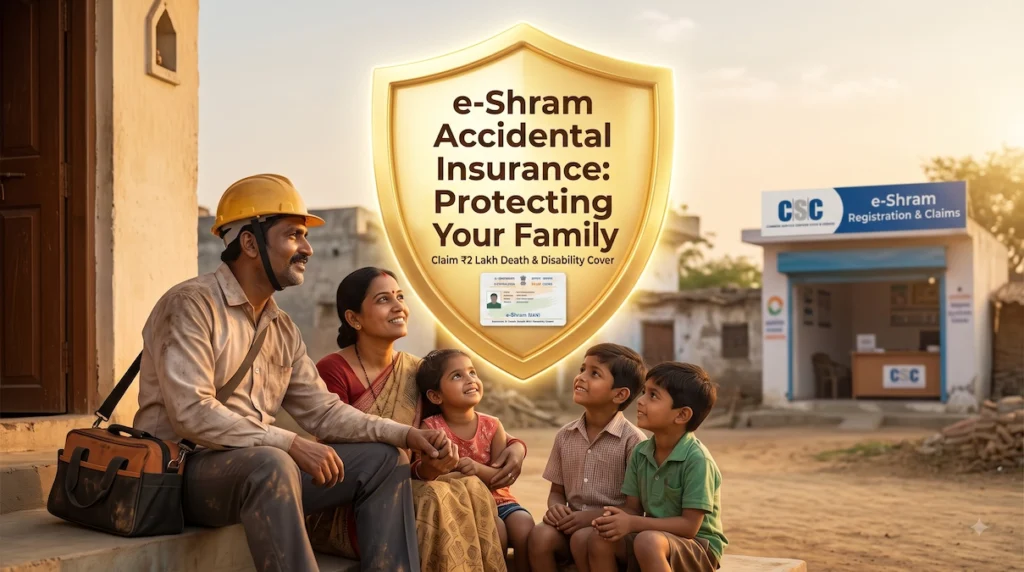
Understanding e-Shram Accidental Insurance: Coverage, Eligibility, and Benefits
An accident on a construction site, a fatal fall from a moving train, a road crash on the way to a shift: for a household that depends on daily wages, these moments carry a financial shock that formal-sector families rarely face without a safety net. In such a scenario, an e-Shram accidental insurance claim can become a major relief.
The e-Shram portal exists to close exactly that gap. Every worker who registers gets a Universal Account Number, and through it, accident cover worth ₹2 lakh for death or total disability and ₹1 lakh for partial disability, at no cost to the worker. More than 30 crore workers have registered on the portal since it launched. Most families still don’t know the claim exists until an accident forces the question, and by then, confusion about paperwork, deadlines, and which office to approach can cost weeks a grieving household doesn’t have. Who qualifies, which documents matter, how the file moves from bank branch to insurer, and what to do if the payment doesn’t arrive: that’s what follows.
At A Glance: e-Shram accidental insurance claim
Claim Amount: Up to ₹2 Lakh for accidental death or total permanent disability, and ₹1 Lakh for partial permanent disability (illness or natural death are excluded).
Eligibility Criteria: Available exclusively to unorganised sector workers (ages 16-59) who hold a valid e-Shram Universal Account Number (UAN) and are not covered by EPFO/ESIC or paying income tax.
Strict Timeline: The worker’s linked bank branch must be officially notified within 30 days of the accident to avoid processing delays.
Mandatory Documents: Claims strictly require an official Police FIR, Death/Disability Certificate, Aadhaar cards (for both worker and nominee), and a filled PMSBY claim-cum-discharge form.
Where to Apply: All claims and physical documents must be submitted directly to the worker’s linked bank branch, not through the e-Shram website.
Preventing Rejections: Ensure the bank account remains active and nominee details are strictly updated on the e-Shram portal before any incident occurs.
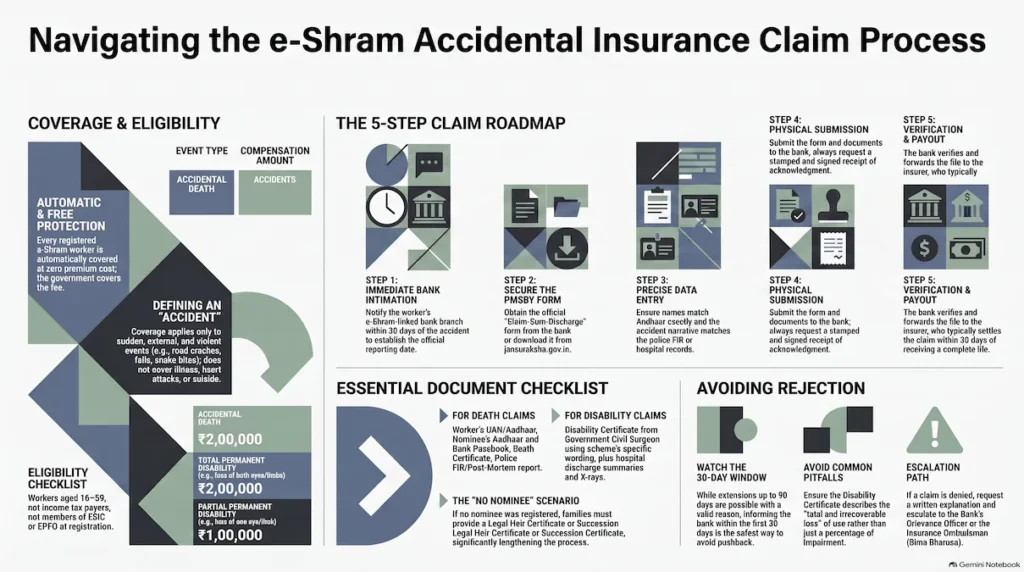
Understanding the e-Shram Card and Its Accidental Insurance Coverage
What is the e-Shram Portal and the Universal Account Number (UAN)?
e-Shram is the central government’s National Database of Unorganised Workers, run by the Ministry of Labour and Employment and launched on 26 August 2021. Its job is simple to state and hard to execute at scale. It has to identify every worker in the unorganised sector, whether they work from home, are self-employed, or draw wages, most of them with no Provident Fund or ESI cover, and give each one a single identity that different welfare schemes can rely on.
That identity is the Universal Account Number, a 12-digit UAN issued the moment registration is complete. It does not expire and it never changes, no matter how many times the worker changes jobs, cities, or occupations. Registration itself needs only an Aadhaar number and an Aadhaar-linked mobile number, done free of charge either at the official portal or at a nearby Common Service Centre using biometric verification where a linked mobile number isn’t available.
Gig and platform workers, delivering for apps or driving for aggregators, register through a separate form made for that category. That separate form exists because platform companies carry specific obligations under the Code on Social Security 2020. The e-Shram card that comes out of this process is what a bank, an insurer, or a welfare board will ask to see when a claim is filed later. The UAN is worth writing down somewhere more permanent than a single phone.
Also Read: Ayushman Bharat for Gig Workers 2026: Enrolment Guide
The Role of Pradhan Mantri Suraksha Bima Yojana (PMSBY) in e-Shram Benefits
The accident cover attached to e-Shram runs on the same terms as the Pradhan Mantri Suraksha Bima Yojana, a personal accident insurance scheme the Department of Financial Services launched on 8 May 2015 in Kolkata, alongside PMJJBY and the Atal Pension Yojana, as one of three flagship Jan Suraksha social security schemes. Ordinarily, PMSBY is something a bank account holder chooses to join, paying ₹20 a year by auto-debit for a one-year policy that runs from 1 June to 31 May and renews on the same terms unless the balance falls short on the debit date.
e-Shram changes that arithmetic for registered workers. The scheme extends PMSBY-equivalent accident cover automatically on registration, at no premium cost to the worker. Banks, not insurers, hold the master policy under this design, since participating banks and post offices are the master policyholders who deal directly with the insurance company on behalf of every enrolled account. That single choice explains why the claim paperwork described later runs through a bank branch rather than through the e-Shram portal itself. Families should confirm with their branch or nearest CSC whether a specific claim runs through standard PMSBY enrolment or through the government’s parallel ex-gratia arrangement for e-Shram registrants, since the two can carry slightly different paperwork trails even though the payout amounts are the same.
Financial Coverage Breakdown: Accidental Death vs. Partial Disability
The payout depends entirely on what happened, not on how long the worker had been registered or how much they earned. An accident, in the scheme’s own definition, has to be sudden and involuntary, something nobody saw coming, caused by force from outside the body rather than from within it, and visible in its effects. That’s why a heart attack or a stroke doesn’t qualify, even if it happens on a job site. Within that definition, four outcomes qualify, and only four.
| Event | Compensation | What Qualifies |
| Accidental death | ₹2,00,000 | Death caused by a sudden, external, violent event; not illness or natural causes |
| Total permanent disability | ₹2,00,000 | Total and irrecoverable loss of both eyes, both hands, both feet, or one eye plus one hand or foot |
| Partial permanent disability | ₹1,00,000 | Total and irrecoverable loss of sight in one eye, or loss of use of one hand or one foot |
| Death by suicide or illness | Not covered | Falls outside the accident-only design of the scheme |
A partial injury that doesn’t fit one of these two disability categories receives nothing under this scheme, no matter how severe it looks on an X-ray. That is the single most common source of disappointment among claimants, so check the exact wording of a doctor’s certificate before assuming a payout is coming. Natural disasters such as floods and cyclones count as accidents too, since they meet the same sudden and external test, while murder is covered and suicide is not.
Two more boundaries are worth knowing before a family assumes the scheme covers something it doesn’t. It pays out only once: if a worker was somehow covered through more than one bank account, only one claim is honoured and the second premium is forfeited. And it isn’t a health insurance policy. Hospital bills after an accident aren’t reimbursed under this scheme, and neither are ongoing treatment costs or any other medical expenses; the payout is a single lump sum tied only to death or the two disability tiers described above.
Eligibility Criteria for Claiming e-Shram Insurance Benefits
Who Qualifies as an Unorganised Worker Under the Scheme?
The eligibility test is about the nature of the work, not its scale of income. An unorganised worker, in the government’s own definition, is somebody who works from home, is self-employed, or draws wages, without being a member of the Employees’ State Insurance Corporation or the Employees’ Provident Fund Organisation.
The unorganised sector itself is defined just as concretely: any establishment producing or selling goods and services with fewer than ten workers, and not covered under ESIC or EPFO. There is no income threshold to clear either. The only financial condition is that the worker isn’t currently an income tax payee.
In practice this covers a wide spread of occupations: domestic workers, street vendors and hawkers, construction labour, agricultural and landless farm labour, migrant workers, gig and platform workers delivering for apps, plantation workers, and staff at small MSME units with fewer than ten workers on the payroll that fall outside ESIC and EPFO coverage. A worker already contributing to EPFO or ESIC, or currently on the payroll of central or state government, cannot register for e-Shram, because those categories already sit inside a different social security net.
Age Requirements and Valid e-Shram Registration Verification
Registration is open to anyone between 16 and 59 years of age, and no proof of date of birth is required at the time of registration. Nothing forces a worker to act once they cross 60; the card and its benefits simply continue, with no renewal step required on the worker’s part.
Before a family assumes a claim will succeed, though, check that the registration itself was valid at the time of the accident, starting with whether the Aadhaar number was entered correctly. The mobile number or bank account linked to the UAN matters just as much, and so does whether the worker’s occupation category was recorded correctly. A mismatch on any of these points is one of the more common reasons a claim stalls at the bank’s verification stage, long before it ever reaches the insurer.
Identifying the Authorized Nominee or Legal Heir for Death Claims
For a death claim, the money goes to whoever was named as nominee at the time of enrolment. If no nomination was recorded, and this happens often when registration was rushed through a CSC visit, the payout instead goes to the legal heirs of the deceased worker. Disability claims work differently: since the worker survives the accident, the payment goes directly into their own bank account, and no nominee question arises at all.
Check the nomination on record well before an emergency forces the question, because correcting it after an accident adds an extra layer of proof that a straightforward nominated claim never needs, and a wrongly recorded nominee can delay a payout even when every other document is in order.
Essential Document Checklist for Accidental Death Claims
Every death claim needs to establish two things beyond the accident itself: who the claimant is, and where the money should land. The identity and banking papers below cover both, and gathering them before the first bank visit saves at least one repeat trip.
Mandatory Identity and Bank Documents (Aadhaar, Bank Passbook, UAN)
| Document | Why It’s Asked For |
| Worker’s Aadhaar card and e-Shram UAN | Confirms the deceased was a registered e-Shram worker and links the claim to the correct record |
| Nominee’s or legal heir’s Aadhaar card | Establishes who is entitled to receive the payout |
| Bank passbook or cancelled cheque in the nominee’s name | Gives the bank and insurer the account details for the transfer |
| Filled PMSBY claim form (available at the bank or at jansuraksha.gov.in) | The formal application the insurer processes |
Carry originals along with photocopies to the bank branch. Branch staff typically verify against the original and return it, keeping only the copy, and a claim that arrives with just photocopies and no originals for verification is one of the easiest ways to add weeks to the process.
Crucial Medical and Legal Records (Original Death Certificate, FIR, Post-Mortem)
This is the set of papers that actually shows an accident happened, and it is where most claims either move quickly or stall for months. The death certificate issued by the municipal or panchayat authority is non-negotiable, since no claim proceeds without formal proof of death. Where the death followed a road accident, a rail accident, drowning, or any incident with a criminal angle, the police First Information Report has to accompany the claim, because the scheme’s own rules require police involvement for exactly these categories of accident.
Insurers generally ask for a post-mortem report alongside the FIR in accidental death cases too. Where the cause was something like a snake bite or a fall from a tree, an immediate hospital record documenting the cause stands in for the FIR instead. Missing any one of these documents is enough for a bank to hold the file rather than forward it, so request certified copies at the time of the incident rather than weeks later, once memories and paperwork trails have gone cold.
Alternative Documentation for Cases Without a Registered Nominee
When no nominee was recorded, the claim doesn’t disappear, but it does get heavier. The bank and insurer will ask the surviving family to establish legal heirship before releasing funds, since the payout must go to someone with a documented right to it. In practice this usually means a legal heir certificate or succession certificate issued by the local revenue or judicial authority, along with an affidavit naming all surviving heirs.
Where more than one heir exists, they’ll also need to put in writing how the amount should be divided, or who should receive it on the family’s behalf. This route takes longer than a straightforward nominated claim, sometimes considerably so, which is the strongest argument for updating a nomination the moment it’s found missing rather than after an accident has already happened. A ten-minute correction today can save a family months of paperwork later.
Document Checklist for Permanent or Partial Disability Claims
A disability claim runs on different paper than a death claim.
Securing a Valid Disability Certificate from a Government Civil Surgeon
A disability claim rises or falls on one document: the certificate that states, in the scheme’s own language, which of the two disability categories applies. This has to come from a competent medical authority, ordinarily the Civil Surgeon or an equivalent authority at a government hospital, not a private clinic’s discharge note.
The certificate needs to describe the injury in terms that map directly onto the scheme’s own wording, total and irrecoverable loss of sight in one eye or loss of use of one hand or one foot for the ₹1 lakh tier, or the more severe combinations for the ₹2 lakh tier. A certificate that simply states a percentage of disability without that specific language gives the insurer room to ask for clarification, or to reject the claim outright, so ask the certifying doctor to use the scheme’s exact terms rather than a generic disability percentage.
Required Hospital Discharge Summaries and Medical Investigation Reports
Alongside the disability certificate, the insurer wants the paper trail that led to it. That means the hospital discharge summary, the X-rays or scans behind the diagnosis, and the record from the initial admission and treatment. All of it needs to show the injury followed a specific accident, not a pre-existing condition. Where the injury followed a road or rail accident, the same police report requirement that applies to a death claim applies here too. Keep every original bill and prescription from the first hospital visit onward, plus whatever reports come out of it, even the ones that seem routine at the time. Insurers cross-check dates on these documents against the date claimed for the accident, and a gap between the two, even an innocent one caused by a delayed hospital visit, is one of the quieter reasons a disability claim gets sent back for review.
Step-by-Step Process to File an e-Shram Accidental Insurance Claim
Five steps stand between an accident and a settled claim.
Step 1: Immediate Intimation to the Bank Linked to the e-Shram Account
The very first call a family should make, ideally within days of the accident, is to the bank branch where the worker’s e-Shram-linked account sits. This is the branch that holds the enrolment record and the one that will eventually forward the claim to the insurer, so nothing else in this process moves until this call is made.
Ask specifically for the PMSBY or e-Shram accident claim process by name, since a bank counter that hears only “accident” and “insurance” may point toward an unrelated product. Note down the name of the official who takes the call, and get written acknowledgement of the date the accident was reported. That date matters more than almost anything else in this process, because every later deadline is measured against it, not against the date of the accident itself.
Step 2: Procuring the Official PMSBY Claim-Cum-Discharge Form
The branch will hand over, or direct the family to, the PMSBY claim-cum-discharge form, the same document used for the standard version of the scheme regardless of whether the underlying cover came from a paid enrolment or from e-Shram registration. It is also downloadable in advance from the Jan Suraksha portal, under the Forms section, for anyone who wants to fill it in before visiting the branch rather than sitting at the counter with a pen. The discharge portion of the form is what confirms, once signed, that the claimant accepts the settlement as full and final. It should only be signed after the amount and the recipient’s bank details have been checked against what was actually submitted, not before.
Step 3: Accurately Filling Nominee Details and Accident Circumstances
This is the step where small errors do the most damage later. The claimant’s name has to read exactly as it appears on their Aadhaar. The bank account number and IFSC code need to be copied without a single digit transposed, and the narrative section describing how the accident happened should tally, fact for fact, with what the FIR or hospital record already states. An insurer reading two accounts of the same accident that disagree on basic facts, the date, the location, how things actually unfolded, will pause the claim to ask which version is correct, and that single question, small as it seems, can add a month to settlement. Where the family isn’t confident filling in this section alone, ask the bank official or a CSC operator to check it before submission rather than after.
Step 4: Physical Submission of the Application and Supporting Evidence
Once the form is complete, it goes back to the same bank branch along with every document from the two checklists above, originals for verification and photocopies to leave behind. Ask for a receiving acknowledgement that lists exactly what was submitted and the date it was received, ideally signed and stamped rather than a verbal assurance. This single piece of paper becomes the family’s proof if the claim is challenged later, or simply goes quiet for weeks, and it is worth the extra few minutes it takes to get the branch to issue it properly. A family that skips this step has almost nothing to point to later if the file goes missing between departments.
Step 5: Bank Verification and Insurance Company Processing Flow
From here, the file leaves the family’s hands. The bank checks the submission against its own enrolment and account records, then forwards the complete set to the empanelled general insurance company that underwrites the policy for that branch, usually one of the public sector general insurers the scheme works with. The insurer’s own claims team then checks the documents against the scheme’s definitions, death on one side, the two disability tiers on the other. From there it can approve the payout. It can also ask for one specific missing document, or, less often, send back a written rejection with a stated reason. None of this should take more than a matter of weeks once the file is genuinely complete, and delays past that point are worth watching for.
Important Timelines, Deadlines, and Grace Periods for Claim Submission
The Critical 30-Day Notification Window Following the Incident
The working rule across PMSBY-linked claims, e-Shram’s included, is that the bank and insurer should be informed within 30 days of the accident. This isn’t written into the scheme’s founding rules as an absolute bar that kills a later claim outright, but it is the window insurers treat as normal, and intimation inside it removes one of the most common grounds insurers cite when they push back on a claim.
A family dealing with a sudden death rarely has the bank on its list of first calls. Even so, a short phone call to the branch within the first week, followed by the actual paperwork over the following weeks, satisfies this requirement far better than waiting until every last document is in hand before making any contact at all.
Requesting a 90-Day Extension for Delayed Document Submissions
Real life rarely fits inside 30 days. A post-mortem report can take weeks to be released. A police FIR can be delayed by an ongoing inquiry. A family in mourning simply isn’t tracking paperwork deadlines while arranging a funeral. Banks and insurers administering these claims generally accept a justified delay stretching out to around 90 days from the date of the accident, provided the family can show a genuine reason for the gap, such as a pending police report or a hospital record that wasn’t issued in time. Because the exact extension granted sits with the insurer’s discretion and the scheme’s current administrative guidelines, the safest approach is to inform the bank in writing about which document is still pending and why, rather than staying silent until it eventually arrives on its own.
Expected Turnaround Time for Benefit Disbursement to the Nominee
Once the insurer has every document it needs, it generally settles within 30 days. That clock starts from the date the complete file reaches the insurer, not from the date of the accident, which is exactly why chasing missing documents early matters more than almost anything else here. The insurer remits death claims to the nominee’s or legal heir’s bank account, while disability claims go directly into the account of the insured worker. If 30 days pass after a genuinely complete submission with no payment and no written explanation, that is the point at which a family should stop waiting quietly and start escalating instead.
One edge case is worth flagging separately. Because standalone PMSBY cover runs on an annual cycle from 1 June to 31 May, an accident in the last days of May can fall right at the renewal boundary, and a family should check which policy year was actually active on the date of the accident before assuming the claim is straightforward.
How to Track Your e-Shram Insurance Claim Status
Patience alone rarely moves a stuck file.
Offline Tracking Through Your Home Bank Branch
There is no public website where a claim number can be typed in for a live update, and it helps to know that upfront so a family doesn’t waste time searching for one. Tracking runs entirely through the branch that received the claim and the insurer it was forwarded to (https://righttoinformation.wiki/check-status/pmjjby-pmsby-claim-status).
Start by confirming the policy or cover was actually active at the time of the accident, since a lapsed enrolment settles nothing regardless of how complete the claim paperwork otherwise is. Then return to the branch with the claim reference number from the acknowledgement collected at submission, and ask the nodal officer for the current stage and the name of the insurer holding the file. A follow-up visit every couple of weeks, rather than one visit and a long wait, tends to get a stuck file moving again.
Utilizing the Jan Suraksha Ecosystem and Official Government Portals
Beyond the branch, the Department of Financial Services runs a national toll-free line for exactly this kind of query, reachable at 1800-180-1111 or 1800-110-001, with state-specific numbers listed on Jan Suraksha portal. Calling the empanelled insurer directly, using the claim reference number the bank provided, is usually faster than waiting for the branch to follow up on its own initiative. For anything specific to the e-Shram side of the claim rather than the PMSBY side, the grievance route at official portal or the national e-Shram helpdesk on 14434, staffed daily from 9 am to 6 pm including Sundays, is the better first call.
Common Reasons for e-Shram Claim Rejection and Mitigation Strategies
Most claims fail for the same handful of reasons, and almost all of them are avoidable.
Addressing Discrepancies in Nominee Details or Bank Account Information
A payout can only land in an account if the name and details on file are exactly correct against the claim. Where the nominee’s Aadhaar spelling differs from the bank passbook, or an account has since been closed, the transfer fails, and the same happens when the IFSC code was copied incorrectly at the original enrolment, even after the underlying claim has been approved on merit. The fix here is almost always faster than the rest of the claims process. Visit the branch, get the account details corrected on record, and don’t consider it done until there’s written confirmation the correction has gone through, before the payment is reattempted.
The Impact of Missing Police Reports (FIR) or Incorrect Medical Certificates
Because the scheme only pays for accidents, and because an FIR or an equivalent hospital record is how an insurer tells an accident apart from an illness or a natural death, a claim missing this document rarely gets approved on the first attempt, no matter how genuine the underlying accident was.
The same problem shows up with a disability certificate that states a percentage of impairment instead of describing the specific loss the scheme spells out in its own wording. Both problems share the same fix: go back to the source, the police station or the certifying government doctor, and request a corrected or supplementary document, rather than trying to argue the point with the insurer directly, which rarely works without the underlying paper changing.
Avoiding Denials Due to Lapsed Registration or Ineligible Accident Types
Two categories of denial have nothing to do with the paperwork at all, and no amount of better documentation fixes them. The first is a lapsed or inactive enrolment, which happens when annual renewal premiums for a directly enrolled PMSBY policy go undebited for want of balance, or when an e-Shram profile hasn’t been kept current, which can leave the record flagged as inactive.
The second is an accident type the scheme was never designed to cover. The scheme explicitly excludes death by suicide, and death from illness or natural causes falls under a life insurance scheme like PMJJBY rather than this one. Neither of these is something an appeal can fix after the fact. That’s exactly why keeping the underlying registration and enrolment in good order matters as much as the claim process itself.
Escalation Matrix: What to Do If Your Claim Application is Denied
Rejection is not the final word.
Requesting a Formal Written Explanation from the Insurance Provider
A verbal rejection at the bank counter is not the end of the road, and it shouldn’t be treated as final by a family that hasn’t yet asked why. Every claimant is entitled to ask the insurer for the specific, written reason a claim was declined, rather than accepting a general statement that it simply didn’t qualify (https://righttoinformation.wiki/yojana/pmsby-suraksha-bima).
That written reason becomes the foundation for any further appeal, since a grievance officer or an ombudsman further up the chain will ask for it before doing anything else, and a family that can’t produce one usually has to start the request over from the beginning.
Approaching the Bank’s Grievance Redressal Officer for Resolution
If the branch itself can’t resolve the problem, or if 30 days pass after a complete submission with no movement at all, the next step is a written complaint to the bank’s grievance redressal officer. Reference the claim number and the date of original submission in it.
The rules require banks to respond to a formal written grievance in a way they aren’t for an informal phone call, which puts a paper trail behind the complaint that a counter conversation never creates. Keep a copy of everything sent and note the date it was submitted. If the bank’s own response deadline passes without an answer, follow up in writing.
Filing a Complaint with the Insurance Ombudsman via Bima Bharosa
When the insurer’s own grievance cell doesn’t resolve the matter, or simply stops responding altogether, the complaint moves outside the bank-insurer relationship and into the regulator’s domain. The Insurance Regulatory and Development Authority of India runs the Bima Bharosa grievance system for exactly this situation, and a complaint filed through the regional Insurance Ombudsman carries weight that a branch-level follow-up doesn’t.
A parallel route sits with the Department of Financial Services itself, through its public grievance portal, and it is worth using alongside the ombudsman route rather than instead of it once a legitimate claim has stalled for months rather than weeks. Bring the same set of documents to every stage of this ladder, the original claim acknowledgement and the written rejection at minimum, plus every complaint filed along the way.
Alternative Support Channels for Grieving Families
Seeking Claim Assistance from Local Common Service Centers (CSCs)
Not every family has the time this process assumes, or the comfort with paperwork it quietly takes for granted. A Common Service Centre, the same assisted-access point many workers used to register on e-Shram in the first place, can also help fill out claim forms and track down a bank branch’s nodal officer. Some will even follow up on a stalled file on the family’s behalf. The nearest centre can be located through this government portal. Because these centres are already familiar with the e-Shram database and its common failure points, they are often faster at spotting a data mismatch or a missing document, an outdated bank account, whatever the snag, than a family working through the process alone for the first time.
Coordinating with Village/Ward Secretariats and Welfare Assistants
State governments run their own parallel channels for exactly this kind of assistance, and it helps to know they exist alongside the central e-Shram route rather than instead of it. Jharkhand, for instance, operates a dedicated unorganised worker death and accident assistance scheme through its Shramadhan portal, separate from the central benefit covered here.
Odisha, Karnataka , and Madhya Pradesh (maintain similar state-level registration and welfare systems specifically for construction workers, and a family should check whether the deceased or injured worker was also registered under one of these state boards, since the benefits can stack rather than substitute for each other.
Several states, including Andhra Pradesh, route this kind of assistance through ward or village-level welfare functionaries as part of their wider administration, and that local functionary is often the fastest route to figuring out which of the central and state schemes actually applies to a specific family’s situation.
FAQ: e-Shram accidental insurance claim
No, possessing an e-Shram card does not automatically guarantee a ₹2 Lakh accident payout. The actual financial coverage operates through the Pradhan Mantri Suraksha Bima Yojana (PMSBY). To be eligible, workers must actively enroll via their linked bank account, which requires an annual premium of ₹20 deducted via auto-debit.
Under the linked PMSBY scheme, claimants receive ₹2 Lakh for accidental death or total permanent disability, which includes the total and irrecoverable loss of both eyes, hands, or feet. For a partial permanent disability, such as losing the use of one hand or the sight in one eye, the compensation is ₹1 Lakh.
Yes, obtaining a Police FIR is strictly mandatory for vehicular accidents, drowning, or deaths involving a crime. However, for accidents like a fall from a tree or a snake bite, an immediate hospital medical record must be provided to support the claim.
An accidental death claim can only be filed by the designated nominee stated on the enrollment form. If no nominee was properly named, the legal heirs of the deceased bank account holder are eligible to file the claim.
After successfully submitting the required documents (including the e-Shram card, FIR, and medical certificates) to your bank, the insurance company typically processes the payout within 30 to 90 days.
Any home-based, self-employed, or wage worker in the unorganised sector who is not a member of ESIC or EPFO qualifies.
Proactive Steps to Secure Your Family’s Financial Future
Keeping Your e-Shram Profile and Nominee Details Updated Online
None of this process works if the underlying record is wrong before the accident even happens. e-Shram itself advises registrants to keep their profile and occupation details current for continued benefits. They can update it through here using the UAN and an Aadhaar-linked OTP, or in person at a CSC .
A mobile number that changed two years ago and was never updated is one of the most ordinary, avoidable reasons a family later discovers a claim has stalled, since OTP verification and every piece of claim correspondence depend on that number still being current. Setting a yearly reminder to check the profile costs a few minutes and prevents a much longer delay when it actually matters.
Maintaining an Active Bank Account for Seamless Benefit Transfers
The payout, whenever it eventually comes, lands in a bank account, so an account that has gone dormant or been closed since registration defeats the purpose of the scheme regardless of how clean the rest of the paperwork is.
Keep the account linked to the e-Shram UAN active with at least occasional transactions. Keep the passbook, or a photo of the account details, somewhere the family can find quickly under pressure. And make sure whoever is named as nominee actually knows which account it is and where the passbook lives. A benefit that sits approved but undeliverable, because of a closed or forgotten account, does a family no more good than a claim that was never filed at all.
Disclaimer
This article is for general informational purposes only and is not legal, financial, or insurance advice. It creates no professional or advisory relationship between the reader and India Policy Hub.
India Policy Hub is an independent publication and is not affiliated with, endorsed by, or acting on behalf of the Government of India, e-Shram, PMSBY, IRDAI, or any bank, insurer, or state welfare body named here.
Details such as eligibility, compensation amounts, documents, timelines, and contact information reflect publicly available sources as of publication and may change without notice. Readers should verify current details with their bank, insurer, or the relevant government authority before relying on them. Describing the claims process does not guarantee that any specific claim will be accepted or paid, or settled on time.
This article links to third-party and government websites that India Policy Hub does not control. To the extent permitted by law, India Policy Hub and its contributors accept no liability for loss arising from reliance on this article. Readers with an active or disputed claim should consult a licensed insurance advisor or lawyer.




Leave a Reply