
Ayushman Bharat for Gig Workers 2026: Enrolment Guide
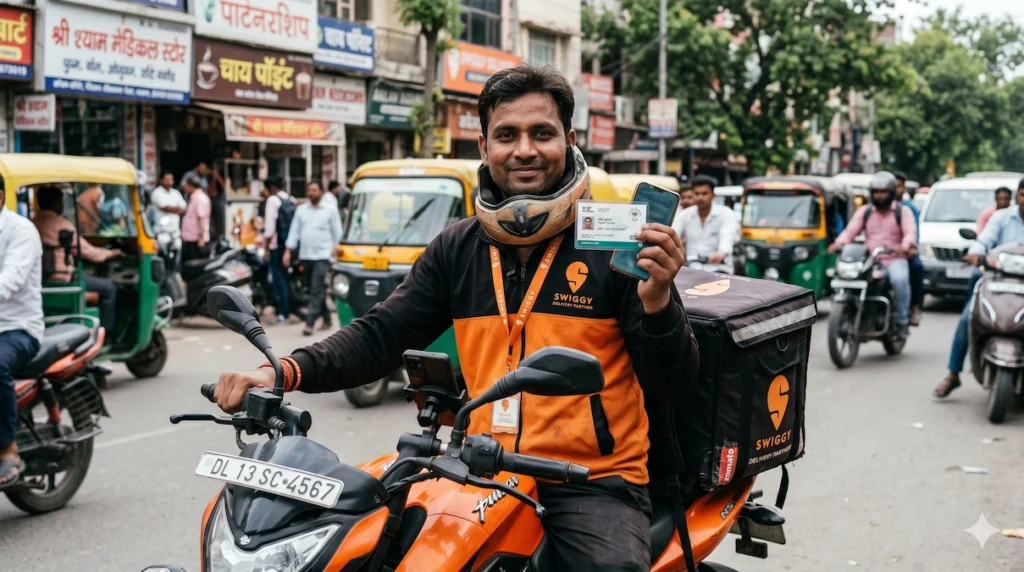
Ayushman Bharat for Gig Workers in 2026
India’s gig economy has grown at a remarkable pace over the last few years. From food delivery partners and cab drivers to freelance designers, writers, and service professionals, millions now earn their living through flexible, platform-based work. Yet for a long time, these workers occupied an uncomfortable middle ground when it came to social security. They were neither part of the formal workforce covered by schemes like ESI and EPFO, nor did they neatly fit into welfare programs designed for traditional low-income households. It is in this context that Ayushman Bharat for gig workers in 2026 assumes significance.
This gap was highlighted by NITI Aayog’s 2021 assessment, which described gig workers as part of India’s “missing middle” in health coverage. In practical terms, that meant many workers who kept cities moving and digital services running had little protection against major medical expenses. That situation is now beginning to change.
Here’s how the expansion of protections for gig and platform workers unfolded:
| Date | Milestone |
| August 2021 | e-Shram portal launched for unorganised worker registration |
| June 2022 | NITI Aayog estimates 7.7 million gig workers; projects 23.5 million by 2029-30 |
| February 2025 | Union Budget 2025-26 announces PM-JAY extension for gig workers |
| March 2025 | MoLE formal notification on platform worker e-Shram registration |
| October 2025 | e-Shram One-Stop Solution upgraded with 14 integrated schemes |
| November 21, 2025 | Code on Social Security 2020 comes into force; gig workers legally defined |
| December 2025 | MoLE notification on social security measures for gig/platform workers |
| 2026 | Full national rollout; all 36 states/UTs implementing AB-PM-JAY |
The key takeaway is straightforward. If you earn through platforms such as Swiggy, Zomato, Ola, Uber, Urban Company, Dunzo, or similar services, or if you work independently as a freelancer, you may now be eligible for up to ₹5 lakh in annual health coverage under PM-JAY. This guide walks you through the eligibility requirements, enrollment process, and the steps needed to access your benefits.
At a Glance: Ayushman Bharat for gig workers 2026
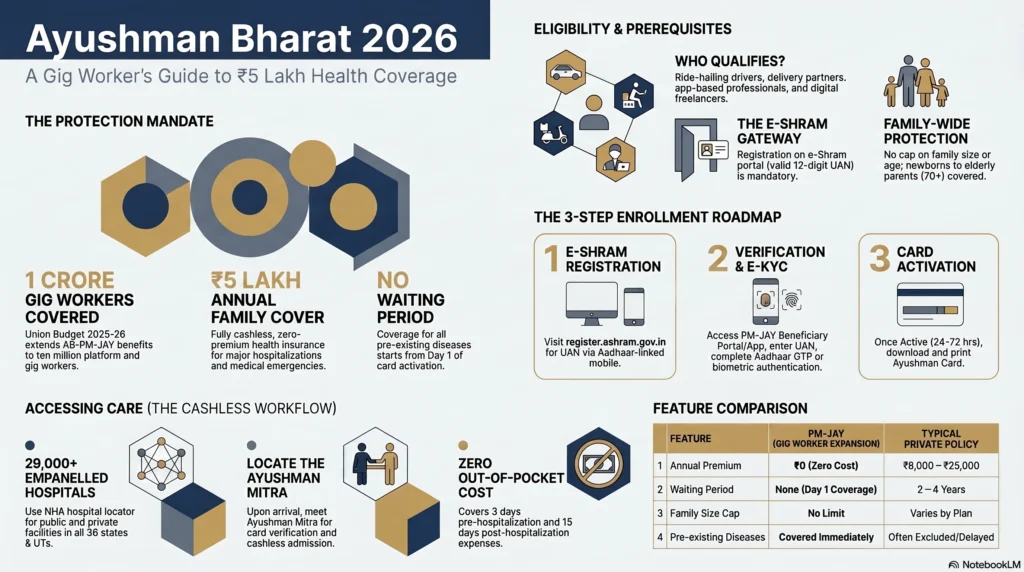
- The Mandate: As part of the 2025-26 Union Budget, the Ayushman Bharat PM-JAY scheme has been officially expanded to cover 1 crore gig and platform workers across India.
- The Core Benefit: A fully cashless, zero-premium health insurance cover of up to ₹5,00,000 per family, per year, specifically for major hospitalizations and medical emergencies.
- Who is Eligible? Ride-hailing drivers (Ola, Uber), delivery partners (Swiggy, Zomato, Dunzo), app-based service professionals (Urban Company), and independent freelancers. Part-time platform workers are fully covered.
- The Mandatory Prerequisite: You must first be registered on the e-Shram portal and hold a valid Universal Account Number (UAN) to be mapped into the PM-JAY beneficiary database.
- Crucial Documents: A mobile-linked Aadhaar card for OTP-based e-KYC and your e-Shram UAN are the primary requirements for digital enrollment.
- Major Advantages: The scheme features no waiting period for pre-existing diseases (coverage starts from day one) and is entirely portable across 29,000+ empaneled public and private hospitals nationwide.
- How to Apply: Eligible workers can self-register online via the PM-JAY Beneficiary Portal, use the Ayushman mobile app, or visit a local Common Service Centre (CSC) for offline, biometric assistance.
What is the Ayushman Bharat PM-JAY Scheme?
| Feature | Detail |
| Full Name | Ayushman Bharat – Pradhan Mantri Jan Arogya Yojana (AB-PM-JAY) |
| Launched | 2018, National Health Authority (NHA) |
| Cover | ₹5 lakh per family per year |
| Treatment Type | Fully cashless and paperless |
| Family Size Cap | None — all members covered |
| Cards Issued (Mar 2025) | 36.9 crore+ |
| Official Portal | https://pmjay.gov.in |
| Beneficiary Portal | https://beneficiary.nha.gov.in |
At its core, Ayushman Bharat PM-JAY is India’s flagship public health insurance programme, designed to protect families from the financial shock of major medical expenses. Instead of worrying about arranging money during a health emergency, eligible beneficiaries can receive treatment at empanelled hospitals without making payments upfront.
The scheme offers up to ₹5 lakh in annual health coverage per family and operates on a fully cashless, paperless model. There are no restrictions on family size, which means all eligible members of a household can be covered under the same benefit limit.
One of the biggest advantages of PM-JAY is its simplicity. When treatment is needed, beneficiaries only have to present their Ayushman Card at a participating hospital. The hospital coordinates directly with the National Health Authority (NHA), which settles eligible claims on the patient’s behalf. That means no reimbursement forms, no lengthy paperwork, and no waiting months to recover expenses.
The scale of the programme is equally significant. By March 2025, more than 36.9 crore Ayushman Cards had been issued across the country, making it one of the world’s largest government-backed healthcare initiatives.
For gig workers entering the scheme in 2026, PM-JAY represents something many have never had before: meaningful hospitalisation coverage that doesn’t depend on an employer, a private insurance premium, or a formal employment contract.
The Union Budget Expansion: Covering 1 Crore Gig Workers
The Union Budget 2025-26 marked a significant turning point for India’s platform workforce. For years, gig workers powered food delivery networks, ride-hailing services, logistics operations, and countless digital marketplaces, yet remained largely outside the country’s formal social security framework. The budget’s announcement changed that by introducing a dedicated set of welfare measures aimed specifically at this growing workforce.
As confirmed in the PIB press release at, the government outlined three key initiatives:
• Registration of platform workers on the e-Shram portal — mandatory, Aadhaar-seeded, with a Universal Account Number (UAN) as portable identity
• Identity cards issued to registered gig workers — official recognition as a labour category for the first time in Indian policy history
• Extension of AB-PM-JAY healthcare benefits to all registered platform workers — ₹5 lakh/year, fully cashless, zero premium
Taken together, these measures do far more than provide healthcare access. They formally acknowledge gig workers as an important part of India’s economic infrastructure, deserving of the same baseline protections that have traditionally been associated with more formal employment.
This recognition is particularly important when viewed against the scale of the sector. India’s gig workforce was estimated at more than 7.7 million workers in 2020-21 and is expected to expand rapidly over the coming decade. As platform-based work becomes increasingly common, extending social security protections is no longer a niche policy issue. It’s a workforce necessity.
The Code on Social Security, 2020 strengthens this shift by requiring aggregator platforms to contribute financially toward worker welfare. In other words, responsibility for social protection is no longer expected to rest solely with the government. Platforms that benefit from gig labour are now expected to play a role in supporting the workers who help generate that value.
Key numbers at a glance
| Metric | Figure | Source |
| Coverage target | 1 crore gig workers | Schemes in India |
| Platform workers registered on e-Shram (Dec 2025) | ~5.12 lakh | Ministry of Labour & Employment |
Total unorganised workers on e-Shram (Nov 2025) | 31.38 crore | Ministry of Labour & Employment |
| e-Shram workers linked to AB-PM-JAY (Nov 2025) | 15.10 crore | Ministry of Labour & Employment |
| PM-JAY health cover | ₹5 lakh/year | National Health Authority |
| Accidental death/disability cover (e-Shram linked) | ₹2 lakh | Schemes of India |
| Platform welfare fund contribution | 1–2% of platform fees | Schemes of India |
To speed up adoption, the Ministry of Labour and Employment launched multiple nationwide registration drives following the Budget announcement. Major platforms including Swiggy, Zomato, Ola, and Uber were directed to support worker registration and meet government deadlines. This is an important distinction because enrolment is no longer being treated purely as an individual worker’s responsibility. Aggregators themselves are expected to participate in the process and ensure compliance.
For gig workers, the message is simple: registration is becoming the gateway to a broader ecosystem of benefits. Health coverage under PM-JAY is the most visible advantage, but it is also part of a much larger move toward formal recognition, portability of benefits, and long-term social security for India’s platform workforce.
Who Qualifies as a “Gig Worker” or “Platform Worker” under the Code on Social Security?
For years, terms like gig worker and platform worker were widely used in conversations about the digital economy, but they lacked clear legal definitions. That changed on November 21, 2025, when the Code on Social Security, 2020 (SS Code) came into force and formally recognised these categories within Indian law. Full gazette text is available here.
This legal recognition matters because eligibility for welfare benefits, including PM-JAY coverage, depends on whether a worker falls within these statutory definitions.
Workers typically covered under the framework include:
• Ola / Uber / Rapido drivers and bike taxi riders
• Swiggy / Zomato / Dunzo / Porter delivery partners
• Urban Company / UrbanClap service professionals
• App-based logistics and last-mile courier workers
• Freelancers earning through digital platforms (design, content, tech)
• Part-time platform workers with any level of engagement
One of the most significant aspects of the Code is that it recognises work arrangements that do not fit the traditional employer-employee model. A worker does not need a permanent contract, fixed office location, or full-time schedule to be included. Even individuals earning part of their income through digital platforms may fall within the scope of these protections.
The framework goes beyond healthcare access. According to Ministry of Labour & Employment, the Code establishes a broader foundation for social security benefits, including:
• Life and disability cover
• Accident insurance
• Health and maternity benefits
• Old-age protection
• A dedicated National Social Security Board for gig/platform workers
• A Social Security Fund financed by platform fee contributions
These provisions reflect a wider shift in how policymakers view gig work. Rather than treating platform workers as a temporary or peripheral segment of the labour market, the law acknowledges them as a distinct workforce with long-term social protection needs.
Additional details on the rights framework can be found here.
For workers who have spent years operating outside traditional employment systems, this recognition is arguably just as important as the benefits themselves. Before healthcare coverage, pensions, or welfare programmes can be extended, workers first need to be recognised within the legal framework. The Social Security Code provides that foundation.
Why Health Insurance is Critical for India’s 7.7+ Million Gig Economy Workers
India’s gig economy is no longer a small or experimental part of the workforce. According to NITI Aayog, the sector employed approximately 7.7 million workers in 2020-21 and is projected to grow to 23.5 million by 2029-30.
That growth tells one story. The other story is risk.
Unlike traditional employees who may receive health insurance through their employers or have access to schemes such as ESI, most gig workers operate without a built-in safety net. Their income often depends on staying active and available for work. When illness or injury strikes, earnings can stop immediately while medical expenses start piling up.
The financial consequences can be severe:
• A single road-accident hospitalisation, which is a particularly relevant risk for delivery riders and cab drivers, can consume several months’ worth of income.
• Most gig workers do not have access to employer-sponsored health insurance, ESI coverage, or corporate group medical plans.
• Hospitalisation expenses in India can easily range from ₹20,000 to well over ₹1 lakh depending on the treatment required.
• Delivery partners and ride-hailing drivers face greater exposure to road accidents and physical injuries simply because of the nature of their work.
• Common illnesses such as dengue, typhoid, and other infectious diseases can result in multi-day hospital stays, leading to both medical bills and lost income.
These concerns are not merely anecdotal. NITI Aayog’s study on India’s “missing middle” highlighted how millions of workers fall outside both government-targeted welfare schemes and employer-sponsored health coverage.
This is where PM-JAY can make a meaningful difference.
For gig workers, the scheme shifts the burden of major hospitalisation expenses away from the individual and onto a publicly funded healthcare framework. Instead of worrying about raising money during a medical emergency, eligible beneficiaries can access treatment through a cashless system.
Key benefits include:
• Zero premium requirements, meaning workers do not need to make monthly or annual payments.
• Immediate coverage without waiting periods for pre-existing conditions.
• Family-wide protection under the same annual coverage limit.
• Access to a nationwide network of more than 29,000 empanelled hospitals across all states and union territories.
In practical terms, PM-JAY functions much like a comprehensive hospitalisation insurance policy that many gig workers might otherwise struggle to afford. A private family floater plan offering similar levels of protection could cost anywhere from ₹10,000 to ₹25,000 annually. Under PM-JAY, that protection is available at no direct cost to eligible beneficiaries.
For someone earning ₹18,000 to ₹25,000 a month through food delivery, ride-hailing, or similar platform work, the value goes far beyond the insurance figure itself. It provides protection against a scenario that many workers quietly worry about: a medical emergency turning into a financial crisis.
Healthcare costs can be stressful for any household. For gig workers whose income often depends on daily participation, access to cashless hospital treatment can be the difference between a temporary setback and a long-term financial blow.
Eligibility Criteria for Gig Workers Under PM-JAY
e-Shram Portal Registration: The Primary Prerequisite
For gig workers, everything starts with e-Shram registration. Think of it as the entry gate to the wider social security ecosystem. Without a valid Universal Account Number (UAN) issued through the e-Shram portal , a gig worker cannot be mapped into the PM-JAY beneficiary database and access the healthcare benefits linked to the scheme.
In simple terms, if you’re not registered on e-Shram, you’re unlikely to appear in the system that determines PM-JAY eligibility under the gig worker expansion.
An e-Shram registration provides:
• A 12-digit Universal Account Number (UAN) that serves as a permanent and portable worker identity
• Aadhaar-linked recognition across multiple government welfare programmes
• Direct integration with schemes such as AB-PM-JAY, PMSBY accident insurance, PMAY housing initiatives, and several other benefits
• Access to a centralised worker dashboard through the e-Sharam portal
The scale of the platform is already substantial. According to the Ministry of Labour & Employment , the e-Shram ecosystem had reached the following milestones by November 2025:
| Category | Registrations |
| Total unorganised workers | 31.38 crore |
| Gig and platform workers | 5.09 lakh |
| e-Shram workers linked to AB-PM-JAY | 15.10 crore |
Workers who have not yet registered can complete the process through the self-registration portal.
Additional scheme information is available at Schemes in India.
What makes e-Shram particularly important is that it is no longer just a registration database. It has evolved into a central welfare access point. Rather than applying separately for every available benefit, workers can use their UAN as a common identifier across multiple schemes.
For gig workers, that means the journey to PM-JAY coverage doesn’t begin at the health insurance portal. It begins with securing a valid e-Shram registration and obtaining a UAN. Once that foundation is in place, the rest of the enrollment process becomes significantly smoother.
Specific Income and Age Limitations for Platform Workers
One of the most common questions gig workers ask is whether there is an income ceiling attached to this PM-JAY expansion. The short answer is no. Unlike some welfare schemes that rely heavily on income thresholds, eligibility for the gig worker extension is primarily linked to occupational status and successful e-Shram registration.
In other words, being recognised as a gig or platform worker and being properly enrolled in the system matter more than a specific monthly earnings figure.
That said, certain standard PM-JAY exclusion rules continue to apply.
You may not be eligible if you are:
• Covered under CGHS or another government-funded health scheme
• A central government, state government, or PSU employee receiving employer-provided healthcare benefits
• An income taxpayer above the applicable annual income threshold
• Covered under Employees’ State Insurance (ESI)
• Part of a household that owns more than 2.5 acres of irrigated land under rural exclusion criteria
• Part of a household that owns a motorised two-, three-, or four-wheeler in states where this remains an exclusion criterion. State-specific rules can be checked here.
A situation that often creates confusion involves workers with multiple income streams.
For example, suppose someone drives for Ola on weekends but also works part-time elsewhere. Whether they qualify depends on the nature of that other employment. If the salaried role provides ESI coverage, the worker would generally be excluded from PM-JAY under the ESI rule.
On the other hand, a worker who combines platform work with another informal occupation remains eligible in most cases. A Swiggy delivery partner who also works as a daily-wage labourer, freelance technician, or self-employed tradesperson would typically continue to qualify, provided none of the exclusion criteria apply.
Age Rules
Another advantage of PM-JAY is its broad age coverage.
• There is no upper age limit for beneficiaries, including senior citizens aged 70 and above.
• There is no minimum age requirement. Newborn children can be covered from birth as part of the enrolled household.
• Elderly parents and in-laws can also be included without restrictions linked to family size.
This family-focused structure is particularly valuable for gig workers, many of whom support multiple generations under one roof. Instead of purchasing separate policies for different family members, eligible households can access protection through a single PM-JAY entitlement.
If you’re unsure about your own status, the fastest option is to use the “Am I Eligible” feature available here. You can verify your eligibility in just a few minutes before starting the enrollment process.
For an additional overview of eligibility and exclusions, see here.
One practical takeaway stands out: most gig workers do not need to worry about age-based restrictions. The more important factors are e-Shram registration, occupational classification, and ensuring that they are not already covered under another government or employer-sponsored healthcare system.
Identifying Your Beneficiary Status via SECC or e-Shram Database
Not everyone becomes eligible for PM-JAY through the same route. Some beneficiaries are covered under the scheme because they were identified through the Socio-Economic Caste Census (SECC) database, while others, particularly gig and platform workers, gain access through their e-Shram registration.
Understanding which category you fall into can save time and make the enrollment process much smoother.
Two Routes to Eligibility
| Route | Who It Applies To | Where to Check |
| SECC 2011 database | Original PM-JAY beneficiaries (rural/urban poor) | National Health Authority |
| e-Shram database | Gig and platform workers (Budget 2025-26 expansion) | National Health Authority |
For most gig workers reading this guide, the e-Shram route will be the relevant pathway. Once your e-Shram registration is completed and linked correctly, your details can be mapped into the PM-JAY beneficiary system.
How to Check If You Are in the Database
The verification process is straightforward and usually takes only a few minutes:
- Visit https://pmjay.gov.in or https://beneficiary.nha.gov.in
- Click on the “Am I Eligible” option
- Enter your Aadhaar-linked mobile number and complete OTP verification
- Provide one of the requested identifiers, such as your Aadhaar number, ration card number, or e-Shram UAN
- Review the result displayed on the screen
If your details have already been mapped successfully, the system will indicate that you are eligible. If not, you may need to complete additional registration steps or wait for database updates to sync across platforms.
Another useful option is the Setu portal, which can be used for eligibility checks, document submissions, and certain enrollment-related services.
It’s worth checking your status before gathering documents or beginning the full application process. A quick eligibility search can help confirm that your records are correctly linked and reduce the chances of running into delays later.
For gig workers who have recently registered on e-Shram, patience may occasionally be required. Database updates do not always happen instantly, and it can take some time for records to appear across connected systems. If your eligibility is not visible immediately after registration, it doesn’t necessarily mean there’s a problem. It may simply mean the mapping process is still underway.
Do Part-Time Freelancers and Delivery Partners Qualify?
Yes. One of the most important aspects of the Social Security Code, 2020 is that eligibility is not limited to full-time platform workers. The law recognises that gig work often exists on a spectrum. Some people rely on it as their primary source of income, while others use it to supplement earnings from other occupations.
As a result, part-time participation does not automatically disqualify someone from receiving benefits.
You generally qualify if:
- Your work falls within the definition of gig work or platform work under the Social Security Code, 2020
- You have successfully registered on e-Shram and received a valid Aadhaar-linked UAN
- You are not already covered under a government-funded healthcare scheme or employer-sponsored health coverage that creates an exclusion
This flexibility is particularly important because many workers move in and out of platform work depending on personal circumstances, local demand, or seasonal opportunities. The system is designed to recognise the nature of the work itself rather than imposing rigid requirements around working hours.
Examples of Workers Who May Qualify
• A weekend Zomato delivery partner who earns additional income through other informal work
• A part-time Ola driver who combines platform earnings with other self-employed activities
• A freelance designer, writer, developer, or creative professional who secures projects through digital marketplaces
• A tailor, technician, beautician, or service provider receiving customer bookings through Urban Company or similar platforms
What matters is that the platform-based work falls within the recognised category and that the worker has completed the required registration process.
Formal notification on platform worker eligibility is available here.
For many freelancers, this is particularly significant. Traditional social security systems have often struggled to accommodate independent professionals who work project-to-project rather than through conventional employment arrangements. The inclusion of platform-connected freelancers signals a broader understanding of how modern work actually functions.
The practical takeaway is reassuring: you do not need to drive full-time for a ride-hailing app or spend every day delivering orders to qualify. If your work falls within the recognised gig or platform ecosystem, and you meet the registration and eligibility requirements, part-time participation alone should not prevent you from accessing PM-JAY benefits.
Pre-Enrollment Checklist: Documents Required for Registration
Before starting your PM-JAY enrollment, it’s worth spending a few minutes gathering the required documents and verifying that your details are accurate. Most application delays happen not because workers are ineligible, but because of missing information, mismatched records, or incomplete verification.
A little preparation upfront can save a lot of frustration later.
Primary Identification: Aadhaar Card and Linking Requirements
Your Aadhaar card sits at the centre of the entire enrollment process. Both e-Shram registration and PM-JAY verification rely heavily on Aadhaar-based authentication, which means your details must be current and your mobile number must be properly linked.
Before you begin, make sure:
• Your Aadhaar number is available and accessible
• Your mobile number is linked to Aadhaar for OTP verification (check at uidai.gov.in)
• Your name and date of birth match across all supporting documents
• Any outdated or incorrect information has been corrected before enrollment
If your mobile number is not linked to Aadhaar, you’ll need to visit an Aadhaar Seva Kendra or a nearby Common Service Centre (CSC) to complete the linking process.
One issue appears far more frequently than most applicants expect: mismatched personal details. A small spelling difference in a name or an incorrect date of birth can trigger verification failures across multiple systems. According to this guide, discrepancies between Aadhaar and supporting documents remain one of the most common causes of enrollment problems.
A quick review now can prevent multiple rounds of corrections later.
Professional Verification: e-Shram UAN (Universal Account Number)
Once registered on e-Shram, you’ll receive a Universal Account Number (UAN). This number acts as your official identity within the government’s unorganised worker database and is the key link connecting your worker status to PM-JAY benefits.
The UAN is automatically generated through e-Sharam portal after successful registration.
If you work with a major platform such as Ola, Uber, Swiggy, or Zomato, there is a possibility that your registration has already been initiated through platform-supported enrollment drives.
In that case:
• Your UAN may already exist
• You can verify your status by logging into the e-Sharam portal using your Aadhaar-linked mobile number
Additional guidance on UAN registration can be found here.
A broader overview of the scheme is available at here.
Because the UAN serves as your official worker identifier, it is worth saving a digital copy and keeping the number easily accessible. You may be asked to provide it during eligibility checks, enrollment, or future welfare scheme applications.
Supplementary Documents: Ration Card, PAN Card, and Income Certificates
Depending on your state and individual circumstances, you may also be asked to provide additional supporting documents.
| Document | When Required | Purpose |
| Ration card / family ration card | Most states | Alternative eligibility identifier (SECC route) |
| PAN card | Some states | Confirms non-income-taxpayer status |
| Income certificate / self-declaration | States with additional income filters | State-level eligibility gate |
| Aadhaar-linked bank account details | All | For complementary cash benefits (PMSBY, PMJJBY) |
| Passport-size photographs | Some states | For card and family member records |
A complete document checklist is available here.
Not every applicant will need every document listed above. Requirements can vary by state and by the eligibility route being used. Still, having these documents ready before you begin can make the process considerably smoother.
Verification of Family Members and Dependents
One of the strongest features of PM-JAY is that coverage extends beyond the primary applicant. The scheme protects the entire household under the same ₹5 lakh annual coverage limit, and there is no cap on family size.
To add family members:
• Collect Aadhaar details for each eligible family member, including spouse, children, parents, and in-laws
• Add them during enrollment or later through the “Add Family Member” feature at the National Health Authority portal.
• Complete individual e-KYC verification for each person
• Provide photographs where required
A useful point to remember is that you do not need to complete every family member’s enrollment on the same day. Once your own registration is active, additional members can be added later as needed.
For many gig workers supporting large or multi-generational families, this flexibility can be especially helpful. Rather than rushing to gather everyone’s documents immediately, you can focus on activating your own enrollment first and then gradually complete the remaining family records.
The goal of this checklist is simple: make sure every key document is in order before you start. Doing so dramatically reduces the likelihood of verification issues and helps ensure a faster path to receiving your Ayushman Card.
Step-by-Step Ayushman Bharat Enrollment Process for Gig Workers
Getting enrolled under PM-JAY is much simpler than many workers assume. Whether you’re comfortable completing the process online, prefer using a mobile app, or would rather visit a Common Service Centre (CSC), there is an option designed to fit different levels of digital access and familiarity.
Before you begin, choose the enrollment method that works best for your situation:
| Method | Best For | Time Required |
| Online — PM-JAY beneficiary portal | Smartphone users with Aadhaar-linked mobile | 15–20 minutes |
| Ayushman mobile app | Delivery/cab workers; small-screen preference | 15–20 minutes |
| Offline — Common Service Centre (CSC) | No smartphone / mobile not linked to Aadhaar | 30–45 minutes |
Let’s walk through each option.
Method 1: Online Registration via the PM-JAY Beneficiary Portal
For most workers, the online portal is the fastest and most convenient route. If your Aadhaar-linked mobile number is active and your e-Shram registration is already complete, you can finish much of the process from home.
Full process documented in this guide.
Step-by-Step Process
- Visit https://beneficiary.nha.gov.in using your browser.
- Select “Beneficiary” as the login type.
- Enter your Aadhaar-linked mobile number, choose OTP authentication, and complete verification.
- Select the appropriate scheme (AB-PM-JAY), sub-scheme (gig/platform worker via e-Shram), state, and district.
- Enter your e-Shram UAN or Aadhaar number. The system will check and confirm your eligibility.
- Review the details displayed on the screen. If additional documents are requested, upload them at this stage.
- Complete the required e-KYC process.
- Once your application is approved and your status becomes “Active”, download your Ayushman Card PDF. Approval generally takes between 24 and 72 hours after successful e-KYC.
The portal has been designed to minimise manual data entry wherever possible. If your records are properly linked across Aadhaar, e-Shram, and PM-JAY databases, much of the information will already be pre-filled.
Method 2: Enrollment Through the Ayushman Mobile App
For gig workers who spend most of their day on the move, the mobile app can be a practical alternative to the desktop portal.
Getting started is straightforward:
• Search for “Ayushman Bharat” or “PM-JAY” on the Google Play Store or Apple App Store
• Log in using the same Aadhaar-linked mobile number used for the beneficiary portal
• Follow the enrollment process, which mirrors the website workflow
• Receive notifications when your application status changes
The app offers a few advantages that are especially useful for platform workers:
• Designed for smaller screens and mobile-first use
• Easy access to your card and QR code during hospital visits
• Quick OTP-based re-authentication for future logins
• Status updates delivered directly to your phone
Further details available here.
For workers constantly travelling between deliveries, rides, or service appointments, having the card accessible on a phone can be more convenient than relying on printed documents alone.
Method 3: Offline Registration at Common Service Centres (CSCs)
Not everyone has access to a smartphone, reliable internet connectivity, or an Aadhaar-linked mobile number. That’s where Common Service Centres become particularly valuable.
If you choose the offline route, carry the following:
• Original Aadhaar card (or acknowledgement slip)
• Mobile number for communication purposes
• Ration card
• e-Shram UAN card, if already available
• Income certificates, where applicable under state-specific requirements
At the CSC, the operator will:
• Enter your application details into the beneficiary portal
• Complete biometric verification through fingerprint or iris authentication if required
• Assist with document uploads and verification
• Print your Ayushman Card after approval
You can locate your nearest CSC through the National Health Authority portal or by contacting your local district administration.
Some states also provide dedicated resources and locator tools through their own portals, such as the one in Uttar Pradesh.
Full offline process available in this guide.
For workers who are less comfortable navigating government websites or digital verification systems, the CSC route often provides peace of mind. Having a trained operator guide the process can reduce mistakes and speed up resolution if any documentation issues arise.
The important thing to remember is that all three enrollment methods ultimately lead to the same outcome: successful registration, e-KYC completion, and activation of your Ayushman Card. The best option is simply the one that fits your circumstances.
Completing e-KYC (Know Your Customer) and Aadhaar Authentication
e-KYC is the stage that officially connects your identity to your PM-JAY record. You can think of it as the final verification checkpoint before your Ayushman Card can be approved and activated.
No matter which enrollment method you choose, e-KYC is mandatory. Without it, your application cannot move forward.
The process confirms that the information in your PM-JAY application matches the details stored in your Aadhaar records. This helps prevent duplicate registrations, identity errors, and fraudulent claims while ensuring that benefits reach the correct beneficiary.
Two e-KYC Modes
| Mode | How It Works | Where Available |
| OTP-based | OTP sent to Aadhaar-registered mobile | Online portal / mobile app |
| Biometric | Fingerprint or iris scan | CSC / Ayushman Mitra kiosk at hospital |
For most applicants, OTP-based verification is the quickest option. If your Aadhaar-linked mobile number is active, you can complete the process in just a few minutes from your phone or computer.
Biometric verification serves as an alternative for workers who do not have access to their registered mobile number or encounter OTP-related issues. In such cases, a CSC operator or Ayushman Mitra can assist with fingerprint or iris-based authentication.
What Happens During e-KYC?
During verification, the system will:
• Confirm your name, date of birth, gender, and address against Aadhaar records
• Capture a live photograph for identity validation
• Create an application status that initially appears as “Pending”
• Forward the record for backend verification and approval
Once this stage is completed successfully, your application enters the review process.
Many applicants become concerned when they see the word “Pending” immediately after submission. In most cases, this is completely normal. The status simply indicates that the system is validating information across multiple databases before activating the card.
After verification, the status typically changes from “Pending” to “Active” within one to three working days.
A detailed walkthrough of the e-KYC process is available here.
For gig workers, this stage is worth completing carefully rather than rushing through. A missed OTP, incorrect personal detail, or mismatched Aadhaar record can lead to avoidable delays. Taking a few extra minutes to verify everything before submission often saves much more time later.
Once e-KYC is approved, you’re essentially on the home stretch. The next step is activating, downloading, and storing your Ayushman Card for future use.
How to Download and Print Your Ayushman Card
Approvals and Waiting Periods: What Happens After e-KYC?
Once you’ve completed e-KYC, the waiting period begins. Fortunately, this stage is usually much shorter than many applicants expect.
Behind the scenes, the system performs a series of checks across Aadhaar, e-Shram, and PM-JAY databases to confirm that all records align correctly. During this period, your application status will generally remain marked as “Pending”.
Here’s what the typical timeline looks like:
| Stage | Expected Time |
| e-KYC submitted | Day 0 |
| NHA backend verification (e-Shram ↔ PM-JAY ↔ Aadhaar cross-check) | 24–72 hours |
| Status changes “Pending” → “Active” | Day 1–3 |
| Peak campaign periods (high volume) | Up to 5 working days |
| Card PDF available for download | Immediately on “Active” |
In most cases, approval happens within a few days. However, during large enrollment drives or periods of unusually high application volume, processing may take slightly longer.
The important thing is not to panic if your card isn’t available immediately after e-KYC. A short waiting period is a normal part of the verification process.
Step-by-Step Ayushman Card PDF Download Process
Once your status changes to “Active”, you can download your Ayushman Card right away.
Full process available here.
Follow these steps:
- Log in to https://beneficiary.nha.gov.in using your Aadhaar-linked mobile number.
- Open your family beneficiary record.
- Locate the relevant beneficiary and click “Download Card”.
- Save the PDF to your device. The card contains your name, Ayushman ID, and a QR code linked to your beneficiary record.
- Print a colour copy and laminate it if possible. This can be particularly useful for gig workers who spend long hours on the road and may need quick access during an emergency.
- Store a digital copy in DigiLocker or within the Ayushman Bharat mobile app so that it’s always accessible.
While the digital version is generally sufficient, having both physical and digital copies is a sensible precaution. Phones run out of battery. Internet connections fail. Documents get misplaced. Keeping multiple copies ensures you can access your benefits when you need them most.
For delivery partners, drivers, and other mobile workers, saving the card in more than one place is a small step that can make a big difference during an unexpected hospital visit.
Troubleshooting “Status Not Generated” or “Pending” Errors
Not every application moves through the system perfectly on the first attempt. Occasionally, applicants encounter status errors or verification delays. Most of these issues are relatively common and can be resolved without restarting the entire process.
| Error | Likely Cause | Resolution |
| “Name not found in database” | e-Shram record not yet mapped to PM-JAY | Visit CSC; re-submit via Setu portal |
| “Aadhaar mismatch” | Name/DOB discrepancy between e-Shram and Aadhaar | Correct profile at the e-Sharam portal, then retry |
| “e-KYC failed” | Mobile number not linked to Aadhaar | Complete mobile-Aadhaar linking; use biometric at CSC as alternative |
| “Pending” for 7+ days | High queue volume or backend escalation needed | Call PM-JAY helpline 14555 with your application reference number |
Full troubleshooting guide available here.
One recurring theme behind many application issues is data consistency. Even a minor mismatch between records can trigger delays. If you encounter a problem, start by comparing your Aadhaar details, e-Shram profile, and any supporting documents to ensure they all match exactly.
Most enrollment hurdles are administrative rather than eligibility-related. Once the underlying record issue is corrected, applications generally move forward without major complications.
At this stage, your goal is simple: get the card activated, download it, and keep it readily available. Once that’s done, you’re ready to start using the healthcare benefits attached to your PM-JAY coverage.
Understanding Your Healthcare Benefits (₹5 Lakh Coverage)
Getting enrolled is only half the story. To make the most of PM-JAY, gig workers need to understand exactly what the scheme covers, where its strengths lie, and where its limitations begin.
The headline benefit is clear: up to ₹5 lakh in annual health coverage per family. But the real value becomes apparent when you look at the range of treatments, procedures, and services that fall under that protection.
What Medical Procedures and Specialities Are Covered?
PM-JAY provides access to more than 1,670 Health Benefit Packages (HBPs) spanning over 25 medical specialities. Full compendium available here.
Some of the most important specialities covered include:
| Speciality | What Is Covered |
| Trauma & Emergency | Road accident injuries, fractures, ICU care, trauma surgery |
| Cardiology | Bypass surgery, angioplasty, heart valve procedures |
| Oncology | Cancer surgery, chemotherapy, radiation therapy |
| Orthopaedics | Knee replacement, hip replacement, spinal surgery |
| Nephrology | Dialysis and kidney-related procedures |
| Neurosurgery | Brain surgery and spinal cord interventions |
| Ophthalmology | Cataract surgery and retinal treatments |
| General Surgery | Appendicitis, hernia repair, gallbladder removal |
| Neonatology | Newborn intensive care and related treatment |
For gig workers, some of these benefits are particularly relevant.
Delivery partners, bike riders, and cab drivers spend a significant portion of their working lives on the road. Unfortunately, that also means greater exposure to accidents and physical injuries. Under PM-JAY, treatment for road traffic injuries, fractures, emergency surgeries, ICU admissions, burns, and serious trauma can be covered through the scheme.
This is where the programme can have an immediate financial impact. A serious accident can generate hospital bills running into lakhs of rupees. Without coverage, those costs often fall entirely on the worker and their family. PM-JAY helps absorb that risk.
Pre-Hospitalization and Post-Hospitalization Expenses
Many people assume health insurance only applies once a patient is admitted to a hospital. PM-JAY goes a step further by covering certain expenses that occur before and after hospitalisation.
The scheme generally includes:
• Up to 3 days of pre-hospitalisation expenses, including diagnostic tests, consultations, and prescribed medicines connected to the upcoming admission
• Up to 15 days of post-hospitalisation care, including follow-up consultations, medicines, wound care, and recovery-related treatment
This can be particularly useful for conditions that require extensive testing before admission or ongoing monitoring after discharge.
For patients dealing with complex illnesses, these additional benefits can reduce a meaningful portion of out-of-pocket expenses that would otherwise accumulate around the hospital stay itself.
Pre-Existing Disease Coverage from Day One
This is arguably one of the strongest features of PM-JAY for gig workers.
Unlike many private health insurance policies, PM-JAY does not impose a waiting period for pre-existing medical conditions.
| Feature | PM-JAY | Typical Private Policy |
| Pre-existing disease waiting period | None — Day 1 coverage | 2–4 years |
| Premium | Free (government-funded) | ₹8,000–₹25,000/year |
| Sum insured | ₹5 lakh/family/year | Varies |
| Family size cap | None | Depends on plan |
This means that once your Ayushman Card becomes active, you can access eligible treatment for conditions such as diabetes, hypertension, chronic kidney disease, and other pre-existing illnesses without waiting years for coverage to begin.
This benefit is confirmed in this guide.
For workers who may have delayed buying private insurance because of cost, age, or existing medical conditions, this provision can be especially valuable. A pre-existing diagnosis does not automatically place treatment out of reach.
Exclusion List: What PM-JAY Does Not Cover
While PM-JAY offers substantial hospitalisation coverage, it is not an all-purpose healthcare plan. Understanding its exclusions is just as important as understanding its benefits.
PM-JAY does not generally cover:
• OPD (outpatient) consultations and medicines that are not linked to hospitalisation
• Cosmetic and aesthetic procedures such as rhinoplasty, hair transplants, or cosmetic weight-loss surgery
• Fertility treatments, including IVF and related procedures
• Certain aspects of organ transplantation, including the donor side of the process
• Substance abuse rehabilitation programmes
• Self-inflicted injuries
• Routine dental care that does not require inpatient admission
• Routine vision correction, including spectacles and contact lenses
• Injuries sustained during criminal activity
To make this easier to understand, here’s a practical breakdown:
| Healthcare Need | PM-JAY Cover? | Alternative |
| Emergency hospitalisation | Yes | — |
| Major surgery | Yes | — |
| Dialysis for kidney failure | Yes | — |
| Dengue / typhoid inpatient treatment | Yes | — |
| Road accident trauma | Yes | — |
| OPD doctor visits | No | Health and Wellness Centres (free) |
| Daily medicines | No | Jan Aushadhi Kendra (subsidised) |
| Dental checkups | No | Government dental clinics |
| Spectacles | No | Government optical schemes |
| Maternity-related OPD care | No | PMJSY / JSSK schemes |
The practical takeaway is that PM-JAY is designed primarily to protect families against major hospitalisation expenses. It excels at reducing the financial impact of surgeries, emergencies, serious illnesses, and inpatient treatment.
For routine healthcare needs such as outpatient consultations, prescription medicines, preventive care, and dental services, workers may need to rely on complementary government programmes, Health and Wellness Centres, or personal healthcare spending.
Those looking for broader OPD-focused protection may also consider supplementary private insurance options available through providers listed here.
Viewed in the right context, PM-JAY performs the role it was built for extremely well: shielding families from the kind of hospital bills that can destabilise finances overnight. For gig workers, that protection alone can be transformative.
How to Avail Cashless Treatment at Empanelled Hospitals
One of the biggest advantages of PM-JAY is that eligible beneficiaries do not need to arrange large sums of money before receiving treatment. The scheme operates on a cashless basis, meaning approved hospital expenses are settled directly between the hospital and the National Health Authority (NHA).
For gig workers, this can be especially important during emergencies. Whether it’s a road accident, an unexpected surgery, or a serious illness requiring hospitalisation, the focus can remain on treatment rather than finding funds at short notice.
Finding Public and Private Empanelled Healthcare Providers (EHCPs)
A health insurance card is only useful if there are hospitals where it can be used. Fortunately, PM-JAY’s network has expanded into one of the largest healthcare provider systems in the country.
As of 2025:
| Type | Count |
| Total empanelled hospitals nationwide | 29,000+ |
| States and UTs with full PM-JAY implementation | 36 |
| Hospital locator | https://pmjay.gov.in |
The nationwide rollout reached a major milestone when West Bengal became the 36th state/UT to implement AB-PM-JAY, completing full national coverage.
How to Find the Nearest Empanelled Hospital
The process is simple:
- Visit https://pmjay.gov.in and select “Find Hospital”
- Choose your state, district, and required medical speciality
- Browse the list of participating public and private hospitals
- Review contact information and location details before visiting
You can also search through the beneficiary portal using the hospital locator tools available there.
For gig workers who frequently travel between cities, it is a good idea to bookmark the hospital locator page. In an emergency, knowing where the nearest empanelled facility is can save valuable time.
The Role of the Ayushman Mitra at the Hospital
Every empanelled hospital has a designated representative known as an Ayushman Mitra.
Think of this person as your guide through the PM-JAY admission process.
Their responsibilities include:
• Verifying your Ayushman Card and beneficiary details
• Confirming your identity through the NHA system
• Initiating treatment pre-authorisation requests
• Handling documentation and claims processing
• Coordinating with hospital departments and billing teams
• Helping resolve administrative issues during admission
For many beneficiaries, the Ayushman Mitra is the first point of contact after arriving at the hospital.
A practical tip for gig workers: if you are admitted during an emergency or accompanying a family member for treatment, ask for the Ayushman Mitra as early as possible. Doing so can help speed up verification and ensure your PM-JAY benefits are activated without unnecessary delays.
They are typically located near the reception area, admission desk, or emergency department.
Admission to Discharge: The Cashless Claim Workflow
Many first-time beneficiaries worry that cashless treatment sounds more complicated than it actually is. In reality, the process is designed to be straightforward.
Here’s how a typical PM-JAY cashless claim works:
Arrive at an empanelled hospital
↓
Present your Ayushman Card and have the QR code scanned
↓
Identity verified through OTP or biometric authentication
↓
Hospital submits pre-authorisation request to NHA
↓
Approval received for eligible treatment
↓
Patient admitted and treatment begins
↓
Hospital bills covered expenses directly to NHA
↓
Patient discharged after treatment
↓
NHA settles the claim with the hospital
Throughout this process, eligible patients are not expected to make payments for covered services. Costs such as surgery, room charges, medicines, diagnostic tests, anaesthesia, and other approved treatment expenses are handled through the scheme.
Routine cases are often approved quickly, while more complex procedures may require additional review before authorisation is granted.
For gig workers, this cashless structure removes one of the most stressful aspects of medical emergencies. Instead of scrambling to arrange funds, borrow money, or liquidate savings, the focus can remain where it belongs: receiving treatment and recovering.
In many ways, this is where the practical value of PM-JAY becomes most visible. Enrollment is important. Eligibility checks matter. But the real benefit is knowing that when a serious health event occurs, access to care does not depend entirely on the cash available in your pocket that day.
Linking ABHA (Ayushman Bharat Health Account) with PM-JAY
As India’s healthcare system becomes increasingly digital, PM-JAY is being supported by another important initiative: the Ayushman Bharat Digital Mission (ABDM). While PM-JAY focuses on healthcare coverage, ABDM focuses on healthcare records, creating a digital framework that allows medical information to move with patients wherever they go.
For gig workers, who often relocate, travel across cities, or work in multiple states, this can be particularly useful.
What is the Ayushman Bharat Digital Mission (ABDM)?
The Ayushman Bharat Digital Mission (ABDM) aims to build a connected healthcare ecosystem where individuals can maintain a secure digital health identity and access their medical records more easily across different healthcare providers.
The long-term vision is simple: reduce paperwork, improve continuity of care, and make health information more accessible when it is needed most.
Some of the key benefits include:
• A single health identity that can be used across hospitals, laboratories, pharmacies, and healthcare providers
• Digital prescriptions and treatment histories that help doctors make better-informed decisions
• Easier sharing of medical records between healthcare facilities
• Reduced duplication of tests and diagnostic procedures
• Future integration with insurance systems, preventive healthcare programmes, and advanced digital health services
For patients who receive treatment in different cities over time, having a portable digital health record can make a significant difference.
ABHA vs Ayushman Card — What is the Difference?
Many people assume that an ABHA number and an Ayushman Card are the same thing. They are related, but they serve different purposes.
| ABHA (Health Account) | Ayushman Card (PM-JAY) | |
| Purpose | Universal health identity + digital records | Health insurance card |
| Issued by | ABDM / NHA | NHA |
| Format | 14-digit number | Physical / digital card with QR code |
| Mandatory? | No (voluntary) | Yes, for cashless PM-JAY treatment |
| Links to | Hospitals, labs, pharmacies across India | PM-JAY empanelled hospitals |
| Cost | Free | Free |
A simple way to think about it is this:
Your Ayushman Card helps you access healthcare benefits under PM-JAY.
Your ABHA number helps organise and manage your healthcare records.
One provides insurance access. The other provides a digital health identity.
Used together, they create a more seamless healthcare experience.
For example, when treatment is received at a PM-JAY hospital and the patient’s ABHA account is linked, those medical records can become part of a long-term digital health history that may be useful during future consultations or emergencies.
How Gig Workers Can Create a 14-Digit ABHA Number
Creating an ABHA number is free and usually takes only a few minutes.
Follow these steps:
- Visit https://healthid.ndhm.gov.in
- Click “Create ABHA Number”
- Choose Aadhaar or driving licence as your identification document
- Complete OTP-based verification
- Receive your 14-digit ABHA number instantly
- Download and save your digital ABHA card
Once the account has been created, you can connect it to your PM-JAY profile.
Linking ABHA to PM-JAY
• Log in to https://beneficiary.nha.gov.in
• Select the “Link ABHA” option
• Enter your 14-digit ABHA number
• Complete OTP verification
• Confirm the linking request
The process typically takes only a few minutes if your records are already verified.
Centralizing Medical Records for Easy Access
This is where ABHA becomes especially valuable for gig workers.
Unlike many traditional employees who may spend years working in the same city, gig workers often move where opportunities exist. A delivery partner might spend several months in Bengaluru before returning to Bihar. A driver could relocate temporarily to another state during peak demand periods. Freelancers frequently travel between locations as projects change.
In these situations, maintaining consistent healthcare records can become challenging.
ABHA helps address that challenge by:
• Keeping treatment histories accessible across locations
• Allowing participating healthcare providers to access relevant medical information when authorised
• Reducing the need to repeatedly carry paper files and prescriptions
• Supporting continuity of care for chronic conditions such as diabetes or hypertension
• Creating a long-term digital health record that remains available regardless of location
As the ABDM ecosystem continues to expand, ABHA is expected to play a larger role in healthcare delivery, record management, and digital service integration.
For gig workers, linking an ABHA account is not mandatory for PM-JAY coverage. However, it is one of those small steps that can provide meaningful convenience in the future. The Ayushman Card protects you financially during hospitalisation. The ABHA account helps ensure that your healthcare information travels with you wherever work takes you.
Common Challenges Faced by Platform Workers and Solutions
Even with a nationwide rollout and simplified enrollment systems, not every application proceeds without friction. Many gig workers encounter issues that have less to do with eligibility and more to do with data mismatches, system synchronisation delays, or verification errors across government databases.
The good news is that most of these problems are fixable once you understand what’s causing them.
Issues with Algorithmic Disconnects and Identity Mismatches
A common challenge arises when information stored across different systems doesn’t line up perfectly. Since PM-JAY relies on data from Aadhaar, e-Shram, and other government databases, even a minor discrepancy can temporarily block enrollment or delay card activation.
Here are some of the most frequently reported issues and their solutions:
| Problem | Root Cause | Fix |
| e-Shram UAN not recognised in PM-JAY portal | Database mapping delay | Wait 48 hours and retry; escalate via https://setu.pmjay.gov.in/setu/ |
| Name mismatch across documents | Spelling variation in Aadhaar vs ration card | Update e-Shram profile at https://eshram.gov.in to match Aadhaar exactly |
| DOB mismatch | Different date formats or records | Correct details on e-Shram portal; visit CSC if Aadhaar correction is needed |
| Card stuck on “Pending” for more than 7 days | Backend verification queue | Call 14555 with your application reference number |
| Biometric failure at CSC | Fingerprint quality or skin condition issues | Request iris authentication as an alternative |
Parliament has also received representations concerning broader beneficiary-identification challenges within welfare systems. Relevant references can be found here.
A practical lesson emerges from many of these cases: consistency matters. Before beginning enrollment, it’s worth checking that your name, date of birth, mobile number, and other personal details match across all major documents. A few minutes spent reviewing records can prevent days of troubleshooting later.
Another point worth remembering is that not every error message signals a serious problem. Sometimes systems simply need time to sync information between databases. If you’ve recently completed e-Shram registration, a temporary delay in PM-JAY recognition may be part of the normal update process rather than a sign that something is wrong.
Migrant Gig Workers: Portability of Ayushman Benefits Across States
One of PM-JAY’s most valuable features for platform workers is portability.
Gig work is often highly mobile. Drivers relocate for better demand. Delivery partners move between cities. Freelancers frequently take assignments across different regions. Traditionally, this kind of movement has complicated access to welfare benefits.
PM-JAY addresses that issue by making coverage fully portable across all 36 states and union territories.
What this means in practice:
• Your ₹5 lakh annual health cover remains valid regardless of where you’re working in India.
• You can visit any empanelled hospital within the PM-JAY network, even if it is located in a different state from where you originally enrolled.
• Treatment eligibility is verified through the central NHA system rather than a state-specific enrollment process.
• There is no need to complete a fresh PM-JAY registration every time you relocate.
For workers whose livelihoods depend on mobility, this flexibility is particularly important. A delivery rider from Bihar working temporarily in Bengaluru should have the same ability to access treatment as someone enrolled and residing locally.
To make portability work smoothly, consider these best practices:
• Keep your current working-city information updated in your e-Shram profile.
• Save the PM-JAY hospital locator for quick access when travelling
• Store your Ayushman Card digitally through DigiLocker so it remains available even if the physical copy is lost
The December 2025 MoLE notification reinforces this portability framework and encourages platforms to keep worker registration records updated.
For many gig workers, portability may be one of the scheme’s most underrated benefits. Healthcare access should not disappear simply because work opportunities require a move to another city. PM-JAY is designed to travel with the worker, not remain tied to a single location.
Helpline Information (14555) and Grievance Redressal Mechanisms
Even with careful preparation, situations may arise where you need assistance. Whether you’re facing enrollment delays, eligibility issues, profile errors, or hospital-related concerns, several support channels are available.
Quick reference guide:
| Issue | Contact | Channel |
| PM-JAY card, hospital, claim issues | 14555 (24/7, multilingual) | Toll-free call |
| e-Shram UAN, profile, scheme mapping | 14434 | Toll-free call |
| e-Shram self-service updates | e-Shram portal | Online portal |
| PM-JAY escalations | https://setu.pmjay.gov.in/setu/ | Online grievance |
| Wage/termination/social security complaints | Samadhan portal | Online portal |
| Formal government grievance | CPGRAMS | Online portal |
Additional resources on scheme-level grievance mechanisms can be found here.
When contacting support, keep important information ready, including:
• Aadhaar number
• e-Shram UAN
• Application reference number
• Registered mobile number
• Screenshots or copies of any error messages
Providing these details upfront can help support teams resolve issues more efficiently.
The broader takeaway is encouraging: while enrollment challenges can occur, workers are not expected to navigate them alone. Dedicated helplines, grievance portals, CSCs, and support systems exist specifically to help resolve problems and ensure eligible beneficiaries receive their entitlements.
FAQ: Ayushman Bharat for gig workers 2026
To enroll, platform workers must complete mandatory registration on the e-Shram portal. Once you secure your 12-digit Universal Account Number (UAN), your profile is mapped to the National Health Authority database. You can then verify your eligibility and finalize Aadhaar-based e-KYC on the PM-JAY beneficiary portal or mobile app to generate your card.
Yes, part-time gig workers are fully eligible. The 2026 expansion recognizes platform-based workers—including Swiggy, Zomato, Uber, and Urban Company partners—without requiring a full-time contract or minimum daily hours, provided they maintain an active e-Shram registration.
The scheme grants up to ₹5,00,000 per family, per year for secondary and tertiary hospitalizations. This cashless benefit covers major medical procedures, trauma emergencies, and all pre-existing diseases from day one, with no caps on family size or beneficiary age.
The Future of Social Security in India’s Gig Economy
Integrating Welfare Schemes and the Road Ahead
The expansion of AB-PM-JAY for gig workers is not an isolated policy move. It is part of a much broader effort to build a connected social security ecosystem for workers who have traditionally operated outside the formal employment structure.
At the centre of that ecosystem is e-Shram. What began as a registration platform has evolved into a gateway for multiple welfare programmes, allowing workers to access a growing range of benefits through a single identity and dashboard.
For registered gig workers, that means access to more than just healthcare coverage.
| Scheme | Benefit | Status |
| AB-PM-JAY | ₹5 lakh/year hospitalisation insurance | Active — 15.10 crore linked |
| PMSBY (e-Shram linked) | ₹2 lakh accidental death/disability cover | Active |
| PMJJBY | ₹2 lakh life insurance cover | Active |
| One Nation One Ration Card (ONORC) | Ration portability across states | Active — 24.15 crore linked |
| PM Awas Yojana – Gramin | Priority access to rural housing | Active |
| PM Awas Yojana – Urban | Priority access to urban housing | Active |
| PM Matru Vandana Yojana | Maternity benefit scheme | Active |
| MGNREGS | Employment guarantee for rural workers | Active |
| PM Kisan Samman Nidhi | Farmer income support | Active |
| 5 further schemes | Widow pension, disability pension, livelihood support | Active |
Source: PIB scheme data
Taken together, these programmes represent something that gig workers have often lacked: a coordinated support system rather than a collection of disconnected welfare initiatives.
The direction of policy also suggests that this is only the beginning.
Several developments are expected to shape the next phase of gig worker welfare:
• The Code on Social Security 2020 provides for a National Social Security Board dedicated to gig and platform workers. Its role will include guiding welfare policies, allocating resources, and overseeing implementation.
• Aggregator platforms such as Ola, Uber, Swiggy, and Zomato are legally required to contribute 1–2% of their platform fees toward worker welfare under the Social Security Code framework.
• Parliament’s Standing Committee on Labour has advocated stronger protections, including regulated algorithmic management, platform grievance mechanisms, and a gradual move toward benefit parity with more traditional employment structures. Further discussion is available here.
• PM Vishwakarma provides skill development and financial support for eligible artisan workers.
• PM Internship creates opportunities for younger workers to gain formal workplace exposure.
• The Maandhan pension scheme offers a voluntary retirement savings pathway for self-employed and informal workers.
• The Deen Dayal Upadhyaya Antyodaya Yojana and Aajeevika programme support livelihoods, self-help groups, and community-based economic development.
Viewed collectively, these initiatives point toward a larger shift in how gig work is understood in India. The conversation is gradually moving away from treating platform workers as temporary participants in the economy and toward recognising them as a permanent workforce segment deserving long-term protections.
The transition will not happen overnight. Implementation challenges, coverage gaps, and administrative hurdles will continue to exist. Yet the overall trajectory is increasingly clear: gig workers are becoming more visible within India’s labour and social security framework than ever before.
Final Thoughts on Empowering the Platform Workforce
For gig workers, the enrollment process can ultimately be reduced to three practical steps:
• Step 1: Register on e-Shram and obtain your UAN
• Step 2: Enrol through PM-JAY, complete e-KYC, and download your Ayushman Card
• Step 3: Create and link an ABHA account to build a portable digital health record
If you encounter difficulties during the process:
• Call the PM-JAY helpline at 14555 for round-the-clock assistance
• Visit your nearest Common Service Centre (CSC)
• Submit grievances through the Setu portal
If your platform has not yet completed the required worker registration steps:
• Direct the aggregator to the Ministry of Labour and Employment portal
• Refer to the December 2025 MoLE notification
At its heart, this initiative is about recognising the people who keep large parts of the modern economy running. Delivery partners bring essentials to homes. Drivers support urban mobility. Freelancers power digital businesses behind the scenes. Platform workers have become an integral part of everyday life, yet for years many of them lacked access to even basic social protections.
The 2026 PM-JAY expansion represents a meaningful step toward closing that gap.
A ₹5 lakh health cover. No premiums. No waiting period for pre-existing conditions. Access to cashless treatment at more than 29,000 hospitals across the country.
For many workers and families, that protection could prove invaluable when facing an unexpected medical emergency.
The enrollment process is relatively straightforward. The benefits can be substantial. If you’re eligible, there’s little reason to postpone registration.
Disclaimer
This article reflects scheme guidelines as of June 2026. Verify current eligibility criteria and operational details at https://pmjay.gov.in and https://beneficiary.nha.gov.in, as government schemes are updated periodically. This is not legal or financial advice.


Discussion (4)
Leave a Reply