
Ayushman Bharat Hospital Denied Treatment? How to Report Hospital Extortion to the State Authority
What to Do When Ayushman Bharat Hospital Treatment is Denied?
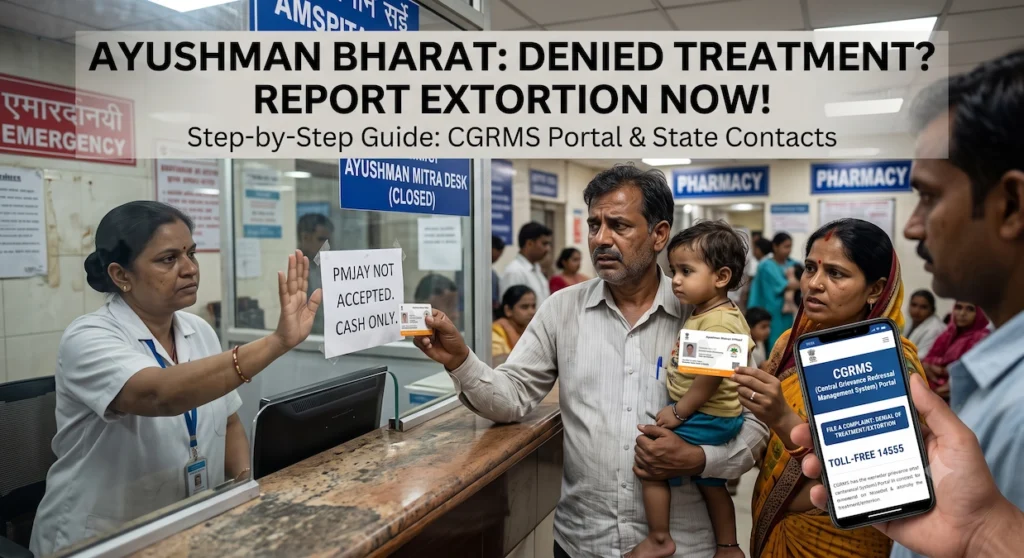
A family arrives at an empanelled hospital carrying a valid Ayushman card, facing a genuine medical emergency, and expecting the cashless treatment the scheme promises. Instead, they’re told the scheme is “temporarily unavailable,” or asked to pay a hefty deposit before a bed can even be confirmed. Situations like these happen far more often than they should. The biggest reason is simple: many beneficiaries do not realise that the legal responsibility rests with the hospital, not the patient. Herein comes the issue of when an Ayushman Bharat hospital denies treatment.
Ayushman Bharat, officially known as Pradhan Mantri Jan Arogya Yojana (AB-PMJAY), is not a goodwill gesture that hospitals can choose to honour whenever it suits them. Hospitals that join the scheme accept binding conditions as part of their empanelment.
Those obligations are backed by a structured grievance system that starts at the hospital help desk and extends through district authorities, state health agencies, the National Health Authority’s anti-fraud framework, and, where necessary, consumer courts or even the police. Every stage is either free or inexpensive to access, and each one creates an official record that hospitals cannot simply dismiss or explain away.
This guide explains that process step by step. You’ll learn what your rights are under PMJAY, what to do immediately if you’re denied treatment or asked for money, how to file a complaint that can be tracked, how to use the Right to Information Act to obtain hospital records, and what legal remedies are available if you’ve already paid out of pocket or suffered harm because a hospital failed to meet its obligations.
This article reflects publicly available Ayushman Bharat–PMJAY guidelines, portal information, and government data current as of July 2026, and is intended for general awareness rather than as legal, medical, or financial advice specific to any individual case. Portal URLs, toll-free numbers, fee structures, and statutory timelines are set by the National Health Authority, state health agencies, and other government bodies, and can change, so beneficiaries should verify current details directly with the relevant portal or helpline before acting on them.
For disputes involving denial of emergency care, large refund claims, suspected fraud, or serious medical harm, readers are encouraged to consult a qualified advocate or approach the nearest Legal Services Authority for personalised guidance.
At A Glance: Ayushman Bharat Hospital Denied Treatment?
- Mandatory Cashless Treatment: Hospitals empanelled under AB-PMJAY are legally bound to provide cashless, paperless treatment up to ₹5 lakh per year. Refusing eligible patients or demanding cash for covered packages violates their empanelment contract.
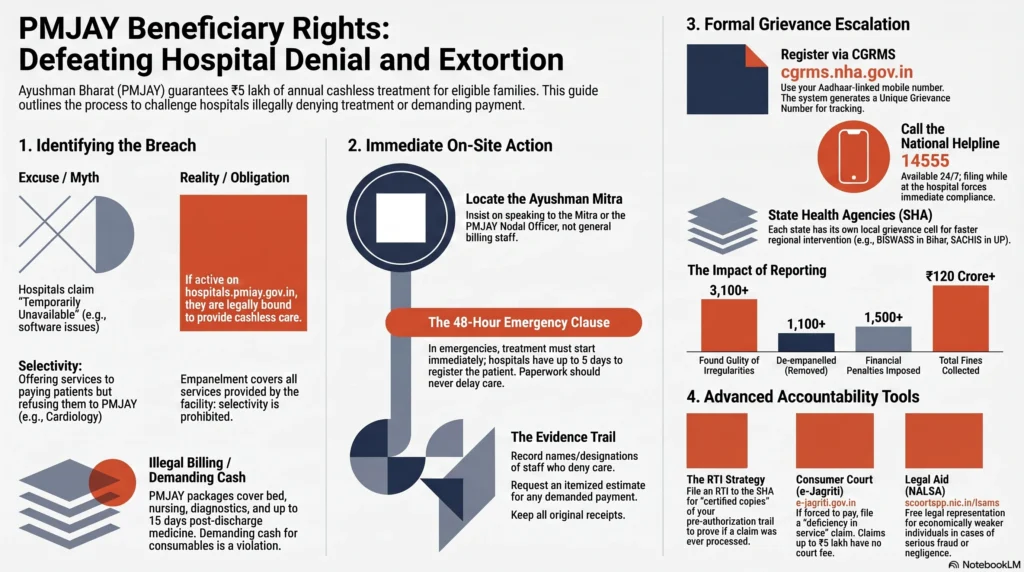
- The 48-Hour Emergency Clause: In medical emergencies, care must begin immediately. Hospitals have a 48-hour window to process PMJAY paperwork, and the lack of a physical card cannot delay care if a verified Beneficiary ID is available.
- On-Site Escalation: If asked for money, bypass the billing counter and speak directly to the hospital’s Ayushman Mitra or PMJAY Nodal Officer. Always demand a written reason for refusal and an itemized estimate before paying.
- Official Grievance Channels: Report extortion or denial of service immediately via the National Toll-Free Helpline (14555), the online CGRMS Portal, or your State Health Agency (SHA) to generate a tracked Unique Grievance Number.
- Legal & RTI Recourse: To challenge illegal billing, patients can file an RTI application to extract hospital pre-authorization trails, demand refunds through the e-Jagriti (Consumer Court) portal, or file a police FIR under the Bharatiya Nyaya Sanhita (BNS) for severe medical extortion or negligence.
Understanding Your Rights Under PMJAY
Most disputes under PMJAY become much easier to challenge once you know what the scheme actually guarantees. These protections are not based on vague promises or hospital discretion. They are written into the conditions every empanelled hospital agrees to before it is allowed to participate in the scheme. Understanding those commitments turns a frustrating experience into a complaint backed by specific rights.
The Legal Obligation of Empanelled Private and Public Hospitals
AB-PMJAY provides eligible families with health coverage of up to ₹5 lakh per year for secondary and tertiary hospitalisation on a family floater basis. There is no cap on the number of family members or their age, and eligible treatment is meant to be completely cashless and paperless. Eligibility is determined using the Socio-Economic Caste Census (SECC) 2011 database, which identifies around 1.21 crore entitled families, amounting to roughly 5.5 crore beneficiaries according to government records available on Bihar’s Ayushman Bharat portal.
Government hospitals with inpatient facilities are generally empanelled automatically once they meet the required infrastructure standards. Private hospitals, on the other hand, must apply through the Hospital Empanelment Module and undergo physical verification before they are approved. Their empanelment status can be checked through the official portal.
What many patients do not realise is that empanelment comes with clear responsibilities. Once a hospital joins PMJAY, it cannot selectively decide which eligible patients to treat or which covered specialties it will honour under the scheme. If it offers a specialty to paying patients, it must provide the same service to eligible PMJAY beneficiaries. Likewise, a hospital cannot suspend cashless treatment simply because reimbursements are delayed or administrative issues arise. Refusing treatment to an eligible beneficiary is a breach of the very conditions the hospital accepted when it joined the scheme.
One important distinction is worth keeping in mind. PMJAY grievances are handled by the National Health Authority (NHA) and the relevant State Health Agency, not by the Insurance Regulatory and Development Authority of India (IRDAI). If your issue involves a private health insurance policy purchased independently or provided by your employer, the Insurance Ombudsman is the appropriate authority. For disputes under PMJAY, however, the grievance mechanisms discussed throughout this guide are the correct route.
Common Excuses Hospitals Use to Deny Eligible Patients
Beneficiaries across the country often hear the same explanations when hospitals refuse cashless treatment. Knowing these common excuses can help you distinguish a genuine issue from an attempt to avoid providing services under the scheme.
| What the hospital says | What is actually true |
| “PMJAY is suspended here this week. Pay now and claim later.” | Empanelment status is publicly available. Check it yourself at https://hospitals.pmjay.gov.in. If the hospital is listed as active, this excuse has no valid basis. |
| “We only accept PMJAY for emergencies, not for this planned procedure.” | Hospitals cannot selectively exclude covered specialties that they already provide to paying patients. |
| “Your treatment doesn’t fit any PMJAY package, so you’ll have to pay privately.” | Selecting the correct Health Benefit Package code is the hospital’s responsibility. If the wrong package has been chosen, it can be corrected before discharge. |
| “This implant or consumable isn’t covered, so you’ll need to pay extra.” | If the procedure falls within a covered package, its listed components are included. Any optional upgrade requires the patient’s clear written consent before additional charges can be imposed. |
| “Come back once your physical Ayushman card is ready.” | A verified beneficiary ID is sufficient to begin treatment. Hospitals can register eligible patients in the system up to five days after admission, so the absence of a physical card should never delay emergency care. |
These explanations all follow a familiar pattern. They shift the burden onto patients at a time when they are already under immense stress, often during a medical emergency when there is little opportunity to verify facts or challenge hospital staff. Recognising these tactics is the first step. Knowing how to respond is the next, and that’s exactly what the following section covers.
Identifying Extortion, Bribery, and Unauthorized Billing
Under PMJAY, package rates are designed to cover the full cost of treatment for approved procedures. That means patients should not receive separate bills for routine hospital expenses that are already included in the package. Coverage generally extends to accommodation in a general ward for the approved duration, nursing care, surgeon and anaesthetist fees, operation theatre charges, medicines and consumables used during the hospital stay, diagnostic tests related to the procedure, and follow-up consultations and medicines for up to 15 days after discharge. If your treatment falls under a covered PMJAY package at an empanelled hospital, these costs should not be billed separately.
There are limited situations where additional charges may be legitimate. For example, if a patient voluntarily chooses a private room instead of a general ward or requests a premium implant that goes beyond what the package includes, the hospital may charge the difference. However, this can only happen after the patient has given clear, informed, and written consent. It cannot be presented as a condition for admission, treatment, or discharge.
There are also warning signs that suggest the issue goes beyond a billing disagreement and may amount to extortion or misconduct. These include being asked to pay cash before treatment begins, being denied an itemised estimate, being told to hand over money away from the official billing counter or Ayushman Mitra desk, or being threatened with the withholding of discharge papers or medical records unless payment is made.
These practices are not simply unethical. They violate the rules governing PMJAY and can attract serious consequences for the hospital, including financial penalties and even removal from the scheme. As we’ll discuss later in this guide, hospitals found guilty of such violations can face disciplinary action that directly affects their empanelment status.
Immediate Steps to Take When Denied Treatment
The first few minutes after a hospital refuses treatment or demands payment can make a significant difference. Your immediate priority should always be the patient’s health, but the steps you take during this time can also determine how strong your complaint will be later. The sooner you start documenting what happened, the easier it becomes to establish exactly where the hospital failed to follow PMJAY rules.
Confronting the Hospital’s Ayushman Mitra
Every empanelled hospital under PMJAY is required to have a dedicated help desk staffed by an Ayushman Mitra. This person is responsible for assisting beneficiaries, verifying their eligibility, coordinating with doctors, and facilitating the cashless treatment process. They are not the same as the staff at the billing counter, and that distinction matters. Billing personnel may not be fully familiar with PMJAY procedures and, in some cases, may even encourage patients to opt for private billing instead.
If you’re being denied treatment or asked to pay, insist on speaking directly with the Ayushman Mitra or the hospital’s designated PMJAY nodal officer. Their role includes verifying your eligibility through the Beneficiary Identification System and submitting the required pre-authorisation request on the Transaction Management System using the treating doctor’s diagnosis. When hospitals claim there is “no package available” or “there isn’t enough time to process the request,” they are often failing to complete this mandatory step.
If the Ayushman Mitra is unavailable or you’re told it’s simply “hospital policy,” ask to speak with the Medical Coordinator or the hospital’s PMJAY in-charge. Make a note of the names, designations, and the time of each interaction. These details may seem minor in the moment, but they become valuable evidence if you need to escalate the matter later.
Documenting the Refusal or Extortion Attempt in Writing
Whenever possible, ask the hospital to give its reason for denying treatment in writing. Even a brief statement on hospital letterhead carries far more weight than a verbal explanation that can later be denied.
While you’re there, take a few additional steps to strengthen your record:
- Record the date and time of the incident, along with the full name and designation of the person who denied treatment or demanded payment. A photograph of their ID badge or a voice memo made immediately afterwards can help preserve these details accurately.
- If you’re asked to pay, request an itemised estimate before handing over any money, and take a clear photograph of it.
- If paying is unavoidable because of the medical emergency, keep every receipt, invoice, and payment acknowledgement. These documents are essential if you later seek a refund.
- Save all communication with the hospital, including SMS messages, WhatsApp chats, emails, or any written instructions.
- Before leaving the hospital, ask for the discharge summary and complete medical records, even if you ended up paying privately. These records are likely to be required if you file a CGRMS complaint, submit an RTI application, or pursue legal action.
Building a paper trail at this stage may feel overwhelming, especially during a medical crisis, but it often becomes the strongest evidence you have if the dispute progresses further.
Invoking the 48-Hour Emergency Treatment Clause
During a genuine medical emergency, treatment is supposed to begin immediately. The hospital should process the PMJAY pre-authorisation request alongside the patient’s treatment, not insist on receiving approval before providing care.
If hospital staff tell you they are waiting for approval from the State Health Agency or ask you to return after the paperwork is completed, they have the process backwards. Emergency care should not be delayed because administrative formalities are still underway.
In most cases, emergency pre-authorisations are reviewed by the State Health Agency’s medical auditor within a matter of hours. Even if the beneficiary does not have a physical Ayushman card at the time of admission, a verified beneficiary ID is sufficient to begin treatment. Hospitals are also allowed to register an eligible patient in the system up to five days after admission, giving them enough flexibility to complete the formalities without delaying care.
Taken together, these provisions effectively give beneficiaries a practical window of around 48 hours to resolve documentation issues while still receiving cashless emergency treatment.
If an empanelled hospital continues to refuse admission or delays emergency treatment because of pending paperwork, that refusal should itself be reported. You can file a priority grievance through the CGRMS portal or call the national toll-free helpline discussed in the next section. Both mechanisms are specifically intended to deal with delays or denials of emergency care.
How to File a Formal Complaint Against a Hospital
If the hospital refuses to reverse its decision or the immediate crisis has passed, the next step is to file a formal complaint. This creates an official record of what happened and places the matter within a system that requires authorities to examine and respond to your grievance.
Registering a Grievance on the CGRMS Online Portal
The Central Grievance Redressal Management System (CGRMS), available at is the National Health Authority’s official platform for PMJAY complaints. The process is designed to be straightforward, and you do not need legal assistance or even an account to use it. Your identity is verified through an OTP sent to your registered mobile number, after which you simply select “Beneficiary” as the complainant type and complete the required details.
Before you begin, keep the following information ready:
- Your PMJAY beneficiary ID or the Aadhaar-linked mobile number associated with your record.
- The name and location of the hospital.
- The date of the incident.
- Copies of any supporting documents, such as a written refusal, payment estimate, receipts, or other relevant records. The portal allows you to upload multiple documents with a single complaint.
After submission, the system generates a Unique Grievance Number. Save this carefully. It is your reference number for tracking the complaint and will be required for every future follow-up or escalation.
Once your grievance is registered, it is forwarded to the District Grievance Nodal Officer, who is responsible for handling PMJAY disputes within the district. Each category of complaint is governed by prescribed timelines, and if the matter is not resolved within the allotted period, it is automatically escalated to a higher authority. Throughout the process, status updates are generally shared through SMS and email, allowing beneficiaries to monitor the progress of their complaint.
Using the National Toll-Free Helpline (14555)
Not everyone has reliable internet access, and sometimes the problem needs to be reported while you’re still at the hospital. In such situations, the PMJAY national helpline on 14555 provides an effective alternative. The service operates round the clock and allows beneficiaries to register complaints over the phone.
When you call, be prepared to provide the hospital’s name, your beneficiary or Ayushman card number, and a clear explanation of the issue, whether it involves denial of treatment, an illegal demand for money, or an unreasonable delay in providing care. The call centre executive records the complaint directly in the CGRMS system and generates the same Unique Grievance Number that you would receive if you filed the complaint online.
Making the call while you are still inside the hospital can sometimes have an immediate impact. Knowing that an official complaint has been registered with the National Health Authority often prompts hospitals to reconsider their position, especially when the incident is unfolding in real time.
Contacting Your State Health Agency (SHA) Grievance Cell
Every state and Union Territory implementing PMJAY has its own State Health Agency (SHA). These agencies oversee the scheme locally, manage hospital empanelment, and operate their own grievance cells and helplines. Because they directly supervise hospitals within their jurisdiction, approaching the relevant SHA can sometimes lead to faster intervention than relying solely on the national grievance system.
Some examples include:
| State | SHA / Portal | Contact |
| Maharashtra | Mahatma Jyotirao Phule Jan Arogya Yojana — https://www.jeevandayee.gov.in | 155 388 or 1800 233 2200 |
| Uttar Pradesh | State Agency for Comprehensive Health and Integrated Services — https://www.sachis.in | 1800 1800 4444 |
| Bihar | Bihar Swasthya Suraksha Samiti (BISWASS) — https://biswass.bihar.gov.in | Contact details and grievance routes listed on the portal |
| Manipur | State Health Agency, Manipur — https://shamanipur.mn.gov.in/Static/Grievance | 1800-103-2015 (state) or 14555 (national) |
These examples are not exhaustive. Every state implementing PMJAY has an equivalent agency responsible for addressing beneficiary grievances. Many of these agencies also provide offline options, including district coordinators, grievance offices, and help desks located in government hospitals, making it easier for beneficiaries who have limited internet access.
Escalating the Issue to the District Implementing Unit (DIU)
If your complaint remains unresolved, it can be escalated to the District Implementation Unit (DIU). Every implementing district has one, typically headed by the district’s senior administrative officer and supported by officials responsible for medical, grievance, and technical matters.
The DIU has the authority to conduct physical inspections and audits of empanelled hospitals. Because it operates at the district level, it is often well placed to deal with complaints involving a specific hospital rather than broader policy issues. Your complaint may reach the DIU through the District Grievance Nodal Officer, or you can approach the district office directly if previous attempts have not produced a satisfactory response.
If both the district and state mechanisms fail to resolve the issue, there is another avenue available. Since PMJAY falls under the Ministry of Health and Family Welfare, unresolved grievances can also be submitted through the Centralised Public Grievance Redress and Monitoring System.
The portal accepts complaints at any time, generates a registration number for tracking, and requires a response from the ministry’s designated nodal officer. It also includes an appeal mechanism if you are dissatisfied with the resolution provided. Because this platform functions independently of the National Health Authority’s internal grievance system, it can be particularly useful when you believe your complaint has stalled within the PMJAY framework itself.
Filing an RTI to Challenge Denied Claims and Treatments
When a hospital’s explanation doesn’t add up, or you suspect the denial wasn’t an isolated mistake, filing a grievance may not be enough. In such cases, the Right to Information (RTI) Act gives you another powerful option. Unlike a complaint, an RTI application allows you to obtain official records that can reveal exactly what happened behind the scenes. Those documents often become valuable evidence if you later pursue a consumer case or another legal remedy.
Identifying the Correct Public Information Officer (PIO)
The National Health Authority (NHA) functions under the Ministry of Health and Family Welfare, which means records relating to PMJAY claims, pre-authorisations, and approvals are maintained within the NHA or the relevant State Health Agency (SHA). If your request concerns a central PMJAY record, your RTI application should be addressed to the NHA’s Central Public Information Officer (CPIO). If it relates solely to a state-run hospital or a state-specific implementation issue, the designated Public Information Officer at the concerned SHA is usually the appropriate authority.
The RTI process itself is relatively simple. You need to submit a written application in English, Hindi, or the relevant regional language, clearly describing the information you want. A fee of ₹10 is payable in most cases, although applicants who fall below the poverty line are exempt from paying it.
Under the Right to Information Act, 2005, the Public Information Officer is generally required to respond within 30 days. If no response is received within that period, or the reply is incomplete or unsatisfactory, you have the right to file a First Appeal before the designated Appellate Authority within the same department. This appeal must usually be submitted within 30 days of the original deadline and does not involve any additional fee.
Requesting the Pre-Authorization Trail and Denial Noting
A common mistake is asking broad questions like, “Why was my treatment denied?” Such requests often lead to vague replies. Instead, ask for specific documents.
For example, you can request:
- A certified copy of the pre-authorisation request submitted by the hospital for your treatment, or confirmation that no such request was ever submitted.
- Copies of the approval, rejection, or query remarks recorded by the State Health Agency or third-party administrator.
- Details of the Health Benefit Package code originally selected for your case and any subsequent changes.
- Copies of internal file notings or communications relating to the approval, rejection, or processing of your claim.
These records can make a significant difference. Suppose a hospital tells you that your treatment wasn’t approved under PMJAY, but the RTI response shows that no pre-authorisation request was ever submitted. That directly contradicts the hospital’s explanation and demonstrates that the required process may never have been initiated. Evidence like this carries considerable weight when pursuing a CGRMS complaint, consumer dispute, or even criminal proceedings where appropriate.
Keep your RTI request focused on your own treatment and admission dates. Narrowly worded applications are generally easier to process and leave less room for delays or evasive responses.
Gathering SECC Eligibility Entries and Hospital Records
Before challenging a hospital’s claim that you are ineligible for PMJAY, it is worth confirming your eligibility independently. Since the scheme relies on the 2011 Socio-Economic Caste Census (SECC), your entitlement is based on the data recorded there rather than a hospital’s interpretation.
Among the rural households that may qualify are those meeting criteria such as:
- Living in a single-room house with non-permanent (kuccha) walls and roof.
- Having no adult member between the ages of 16 and 59.
- Being headed by a woman with no adult male member aged 16 to 59.
- Having a disabled family member with no able-bodied adult in the household.
- Belonging to an SC or ST household.
- Being landless and primarily dependent on casual manual labour for income.
At the same time, certain households are automatically excluded from the scheme. Examples include families owning a motorised vehicle, those with a government employee, households holding a Kisan Credit Card above the prescribed limit, or those earning beyond the notified income threshold. Understanding these criteria helps you determine whether a rejection is genuinely based on eligibility or whether the hospital has simply made an incorrect claim.
Rather than relying on what hospital staff tell you, verify your status yourself. Both https://beneficiary.nha.gov.in and https://mera.pmjay.gov.in/search/login allow eligible beneficiaries to check their status and download their Ayushman card using their registered mobile number and identity details.
If your eligibility is confirmed, keep a printed or downloaded copy of that verification. Attaching it to your RTI application or CGRMS complaint strengthens your case and makes it much harder for the hospital to argue that you were never entitled to receive PMJAY benefits in the first place.
Legal Recourse and Consumer Protection Actions
Administrative complaints can help hold hospitals accountable, but they do not automatically return money you’ve already paid or compensate you for the harm you’ve suffered. If you’ve incurred out-of-pocket expenses or experienced financial or personal loss because a hospital failed to honour PMJAY, the law provides several avenues for seeking relief.
Approaching the Consumer Disputes Redressal Commission
If an empanelled hospital charges you for treatment that should have been provided free under PMJAY, it may amount to a deficiency in service under the Consumer Protection Act, 2019. In simple terms, the hospital has failed to deliver a service it was legally obligated to provide.
Consumer complaints can now be filed online through e-Jagriti. If you come across the older e-Daakhil portal, don’t be concerned. It has been integrated into the e-Jagriti system, so both routes ultimately lead to the same filing platform.
The forum that hears your complaint depends on the value of your claim:
| Commission | Jurisdiction |
| District Commission | Claims up to ₹50 lakh |
| State Commission | Claims above ₹50 lakh and up to ₹2 crore |
| National Commission | Claims exceeding ₹2 crore |
In practice, almost every PMJAY-related billing dispute falls within the jurisdiction of the District Commission. There is no court fee for claims up to ₹5 lakh, making this an accessible remedy for most beneficiaries. While you are free to engage a lawyer, it is not mandatory. A complaint that clearly sets out the facts, supported by dates, receipts, and documentary evidence, is often far more effective than a lengthy but unsupported narrative.
Demanding Refunds for Out-of-Pocket Payments
Before taking the matter to a consumer commission, consider sending the hospital a formal written demand asking for a refund. Many hospitals choose to settle genuine disputes at this stage rather than face proceedings that could affect both their reputation and their PMJAY empanelment.
Your letter should explain what happened, state the amount you are seeking to recover, and provide a reasonable deadline, usually between 15 and 30 days, for the hospital to respond. If you have already filed a grievance through CGRMS, include your Unique Grievance Number. This signals that the matter is already on record with the National Health Authority and is being formally tracked.
If the hospital ignores your request or refuses to refund the money, you can include that amount as part of your consumer complaint. In addition to reimbursement, you may also seek compensation for the inconvenience, harassment, mental distress, and costs you incurred while pursuing the matter.
This is why preserving documents from the very beginning is so important. Receipts, payment estimates, written refusals, discharge summaries, and correspondence with the hospital often become the foundation of both the refund demand and any legal proceedings that follow.
Filing a Police FIR for Medical Negligence or Fraud
Not every PMJAY dispute requires criminal action. However, certain situations go beyond an ordinary billing disagreement and may justify filing a First Information Report (FIR).
Examples include money being demanded through threats or coercion, deliberately false diagnoses being used to justify unnecessary treatment or claims, or negligence so serious that it results in significant injury or death.
Since 2024, criminal offences in India are governed by the Bharatiya Nyaya Sanhita (BNS) rather than the Indian Penal Code. Under the BNS, offences such as cheating through deception fall under Section 318, criminal breach of trust under Section 316, and causing death through a rash or negligent act under Section 106. For registered medical practitioners acting during a medical procedure, Section 106 prescribes a maximum punishment of two years’ imprisonment, whereas the general maximum penalty for similar offences in other circumstances can extend to five years.
If you believe a criminal offence has occurred, file an FIR at the police station with jurisdiction over the hospital. Present the events in chronological order and attach whatever supporting evidence you have collected, including receipts, written refusals, medical records, or correspondence.
If the police refuse to register your complaint despite the disclosure of a cognisable offence, the Bharatiya Nagarik Suraksha Sanhita (BNSS) provides a clear escalation process. You can submit a written complaint to the Superintendent of Police, and if that still does not result in registration, approach the jurisdictional Magistrate to direct the police to investigate the matter.
Beneficiaries who qualify for free legal aid, including economically weaker individuals, women, children, members of SC/ST communities, and several other eligible categories, can seek assistance through the National Legal Services Authority (NALSA). The portal also allows applicants to track the status of their legal aid request.
In cases where a hospital’s conduct raises broader concerns about a patient’s dignity or the right to healthcare, you may also consider filing a complaint with the National Human Rights Commission .The Commission has the authority to seek reports from hospitals and state authorities independently of consumer or criminal proceedings, providing an additional avenue for accountability in appropriate cases.
Tracking Your Grievance and Ensuring Accountability
Filing a complaint is only the first step. Following up is just as important. PMJAY has a structured grievance system with defined timelines, escalation mechanisms, and enforcement measures. Knowing how these work helps ensure your complaint does not simply sit unanswered and gives you a better chance of seeing meaningful action against the hospital.
Using the ABDM Grievance Tracking System
It’s important not to confuse this portal with the PMJAY grievance system. The Ayushman Bharat Digital Mission (ABDM) grievance portal, is designed specifically for issues related to your ABHA (Ayushman Bharat Health Account). This includes problems such as failed authentication, duplicate ABHA numbers, or incorrect linking of your digital health records.
If your complaint is about a hospital refusing treatment, demanding money, or denying cashless care, you should continue using the CGRMS portal. Those issues do not fall within the ABDM grievance system.
There are situations, however, where the two systems overlap. For instance, if a technical problem with your ABHA prevents the hospital from processing your PMJAY pre-authorisation, the underlying issue may need to be resolved through the ABDM portal. Once you submit a grievance, you’ll receive an application number that can be used to track its progress, and cases are handled within the timelines prescribed under the government’s digital health framework.
Timelines for Resolution and Financial Penalties Against Hospitals
PMJAY’s enforcement framework is backed by more than just policy documents. The National Health Authority operates a dedicated National Anti-Fraud Unit, working alongside State Anti-Fraud Units to investigate violations by empanelled hospitals.
According to official government data, enforcement action since the launch of the scheme has been substantial. More than 3,100 hospitals have been found guilty of irregularities or violations. Of these, over 1,100 have been de-empanelled, financial penalties exceeding ₹120 crore have been imposed on more than 1,500 hospitals, and nearly 550 additional hospitals have faced suspension.
These aren’t just national statistics. Action is regularly taken at the district level as well. District Grievance Redressal Committees, led by the District Magistrate, can investigate complaints against individual hospitals and impose significant financial penalties where violations are established. In serious cases involving denial of treatment or failure to provide services covered under PMJAY, fines can run into several lakh rupees.
For beneficiaries, the takeaway is straightforward. A well-supported CGRMS complaint backed by documents such as receipts, written refusals, payment estimates, and medical records does more than create a paper trail. It becomes part of the same enforcement system that has already resulted in action against thousands of hospitals across the country.
FAQ: Ayushman Bharat Hospital Denied Treatment?
If an empanelled hospital refuses your valid card, bypass the general billing desk and immediately speak with the designated Ayushman Mitra or PMJAY Nodal Officer on-site. If the refusal persists, demand a written explanation for the denial and an itemized payment estimate. You should immediately report the hospital by calling the National Toll-Free Helpline (14555) or filing a formal grievance on the CGRMS portal. In severe medical emergencies, hospitals are bound by a 48-hour emergency clause and cannot legally delay life-saving care while waiting for administrative paperwork.
The scheme focuses strictly on secondary and tertiary inpatient care. This means Outpatient Department (OPD) visits, routine doctor consultations, standalone medications, and independent diagnostic tests are not covered. Additionally, the scheme explicitly excludes cosmetic and aesthetic surgeries, routine dental procedures, fertility treatments like IVF, and care for persistent vegetative states. If a procedure is not explicitly mapped within the government’s National Health Benefit Package (HBP), it will not be covered and requires out-of-pocket payment.
No, not all private hospitals are part of the scheme. While government hospitals with inpatient facilities are generally included automatically, private medical facilities must voluntarily apply and pass strict physical verification to become empanelled hospitals. It is crucial to verify a private hospital’s active participation status using the official PMJAY Hospital Empanelment portal before seeking admission. Non-empanelled private clinics have no legal or contractual obligation to accept the Ayushman card.
A major limitation is the rigid eligibility criteria. Coverage is strictly limited to vulnerable households identified in the historical SECC 2011 database, which excludes many lower-middle and middle-income families who cannot afford private insurance. Furthermore, the scheme’s strict reliance on predefined package codes means patients often face unexpected out-of-pocket costs if a complex surgery requires advanced implants or consumables outside the approved government rate. Finally, administrative bottlenecks and pre-authorization approval delays from state authorities can sometimes slow down scheduled, non-emergency treatments.
Hospital De-empanelment and Disciplinary Procedures
Hospitals admitted to the PMJAY network through the Hospital Empanelment Module are not monitored only once. Their compliance is reviewed periodically, and complaints from beneficiaries can trigger further scrutiny.
Disciplinary action generally follows a staged process rather than moving directly to the most severe penalty. A hospital may first receive a show-cause notice requiring it to explain the alleged violation. If its explanation is found to be unsatisfactory, financial penalties may follow. Continued non-compliance or more serious breaches can lead to temporary suspension from the scheme, while repeated or grave violations may ultimately result in permanent de-empanelment.
Empanelled hospitals also receive quality gradings such as Bronze, Silver, and Gold. These ratings influence reimbursement levels under PMJAY, so disciplinary proceedings can affect more than just a hospital’s participation in the scheme. They may also have financial and reputational consequences.
Before seeking treatment, or if a hospital claims that it is no longer accepting PMJAY beneficiaries, take a few minutes to verify its status yourself. The official portal allows beneficiaries to check whether a hospital is currently empanelled, suspended, or de-empanelled by searching by state and district.
It’s a simple step, but one that can save considerable time, stress, and expense. Verifying a hospital’s status before admission, whenever circumstances allow, can help you avoid unnecessary disputes and ensure you’re seeking treatment at a facility that is still authorised to provide services under the scheme.
Disclaimer
This article reflects publicly available Ayushman Bharat–PMJAY guidelines, portal information, and government data current as of July 2026, and is intended for general awareness rather than as legal, medical, or financial advice specific to any individual case. Portal URLs, toll-free numbers, fee structures, and statutory timelines are set by the National Health Authority, state health agencies, and other government bodies, and can change, so beneficiaries should verify current details directly with the relevant portal or helpline before acting on them. For disputes involving denial of emergency care, large refund claims, suspected fraud, or serious medical harm, readers are encouraged to consult a qualified advocate or approach the nearest Legal Services Authority for personalised guidance.s




Leave a Reply