
Section 194P Exemption: The Complete 2026 ITR Guide for Senior Citizens

Understanding the Section 194P Exemption for Senior Citizens (AY 2026-27)
The income tax return filing deadline for Assessment Year 2026-27 is approaching quickly, with most individual taxpayers expected to file by 31 July 2026. But for many senior citizens across India, especially those aged 75 and above, the requirement to file an ITR may not apply in the first place. Herein comes the issue of exemption under Section 194P of the Income-tax Act.
Section 194P of the Income-tax Act, 1961 offers relief to a specific group of elderly taxpayers. If a senior citizen is 75 or older, receives only pension income and interest from the same specified bank, and meets the prescribed conditions, the bank can calculate the tax liability, deduct the applicable tax, and complete the compliance process on the taxpayer’s behalf. In such cases, filing an income tax return is not required.
Although this provision has been in force since 2021, questions about how it works come up every tax season. This year, the confusion has grown because the new Income-tax Act, 2025 has also come into effect, leaving many pensioners unsure about which rules apply, whether their bank qualifies as a specified bank, and what happens if they accidentally make an incorrect declaration.
This guide explains who can claim the Section 194P exemption for FY 2025-26 (AY 2026-27), how the process works in practice, and the situations where filing an ITR is still mandatory despite being over the age of 75.
At A Glance: Section 194P Exemption
Core Benefit: The Section 194P exemption relieves eligible senior citizens from the burden of filing an annual Income Tax Return (ITR).
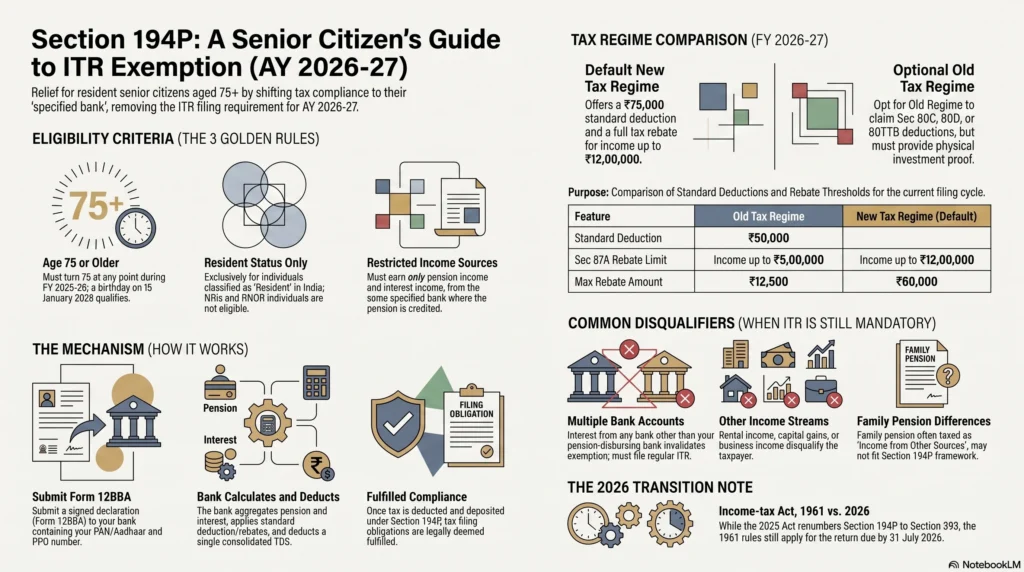
Strict Eligibility: You must be a resident Indian aged 75 or older during the financial year.
Permitted Income: Your earnings must be strictly limited to pension and interest income routed through the same specified bank.
Required Documentation: To claim the exemption, you must submit Form 12BBA to your specified bank, declaring your income and eligible deductions.
Bank’s Role: Once approved, the bank calculates your liability, applies the Section 87A rebate, and deducts applicable TDS on your behalf.
AY 2026-27 Tax Relief: Under the default new tax regime, eligible seniors can claim a ₹75,000 standard deduction and pay zero tax on income up to ₹12,00,000.
Major Disqualifiers: Earning interest from multiple banks, capital gains, or rental income immediately disqualifies you from this senior citizen ITR exemption.
What is Section 194P of the Income Tax Act?
Section 194P is often described as an exemption from filing an income tax return, but that is only part of the picture. It does not exempt eligible senior citizens from paying tax. Instead, it changes who is responsible for handling the tax calculation.
Under the normal rules, anyone whose income crosses the basic exemption limit is generally expected to file an income tax return under Section 139, even if tax has already been deducted at source. Section 194P creates a limited exception for a specific category of senior citizens. Rather than requiring the individual to calculate their tax, claim eligible deductions, and file a return, the responsibility shifts to the bank.
If a taxpayer qualifies as a “specified senior citizen,” the specified bank calculates the total income, factors in eligible deductions and the applicable rebate, deducts the correct amount of tax, and deposits it with the government. Once this process is completed, the compliance requirement for that financial year is considered fulfilled, removing the need for the senior citizen to file an ITR.
The complete legal provision can be read in the official Income Tax Department portal. The Income Tax Department also explains the relief in simple terms, confirming that a resident senior citizen aged 75 or above is not required to file an income tax return if their income is limited to pension and interest from a specified bank that has correctly computed and deducted the tax, as explained by the Income Tax Department.
The Legislative Intent Behind Section 194P
Section 194P was introduced with a simple objective: to make tax compliance easier for some of India’s oldest taxpayers.
Many people aged 75 and above depend entirely on a monthly pension and the interest earned on savings or fixed deposits. For them, the annual return filing process can feel unnecessarily complicated. Collecting tax documents, checking Form 26AS, choosing the right ITR form, reporting the same income every year, and completing the verification process can become a significant burden, especially when there are no other income sources to report.
The government recognised that, in many of these cases, the bank already has all the information needed to calculate the individual’s tax liability. When both the pension and the interest income flow through the same specified bank, asking the senior citizen to file a separate return often serves little practical purpose.
That is the thinking behind Section 194P. Instead of making the taxpayer go through the entire filing process, the bank takes over the responsibility. It calculates the total income, considers the deductions and rebate that the senior citizen is eligible for, deducts the correct amount of tax, and deposits it with the government through the TDS mechanism.
The Central Board of Direct Taxes (CBDT) has consistently explained the provision along these lines. The idea is to simplify compliance for eligible senior citizens while ensuring that the correct tax is still collected. In many ways, the process resembles how tax is deducted from a salaried employee’s income by an employer, with the key difference being that, under Section 194P, the specified bank performs that role for qualifying pensioners.
When Did the Section 194P Exemption Take Effect?
Section 194P was introduced through the Finance Act, 2021 and came into effect on 1 April 2021. As a result, eligible senior citizens have been able to claim this relief from Assessment Year 2022-23 onwards.
The government followed up with two important implementation measures later that year. On 2 September 2021, it issued a notification specifying which banks could operate under Section 194P. Around the same time, the Income-tax Rules, 1962 were amended to introduce Form 12BBA, the declaration that eligible senior citizens must submit to their bank to avail of the benefit. Both of these are discussed in detail later in this guide.
Since its introduction, the core framework of Section 194P has remained unchanged. The eligibility conditions that applied when the provision was first introduced continue to apply for FY 2025-26 (AY 2026-27). In other words, senior citizens who qualified under the original rules can still rely on the same criteria for the current filing season.
Impact of the New Tax Regime on Section 194P for FY 2025-26 (AY 2026-27)
This year’s tax filing season has created more confusion than usual for senior citizens, largely because two major changes have happened around the same time. Although they are connected, they affect taxpayers in different ways, so it helps to look at them separately.
The first relates to the tax regime. After the amendments introduced through the Finance Act, 2023, the new tax regime under Section 115BAC became the default option for individual taxpayers, including those claiming relief under Section 194P. This means that if an eligible senior citizen does not specifically choose a tax regime, the specified bank will calculate tax under the new regime by default.
For many pensioners, this can be beneficial. The new regime offers a higher standard deduction of ₹75,000 on pension income, compared with ₹50,000 under the old regime. It also provides a much larger rebate under Section 87A. For FY 2025-26, taxpayers with total income up to ₹12,00,000 can claim a rebate of up to ₹60,000 under the new regime. Under the old regime, the rebate is limited to ₹12,500 for income up to ₹5,00,000. These limits are confirmed in the Income Tax Department’s FAQ.
The trade-off is that the new regime does not allow most deductions available under Chapter VI-A. Popular deductions such as Section 80C investments, Section 80D health insurance premiums, and the Section 80TTB deduction on interest income are generally available only under the old regime. As a result, some senior citizens may still find the old regime more tax-efficient, particularly if they have substantial eligible deductions.
Anyone who wants the bank to calculate tax under the old regime must communicate that choice clearly and provide the necessary supporting documents. Banks typically ask for proof of deductions before considering claims under the old regime.
The second source of confusion is the introduction of the Income-tax Act, 2025, which came into force on 1 April 2026. The new law replaces the Income-tax Act, 1961 and renumbers many familiar provisions. Under the new Act, Section 194P has been shifted into the TDS framework as Section 393, while Form 12BBA has been replaced by Form No. 125.
Even so, these changes do not affect the return currently being filed.
The reason is straightforward. The return for AY 2026-27 relates to income earned during FY 2025-26, which ended before the new legislation took effect. Therefore, income for that period continues to be governed by the Income-tax Act, 1961. For the ongoing filing season, eligible senior citizens should still rely on Section 194P and Form 12BBA, not the renumbered provisions introduced under the Income-tax Act, 2025.
The new section numbers and forms will become relevant only when income earned from 1 April 2026 onwards is assessed during the 2027 filing season.
Eligibility Criteria for ITR Exemption Under Section 194P
The relief available under Section 194P is subject to strict eligibility conditions. A senior citizen must satisfy all of them to qualify for the exemption from filing an income tax return. Meeting only one or two of the requirements is not enough.
To be treated as a specified senior citizen under Section 194P, an individual must:
- Be 75 years of age or older at any time during the relevant previous year.
- Be a resident in India for that previous year.
- Receive only pension income and interest income, with the interest earned from the same specified bank that credits the pension.
These conditions are outlined by the Income Tax Department. Each requirement has its own significance, and understanding them carefully can help determine whether the exemption is actually available.
Age Requirement: The 75 Years Threshold
The law states that the individual must be “of the age of seventy-five years or more at any time during the previous year.” This wording is important because it means a person does not have to be 75 on the first day of the financial year.
For example, someone who celebrates their 75th birthday on 15 January 2026 still satisfies the age condition for FY 2025-26. Even though they spent most of the financial year being 74, they crossed the required age during the relevant previous year and therefore meet this criterion.
It is also worth noting that this age requirement is unique to Section 194P. Elsewhere in the Income-tax Act, resident individuals aged 60 to 79 are classified as senior citizens, while those aged 80 and above fall into the super senior citizen category. Those classifications continue to matter for certain tax benefits, particularly under the old tax regime.
Section 194P, however, follows its own threshold of 75 years. As a result, a 76-year-old taxpayer may qualify for the Section 194P filing relief, but if they opt for the old tax regime, they will still be taxed using the basic exemption limit applicable to the 60 to 79 age group rather than the higher exemption available to taxpayers aged 80 or above.
Residential Status: Exclusively for Resident Senior Citizens
Section 194P is available only to individuals who qualify as residents in India for the relevant previous year under the Income-tax Act.
This means Non-Resident Indians (NRIs) cannot claim the benefit, even if they are well over 75 years of age and their Indian income consists only of pension and bank interest. Similarly, individuals who are classified as Resident but Not Ordinarily Resident (RNOR) are also outside the scope of this provision.
If a senior citizen’s residential status changes during the year, such as someone who has recently returned to India after living abroad for many years, it is advisable to verify their status carefully before submitting Form 12BBA. An incorrect declaration regarding residency can have consequences, which are discussed later in this guide.
Permissible Income Sources: Pension and Interest Only
This is one of the most restrictive conditions under Section 194P and often the reason otherwise eligible taxpayers lose the benefit.
The law permits only two types of income:
- Pension income.
- Interest income received from accounts maintained with the same specified bank that pays the pension.
Any additional source of income, no matter how small, can make the exemption unavailable for that financial year. Rental income from a house property, capital gains from selling shares or mutual funds, dividend income, business income, or professional income all fall outside the permitted scope.
The law also requires that the interest income come from the very same specified bank through which the pension is received. For instance, if a senior citizen receives their pension in one bank but earns fixed deposit interest from another bank, the conditions of Section 194P are no longer satisfied. Since the specified bank does not have visibility of the complete income picture, it cannot accurately compute the taxpayer’s overall liability. In such a situation, the senior citizen must file a regular income tax return instead of relying on the exemption.
The Role of the “Specified Bank” in Section 194P
The smooth functioning of Section 194P depends almost entirely on one institution: the specified bank. Since the bank takes over the responsibility of calculating tax and deducting TDS for eligible senior citizens, it is important to understand what qualifies as a specified bank and why the law insists that both pension and interest income come through the same institution.
Defining a Specified Bank According to the Central Government
Section 194P itself does not list the banks that qualify under this provision. Instead, it authorises the Central Government to notify eligible banks through an official notification.
Accordingly, Notification No. 98/2021 dated 2 September 2021 states that a specified bank is a scheduled banking company that has also been appointed as an agent of the Reserve Bank of India under Section 45 of the RBI Act, 1934. The notification can be accessed.
In practical terms, this includes most major public sector banks and several large private sector banks that handle government banking operations. Since these banks are already authorised to disburse government pensions, collect taxes, and perform other RBI agency functions, they generally meet the conditions laid down under Section 194P.
There is no official master list that taxpayers need to check every year. If your pension is credited through a scheduled bank that handles government pension payments, it is very likely to qualify. If you are unsure, the simplest approach is to ask your pension-disbursing branch, which can confirm whether it operates as a specified bank for the purposes of Section 194P.
Why Pension and Interest Must Remain in the Same Bank
One of the most important requirements under Section 194P is that both pension and interest income should be routed through the same specified bank. This is not just a technical condition. It is what allows the entire system to work.
Since the bank is responsible for calculating the senior citizen’s total taxable income, it must have a complete picture of all eligible income. If pension is received in one bank while fixed deposits or savings earning interest are maintained elsewhere, no single bank has access to all the necessary information. That makes it impossible for the bank to calculate the correct tax liability with confidence.
For this reason, even a relatively small amount of interest earned from another bank can make the taxpayer ineligible for the Section 194P exemption for that financial year.
The Bank’s Responsibility for TDS Calculation and Deduction
Once an eligible senior citizen submits a valid Form 12BBA, the specified bank assumes several important responsibilities. According to the Income Tax Department’s guidance, the bank must:
- Combine the pension income and eligible interest income for the relevant financial year.
- Consider deductions available under Chapter VI-A, wherever applicable, along with the rebate under Section 87A, based on the documents provided by the senior citizen.
- Calculate and deduct income tax at the applicable rates, including surcharge and health and education cess wherever required.
- Deposit the deducted tax with the Central Government through Challan ITNS 281 within the prescribed timelines.
Section 194P also overrides the normal TDS provisions that would otherwise apply to interest income. For example, if the interest amount would ordinarily attract TDS under Section 194A, the bank does not deduct tax separately under that provision. Instead, it performs a single, consolidated tax computation under Section 194P and deducts TDS accordingly. This ensures that the same income is not subjected to tax deduction under multiple provisions.
How to Claim the Section 194P Exemption (Form 12BBA)
The benefit under Section 194P is not applied automatically. Even if a senior citizen satisfies all the eligibility conditions, the specified bank cannot process the exemption unless it receives the prescribed declaration. That declaration is submitted through Form 12BBA.
Essential Details Required in Form 12BBA
Form 12BBA, prescribed under Rule 26D of the Income-tax Rules, 1962, is a straightforward declaration that enables the bank to determine whether a senior citizen qualifies for the Section 194P relief. According to the official format published by the Income Tax Department the form requires the following information:
| Field | What Is Required |
| Name and address | Full name and residential address of the senior citizen |
| PAN or Aadhaar | Either PAN or Aadhaar details |
| Previous year | The financial year for which the declaration is being made |
| Date of birth | To establish that the taxpayer meets the minimum age requirement of 75 years |
| Name of the specified bank | The bank through which both pension and interest income are received |
| Name of employer | The employer or authority responsible for paying the pension |
| Pension Payment Order (PPO) number | The unique PPO allotted to the pension account |
The declaration concludes with a verification statement in which the senior citizen confirms that all the information provided is true and complete. It also requires the individual to declare that they have no income other than pension and eligible interest received through the specified bank. This verification is important because an incorrect declaration can have legal consequences, which are discussed later in this guide.
Declaring Chapter VI-A Deductions and Section 87A Rebates
Although Form 12BBA itself is brief, the overall process involves more than simply filling out the form.
Since the bank has to calculate the taxpayer’s final tax liability, it also needs documentary evidence for any deductions that are being claimed, particularly when the old tax regime has been chosen. Depending on the deductions claimed, this may include investment proofs for Section 80C, health insurance premium receipts for Section 80D, or interest certificates to support a claim under Section 80TTB.
The Income Tax Department has clarified that Chapter VI-A deductions are allowed only on the basis of evidence furnished by the senior citizen during the relevant financial year. The bank is also required to retain both the declaration and the supporting documents, making them available to the tax authorities if requested.
The Section 87A rebate does not have to be claimed separately. Once the bank computes the total taxable income, it automatically applies the eligible rebate under the tax regime selected by the senior citizen.
Timeline and Submission Process for Assessment Year 2026-27
Unlike an income tax return, Form 12BBA does not have a fixed statutory deadline such as 31 July. However, the timing of its submission is still important.
The declaration has to be submitted separately for every financial year. Banks cannot simply carry forward the previous year’s declaration because a taxpayer’s income, deductions, or eligibility may change from one year to the next.
More importantly, Form 12BBA should be submitted during the financial year for which the exemption is being claimed. Since the bank calculates and deducts tax throughout the year, it needs the declaration before completing that year’s TDS computation.
For FY 2025-26 (AY 2026-27), this means the practical window ended on 31 March 2026. A senior citizen who did not submit Form 12BBA during that financial year cannot claim the Section 194P benefit retrospectively after the year has closed. By July 2026, the bank would already have completed its tax computation for FY 2025-26, leaving the individual with the normal requirement to file an income tax return for AY 2026-27 if they are otherwise liable to do so.
However, all is not lost for the current financial year. A senior citizen who now qualifies under Section 194P can still submit a fresh Form 12BBA for FY 2026-27. Doing so allows the specified bank to apply the Section 194P mechanism for the ongoing year instead of continuing with regular TDS deductions under the standard provisions.
Understanding the Tax Calculation Process by the Specified Bank
Once the specified bank receives a valid Form 12BBA along with the necessary supporting documents, it takes over the tax computation process for the eligible senior citizen. In effect, the bank performs the same basic calculations that would otherwise be done while preparing an income tax return. The process can be understood in four simple stages.
Aggregation of Pension and Interest Income
The first step is to calculate the senior citizen’s gross income by combining the two permitted sources of income under Section 194P.
This includes:
- Pension received during the financial year.
- Interest earned on savings accounts, fixed deposits, or other eligible deposits maintained with the same specified bank.
Although pension is taxed under the head “Salaries” and interest falls under “Income from Other Sources,” the bank brings both together to determine the taxpayer’s total income. Since Section 194P applies only to these two categories, there is no need for the detailed reporting that would normally be required while filing an ITR.
Applying Allowable Deductions (Sections 80C to 80U)
After arriving at the gross income, the bank reduces it by applying the deductions that the taxpayer is eligible to claim.
The standard deduction on pension is always considered first. As explained by the Income Tax Department, the deduction is:
| Deduction | Old Tax Regime | New Tax Regime |
| Standard deduction on pension (Section 16) | ₹50,000 | ₹75,000 |
If the senior citizen has opted for the old tax regime, the bank can also consider eligible deductions under Chapter VI-A, provided the required supporting documents have been submitted.
Some of the commonly claimed deductions include:
| Deduction | Old Tax Regime | New Tax Regime |
| Section 80C (PPF, life insurance, ELSS, etc.) | Up to ₹1,50,000 | Not available |
| Section 80D (Health insurance or eligible medical expenditure) | Up to ₹50,000 | Not available |
| Section 80TTB (Interest on deposits for senior citizens) | Up to ₹50,000 | Not available |
| Section 80DDB (Treatment of specified diseases) | Up to ₹1,00,000 | Not available |
This is one of the main reasons some pensioners still prefer the old regime. Even though the new regime offers a larger standard deduction and rebate, taxpayers with significant deductions under Sections 80C, 80D, or 80TTB may end up paying less tax under the old regime.
Factoring in the Tax Rebate Under Section 87A
Once all eligible deductions have been applied, the bank calculates the tax liability and then considers the rebate available under Section 87A.
The Income Tax Department’s FAQ confirms the following rebate limits for FY 2025-26:
| Tax Regime | Maximum Rebate | Available if Total Income Does Not Exceed |
| New Tax Regime (Default) | ₹60,000 | ₹12,00,000 |
| Old Tax Regime | ₹12,500 | ₹5,00,000 |
Marginal relief is also available where applicable, ensuring that taxpayers whose income exceeds the prescribed threshold by a small amount are not burdened with a disproportionately higher tax liability.
For many senior citizens covered by Section 194P, this rebate makes a significant difference. Under the default new tax regime, a pensioner whose taxable income remains within ₹12,00,000 may end up paying no income tax at all after the rebate is applied. Since many eligible senior citizens rely on fixed pension income and modest bank interest, a large number naturally fall into this category.
Final Deduction of TDS at the Applicable Rates
After completing the calculation, the bank deducts tax at source wherever it is payable.
Consider an example where a specified senior citizen receives an annual pension of ₹9,00,000 and earns ₹2,00,000 as interest from deposits held with the same specified bank. The total income comes to ₹11,00,000. After allowing the ₹75,000 standard deduction under the new tax regime, the taxable income becomes ₹10,25,000.
Based on the applicable tax slabs, the tax works out to ₹42,500 before rebate. Since the taxable income is below ₹12,00,000, the senior citizen qualifies for the full rebate under Section 87A. As the rebate exceeds the tax payable, the entire tax liability is eliminated, and the bank does not deduct any TDS.
Now consider another case where the annual pension is ₹14,00,000 and interest income from the same bank is ₹4,00,000. The combined income is ₹18,00,000. After the standard deduction of ₹75,000, the taxable income becomes ₹17,25,000.
Because the income exceeds the rebate threshold, no benefit under Section 87A is available. Tax is calculated according to the applicable slabs, and after adding the 4% health and education cess, the bank deducts approximately ₹1,50,800 as TDS over the course of the financial year. The deducted amount is deposited against the taxpayer’s PAN and later appears in Form 26AS.
This example also highlights an important feature of Section 194P. Although the interest income would ordinarily fall under the TDS provisions of Section 194A, the bank does not make a separate deduction under that section. Instead, it computes tax on the combined pension and interest income under Section 194P, ensuring there is only one consolidated TDS calculation.
Common Disqualifiers: When Does a 75+ Senior Still Need to File an ITR?
Meeting the age requirement alone does not automatically exempt a senior citizen from filing an income tax return. Even if a taxpayer is over 75 years old and is a resident of India, certain situations can make Section 194P inapplicable.
Some of the most common reasons are:
- Interest income earned from more than one bank.
- Income from sources other than pension and bank interest.
- Non-resident status during the relevant financial year.
- Pension arrangements that do not fit the framework intended under Section 194P.
Holding Multiple Bank Accounts for Interest Income
One of the key conditions under Section 194P is that all eligible interest income must come from the same specified bank that credits the pension.
This requirement often catches taxpayers by surprise. Many senior citizens keep fixed deposits with different banks to benefit from higher interest rates or to spread their deposits. While this is a perfectly reasonable financial decision, it can make them ineligible for the Section 194P exemption.
The reason is straightforward. The specified bank is responsible for calculating the senior citizen’s total tax liability. If some interest income is being earned elsewhere, the bank no longer has a complete view of the taxpayer’s income and cannot accurately compute the tax payable.
Senior citizens who wish to use Section 194P in a future financial year may consider consolidating their deposits with the pension-paying specified bank before the beginning of that year, provided doing so aligns with their broader financial goals.
Earning Rental, Business, or Capital Gains Income
Section 194P is meant for taxpayers whose income is limited to pension and eligible bank interest. The moment another source of income enters the picture, the exemption generally ceases to apply.
This includes income such as:
- Rent from a house property.
- Capital gains from selling shares, mutual funds, or property.
- Dividend income.
- Business or professional income.
- Any other taxable income outside the permitted categories.
The amount involved does not matter. Even a relatively small capital gain or a modest amount of rental income can make the senior citizen ineligible for the exemption for that financial year. In such cases, the taxpayer must file the appropriate income tax return based on their overall income profile.
Maintaining Non-Resident Indian (NRI) Status
Section 194P is available only to individuals who qualify as residents in India under the Income-tax Act.
An NRI who is 75 years or older cannot claim this relief simply because their Indian income consists only of pension and bank interest. If their income exceeds the applicable threshold, they must follow the normal ITR filing requirements for non-resident taxpayers.
Returning NRIs and individuals who qualify as Resident but Not Ordinarily Resident (RNOR) should be particularly careful when determining their residential status. Since residency depends on the number of days spent in India and other statutory conditions, it is important to confirm the correct status before submitting Form 12BBA.
Receiving Pension Through Non-Specified Entities
Although Section 194P does not expressly restrict the relief to government pensioners, the structure of Form 12BBA makes it clear that the provision was designed primarily for pensioners receiving payments through recognised pension-disbursing systems.
For example, the form asks for details such as the Pension Payment Order (PPO) number and the name of the employer or authority paying the pension. These details are commonly available for central government, state government, defence, and other public sector pensioners.
Senior citizens receiving retirement income through private superannuation funds, pension or annuity plans issued by life insurance companies, or privately managed retirement arrangements may find that their pension does not fit neatly into the framework contemplated under Section 194P. In such situations, it is advisable to check with the pension-paying bank before assuming that the exemption applies.
Family pension deserves separate attention. Unlike a regular pension received by the retired employee, family pension is generally taxed under the head “Income from Other Sources” rather than “Salaries.” As explained on the Income Tax Department’s pension guidance page, family pension is eligible for a separate deduction under Section 57(iia) instead of the standard deduction available on pension under Section 16.
Because Section 194P and Form 12BBA are structured around pension that is taxable under the head “Salaries,” family pension recipients should not assume that they automatically qualify for the exemption. It is always prudent to verify eligibility with the specified bank before relying on Section 194P.
Ramifications of Non-Compliance and Incorrect Declarations
Section 194P simplifies tax compliance for eligible senior citizens, but it also places responsibilities on both the taxpayer and the specified bank. Since the bank calculates and deducts tax based on the information provided in Form 12BBA, the accuracy of that declaration is critical.
Penalties for Filing False Information in Form 12BBA
When signing Form 12BBA, the senior citizen declares that all the information provided is complete and accurate. This is not merely a procedural formality. It is a legal verification made under the Income-tax Act.
If a person knowingly provides false information, such as concealing interest earned from another bank, misrepresenting their residential status, or claiming to have no other income when additional taxable income exists, they may be exposed to prosecution under Section 277 of the Income-tax Act. This provision deals with false statements made during tax proceedings.
Depending on the amount of tax sought to be evaded, Section 277 can result in imprisonment along with a monetary fine. However, the law distinguishes between deliberate misrepresentation and genuine mistakes. An honest error that is corrected promptly is treated very differently from an intentional false declaration.
For that reason, senior citizens who are unsure whether they satisfy every condition under Section 194P should consider seeking professional advice or filing a regular income tax return instead of relying on an exemption they may not actually qualify for.
What Happens if the Bank Fails to Deduct Accurate TDS?
The bank also carries significant responsibilities under Section 194P. Once it accepts a valid Form 12BBA, it is expected to calculate the correct tax liability, deduct the appropriate TDS, and deposit it with the Central Government within the prescribed timelines.
The Income Tax Department explains these obligations.
If a specified bank fails to deduct tax where it was required to do so, it may face a penalty under Section 271C, generally equal to the amount of tax that should have been deducted.
If the bank deducts the tax but does not deposit it with the government, the consequences are more serious. It may be liable for a penalty under Section 221, and prosecution under Section 276B may also follow. This provision carries imprisonment ranging from three months to seven years, in addition to a fine.
The law does provide relief where the bank can establish that there was reasonable cause for the failure. It may also seek compounding of the offence in appropriate cases.
From the senior citizen’s perspective, however, the important point is that once a valid declaration has been submitted and all relevant information has been disclosed honestly, the responsibility for correctly calculating and depositing TDS rests with the specified bank.
FAQ: Section 194P Exemption
To qualify, you must be a resident senior citizen aged 75 years or above at any point during the financial year. Your total income must consist strictly of pension and interest earned from the same specified bank, and you must submit a formal declaration to that bank.
No, it is not mandatory if you meet all Section 194P conditions. Once your specified bank accepts your declaration, they will calculate your tax liability, apply the Section 87A rebate, and deduct any applicable TDS. This process completely exempts you from filing an ITR. However, if you earn rental income, capital gains, or interest from a second bank, filing an ITR remains mandatory.
You must submit Form 12BBA directly to your pension-paying bank. This form requires your PAN or Aadhaar, Pension Payment Order (PPO) number, and details of your eligible tax deductions. This declaration must be submitted before the financial year ends (on or before March 31, 2026, for AY 2026-27).
A specified bank is any scheduled banking company officially appointed as an agent of the Reserve Bank of India (RBI). In practice, this includes most public sector banks and large private sector banks that are authorised to handle government pension disbursements.
Yes, but only if you explicitly opt for the old tax regime. You must submit documentary evidence (such as investment proofs or health insurance receipts) to your bank along with Form 12BBA. If you proceed with the default new tax regime, Chapter VI-A deductions are not permitted, though the ₹75,000 standard deduction on pension is automatically applied.
Corrective Actions and Filing ITR in Case of Ineligibility
Eligibility under Section 194P is not permanent. A taxpayer who qualifies in one financial year may become ineligible in the next if their circumstances change.
For example, a senior citizen may open a fixed deposit with another bank, earn rental income from a property, or realise capital gains after selling investments. Any of these changes can bring them outside the scope of Section 194P.
If this happens, the senior citizen should inform the specified bank as soon as possible so that the declaration can be revised or withdrawn. Continuing to rely on an outdated Form 12BBA despite knowing that the eligibility conditions are no longer met can expose the taxpayer to unnecessary legal complications.
Once Section 194P no longer applies, the normal obligation to file an income tax return under Section 139 comes back into effect.
For income earned during FY 2025-26 (AY 2026-27), the Income Tax Department’s e-filing portal states that the due date for most individual taxpayers, including salaried employees and pensioners filing ITR-1 or ITR-2, is 31 July 2026. Certain non-audit business and professional taxpayers have a due date of 31 August 2026, as detailed in the Income Tax Department’s official portal.
Even if the original deadline is missed, a belated return can still be filed, subject to the applicable late filing fee under Section 234F and interest on any outstanding tax liability. However, where filing an ITR becomes necessary because Section 194P no longer applies, it is generally advisable to file within the original due date to avoid additional costs and procedural complications.
Disclaimer
This article is for general informational purposes and does not constitute tax or legal advice. Provisions, rates, and thresholds are based on the Income-tax Act, 1961 and official notifications as of July 2026, and may be revised by subsequent circulars. Senior citizens should verify their specific eligibility with their bank or a qualified chartered accountant before relying on Form 12BBA.




Discussion (3)
Leave a Reply