
Revised Children’s Education & Hostel Allowance 2026: Tax-Free Limits & Rules

Understanding the ₹2.88 Lakh Education and Hostel Exemption in the 2026 Rules
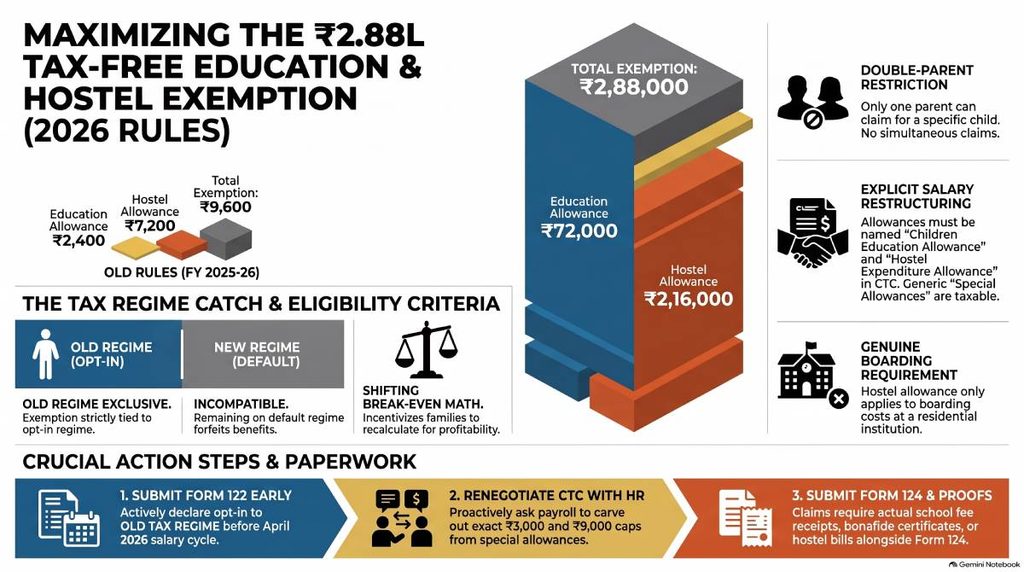
A family with two children in school could see up to Rs 2.88 lakh salary land tax-free every year from Tax Year 2026-27, against a bare Rs 9,600 under the caps that applied until March 2026. The jump comes from CBDT Notification No. 22/2026, G.S.R. 198(E), dated 20 March 2026, which operationalises the Income-tax Act, 2025 through the Income-tax Rules, 2026. Herein the issue of revised children’s education and hostel allowance (2026) assumes significance.
Children Education Allowance rises from Rs 100 to Rs 3,000 a month per child. Hostel Expenditure Allowance rises from Rs 300 to Rs 9,000 a month per child. Both caps apply for a maximum of two children, and both sit inside the old tax regime only.
That last detail matters more than the headline figure. A salaried parent who stays on the new regime, the government’s default option since FY 2023-24, gets none of this. The benefit also reaches only salaried employees drawing these allowances as part of a CTC; a self-employed parent or a business owner has no equivalent head to claim under this specific provision, whatever their children’s school and hostel bills look like. The rest of this piece covers what changed, who qualifies, how the two allowances combine, and the paperwork an employee needs to hand payroll before the April 2026 salary cycle begins.
The change reaches a wide slice of India’s salaried workforce: private-sector employees, public-sector staff, and government employees alike, wherever the employer is willing to structure the CTC to carry these two heads. Teachers, IT professionals, bank employees, and public-sector engineers all sit inside the same Section 10(14) provisions, so the eligibility rules below apply the same way regardless of industry or employer type.
At A Glance: Revised Children’s Education & Hostel Allowance 2026
- Massive Exemption Increase: The revised Income-tax Rules 2026 raise the Children Education Allowance to Rs 3,000 per month and the Hostel Expenditure Allowance to Rs 9,000 per month, per child.
- Up to Rs 2.88 Lakh Tax-Free: A family with two children in a residential school can now exempt up to Rs 2.88 lakh annually, a sharp increase from the previous Rs 9,600 cap.
- Old Tax Regime Exclusive: These allowances are only available under the old, opt-in tax regime. Employees remaining on the default new tax regime cannot claim them.
- Action Required Before April 2026: Employers must actively restructure the employee’s CTC to include these allowances as named components; they cannot be folded into a generic “Special Allowance.”
- Strict Documentation: Claims require the submission of Form 124, alongside actual school fee receipts or hostel bills, and a regime declaration via Form 122.
- The Double-Parent Rule: If both parents are salaried, only one parent can claim the exemption for a specific child; simultaneous claims are prohibited.
Understanding the Income-Tax Rules 2026 Shift
The Income-tax Act, 2025 received presidential assent on 21 August 2025 and came into force on 1 April 2026, retiring the Income-tax Act of 1961 after six decades. Parliament passed the Bill on 12 August 2025. The CBDT followed on 20 March 2026 with the procedural machinery for the new Act: the Income-tax Rules, 2026, notified under Section 533. Anyone touching Indian payroll or personal filings from April 2026 onward is working under a set of rules that read and behave differently from the one in place for six decades.
The stated purpose of the new Act was never to change how much tax people owe. Official communication around the transition described it as a rewrite for plain language and a cleaner structure, not a shift in underlying tax policy. Salary allowance limits are one of the few places where that framing runs into a genuine policy choice. Raising a monetary cap that had sat fixed since long before most of today’s working parents joined the labour force is a substantive change dressed up inside a language-simplification exercise, and it lands directly on take-home pay for anyone eligible to claim it.
Also Read: IT Refund Stuck? A Practical Guide to Responding to Defective Return Notice
The Old vs. New Regime Debate (FY 2026-27 Onward)
Two tax regimes run side by side for FY 2026-27. The new regime stays the default. It carries wider slabs, nil up to Rs 4 lakh, five per cent from four to Rs 8 lakh, 10 per cent from Rs 8 Rs 12 lakh, and so on up to 30 per cent above Rs 24 lakh, plus an effective zero-tax threshold of Rs 12.75 lakh once the Rs 75,000 and the Rs 60,000 Section 87A rebate are applied. What it strips away is nearly every Chapter VI-A deduction, house rent allowance, and the special allowances under old Section 10(14), a category that covers both Children Education Allowance and Hostel Expenditure Allowance.
The old regime still exists. An employee has to opt into it. Its slabs are steeper, 30 per cent applies above Rs 10 rather than Rs 24 lakh, and its standard deduction sits at Rs 50,000 against Rs 75,000 under the new regime. What the old regime buys back is house rent allowance, home loan interest, Section 80C, and the two allowances this piece covers. Not every deduction moved to the new regime’s side of the ledger either; a Deloitte India partner noted that certain perquisites, including food coupons and the exemption for an employee-owned car used for official travel, now carry through to the new regime as well, which narrows but does not close the gap between the two systems.
Consider a salaried professional earning Rs 18 lakh a year with two children in a residential school. Under the new regime, that employee pays tax on a wide slab structure with no scope to exempt education or hostel costs, whatever the employer names them. Under the old regime, the same employee can draw roughly Rs 3,000 a month in education allowance and up to Rs 9,000 a month in hostel allowance for each child, tax free, stacked on top of house rent allowance and any home loan deduction that applies. The comparison stops being one-sided for families in this income band with school-age or hostel-age children; the right answer depends on what rent, loan interest, and school costs actually look like for that household, not on a general rule of thumb about which regime is “usually better.”
A quick self-check helps before running a full calculation. The old regime deserves a serious look when an employee pays meaningful rent, carries a home loan on a self-occupied property, or has children drawing education and hostel allowances near the new caps. The new regime tends to win when none of the above apply, since its flatter slabs and larger standard deduction do the work without any paperwork attached.
The regime choice is not a one-line decision anymore. A family with two children in hostel now carries up to Rs 2.80 lakh of extra exemption headroom on the old side, an amount large enough to move the arithmetic for salaries in the fifteen to twenty lakh range. Employees declare their regime at the start of the tax year, commonly through Form 122 under the new Act, and payroll runs the entire year’s TDS off that single declaration. Miss the April window and the correction has to wait for the return filing stage, by which point TDS for most of the year has already been deducted under the wrong assumption.
| Feature | Old Tax Regime (opt-in) | New Tax Regime (default) |
| Standard Deduction | Rs 50,000 | Rs 75,000 |
| Children Education & Hostel Allowance | Available, per new FY 2026-27 limits | Not available |
| House Rent Allowance | Available | Not available |
| Section 80C, 80D and similar deductions | Available | Not available |
| Effective zero-tax threshold | Depends on deductions claimed | Rs 12.75 lakh gross salary |
Sources: godigit.com/income-tax/new-tax-regime-exemptions, greythr.com/blog/income-tax-act-2025-payroll-compliance-guide-2026
Why the Decades-Old Allowances Finally Jumped
The Rs 100 and Rs 300 caps sat untouched for roughly three decades, unmoved through repeated waves of school fee inflation and hostel cost increases across Indian cities. A Rs 100 a month bought meaningfully less by 2026 than it did when the figure was first set. Two employees at the same company, with children in the same hostel paying the same fees, were both capped at a combined four hundred rupees a month in tax relief no matter what the hostel actually charged, an outcome that had stopped resembling any real cost of raising a school-age child long before this revision arrived.
The 2026 Rules close that gap in one move. The government’s own framing points to inflation correction rather than a new policy direction: officials described the change as bringing exemption limits for allowances and perquisites in line with current economic conditions after years without revision.
The revision did not arrive in isolation. It sits inside a wider recalibration that also expanded house rent allowance’s 50 per cent metro exemption from four cities to eight, adding Bengaluru, Hyderabad, Pune, and Ahmedabad under Rule 279, raised employer meal voucher exemptions from Rs 50 to Rs 200 a meal, lifted annual gift voucher exemptions from five thousand to fifteen thousand rupees, and pushed the tax-free interest-free employer loan threshold from twenty thousand rupees to two lakh rupees. Children Education and Hostel Allowance are one line item in a rulebook-wide catch-up on stale monetary limits, not a standalone concession aimed only at parents. Read next to the meal-voucher and gift-voucher changes, the pattern is consistent: figures fixed decades ago got refreshed once, together, rather than through the piecemeal adjustments that had characterised the old Rules for most of their life.
The overlap with the HRA metro expansion is not incidental either. Dual-income households in Bengaluru, Hyderabad, Pune, and Ahmedabad, cities that just gained the fifty percent HRA exemption alongside the older four metros, are frequently the same households with school-age children in these cities’ private schools and hostels elsewhere. For that specific demographic, the 2026 Rules move on rent and on children’s costs at the same time, which compounds the case for choosing the old regime rather than defaulting to the new one out of habit.
One adjacent change from the same notification gets confused with the two allowances covered here often enough to need separating out clearly. A transport allowance exemption also moved, from Rs 10,000 to Rs 25,000 a month, but it applies narrowly to employees of a transport undertaking, airline, railway, or road-transport crew paid to meet personal expenses while running such transport, and who receive no separate daily allowance. It has nothing to do with an ordinary desk employee’s commute, which was folded into the standard deduction years earlier and is unaffected by this notification. Reading the twenty-five-thousand-rupee transport figure as a general commuting benefit is the single most common misreading of this notification circulating in casual summaries.
There is a mild tension here, and it should be said plainly. The broader thrust of India’s tax policy since FY 2023-24 has pushed taxpayers toward the deduction-free new regime, through a higher standard deduction, wider slabs, and a larger Section 87A rebate. Raising the old regime’s allowance ceilings at the same time runs somewhat against that grain, since it makes the old regime a stronger contender for exactly the household profile, salaried, urban, with school-age children, that the new regime’s design was meant to pull in. The two changes were notified together rather than as competing priorities, and the practical result is that the “default” regime is not automatically the better one for every taxpayer, a family with children in hostel being the clearest case where checking beats assuming.
The Rules themselves shrank even as individual limits grew. The Income-tax Rules, 1962 ran to five hundred eleven rules and roughly three hundred ninety-nine forms. The 2026 version consolidates that down to three hundred thirty-three rules and around one hundred ninety forms, with every retained form carrying a new number. Form 16 is now Form 130. Form 12BB, the investment-declaration form, is now Form 124. Form 12BA, the perquisite statement, is now Form 123. The substance behind each form carried over unchanged; only the numbering and, for allowances like these two, the money attached to them moved. A corrigendum to the principal notification followed on 16 April 2026, a routine reminder that a rulebook this size settles gradually over its first year rather than arriving fully finished on day one.
Also Read: Section 194P Exemption: The Complete 2026 ITR Guide for Senior Citizens
Children Education Allowance (CEA): The Rs 72,000 Annual Exemption
Children Education Allowance is the salary head an employer pays specifically toward a child’s school costs, separate from any tuition-fee reimbursement and from the Section 80C tuition deduction. For FY 2026-27, the exemption under this head rises thirtyfold, from one hundred rupees to three thousand rupees a month per child. Capped at two children, that puts seventy-two thousand rupees a year on the table for a two-child family, against two thousand four hundred rupees before.
Eligibility and Claim Limits Per Child (Rs 3,000/Month)
The exemption is the lower of two figures: the allowance the employer actually pays, and three thousand rupees a month per child. An employer paying one thousand five hundred rupees a month exempts one thousand five hundred rupees, not the full three-thousand-rupee ceiling. Getting the full benefit means the salary structure has to carry the allowance at or above the new cap, which is a conversation most employees will need to raise with HR before the April payslip locks in for the year.
A handful of conditions govern the claim:
- The employee must be salaried and must have opted into the old tax regime for the year.
- The child’s education must take place in India.
- The exemption applies for a maximum of two children per employee.
- Where both parents are salaried, only one parent can claim the exemption for a given child; simultaneous claims by both parents for the same child are not permitted.
That last condition, sometimes called the double-parent rule, closes a gap that existed informally before. Take a couple where both partners work, and both would otherwise draw a Children Education Allowance component from their respective employers for the same two children. Under the new Rules, only one spouse’s claim stands for each child; the couple has to decide between themselves, often the higher earner given how marginal tax rates work, and communicate that choice clearly to both employers, since payroll systems at two different companies have no way to cross-check a spouse’s separate employer records on their own.
Opting into the old regime itself is a separate step from claiming either allowance, and it has to happen first. An employee who has stayed on the new regime by default for the past two or three years, simply because no one asked, has to actively inform their employer of the switch before payroll can apply either exemption; the allowance limits mean nothing to an employee whose declared regime for the year is still the new one.
None of this is automatic. The allowance has to appear as a distinct, named component within the CTC. An amount folded into a generic Special Allowance head stays fully taxable regardless of what the employee actually spends on school fees, because the exemption attaches to how the salary structure is built, not to spending alone. An employee who assumes the higher limit applies automatically, without checking their own payslip for a line item actually called Children Education Allowance, is likely to discover at return-filing time that no exemption was ever claimed.
Maximum Caps and the Two-Child Rule
The two-child ceiling is a headcount limit, not a means test. An employee with four children still claims the exemption for two of them, whichever two the family and employer settle on, regardless of how school costs are actually split across siblings. A parent of three school-going children, for instance, does not get a larger pool of exemption simply because the household’s real education spending is higher than a two-child family’s; the third child’s costs stay entirely outside this particular exemption, whatever else the family may be able to claim elsewhere in the return. The annual arithmetic for two children comes to seventy-two thousand rupees: three thousand rupees a month, times twelve months, times two children.
Set that against where the exemption sat under the 1962 Rules. Two children capped a family’s entire education allowance exemption at Rs 2,400, a sum that would not cover a single month’s tuition at most urban private schools by 2026, where annual fees routinely run into six figures. The distance between two thousand four hundred rupees and seventy-two thousand rupees is the entire reason this allowance stopped being a rounding error on the payslip and turned into something worth restructuring salary for.
Keep this separate, in the same breath: Children Education Allowance is not the tuition-fee deduction available under Section 80C. The 80C tuition benefit is a different provision within Chapter VI-A, claimed against actual tuition paid and subject to its own limit inside the Section 80C cap as a whole. A family can claim both where eligible; restructuring the CTC for the allowance discussed here does not use up any of the separate 80C room.
One point needs to be stated without hedging. FY 2025-26 returns, the ones being filed through 2026 for income earned before 1 April 2026, still run on the old hundred-rupee and three-hundred-rupee caps. The Income Tax Department’s own AY 2026-27 reference table for salaried benefits, current as amended by the Finance Act 2026, still lists Children Education Allowance at Rs 100 per month per child and Hostel Expenditure Allowance at Rs 300 per month per child. The three-thousand-rupee and nine-thousand-rupee figures apply from Tax Year 2026-27 onward, for salary earned on or after 1 April 2026, not retroactively to the year now being assessed. An employee who reads about the new limits and tries to claim them on a return covering FY 2025-26 income is working from the wrong figures for that particular filing.
Also Read: ITR e-Filing 2026: A Step-by-Step Guide for AY 2026-27 (New Rules)
Hostel Expenditure Allowance: The Rs 2,16,000 Annual Exemption
Hostel Expenditure Allowance sits alongside Children Education Allowance under the same Section 10(14) special-allowance category, but it addresses a different cost: a child boarding away from home for school. For FY 2026-27, this exemption moves from three hundred rupees to nine thousand rupees a month per child, again capped at two children, for an annual ceiling of two lakh sixteen thousand rupees.
From Rs 300 to Rs 9,000/Month: Breakdown of the Increase
Nine thousand rupees is thirty times the old three-hundred-rupee cap, the same multiple applied to Children Education Allowance. The two figures did not move by coincidence; both sit in the same notification, addressing the same three-decade freeze on special-allowance limits.
| Allowance | Old limit (per month, per child) | New limit, FY 2026-27 (per month, per child) | Annual exemption for 2 children |
| Children Education Allowance | Rs 100 | Rs 3,000 | Rs 72,000 |
| Children Hostel Allowance | Rs 300 | Rs 9,000 | Rs 2,16,000 |
| Combined | Rs 400 | Rs 12,000 | Rs 2,88,000 |
Source: Income Tax Department
Real hostel bills at many residential schools run well beyond what either allowance alone can offset, with boarding and mess charges together often crossing two to three lakh rupees a year per child at established schools, before tuition is even counted. A family paying those fees now finds a meaningful share offset by an equivalent tax-free salary component, rather than the token amount that covered a fraction of one month’s bill under the old cap. That gap between the exemption and the actual bill deserves attention early. The allowance narrows the tax burden on hostel costs. It does not come close to covering them outright for most families at established boarding schools.
The exemption formula works the same way it does for Children Education Allowance: the lower of the actual allowance paid and the nine-thousand-rupee monthly cap, per child, capped at two children. An employer paying six thousand rupees a month in hostel allowance exempts six thousand rupees. The remaining three thousand rupees of headroom simply goes unused unless the CTC gets restructured to draw on it, which is the same practical trap that catches Children Education Allowance when the salary head is not built to the new cap.
The allowance is tied to a child boarding away from home specifically for education, not to any arrangement where a child happens to live outside the parent’s household. A child staying with grandparents in another city while attending a local day school does not generate a hostel-allowance claim in the way a child enrolled in a residential school’s boarding facility does; the underlying cost has to be a genuine hostel or boarding fee charged by or through the educational institution.
Combining Education and Hostel Allowances for Maximum Tax Relief
The two allowances are independent, and they stack. A child boarding at school for education draws both: the education allowance for tuition-linked costs, and the hostel allowance for the boarding cost itself. Nothing in the Rules forces a choice between the two.
For two children both in hostel, full use of both allowances means seventy-two thousand rupees plus two lakh sixteen thousand rupees, a combined two lakh eighty-eight thousand rupees exemption, against nine thousand six hundred rupees under the old caps (two thousand four hundred rupees for education plus seven thousand two hundred rupees for hostel).
| Worked example | Old Rules (FY 2025-26) | New Rules (FY 2026-27) |
| Education Allowance exempt (2 children) | Rs 2,400 | Rs 72,000 |
| Hostel Allowance exempt (2 children) | Rs 7,200 | Rs 2,16,000 |
| Total exemption | Rs 9,600 | Rs 2,88,000 |
| Approx. tax saved at 30% slab plus 4% cess | Rs 2,995 | Rs 89,856 |
The tax-saved row is a worked example, not a promise. It assumes a taxpayer at the top thirty percent slab, with the four percent health and education cess applied on top, and it assumes the employer has actually built the full twelve thousand rupees a month, three thousand rupees education plus nine thousand rupees hostel, per child, into the salary structure as named, exempt heads rather than folding it into an undifferentiated Special Allowance. A taxpayer in a lower slab, say the twenty percent bracket that applies on income between five and ten lakh rupees, sees a proportionally smaller cash benefit from the same exemption amount, since the saving is the exempted sum multiplied by the marginal rate that would otherwise have applied to it.
This is where the old-versus-new regime math turns genuinely close for families with school-age or hostel-age children. A two-child household weighing house rent allowance, home loan interest, and now this expanded allowance set against the new regime’s flatter slabs and larger standard deduction should run the numbers against its own rent, loan, and school figures rather than default to whichever regime looks simpler at first glance. A household with modest rent, no home loan, and two children in hostel might find the old regime pulls ahead almost entirely on the strength of these two allowances alone, something that was rarely true under the old hundred-rupee and three-hundred-rupee caps.
Partial structuring shows up often enough in year one to flag on its own. An employer that adds Children Education Allowance to the CTC but leaves Hostel Expenditure Allowance folded into a general allowance head gives the employee only half of the available relief. An employee reviewing their own payslip should check for both line items by name, not assume that one correctly structured allowance means the other was handled the same way.
Also Read: ITR 2026 Filing: Investment Taxation Under the Income Tax Act 2025 Guide
Claiming the New Tax-Free Allowances
This exemption does not land on a payslip by itself. Two separate steps have to happen: the employer has to add the allowance into the CTC as a named component, and the employee has to keep the paperwork that backs the underlying spend when it is asked for.
Necessary Documentation, Proofs, and Fee Receipts
Payroll teams typically ask for fee receipts from the school, or hostel bills where the hostel allowance is claimed, before treating the amount as exempt in monthly TDS calculations. Retaining these through the year, rather than searching for them at declaration time, matters more under the new Rules than it did before. The Income Tax Department’s Annual Information Statement increasingly auto-populates return fields from employer-reported data, and a gap between a declared exemption and the paperwork actually on file is exactly the kind of mismatch that draws a query later.
Most payroll systems open a single proof-submission window each year, commonly in January or February, ahead of the final TDS computation for the tax year. Missing that internal deadline typically means the allowance reverts to fully taxable treatment for that year in the employer’s TDS calculation, even where the employee genuinely spent the money on school and hostel fees, since the correction then has to happen through the employee’s own return rather than through payroll.
The core paperwork an employee should keep on hand includes:
- School fee receipts, or a bonafide certificate confirming enrollment, for the education allowance
- Hostel fee receipts, or a hostel-admission letter, for the hostel allowance
- The investment-declaration form, now Form 124 after replacing the earlier Form 12BB, submitted to the employer at the start of the tax year
- Where both parents are salaried, a written declaration confirming which parent is claiming the exemption for which child, to satisfy the double-parent restriction.
Keep these for the same window an assessing officer could reasonably reopen the year’s assessment, past the point where the return is simply filed and accepted. A fee receipt discarded the moment a return clears initial processing offers no protection if a scrutiny notice arrives well after the filing season has ended.
The exemption then surfaces on Form 130, the document that replaced Form 16 as the annual salary TDS certificate under the Income-tax Rules 2026. For income earned in FY 2025-26, employers still issue the old Form 16, due by 15 June 2026. The first Form 130, covering Tax Year 2026-27, is not due to employees until 15 June 2027.
An employee claiming these allowances against salary drawn after 1 April 2026 sees them reflected on Form 130, not on the Form 16 being issued this year, a distinction to keep in mind the first time payroll mentions a form number nobody on the team has seen before.
How Employers Must Restructure Salary Components (CTC)
The exemption exists inside the Rules from the day they take effect. It exists on an employee’s payslip only after the employer’s payroll team redoes the CTC template to carry Children Education Allowance and Hostel Expenditure Allowance as distinct, named heads, set at amounts that actually draw on the new three-thousand-rupee and nine-thousand-rupee caps. A company that leaves its salary structure untouched has, in effect, opted its entire workforce out of a benefit Parliament and the CBDT just created.
Picture a mid-level employee on an eighteen-lakh CTC whose salary slip currently shows a flat Special Allowance of forty thousand rupees a month and nothing labelled education or hostel allowance. Under the old structure, that whole forty thousand rupees is taxable. If the employer carves twelve thousand rupees a month out of that same Special Allowance and relabels it as three thousand rupees Children Education Allowance plus nine thousand rupees Hostel Expenditure Allowance for two children, gross pay does not change by a rupee, but a real slice of it becomes tax-exempt for an employee who has opted into the old regime. The saving comes from relabelling and documentation, not from the company spending more, which is exactly why this is a payroll-configuration exercise rather than a negotiation over compensation.
Before the April 2026 payroll run, payroll and HR teams typically work through a short sequence: reconfigure the exemption caps in the payroll system for both allowances, and collect each employee’s regime declaration, commonly on Form 122, since these exemptions apply to old-regime employees only. They also refresh the investment-declaration and hostel-proof formats so employees can substantiate the higher amounts, then re-run the old-versus-new comparison for employees whose optimal regime may have shifted under the new limits.
| Step | Why it matters |
| Add CEA and Hostel Allowance as separate, named CTC heads | Clubbing the amount under Special Allowance forfeits the exemption entirely, whatever the employee spends |
| Update payroll caps to Rs 3,000 and Rs 9,000 per month per child | The exemption is the lower of the allowance actually paid and the statutory cap |
| Collect Form 122 regime declarations before the April payroll run | These exemptions apply only to employees who have opted into the old regime |
| Refresh Form 124 investment-declaration templates | Captures children count, school, and hostel details needed to substantiate each claim |
| Re-run old-versus-new comparisons for affected employees | Higher caps can shift the break-even point back toward the old regime for some salary bands |
Sources: greythr.com/blog/income-tax-act-2025-payroll-compliance-guide-2026, taxupdate.in/income-tax/787
New hires joining after April 2026 are the easier case, since their salary structure can be built around the new caps from the offer-letter stage onward. Existing employees are the harder case: their CTC was fixed at the last appraisal cycle, often under the old caps or under a generic Special Allowance head, and mid-year restructuring usually has to wait for the next revision cycle unless the employer runs an off-cycle correction specifically for this change. Employees who negotiate their next increment during FY 2026-27 have a natural opening to ask that these two allowances be named and sized correctly as part of that conversation, rather than carried over unchanged from a template built for the old Rules.
The size of the payroll team matters here more than it might seem. A large corporate with an in-house or outsourced payroll platform can typically push a configuration update for the whole workforce in a single release, ahead of the April cycle. A smaller employer running payroll through spreadsheets or a lean HR team may only get to this on an employee-by-employee basis, usually after someone specifically asks. Employees at smaller companies have more reason, not less, to raise the two allowances directly with whoever runs payroll, since the change is far less likely to arrive automatically.
A gap between what the Rules allow and what a company’s actual salary structure contains is common in the first year after a change of this size. An employee earning eighteen lakh rupees a year with two children in hostel, still drawing a generic Special Allowance instead of named education and hostel components, forfeits the entire two lakh eighty-eight thousand rupees of exemption regardless of what the family spends on school and hostel fees. The fix sits with the employer’s payroll configuration, not the employee’s tax return. That’s why raising it with HR before the April payroll run, not after, actually matters. Employees who wait until the investment-declaration window closes for the year are stuck carrying the old, unstructured salary components for twelve more months, watching a benefit that already exists on paper sit unused on their own payslip.
The window for the current cycle is already open. Employees with school-age or hostel-age children have a genuine reason to check their April 2026 payslip line by line rather than skim it, and employers have a genuine reason to treat this as a payroll-configuration task rather than a footnote in a much larger Act.
FAQ : Revised Children’s Education & Hostel Allowance 2026
From April 1, 2026, the tax-free limit for Children Education Allowance is ₹3,000 per month per child, up to a maximum of two children. This allows a total annual exemption of ₹72,000 for a two-child family, replacing the outdated ₹100 monthly limit.
No, both the Hostel Expenditure Allowance and Children Education Allowance are only available under the old, opt-in tax regime. If you remain on the default new tax regime, you cannot claim these exemptions, even if your employer explicitly includes them in your salary structure.
No, the Income-tax Rules 2026 enforce a strict double-parent restriction. If both parents are salaried, only one parent can claim the tax exemption for a specific child. Couples must coordinate who will claim the benefit and submit their investment declarations accordingly.
No, the hostel allowance strictly applies to boarding costs incurred at a residential educational institution. If your child attends a local day school while living at home or staying with relatives, you cannot claim the ₹9,000 monthly hostel exemption. However, you can still claim the ₹3,000 education allowance for their day school tuition-linked costs.
To successfully claim the maximum exemption and avoid an Annual Information Statement (AIS) mismatch, you must submit actual school fee receipts or bonafide certificates for the education allowance, and hostel admission letters or boarding fee receipts for the hostel allowance. You must also submit your regime declaration via Form 122 and your investment proofs via Form 124 to your employer.
No, the exemption is not automatic. Your employer must explicitly restructure your Cost to Company (CTC) to include “Children Education Allowance” or “Hostel Expenditure Allowance” as named components. If the amount is folded into a generic “Special Allowance,” it remains fully taxable regardless of your actual out-of-pocket school or boarding expenses.
Disclaimer
The content published on India Policy Hub is provided strictly for educational and informational purposes and does not constitute professional financial, tax, or legal advice. While every effort is made to ensure the accuracy of our policy explainers and legislative interpretations regarding the Income-tax Rules 2026 and related salary restructuring, tax laws are complex and subject to independent assessment by jurisdictional authorities. The analysis presented here reflects a general understanding of current tax policies and should not be relied upon as a substitute for individualized professional consultation. Readers are strongly advised to consult a qualified Chartered Accountant or certified financial advisor before making any tax regime declarations, submitting investment proofs, or formally requesting changes to their Cost to Company (CTC) structure. India Policy Hub, its publisher, and its authors expressly disclaim any liability for financial loss, penalties, or compliance failures resulting from actions taken or omitted based on the information provided in this article.



Leave a Reply