
Viksit Bharat 2047: Analyzing the Strategic Policy Roadmap for a $30 Trillion Economy
India’s Vision for Viksit Bharat 2047
There’s something almost ceremonial about the way August 2022 was framed in India. Seventy-five years after independence, an anniversary that already carried weight, the country stepped into what Prime Minister Narendra Modi called the Amrit Kaal. A 25-year stretch, not just a timeline, really, but a kind of narrative arc leading to 2047. At the center of that arc sits a phrase that’s now everywhere: Viksit Bharat.
It translates simply enough, “Developed India”, but the way it’s being used, it feels heavier than a slogan. More like a long-term promise the country is making to itself. The idea is that by the time India turns 100, it won’t just be growing, it will have arrived. No longer counted among lower-middle-income economies, but standing, somewhat assertively, among high-income nations.
That’s the aspiration. The math behind it, though, is where things get a bit dizzying.
Right now, India’s GDP is around $3.5 trillion. The Viksit Bharat vision stretches to somewhere between $30 and $35 trillion by 2047.
Ten times larger. In just over two decades. If you pause on that for a second, it’s not just ambitious, it’s borderline audacious.
And it’s not only about the size of the economy. The hope is that this expansion actually changes everyday life in a visible way. Per capita income is rising to about $26,000. Millions, arguably hundreds of millions, moving out of poverty into something more stable, more secure, maybe even comfortable.
There’s also this recurring idea that the timing matters as much as the goal. The Amrit Kaal isn’t being described as just another phase of growth. It’s being treated like a rare window, one where several forces are lining up at once: a young population, rapidly expanding digital infrastructure, rising consumption, and a shifting global order that might give India more room to manoeuvre.
The implication, sometimes stated outright, is a little stark: miss this window, and the opportunity doesn’t come back anytime soon. Maybe not for another generation.
So Viksit Bharat ends up sitting in two places at once. It’s an aspiration, something to aim toward. But it’s also framed as a kind of urgency. Not “if possible,” but “now, or not for a long while.”
Viksit Bharat 2047: At a Glance
The Big Vision
- Goal: Transition India from a “Lower-Middle Income” to a Developed, High-Income Nation.
- Timeline: 2022–2047 (Amrit Kaal – the 25-year transformation window).
- Motto: “Sabka Saath, Sabka Vikas, Sabka Vishwas, Sabka Prayas.”
Economic Targets (Now vs. 2047)
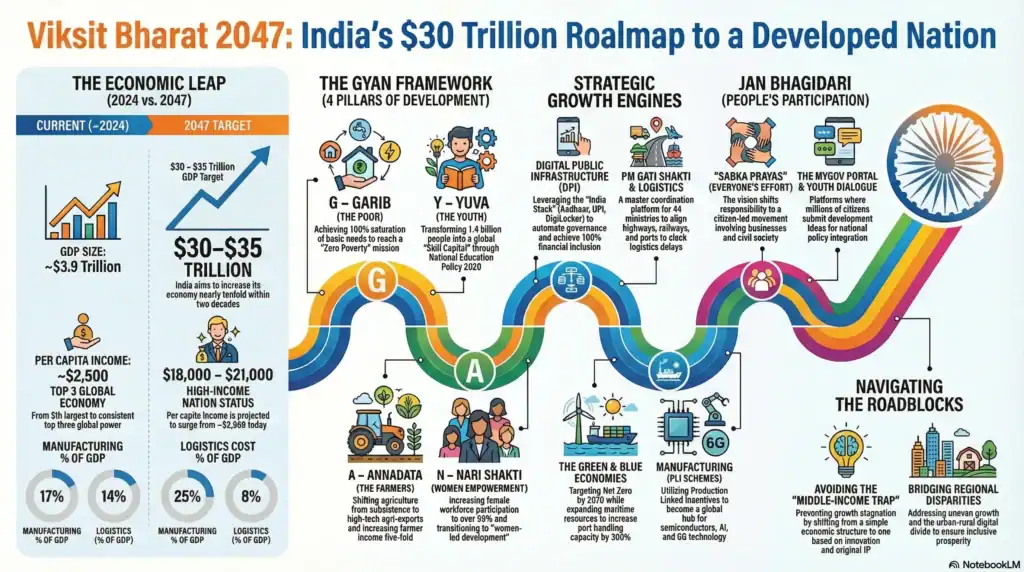
| Metric | Current (~2024) | 2047 Target |
| GDP Size | ~$3.9 Trillion | $30 – $35 Trillion |
| Per Capita Income | ~$2,500 | $18,000 – $21,000 |
| Global Economy Rank | 5th Largest | Top 3 |
The 4 Pillars (GYAN Framework)
- G – Garib (Poor): 100% saturation of basic needs (housing, water, power) and zero poverty.
- Y – Yuva (Youth): Transforming 1.4bn people into a global “Skill Capital” via NEP 2020.
- A – Annadata (Farmers): Shifting from subsistence to high-tech agri-exports.
- N – Nari Shakti (Women): Increasing female workforce participation to over 50%.
Strategic Growth Engines
- Digital Infrastructure: Scaling UPI, Aadhaar, and AI to automate governance.
- Manufacturing (PLI): Raising manufacturing’s share of GDP from 17% to 25%.
- Energy Transition: Achieving Net Zero by 2070 with a massive shift to Green Hydrogen and Solar.
- Logistics: Reducing logistics costs from 14% to 8% of GDP via PM Gati Shakti.
The “Jan Bhagidari” (People’s Participation)
Viksit Bharat is not just a government scheme; it’s a citizen-led movement.
- Call to Action: Citizens are encouraged to share ideas on the MyGov portal.
- Focus: Individual responsibility toward sustainability, civic sense, and innovation.
Who Launched Viksit Bharat? Origins, Timeline, and Leadership
If you try to pin down the exact moment Viksit Bharat was born, it’s a bit slippery. There wasn’t a single dramatic launch or a neat unveiling. Instead, the idea seemed to surface gradually, around late 2021, almost like it was being tested in the air before settling into policy.
By December that year, the government had started anchoring its long-term thinking around 2047, the centenary of independence. And then, over time, Prime Minister Narendra Modi began threading this idea, a developed India by 2047, into speeches, budget narratives, and policy documents. Not loudly at first, but consistently. Repetition did the work.
Somewhere along the way, it stopped being just a phrase and hardened into a framework, and
institutions followed. The Prime Minister’s Office, along with NITI Aayog, began shaping it into something more structured—targets, timelines, measurable outcomes, bureaucratic ownership. The kind of scaffolding that turns ambition into something you can at least attempt to execute.
There’s also been a conscious effort to make it feel participatory, not just top-down. One moment that stands out is the Viksit Bharat Young Leaders Dialogue in January 2025, held at Bharat Mandapam on National Youth Day. About 3,000 young people showed up, including students, early professionals, the sort of crowd that usually sits on the receiving end of policy rather than shaping it.
PM Modi’s message there was fairly direct: a developed India isn’t just about economic strength. It’s also about strategic confidence, social cohesion, cultural grounding, and, this part keeps coming up, it’s not something the government can deliver on its own.
That’s where the phrase Sabka Prayas enters the picture. “Everyone’s effort.” It sounds simple, maybe even familiar if you’ve followed Indian policy language over the years, but here it’s doing a lot of work because it quietly shifts responsibility.
Viksit Bharat, at least in theory, isn’t meant to be a scheme rolled out from Delhi for people to passively receive. It’s framed as something broader, messier, and harder to control. Citizens, businesses, universities, civil society, the state, all moving, ideally, in some kind of loose alignment.
Whether that level of collective ownership is realistic, that’s another question. But as an idea, it gives the vision a different kind of legitimacy. Not just authority from the top, but participation from below.
What Is Viksit Bharat? Meaning, Definition, and Goals
One of the more interesting shifts in the whole Viksit Bharat conversation, maybe easy to miss if you’re skimming, is that it quietly pushes back against the idea that development is just about GDP.
For years, that’s been the shorthand, right? Bigger economy = more developed country. Clean, measurable, convenient. But also, a bit incomplete.
The Viksit Bharat framework leans into that discomfort. It argues, fairly directly, that a country can be economically large and still fall short of being truly “developed” if everyday life doesn’t reflect that wealth. If people are still struggling to access decent schools, reliable healthcare, or even a basic sense of dignity in how they live.
So the definition expands or maybe stretches.
Economic growth is still essential, no one’s pretending otherwise, but it’s treated as one piece of a larger puzzle that includes social equity, environmental sustainability, and even geopolitical positioning. It’s a more layered idea of progress, though also a more difficult one to measure cleanly.
That’s where the Human Development Index (HDI) comes in. Not perfect, but useful. India’s HDI ranking has improved over time, yet it still lags behind what you might expect given the size of its economy. There’s a kind of mismatch there—growth on paper versus lived reality.
Viksit Bharat tries to close that gap. The goal isn’t just higher income, but better outcomes across the board: universal access to quality education, healthcare that doesn’t feel out of reach, and growth that actually filters down instead of pooling at the top.
And then there’s the global angle, which adds another layer altogether.
The vision doesn’t frame India as simply trying to “catch up” with developed nations. Instead, it leans into this idea of India as a Biswabandhu—a “Friend of the World.” A country that doesn’t just join existing systems, but nudges them, reshapes them, maybe even challenges them.
There’s talk of leading the Global South, of sharing digital public infrastructure, of making global institutions more equitable for developing countries. It’s ambitious, maybe even a bit idealistic, but it signals that Viksit Bharat isn’t just inward-looking.
Five Strategic Themes of Viksit Bharat 2047
Up to this point, Viksit Bharat can feel a bit abstract—big ideas, long timelines, a lot of ambition floating around. This section is where it tightens into something more operational. Less vision, and more blueprint.
The government breaks the journey to 2047 into five strategic themes. Think of them less as silos and more as overlapping tracks, each one carrying a chunk of the overall load.
1. Economic Growth and GDP Expansion
At the core of everything is a fairly blunt requirement: sustained GDP growth of 7% to 10% every year for the next two decades. Not a one-off spike, not a lucky cycle—consistent, resilient growth across good years and bad ones.
That’s easier said than done. It means keeping investment flowing, consumption steady, exports competitive, and innovation alive, even when global conditions wobble (which they inevitably will).
2. Technological Advancement and Innovation Leadership
There’s a quiet shift in tone here, from being a user of technology to becoming a creator of it.
The vision talks about India positioning itself as a global hub for artificial intelligence, semiconductors, and next-gen telecom like 6G. But underneath that is a deeper ambition: moving up the value chain. Not just assembling or servicing, but actually designing, inventing, owning intellectual property.
3. Infrastructure Development and Multimodal Connectivity
If you’ve spent time on Indian roads, or waited on delayed freight, you already know this one isn’t optional.
A $30 trillion economy can’t run on patchwork infrastructure. The scale needs to change. That’s where PM Gati Shakti comes in, a kind of master coordination system trying to align everything: highways, railways, ports, airports, even logistics parks.
4. Social Empowerment and Inclusive Development
This is the part that tries to keep growth from becoming exclusionary, because rapid economic expansion can, and often does, leave people behind.
The framework explicitly pushes for inclusive participation: social protection, access to opportunities, and a measurable reduction in poverty, not just by income, but across multiple dimensions of life.
5. Sustainability, Net-Zero Goals, and Green Economy
And then there’s the environmental constraint, which isn’t really optional anymore.
India has committed to net-zero emissions by 2070, but within Viksit Bharat, sustainability is framed less as a burden and more as an economic lever. Green industries, renewable energy, and circular systems are being positioned as growth engines, not trade-offs.
Taken together, these five themes try to answer a basic but difficult question: What actually needs to change for India to look different in 2047?
The answer, unsurprisingly, is almost everything.
Four Pillars of Viksit Bharat (GYAN Framework Explained)
If the earlier sections felt like macroeconomics and policy architecture, this one zooms in to people, or at least to how people are grouped within the vision.
The government packages this into an acronym: GYAN. It means “knowledge,” which is neat, but more importantly, it organizes development around four segments of society that are seen as both beneficiaries and drivers of change.
Garib: Poverty Reduction and Basic Needs Access
The starting point is fairly fundamental: no household should be left without basic necessities. Not as charity, not as occasional welfare, but as a baseline expectation.
So, this pillar leans heavily on access. This includes housing through PM Awas Yojana, tap water via Har Ghar Jal, electricity, LPG connections, and sanitation. Things that, once upon a time, were unevenly distributed enough to shape entire life trajectories.
What’s interesting is how delivery is evolving. The One Nation One Ration Card system, for instance, allows migrant workers to access subsidised food anywhere in the country, a small detail, maybe, but one that quietly acknowledges how mobile and fragmented livelihoods have become.
There’s an attempt here to make welfare portable. Less tied to place, more tied to the individual.
Yuva: Youth Empowerment, Education, and Skills
India’s demographic story gets repeated so often it risks sounding like background noise: 65% of the population is under 35.
But behind that statistic is a tension. A young population can be an asset or a liability, depending on whether there are enough opportunities to absorb it.
The Yuva pillar tries to channel that energy. The National Education Policy 2020 is a big part of this—reworking how education is structured, at least on paper. Then there are skill development programs, attempts to align training with what employers actually need (not always successfully, but the intent is there).
Platforms like My Bharat also signal something else: an effort to pull young people into policymaking conversations, not just treat them as future workers.
Whether that engagement is deep or symbolic probably varies case by case.
Annadata: Agriculture Modernization and Farmer Income
Despite all the talk of digital economies and AI, a huge portion of India still depends on agriculture.
About 140 million farming families—that’s not a sector you can sideline.
The Annadata pillar talks about increasing farmer income five-fold by 2047 which is a big claim. It hinges on modernization—better irrigation, stronger market linkages, more technology (think precision farming, drones, data-driven inputs).
But there’s also a careful balancing act here. The messaging repeatedly emphasizes that modernization shouldn’t mean displacement. That farmers stay at the center, just better equipped, better compensated.
How that balance plays out in reality is something people will keep watching closely.
Nari Shakti: Women Empowerment and Economic Participation
This pillar feels like a deliberate reframing.
Instead of positioning women as beneficiaries of development programs, the narrative shifts to women as drivers of development. It’s subtle, but it changes the tone.
One of the headline goals is increasing female labour force participation to somewhere between 50% and 70% by 2047. That’s not just a social objective, it’s an economic one. The kind that could significantly expand the workforce and reshape productivity.
There’s a mix of approaches feeding into this: self-help groups, entrepreneurship programs, legal reforms around property and inheritance. And then, of course, the broader narrative push—phrases like “women-led development” are becoming part of mainstream discourse.
What GYAN does, in a way, is anchor a very large national vision in recognisable groups. It gives faces- categories, at least- to what could otherwise feel like abstract growth targets.
But it also raises a quiet question: do these four buckets capture the full complexity of India’s social landscape? Or do they smooth over differences that matter?
Probably a bit of both.
Economic Growth Strategy: Scaling India to a $30 Trillion Economy
Strip everything else away – phrases, slogans, frameworks – and the core economic ask of Viksit Bharat is almost brutally simple:
Take a $3- 4 trillion economy and turn it into a $30 trillion one within about 20 years.
Saying it is easy. Sitting with it for a moment is something else.
Because this isn’t just about growing fast. It’s about growing well. A per capita income of around $26,000 doesn’t come from expansion alone, it requires productivity to rise, systems to become more efficient, and growth to hold together over time instead of sputtering in cycles.
And that brings us to manufacturing—the sector that keeps showing up in every serious growth conversation about India.
For decades, manufacturing has hovered at roughly 15% of GDP. The target is 25% by 2047. That gap might look small on paper, but closing it means something massive underneath: a 16-fold increase in manufacturing output, according to M&M Group CEO Anish Shah.
Sixteen times, it’s the kind of number that makes you pause and wonder—not just how, but how consistently over decades.
Policies like the Production Linked Incentive (PLI) schemes are part of that answer. They’re designed to nudge companies into producing more within India—electronics, pharmaceuticals, textiles, specialty steel, and so on.
Whether incentives alone can reshape an industrial base that’s still unfolding.
Then there’s the services sector, which is already doing a lot of the heavy lifting.
It contributes over 55% of GDP today and is expected to inch closer to 60% by 2047. India’s IT and business process outsourcing ecosystem is globally competitive, and the rise of Global Capability Centres (GCCs) adds another layer—over 1,700 of them, employing highly skilled workers for multinational firms, often at significantly lower costs than in their home countries.
In some ways, services are India’s comfort zone. Manufacturing is the stretch.
Hovering over all of this is the idea of Aatmanirbharta—self-reliance. Not in the sense of isolation, but in reducing vulnerability. Building domestic capacity in areas where dependence could become a strategic risk: semiconductors, defence equipment, critical minerals, clean energy systems.
What makes this section interesting is that it doesn’t leave much room for ambiguity. The targets are clear. The gaps are visible. The scale of transformation required is unmistakable.
The real question isn’t whether the roadmap exists.
It’s whether the execution can keep up with the ambition for 20 years straight.
Digital Public Infrastructure (DPI) and India Stack
If there’s one area where India doesn’t sound like it’s catching up, but rather setting the pace a little, it’s this.
The idea of Digital Public Infrastructure (DPI) isn’t flashy at first glance. No grand monuments, no visible skyline changes. But underneath, it’s quietly rewiring how the country functions.
At the center of it all is something often referred to as the India Stack. A layered system built on Aadhaar for identity, UPI for payments, and DigiLocker for document verification. Individually, each solves a specific problem. Together, they form a kind of digital backbone.
And what’s interesting is how quickly it scaled.
Aadhaar, for instance, now covers over 1.36 billion residents.
UPI is even more visible in everyday life. Tea stalls, auto rides, small shops—you see QR codes everywhere now. What used to be cash-heavy transactions have quietly shifted into real-time digital payments. At one point, India accounted for roughly 40% of global real-time payment volume.
It’s the kind of change that sneaks up on you. One day you notice you haven’t carried cash in weeks.
Then there’s Direct Benefit Transfer (DBT). On paper, it sounds bureaucratic—money moving directly from government to beneficiary accounts. But in practice, it’s meant to cut out layers where leakages used to happen. The claim is that it has already saved lakhs of crores by reducing inefficiencies.
Of course, implementation varies. But the direction is clear: fewer intermediaries, more direct access.
Looking ahead, the conversation shifts toward artificial intelligence.
There’s a growing expectation that AI could become a major productivity lever, adding something like $967 billion to India’s GDP by 2035.
That’s a big number, but more interesting is what sits behind it: investments in research, talent pipelines, regulatory frameworks. India’s position on global AI indices has been inching upward, which suggests something is moving beneath the surface.
And then there’s the infrastructure layer most people don’t see—data centres, cloud capacity, compute power. The Digital Hub Policy is trying to attract that kind of investment, positioning India as a base for global digital operations.
What makes this section stand out is that it doesn’t feel entirely hypothetical.
Unlike some other parts of the Viksit Bharat vision, digital infrastructure already has visible proof points. You can see it, use it, rely on it—sometimes without even thinking about it.
The challenge now is different.
Not building from scratch, but scaling responsibly and making sure the benefits don’t stop at the already-connected parts of the country.
Physical Infrastructure and Multimodal Connectivity
There’s a point where economic ambition runs into physical reality.
You can talk about trillion-dollar economies all day, but if goods move slowly, if ports clog up, if trucks sit idle on highways, growth starts leaking out in small, frustrating ways. India knows this part well.
Right now, logistics costs hover around 13–14% of GDP and that’s high. Advanced economies manage closer to 8%. That gap might sound technical, but it quietly affects everything—from the price of goods to how competitive exports are.
So one of the clear goals here is to bring that number down. Not dramatically overnight, but steadily towards that 8% mark by 2047. It’s one of those targets that doesn’t make headlines but could change a lot underneath.
At the centre of this effort sits PM Gati Shakti.
It’s not a single project, which can make it harder to grasp. Think of it more like a coordination layer—a digital platform that pulls together data from 44 ministries and departments. Roads, railways, ports, airports, waterways, logistics parks—all mapped, all (ideally) aligned.
The idea is to avoid the kind of planning gaps that have historically slowed things down like a road built without rail connectivity and a port without efficient hinterland links.
In theory, this should reduce delays, cut costs, and make infrastructure fee less fragmented.
In practice, coordination at that scale is always messy. But the attempt itself is significant.
Then there’s the money side of it.
The National Infrastructure Pipeline lays out an investment plan of around $1.4 trillion. It spans everything—transport, urban development, water systems, even digital infrastructure.
That number isn’t just about spending but it’s about signalling intent. That infrastructure isn’t an afterthought, but a central pillar of growth.
And by 2047, there’s a very specific benchmark in mind: breaking into the top five of the World Bank’s Logistics Performance Index. Not just building more, but building well enough to integrate smoothly into global supply chains.
There’s something very grounded about this part of the Viksit Bharat vision.
No abstraction, no philosophical framing. Just the recognition that for an economy to expand at that scale, its physical backbone has to keep up.
Or maybe even stay a step ahead.
Green Economy and Blue Economy Opportunities in Viksit Bharat
Green Economy: Sustainable Growth and Renewable Energy Transition
There was a time, not that long ago, when environmental goals were framed as trade-offs. Grow fast or stay sustainable. Pick one, compromise on the other.
Viksit Bharat tries to sidestep that binary.
Here, the green transition is positioned less like a burden and more like an opening. Almost an industrial opportunity hiding inside a climate obligation. There’s talk of 36 distinct green value chains—everything from renewable energy and green hydrogen to electric mobility, sustainable agriculture, and circular manufacturing.
Put together, these sectors are expected to generate around $1.1 trillion in market value and create roughly 48 million jobs by 2047. Big numbers again, but what’s interesting is the framing: sustainability as a source of jobs and growth, not just compliance.
Energy sits right at the center of this shift.
India plans to triple its primary energy supply while simultaneously pushing for a 40-fold increase in non-fossil energy capacity. The goal is that about two-thirds of total energy demand would eventually come from clean sources.
That balancing act, more energy, but cleaner, feels like one of the hardest parts of the entire vision because demand will rise no matter what. The question is what fuels it.
Blue Economy: Maritime Growth and Ocean-Based Opportunities
Then there’s the part of India that doesn’t always get as much attention in economic conversations: the ocean.
A 7,500-kilometre coastline, two island territories, and an exclusive economic zone stretching over two million square kilometres. On paper, it’s vast. In practice, still underutilised.
The Maritime Amrit Kaal Vision 2047 tries to change that. One headline target: a 300% increase in port handling capacity. That’s tied closely to initiatives like Sagarmala, which aims to reshape how ports connect to inland logistics.
But the blue economy isn’t just about ports.
India is already the world’s third-largest fish producer. Beyond that, there’s growing investment in deep ocean exploration, offshore wind energy, marine biotechnology, areas that feel a bit futuristic now, but could become significant over time.
At the moment, the blue economy contributes about 4.1% of GDP.
The expectation is that this share will expand as these sectors mature.
What’s interesting about this section is how it reframes two spaces, the environment and the oceans, that are often treated as secondary.
Here, they’re not side notes. They’re positioned as frontiers.
Still, there’s an underlying tension you can’t quite ignore: can rapid economic expansion and environmental sustainability actually move in sync over decades?
That answer probably won’t come from policy documents. It’ll show up slowly, in outcomes.
Human Capital Development in Viksit Bharat: Education, Healthcare, and Social Security
Education: Building a Skilled and Future-Ready Workforce
At some level, all of this – $30 trillion targets, infrastructure, technology – leans on a quieter assumption: that people will be ready for it.
And that’s where education comes in. Not just as a sector, but as the underlying engine.
The Viksit Bharat vision sets some fairly bold markers here – universal literacy, a jump in research and development spending from about 0.7% of GDP to 3% by 2047 – numbers that place India closer to countries like South Korea or Israel in terms of innovation intensity.
But numbers aside, the real shift being talked about is more qualitative.
The National Education Policy 2020 tries to move the system away from rote learning toward something more flexible—multidisciplinary study, early education in mother tongues, vocational skills woven into mainstream education, and a bit more emphasis on critical thinking. On paper, it sounds like the kind of reform that could reshape how people learn.
In reality, education systems are slow to change. Habits linger, but the direction is clear. There’s also a subtle but important goal underneath: keeping talent within the country. Or at least making it easier for researchers and innovators to stay or come back.
Healthcare: Expanding Access and Strengthening Public Health Systems
If education is about long-term capability, healthcare is more immediate. It’s about resilience—how well a society holds up when things go wrong.
Ayushman Bharat sits at the center of this effort. It’s often described as the world’s largest government-funded health assurance scheme, covering hospitalisation for over 55 crore people from economically vulnerable families.
That scale alone is hard to wrap your head around.
At the same time, healthcare in India is a bit of a paradox. There’s enormous potential, the market is projected to reach around $638 billion, but also clear gaps. Infrastructure, doctor-to-patient ratios, access in rural areas all still uneven.
NITI Aayog’s own assessments point out that scaling is unavoidable. More hospitals, more diagnostics, more trained professionals. Because a high-income economy, almost by definition, requires a healthcare system that can support it.
Zero Poverty Mission: Multidimensional Poverty Reduction
Then there’s poverty, which is arguably the most complex piece of all.
What’s changing here is how it’s being measured. Not just income anymore, but a multidimensional approach: access to education, healthcare, housing, sanitation, nutrition. The idea is that poverty isn’t just about how much money someone earns, but how they live.
The SDG India Index tracks this broader view, aligning national goals with the 17 Sustainable Development Goals.
It’s a more nuanced way of looking at deprivation, but also a harder one to solve, because it touches multiple systems at once.
What ties this entire section together is a simple, slightly uncomfortable truth.
Economic growth can build possibilities. But human capital determines whether those possibilities are actually used.
You can have world-class infrastructure, cutting-edge tech, but if education is uneven, if healthcare is fragile, if large sections remain excluded, the system doesn’t quite hold.
And maybe that’s why this part feels less like ambition and more like foundation.
Jan Bhagidari: How Citizens Can Participate in Viksit Bharat
There’s a phrase that keeps surfacing around Viksit Bharat—people’s movement. It sounds good, inclusive, and almost instinctively appealing.
But it also raises a practical question: what does participation actually look like?
Because it’s one thing to say “everyone’s involved,” and another to create real pathways for that involvement.
The government has tried to address this by opening up multiple channels – some formal, some more symbolic – where citizens can contribute ideas, feedback, or even just a sense of ownership.
The most direct entry point is through the Viksit Bharat@2047 section on the MyGov portal. It’s fairly open-ended. Students, professionals, farmers, retirees, and pretty much anyone can register and submit ideas across key development themes.
And people have registered in large numbers.
Millions of submissions, apparently. Suggestions ranging from very practical (local infrastructure tweaks, policy improvements) to more conceptual visions of what India could look like in 2047. Some are rewarded, most probably just sit there, but the act of participation itself seems to be the point.
Then there’s a more curated layer of engagement, especially for younger people.
My Bharat acts as a kind of umbrella platform, connecting youth to civic activities, skill-building programs, and policy discussions. It’s an attempt to bring younger voices closer to decision-making spaces, at least in some structured way.
The Viksit Bharat Young Leaders Dialogue builds on that idea. Every year, a selected group of young contributors gets the chance to engage directly with policymakers, including the Prime Minister, with the stated promise that their ideas won’t just be heard, but potentially integrated into policy.
How much of that actually translates into policy change that’s harder to track from the outside?
There’s also the Voice of Youth initiative by NITI Aayog, which leans more toward students and researchers, inviting them to submit detailed analyses and policy proposals on national challenges.
What all of this adds up to is an attempt- genuine or strategic, depending on how you look at it- to widen the circle of participation.
Not just voting every few years, but contributing ideas, however small.
Still, there’s a subtle tension here.
Opening the door to participation is one thing. Making that participation meaningful visible, and impactful is another. If people don’t see their inputs reflected anywhere, engagement can quietly fade.
But if even a fraction of those voices shape decisions over time then the idea of Jan Bhagidari starts to feel less like a slogan and more like a shift.
Key Challenges and Roadblocks to Achieving Viksit Bharat 2047
Any vision that stretches 20 – 25 years into the future has to wrestle with reality at some point. And this section does that at least to an extent.
Because it’s one thing to map out where India could go. It’s another to acknowledge what might slow it down or derail it entirely.
Inequality and Regional Disparities in India
India doesn’t grow evenly. It never really has.
Some states are pushing toward middle-income levels, building strong industries, attracting investment. Others are still dealing with basic developmental gaps like education, healthcare, infrastructure. And within states, the differences can be just as stark.
So, when you look at national-level numbers – GDP growth, digital adoption – they can sometimes blur what’s happening underneath.
There’s also the urban-rural divide, especially when it comes to digital access. While cities plug into India’s digital ecosystem quite seamlessly, many rural or remote areas are still catching up. Which means the benefits of things like digital public infrastructure aren’t distributed as evenly as they appear on paper.
And there’s a deeper concern here: if India reaches a $30 trillion economy but large sections of its population remain excluded, what does “developed” really mean in that context?
It becomes a statistical success. But a social imbalance.
The Middle-Income Trap Risk
This is the quieter, more structural risk and arguably the more serious one.
Many countries grow rapidly up to a point. Cheap labour, expanding markets, basic industrialization—they carry momentum for a while. But then growth slows, wages rise, competitiveness dips, and without strong innovation or advanced manufacturing and economies plateau.
That’s the middle-income trap.
India isn’t there yet, but it’s not immune either.
According to the Harvard Atlas of Economic Complexity, India’s economic structure is still relatively simple for its size.
Which means the next phase of growth can’t rely on the same playbook.
It has to shift from assembling to designing, from consuming to innovating. That transition demands sustained investment in education quality, research, intellectual property, and institutional strength. Not for a few years, but consistently, over decades.
That’s the hard part. Not starting the climb, but sustaining it.
External Risks and Global Economic Volatility
And then there are the things no country can fully control.
Global trade tensions, climate disruptions, floods, and heatwaves, which impact agriculture and infrastructure. Financial market swings. Rapid technological shifts can make entire industries obsolete almost overnight.
A 25-year plan has to assume that shocks will happen. The only question is how resilient the system is when they do.
This is partly why Aatmanirbharta – self-reliance- keeps coming up. Not as isolation, but as a buffer. Building domestic capacity so that external disruptions don’t hit as hard.
Still, complete insulation isn’t realistic. Nor is it desirable for an economy that wants to stay globally connected.
What stands out in this section isn’t just the challenges themselves, it’s how persistent they are.
These aren’t short-term obstacles you fix with a policy tweak. They’re structural, slow-moving and sometimes invisible until they become unavoidable.
Which means the success of Viksit Bharat may depend less on how fast India grows and more on how it handles these pressures along the way.
FAQ: Everything You Need to Know About Viksit Bharat 2047
Viksit Bharat is India’s national roadmap to becoming a fully developed, high-income nation by 2047, marking 100 years of independence. It focuses on four key areas: economic prosperity, social advancement, environmental sustainability, and effective governance.
Amrit Kaal refers to the critical 25-year transformation period (2022–2047). It is the window for India to leverage its “demographic dividend”, its large youthful population, to achieve rapid, structural economic shifts.
The GYAN framework represents the core groups driving India’s development:
G (Garib/Poor): Achieving 100% saturation of basic needs and zero poverty.
Y (Yuva/Youth): Focusing on education, high-tech skills, and employment.
A (Annadata/Farmers): Modernizing agriculture and boosting global exports.
N (Nari Shakti/Women): Increasing female workforce participation and leadership.
India aims to grow from a ~$3.9 trillion economy to a $30–$35 trillion GDP. This includes raising the per capita income from approximately $2,500 to a high-income range of $18,000–$21,000.
How will India achieve such massive GDP growth?
The strategy involves maintaining a 7–10% real GDP growth rate through:
Increasing manufacturing to 25% of GDP.
Lowering logistics costs via PM Gati Shakti.
Expanding Digital Public Infrastructure (DPI) to ensure 100% financial inclusion and efficiency.
DPI is the digital backbone of the vision. Systems like Aadhaar, UPI, and DigiLocker enable seamless governance, instant payments, and data-driven policy execution, ensuring that development benefits reach every citizen without leakages.
Jan Bhagidari means “People’s Participation.” The vision emphasizes that development is a collective responsibility (Sabka Prayas). Citizens can contribute by sharing ideas on the MyGov portal and aligning personal growth with national goals.
Green Economy: Focuses on renewable energy, green hydrogen, and achieving Net Zero by 2070.
Blue Economy: Focuses on the sustainable growth of maritime resources, including ports, shipping, and ocean-based energy.
Key obstacles include navigating the Middle-Income Trap, reducing regional and income disparities, managing climate change impacts, and ensuring that economic growth translates into high-quality job creation for the youth.
Unlike previous plans that were often fragmented, Viksit Bharat is a holistic, long-term framework. It integrates economic growth with social equity, environmental goals, and India’s role as a “Vishwa Mitra” (Global Friend) in international leadership.
The Road to Viksit Bharat 2047
When you strip everything back, the numbers, the frameworks, the acronyms, Viksit Bharat comes down to a fairly bold wager.
That 1.4 billion people, moving in roughly the same direction (even if not perfectly aligned), can reshape the trajectory of a country within a single generation.
It’s not a small bet.
There’s a certain logic behind it, though. India has a young population, a democratic system that, messy as it is, absorbs pressure over time, and a digital backbone that didn’t exist at this scale even a decade ago. Add to that a sustained policy push, and you start to see why the vision doesn’t feel entirely implausible.
But there’s a catch. Actually, a few.
For one, this can’t be a Delhi-driven story alone. The idea of Viksit Bharat quietly leans on something deeper: that India’s states carry as much weight as the centre—maybe more, in practice.
Because development in India doesn’t happen uniformly. It happens state by state, district by district. A Viksit Bharat, if it ever materialises, will almost certainly be the sum of multiple Viksit States, each evolving at its own pace, solving its own constraints, contributing to a larger whole
That decentralised reality is both a strength and a complication.
There’s also the question of precedent.
Countries like South Korea, Singapore, China, Taiwan have all undergone transformations that, at least numerically, look similar. Rapid growth, structural shifts, rising incomes over a few decades.
But India’s path is different. Larger, more diverse, more politically layered. Progress here tends to be slower, but sometimes more durable because it’s negotiated rather than imposed.
Whether that trade-off works in India’s favour over 25 years—that’s still unfolding.
And then there’s perhaps the most distinctive part of this whole vision: the emphasis on citizen agency.
Not just as a talking point, but as a central idea that Viksit Bharat isn’t something delivered to people, but something built by them.
It sounds idealistic. Maybe it is.
But it also reframes the entire project.
Because if this vision succeeds, it won’t just be because policies were well designed or targets were met. It’ll be because enough people, across different regions, professions, backgrounds chose, in small and uneven ways, to participate in that direction.
And if it doesn’t then that gap between aspiration and outcome will tell its own story.
Either way, the Amrit Kaal isn’t just a countdown to 2047. It’s more like a test of capacity, coordination, and, maybe more than anything else, collective intent.
Disclaimer
The content provided on this page is designed as an educational explainer to help simplify complex topics and is for general informational purposes only. While we make every effort to ensure the accuracy, completeness, and reliability of the information presented at the time of publication, facts and circumstances can change. The information provided here is on an “as is” basis and does not constitute professional, technical, or legal advice. This explainer should be used as a foundational guide for understanding the topic, and readers are encouraged to conduct their own independent research or consult with relevant professionals before taking any action based on this content.




Discussion (5)
Leave a Reply