
PM Viksit Bharat Rozgar Yojana (PMVBRY) 2026: The Complete Guide

Understanding the PM Viksit Bharat Rozgar Yojana (PMVBRY) Scheme
The Pradhan Mantri Viksit Bharat Rozgar Yojana pays a first-time employee up to Rs 15,000, and it pays an employer up to Rs 3,000 a month for each additional hire kept on the payroll. The Employees’ Provident Fund Organisation (EPFO) runs both payments. The Union Cabinet approved the scheme on 1 July 2025 with a budgetary outlay of Rs 99,446 crore, and it covers jobs created between 1 August 2025 and 31 July 2027.
PMVBRY is really two schemes on one database. Part A pays the worker, and Part B pays the establishment. Neither pays out without a live EPF account backed by an Aadhaar-authenticated Universal Account Number (UAN), and neither pays without monthly returns that reach EPFO on time.
On 1 August 2026 the government reported over 72 lakh first-time employees, nearly 30 per cent of them women. More than 15 lakh beneficiaries had already been paid.
Just over 10 months remain in the registration window.
At A Glance: PM Viksit Bharat Rozgar Yojana
- Dual-Benefit Scheme: The PMVBRY pays up to Rs 15,000 to first-time employees (Part A) and up to Rs 3,000 a month to employers for each additional hire (Part B).
- Eligibility Window: Covers formal jobs created between 1 August 2025 and 31 July 2027.
- Mandatory Requirements: Requires an active EPFO account, regular ECR filings, and an Aadhaar-authenticated Universal Account Number (UAN) using Face Authentication on the UMANG app.
- Employee Conditions: Gross wage must be up to Rs 1 lakh a month. The second incentive installment requires completion of a mandatory financial literacy programme.
- Employer Incentives: Paid in six-monthly lump sums for up to two years, extended to four years for the manufacturing sector.
- Financial Scope: Backed by a Rs 99,446 crore budgetary outlay targeting the formalization of over 3.5 crore jobs.
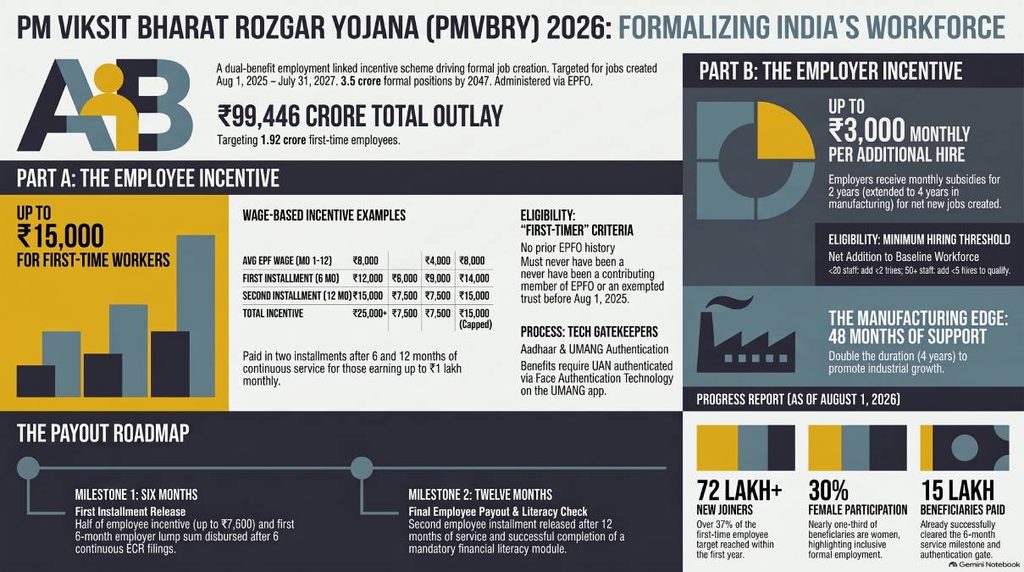
What is the Pradhan Mantri Viksit Bharat Rozgar Yojana (PMVBRY)?
PMVBRY is the Employment Linked Incentive (ELI) scheme under a new name. Official documents spell Rozgar as both Rozgar and Rojgar and write the acronym as both PMVBRY and PM-VBRY, and all of them mean the same scheme. The Cabinet cleared it to promote employment generation and employability across all sectors, MSMEs and rural enterprises included. Social security coverage is meant to widen with it, and manufacturing gets special focus. On 25 July 2025 the Labour Ministry confirmed that the scheme would take effect on 1 August 2025 under the PM-VBRY name.
The two parts split on who receives the money and how it reaches them.
| Feature | Part A | Part B |
| Who is paid | First-time employee | Employer with additional hires |
| Amount | One month of EPF wage, up to Rs 15,000 | Up to Rs 3,000 a month per additional employee |
| Payment schedule | Two instalments, after six and twelve months | Six-monthly lump sums after six completed months of ECRs |
| Payment route | DBT through ABPS to an Aadhaar-seeded account | PAN-linked bank account of the establishment |
| Wage ceiling | Up to Rs 1 lakh a month | Up to Rs 1 lakh a month |
| Duration | One year of employment | Two years, or four in manufacturing |
| Extra condition | Financial literacy programme | Minimum additional hires |
Vision and Objectives of the Employment-Linked Incentive Scheme
The stated purpose is more formal employment, and the method is to pay both sides of the hiring decision. A first-time worker receives one month of EPF wage as an incentive. An employer receives a monthly amount for each additional worker retained for six months. Part of the worker’s payment goes into a savings instrument, and the second instalment stays locked until the worker completes a financial literacy programme.
Nothing is paid up front. The worker’s two instalments wait for six and twelve months of service, and the employer’s lump sums wait for six completed months of returns, so the scheme pays for jobs that last and a job offer on its own earns nothing.
Deloitte’s tax alert on the scheme guidelines traces the idea to the Union Budget 2024-25, where it appeared as a flagship programme for job creation and workforce formalisation. The name came later, when the labour ministry renamed the scheme to fit the Viksit Bharat initiative and tied it to the government’s goal of employment that is inclusive and sustainable.
The Aatmanirbhar Bharat Rozgar Yojana (ABRY) is a working precedent. It started on 1 October 2020 to pay employers for new hires and for jobs restored after the Covid-19 pandemic, and registration closed on 31 March 2022. By 31 March 2024 it had reached 60.49 lakh beneficiaries.
The August 2026 PIB backgrounder frames PMVBRY as part of the demographic-dividend argument. Millions of young people enter the labour market every year, and formal jobs that carry social security are what turn that number into lasting growth.
Also Read: Viksit Bharat 2047: Analyzing the Strategic Policy Roadmap for a $30 Trillion Economy
Key Statistics, Job Targets, and Financial Outlay for 2026
Some of these figures describe the plan and the rest describe the record so far.
| Item | Figure |
| Cabinet approval | 1 July 2025 |
| Effective date | 1 August 2025 |
| Window for jobs created | 1 August 2025 to 31 July 2027 |
| Budgetary outlay | Rs 99,446 crore |
| Job target | More than 3.5 crore |
| First-time employees within that target | 1.92 crore |
| Maximum Part A incentive | Rs 15,000 per employee |
| Maximum Part B incentive | Rs 3,000 a month per additional employee |
| Wage ceiling | Rs 1 lakh a month |
| Union Budget 2026-27 allocation | Rs 20,083 crore |
| First-time employees joined by 1 August 2026 | Over 72 lakh |
| Beneficiaries paid by 1 August 2026 | More than 15 lakh |
| Women among beneficiaries | Nearly 30 per cent |
The targets and dates come from the labour ministry release of 25 July 2025 and the PIB release of 18 December 2025. Deloitte’s alert of 3 July 2025 on the Cabinet decision carries the same job targets and the same window. The results come from the PIB backgrounder of 1 August 2026.
PRS’s analysis of the Union Budget 2026-27 lists Rs 20,083 crore for the scheme in 2026-27, against zero in the same table for 2024-25 actuals and for both the budget and revised estimates of 2025-26. PRS describes the scheme as one that gives incentives to newly employed youth and employers, and it attributes part of the rise in the Scheduled Castes allocation to it. In PRS’s table of major schemes, the Rs 20,083 crore line falls just below PM Surya Ghar Muft Bijli Yojana at Rs 22,000 crore and just above Bharatnet and the RDI Scheme at Rs 20,000 crore each. The 1.92 crore first-timer target sits inside the 3.5 crore job target, which leaves a balance of about 1.58 crore.
Set the 72 lakh joiners against the 1.92 crore first-timer target and the result is a little over 37 per cent, reached at the halfway point of the two-year window. The 15 lakh figure counts payments, a different measure from joiners, and payments trail joining by design because a first instalment cannot fall due before six months of service.
An Economic Times report ran under a headline saying the scheme had met just 10 per cent of its target in six months. That covers the first six months only, while the PIB numbers cover twelve. A separate Economic Times report has a headline that puts the initiative at Rs 1 lakh crore, a rounded-up figure for the Rs 99,446 crore outlay.
The Role of the EPFO in PMVBRY Administration
EPFO is the delivery arm. The Ministry of Labour and Employment runs the scheme through it, and EPFO enrolment data decides who is covered and who gets paid.
- Establishments must hold an EPFO registration to claim Part B, whether they are existing establishments or new ones.
- Workers are identified by their UAN, and no incentive is released until that number has been authenticated through Face Authentication Technology on the UMANG app.
- Monthly Electronic Challan-cum-Return (ECR) filings, made along with contributions, confirm that a job exists and continues.
- Money moves by direct benefit transfer, into an Aadhaar-seeded account for workers and a PAN-linked account for establishments.
- A PM-VBRY portal tracks beneficiaries and sector-wise progress in real time.
The EPFO channel also fixes where the scheme stops. A job without an EPF account cannot draw either incentive, so work outside EPFO coverage falls outside the scheme by design.
Disputes go to EPFO, which works to a 15-day resolution timeline under the guidelines. Outreach runs through cross-functional teams in which EPFO officials work with the Employees’ State Insurance Corporation and the office of the Chief Labour Commissioner.
The scheme sits at four public web addresses. EPFO hosts the main portal at and the labour ministry runs a companion site at The myScheme directory lists the scheme, and the National Portal of India carries a spotlight page.
Part A: PMVBRY Incentives for First-Time Employees
Part A is for workers in their first EPFO-covered job. To qualify, the worker must join an establishment covered by EPFO or an exempted trust between 1 August 2025 and 31 July 2027, on a gross wage of up to Rs 1 lakh a month.
The Rs. 15,000 Financial Incentive Breakdown
The incentive is one month of EPF wage, capped at Rs 15,000, and it arrives in two instalments during the first year of employment.
The arithmetic comes from Deloitte’s summary of the guidelines. The first instalment is half the average EPF wage over six continuous completed months, capped at Rs 7,500. The second is the average EPF wage over twelve completed months minus the first instalment, and the two together cannot pass Rs 15,000.
Four wage profiles run through that arithmetic in the next table. These are worked examples and not an official payout table.
| Average EPF wage, months 1 to 6 | Average EPF wage, months 1 to 12 | First instalment | Second instalment | Total |
| Rs 8,000 | Rs 8,000 | Rs 4,000 | Rs 4,000 | Rs 8,000 |
| Rs 12,000 | Rs 14,000 | Rs 6,000 | Rs 8,000 | Rs 14,000 |
| Rs 15,000 | Rs 15,000 | Rs 7,500 | Rs 7,500 | Rs 15,000 |
| Rs 25,000 | Rs 25,000 | Rs 7,500 | Rs 7,500 | Rs 15,000 |
The cap bites early for higher earners, since a worker whose twelve-month average EPF wage reaches Rs 15,000 receives the full Rs 15,000 and nothing more.
The second instalment does not reach the worker as spending money. The December 2025 PIB release says it is credited to an appropriate savings instrument or savings account for a specified period. The July 2025 Labour Ministry release describes a portion of the incentive as held back in this way and withdrawable later. How long the holding period lasts is not stated in any of the documents cited here, and Deloitte’s September 2025 alert said the ministry would specify it in later guidelines.
Two rules apply once the money has arrived. The incentive is taxable under the Income-tax Act, 1961 unless the competent authority issues an exemption order, and it is payable on top of incentives under any other scheme.
Payments stop in four situations: the worker leaves of their own volition, the beneficiary dies, the establishment closes or winds up, or fraud or misrepresentation comes to light.
Detailed Employee Eligibility Criteria
A worker must meet all six conditions at once.
- The worker had never been a contributing member of EPFO or an exempted provident fund trust before the scheme began.
- The worker joins between 1 August 2025 and 31 July 2027, and EPFO or the trust receives a contribution for that worker for the first time.
- Gross wage at joining is up to Rs 1 lakh a month, and gross wage covers all emoluments, in cash or kind, under the employment contract.
- The UAN is authenticated through Face Authentication Technology on the UMANG app.
- ECRs with contributions are filed for six continuous months to earn the first instalment and for twelve completed months to earn the second.
- The worker completes the financial literacy programme before the second instalment is released.
Contributions decide who counts. Deloitte’s summary is explicit that members for whom the establishment has not deposited the contribution are left out when benefits are worked out under either part. The twelve ECRs must also be filed within 18 months of the worker’s joining date, and past that point the second instalment may not be credited.
A late filing can be fixed only by the establishment, never by the worker.
Four groups of workers fall outside Part A.
- Workers who contributed to EPFO or an exempted trust before the scheme began.
- Anyone whose gross wage at joining is above Rs 1 lakh a month.
- Workers who joined before 1 August 2025 or after 31 July 2027.
- Anyone whose UAN never passes face authentication on the UMANG app.
A worker who changes jobs inside the first year should expect the remaining instalment to stop, because payments cease when a first-time employee leaves employment of their own volition.
The Mandatory Financial Literacy Program Requirement
A course stands between the worker and the second instalment. Deloitte defines the Financial Literacy Course as a mandatory module on personal finance, savings, investing and financial planning, delivered through EPFO’s employee portal.
The labour ministry release makes the second instalment payable after twelve months of service and completion of the programme, and the December 2025 PIB release repeats the condition. The PIB release speaks of successful completion, but the documents cited so far do not say whether that means a test with a pass mark or only finishing the modules.
The labour ministry gives the course a purpose of its own. It ties the parked portion of the incentive to a stated aim, which is to make saving a habit. A worker who joins late in the window faces the same twelve-month requirement as one who joined in August 2025, so the course belongs early in the first year and not at the end of it. No source sets a separate deadline for the course, and the only stated outer limit is the 18-month window for the twelve ECRs.
How the Aadhaar-Linked Direct Benefit Transfer (DBT) Works
Part A payments move by direct benefit transfer through the Aadhaar Bridge Payment System (ABPS), and the money lands in the bank account seeded with the worker’s Aadhaar number. The PIB backgrounder adds a gate. Incentives become available only after the UAN is authenticated through Face Authentication Technology on the UMANG app. Deloitte’s summary says the incentive is disbursed within 45 days after the eligibility condition is met and the paid ECR is on file, so disbursal can trail the last eligibility test by up to 45 days.
Employers are paid differently. Part B incentives go straight into the establishment’s PAN-linked bank account.
Workers need to watch two things. The bank account must be seeded with Aadhaar before the first instalment falls due, and a dispute goes to EPFO, which works to a 15-day resolution window.
Part B: PMVBRY Support and Financial Benefits for Employers
Part B pays establishments for net additional jobs in all sectors, and it applies to employees with gross wages up to Rs 1 lakh. Manufacturers get a longer run. Existing staff earn the employer nothing, because only hires above a defined baseline count.
Monthly Financial Incentives for Job Creation Explained
An employer receives up to Rs 3,000 a month, for two years, for each additional employee who stays employed for at least six months. The amount depends on the new hire’s EPF wage.
| EPF wage of the additional employee | Incentive per additional employee per month |
| Up to Rs 10,000 | Up to Rs 1,000, proportional to wage |
| Above Rs 10,000 and up to Rs 20,000 | Rs 2,000 |
| Above Rs 20,000, up to a salary of Rs 1 lakh | Rs 3,000 |
| Above Rs 1 lakh at joining | Not covered |
The slabs come from the Labour Ministry release. For wages below Rs 10,000, Deloitte puts the proportional rate at 10 per cent of the EPF wage, so a hire on Rs 8,000 earns the employer Rs 800 a month.
Employers are paid in six-monthly lump sums, released once six completed months of ECRs are on file and only for employees whose contributions were received.
Suppose an establishment clears its hiring threshold with two hires on EPF wages of Rs 25,000. It earns Rs 6,000 a month, or Rs 36,000 for each six-month lump sum, and a single top-slab hire kept for the full two years brings in Rs 72,000.
Existing tax relief can continue alongside the incentive. Deloitte notes that employers may remain eligible for the Section 80JJAA deduction of 30 per cent of first-year salary cost for up to three years, where the employee’s gross salary is below Rs 25,000 a month. The guidelines add that scheme incentives are payable on top of those under any other scheme, and that incentives received under the scheme are taxable unless the competent authority orders an exemption.
Special Extended Provisions for the Manufacturing Sector
Manufacturers get four years instead of two. The Labour Ministry extends Part B incentives to the third and fourth years for the manufacturing sector. The PIB backgrounder gives the reason as high employment generation potential.
At the top slab, one hire retained for four years earns an employer up to Rs 1,44,000, which is Rs 3,000 a month for 48 months and double the two-year maximum of Rs 72,000. The arithmetic is illustrative and assumes the hire stays on the EPF rolls throughout.
For a manufacturer with a baseline workforce of 60, the threshold is at least five additional employees. Five hires on EPF wages of Rs 25,000 earn Rs 15,000 a month, or Rs 7.2 lakh over four years, while a non-manufacturer with the same five hires earns Rs 3.6 lakh over two.
Deloitte’s summary defines manufacturing by reference to Section 2(72) of the Central Goods and Services Tax Act, 2017, and by what the establishment’s registration certificate records. A manufacturer counting on the longer window should check that its registration paperwork describes manufacturing activity.
On the scheme’s own terms, a manufacturing job created on the last day of the window, 31 July 2027, would still draw incentives into 2031.
Employer Eligibility and Minimum Hiring Thresholds
An establishment must pass four tests to qualify.
- The establishment is registered with EPFO, whether existing or new, or is an exempted establishment under the EPF Act.
- It adds at least two employees if its baseline workforce is below 50, or at least five if the baseline is 50 or more, and it keeps them for at least six months.
- Each counted employee has contributions received by EPFO or the exempted trust for at least six months, for both the employee and the employer, and a gross wage at joining below Rs 1 lakh a month.
- The establishment has a clean record: no pending EPFO inquiries under Sections 7A to 7C of the EPF Act, no pending inquiries under Para 26-B, no FIR filed by EPFO for fraud, and no irregularities under ABRY or any other scheme that are pending or decided against it.
- The hiring threshold has a cliff edge. An establishment with 49 employees needs two additional hires, while one with 50 needs five, so crossing the line moves the target by three jobs.
The Rs 1 lakh line is worded two ways. The labour ministry release says salaries up to Rs 1 lakh, while Deloitte’s definition of an eligible employee says below Rs 1 lakh. An employee paid exactly Rs 1 lakh sits on that boundary, and EPFO’s own guidance is the place to settle it.
Deloitte adds that Part B may be unavailable while PF inquiries are pending, even where the resulting orders have been appealed or not complied with.
An establishment found to have claimed incentives on fictitious data or documents faces action under the law, and the ministry said a full penalty clause would be issued separately.
For doubtful cases, the guidelines allow authorities to test claimed additional hiring against outside data such as tax deposits or electricity use. Calculation rules were still pending when Deloitte wrote. The scheme document said detailed guidelines for Part B calculations would be issued separately, so the latest EPFO or labour ministry notice is the place to confirm the final method.
Baseline Establishment and ECR Compliance Deadlines
Part B pays only for net additional jobs above a defined baseline. Members for whom no contribution was received earn no incentive but still count toward the baseline.
Exempted establishments have a fixed baseline window. They must submit ECRs with employee details for the twelve wage months from August 2024 to July 2025, and they must obtain Aadhaar-authenticated UANs for every employee, whether existing or new.
The working deadlines come from the ECR rules.
- Six completed months of ECRs with contributions release a worker’s first instalment and an employer’s first six-month lump sum.
- Twelve completed months of ECRs release a worker’s second instalment, and they must be filed within 18 months of the worker’s joining date.
- Under the revamped ECR module, EPFO allows regular returns that omit some active members for the first four months, and the omitted members are added through supplementary returns.
- After that grace period, a regular return is accepted only if returns for all active members of the month four months earlier have been filed.
- Errors are corrected through revised returns, and return and payment are now filed separately. Downward revisions are allowed only before payment starts for the wage month. Deloitte’s alert of 3 October 2025 reported that the revamped module was proposed for September 2025 onward, and EPFO was to confirm the date. It also noted that accurate ECR data now drives the benefit calculation under both parts.
Step-by-Step PMVBRY Registration and Claim Process
None of the scheme documents cited here asks a worker to file an application. Eligibility is read from EPFO data, so the worker’s tasks are authentication and the literacy course, and the employer’s task is clean filing.
How Employers Can Register on the Official PMVBRY Portal
Here is the official portal and the Labour Ministry’s companion site. The PIB backgrounder describes the portal as the platform for running the scheme end to end and monitoring it in real time. EY held a webcast on 21 August 2025 that covered scheme registration and incentive calculation, and its description labels the two parts Scheme A and Scheme B. The click path sits in the portal’s screens, and the sources behind this guide do not spell out its form fields, so the steps below cover what the guidelines make compulsory before any incentive can be claimed.
- Hold a live EPFO registration for the establishment, or exempted status under the EPF Act. Part B covers only establishments on EPFO’s rolls.
- Create Aadhaar-based UANs for every new joiner, and authenticate them for existing employees who qualify.
- Keep the establishment’s PAN-linked bank account current, since Part B is paid into it.
- File the monthly ECR with contributions, and place every active member in the regular return.
- Check beneficiary and incentive status on the PMVBRY portal, and use EPFO’s 15-day grievance channel for disputes.
Deloitte’s advice to employers adds four habits to that sequence. Run a cost-benefit check to spot eligible employees early, and watch workforce changes while keeping ECR filing regular. Reconcile the incentive against payroll each period so reported figures and actual payroll do not drift apart, and review contracts and internal procedures, along with the definition of gross wage, so they fit the scheme’s terms.
Employee Onboarding and Aadhaar Authentication via UMANG App
Workers have four steps to complete.
- Hold a UAN linked to Aadhaar. The first-timer test applies at this point, and Deloitte’s summary defines a first-timer as an employee who was not a contributing member of EPFO or an exempted trust before the scheme began. The joining date must also fall in the registration period, and the first contribution must reach EPFO or the trust.
- Complete Face Authentication Technology on the UMANG app. The PIB backgrounder makes this the gate for every incentive.
- Confirm that the bank account is seeded with Aadhaar for ABPS payments.
- Finish the financial literacy module on EPFO’s employee portal before the second instalment falls due.
The authentication rule applies to the worker whatever the establishment does. An employer can file every ECR on time and the incentive will still wait for the face authentication. The exact taps sit inside the UMANG app.
Timelines for Claiming the Installments
Every deadline in the scheme runs from a worker’s joining date or from the filing of monthly returns.
| Milestone | Timing | What happens |
| Joining | 1 August 2025 to 31 July 2027 | The worker’s first EPFO contribution starts the count |
| Six completed months | ECRs with contributions for six continuous months | First instalment of up to Rs 7,500 falls due, and the employer’s first lump sum falls due |
| Twelve completed months | Twelve ECRs with contributions, plus the literacy course | Second instalment falls due |
| Outer limit | Within 18 months of joining | The twelve months of ECRs must be on file |
| Payment | Within 45 days of eligibility and a paid ECR | DBT to the worker’s Aadhaar-seeded account or the employer’s PAN-linked account |
| Grievance | 15-day resolution window | EPFO handles disputes |
| Employer cycle | Every six completed months of ECRs | Lump-sum release for eligible additional hires |
Take a worker who joins on 1 October 2025. Six completed months end on 31 March 2026 and twelve end on 30 September 2026. The twelve ECRs must be on file by the end of March 2027.
Workers who joined in the scheme’s first weeks completed twelve months on 31 July 2026, so their second-instalment claims are falling due about now. The last joiners run on the same clock. A worker who joins on 31 July 2027 completes six months on 31 January 2028 and twelve on 31 July 2028, and the twelve ECRs must be on file by the end of January 2029.
For an employer, the rhythm is the same. Two hires on EPF wages of Rs 25,000 who join on 1 October 2025 reach six completed months on 31 March 2026. The first lump sum of Rs 36,000 falls due once the ECRs are on file and the eligibility tests are met. A further lump sum falls due at every six-month mark, so the two-year incentive period produces four payments, or eight in manufacturing.
Five things hold up a payment.
- The establishment has not deposited the month’s contribution.
- The UAN has not passed face authentication on UMANG.
- The worker left of their own volition before the milestone.
- EPFO inquiries or an EPFO fraud FIR are pending against the establishment.
- The twelve months of ECRs missed the 18-month window.
Impact and Long-Term Vision of the PMVBRY Scheme
The sources behind this guide back the government’s formalisation claim with numbers, while its manufacturing and 2047 claims rest on stated intentions.
Formalizing the Indian Workforce and Expanding Social Security
Formalisation is the part of the scheme that can be measured. Every incentive rests on an EPFO registration, a UAN, an Aadhaar check and monthly contributions, so a worker who draws one is on the organised-sector rolls by construction. Over 72 lakh first-time employees have joined the formal workforce since August 2025, and nearly 30 per cent of beneficiaries are women. The 15 lakh already paid have cleared the six-month service test and the authentication gate. The backgrounder presents the female share as progress on participation in formal employment, although it publishes no target for it.
ABRY gives PMVBRY a yardstick. It had reached 60.49 lakh beneficiaries by 31 March 2024, counted across its whole life. Joiners and paid beneficiaries are different counts, so the fair test is the 15 lakh paid against ABRY’s 60.49 lakh, and on that measure PMVBRY is still well short of its predecessor.
Verification does not stop at EPFO. Deloitte notes that the scheme brings fraud detection and data integration across the Income Tax, GST, MCA and EPFO systems, so an establishment’s claimed hiring can be checked against records held elsewhere.
Social security coverage is the second output. EY’s summary gives the aims as workforce formalisation and sustained employment, with financial literacy for employees alongside, and the savings instrument attached to the second instalment carries the design past the EPF account itself.
Parliament has asked about the scheme more than once. The December 2025 PIB release was itself a written reply in the Rajya Sabha, and the PRS tracker lists an unstarred Rajya Sabha question titled PMVBRY scheme, put to the Labour and Employment ministry on 30 July 2026.
Accelerating the National Manufacturing Mission
The PIB backgrounder says PMVBRY complements the National Manufacturing Mission by promoting employment in new industries and in expanding ones, and that it widens social security coverage in labour-intensive manufacturing.
In the documents cited here, the four-year incentive is the only sector-specific provision. The slabs and the filing rules apply to every sector alike, so a garment unit and a software firm face the same paperwork and differ only in how long the payments run.
The Union Budget 2026-27 pairs the scheme with industrial spending. PRS lists two manufacturing measures: a higher outlay for electronics component manufacturing, from Rs 22,919 crore to Rs 40,000 crore, and a textile programme whose five parts include a Textile Expansion and Employment Scheme.
The sources cited here give no manufacturing-specific hiring count. The portal is said to track sector-wise progress, and those figures are the ones to watch.\
FAQ: PM Viksit Bharat Rozgar Yojana
To be eligible, a new employee’s gross wage must be up to ₹1,00,000 per month at the time of joining. Employees earning above this threshold are counted toward the employer’s baseline hiring target but do not receive the direct financial incentive.
The first-time employee incentive of up to ₹15,000 is paid in two installments via an Aadhaar-seeded Direct Benefit Transfer (DBT). The first half is disbursed after six completed months of service, and the remainder is paid after twelve months of service and the completion of a mandatory financial literacy course on the EPFO portal.
To receive payments, employees must verify their Universal Account Number (UAN) using the Facial Authentication Technology (FAT) available exclusively on the UMANG mobile application.
If a beneficiary leaves their employment voluntarily before completing the required 6-month or 12-month service milestones, the payment of incentives will immediately cease.
Employers with fewer than 50 employees must hire at least 2 additional workers, while establishments with 50 or more employees must hire at least 5 additional workers over their established baseline to trigger the monthly wage support benefits.
No. Businesses with pending inquiries under Sections 7A, 7B, or 7C of the EPF Act, or those with active police complaints (FIRs) for fraud, are strictly excluded from receiving any employer incentives until cleared.
Building a Secure Workforce for Viksit Bharat 2047
The government frames the scheme around Viksit Bharat 2047. The PIB backgrounder ties PMVBRY to the demographic dividend and treats formal employment with social security as the route from a young population to sustained development.
The Union Budget 2026-27 also announces a Standing Committee on Education to Employment and Enterprise, which is to develop the service sector and to assess what artificial intelligence does to jobs. PMVBRY runs on a separate track and pays for hiring in any EPFO-registered sector, services included.
The registration window is short but the payout tail is long. Hires made late in the window draw incentives for two years in most sectors and four in manufacturing, so the scheme’s cash calls run well past July 2027. PRS shows Rs 20,083 crore budgeted for 2026-27, roughly a fifth of the Rs 99,446 crore outlay.
A scheme that pays when workers reach six months and twelve months of service reports its results in cohorts. The first cohort, the workers who joined in August 2025, completed twelve months in July 2026. The last completes in July 2028, and its employer payments run later still, so the full record arrives years after the window closes.
Any job that begins on or after 1 August 2027 falls outside the scheme.
Disclaimer
The information provided on this website, including details regarding the Pradhan Mantri Viksit Bharat Rozgar Yojana (PMVBRY), is for general informational and educational purposes only. It does not constitute financial, legal, tax, or professional advice. While we endeavor to maintain accuracy, government schemes, guidelines, deadlines, and eligibility criteria are subject to frequent changes without notice. We make no representations or warranties of any kind, express or implied, about the completeness, accuracy, or reliability of the information provided. Any reliance placed on this information is strictly at your own risk. In no event will we be liable for any loss or damage arising from the use of this website or reliance on its content. You should consult with appropriate professionals for specific advice tailored to your situation. Links to third-party websites are provided for convenience; we do not endorse or guarantee the accuracy of their content. This disclaimer is subject to change at any time.




Discussion (1)
Leave a Reply