
Aadhaar Free Document Update Online: Last Date Extended to 2027
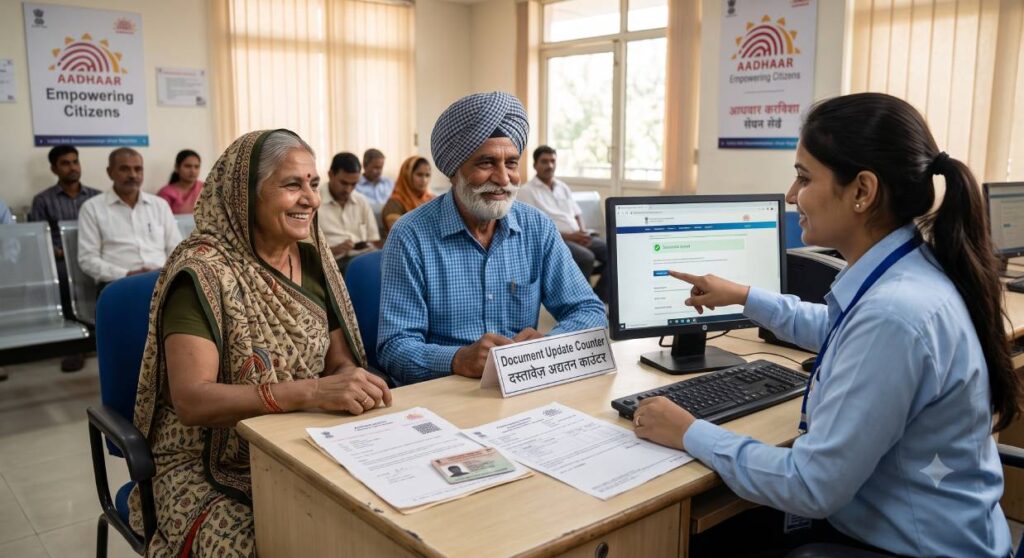
Aadhaar Free Document Update 2026–2027: What Has Changed and Why It Matters
UIDAI has extended the free online Aadhaar document update to June 14, 2027. If you are still searching for the “last date 2026”, that deadline has already been renewed. June 14, 2026 came and went, and the waiver carried on.
The waiver is narrow. It covers one task: uploading proof of identity and proof of address through the myAadhaar portal. A walk-in at an Aadhaar centre, a biometric capture and most other changes to a record still cost money or need a visit in person. Most of the time people lose goes to mixing up these routes.
| Item | Detail |
| Free window | June 15, 2026 to June 14, 2027 |
| What is free | Online upload of identity and address proof on myAadhaar |
| Fee for the same update at a centre | Rs 75 (it was Rs 50 when the free scheme began in 2023) |
| Needed to log in | Aadhaar number and the mobile number registered with it |
| File types accepted | JPEG, PNG and PDF |
| Tracking number | 14-digit URN |
| Free biometric update for children | Window closed on September 30, 2026 |
Everything below was checked as of October 5, 2026. UIDAI revises fee notices with little warning, so confirm anything time-sensitive on the official portal before you pay or travel.
At a Glance: Aadhaar Free Document Update Online, Last Date Extended
- Extended Deadline: The last date for the free Aadhaar document update has been officially extended to June 14, 2027 (previously June 2026).
- Eligible Free Services: The fee waiver applies exclusively to uploading updated Proof of Identity (POI) and Proof of Address (POA) documents.
- Official Online Platform: The service is only free when completed online through the official myAadhaar portal.
- Offline Centre Fees: Submitting the exact same document update in person at an Aadhaar enrolment centre will cost the standard Rs 75 fee.
- Mandatory Prerequisites: You must have access to your linked mobile number to receive the required six-digit login OTP.
- Document Upload Rules: Accepted files must be clear, uncropped JPEG, PNG, or PDF formats, and each file must be under 2 MB in size.
- Excluded Updates: Changes to your mobile number, biometrics, date of birth, or gender are not covered by this waiver and require standard fees and/or a centre visit.
- Children’s Biometrics (Baal Aadhaar): The free biometric update window for children officially closed on September 30, 2026; updates now carry a standard Rs 125 fee.
The Official Deadline: What Happened to the 2026 Last Date?
UIDAI’s Extension from June 2026 to June 14, 2027
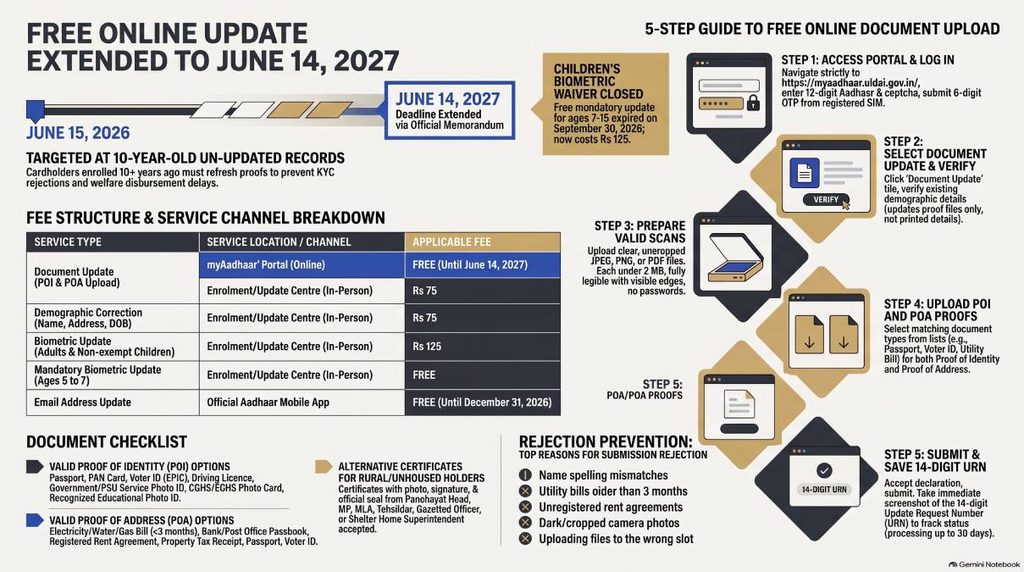
The free window was set to end on June 14, 2026. It did not. UIDAI issued an office memorandum dated May 13, 2026 that renews the fee waiver for another year, from June 15, 2026 to June 14, 2027, and the document update on the myAadhaar portal stays free for that whole period.
The original memorandum is in the Official Memorandums section of the main UIDAI site. Old screenshots and old articles keep stale dates circulating long after a deadline moves, and a forwarded image of a fee notice settles nothing.
Plenty of pages written before the extension still turn up in search results, and they say June 14, 2026. They are out of date. Trust the ones that give June 14, 2027.
The phrase “last date 2026” keeps trending for a reason. The waiver began in 2023 as a three-month offer that ran from March 15 to June 14 of that year, announced by the Ministry of Electronics and IT in a Press Information Bureau release dated March 15, 2023. UIDAI has renewed it repeatedly since, and each renewal set off a fresh wave of articles announcing a new “last date”. The 2026 round is the latest.
UIDAI’s stated reason for this round is simple. Users took well to updating details online, and the authority chose to keep the service free for another year instead of letting the fee return. A year is generous next to earlier extensions, which often ran three or six months at a time.
From today, the window has roughly eight months left. File well before June 14, 2027, not on it. Portals slow down as deadlines near, and an OTP that fails on the final day leaves no room to retry.
Why the Government is Mandating Regular Updates
“Mandating” is the word people use, and it overstates the position. The rule behind the ten-year refresh is softer. Under the Aadhaar Enrolment and Update Regulations, 2016, a holder may update proof of identity and proof of address documents on completing every ten years from the date of enrolment, so the information on record stays accurate. The 2023 government release uses the same word, “may”. No UIDAI notice reviewed for this post attaches a penalty or a deactivation to skipping it.
The nudge exists because Aadhaar data now feeds systems that punish a stale record. The government’s own release put nearly 1,200 central and state schemes and programmes on Aadhaar-based identification for service delivery, and said a document refresh helps with ease of living and service delivery and lifts the authentication success rate. Those figures date from March 2023. UIDAI has since urged holders who got their Aadhaar years ago and never touched their documents to refresh them, for a more accurate database. India Today’s May 2026 report adds the practical stakes. A current record keeps schemes and banking accessible and identity checks smooth; stale data brings authentication problems or delays.
A stale record causes trouble in these places:
- Bank KYC and periodic re-KYC, where a bank that cannot verify the address on file can ask for fresh documents and restrict the account if none arrive.
- PAN linking, where the name and date of birth held against the two numbers need to agree for the link to be accepted.
- Welfare and subsidy payments that run on Aadhaar-based authentication, which depend on details that still describe the holder.
- Address-based verification for a SIM or a gas connection, or when opening a bank account.
Older cards are the real target. An Aadhaar issued in 2012 or 2014 carries proofs from that time, often a document that has since expired or an address the holder left years ago. The ten-year rule is aimed at those records. A card enrolled last year has no reason to hurry.
Keep one distinction in mind, because it clears up most of the confusion later in this post. A document update does not change your name or date of birth, or the address printed on the card. It replaces the proof documents attached to the record. People upload a new passport expecting the card to change, find that nothing has, and decide the system failed. It did exactly what the service is designed to do.
Also Read: Mandatory e-KYC for Ration Cards: Online Update Guide and PDS Integration
Free Online vs. Paid Offline Updates: Knowing the Difference
What You Can Do for Free on the myAadhaar Portal
The waiver covers document updates, meaning an upload of proof of identity (POI) and proof of address (POA). Nothing else on the portal becomes free because of this notice. The waiver is also tied to the channel: it applies on the myAadhaar portal at and nowhere else.
| Service | Where it is done | Fee |
| Document update (POI and POA upload) | myAadhaar portal | Free until June 14, 2027 |
| Document update | Aadhaar enrolment or update centre | Rs 75 |
| Demographic update on its own | Centre | Rs 75 |
| Biometric update (adults, and children outside the free age bands) | Centre | Rs 125 |
| Email address update | Aadhaar mobile app | Free until December 31, 2026 |
| Mandatory biometric update, ages 5 to 7 | Centre | Free |
The email row comes from a notice on the UIDAI home page dated June 18, 2026. The other rows follow the revised rates UIDAI brought in on October 1, 2025. Fees change more often than anything else here, so treat the table as a snapshot and read the amount on screen or at the counter before you agree to pay.
A change to the printed details, such as a new address, is a demographic update. It runs separately from the document refresh and has its own fee schedule. A free document upload and a paid address correction can sit side by side on the same account, and confusing the two is a quick route to a surprise charge.
Two follow-up services fall outside the waiver as well. The e-Aadhaar PDF can be downloaded here once the request clears. A printed PVC card is ordered separately on this official page and carries its own charge.
When You Still Have to Pay the Standard Fee
Any document update done at an Aadhaar enrolment or update centre carries the standard fee. In 2023, when the free window opened, that fee was Rs 50, and the government release said the service was free only on the myAadhaar portal and would keep costing Rs 50 at physical centres. The standard fee is now Rs 75. A figure of Rs 50 in older articles is a leftover from that first window.
Some people end up at a centre whatever the waiver says:
- The registered mobile number is dead or was never linked, so no OTP can reach the holder.
- The change involves a biometric capture or a new photograph.
- An online request was rejected more than once and the holder wants an operator to look at the originals.
- The holder has no smartphone or computer and prefers help at the counter.
Booking ahead saves a morning. You can take an appointment here and find the nearest centre on the Bhuvan locator. Ask for the fee before the operator starts, and keep the acknowledgment slip, which carries the URN. If a centre asks for more than the published fee, report it on the grievance portal.
Also Read: Viksit Bharat 2047: Analyzing the Strategic Policy Roadmap for a $30 Trillion Economy
Step-by-Step Online Process for the Free Document Update
Prerequisite: Your Linked Mobile Number
Without a registered mobile number there is no online update. The portal login sends a six-digit one-time password to the number linked with the Aadhaar, and the request cannot move past that screen without it.
Check these before sitting down:
- The SIM tied to the registered number is in a phone that has signal.
- You know which number is on record. It may be an old SIM from years ago, and the OTP goes there regardless of what number you use today.
- Scans or photos of both documents are saved on the device you are using.
- You have the 12-digit Aadhaar number in front of you.
If the registered number is gone, the web portal is a dead end. The Aadhaar app lists an in-app option to update the linked mobile number without visiting a centre, added in December 2025 according to its version history. The listing does not spell out the verification steps or any fee, so read the terms on screen before you go ahead. Without the app, a centre visit fixes it.
Logging into the Official myAadhaar Portal
The only address is https://myaadhaar.uidai.gov.in/. Type it into the browser bar. Do not reach it through a search ad, because sponsored results for Aadhaar services are an easy place for lookalike sites to sit.
Phishing around Aadhaar never lets up, and the free offer hands scammers a ready script. A few habits close off most of it:
- Check the spelling before the first slash. Lookalike domains swap letters or add words such as “update” or “online” to the name.
- Look for https and the padlock, then check that the domain still reads uidai.gov.in.
- Never read an OTP aloud to a caller, and never type it into a page reached through a link in an SMS or a WhatsApp message. The OTP belongs only in the portal or app screen you opened yourself.
- Walk away from any “agent” who asks for a fee on the free route. UIDAI charges nothing for it.
- Log out and close the tab after downloading anything, especially on a shared computer.
- Skip unsolicited messages that claim your Aadhaar will be blocked unless you update today. No such notice exists for the free window.
Login itself takes a minute. Enter the 12-digit Aadhaar number and the captcha, then ask for the OTP and type in the six digits that reach the registered mobile.
Uploading Your Identity and Address Proofs
The steps, in order:
- Log in with the Aadhaar number and captcha, then the OTP.
- On the dashboard, pick the Document Update tile. The portal flags it with the free-until date.
- Read the name, address and other details the portal displays and confirm them. The document update leaves these fields untouched, so an error here needs a separate correction request.
- Choose the POI document type from the drop-down and upload the file. Repeat for POA.
- Preview both uploads. Then accept the declaration and submit.
India Today’s step list for the extended window runs the same way: log in with the Aadhaar number and OTP, verify the identity and address details, select the proof documents, upload them as JPEG, PNG or PDF, and submit. It also sets the file size limit below 2 MB. Screen labels shift from time to time, so go by the portal’s wording where it differs.
The upload fails or gets rejected for reasons that have little to do with the document itself:
| Requirement | Detail |
| Format | JPEG, PNG or PDF |
| File size | Up to 2 MB per file |
| Framing | Full page, all four edges visible, no cropping |
| Legibility | Text readable at normal zoom, no glare or shadow across it |
| PDF files | No password protection |
| Name on the document | Should line up with the name on the Aadhaar |
A phone photo of a document on a desk under a flash is the commonest failure. Flatten the paper first and use a scanning app in daylight, then check the file size before upload. A single clean page beats a heavy multi-page PDF that the portal refuses.
Tracking Your Update Request Number (URN)
Submitting the request generates a 14-digit Update Request Number, which appears on screen and arrives by SMS on the registered mobile. Take a screenshot the moment it appears, because everything after that point runs on this number.
You can check status on this official page which asks for the URN along with the Aadhaar number. The page shows where the request stands. Portal guidance puts processing at up to 30 days, so a request that sits quietly for a week is not stuck.
If the SMS is lost, the update history under the Profile tab of the Aadhaar app brings the URN back.
Once the request clears, download the updated e-Aadhaar from https://myaadhaar.uidai.gov.in/genricDownloadAadhaar. The PDF opens with a password made of the first four letters of the name in capitals followed by the year of birth.
The status page is also the quickest way to tell whether a request needs attention. If one has sat in the queue for weeks without movement, send a note to the grievance portal at this official page quoting the URN and the date of submission, and listing the documents uploaded.
A cleared request means UIDAI accepted the documents. Banks and other agencies that hold an older copy of your Aadhaar will not know until you give them the new one.
Complete Checklist of Valid Documents for 2026-2027
UIDAI’s drop-down lists decide what is accepted on the day. The groups below follow the published POI and POA lists. Each document must carry the holder’s name and, for address proof, a current address. Where a name below differs from the portal’s wording, go by the portal.
Approved Proof of Identity (POI) Documents
The documents most holders use:
| Document | What to check |
| Passport | Scan the photo page. The name should be spelled as on the Aadhaar. |
| PAN card | Name and date of birth should carry the same spelling as the Aadhaar. |
| Voter ID | The EPIC card with photograph, both sides if the address is printed. |
| Driving licence | A valid licence with photograph. |
Secondary and specialised identity documents:
| Document | What to check |
| CGHS or ECHS photo card | Issued to central government staff, pensioners and ex-servicemen families; photo and name must be visible. |
| Photo ID from an approved educational institution | A current card with the institution’s name, stamp and the holder’s photograph. |
| Government-issued marriage certificate | Accepted on the list in some categories; confirm that your portal drop-down carries it. |
| Government or public sector service photo ID | Card issued by the department or undertaking, showing name, photo and designation. |
Several of these double as address proof because they print an address. Passport and voter ID are the usual crossovers, and using one document in both slots is allowed when it carries both details.
Approved Proof of Address (POA) Documents
| Document | What to check |
| Electricity, water or gas bill | Dated within the last three months. |
| Bank or post office passbook or statement | Shows the current address; a statement should be recent. |
| Registered rent, lease or leave and licence agreement | The agreement needs to be registered. |
| Passport or voter ID | Only if it prints the current address. |
| Property tax receipt | A recent receipt in the holder’s name. |
Utility bills age out fast. A bill dated four months ago fails the three-month rule, and the fix is a ten-minute download of the latest one from the provider’s site. A rent agreement tends to cause arguments for another reason: a signed but unregistered agreement does not count.
If the name on a bill belongs to a landlord or a family member, the bill is the wrong document for that holder. Pick another from the table or use a registered agreement.
Alternative Documents for Rural or Unhoused Individuals
Some holders have no bill or lease and no card from an institution. UIDAI accepts a certificate in their place: a certificate of identity or address, with the holder’s photograph, issued by an authority UIDAI names. The authorities include:
- The head of the Village Panchayat, or the equivalent officer in rural areas
- A Member of Parliament
- A Member of the Legislative Assembly
- A Gazetted Officer or a Tehsildar
- The superintendent or head of a shelter home, for unhoused residents
The certificate has to be in UIDAI’s prescribed format. It must carry the holder’s photograph and bear the issuer’s signature and seal. Confirm the current format and the list of authorities with a centre or on https://uidai.gov.in/ before getting one signed. A certificate in the wrong layout costs a day.
The online route may not list every certificate type. Where the drop-down omits one, a centre accepts it at the Rs 75 fee, and the operator can say on the spot whether it will pass.
Services Excluded from the Free Online Window
The waiver covers documents and nothing else. The table lays out the split at a glance.
| Service | Covered by the free window | Route |
| POI and POA document upload | Yes | myAadhaar portal |
| Mobile number link or change | No | Aadhaar app or centre |
| Date of birth or gender correction | No | Centre |
| Fingerprints, iris scan, photograph | No | Centre only |
Mobile Number Linking and Updates
The mobile number is where the confusion peaks. It unlocks every online Aadhaar service, because the OTP lands there. Picture a web page that let anyone swap the number: there would be no OTP route to confirm who is asking, and an account would go to whoever clicked first. For years the way to change it was a centre visit, and India Today’s May 2026 report still lists mobile number updates among the services that need one.
The Aadhaar app may be changing that. Its version history records a feature added in December 2025 to change or link a mobile number without visiting a centre. The same history lists address updates inside the app from late December 2025. The waiver covers neither, and the fee shown in the app at the point of payment is the one that applies.
For a holder without the app, or without any working number at all, the centre visit stays the fallback. The demographic update fee of Rs 75 applies there.
Changes to Date of Birth, Gender, and Biometrics
A device at a centre captures fingerprints and iris scans and takes the photograph. No upload on the portal replaces any of it. UIDAI’s own home page lists enrolment and Baal Aadhaar, along with the mandatory biometric update, among the services that need an in-person visit.
Date of birth and gender are core identity corrections. Both face stricter proof requirements and limits on how many times each can change. The free document refresh does not touch them. A holder who uploads a new passport and expects the date of birth on the card to change will find nothing has moved, because a document update replaces proof, not printed data.
India Today’s report lists gender correction and date of birth changes among the services that still need a visit to an Aadhaar Enrolment Centre. The centre charges the Rs 75 demographic fee for such a correction, or the biometric fee if a capture is part of the job.
Carry original documents for any such correction. Operators check the printed record against the paper in hand, and a photocopy rarely settles a disputed date of birth.
Special Exemptions: Free Biometric Updates for Children
The September 2026 Deadline for ‘Baal Aadhaar’
The free biometric window for children closed on September 30, 2026. As of October 5, 2026, no extension turned up in the UIDAI announcements reviewed for this post. Check https://uidai.gov.in/ for any late notice before you assume a fee.
The initiative was separate from the document update waiver. UIDAI waived the mandatory biometric update fee for children in the 7 to 15 age band for one year, from October 1, 2025 to September 30, 2026. Its reminders in August 2026 addressed parents of children aged 5 to 17 and asked them to finish before the cut-off. A first update between ages 5 and 7 is free in any case.
Baal Aadhaar is the card issued to a child under five. Enrolment at that age records demographic details and a photograph, and leaves out fingerprints and iris scans because they are still developing. UIDAI’s home page lists Get BaalAadhaar and the mandatory biometric update among the services handled in person.
A child enrolled young holds a card with no fingerprint or iris data behind it. UIDAI asks for the mandatory biometric update twice, at age five and again at fifteen, because growing bodies change: fingers lengthen, irises settle, and the face at fifteen bears little likeness to the face at three. A record that stopped updating at enrolment starts to fail when the child tries to authenticate.
The failures show up at awkward moments:
- School admissions and board exam registrations that ask for Aadhaar verification
- Scholarship disbursal through Aadhaar-linked bank accounts
- Benefit schemes that authenticate the child or a parent on the child’s behalf
- A first bank account or a first passport application
With the waiver over, a child outside the free age bands pays the standard biometric fee, Rs 125 at present. Confirm the amount at the counter before the capture begins.
What parents should carry and do:
- The child’s Aadhaar or enrolment details
- A parent’s Aadhaar and the mobile number registered to it
- An appointment, booked at https://bookappointment.uidai.gov.in/
- Patience for a camera and fingerprint scanner that need a child to hold still
The update cannot be done online, and UIDAI lists it among the in-person services. A parent who missed the window should still go, because an old biometric record costs far more later than the fee costs now.
Troubleshooting Common Portal Errors
Dealing with OTP Delivery Failures
The six-digit code is the single point of failure in the whole flow. Work through these steps in order:
- Wait a full minute. SMS delivery lags at peak hours, and repeated resend clicks can trigger a temporary block on further requests.
- Check the signal and make sure the registered SIM is the active one in a dual-SIM phone.
- Clear space in the SMS inbox and switch off any filter that quarantines messages from short-code senders.
- Switch between mobile data and Wi-Fi. Reviewers on the iOS listing describe SMS verification failing on Wi-Fi at app login.
- If the Aadhaar app is already set up on your phone, try a TOTP generated in the app, which the version history lists from June 2026. The myAadhaar login screens offer TOTP as an alternative where it is available.
- Retry after a few hours. If the code still never arrives, the registered number is the likely culprit, and the routes are the in-app mobile update or a centre visit.
A forgotten Aadhaar number or enrolment ID is a separate problem with its own page at though it too sends an OTP to the registered mobile.
If every attempt fails and the number is live, file a complaint on the official grievance page with screenshots and the time of each attempt.
Fixing Document Rejection Issues
A rejected request is not a locked record. It returns a reason, or sometimes only a vague line, and the holder files again. The same handful of faults cause most rejections.
| Reason | Fix |
| Name on the document disagrees with the Aadhaar | A PAN card issued with initials, such as R Kumar, against an Aadhaar that spells the full name reads as two different names. Pick another document whose spelling agrees, or correct the Aadhaar name first. |
| Blurry, dark or cropped image | Rescan in daylight with all four edges visible and the text readable at normal zoom. |
| File too large or wrong format | Convert to JPEG, PNG or PDF and bring the file under 2 MB. |
| Utility bill older than three months | Download the latest bill from the provider and upload that. |
| Document placed in the wrong slot | A bill is address proof and a PAN card is identity proof. Check each upload against its drop-down. |
| Unregistered rent agreement | Use another address document, or register the agreement before upload. |
Resubmission is a fresh request. It gets a new URN, and the earlier rejection stays on file. Keep both numbers and the rejection message in one place.
Users on the Play Store listing describe repeated rejections with little explanation, including cases where a request failed after the holder had paid for a related service. Those are user reviews, not UIDAI statements, but they are a fair warning to read each document against the rules before upload instead of resubmitting blind.
If two clean attempts fail, stop uploading. File a complaint with the URN at the official grievance page ,or book a counter appointment at this official page and carry the originals.
The Digital Transition: Retiring the mAadhaar App
Sunsetting the Legacy Application
UIDAI has announced that the existing mAadhaar app will soon be retired and has asked holders to move to the new Aadhaar app. The replacement was first released in September 2025, according to the App Store version history. The Play Store description thanks 10 million users who tested the app and helped refine it before it was formally dedicated to the nation.
The legacy app still appears on UIDAI’s developer page on the App Store at the time of writing, and no cut-off date turned up in the UIDAI announcements reviewed for this post. Treat the date as unannounced, since “soon” is all the announcement offers, and move across now.
Before switching:
- Download the e-Aadhaar PDF from the official page so a copy exists outside either app.
- Install only from the two official listings given at the end of this section, and check that the publisher reads UIDAI.
- Keep the registered mobile number handy, since onboarding asks for it. Reviewers also describe a face authentication step at login, so good light helps.
- Note any family members whose cards you manage in the old app, and add them again in the new one.
Features of the New Official App
The store listings pitch the app as UIDAI in your pocket: from one screen a holder can share Aadhaar, verify credentials, authenticate, manage updates, view history and lock biometrics.
Version notes and the UIDAI home page add detail:
- Update history under the Profile tab, and update requests started inside the app
- Aadhaar Lock, Biometric Lock and Virtual ID under the Security tab
- TOTP-based authentication and an e-KYC download straight from the app
- A two-minute session timeout, and a 10-minute temporary biometric unlock for users who have both locks on, added in version 1.4.4 on September 6, 2026
- Contact-card sharing
- Email address update, free through the Aadhaar app until December 31, 2026
- In-app address and mobile number updates, covered earlier
India Todayv credits the new app with QR-based Aadhaar sharing and easier access to Aadhaar services, and with stronger privacy controls. On the QR side, UIDAI also publishes a separate Aadhaar QR Scanner app, listed on its App Store developer page, and that is where QR-based verification lives. For sharing without a photocopy, the paperless offline e-KYC at https://myaadhaar.uidai.gov.in/offline-ekyc produces a signed record that the holder shares with a code of their choosing.
Privacy controls sit mostly in the locks. The same pair is available on the web at https://resident.uidai.gov.in/aadhaar-lockunlock. Switching on both locks has a catch that one iOS reviewer described in July 2026: with both on, unlocking Aadhaar needs a face authentication, and the face authentication fails because biometrics are locked. The temporary 10-minute unlock in the September update addresses that case. Read what each lock does before you turn both on.
Ratings split sharply by platform: the Play Store listing shows 4.1 stars from 70.8 thousand reviews, the App Store listing 2.5 from 2.4 thousand ratings. Reviewers on both complain about login trouble and forced logouts after updates, as well as a downloaded PDF that lands in a hidden folder. None of that changes where UIDAI is heading. It only raises the patience the switch takes.
The only versions worth installing are the two UIDAI publishes: Android at and iOS.
FAQ: Aadhaar Free Document Update Online, Last Date Extended
The official deadline has been extended to June 14, 2027. UIDAI previously set the last date as June 14, 2026, but granted a one-year extension, allowing citizens to refresh their ten-year-old records without paying a fee.
No. The fee waiver only covers the online upload of Proof of Identity (PoI) and Proof of Address (PoA) documents. Actually altering demographic details (like updating the address printed on your card) or linking a mobile number carries a standard Rs 75 fee. Mobile number updates also require an in-person visit to an Aadhaar centre.
You must log into the official myAadhaar portal using your 12-digit Aadhaar number and a six-digit OTP sent to your registered mobile number. Once logged in, select the “Document Update” tile to upload your valid JPEG, PNG, or PDF files (under 2 MB each).
While your Aadhaar will not be immediately deactivated, outdated records can lead to authentication failures. You may experience frustrating delays with bank KYC verification, PAN card linking, passport issuance, and direct benefit transfers (DBT) if your current credentials do not match the UIDAI database.
Upon successful submission, you will receive a 14-digit Update Request Number (URN) via SMS. Enter this URN on the myAadhaar status tracking page. Processing typically takes up to 30 days, after which you can download your updated e-Aadhaar.
The most common reasons for rejection are a name mismatch between your Aadhaar and the uploaded proof, blurry or cropped document images, or using an expired utility bill (which must be dated within the last three months).
Disclaimer
The information provided in this article regarding the Aadhaar Free Document Update is for general informational and educational purposes only. This website is an independent publisher and is not affiliated with, endorsed by, or associated with the Unique Identification Authority of India (UIDAI) or the Government of India. While we make every effort to ensure the information is accurate as of the publication date, government deadlines, fee structures, and procedural guidelines are subject to change without prior notice. We make no representations or warranties, express or implied, regarding the completeness, accuracy, reliability, or availability of the UIDAI portal services or official regulatory timelines. Any reliance you place on this material is strictly at your own risk. Readers must verify all deadlines, processing fees, and valid document criteria directly on the official UIDAI website before initiating any updates. In no event shall we be held liable for any loss, damage, or delayed application processing arising from the use of this guide.




Leave a Reply