
Is a 4-Day Work Week Legal in India? Decoding the 48-Hour Weekly Limit Rules

4-Day Work Week in India: What the New Labour Codes Allow
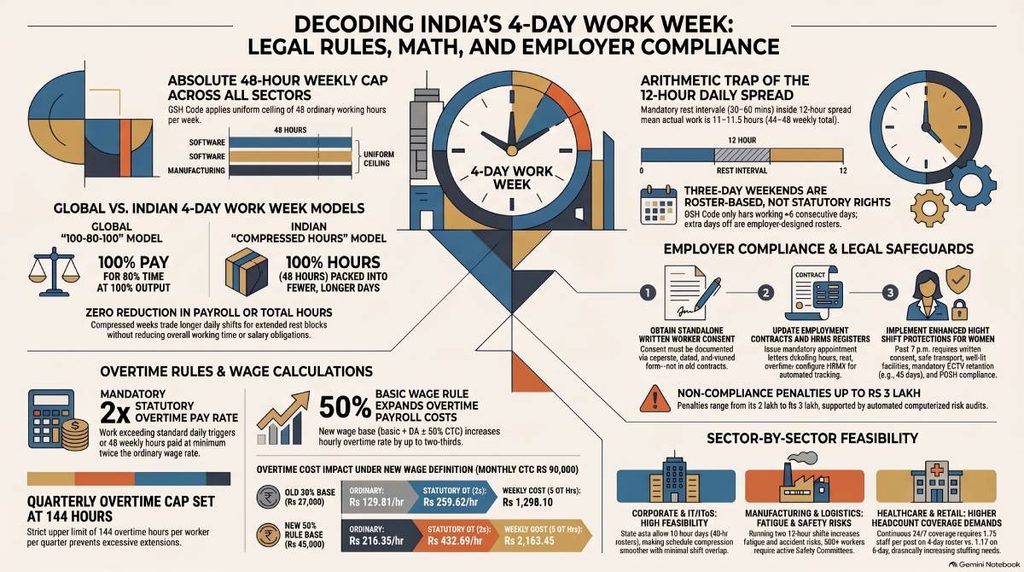
Yes, a four-day work week is legal in India, but the law sets terms and does not bend them. Weekly working time stays at or under 48 hours. Where the applicable rules ask for consent, workers give it in writing. The employer follows the rest-break, spread-over and overtime limits of whichever government regulates the establishment.
Nothing in law forces the schedule on anyone. The Occupational Safety, Health and Working Conditions (OSH) Code lets an employer compress the week, and that is all it does.
The four labour codes took effect on 21 November 2025, and the Centre notified its final rules on 8 May 2026. Those central rules cover banks, insurers, telecom, railways, ports, mines and central public sector units, while a private IT firm, a factory or a retail chain mostly answers to the rules of its own state. States have moved at different speeds. Check every figure below against the notification that applies to you.
At a Glance: Is a 4-Day Work Week Legal in India
- A four-day work week is legal in India under the OSH Code, but it is optional for employers.
- Weekly working hours stay capped at 48. Twelve hours across four days is the usual way to reach that number.
- Where states allow 12-hour days, written worker consent is required. A worker who declines stays on the standard schedule.
- Karnataka permits a 12-hour spread-over including rest, so actual work often lands at 11 to 11.5 hours a day.
- Overtime is paid at twice the ordinary rate of wages under Section 27. In Karnataka factories on a four-day pattern, it starts after 11 hours.
- A three-day weekend is not a statutory right. Section 26 only bars more than six working days a week.
- The labour codes took effect on 21 November 2025, and the Centre notified its final rules on 8 May 2026. State rules govern most private employers.
The Evolution of Working Hours and Labour Laws in India
From the Factories Act to the New Occupational Safety and Health (OSH) Code
The Factories Act of 1948 set the old ceiling: 48 hours a week for an adult factory worker under Section 51, and nine hours a day under Section 54 . A proviso let the daily limit stretch to cover a change of shifts. Section 65 let a state exempt factories during a sudden press of work, though never past 12 hours a day.
States read those openings generously. Karnataka’s 2023 amendment pushed the daily limit to 12 hours with written consent from workers. The NLS Business Law Review describes the pattern that followed: 12 hours across four days, with three paid days off.
The OSH Code now holds the national rules and replaces the Factories Act along with 12 other laws. Section 25 sets 8 hours a day. Section 26 allows no more than six working days a week. Section 27 puts overtime at twice the ordinary wage.
Why the Indian Government is Shifting Towards Flexible Work Schedules
Manufacturing pushes hardest. Karnataka and Tamil Nadu rolled out longer working hours after lobbying by Apple and Foxconn, with the aim of running two 12-hour shifts where plants once ran three of eight.
The broader policy case is simpler compliance and wider coverage of informal work, and it gives employers room to organise a workforce without waiting on permissions. FICCI and NASSCOM welcomed the reforms. Trade unions say fixed-term hiring and higher retrenchment thresholds tilt bargaining power toward employers.
Doubt has surfaced inside the establishment too. The Economic Advisory Council to the Prime Minister called labour reform no magic bullet for jobs or industrial growth and said skills and public investment need attention alongside it.
Busting Common Myths About the Daily 8-Hour Work Rule
Most of the confusion comes from treating one number as the whole rule.
| Myth | What the sources say |
| Eight hours a day is a fixed legal ceiling | Eight hours is the standard. Longer days up to 12 hours are allowed with worker consent and breaks, where state rules permit (https://www.shiftelio.com/labour-law) |
| A four-day week cuts working hours | The weekly cap stays at 48. The hours move into fewer days. |
| An employer can switch the whole workforce | Where states allow 12-hour days, written consent from workers is part of the deal. |
| The codes wait until every state finishes its rules | Provisions that need no rules bit from 21 November 2025. Spread-over and overtime limits wait for rules. |
| A three-day weekend is a statutory right | The law caps a worker at six days a week. The extra days off come from the roster the employer sets. |
The sources split on one point. Some say firms can now run 12-hour days without special exemptions . Another one says compressed weeks work only where states allow them. The second reading is the safe one.
Decoding the 48-Hour Weekly Work Limit
The Uniform 48-Hour Cap Across All Industries and Sectors
Every source repeats the same number. Forty-eight hours is the weekly ceiling on ordinary working time, and the OSH Code applies it across sectors. A software firm and a textile unit start from the same 48.
The cap attaches to “workers” as the Code defines the term, and that definition leaves out people hired mainly in managerial or administrative roles, along with supervisors above a wage threshold. Office staff in that group may fall under a state shops and establishments act instead, which keeps applying alongside the codes.
The cap has two escape valves. Section 127(2) lets a state exempt establishments in the public interest to create economic activity and jobs. Overtime also sits on top of the 48. A Tamil Nadu exemption notified in August 2026 keeps ordinary hours at 8 a day and 48 a week, yet lets total time including overtime reach 10.5 hours a day and 57 hours a week.
So the cap is uniform. The ceiling on total hours is not.
The Math Behind the 4-Day Work Week: 12 Hours x 4 Days
Twelve hours across four days gives 48. That is the whole trick, and it is why headlines call it a legal 4-day week.
| Schedule | Hours per day | Days | Weekly total |
| Compressed week | 12 | 4 | 48 |
| Five-day week | 9.6 | 5 | 48 |
| Six-day week | 8 | 6 | 48 |
The neat arithmetic hides a trap. Littler’s summary of the Karnataka amendment counts rest intervals inside the 12 hours. A mandatory half-hour break after six hours of work then eats into paid time. Four 12-hour spreads carry perhaps 11 to 11.5 hours of actual work a day, which lands at 44 to 46 hours a week.
Reaching a true 48 under a 12-hour spread-over limit may not be possible. An employer who promises staff “48 hours in four days” without checking how the state counts breaks may be promising something the rules do not allow.
Cost is the other catch. A four-day week does not reduce hours, so it does not cut payroll. It redistributes work, and the redistribution lands on the employer’s budget as shift design, transport, canteen hours, security cover and supervision.
Alternative Models: 5-Day (9.6 Hours) vs. 6-Day (8 Hours) Structures
The six-day, 8-hour week is the plain default. It sits at the Code’s own limits and needs no consent for the daily figure.
The five-day, 9.6-hour week is rarer. It runs past the nine-hour daily cap of the old Factories Act, so it depends on state rules that raise the daily limit. Telangana lifted the daily limit for commercial establishments from 8 to 10 hours in 2025 and kept the 48-hour weekly cap. Punjab’s 24×7 permission carries a 10-hour daily limit with the same weekly cap
The fit is tight. Under a 10-hour daily limit, 9.6 hours of work leaves 24 minutes of headroom, and a 30-minute rest break inside the day stretches the spread to 10.1 hours. That sits well inside a 12-hour spread-over limit but slightly above a 10-hour cap if the state counts rest toward the cap. These are this article’s own figures. The sources do not say how each state counts rest, so an employer should get the answer in writing from the labour department or from counsel before fixing a 9.6-hour roster.
Karnataka shows how the choice of model moves the overtime trigger. For factory workers who consent to overtime, pay at double the ordinary rate starts after:
| Week pattern | Daily overtime trigger |
| Six days | 9 hours |
| Five days | 10 hours |
| Four days | 11 hours |
Every pattern also triggers overtime past 48 hours a week, up to 144 overtime hours a quarter. Read the last row twice. Under Karnataka’s factory rules, the twelfth hour of a four-day week is overtime.
The Mandatory 12-Hour Inter-Shift Gap and Spread-Over Regulations
Spread-over is the clock time from first clock-in to last clock-out, breaks included. The figure to watch is 12 hours.
Karnataka’s amendment allows a daily spread-over of 12 hours including rest, up from 10.5 (https://www.littler.com/news-analysis/global-guide-quarterly/littler-global-guide-india-q3-2023). Telangana’s conditions for commercial establishments cap it at 12 hours too. Under the central text, spread-over and overtime limits depend on notified rules and bind only once those rules exist.
None of the sources behind this piece mentions a separate 12-hour rest gap between shifts. They do contain a bar on overlapping shifts, where more than two shifts work on the same thing at the same time. A worker on a 12-hour spread who starts at the same hour each day does get 12 hours away. That is arithmetic. It is no stand-alone entitlement.
Is the 4-Day Work Week Mandatory for Indian Companies?
Employer Discretion and Assessing Operational Feasibility
No. The codes permit compressed schedules without requiring them, and a firm that stays on five or six days breaks no rule.
The decision belongs to the employer, and operating costs usually settle it. A compressed week means redesigned shifts, new transport arrangements, cafeteria hours, security cover and supervisory staffing.
Before committing, an employer should answer four questions:
- Does the state regulating your establishment permit 12-hour days, and on what conditions?
- Can the roster stay inside the spread-over limit once breaks are counted?
- Who covers the days a worker is off, and at what overtime cost?
- Will enough workers say yes in writing?
The last question carries the most weight, since a schedule that most of the workforce refuses exists only on paper.
The Legal Necessity of Explicit Employee Consent
Consent runs through nearly every source. Karnataka ties 12-hour days and overtime to written worker consent. One explainer says a firm can adopt 12-hour shifts over four days only with employees’ agreement. Overtime has to be voluntary, and no employer can make it compulsory.
Consent for overtime and for women working at night needs no state rules to take effect, and it has applied since 21 November 2025.
Form matters. Indian HRM makes the point for night shifts: consent should be a standalone, dated, signed document, and a line buried in an appointment letter signed years earlier will not do. The same discipline suits a compressed schedule. Some states also prescribe forms.
A worker who declines the four-day pattern stays on the standard schedule. Pressure to sign undermines the legal basis of the arrangement.
How to Roll Back to a Traditional Schedule Safely
No source lays out a statutory rollback procedure. What they give is a set of obligations that any reversal has to respect, and an employer can plan a sound exit around them.
Start from the consent. If the schedule rests on written consent, a worker’s withdrawal ends the legal basis for that worker’s 12-hour days. For night work, the HRM guide says consent must be revocable, and refusal cannot trigger adverse action.
A reversal then touches five records:
- The appointment letter and any schedule clause
- The notice board display of working hours, which the Central Rules require
- The attendance register and roster
- The standing orders where the firm has adopted them
- The overtime records, since daily thresholds change with the week pattern. Reissue paperwork before the first day on the old schedule.
Overtime, Wages, and Leave Entitlements Under the New Structure
When Does Overtime Legally Kick In? (Daily vs. Weekly Triggers)
Two triggers exist, and sources describe them differently. The weekly one is simple: work past 48 hours in a week is overtime. The daily one depends on the week pattern and the state.
One explainer notes that guidance varies. Some sources place the daily start at eight hours, others at nine, and others only at the weekly limit, though all agree on the rate. Karnataka’s factory rules use 9, 10 or 11 hours depending on whether the week runs six, five or four days. The Tamil Nadu exemption conditions fix the ordinary day at eight hours.
Compressed weeks create a practical problem. A worker on a four-day, 12-hour roster in Karnataka crosses the daily trigger every working day. Overtime is then baked into the roster, and each instance needs the worker’s consent.
Quarterly ceilings sit on top. The Central Rules cap overtime at 144 hours a quarter, according to one summary.
Calculating the Statutory 2x Overtime Wage Rate
Section 27 of the OSH Code sets overtime at no less than twice the ordinary rate of wages. The base is “wages” as the new definition frames it, and overtime pay itself sits outside that definition.
India Policy Hub’s salary example takes a monthly CTC of Rs 90,000 and moves wages (basic plus dearness allowance) from Rs 27,000 to Rs 45,000 under the 50 per cent rule. The same article says overtime calculations rest on a 26-day month. Apply that month and an 8-hour day and the arithmetic comes out as below. The figures are this article’s own working, not a statutory formula.
| Wages base per month | Ordinary hourly rate | Overtime rate (2x) |
| Rs 27,000 | Rs 129.81 | Rs 259.62 |
| Rs 45,000 | Rs 216.35 | Rs 432.69 |
The gap is wide. Complying with the wage definition lifts the overtime bill by two thirds for the same hours.
One overtime hour pays Rs 259.62 on the lower base and Rs 432.69 on the higher one. Five such hours in a week come to Rs 1,298.10 against Rs 2,163.45, and a roster that pushes each worker one hour past the daily trigger on five working days produces exactly that pattern. Finance should price the roster before HR announces it. Manufacturing, logistics and warehousing carry the highest exposure, since their overtime volumes run highest.
Mandatory Rest Breaks During 12-Hour Shifts
A 12-hour day without breaks is not a lawful 12-hour day. Every regime in the sources attaches a rest interval to long stretches of work.
| Regime | Rest rule |
| Karnataka factories | Continuous work without a break up to six hours, raised from five |
| Telangana commercial establishments | At least 30 minutes of rest before a worker passes six hours in a day |
| Punjab 24×7 establishments | One hour of rest after five hours of continuous work (https://www.khaitanco.com/sites/default/files/2025-08/ELB%20Bulletin-July%202025.pdf) |
| Haryana exemptions | A rest interval after every six hours of work |
Rest rooms and basic amenities come with the territory. The Central Rules list canteens, rest rooms, washing facilities and first aid among welfare duties, some of them tied to headcount thresholds.
Weekly Off Entitlements: Guaranteeing the 3-Day Weekend
The law guarantees a weekly rest day. It does not guarantee three.
Section 26 of the OSH Code bars more than six working days in a week. Under a compressed roster, the extra days off exist only because the employer’s schedule creates them. Karnataka’s version treats the three non-working days as paid holidays.
State conditions on weekly rest show what employers owe. Punjab’s 24×7 permission requires one paid holiday a week and a monthly timetable on display. Tamil Nadu’s exemption for shops that open all 365 days requires one day off a week on rotation.
Put the three-day weekend in the contract. A promise that lives only in a policy deck can be withdrawn.
Comprehensive Compliance Checklist for Indian Employers
Redrafting Employment Contracts and Written Consent Forms
Appointment letters are now mandatory. Under the Central Rules, no employee can be engaged without one in the prescribed format, and it must carry the designation, skill category, nature of employment, wages, joining date, social security details and duties.
Put the schedule in that letter and keep the consent to the compressed week as a separate signed document. Name the daily hours, the number of working days, the rest interval, the spread-over, the overtime terms and the weekly off pattern.
Standing orders need a look too. The Model Standing Orders notified with the Industrial Relations Rules apply separately to manufacturing, mining and services. An employer who adopts them is deemed certified if the certifying officer raises no objection within 30 days. Establishments with 20 or more workers must also set up a grievance redressal committee, a separate body from the POSH committee.
Fixed-term and contract staff need their own versions of the consent form. Parity rules mean a fixed-term worker on a compressed week cannot be treated worse than a permanent colleague on the same roster.
Implementing Real-Time HRMS and Attendance Tracking
A 48-hour cap, a quarterly overtime cap and a spread-over limit cannot be policed on spreadsheets. The payroll system needs weekly hour tracking, automatic overtime triggers and wage slips in the prescribed format.
Accurate attendance data also protects the employer. The OSH Code leans toward digital registers and electronic wage records, and an Inspector-cum-Facilitator can ask for them on short notice.
Watch the terminology, because two unrelated rules both say 48. One is the weekly working-hour ceiling. The other is the two-working-day deadline for paying a separated employee’s final wages. Payroll teams that mix them up configure the wrong alerts.
Check what the system records:
- Clock-in and clock-out times, with the totals
- Break start and end
- Overtime consent status per worker
- Weekly off assignment
Maintaining Statutory Registers for Labor Audits
The Central Rules name the records: an employee register, an attendance register-cum-muster roll, a register of wages, overtime and deductions, a register of accidents and dangerous occurrences, and a register of leave with wages. Employers may keep them electronically. They must stay current, be preserved for five calendar years and be produced to the Inspector-cum-Facilitator on demand.
Wage slips go out on or before the payment date. A notice at a visible spot must carry working hours among other particulars, and annual returns are filed electronically by 28 or 29 February each year.
One summary of the final rules names Form I for the employee register, Form IV for wages and deductions and Form IX for attendance.
Inspection is moving from prosecution toward facilitation, so an employer gets a chance to fix a lapse. Bihar’s scheme picks establishments by computerised risk assessment and announces monthly lists 72 hours ahead. Penalties still bite, though. The general OSH Code penalty runs from Rs 2 lakh to Rs 3 lakh.
Managing Women’s Night Shift Regulations Under the OSH Code
Section 43 of the Code opens all establishments and all types of work to women, including between 7 p.m. and 6 a.m., with their consent. The Central Rules make that consent written, and they load the employer with duties: safe pick-up and drop from home, well-lit entry points and pathways, CCTV near common facilities, nearby toilets and drinking water, displayed emergency numbers, and compliance with the POSH Act.
A compressed week with 12-hour shifts brings these duties into play more often, because a long day that starts early or ends late crosses the 7 p.m. and 6 a.m. lines.
State rules add conditions. Karnataka’s factory amendment asks for women to be rostered in batches of at least 10 and for CCTV footage to be kept for at least 45 days. The Tamil Nadu exemption conditions treat 8 p.m. as the line and require written consent for work between 8 p.m. and 6 a.m. Tamil Nadu has also historically wanted prior permission for night work in factories, and in 2023 the Madras High Court refused to excuse a factory from that route even though employees had consented.
Maternity benefit rules and the Internal Committee under the POSH Act apply at 2 a.m. exactly as they do at 2 p.m.
Sector-by-Sector Impact of Compressed Work Weeks
IT, Tech, and Corporate Sectors: High Adaptability and Focus
Office-based firms start with the most room. Their staff often sit partly outside the “worker” definition and under state shops and establishment acts, and some of those acts allow 10-hour days. A 10-hour, four-day roster comes to 40 hours, which is well under the cap and needs no 12-hour spread.
Night work matters here. Karnataka, Gujarat and Haryana have relaxed night-shift rules for IT and ITeS.
Pay is the pressure point for this sector. IT services, banking and financial services and sales-led firms kept basic pay low, often at 30 to 35 per cent of CTC, and they face the biggest restructuring under the 50 per cent wage rule. A move to a four-day roster should be planned alongside that change, so employees see one coherent offer and not two overlapping surprises.
Manufacturing and Logistics: Managing Machine Uptime and Fatigue
Manufacturing is where the 12-hour day began, and it draws the sharpest criticism there. The NLS piece argues that two 12-hour shifts instead of three eight-hour shifts save little handover time, while longer days risk falling productivity, fatigue and industrial accidents, with older workers more exposed. It also warns that more output per worker can mean fewer jobs.
The legal footing is untested at the top. The Supreme Court in Gujarat Mazdoor Sabha rejected justifications for 12-hour shifts after the pandemic on Article 21 grounds, and the NLS author reads that as a warning to states that extend hours for growth alone.
Plant managers have concrete duties on top. Establishments with 500 or more workers need a safety committee that meets every quarter. Free annual medical examinations for workers aged 40 and above apply to dock work, mines and construction under the Central Rules, though some summaries describe a wider scope.
Logistics adds a shift-overlap problem. The Code bars overlapping shifts of the kind that put more than two shifts on the same work together.
Healthcare, Retail, and Client-Facing Roles: The Coverage Challenge
Coverage arithmetic works against these sectors. A post that must be staffed seven days a week needs 1.75 people on a four-day roster, 1.4 on a five-day roster and about 1.17 on a six-day roster. Every day off a compressed week adds is a day someone else must fill.
Section 43 sweeps in hospitals, hotels, warehouses and shops. States have already loosened opening hours. Tamil Nadu exempts shops and establishments from the closing-day rule and lets them stay open 365 days for three more years, on conditions that include rotating weekly offs and transport for women on shifts. Punjab allows 24×7 operation with a 10-hour daily limit.
Client-facing work adds a human limit. A 12-hour day at a counter or bedside leaves less slack for fatigue than a desk day, and a missed hand-off hurts someone outside the firm.
For these sectors, a 5-day roster with a 9.6 or 10-hour day often fits the rules and the coverage need better than 12 hours across four days.
The Global 4-Day Work Week vs. The Indian Model
The Global “100-80-100” Standard (Reduced Hours, Same Pay)
The label names a bargain: 100 per cent pay for 80 per cent of the time, in return for 100 per cent output. Weekly hours fall and wages do not.
Nothing in the Indian codes does that. No provision cuts the weekly ceiling below 48 or guarantees the same pay for fewer hours. Business India points to a regional example of a shorter week, the four-and-a-half day week the UAE applies to government staff, and notes critics who call the four-day week a western idea aimed at work-life balance.
India’s legal commentary has little to say about reduced-hours pilots, and this piece does not borrow results from outside its sources.
The Indian “Compressed Hours” Reality (Same Hours, Fewer Days)
The Indian model compresses. The 48 hours stay, and they land on four days. A four-day work week does not reduce the total number of hours employees work.
That distinction changes who benefits. Workers gain a longer rest block. Employers gain fewer commutes and fewer shift changes to administer. Neither side gains an hour back.
Business India puts the worker-side risk bluntly: a four-day week means 12-hour days, and some fear a recipe for burnout.
Productivity Lessons from International Pilot Programs
The NLS Business Law Review cites ILO modelling of the manufacturing sector and reads it as evidence that shorter hours tend to lift productivity and performance. It adds that the early belief that longer days offset their costs may not hold over time.
Read against the Indian model, the lesson is blunt. Gains seen when hours fall cannot be assumed when hours stay put and move around. A compressed week should be judged on its own record, and a firm that runs one should track output, error rates and absence before and after.
The Psychological and Physical Impact of 12-Hour Workdays
Recognizing and Mitigating Workplace Fatigue
Fatigue shows up first as errors. The NLS piece lists diminishing marginal productivity, tiredness and a higher risk of industrial accidents among the costs of long shifts.
The law gives employers some tools. Rest intervals, welfare facilities, safety committees and free medical examinations for older workers in covered sectors all exist to catch strain early. Workers can also report unsafe or unhealthy conditions to the employer or a safety officer, and the employer must act at once on a report of imminent danger.
Supervisors should watch the roster as well as the people. A worker who is near the quarterly overtime cap, on a 12-hour spread, with a long commute, is the likeliest to tire.
Does a 3-Day Weekend Counteract Daily Burnout?
None of the sources measures the effect. A fair answer says it depends on the work.
The case for the long weekend is recovery time: three consecutive days away is more rest than two. The case against is load. A worker who spends 12 hours at a desk or on a floor, four days running, carries a heavier daily load, and Business India’s burnout concern comes from there.
Sedentary work and physical work split here. Desk roles may absorb a long day better than lifting, driving or patient care. Treat that as a working assumption to test and not as a finding.
Strategies to Maintain Productivity During Longer Shifts
A few practices follow from the rules themselves:
- Roster rest breaks at fixed times instead of leaving them to the workers’ discretion
- Keep overtime off the compressed week, since a 12-hour day already sits at or past the daily trigger in some states
- Keep the schedule voluntary, with an easy way back to a standard roster
- Hold safety committee meetings on schedule and use them to review fatigue incidents
- Offer the annual health examination to older staff even where it is not mandatory
Transport matters more on long days. The Central Rules require safe transport for women on night shifts, and extending that practice to anyone finishing a 12-hour shift at night costs little.
Track results. Output per hour, error rates and sick leave by roster type will tell you within a quarter whether the pattern works for your site.
Preparing for the Future of Work in India
Next Steps for HR Leaders and Business Owners
Start with jurisdiction. Find out whether the Centre or your state is the appropriate government for your establishment, and read that government’s current OSH rules. Tamil Nadu, Karnataka, Maharashtra and several others had only draft rules in the sources reviewed, while Gujarat, Bihar and Arunachal Pradesh had final ones. Rajasthan and Uttar Pradesh notified OSH rules in August 2026.
Then work down the list:
- Test every proposed roster against the spread-over limit with breaks counted
- Draft the consent form and the appointment letter clause together
- Re-run payroll on the new wage definition, since overtime costs move with it
- Switch on weekly-hour and overtime alerts in the HRMS
- Set up the registers and the notice board display
- Pilot with a volunteer team for a quarter before widening
Run the compressed week as a pilot first. A state notification can change the numbers beneath it.
What Employees Need to Know Before Opting In
You can say no. Where a state ties 12-hour days to written consent, the schedule needs your signature, and overtime must be voluntary.
Ask what you are signing. The letter should state your daily hours, how breaks are counted, your weekly off pattern, and how overtime is paid. Overtime pays double the ordinary rate, and a higher wage base under the 50 per cent rule lifts that rate.
Check your pay slip too. A bigger basic raises provident fund deductions, so take-home pay can fall even when CTC stays level.
Count the long day honestly. Twelve hours at work plus the commute leaves little else. For women asked to work late, consent to night work is yours to give in writing, and safe transport and lighting are the employer’s duty.
Keep a personal log of hours. Registers are the employer’s record, and yours is the only one you control.
FAQ: Is a 4-Day Work Week Legal in India
Yes. The OSH Code lets an employer compress the week into four longer days. Weekly working time stays at or under 48 hours, and the roster has to fit the rest-break, spread-over and overtime limits of the government that regulates the establishment. Banks and telecom follow the central rules, while factories and private IT firms mostly follow their own state’s.
No. The codes permit it and require nothing. A company that stays on a five-day or six-day roster breaks no rule.
In states that allow it, yes, with written worker consent. Karnataka permits a 12-hour spread-over including rest. Twelve hours across four days adds up to 48, but breaks sit inside that spread, so actual work often lands at 11 to 11.5 hours a day. Check your state’s notification before fixing a roster.
No. Section 26 of the OSH Code bars more than six working days a week. The extra days off come from the employer’s roster, so write the three-day pattern into the contract.
Section 27 sets overtime at no less than twice the ordinary rate of wages. Work past 48 hours a week always counts. The daily trigger varies by state. For consenting factory workers in Karnataka on a four-day pattern, double pay starts after 11 hours.
Where 12-hour days are allowed, written consent is part of the deal. A worker who declines stays on the standard schedule. Keep the consent as a separate signed document, not a line in the appointment letter.
Disclaimer
The information provided in this article is for general informational and educational purposes only and does not constitute formal legal, HR, or professional advice. While every effort has been made to ensure the accuracy of the content regarding the Occupational Safety, Health and Working Conditions (OSH) Code, 2020, and the associated central and state labour rules, labour law in India is a concurrent subject. State-specific rules, exemptions, and notifications are subject to continuous updates and varying interpretations by local authorities. The practical application of a compressed four-day work week, 12-hour shifts, and overtime calculations will differ based on your jurisdiction, industry, and the nature of your workforce. Employers and individuals should not act or refrain from acting based solely on this information. We strongly advise consulting with a qualified labour law attorney or a certified compliance professional before implementing any structural changes to work schedules, employment contracts, or payroll systems.




Leave a Reply