
UPS Tax Rules 2026-27: Deductions and Payouts for the Unified Pension Scheme

The UPS tax rules treat the Unified Pension Scheme exactly like an NPS option. The section numbers changed when the Income-tax Act, 2025 took over from the 1961 Act on 1 April 2026, but the outcome for the employee stayed the same.
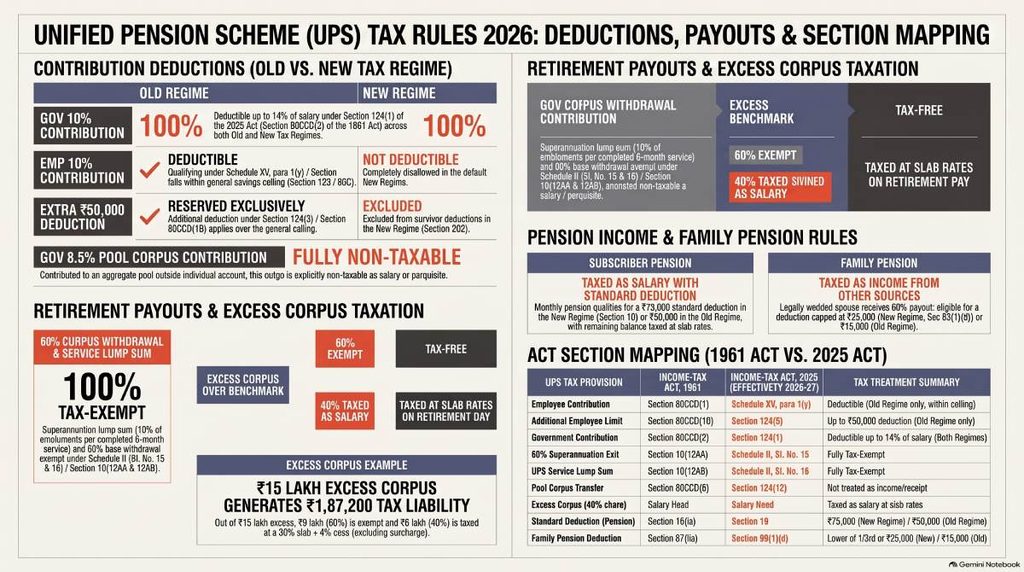
The government’s 10% contribution is deductible in both regimes. The employee’s own 10% is deductible only in the old regime, and only within the general savings ceiling. At retirement, nearly every lump sum is exempt. The monthly pension is taxed as salary, and so is 40% of any excess corpus.
The parity was announced first and legislated later. The PIB release of 4 July 2025 said NPS tax benefits apply to UPS mutatis mutandis. A Taxation Laws (Amendment) Bill reported in August 2025 came next. Then Act No. 29 of 2025, footnoted on the official Section 80CCD page, inserted sub-sections (3A) and (6) with effect from 1 April 2025.
Over 1.18 lakh central government employees had opted for UPS by mid-July 2026, according to the Finance Ministry. Sooner or later, each of them has to work out five things: what the contribution deducts, what the retirement payout costs, how the monthly pension is taxed, what the family receives, and whether NPS would have been kinder.
Each rule below comes with both its Income-tax Act, 1961 section and its Income-tax Act, 2025 section. A payslip quoting one numbering and a DFS circular or old advisory quoting the other can then both be read against the right provision. The rupee figures in the worked examples are illustrative.
UPS Tax Rules 2026 At A Glance
- The Unified Pension Scheme (UPS) is taxed exactly like an NPS option. The Income-tax Act, 2025 replaced the 1961 Act on 1 April 2026 and renumbered the sections, but the outcome for the employee did not change.
- The government’s 10% contribution is deductible in both the old and new tax regimes, up to 14% of salary under Section 124(1) (Section 80CCD(2) in the 1961 Act).
- The employee’s own 10% is deductible only in the old regime, and only within the general savings ceiling. The extra Rs 50,000 deduction under Section 124(3) is also an old-regime benefit.
- At retirement, the 60% withdrawal and the superannuation lump sum are exempt. The lump sum equals 10% of monthly emoluments for every completed six-month period of service (Section 10(12AB)).
- Retirement day produces a tax bill from one source only: 40% of any excess of individual corpus over benchmark corpus, taxed as salary. The other 60% of the excess is exempt. A Rs 15 lakh excess leaves Rs 6 lakh taxable, which costs Rs 1,87,200 at the 30% slab plus 4% cess (surcharge ignored).
- The monthly pension is taxed as salary, with a Rs 75,000 standard deduction in the new regime and Rs 50,000 otherwise. A spouse’s family pension is taxed as income from other sources.
- The 8.5% pool corpus contribution is not taxable in the employee’s hands. The NPS-to-UPS option window closed on 30 November 2025, and new joiners get 30 days from joining.
- The tax result of switching from UPS back to NPS has no official text yet.
What is the Unified Pension Scheme (UPS)?
UPS is an option inside the National Pension System for Central Government employees. The NPS account and the PRAN stay, and so do the fund managers. What changes is the payout: a defined monthly pension replaces whatever the market happens to return. The DFS page on UPS has the notification and the Rules along with the FAQs, and every rule in this post traces back to one of them.
The assured payout is half of the average basic pay over the last 12 months before superannuation, for 25 years of qualifying service. Shorter service scales it down in proportion. After 10 years of service there is a floor of Rs 10,000 a month. Family pension is 60% of the payout and goes to the legally wedded spouse. The subscriber FAQs of 13 September 2025 give the formulas.
Who can opt for UPS and what changes in Tax Year 2026-27
The Department of Financial Services notified UPS on 24 January 2025 (Notification F. No. FX-1/3/2024-PR), and it has applied since 1 April 2025. Central Government employees already under NPS could switch during an option window. That window was first set to close on 30 June 2025, then moved to 30 September 2025, and finally closed on 30 November 2025 after a PFRDA circular extending the cut-off by two months. It is shut now. New joiners get 30 days from the date of joining.
Tax Year 2026-27 is the first under the Income-tax Act, 2025. For a UPS subscriber the section numbers moved, and the split between the old and new tax regimes now sits in Section 202. The pension formula and the contribution rates stayed put, and so did the amounts of the exemptions.
UPS contribution rates and the 8.5% pool corpus
The employee puts in 10% of monthly emoluments and the government pays an equal 10%. Both go into the individual corpus, which is the NAV of the units held in the subscriber’s PRAN. Emoluments, under the UPS Rules, 2025, mean basic pay and admissible dearness allowance, plus non-practising allowance for medical officers.
A third stream sits outside the individual corpus. The government adds an estimated 8.5% of emoluments to a pool corpus on an aggregate basis, which brings its total outgo to 18.5%. Under NPS the government contribution is 14%. A subscriber who switches from UPS to NPS receives the 4% differential, computed on the default investment pattern and credited at exit, as the subscriber FAQs describe it.
The benchmark corpus is a notional value the CRA computes from the NAV of the default investment. It never reaches the subscriber’s account. Its job is to decide how much of the individual corpus is ordinary retirement money and how much counts as an excess. That split drives the tax treatment later in this post.
Also Read: PPF vs. EPF vs. NPS in 2026: The Complete Guide to Indian Retirement Funds
UPS tax sections: Section 80CCD in the 1961 Act, Section 124 in the 2025 Act
The year of income decides which Act applies, not the date of payment. Income up to FY 2025-26 falls under the Income-tax Act, 1961. Income from 1 April 2026 falls under the Income-tax Act, 2025, which calls that period Tax Year 2026-27. A subscriber filing a return for FY 2025-26 uses the middle column. One who retires in October 2026 uses the right one.
| Rule | Income-tax Act, 1961 | Income-tax Act, 2025 |
| Employee contribution, general ceiling | Section 80C | Section 123 |
| Employee contribution to NPS or UPS | Section 80CCD(1) | Schedule XV, para 1(y) |
| Additional Rs 50,000 for the employee | Section 80CCD(1B) | Section 124(3) |
| Government’s contribution | Section 80CCD(2) | Section 124(1) |
| Higher limit for other employers in the new regime | Section 80CCD(2) | Section 124(2) |
| Amounts taxable on closure, opt-out or annuity | Section 80CCD(3) | Section 124(6) and (7) |
| UPS amounts received at superannuation or similar events | Section 80CCD(3A) | Section 124(11) |
| Amount used to buy an annuity | Section 80CCD(5) | Section 124(9) |
| Transfer from individual corpus to pool corpus | Section 80CCD(6) | Section 124(12) |
| Definitions of pool and individual corpus | Explanation to Section 80CCD | Section 124(13) |
| Partial withdrawal of up to 25% | Section 10(12B) | Schedule III, Sl. No. 4 |
| 60% withdrawal at superannuation | Section 10(12AA) | Schedule II, Sl. No. 15 |
| UPS lump sum | Section 10(12AB) | Schedule II, Sl. No. 16 |
| Standard deduction | Section 16(ia) | Section 19 |
| Family pension deduction | Section 57(iia) | Section 93(1)(d) |
| New tax regime | Section 115BAC | Section 202 |
The DFS tax FAQ cites both numberings for the exemptions and the corpus transfer. The 124(3) and 124(1) entries come from Section 124 of the 2025 Act itself.
Two entries in the middle column are recent. Sub-sections (3A) and (6) of Section 80CCD came in through Act No. 29 of 2025 with effect from 1 April 2025. The official Section 80CCD page records this in a footnote. That is why the DFS FAQ can cite 80CCD(6) for the pool corpus transfer.
Section 124(13) of the 2025 Act defines both corpus terms by reference to the 24 January 2025 notification. Section 124(11) holds the UPS-specific wording on amounts received at superannuation.
Employer advisories and older articles quote whichever numbering was current when they were written. A rule quoted with a 1961 number still describes the same exemption in the 2025 Act, and the table above pairs the two.
UPS tax deductions on contributions: Old regime vs new regime
The tax regime you file under decides which UPS deductions survive. Section 202(1) of the 2025 Act (Section 115BAC of the 1961 Act) is the new regime, and it is the default. Under Section 202(2)(a)(xii), Chapter VIII deductions are disallowed except those in Sections 124(1), 124(2), 125(2) and 146. The employee’s own contribution falls outside that list. The government’s contribution falls inside it.
| UPS contribution | Old regime | New regime, Section 202(1) |
| Employee 10%, Section 80CCD(1) | Deductible, inside the general savings ceiling | Not deductible |
| Extra amount, Section 80CCD(1B) / 124(3) | Up to Rs 50,000 | Not deductible |
| Government 10%, Section 80CCD(2) / 124(1) | Deductible up to 14% of salary | Deductible up to 14% of salary |
| Government 8.5% to pool corpus | No deduction section listed | No deduction section listed |
For the illustrative employee, the government’s Rs 2,40,000 a year stays out of taxable income in both regimes. The employee’s own Rs 2,40,000 stays out only in the old regime, and only up to whatever room the savings ceiling leaves.
Employee contribution deduction under Section 80CCD(1) and 80CCD(1B)
The employee’s 10% of emoluments qualifies under Section 80CCD(1) of the 1961 Act. The 2025 Act places it in para 1(y) of Schedule XV, as Q2 of the DFS tax FAQ records. The deduction sits inside the general ceiling on savings deductions (Section 80C, now Section 123), so it shares that ceiling with every other qualifying investment. The current figure is on the official page for the section. Read it there before filing.
An illustrative employee with emoluments of Rs 2,00,000 a month contributes Rs 20,000, or Rs 2,40,000 a year. Under the old regime that sum competes with every other qualifying investment for room under the general savings ceiling, so the deduction actually used can fall below the contribution. The Rs 50,000 limb sits in addition to the amount claimed under Section 80CCD(1).
Section 80CCD(1B) adds a further deduction of up to Rs 50,000. In the new Act it lives at Section 124(3), which says an individual who pays or deposits into a notified pension scheme account “shall be allowed a deduction not exceeding ₹ 50000”. No DFS document names 80CCD(1B) for UPS. The claim rests on the parity statement, since the PIB release and the Taxmann note on extending NPS benefits to UPS both carry NPS deductions across. Section 124(3) is missing from the list of survivors in Section 202(2)(a)(xii), so the Rs 50,000 is an old-regime benefit.
Government’s 10% contribution: Section 80CCD(2) and Section 124(1)
Q1 of the DFS tax FAQ treats the government’s 10% of monthly emoluments as deductible under Section 80CCD(2), which is Section 124(1) of the 2025 Act. The ceiling in Section 124(1) is 14% of salary where the employer is the Central Government or a State Government, and 10% for any other employer. Sub-section (2) lifts the 10% to 14% for those taxed under Section 202(1). Salary here has the meaning given in Section 124(13): basic pay plus dearness allowance when the terms of employment provide for it, and no other allowance or perquisite.
Take an illustrative employee with basic pay of Rs 1,25,000 and dearness allowance of Rs 75,000. Salary is Rs 2,00,000 a month. The government pays Rs 20,000 a month into the individual corpus, or Rs 2,40,000 a year. The ceiling at 14% is Rs 28,000 a month, so the whole contribution is deductible in either regime.
The Act also has a separate rupee ceiling on the combined employer contribution to retirement funds. It reaches only high earners and falls outside this post.
Tax treatment of the 8.5% pool corpus contribution
Q3 of the DFS tax FAQ is the only official text on this stream. It says the additional 8.5% of basic pay plus dearness allowance goes to the pool corpus on an aggregate basis and “is not towards the individual corpus”. It adds that the amount is not taxable as salary or perquisite in the employee’s hands.
The FAQ says nothing more. It lists no deduction section for the 8.5%, and this post adds nothing beyond it.
Do not confuse this stream with the transfer that happens at retirement. That transfer moves part of the employee’s own individual corpus into the pool, and it has its own provision, covered in the withdrawals section below.
Also Read: Section 194P Exemption: The Complete 2026 ITR Guide for Senior Citizens
UPS withdrawal and lump sum tax rules at retirement
The retirement settlement splits into several streams, and the tax answer differs for each. Only one of them can create a tax bill on retirement day: the part of the individual corpus that exceeds the benchmark corpus.
| Stream | 1961 Act | 2025 Act | Tax result |
| Partial withdrawal, up to 25% of own contribution | Section 10(12B) | Schedule III, Sl. No. 4 | Exempt |
| Withdrawal at superannuation, up to 60% of the lower of individual and benchmark corpus | Section 10(12AA) | Schedule II, Sl. No. 15 | Exempt |
| Balance moved to the pool corpus | Section 80CCD(6) | Section 124(12) | Not treated as received |
| Excess of individual corpus over benchmark corpus, first 60% | Section 10(12AA) | Schedule II, Sl. No. 15 | Exempt |
| Excess of individual corpus over benchmark corpus, remaining 40% | Salary income | Salary income | Taxable at slab rates |
| Superannuation lump sum | Section 10(12AB) | Schedule II, Sl. No. 16 | Exempt |
Each row comes from the DFS tax FAQ, Q4 to Q8.
UPS partial withdrawal: tax on up to 25% of your own contribution
A subscriber can take out up to 25% of the contribution made personally. The withdrawal is exempt under Section 10(12B) of the 1961 Act, which becomes Schedule III, Sl. No. 4 of the 2025 Act. How often a subscriber may withdraw, and for what purpose, is set by scheme rules, not tax rules, and this post covers tax only.
UPS withdrawal at superannuation: the 60% exemption and the 40% pool corpus transfer
At superannuation the subscriber may withdraw up to 60% of the individual corpus or the benchmark corpus, whichever is lower. Q7 of the FAQ exempts that withdrawal under Section 10(12AA) (Schedule II, Sl. No. 15).
The rest of the base amount does not come back to the subscriber as cash. It moves to the pool corpus, and the Act does not count that move as a receipt. Q5 cites Section 80CCD(6) for it, which is Section 124(12) in the new Act.
Taking the withdrawal lowers the monthly payout. The subscriber FAQs give the admissible payout as the assured payout scaled by the ratio of individual to benchmark corpus and then reduced by the share withdrawn. Withdraw 60%, and the monthly payout falls to 40% of what it would have been.
In plain terms, the formula takes the assured payout, scales it by the ratio of individual to benchmark corpus (capped at one) and multiplies the result by one minus the share withdrawn. A larger withdrawal is exempt but shrinks the pension, and the pension is the taxable part. A smaller withdrawal leaves more pension, and every rupee of that pension is taxed as salary.
Tax on excess corpus: when the individual corpus exceeds the benchmark corpus
The individual corpus can end up above the benchmark corpus when the subscriber’s own fund choices earn more than the default pattern does. The base amount follows the rules above, with the lower figure, the benchmark corpus, as the base. The excess is paid out as a lump sum. Q8 of the FAQ splits it: up to 60% is exempt under Section 10(12AA), and the DFS document states that the remaining 40% “will be chargeable to tax”. CAalley’s report on the FAQ reads the rule the same way.
The 60/40 split applies to the excess alone, not to the whole corpus. DFS’s first worked example puts numbers on it: an excess of Rs 20 lakh gives Rs 12 lakh exempt and Rs 8 lakh taxable as salary in the year it is paid, allowed or due, whichever is earlier. The withdrawal of Rs 1.08 crore in the same example, which is 60% of the Rs 1.8 crore benchmark corpus, stays fully exempt.
An excess is the one case where the payout formula adds no pension. The ratio of individual to benchmark corpus is capped at one, so the monthly figure never rises above the assured payout.
UPS superannuation lump sum under Section 10(12AB), and why it is not gratuity
The lump sum equals 10% of monthly emoluments for every completed six-month period of qualifying service. Q6 exempts the whole of it under Section 10(12AB) (Schedule II, Sl. No. 16). Take an illustrative employee with emoluments of Rs 2,00,000 and 28 years of service: that is 56 six-month periods, so the lump sum is Rs 11,20,000.
Gratuity is a separate payment under a separate regime. The subscriber FAQs point to the Central Civil Services (Payment of Gratuity under National Pension System) Rules, 2021 for it. The DFS tax FAQ does not address gratuity, so this post does not either.
Is UPS pension taxable? Monthly pension and family pension rules
The monthly payout is where UPS keeps taxing the retiree for life: the lump sums are mostly exempt, but the pension is not.
UPS monthly pension: taxed as salary with a standard deduction
Q9 of the DFS tax FAQ calls the monthly payout pension-like and taxes it under the head Salaries. Pension in that head qualifies for the standard deduction. Section 19 of the 2025 Act (Section 16(ia) of the 1961 Act) allows Rs 75,000 or the amount of the salary, whichever is less, for a person taxed under Section 202(1). Any other taxpayer gets Rs 50,000 or the salary, whichever is less.
So the first Rs 75,000 of annual pension is free of tax in the new regime, and the rest meets the slab rates. A retiree on the old regime gets the smaller deduction but keeps access to the other Chapter VIII deductions.
In Scenario 1 of the worked examples, a payout of Rs 22,727 a month is Rs 2,72,727 a year. The Rs 75,000 standard deduction leaves Rs 1,97,727 to be added to any other income and taxed at slab rates. For a retiree with no other income, that figure is the whole of the Salaries income for the year.
UPS family pension: Taxed as income from other sources
Q10 of the FAQ places the monthly family pension paid to the spouse of a deceased subscriber under Income from other sources. The head differs from the one that applied to the subscriber, and so does the deduction. Section 93(1)(d) of the 2025 Act (Section 57(iia) of the 1961 Act) allows one-third of the family pension or Rs 25,000, whichever is less, for a person taxed under Section 202(1). In every other case the cap is Rs 15,000.
Take a spouse drawing Rs 13,636 a month, which is Rs 1,63,636 a year. One-third of that is Rs 54,545, so the Rs 25,000 cap binds. Taxable family pension in the new regime is Rs 1,38,636. In the old regime the cap is Rs 15,000, and Rs 1,48,636 is taxable.
The spouse’s share is 60% of the payout, as the subscriber FAQs set it. The Rs 13,636 above is 60% of the Rs 22,727 pension in the first worked example later in this post.
UPS claim forms B1 to B6 are payout forms, not tax forms
The subscriber FAQs list six claim forms. B1 is for a subscriber who retired on or after 1 April 2025, and B2 is its counterpart for those who retired earlier. B3 is for a spouse where the subscriber had already drawn benefits, and B4 is the same for the earlier cohort. B5 is for a spouse where the benefits had not been drawn, and B6 covers the earlier cohort.
None of the six computes tax. The retiree or the spouse declares the pension in the return, under Salaries for the subscriber and under Income from other sources for the spouse. Putting the pension under the wrong head is the error to avoid, because the deduction attached to each head differs.
Also Read: Senior Citizen Savings Scheme (SCSS) 2026: Maximize Your Returns & Tax Benefits
UPS vs NPS tax: What differs in 2026
The tax code treats the two schemes alike. The differences come from how much money goes in and how it comes out.
| Feature | NPS | UPS |
| Employee contribution | 10% of emoluments | 10% of emoluments |
| Government contribution to the individual account | 14% | 10% |
| Further government money | None | Estimated 8.5% to the pool corpus |
| Government contribution deduction | Section 80CCD(2) / 124(1), up to 14% of salary | Same section, same ceiling |
| Employee deductions | Section 80CCD(1) and (1B) | Same sections |
| Amount received on closure, opt-out or annuity | Taxed as income when received, Section 124(6) | Section 124(11) for superannuation and similar events |
| Monthly income in retirement | Annuity pension, taxed when received | Monthly payout, taxed as Salaries |
UPS vs NPS contribution rates and deduction limits
Under NPS the government puts 14% of emoluments into the subscriber’s account. Under UPS it puts 10% there and an estimated 8.5% into the pool corpus. The 14% ceiling in Section 124(1) means a full NPS contribution is deductible, and so is the smaller UPS contribution. The subscriber’s own deductions under Section 80CCD(1) and (1B) are identical.
On illustrative emoluments of Rs 2,00,000 a month, NPS carries Rs 28,000 from the government. UPS carries Rs 20,000 into the individual account and an estimated Rs 17,000 into the pool corpus, Rs 37,000 in all.
The tax parity has a documented origin. The Central Board of Direct Taxes applied the NPS provisions to UPS through Office Memorandum F. No. 178/4/2025-ITA-1 of 2 July 2025, which the subscriber FAQs reproduce. Act No. 29 of 2025 then inserted Section 80CCD(3A) and (6) from 1 April 2025, so the parity no longer rests on the memorandum alone.
UPS vs NPS tax on exit and withdrawal
The partial withdrawal exemption under Section 10(12B) applies to UPS, as Q4 of the DFS tax FAQ confirms. On the NPS side, Section 124 of the 2025 Act taxes amounts withdrawn on closure or opt-out, and amounts received as annuity pension, in the year of receipt. Sub-section (9) keeps the amount used to buy an annuity out of that year’s income. The exempt share of an NPS exit lump sum sits in the Schedules to the Act, and this post does not quote it.
UPS replaces the annuity with a formula payout. The 60% withdrawal is exempt, the transfer to the pool is not a receipt, and the monthly payout is salary. The practical gap is that a UPS retiree’s income is a formula result, while an NPS retiree’s income depends on the annuity bought.
Can you switch between UPS and NPS in 2026?
The route from NPS to UPS is closed. The window ended on 30 November 2025, and only new joiners, who have 30 days from joining, can still choose UPS.
A route back from UPS to NPS exists under the DFS memorandum on the switch and Rule 11 of the UPS Rules. The subscriber FAQs add that the 4% differential between the NPS government rate of 14% and the UPS rate of 10% is computed on the default investment pattern and credited at exit.
No source used for this post says how the switch or the 4% credit is taxed, and the DFS tax FAQ does not cover switching at all. A subscriber considering the move should get a written clarification from the Drawing and Disbursing Officer or the nodal office before acting, and should not assume the NPS treatment carries over.
UPS tax calculation: worked examples with rupee figures
Both scenarios use one illustrative employee. Basic pay is Rs 1,25,000 and dearness allowance is Rs 75,000, so emoluments are Rs 2,00,000 a month. Service is 28 years. The employee withdraws the full 60%, files under the new regime and has made no earlier partial withdrawal. Every figure here is illustrative. The DFS tax FAQ carries two official examples with different inputs.
The assured payout is 50% of Rs 1,25,000, which is Rs 62,500, because 28 years exceeds the 25-year ceiling of 300 months. The lump sum is 10% of Rs 2,00,000 for each of 56 six-month periods, which is Rs 11,20,000. Both scenarios share that lump sum, and it is exempt under Section 10(12AB) (Schedule II, Sl. No. 16).
Scenario 1: individual corpus below the benchmark corpus (no excess)
The individual corpus is Rs 1.50 crore and the benchmark corpus is Rs 1.65 crore. There is no excess.
| Item | Amount (Rs) | Tax result |
| Withdrawal, 60% of Rs 1.50 crore | 90,00,000 | Exempt, Section 10(12AA) / Schedule II, Sl. No. 15 |
| Balance moved to pool corpus | 60,00,000 | Not a receipt, Section 80CCD(6) / 124(12) |
| Superannuation lump sum | 11,20,000 | Exempt, Section 10(12AB) / Schedule II, Sl. No. 16 |
| Monthly payout: 62,500 x (1.50 / 1.65) x 40% | 22,727 | Salary |
| Annual pension after the Rs 75,000 standard deduction | 1,97,727 | Taxable at slab rates |
Tax payable on the retirement payout itself is nil.
Scenario 2: individual corpus above the benchmark corpus (Rs 15 lakh excess)
The individual corpus is Rs 1.80 crore and the benchmark corpus is Rs 1.65 crore. The excess is Rs 15,00,000.
| Item | Amount (Rs) | Tax result |
| Withdrawal, 60% of Rs 1.65 crore | 99,00,000 | Exempt, Section 10(12AA) / Schedule II, Sl. No. 15 |
| Balance moved to pool corpus | 66,00,000 | Not a receipt, Section 80CCD(6) / 124(12) |
| Excess, first 60% | 9,00,000 | Exempt, Section 10(12AA) / Schedule II, Sl. No. 15 |
| Excess, remaining 40% | 6,00,000 | Taxable as salary |
| Superannuation lump sum | 11,20,000 | Exempt, Section 10(12AB) / Schedule II, Sl. No. 16 |
| Monthly payout: 62,500 x 1 x 40% | 25,000 | Salary |
| Annual pension after the Rs 75,000 standard deduction | 2,25,000 | Taxable at slab rates |
The streams add back to the whole: Rs 99,00,000, Rs 66,00,000 and Rs 15,00,000 make Rs 1.80 crore. Only the Rs 6,00,000 is taxed on retirement day. At the top slab of 30% plus 4% cess, with surcharge ignored, that costs Rs 1,87,200.
The ratio of individual to benchmark corpus is capped at one, so the extra Rs 15,00,000 buys no additional pension. The monthly payout in Scenario 2 is higher only because the ratio stops cutting it, and it stops at Rs 25,000.
Put the two scenarios side by side. Scenario 2 holds Rs 30,00,000 more individual corpus than Scenario 1. Of that, Rs 9,00,000 more is withdrawn tax-free, Rs 6,00,000 more moves to the pool corpus, and Rs 15,00,000 arrives as the excess. After the Rs 1,87,200 of tax, the extra cash in hand is Rs 22,12,800, and the monthly payout is higher by Rs 2,273.
How to claim UPS tax benefits in your return
Most of the work happens before the return. The choices that matter are made in the payslip year and at retirement.
- Pick the regime early. The employee’s 10% and the Rs 50,000 limb disappear in the new regime, while the government’s contribution survives in both.
- Keep the CRA’s statement of the individual corpus and the benchmark corpus. Every exemption in the withdrawal table depends on the lower of the two figures.
- Report the taxable part of any excess in the year it is paid, allowed or due, whichever comes first. The DFS tax FAQ’s first example uses that timing.
- Let the spouse declare family pension under Income from other sources, with the Section 93(1)(d) deduction, and not under Salaries.
- Quote the section number of the Act that governs the year. Returns for FY 2025-26 use the 1961 numbers, and returns for Tax Year 2026-27 use the 2025 numbers.
- Read the name on the employer’s salary TDS certificate. Secondary reports say the 2025 Act renames Form 16 as Form 130 from Tax Year 2026-27, and the Department’s own notification is the place to settle it.
The claim forms described earlier never carry tax figures. The return does.
The month of retirement decides the numbering on the return, though not the amounts. A subscriber who retires between 1 April 2026 and 31 March 2027 reports every UPS receipt in the return for Tax Year 2026-27, with 2025 Act numbers. A subscriber who retired in FY 2025-26, in March 2026 for instance, reports under the 1961 numbers.
UPS Tax Rules 2026: Frequently Asked Questions
Yes. The monthly payout is taxed as salary. The new regime allows a Rs 75,000 standard deduction, and every other taxpayer gets Rs 50,000.
No. The superannuation lump sum and the 60% withdrawal are exempt under Sections 10(12AB) and 10(12AA) of the 1961 Act, or Schedule II of the 2025 Act.
No. The employee’s 10% is deductible only in the old regime. The government’s 10% is deductible in both regimes, up to 14% of salary.
Section 124(3) of the 2025 Act allows up to Rs 50,000, in the old regime only. No DFS document names 80CCD(1B) for UPS, so the claim rests on NPS parity.
When individual corpus exceeds benchmark corpus, 60% of the excess is exempt and 40% is taxed as salary. A Rs 15 lakh excess leaves Rs 6 lakh taxable.
A spouse’s family pension falls under income from other sources. The deduction is the lower of one-third of the pension or Rs 25,000 in the new regime. The cap is Rs 15,000 otherwise.
Yes. The CBDT applied NPS provisions to UPS, and Act No. 29 of 2025 wrote them into Section 80CCD from 1 April 2025. Cash flow differs: the government puts 10% into the individual account under UPS and 14% under NPS.
No. The DFS tax FAQ says the amount goes to the pool corpus, not the individual corpus, and is not taxable as salary or perquisite in your hands.
UPS Tax Rules in brief, and the one open question
UPS is taxed like an NPS option: the government’s contribution is deductible in both regimes, the employee’s own contribution only in the old regime, nearly every retirement lump sum is exempt, and the pension plus 40% of any excess corpus is taxable.
The open question is the switch from UPS back to NPS, where no official text yet states the tax result. India Policy Hub will update this explainer when the CBDT or the DFS settles it. Subscribe to the India Policy Hub newsletter for pension tax-rule updates.
Last verified: 15 October 2026.




Leave a Reply