
Fixed-Term Employee Gratuity: Why the One-Year Threshold Is Creating Unexpected Severance Liabilities

The Hidden Cost of the 1-Year Gratuity Rule for Fixed-Term Employees
Somewhere between signing an offer letter and wrapping up an employee’s exit formalities, many employers in India are running into a cost they never expected to pay. The issue is fixed-term employee gratuity
Picture this. A company hires someone on an 18-month fixed-term contract to manage a client project, cover a maternity leave, or help through a seasonal rush. The contract ends, the employee completes their handover, and then asks for gratuity. Until recently, that request would almost certainly have been rejected. Gratuity generally became payable only after five years of continuous service, and very few fixed-term employees stayed long enough to qualify.
That assumption no longer holds true.
Since the four Labour Codes came into force on 21 November 2025, fixed-term employees who complete just one year of continuous service are entitled to gratuity on a pro-rata basis for the time they have actually worked. It is a relatively small change on paper, but its financial impact can be surprisingly large.
For HR teams, this changes how fixed-term hiring needs to be planned. For finance teams, it creates a liability that can no longer be ignored until an employee has spent years with the organisation. Instead, gratuity may need to be recognised, funded, and accounted for much earlier than many businesses are used to.
In this guide, we’ll look at where the one-year gratuity rule comes from, how Indian labour law defines fixed-term employment, how gratuity is calculated under the new framework, the situations where it can still be withheld, and the practical steps both employers and employees should understand now that the traditional five-year waiting period no longer applies to every worker.
At A Glance: Fixed-Term Employee Gratuity
1-Year Eligibility Threshold: Fixed-term employees now qualify for statutory gratuity after completing just one year of continuous service, replacing the previous five-year requirement.
Pro-Rata Payout Calculation: Gratuity is calculated proportionally at 15 days’ wages for every completed year of service, using the standard formula.
Increased Severance Liabilities: The new uniform wage definition mandates that allowances over 50% of total pay be included in basic wages, significantly increasing the base for gratuity calculations.
Strict Applicability: The one-year rule applies strictly to direct fixed-term employees, excluding third-party contract labor and independent consultants.
Accounting & Compliance: Employers must immediately recognize these costs in financial planning, treating them as recurring employment expenses rather than theoretical exit liabilities.
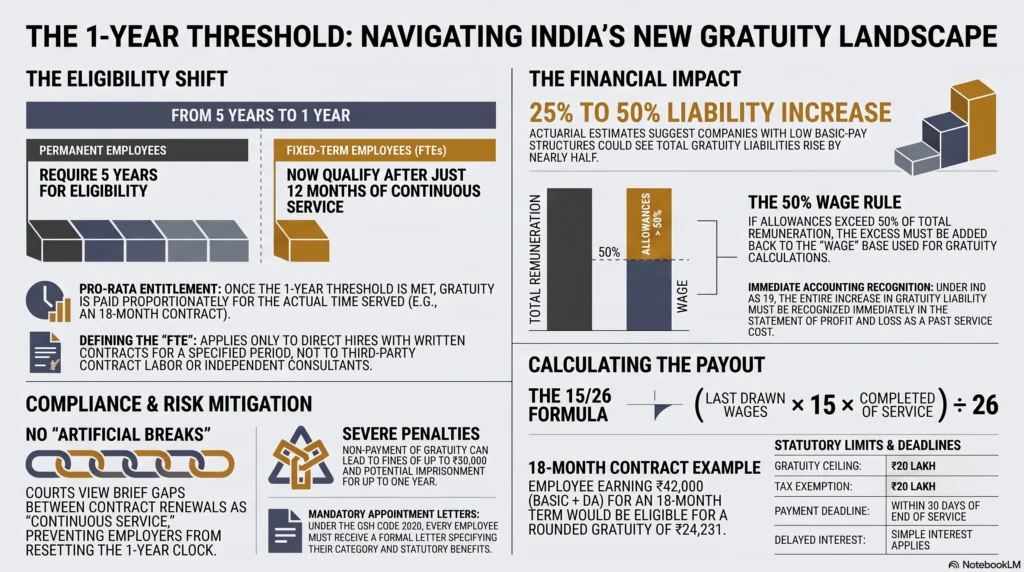
Understanding the Shift: From 5 Years to 1 Year for Fixed-Term Employees
The one-year gratuity rule did not appear overnight. It is the result of years of labour law reform, building on earlier efforts to formalise fixed-term employment in India. Looking at that journey helps explain why employers now have a legal obligation that did not exist in the same practical sense just a few years ago.
The Code on Social Security, 2020 and Gratuity Amendments
For decades, gratuity in India was governed by the Payment of Gratuity Act, 1972. That changed on 21 November 2025, when the Code on Social Security, 2020 (Act No. 36 of 2020) came into force. Rather than creating an entirely new gratuity law, the Code brought together the Payment of Gratuity Act and eight other social security laws, including those governing provident fund, employee state insurance, and maternity benefits, into a single legislative framework.
Today, gratuity is covered under Chapter V of the Code, specifically Sections 53 to 58. Section 53 is the key provision. It retains the familiar five-year continuous service requirement for permanent employees but also introduces a separate rule for fixed-term employees. Under this provision, a fixed-term employee becomes eligible for gratuity after completing one year of continuous service.
The Ministry of Labour and Employment has also clarified this position in its compliance handbook for employers. According to the handbook, gratuity must be paid to a fixed-term employee when their contract ends, provided they have completed at least one year of service. The handbook also reiterates the standard gratuity formula of 15 days’ wages for every completed year of service, subject to the statutory ceiling, and requires employers to settle the payment within 30 days after it becomes due.
Another important change sits quietly in the background. The Code introduces a uniform definition of “wages” across all four Labour Codes. Instead of different laws using different definitions, statutory calculations now rely on the same core components, namely basic pay, dearness allowance, and retaining allowance, while placing limits on how much of an employee’s salary can be structured through exclusions.
The Codes also align the definition of fixed-term employment across different areas of labour law. Both the Code on Wages, 2019 and the Industrial Relations Code, 2020 use almost identical language, ensuring that a worker recognised as a fixed-term employee is treated consistently for gratuity, wage parity, leave, and other statutory benefits. The result is a far more unified system than the patchwork employers had to navigate under the earlier legal framework.
Why the Government Introduced the One-Year Threshold
The one-year gratuity rule is part of a broader policy shift that has been developing for several years. Its roots go back to 2018, when the Ministry of Labour and Employment formally recognised “Fixed Term Employment Workman” as a separate category under the Industrial Employment (Standing Orders) Act, 1946 through Notification No. G.S.R. 235(E), issued on 16 March 2018.
At the time, the government’s stated objective was straightforward. Fixed-term employment would give businesses greater flexibility to respond to changing market conditions while ensuring that workers hired on fixed-term contracts received statutory benefits on a proportionate basis, similar to permanent employees. The reform was also intended to reduce the long-standing practice of repeatedly engaging workers through contract intermediaries without extending comparable employment protections.
Even so, one major gap remained.
Although fixed-term workers were promised proportionate statutory benefits, gratuity was still governed by the Payment of Gratuity Act, which required five years of continuous service before any entitlement arose. In practice, that meant many employees completed one or more fixed-term contracts, sometimes spanning several years, without ever becoming eligible for gratuity. Employers also had a financial incentive to keep renewing fixed-term arrangements instead of offering permanent employment, because doing so often delayed or avoided long-term statutory obligations.
The Code on Social Security directly addresses that gap. Its one-year gratuity provision ensures that fixed-term employees no longer miss out on gratuity simply because the nature of their employment is temporary. The government’s own explanatory material describes this as both a pro-worker and pro-employment measure, aimed at extending meaningful social security benefits to short-term employees while discouraging unnecessary contractualisation of roles that are effectively permanent.
In practical terms, employers can still hire workers on genuine fixed-term contracts where the business requires it. What has changed is that the financial consequences of that decision now arise much earlier. Once a fixed-term employee completes one year of continuous service, gratuity becomes part of the cost of employing them, and organisations need to factor that liability into their workforce planning and financial reporting.
Do Fixed-Term Employees Get Gratuity?
The short answer is yes, but only if two conditions are met. First, the individual must genuinely be a fixed-term employee as recognised under Indian labour law. Second, they must have completed at least one year of continuous service.
Both of these requirements matter. Indian labour law clearly distinguishes between a fixed-term employee, a contract worker engaged through a third-party contractor, and an independent consultant. While these categories are often used interchangeably in everyday conversations, they carry very different legal consequences. Only genuine fixed-term employees qualify for the one-year gratuity benefit.
Defining “Fixed-Term Employment” Under Indian Labour Law
Section 2(o) of the Industrial Relations Code, 2020 defines fixed-term employment as the engagement of a worker under a written employment contract for a specified period. The definition comes with several important protections.
A fixed-term employee must receive wages, working hours, allowances, and other employment benefits that are no less favourable than those of a permanent employee performing the same or similar work. They are also entitled to statutory benefits on a proportionate basis according to the time they actually serve. For gratuity, the law specifically provides eligibility after completing one year of service under the contract. The Code on Social Security, 2020 adopts an almost identical definition in Section 2(34), which works alongside Section 53 to determine gratuity eligibility.
It is important not to confuse fixed-term employment with temporary staffing in the broader sense. A fixed-term employee is hired directly by the employer through a written contract that clearly specifies both the commencement and end of employment. These appointments are typically made for genuine business needs such as project work, maternity leave replacements, seasonal demand, or assignments with a defined completion date.
That is very different from contract labour, where workers are supplied by a third-party contractor and are governed by separate legislation. It is also different from independent consultants or freelancers, who provide services under a contract for service rather than a contract of employment and therefore do not have an employer-employee relationship with the engaging organisation.
Getting this distinction wrong can be expensive.
Compliance guidance issued after the Labour Code reforms makes it clear that directly employed fixed-term staff are covered by the one-year gratuity rule, whereas workers supplied through staffing contractors are not. Misclassifying employees to avoid gratuity obligations is not viewed as a minor administrative error. It can expose an employer to significant legal and financial consequences. Attempting to structure what is effectively direct employment through a third-party arrangement simply to sidestep gratuity obligations is a strategy that carries far greater risk than many employers realise.
How Contract Renewals and Extensions Affect Continuous Service
Completing one year of service sounds straightforward, but the calculation is not limited to a single contract document.
The Code on Social Security defines a completed year of service as twelve months of continuous service. When a fixed-term employee’s contract is renewed or extended by the same employer without a genuine break in employment, the service period across those contracts is generally treated as continuous. In other words, employers cannot automatically reset the service clock every time a fresh agreement is signed.
Indian courts have consistently taken a close look at arrangements involving repeated fixed-term renewals. Long before the Labour Codes came into force, the judiciary examined cases where employers repeatedly issued fresh contracts separated only by brief artificial breaks. Where those gaps appeared to exist solely to prevent employees from acquiring statutory rights, courts were willing to treat the arrangement as a disguised form of permanent employment.
A well-known example is Haryana State Electronics v Mamni, AIR 2006 SC 2427. In that case, the Supreme Court viewed repeated fixed-term appointments interrupted by artificial breaks as evidence that the employer was attempting to deny the worker the protections associated with permanent employment.
The consequences of such findings extend well beyond gratuity. If a court concludes that a fixed-term arrangement is merely a facade, the employee may be treated as a permanent worker and become entitled to the corresponding wages, statutory benefits, and retrenchment protections. Employers may also face findings of unfair labour practices.
From a practical standpoint, HR and payroll systems need to record service as a continuous employment history rather than as separate periods tied to individual contract documents. Treating every renewal as a brand-new appointment risks undercounting an employee’s tenure, which can lead to incorrect calculations not only for gratuity but also for leave and other statutory benefits that depend on continuous service.
The Financial Impact: Unforeseen Severance Liabilities for Employers
The legal change is important, but its real impact shows up in company budgets.
For years, many businesses assumed that fixed-term employees would never qualify for gratuity because very few stayed long enough to complete five years of service. That assumption allowed employers to treat gratuity as a cost associated mainly with permanent staff. The new rules change that equation.
The financial impact comes from two developments happening at the same time. First, fixed-term employees can now become eligible for gratuity after just one year of continuous service. Second, the revised definition of “wages” has increased the salary base on which gratuity is calculated for many employees. Together, these changes can substantially increase an employer’s long-term benefit obligations.
The Immediate Rise in Short-Term Contract Costs
Under the previous framework, most fixed-term employees never generated a gratuity liability because they rarely crossed the five-year qualifying period. From an accounting perspective, gratuity for short-term hires was often little more than a theoretical obligation.
That is no longer the case.
Any fixed-term employee who completes twelve months of continuous service now creates a statutory gratuity liability. This applies whether they are serving under a single contract or across successive contracts that count as continuous employment.
Actuarial advisors working with Indian companies have pointed out that this is not a liability business can gradually absorb over several years. Since the revised eligibility rules took effect on 21 November 2025, organisations with existing fixed-term employees who have already crossed, or are close to crossing, the one-year threshold must recognise these obligations in their financial planning now.
The position becomes even more important when contracts are renewed. Every extension increases the employee’s total period of continuous service, which means gratuity provisions should also be reviewed and updated instead of being left unchanged until the employee eventually exits.
Industries that rely heavily on project-based or seasonal hiring are likely to feel the greatest impact. Sectors such as IT services, media, publishing, construction, infrastructure, retail, and businesses with seasonal demand often maintain a sizeable fixed-term workforce. For these employers, gratuity is no longer an occasional exit cost. It is becoming a recurring employment expense that should be factored into project budgets, workforce planning, and client pricing from the very beginning.
How the 50% Wage Rule Amplifies Gratuity Payouts
Eligibility is only part of the story. The amount payable can also increase because the Labour Codes have introduced a uniform definition of wages.
Gratuity is calculated using an employee’s last drawn wages. Under the Code on Wages, 2019, wages generally include basic pay, dearness allowance, and retaining allowance. Other salary components, such as house rent allowance, conveyance allowance, special allowances, overtime, and commission, remain outside this definition, but only up to a point.
If those excluded components together exceed 50% of an employee’s total remuneration, the excess has to be added back into wages for statutory calculations, unless the Central Government notifies a different percentage in the future.
The Ministry of Labour’s own FAQ illustrates how this works. In one example, an employee earning a total monthly remuneration of ₹76,000 had basic pay and dearness allowance of only ₹20,000, while other allowances totalled ₹40,000. Because those allowances exceeded the permitted limit, ₹2,000 had to be added back into wages. As a result, the statutory wage for gratuity calculations increased from ₹20,000 to ₹22,000.
This seemingly technical adjustment can have a noticeable financial impact.
For many years, salary structures in the private sector often relied on relatively low basic pay and higher allowances to reduce statutory costs such as provident fund contributions, gratuity, and leave encashment. The uniform wage definition significantly limits that flexibility. The government’s own explanation of the Code acknowledges this directly, noting that a higher statutory wage base will naturally increase social security benefits linked to wages, including gratuity, pension, and leave salary.
How much this affects an organisation depends largely on how salaries were structured before the reforms. According to actuarial consultants advising employers during the transition, companies where basic pay represented only about 30% to 40% of total compensation could see overall gratuity liabilities rise by roughly 25% to 50%. For some individual employees, the combined effect of the broader wage definition and the reduced eligibility period for fixed-term staff could increase gratuity payouts by as much as 40% to 70% compared with the previous framework.
One practical way to assess the impact is through a payroll review. Employers should compare basic pay plus dearness allowance against total remuneration across different employee grades. Where that proportion falls significantly below the 50% threshold, salary structures may need to be reviewed to ensure compliance while also providing a clearer picture of future gratuity liabilities.
Accounting and Actuarial Provisioning Challenges for CFOs
The changes are not just an HR issue. They also affect financial reporting and accounting compliance.
The Accounting Standards Board of the Institute of Chartered Accountants of India (ICAI) has clarified that the increase in gratuity liability resulting from the Labour Codes should be treated as a plan amendment. Under both Ind AS 19 and AS 15, this additional obligation is recognised as past service cost rather than an ordinary actuarial adjustment.
That distinction matters because past service costs cannot simply be spread out in the same way that some actuarial gains or losses can.
For companies following Ind AS 19, typically listed entities and larger organisations, the entire increase in gratuity liability must be recognised immediately in the Statement of Profit and Loss.
Organisations reporting under AS 15 follow a slightly different approach. The vested portion of the increased liability must be recognised immediately, while the unvested portion may be amortised over the average remaining vesting period. Leave encashment obligations, however, receive no such relief and must be recognised immediately under both accounting standards.
Timing is equally important.
Because the Labour Codes came into force on 21 November 2025, ICAI considers the changes to be a non-adjusting event for financial statements covering earlier reporting periods. Businesses were not required to restate accounts ending before that date, but they did need to disclose the nature of the change and, wherever reasonably possible, estimate its financial impact. Financial statements and actuarial valuations prepared on or after 21 November 2025 must fully incorporate both the revised wage definition and the expanded gratuity eligibility for fixed-term employees.
For finance leaders, this means fresh actuarial valuations are no longer simply an annual compliance exercise. Accurate calculations now depend on reliable employee-level information, including age, joining date, employment category, and salary details aligned with the revised wage definition. Permanent employees and fixed-term employees also need to be assessed separately because their eligibility rules differ. Auditors are increasingly expected to verify not only the actuarial reports themselves but also whether payroll systems have actually been updated to reflect the new statutory wage calculations.
Is Gratuity Payable After 1 Year? Rules and Exceptions
Completing one year of continuous service is what opens the door to gratuity for fixed-term employees. But that is only the starting point. The amount payable depends on how long the employee has actually worked, while the circumstances surrounding the end of employment can also affect what the employer is required to pay.
Understanding these two aspects is important because eligibility alone does not determine the final gratuity amount.
The Pro-Rata Payment Principle Explained
The government’s position is clear. Once a fixed-term employee completes one year of continuous service, gratuity becomes payable on a proportionate basis for the period actually served.
This is one of the biggest differences between gratuity for permanent employees and gratuity for fixed-term employees.
For permanent employees, the five-year qualifying period acts as a strict threshold. An employee who leaves before completing five years generally receives no gratuity, while someone who crosses that mark becomes eligible for payment calculated over their entire period of service.
Fixed-term employees follow a different path.
Once they complete one year of continuous service, gratuity begins to accrue in proportion to the service they continue to render. Someone who finishes a two-year contract receives gratuity based on two years of service. Another employee who works for three years and four months receives gratuity for the completed years, together with any qualifying part-year, using the same rounding principles that apply under the gratuity law. Where the remaining period exceeds six months, it is treated as an additional completed year for calculation purposes.
The formula itself has not changed. The only difference is when a fixed-term employee becomes eligible to have that formula applied.
This distinction is worth explaining clearly to employees. Completing one year does not entitle someone to a fixed gratuity amount that never changes. As long as they remain in service under the qualifying conditions, gratuity continues to build with every additional completed year, subject to the statutory ceiling discussed later in this article.
Exceptions: Resignation vs. Natural Contract Expiration
The Code on Social Security specifies several situations in which gratuity becomes payable. These include resignation, retirement, superannuation, death, disablement, termination of employment, and the expiry of a fixed-term contract.
This means a fixed-term employee does not have to wait until the contract naturally expires. If they resign after completing the required one year of continuous service, gratuity can still become payable, provided the statutory conditions are satisfied.
That said, gratuity should not be confused with retrenchment compensation.
The Industrial Relations Code, 2020 specifically excludes the natural expiry of a fixed-term contract from the definition of retrenchment. As a result, when a fixed-term contract simply reaches its agreed end date, the employer is generally not required to pay retrenchment compensation, notice pay, or issue the notifications that would normally apply when terminating a permanent employee.
These are two entirely separate legal concepts. Gratuity depends primarily on the employee meeting the required service conditions, while retrenchment compensation depends on the reason employment comes to an end. Because both often arise during exit discussions, they are easy to confuse, but the law treats them differently.
The Supreme Court’s decision in Ashok Kumar Dabas (Dead) Through Legal Heirs v Delhi Transport Corporation, delivered on 9 December 2025, reinforces the independent nature of gratuity as a statutory benefit. The Court held that once an employee completes the qualifying period of service, gratuity remains payable regardless of whether employment ends through retirement or resignation. In that case, the employee lost pension benefits because of the applicable service rules, yet the Court still recognised the employee’s entitlement to gratuity.
The broader takeaway is that gratuity is not ordinarily lost simply because an employee chooses to resign. The same principle applies to eligible fixed-term employees who have completed the required one year of continuous service.
How is Gratuity Calculated for Fixed Term Employees?
Once you’ve established that a fixed-term employee is eligible for gratuity, the actual calculation is fairly straightforward. The formula itself has remained unchanged since the Payment of Gratuity Act was introduced in 1972. Neither the Code on Social Security nor the rules notified under it have altered the basic method of calculation.
What has changed is who can claim gratuity and the definition of “wages” used while applying the formula.
The Standard Gratuity Formula (The 15/26 Rule)
Gratuity is calculated using the following formula:
Gratuity = (Last Drawn Wages × 15 × Completed Years of Service) ÷ 26
The formula is built around two simple principles. Employees earn gratuity at the rate of fifteen days’ wages for every completed year of service, while the figure of 26 represents the number of working days considered to exist in a month for gratuity calculations. Put simply, the law works out a daily wage and then grants the equivalent of fifteen days’ wages for each completed year of service.
For gratuity purposes, “last drawn wages” generally consist of basic pay together with dearness allowance. Under the revised wage framework introduced by the Labour Codes, these components must also satisfy the uniform wage definition discussed earlier.
A few statutory figures are worth keeping in mind:
| Parameter | Current Position |
| Gratuity ceiling | ₹20 lakh, increased from ₹10 lakh under the Payment of Gratuity (Amendment) Act, 2018 |
| Income tax exemption | ₹20 lakh under Section 10(10) of the Income Tax Act |
| Payment deadline | Within 30 days from the date gratuity becomes payable |
| Interest on delayed payment | Simple interest, unless the delay is attributable to the employee and the employer has obtained the required permission |
| Fixed-term employee eligibility | One completed year of continuous service |
| Permanent employee eligibility | Five completed years of continuous service |
The maximum gratuity payable has remained at ₹20 lakh since the 2018 amendment and has not changed under the Labour Codes. The tax exemption available to eligible private-sector employees also continues to stand at ₹20 lakh.
Employers are required to release gratuity within 30 days of it becoming due. If payment is delayed beyond that period, simple interest generally becomes payable unless the delay is attributable to the employee and the employer has obtained the necessary approval under the law.
Step-by-Step Pro-Rata Calculation Example for an 18-Month Contract
Consider a practical example.
A Bengaluru-based analytics company hires a project coordinator on an 18-month fixed-term contract for a specific client engagement. She completes the full contract, and her last drawn basic pay together with dearness allowance is ₹42,000 per month.
This is how the gratuity calculation works.
Step 1: Confirm eligibility
She has completed 18 months of continuous service under a fixed-term contract. Since this exceeds the one-year qualifying period, she becomes eligible for gratuity.
Step 2: Determine the completed years of service
Under the gratuity rules, any part of a year exceeding six months is generally treated as a completed year. In this example, the employee has completed exactly one year and six months. Since the additional period sits right on the six-month mark, the service is treated conservatively as one completed year. Had the contract continued even slightly beyond 18 months, the additional service would ordinarily have rounded up, increasing the gratuity payable.
Step 3: Apply the formula
Gratuity = (₹42,000 × 15 × 1) ÷ 26
Step 4: Calculate the amount
₹42,000 × 15 = ₹6,30,000
₹6,30,000 ÷ 26 = ₹24,230.77
Rounded off, the gratuity payable is ₹24,231.
| Step | Detail | Figure |
| Last drawn wages (Basic + DA) | Monthly wages | ₹42,000 |
| Completed years of service | 18-month contract | 1 year |
| Formula | (Wages × 15 × Years) ÷ 26 | — |
| Calculation | (₹42,000 × 15 × 1) ÷ 26 | ₹24,230.77 |
| Gratuity payable | Rounded amount | ₹24,231 |
Now compare that with an employee on the same monthly wages who completes a 30-month fixed-term contract. In that situation, the service period would round up to three completed years, producing a gratuity amount of approximately ₹72,692 using the same formula.
The calculation itself never changes. What changes is the number of completed years used in the formula.
For employers managing multiple fixed-term employees, relying on manual calculations can quickly become impractical, especially when contracts are renewed or extended. A simple tracker that records each employee’s last drawn wages, contract commencement date, and cumulative continuous service can significantly reduce the risk of errors while ensuring gratuity liabilities are identified well before an employee exits.
Navigating New Labour Code Gratuity Eligibility
Understanding the legal position is only half the job. The bigger challenge for most organisations is putting those rules into practice.
That means reviewing employment contracts, updating HR policies, and making sure payroll and compliance processes reflect the new gratuity framework. It also means identifying and fixing gaps before they turn into disputes or regulatory issues.
Updating HR Policies, Offer Letters, and Employment Contracts
The Occupational Safety, Health and Working Conditions Code, 2020 requires employers to issue formal appointment letters to every employee. The Central OSH Rules notified in May 2026 also prescribe the format these appointment letters must follow. Existing employment contracts are expected to be updated within three months of the relevant rules taking effect for the establishment concerned.
For employers using fixed-term contracts, this is more than a paperwork exercise.
A well-drafted appointment letter should clearly state the start date and end date of employment, explain why a fixed-term arrangement is being used, and spell out the statutory benefits available to the employee. That includes gratuity once the employee completes one year of continuous service. It should also explain the circumstances in which the contract may be renewed or extended.
Legal experts advising employers during the Labour Code transition consistently recommend keeping these contracts as clear and specific as possible. The contract should identify the temporary business requirement behind the appointment, avoid vague wording around employee benefits, and accurately reflect the nature of the engagement.
This is particularly important where contracts are renewed repeatedly.
If an employee continues performing the same role through a series of back-to-back fixed-term contracts separated only by brief artificial breaks, the arrangement may attract judicial scrutiny. Courts have historically looked beyond the wording of the contract to examine whether the role is genuinely temporary or, in reality, a permanent position disguised as fixed-term employment.
Another point employers should keep in mind is that the Central Rules currently apply directly only where the Central Government is the “appropriate government.” This generally includes central public sector undertakings and industries such as railways, telecommunications, banking, insurance, ports, and mines, as well as certain establishments operating across multiple states under the Social Security Code.
Many state governments are still in the process of notifying their own corresponding rules. As a result, employers operating entirely within a single state should verify the latest position under their state’s labour rules before finalising employment documentation, even though the underlying gratuity provisions under the Code itself already apply nationally.
From a practical perspective, HR teams should not wait until an employee resigns or a contract expires before reviewing compliance. It is worth conducting an audit of the existing fixed-term workforce now. Identify employees who have already crossed, or are approaching, the one-year mark, confirm that salary structures comply with the revised wage definition, and review contract histories for repeated renewals that could potentially be questioned if examined later.
Mitigating Compliance Risks and Avoiding Legal Disputes
Gratuity is not simply another employee benefit. It is a statutory obligation backed by legal consequences.
According to commentary on the Code on Social Security, Section 133 provides penalties for non-payment of gratuity, including fines of up to ₹50,000 and, in more serious cases, imprisonment for up to one year. Employers should therefore treat the statutory 30-day payment period as a firm deadline rather than an internal administrative target.
Courts have generally shown little sympathy where payment delays are attributed to internal approvals or procedural inefficiencies. Responsibility for timely payment rests squarely with the employer.
Beyond delayed payments, misclassification remains one of the biggest compliance risks.
Problems arise when employers incorrectly classify directly engaged fixed-term employees as contract labour supplied through a third-party contractor, or when genuinely permanent roles are repeatedly presented as fixed-term appointments to postpone statutory obligations.
If a court concludes that the fixed-term arrangement is merely a device to avoid labour protections, the consequences can extend far beyond gratuity. The employee may be treated as a permanent worker, with entitlement to the wider range of statutory benefits and retrenchment protections available to permanent employees).
A practical compliance review should therefore include a few key checks:
- Confirm that every fixed-term employee is engaged directly by the organisation rather than through an intermediary where direct employment actually exists.
- Verify that salary structures comply with the revised 50% basic pay and dearness allowance requirement.
- Track continuous service across renewals instead of resetting service records every time a fresh contract is signed.
- Recognise gratuity liabilities in management accounts well before employees complete one year of service, rather than waiting until the exit process begins.
Taking these steps early can significantly reduce compliance risks while making future gratuity obligations far easier to manage.
Can Gratuity Be Denied to Fixed-Term Employees?
Gratuity is a statutory right, but it is not unconditional. Indian labour law has always recognised a handful of situations where an employer can withhold gratuity, either partially or in full. Those exceptions continue under the Code on Social Security, and they apply to fixed-term employees just as they do to permanent employees.
That said, the grounds for forfeiture are deliberately narrow. Employers cannot deny gratuity simply because an employee resigns, performs poorly, or leaves before the end of a contract after becoming eligible. The law permits forfeiture only in specific circumstances involving misconduct.
Misconduct, Damage, and Moral Turpitude Exceptions
The gratuity provisions originally laid down under the Payment of Gratuity Act, 1972, and now carried forward under the Code on Social Security, recognise three principal situations where gratuity may be forfeited.
The first relates to financial loss. If an employee’s wilful act, omission, or negligence causes damage to the employer’s property, gratuity may be forfeited to the extent of the actual loss suffered.
The second involves serious misconduct. Where an employee’s services are terminated because of riotous or disorderly conduct, or for committing an act of violence during employment, gratuity may be forfeited entirely.
The third concerns offences involving moral turpitude. If an employee is dismissed for an act amounting to an offence involving moral turpitude committed in the course of employment, gratuity may be wholly or partly forfeited.
While the legislation uses the expression “moral turpitude,” it does not define it. Over the years, courts have generally interpreted the phrase to cover conduct involving dishonesty or serious breaches of integrity, such as fraud, theft, criminal breach of trust, or financial misappropriation. By contrast, poor performance, ordinary workplace disagreements, missed targets, or routine disciplinary issues have not been treated as offences involving moral turpitude .
Although dealing with a different benefit, the Central Social Security Rules notified in May 2026 offer a useful indication of how the government approaches serious employee misconduct. For example, the Rules identify conduct such as wilful destruction of the employer’s property, assault on colleagues or supervisors, theft, fraud, dishonesty connected with the employer’s business, conviction for offences involving moral turpitude, and deliberate disregard of safety rules as examples of gross misconduct in the context of maternity benefits. Although these provisions govern a different statutory benefit, they provide a helpful reference point for understanding the seriousness of misconduct that labour laws generally contemplate.
Recent Supreme Court Stances on Gratuity Forfeiture
One of the most important recent judgments on gratuity forfeiture is Western Coal Fields Ltd. v Manohar Govinda Fulzele, 2025 INSC 233.
The Supreme Court considered appeals arising from two different factual situations. One involved an employee who had secured employment by producing a fraudulent birth certificate and continued in service for more than two decades before the fraud came to light. The other involved bus conductors employed by a state transport corporation who had been found guilty of misappropriating passenger fares. In both instances, the employers forfeited gratuity after conducting departmental disciplinary proceedings, even though there had been no criminal conviction.
The employees relied on the Supreme Court’s earlier decision in Union Bank of India v C.G. Ajay Babu, (2018) 9 SCC 529, arguing that gratuity could not be forfeited on the ground of moral turpitude unless a criminal court had first convicted the employee.
The Supreme Court took a different view.
It clarified that its earlier observations in Ajay Babu on this issue did not constitute binding precedent. According to the Court, the relevant gratuity provisions require the disciplinary authority to determine whether the proven misconduct amounts to an offence involving moral turpitude. A criminal conviction is not an essential precondition for forfeiture.
At the same time, the Court stressed that employers must follow the principles of natural justice. Employees must receive proper notice of the allegations against them and a genuine opportunity to defend themselves before any decision to forfeit gratuity is made.
The judgment also reinforces another important principle: proportionality.
Where the employee had obtained the job itself through fraud, as in the forged birth certificate case, the Court upheld complete forfeiture of gratuity because the misconduct struck at the very foundation of the employment relationship.
The position was different for the bus conductors. Although the Court accepted that misconduct had occurred, it concluded that withholding the entire gratuity amount would have been excessive. Instead, it directed that only 25% of the gratuity be forfeited while the remaining 75% be paid to the employees.
One point is worth keeping in mind, however. The legal position is still evolving.
Later in 2025, the Madhya Pradesh High Court declined to permit forfeiture of gratuity in a case involving a dismissed bank officer where no criminal proceedings had been initiated. In doing so, it relied on the earlier Ajay Babu approach rather than the reasoning adopted in Western Coal Fields .
Until the law becomes more settled through future judicial decisions, employers should proceed with caution before withholding gratuity solely on the basis of an internal disciplinary inquiry. In cases involving allegations of moral turpitude, obtaining legal advice before deciding on forfeiture remains the safest course of action for both fixed-term and permanent employees.
Fixed Term Employment Rules in India: Strategic Workforce Planning
With gratuity, wage parity, and leave entitlements now extending much further to fixed-term employees, the difference between hiring someone on a fixed-term contract and hiring them permanently is not as pronounced as it once was. That does not mean fixed-term employment has lost its value. It simply means employers need to be more deliberate about when and why they use it.
The focus has shifted from avoiding statutory costs to choosing the hiring model that genuinely fits the role.
Balancing Permanent Hires vs. Fixed-Term Contracts
Fixed-term employment continues to serve an important purpose. It remains well suited for situations where the work itself has a clear end point, such as a client project, seasonal demand, a temporary increase in workload, or covering an employee during an extended period of leave.
There is another practical advantage as well. When a genuine fixed-term contract reaches its agreed expiry date, the Industrial Relations Code does not treat that event as retrenchment. As a result, employers are generally not required to pay retrenchment compensation or follow the procedures that would ordinarily apply when terminating a permanent employee.
What has changed is the financial comparison.
Fixed-term employees are now entitled to gratuity after one year of continuous service. They are also entitled to wages and statutory benefits comparable to permanent employees performing similar work. In addition, the qualifying threshold for annual leave has been reduced from 240 working days to 180 working days, extending paid leave benefits to employees with shorter periods of service.
Taken together, these reforms significantly reduce the cost advantage that fixed-term employment once offered.
This also changes the risk calculation.
Where employers repeatedly renew fixed-term contracts for roles that continue year after year with no real temporary business justification, courts are more likely to question whether the arrangement genuinely reflects the nature of the work. A pattern of successive renewals can suggest that the role is effectively permanent, regardless of what the employment contract says.
For many organisations, a more sustainable approach is to reserve fixed-term contracts for genuinely temporary assignments and clearly document the business reason for doing so. If the same position keeps being renewed over multiple contract cycles, it is often worth reassessing whether converting the role into a permanent position would be both legally safer and operationally simpler.
The gap between the two hiring models has narrowed considerably. In many ongoing business functions, the administrative effort involved in maintaining repeated fixed-term contracts may now outweigh whatever limited cost advantage remains.
Frequently Asked Questions: Fixed-Term Employee Gratuity
Yes, under the updated Labour Codes (Code on Social Security, 2020), fixed-term employees are eligible for pro-rata gratuity after completing just one year of continuous service. This represents a major shift from the traditional Payment of Gratuity Act rules, which historically required a five-year continuous service period—a rule that now remains applicable only to permanent employees.
The new regulation ensures that short-term workers receive end-of-service benefits proportionate to their tenure. The standard calculation formula remains unchanged: (15 × Last Drawn Wages × Completed Years) ÷ 26. However, the updated legal framework requires that Basic Pay and Dearness Allowance (DA) must constitute at least 50% of your total Cost to Company (CTC). This mandatory wage restructuring often results in a significantly higher base for calculating final gratuity payouts.
This specific one-year eligibility applies exclusively if you are hired directly under a formal, written fixed-term employment contract. The rule was specifically designed to ensure parity with permanent staff and to close legal loopholes where companies repeatedly hired workers on short contracts strictly to avoid paying statutory long-term benefits.
No, for private-sector workers covered under the Act, gratuity payments are entirely tax-exempt up to a maximum lifetime ceiling of ₹20 lakh. This exemption limit remains unchanged under the new labour laws. Furthermore, employers are legally mandated to process and settle the gratuity payment within 30 days of the employee’s exit to avoid interest penalties.
Long-Term Financial Planning for Evolving Employee Benefits
The gratuity reforms are part of a much broader shift in India’s labour law landscape.
Over the past several years, the direction of policy has consistently been towards expanding social security protections rather than limiting them. Fixed-term employees have gained gratuity rights after one year of service. Gig and platform workers now fall within a dedicated social security framework funded through aggregator contributions. At the same time, the Labour Codes have introduced a single definition of wages that applies across multiple employee benefits, making it more difficult to reduce statutory obligations through salary structuring alone.
For employers, that trend carries an important lesson.
Employee benefit costs should no longer be viewed as something to revisit only during the annual actuarial valuation. They need to become part of routine financial planning.
That may involve commissioning actuarial valuations more frequently where organisations employ a sizeable fixed-term workforce, maintaining dedicated funding arrangements for gratuity liabilities instead of relying solely on operating cash flows, and reviewing salary structures periodically to ensure continued compliance with the revised wage definition as compensation packages evolve.
For startups and smaller businesses in particular, early planning can prevent unpleasant surprises later. A simple internal review showing how many fixed-term employees are expected to cross the one-year gratuity threshold within the next six months, together with an estimate of the resulting liability under the current wage structure, can make budgeting far more predictable than discovering the obligation only when employees begin leaving the organisation.
Disclaimer
This article is intended for general informational purposes and does not constitute legal, tax, or financial advice; labour law compliance depends on facts specific to each establishment, sector, and state, so readers should consult a qualified labour law practitioner or chartered accountant before making decisions based on it. Implementation of the Labour Codes remains uneven across India, with the Central Rules notified so far binding only establishments where the Central Government is the “appropriate government,” while most states are yet to notify their own corresponding rules, so the practical position can vary by location. India Policy Hub has verified the information in this article against government notifications, bare Acts, and professional legal and accounting commentary current as of July 2026, but readers should confirm the latest position with primary sources before relying on it for compliance purposes.




Discussion (1)
Leave a Reply