
LPG Subsidy Not Coming? How to Link Your Aadhaar-Bank Account Correctly to Fix the Leakage
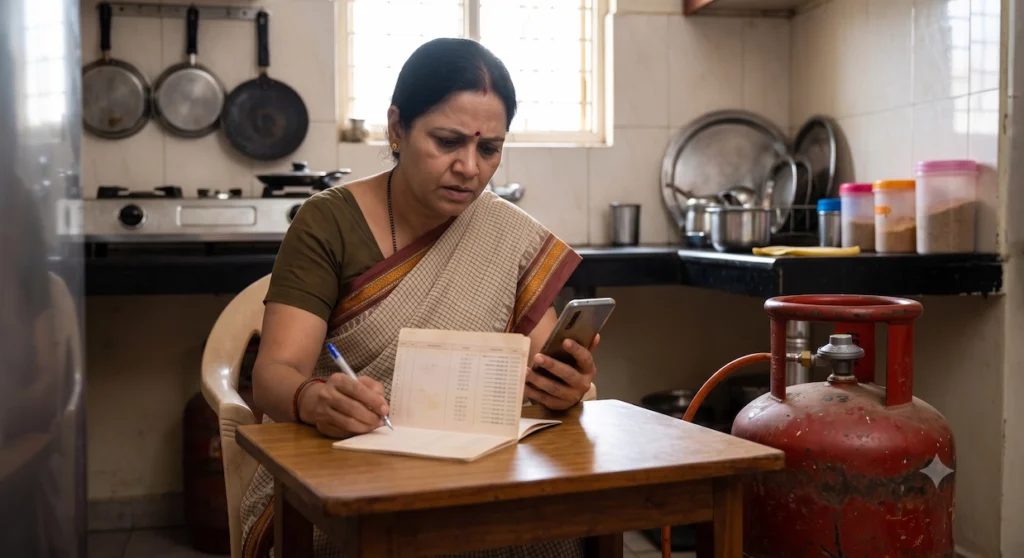
A cylinder gets delivered, you pay the full amount, and then you expect the subsidy to show up in your bank account within a day or two. For many households across India, that payment never arrives. The scheme hasn’t necessarily stopped. More often, the money is held up because two different government records don’t match, leaving the system unsure about where the subsidy should be sent. Herein comes the issue of LPG subsidy not coming and how to resolve the issue.
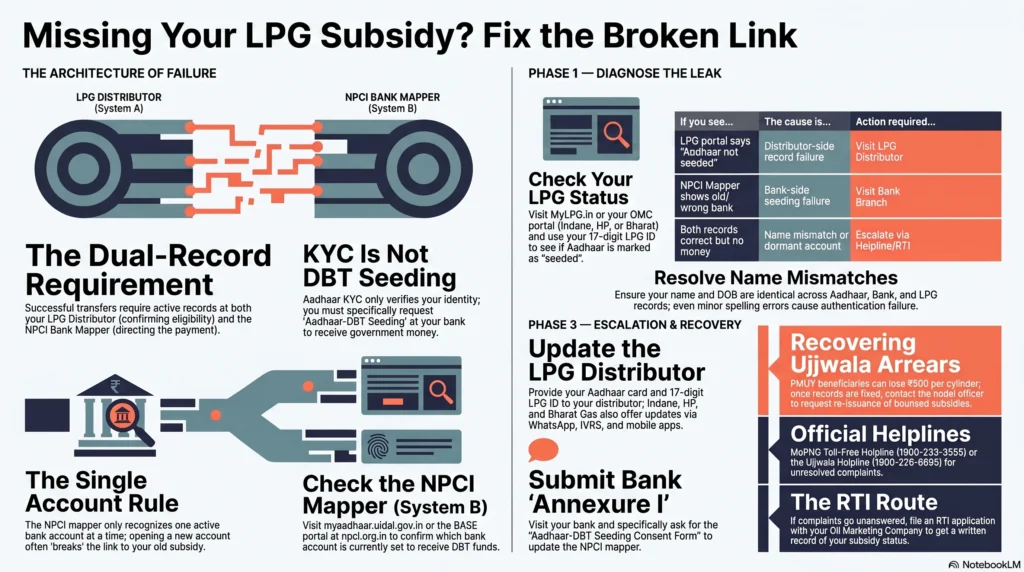
It’s easy to assume that once your Aadhaar is linked to either your LPG connection or your bank account, everything is in place. That’s where many people get caught out. Under the Pratyaksh Hastantrit Labh (PAHAL) scheme, also called Direct Benefit Transfer for LPG (DBTL), two separate records have to work together. One sits with your LPG distributor, while the other is maintained through the National Payments Corporation of India (NPCI) for your bank. If either record is missing, outdated, or doesn’t match the other, your subsidy can stop even though you’re fully eligible to receive it.
This article walks you through both records, shows you how to check each one yourself, and explains what to do if the subsidy still doesn’t reach your account. It also covers when to contact the Ministry of Petroleum and Natural Gas’s toll-free helpline (1800-233-3555) and how the Right to Information Act can help you get a written response from your oil marketing company if your issue remains unresolved.
At A Glance: LPG Subsidy Not Coming
Dual Linking Requirement: Receiving your LPG subsidy requires your account to be correctly updated at both your LPG distributor and the NPCI bank mapper.
KYC vs. DBT Seeding: Having your identity verified (Aadhaar KYC) is not enough; you must explicitly request Aadhaar-DBT seeding at your bank to receive government payments.
Diagnose the Problem First: Verify your 17-digit LPG ID status via MyLPG.in and confirm your active DBT bank account through the UIDAI/NPCI BASE portal before visiting any offices.
The Single Account Rule: Only one bank account can receive DBT funds at a time. Opening a new account or changing banks requires submitting a fresh DBT seeding consent form.
Where to Fix It: Visit your LPG distributor to resolve scheme seeding failures, or approach your bank branch directly to fix NPCI mapper errors.
Escalation Channels: Unresolved missing arrears or stuck applications can be escalated via the MoPNG helpline (1800-233-3555), CPGRAMS, or by filing an RTI application for formal accountability.
Understanding the Architecture of the PAHAL (DBTL) Scheme
PAHAL changed the way LPG subsidies are paid. Instead of buying a cylinder at a lower, subsidised price, every domestic consumer now pays the market price first. If the connection qualifies for a subsidy, the eligible amount is sent separately to the consumer’s bank account after the purchase.
The scheme appears on the government’s myScheme portal as PAHAL (DBTL). It is run by the Ministry of Petroleum and Natural Gas in partnership with the country’s three public sector oil marketing companies: Indian Oil, Bharat Petroleum, and Hindustan Petroleum.
How the Direct Benefit Transfer System is Designed to Work
The payment process itself is fairly simple, even if the paperwork behind it isn’t. You book your LPG cylinder, pay the price charged by your oil marketing company, and take delivery as usual. After that, if you’re entitled to a subsidy, the government sends the approved amount to the bank account currently registered for Direct Benefit Transfer under your Aadhaar.
According to the Unique Identification Authority of India (UIDAI), this does not happen automatically. You must visit your bank, submit its Aadhaar mandate and consent form, and ask the branch to link your Aadhaar for DBT purposes. The bank then updates the NPCI mapper so that your account can receive government benefit payments.
Think of the process as two separate checkpoints. Your LPG connection has to be linked correctly, and your bank account has to be registered for DBT through NPCI. If either step is incomplete, the subsidy payment won’t reach you.
What Makes You a Cash Transfer Compliant (CTC) Consumer?
A consumer is generally treated as cash transfer compliant only when both records are active and match each other. Your LPG distributor must have your Aadhaar correctly linked to your 17-digit consumer number, and the NPCI mapper must point your Aadhaar to an active bank account that can receive DBT payments.
If one of those records is missing or outdated, the LPG connection itself continues to work and you can still book cylinders. The subsidy, though, doesn’t follow. That’s why two members of the same family, buying cylinders from the same distributor, can end up with very different results if one completed both steps and the other did not.
Also Read: Scholarship Money Not Received? How to Track Your DBT Status in 2026
The Financial Impact of Subsidy Leakage on Ujjwala and Standard Consumers
The effect of a failed subsidy transfer depends on the type of LPG connection you have.
For most regular domestic consumers, LPG subsidies have gradually reduced over the years as cylinder prices moved closer to market rates. Many standard connections now receive little or no subsidy, so a broken Aadhaar-bank link usually becomes an issue only when an earlier payment or pending arrears is involved.
For beneficiaries of the Pradhan Mantri Ujjwala Yojana (PMUY), the situation is very different. Eligible households currently receive a refill subsidy of ₹300 for every 14.2 kg cylinder, up to nine refills in a financial year, with proportionate assistance for 5 kg cylinders. That can add up to ₹2,700 a year for a household that uses all eligible refills during FY 2025-26.
The government also covers the cost of a new PMUY connection. For a 14.2 kg connection, the assistance is ₹2,050. For a 5 kg connection, it is ₹1,300. This covers the security deposit for the cylinder, the pressure regulator, hose, gas card, and installation charges, as listed on the scheme’s official website
Even when every document has been submitted and the LPG connection is active, a broken Aadhaar-bank link can stop these payments from reaching the beneficiary.
The Core Problem: Why “Aadhaar Linked” Does Not Guarantee Subsidy Receipt
Many people who miss their LPG subsidy are convinced their Aadhaar is already linked to their bank account. In many cases, they’re right. The catch is that they’re referring to one kind of linking, while the subsidy system depends on another.
The Fatal Flaw in the Word “Linking”
The word “linking” gets used for two different processes, and that creates a lot of confusion.
The first is Aadhaar KYC. This is where your bank records your Aadhaar number as part of its identity verification process. It helps confirm who you are, but by itself it doesn’t decide where government benefit payments should go.
The second is Aadhaar DBT seeding. Here, the bank goes a step further and updates NPCI’s central mapper to mark a specific account as the one that should receive Direct Benefit Transfer payments. That extra step is what the subsidy system relies on.
A practical guide explaining this distinction notes that many failed subsidy payments happen because people assume Aadhaar KYC and DBT seeding are the same thing. They are not. An account can be fully KYC-compliant and still never receive a government benefit because it was never registered for DBT through the NPCI mapper.
This is why someone may continue using the same bank account for everyday transactions without any issues, yet still wonder why an LPG subsidy never arrives. The account works perfectly for banking, but the DBT system has no instructions to send government payments there.
System A: The Scheme Seeding Record (LPG Distributor)
The first record sits with your LPG distributor and the oil marketing company that manages your connection. This record links your Aadhaar number to your 17-digit LPG consumer number, confirming that the connection belongs to you.
A practical guide on failed Aadhaar seeding describes this as linking Aadhaar to the benefit record itself, which in this case is your LPG consumer number. It is separate from any bank-related process.
If this record is missing, contains incorrect details, or was never updated because of an authentication problem, the system cannot confirm your eligibility for the subsidy, even if your bank account is ready to receive DBT payments.
System B: The NPCI Bank Mapper (Your Bank Branch)
The second record is maintained through NPCI and updated by your bank. This is done using the Bharat Aadhaar Seeding Enabler (BASE) platform.
Punjab National Bank explains that the BASE platform lets customers check their Aadhaar mapping status, view mapping history, remove an existing mapping, or create a new one. It also allows Aadhaar mapping to be shifted either to another account within the same bank or to an account in a different bank altogether .
State Bank of India provides the same route for customers. Visit npci.org.in, open the Consumer section, choose Bharat Aadhaar Seeding Enabler, and then check either your Aadhaar mapping status or mapping history.
One rule catches many people by surprise. Only one bank account can remain active in the NPCI mapper at any given time. Whenever a new account is seeded for DBT, it replaces the earlier one, regardless of which account you normally use.
| System A: LPG Distributor Record | System B: NPCI Bank Mapper |
| Maintained by your oil marketing company (Indane, HP Gas, or Bharat Gas) | Maintained by your bank through NPCI |
| Confirms that your Aadhaar is linked to your LPG consumer number | Decides which single bank account receives DBT payments |
| Checked through your distributor or the OMC’s customer portal | Checked through myaadhaar.uidai.gov.in or the BASE platform on npci.org.in |
| Common problems include biometric failures, incorrect consumer details, or name mismatches | Common problems include an old account remaining active or an account being KYC-linked but never DBT-seeded |
Why Funds Bounce Back from Dead or Dormant Accounts
A common situation begins when someone closes an old bank account after opening a new one. Many people assume the subsidy will automatically move to the new account. It doesn’t.
Unless the new account is separately registered for Aadhaar DBT, the NPCI mapper continues pointing to the old account. As a result, the subsidy payment may fail, return to the scheme, or remain against an account that is no longer operational.
Practical guidance on this issue lists one of the most frequent mistakes as closing an old account without completing fresh Aadhaar DBT seeding for the replacement account.
If you think money may have gone to an inactive account, the Reserve Bank of India’s UDGAM portal can help trace unclaimed deposits held in dormant or inoperative accounts across participating banks. Several banks also direct customers to this portal through their Aadhaar and DBT information pages.
Step-by-Step Diagnostics: Finding Your Broken Link
Before visiting your bank or LPG distributor, spend a few minutes checking where the problem actually lies. A quick check can save you from making unnecessary trips or being sent from one office to another.
Phase 1: Checking Your PAHAL LPG Subsidy Status via MyLPG.in
The government’s unified LPG consumer portal, which is also listed by the DBT Bharat Mission as the official PAHAL portal, lets consumers view their subsidy transfer history using their 17-digit LPG ID.
One practical guide explains that after entering your 17-digit LPG ID, you can see the bank account linked to your LPG connection along with recent subsidy credits.
Keep your 17-digit consumer number ready before you begin. You’ll find it in your gas booklet or on a recent cylinder delivery receipt.
If the MyLPG portal is slow or temporarily unavailable, don’t assume your records can’t be checked. The same information is usually available through your own oil marketing company’s customer portal, whether that’s cx.indianoil.in, my.ebharatgas.com, or myhpgas.in.
Phase 2: Verifying Your Active Bank in the NPCI Mapper (UIDAI/BASE Portal)
This is the check many people skip, even though it determines where your subsidy is actually sent.
According to UIDAI’s FAQ, you can check your Aadhaar-bank mapping through myaadhaar.uidai.gov.in or directly through NPCI’s portal at base.npci.org.in/catalog/seedingRequestDetails. UIDAI also notes that this information comes from NPCI’s database rather than its own.
Another option is to visit npci.org.in, open the Consumer section, select Bharat Aadhaar Seeding Enabler (BASE), and view either your Aadhaar mapping status or mapping history. This is the same route recommended by both SBI and PNB.
At this stage, you’re checking one simple thing. Which bank account is currently marked as your active DBT account? If the account shown is different from the one you expect, you’ve likely found the source of the problem.
Phase 3: Interpreting the Results (Is the Oil Company or the Bank at Fault?)
Once you’ve checked both records, compare your findings before deciding where to go next.
| What you see | Likely cause | Where to act |
| LPG portal shows “Aadhaar not seeded” against your consumer number | The distributor-side seeding was never completed or did not go through successfully | Visit your LPG distributor |
| NPCI mapper shows an old, closed, or different bank account | The current account has not been DBT-seeded, or the previous mapping was never replaced | Visit your bank branch |
| Both records appear correct, but no subsidy has arrived | There could be a name mismatch, dormant account, or processing delay | Raise the issue through your OMC helpline or CPGRAMS |
Taking a few minutes to confirm which record is causing the problem can save a lot of frustration. Once you know whether the issue sits with the LPG distributor or your bank, you can approach the right office straight away instead of being passed back and forth between the two.
Fixing the First Wire: Updating Seeding at the LPG Distributor
Once you’ve confirmed that the issue is with your LPG distributor’s records, the next step is to update your Aadhaar seeding there. The process is straightforward, though the exact options vary slightly between oil marketing companies.
Essential Documents Required for Scheme Seeding
Keep the following documents with you before starting the request, whether you’re visiting the distributor or using an online service.
| Document | Why it’s needed |
| Aadhaar card or e-Aadhaar | To verify your identity for the seeding request |
| LPG consumer number (17 digits) | To identify the LPG connection that needs updating |
| Bank passbook or cancelled cheque | To confirm your bank account details, if required |
| Registered mobile number | For OTP verification during online or app-based requests |
Process for Indane Gas Consumers (Online, SMS, IVRS, Offline)
| Channel | Detail |
| Online portal | cx.indianoil.in |
| Mobile app | IndianOil ONE |
| IVRS | 7718955555 |
| Missed call | 8454955555 |
| 7588888824 | |
| Offline | Visit your Indane distributor with the documents listed above |
These are Indian Oil’s official customer service channels, published on the PMUY website (https://pmuy.gov.in). Besides booking cylinders, they can also be used for Aadhaar updates, KYC requests, and related account changes.
If you submit your request online but aren’t sure whether it has been processed, visiting your distributor is often the quickest way to confirm the status. Staff can usually check your record immediately and let you know if anything is still pending.
Process for HP Gas Consumers (Online, SMS, IVRS, Offline)
| Channel | Detail |
| Online portal | myhpgas.in |
| Mobile app | HP PAY |
| IVRS | State-wise numbers available at hindustanpetroleum.com/hpanytime |
| Missed call | 9493602222 |
| 9222201122 | |
| Offline | Visit your HP Gas distributor with the documents listed above |
Unlike the other public sector LPG companies, HP Gas uses state-specific IVRS numbers instead of one nationwide helpline. Check the number for your state before calling. Apart from that, the online portal, mobile app, WhatsApp service, and distributor visit all follow the same general process.
Process for Bharat Gas Consumers (Online, SMS, IVRS, Offline)
| Channel | Detail |
| Online portal | my.ebharatgas.com |
| Mobile app | Hello BPCL |
| IVRS | 7715012345 or 7718012345 |
| Missed call | 7710955555 |
| 1800224344 | |
| Offline | Visit your Bharat Gas distributor with the documents listed above |
Bharat Gas provides two IVRS numbers. If one is busy, you can simply call the other, as both connect to the same customer support system.
Handling Name Mismatches and Biometric Authentication Failures
Many Aadhaar seeding requests fail even when all the required documents have been submitted. The reason is often a mismatch in personal details rather than a missing document.
Before submitting another request, check that your name, date of birth, and Aadhaar number are identical across your Aadhaar record and your LPG connection. Even a small spelling difference can prevent the records from matching. If you spot an error, correct the incorrect record first and then submit a fresh seeding request.
For Pradhan Mantri Ujjwala Yojana (PMUY) applicants, biometric eKYC can also become a stumbling block. A fingerprint or iris scan that fails to match, or an Aadhaar that has been locked, can stop the application process at the distributor’s counter. A practical guide recommends asking the distributor for the exact Aadhaar authentication error code instead of accepting a generic explanation, as this makes it much easier to identify the real issue.
If the problem lies with your Aadhaar details themselves, those corrections must first be completed through UIDAI before returning to your LPG distributor for fresh seeding.
Fixing the Second Wire: Resolving NPCI Mapper Failures at Your Bank
If your checks show that the wrong bank account is active in the NPCI mapper, or no account is mapped at all, the next stop is your bank branch. Your LPG distributor cannot fix this part of the process because the mapping is handled by the bank and NPCI.
Why You Must Fill the DBT Aadhaar Seeding Consent Form (Annexure I)
Simply asking a bank official to link your Aadhaar is often not enough. Unless the branch processes your request as Aadhaar-DBT seeding, your account may only be updated for KYC purposes and still remain outside the Direct Benefit Transfer system.
UIDAI states that you must complete the bank’s Aadhaar mandate and consent form before the bank can send a seeding request to NPCI.
Some schemes also provide their own consent form. For example, the PMUY website publishes a separate “NPCI form for Aadhaar linking with bank,” which can be submitted directly to your bank.
When you’re at the branch, don’t just ask for Aadhaar linking. Ask specifically for Aadhaar-DBT seeding. That small difference in wording matters because it tells the bank that you want your account registered in the NPCI mapper for government benefit payments, not just updated for identity verification.
The Danger of Opening New Accounts Without Updating the Mapper
Changing your bank account does not automatically change your DBT destination.
Many people open a new savings account, close an older one, or switch from one bank to another, believing their subsidy will automatically follow them. It doesn’t work that way. Until the new account is separately seeded for Aadhaar DBT, the NPCI mapper continues pointing to whichever account was last registered.
A practical guide on misplaced DBT payments lists this as one of the most common mistakes consumers make. Closing an old account without completing fresh Aadhaar seeding for the replacement account often leaves subsidy payments heading to the wrong place.
The same applies if you’ve moved from a Jan Dhan account to a regular savings account, converted a joint account into an individual one, or changed banks altogether. Every new account needs its own DBT seeding request.
Moving Your Aadhaar Mapping from One Bank to Another
The Bharat Aadhaar Seeding Enabler (BASE) platform was designed for situations like this.
Punjab National Bank explains that customers can carry out fresh Aadhaar seeding, move the mapping to another account within the same bank, or shift it to an entirely different bank using the BASE platform.
You can complete the process in either of two ways. Visit the bank branch where you want future subsidy payments to arrive and request Aadhaar-DBT seeding, or submit the movement request yourself through the Consumer section on npci.org.in using BASE.
Whichever method you choose, ask for a written acknowledgement or reference number before leaving. If the mapping is not updated within a reasonable period, you’ll have proof of when the request was made.
How Bank Officials Update the Core Banking System (CBS) and NPCI Files
After receiving your request, the bank first verifies your Aadhaar details with UIDAI. It then updates its own Core Banking System (CBS) to show that your Aadhaar is linked with the account.
That isn’t the final step.
The bank must also send a separate update to the NPCI mapper. This second update is what decides which account receives your DBT payments.
Because these are two separate actions, it’s possible for a bank official to confirm that your Aadhaar is linked while the NPCI mapper still points to another account. Until the mapper itself is updated, government benefit payments may continue going to the wrong account or fail altogether.
Navigating Special Circumstances and Complex Errors
Some subsidy issues don’t fit neatly into either the LPG distributor or bank category. In these cases, a little more digging is needed because the delay may be caused by eligibility checks, household records, or a failed backend process.
What to Do When Family Members Are Split Across Different Ration Cards
Under the Pradhan Mantri Ujjwala Yojana (PMUY), a household is generally eligible for only one LPG connection. During the application process, oil marketing companies rely on ration cards and other family records to check whether another connection already exists in the same household.
Problems can arise when a joint family has separated but the official records haven’t fully caught up. For example, two brothers may now have separate ration cards while continuing to live at the same address. Even though they function as separate households, the system may still flag the second application as a duplicate.
Where a ration card does not accurately reflect the family’s current situation, applicants can use the migrant self-declaration option through Annexure-I to provide details about their address and family composition. If an application has already been rejected because of an incorrect duplicate-household flag, that decision can also be challenged through the grievance and RTI routes discussed later in this article.
Resolving “Seeding Failed” Messages Despite Active Accounts
It can be frustrating to see a “seeding failed” message when your bank account is active and working normally.
The first thing to do is read the message carefully. Terms such as “not seeded,” “not linked,” and “mapping failed” do not all mean the same thing. Each points to a different stage of the process, so the solution also changes depending on the message you receive.
Guidance on troubleshooting these cases recommends checking the LPG record and the NPCI bank mapping separately instead of assuming that fixing one automatically fixes the other.
If your account works without any trouble for deposits, withdrawals, and other banking transactions, the issue is often that the Aadhaar-DBT request never reached the NPCI mapper. In that situation, it’s better to speak directly with the branch staff responsible for Aadhaar seeding instead of relying only on general customer service.
PMUY (Ujjwala Yojana) Specific Compliance Hurdles
A PMUY application passes through several checks before the subsidy is released. These include KYC verification, biometric eKYC, duplicate-household verification, eligibility checks, release of the LPG connection, and finally the first refill subsidy.
A delay at any one of these stages can leave applicants wondering why nothing is moving, because the outward signs often look the same.
One of the more common problems is the duplicate-household check. An existing LPG connection registered to a relative at the same address can sometimes trigger an incorrect rejection, even when the new applicant is genuinely eligible.
Another difficulty is that distributors do not always provide a written explanation when an application is held up. That’s one reason the Right to Information route can be useful. It gives applicants a way to request the official record and identify exactly where the application has stopped.
If you’re dealing with a PMUY-related issue, keep these helpline numbers handy. The LPG Emergency Helpline is 1906, while the dedicated Ujjwala Helpline is 1800-266-6696.
Reclaiming Your Missing Money: Arrears, Grievances, and RTI
Getting your Aadhaar and bank records back in sync is only part of the solution. If earlier subsidy payments failed or bounced, you’ll usually need to ask for those amounts to be traced and credited again.
Will You Receive Back-Payments for Bounced Subsidies?
In many cases, yes. But don’t expect the money to return on its own.
When a DBT payment fails, it normally goes back to the scheme instead of disappearing. The first step is to complete Aadhaar-DBT seeding with the correct bank account. Once that’s done, you should contact the scheme’s nodal officer and ask for the earlier payment to be reissued, quoting the original credit date wherever possible.
If you request arrears before fixing the bank mapping, there’s a good chance the payment will fail all over again.
How to Escalate Through MoPNG E-Seva and Toll-Free Helplines (1800-233-3555)
If you’ve already visited your bank and LPG distributor without getting the issue resolved, it’s time to raise a formal complaint instead of repeating the same visits.
| Helpline or portal | Contact | Use it for |
| LPG Emergency Helpline | 1906 | Gas leaks and other safety emergencies |
| MoPNG Toll-Free Helpline | 1800-233-3555 | LPG subsidy issues and general consumer complaints |
| Ujjwala Helpline | 1800-266-6696 | PMUY connection and subsidy-related matters |
| MoPNG E-Seva | mopnge-seva.in | Filing a formal complaint that can be tracked |
| CPGRAMS | pgportal.gov.in | Public grievances when the OMC or bank process has stalled |
The PMUY website lists these as its official consumer contact channels.
Among them, MoPNG E-Seva is often the better option once your initial attempts haven’t worked because it gives you a complaint number that you can track later.
If the matter still isn’t resolved, you can move to CPGRAMS, the Centralised Public Grievance Redress and Monitoring System. It accepts complaints involving government departments, although it does not deal with matters that fall under the Right to Information Act.
FAQ: LPG Subsidy Not Coming
Your subsidy is likely held up because your Aadhaar is not seeded for Direct Benefit Transfer (DBT) in the NPCI mapper, or there is a mismatch between your LPG distributor records and your bank. Even if your account is active, you must explicitly submit an Aadhaar-DBT consent form to your branch to receive scheme funds.
You can verify your mapping status by visiting the UIDAI website (myaadhaar.uidai.gov.in) or the Bharat Aadhaar Seeding Enabler (BASE) portal on npci.org.in. This database will show you exactly which single bank account is currently active to receive government payments.
Aadhaar KYC simply verifies your identity for standard banking purposes. DBT seeding updates the central NPCI mapper, giving the government direct instructions on where to send your subsidy. An account can be fully KYC-compliant but still fail to receive subsidies if it isn’t DBT-seeded.
Changing your primary bank account does not automatically reroute your subsidy. You must visit your new bank branch and submit a fresh Aadhaar-DBT seeding request (Annexure I). Until the NPCI mapper is updated, the government will continue trying to send money to your old account.
If fixing your bank and distributor records doesn’t work, you can call the Ministry of Petroleum and Natural Gas toll-free helpline at 1800-233-3555, register a complaint on the MoPNG E-Seva portal, or escalate the issue through CPGRAMS for formal resolution.
Using the Right to Information (RTI) Act to Force Action on Failed DBTs
If repeated complaints produce no written response, the Right to Information Act offers another route.
Oil marketing companies are public sector undertakings, which means they fall within the scope of the RTI Act, 2005, along with the Ministry of Petroleum and Natural Gas. Filing an RTI application costs ₹10. Applicants who fall below the poverty line are exempt from this fee after submitting a valid BPL certificate. The Public Information Officer is expected to reply within 30 days.
It’s usually better to send your main RTI application to the Central Public Information Officer (CPIO) at your oil marketing company’s Area Office because that’s where the operational records are held. You can also submit a copy to the Ministry through rtionline.gov.in so both offices are aware of the request.
When drafting your RTI, ask for specific records instead of broad explanations. For example, request the UTR and credit date of a subsidy payment, the Aadhaar seeding status linked to your LPG consumer number, or the exact stage where a Ujjwala application is pending. Requests for clearly identified records are generally harder to dismiss than open-ended questions.
If you don’t receive a reply within 30 days, or the response doesn’t answer your request properly, you can file a First Appeal under Section 19(1) with the Appellate Authority of the same public authority. If you’re still dissatisfied, a Second Appeal under Section 19(3) can be filed before the Central Information Commission within 90 days without paying any additional fee.
The RTI Act also allows the Commission to impose a penalty of up to ₹250 per day, subject to a maximum of ₹25,000, on a Public Information Officer for an unjustified delay under Section 20. That provision often encourages pending cases to receive attention instead of being left unanswered.
Disclaimer
This article is for general information and does not replace advice from your bank, LPG distributor, or a qualified professional for your specific case. Helpline numbers, subsidy amounts, and procedural requirements are set by UIDAI, NPCI, individual banks, and the Ministry of Petroleum and Natural Gas, and are revised from time to time, so confirm current details on the relevant official portal before you act. Neither the publication nor the author is liable for outcomes arising from reliance on this guide.

Leave a Reply