
Full and Final Settlement Rules 2026: How to Ensure You Get Paid Within 48 Hours

An employee who resigns today can expect the money owed to them within two working days, not the 30 to 45 days that used to pass for standard practice at most Indian companies. That single change, written into Section 17(2) of the Code on Wages, 2019, has reset how employers handle every exit, whether the departing employee quit, got laid off, or lost their job when an establishment shut its doors. Here comes the factor of the full and final settlement rules (2026).
The four Labour Codes that carry this rule were notified on 21 November 2025, and the detailed Central Rules that operationalise them followed on 8 May 2026. Companies that once ran full and final settlement alongside next month’s payroll now have 48 hours from an employee’s last working day to clear wages, or they face a fine, a compensation order, or both.
What follows covers what the 48-hour rule includes and where it stops, how a separate 50% wage rule changes the size of a typical settlement, the compliance steps that keep an employer inside the deadline, which deductions are lawful, and what to do the moment a payment is late. An employee checking what they’re owed and an HR team redesigning offboarding around a shorter clock are looking for the same set of facts.
At a Glance: Full and Final Settlement Rules 2026
- The 48-Hour Deadline: Under Section 17(2) of the Code on Wages, 2019, employers must clear unpaid salary, leave encashment, and bonuses within two working days of an employee’s last day.
- Universal Scope: The accelerated timeline applies universally across resignations, terminations, retrenchments, and company closures, regardless of employee seniority or contract type.
- The 50% Basic Wage Rule: Basic pay and dearness allowance must now account for at least 50% of total CTC, legally requiring employers to restructure compensation and subsequently increasing exit payouts for leave encashment.
- Gratuity Excludes the 48-Hour Clock: Unlike standard wages, gratuity payouts operate on a separate statutory timeline and must be settled within 30 days of becoming payable.
- Strict Deduction Limits: Employers can only deduct costs explicitly permitted by law (like notice period shortfalls). Withholding settlements for arbitrary fines or unreturned assets (beyond their documented value) is illegal.
- Escalation and Recourse: Employees facing delayed settlements can issue a legal notice or file a grievance with the Labour Commissioner, which can result in employer fines of up to ₹1,00,000 and compensation orders.
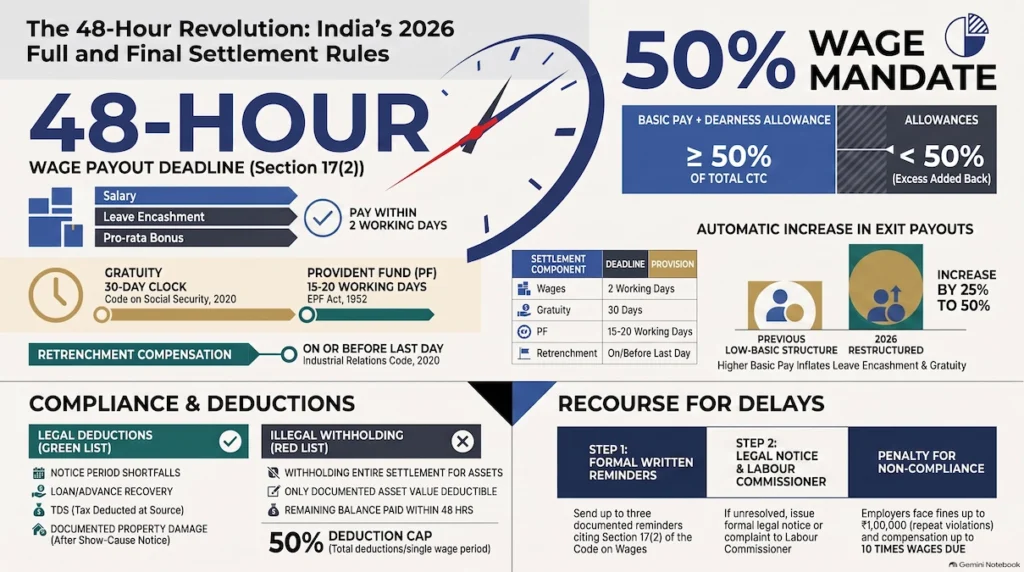
Understanding the New 48-Hour Full and Final Settlement Rule Under the 2026 Labour Codes
What is the 48-Hour Rule for Full and Final Settlement?
Section 17(2) of the Code on Wages, 2019 states that when an employee is removed, dismissed, retrenched, or resigns, the wages payable to them must be paid within two working days of that event.
Most coverage of this rule shortens it to “48 hours.” That’s a fair approximation, but not quite literal. The clock runs on working days, not a fixed hour count, so a resignation that lands just before a weekend or a public holiday buys a little more real time than the headline number implies, since weekly offs and declared holidays don’t count toward the two days.
What falls inside that window matters more than the exact hour count. The rule covers wages: unpaid salary, leave encashment, pro-rata bonus, and pending reimbursements. It does not cover gratuity, which runs on its own 30-day clock, or provident fund, which moves through the EPFO portal on a timeline of its own. Mixing up the two is probably the single most common mistake employees, and even some HR teams, make with this rule. It comes up again more than once in what follows.
Before the new codes, no statutory deadline existed for wage settlement on exit. Employers set their own pace, and 30 to 45 days counted as reasonably fast. Some organisations stretched it to 60 or 90 days with no penalty attached and no real recourse for the employee still waiting on their money.The table below shows how the deadlines now split across the different pieces of a settlement.
| FnF Component | Governing Provision | Payment Deadline |
| Wages: salary, leave encashment, pro-rata bonus, reimbursements | Section 17(2), Code on Wages, 2019 | 2 working days from the last working day |
| Gratuity | Sections 53 and 56, Code on Social Security, 2020 | 30 days from the date it becomes payable |
| Provident fund transfer or withdrawal | EPF and Miscellaneous Provisions Act, 1952, via EPFO | Typically 15 to 20 working days after the claim is filed |
| Retrenchment compensation | Industrial Relations Code, 2020 | On or before the last working day |
The Code sets deadlines for routine wage periods too, separate from exits. Daily-rated staff get paid at the end of the day, weekly workers on the last working day of the week, fortnightly staff within two days of the fortnight closing, and monthly employees before the seventh day of the following month.
The two-day exit rule sits alongside those wage-period deadlines. It covers the one-off final payment that closes out the employment relationship, rather than routine pay cycles.
Does the 48-Hour Rule Apply to Resignations and Terminations?
Yes, and this is where the rule has real teeth. Section 17(2) lists four triggers by name: removal, dismissal, retrenchment, and resignation. It then adds a fifth for unemployment caused by closure of the establishment. Every route out of a job, voluntary or not, starts the identical two-day clock.
There’s no exemption tied to seniority. A factory worker on minimum wage and a vice president on a seven-figure package sit under the same deadline. Industry, company size, and employment type change nothing either. Permanent staff, fixed-term employees, contract workers, and employees still on probation all fall within scope.
The old habit of quietly taking longer with senior or high-earning exits no longer has any legal footing. For large employers processing dozens of exits in a single month, that uniformity removes the room for informal triage that used to exist, where a senior departure got fast attention while everyone else waited their turn.
Retirement and death in service work a little differently, since these are the events that specifically trigger gratuity eligibility rather than the wage-settlement clock. An employee’s unpaid wages at retirement still fall under the same two-day rule. It’s only gratuity, calculated separately, that follows its own 30-day path regardless of how the employment ended.
Why Was the 48-Hour FnF Settlement Deadline Introduced?
The two-day rule didn’t appear on its own. It’s one piece of a larger project that folded 29 separate central labour laws into four consolidated codes, cutting 1,228 sections down to 480 and reducing 1,436 rules to 351.
Thirty-one different returns became a single electronic filing, and the number of registers an employer had to maintain dropped from 84 to eight. The Ministry of Labour and Employment frames the whole exercise as a move toward clearer rules and simpler procedures for employers, paired with stronger protection for workers.
Those two goals don’t always pull in the same direction, and the 48-hour rule is one of the clearest places where the worker-protection side actually shows up in day-to-day payroll practice rather than staying a line in a policy document.
None of this happened quickly. Parliament had already passed all four codes between 2019 and 2020, but they sat unimplemented for roughly five years while the Centre and individual states worked through draft rules, industry consultations, and repeated delays. As late as September 2025, industry trackers were still noting that the codes, presidential assent notwithstanding, remained largely on paper, with several states yet to publish even draft rules on wages.
The November 2025 notification, and the Central Rules that followed in May 2026, closed that gap for establishments under central jurisdiction, though a number of state-specific rules were still pending as of mid-2026.
For wage payment specifically, the gap this rule closes is a familiar one to anyone who has managed an exit in India. Gratuity carried a 30-day statutory deadline for decades under the old Payment of Gratuity Act. Ordinary wages had no deadline at all. Chasing HR for a final paycheck had become close to routine for anyone leaving a job, and that asymmetry is exactly what the reform targets.
The four codes were notified on 21 November 2025, with the Code on Wages Central Rules following on 8 May 2026, after a public consultation period on the draft rules that began in December 2025.
Key Components Included in Your Full and Final Settlement
Unpaid Salary and Pro-Rata Wages
The core of any settlement is salary for the days actually worked in the final month, plus anything still unpaid from earlier cycles. Payroll teams typically calculate this by dividing gross monthly salary by the number of days in the standard payroll cycle and multiplying by days worked before exit. The exact divisor, 26 working days versus 30 calendar days, depends on company policy and varies from one payroll system to the next.
Pending arrears belong here too. A March expense reimbursement, or a delayed increment that never made it into a payslip, goes into the final settlement. Both get calculated up to the last working day rather than the resignation date, and checked against attendance records instead of a rough estimate. (https://bharatpayroll.com/blog/full-and-final-statement/)
Leave Encashment Calculation Rules for 2026
Unused earned leave, sometimes called privilege leave, converts to cash on exit. Sick leave and casual leave generally don’t qualify. Each company’s own policy decides exactly which leave types are encashable, so the list varies from employer to employer. A common formula divides basic salary by 26 and multiplies the result by the number of unused earned-leave days on record. (https://www.pockethrms.com/guide/full-and-final-settlement/)
Because leave encashment counts as a wage component under Section 17(2), it falls inside the two-day payment window rather than running on a separate clock. And because the underlying calculation runs on basic salary, the 50% wage rule covered further down changes the final number directly. A higher basic means a higher payout for the exact same stack of unused leave days.
Tax treatment depends on how the employment ended. Leave encashment paid out on resignation is generally taxed in full for private-sector employees, while the same kind of payout made at retirement carries a partial exemption, up to ₹25 lakh under Section 10(10AA).
Gratuity Eligibility and Payout Timelines
Gratuity sits outside the 48-hour rule entirely, and it earns its own paragraph because so much confusion clusters around it. Under the Code on Social Security, 2020, which absorbed the standalone Payment of Gratuity Act, 1972, an employee becomes eligible after five years of continuous service, triggered by superannuation, retirement, resignation, death, or disablement due to accident or disease.
Fixed-term employees now qualify after just one year of service, and any extra stretch beyond six months but short of a full additional year gets rounded up and counted as one more year.
The payout formula is 15 days’ wages for each completed year of service, and the employer has 30 days from the date it becomes payable to make the payment. That’s a full month, not two working days. At least one payroll guide lists treating the two-day rule as covering gratuity as the single most common employer mistake in this whole area.
For non-government employees, gratuity stays tax-exempt up to ₹20 lakh, a detail worth confirming before assuming a payout is fully taxable.
Employers, for their part, are expected to start the gratuity calculation on the last working day even though payment itself isn’t due for a month. That way the number is ready well before the 30-day deadline arrives, instead of becoming a last-minute scramble.
It also helps to have a gratuity nomination on file well before that point. Every employee is required to submit one within a set period after completing a year of service, and a missing or outdated nomination is a surprisingly common reason gratuity payment gets held up right at the end.
Statutory Bonuses, Variable Pay, and Reimbursements
Any employee who worked at least 30 days in the accounting year, which runs from 1 April, and who earns within the wage ceiling the government sets, qualifies for an annual bonus of at least 8.33%, capped at 20% of wages earned that year.
On exit, this bonus gets pro-rated to the days actually worked. Because it counts as a wage component, it falls inside the two-day settlement window alongside salary and leave encashment rather than waiting for the annual bonus cycle.
Reimbursements are less automatic. Travel, medical, and telephone claims only make it into the final payout when they were submitted with receipts and approved before the employee’s last working day. Claims filed late, or without proper documentation, are routinely left out of the settlement, which is one more reason to close out expense claims before a notice period ends rather than after.
One distinction is worth holding onto across all four of these components. Wages and gratuity are hard statutory entitlements, fixed by law regardless of what any individual company decides. Leave encashment is more of a hybrid: whether earned leave can be encashed at all, and how much of it, comes from each employer’s own leave policy. Once that entitlement is established, though, its payment on exit falls under the same wage definition and the same two-day clock as ordinary salary.
How the 50% Basic Wage Rule Impacts Your Final Settlement
The Mandate: Basic Salary Must Be 50% of CTC
Section 2(y) of the Code on Wages, 2019 sets a single definition of “wages” that now applies across PF, gratuity, bonus, and every other statutory calculation an employer runs. Wages mean basic pay, dearness allowance, and retaining allowance. A long list of items sits outside that definition: house rent allowance, conveyance allowance, overtime pay, commission, employer contributions to PF or pension, and gratuity itself, among others.
Here’s the mechanism that gives the rule its actual bite. If those excluded items together exceed 50% of an employee’s total pay, the excess amount does not simply sit outside the wage calculation. It gets added back into wages.
In practice, that forces basic pay plus dearness allowance to sit at 50% of total remuneration or higher, no matter how a company’s salary structure was originally set up.
A simplified illustration makes the mechanism easier to follow. Picture an employee on a CTC of ₹12 lakh a year, paid out as ₹30,000 a month in basic salary against total monthly pay of ₹1 lakh, so basic sits at 30% of the total. That structure was ordinary under the old rules. Under the new wage definition, the excluded components, HRA, special allowance, and the rest, cannot add up to more than half of that ₹1 lakh, so basic plus dearness allowance has to rise to at least ₹50,000 a month. Gratuity and leave encashment, both calculated against that basic figure, rise along with it.
For years, plenty of companies kept basic salary deliberately low, often somewhere between 25% and 40% of CTC, because PF and gratuity are calculated on basic pay and a smaller basic meant smaller statutory liability.That structure stopped being compliant the day the wage codes took effect.
The change applies from 21 November 2025 onward, the date the four Labour Codes came into force. One HR technology platform’s own guidance on the transition puts the cutover plainly: an employee whose last working day fell on or before 20 November 2025 has gratuity calculated on the old basic salary, while anyone leaving on or after 21 November 2025 gets the new wage definition applied instead.
| Typical Old Structure | Under the 50% Wage Rule | |
| Basic pay plus DA, as a share of CTC | Roughly 25% to 40% | At least 50% |
| Allowances such as HRA, conveyance, and other special pay components | Could run past 60% to 70% of CTC | Capped so the excluded total stays under 50% |
| Base used for PF and gratuity calculation | The smaller, old basic figure | The larger, restated wage figure |
| Employee take-home pay | Often higher, from lower statutory deductions | Often somewhat lower, as more moves into basic and PF |
Increased Payouts for Leave Encashment and Gratuity
Every statutory payout calculated on “wages”, gratuity, leave encashment, PF, overtime, moves the same direction once basic pay rises to meet the 50% floor: up. An employee who previously had a basic salary at 30% of CTC and now sits at 50% doesn’t just see a slightly different payslip. Their gratuity and leave encashment on exit get calculated against a larger number.
How much larger depends entirely on how aggressively a company minimised basic pay before the rule took effect. Payroll commentary has floated gratuity-liability increases somewhere between 25% and 50% for employers coming from a low-basic structure, though the real figure for any individual employee depends on tenure, total CTC, and how far the old basic sat below the new floor.
This increase isn’t new money the rule invented. It’s money the employee had already earned under their terms of employment, made visible again after years of salary structures that quietly kept statutory dues low.
Employers face this retroactively too. Existing employees whose CTC was set up around a low basic need their salary breakup revisited now, not at their next exit. Any past actuarial estimate of gratuity liability needs to be redone as well, since it would have used the smaller basic figure that applied before the reform.
Adjustments in PF Contributions at Exit
Provident fund contributions rise the same way, for the same reason. The government’s own compliance handbook sets the employer’s contribution at 10% of wages under Section 16 of the Code on Social Security, 2020, matched by an equal employee contribution. Once “wages” expands to meet the 50% floor, that percentage applies to a larger base, and the PF corpus an exiting employee walks away with grows in step.
PF itself isn’t part of the cash that lands in a bank account within 48 hours. It sits in a completely separate system. An employer’s job at exit is limited to marking the employee as separated on the EPFO portal and depositing the final month’s contribution on schedule. From there, the employee files their own withdrawal or transfer claim, which typically takes 15 to 20 working days to process. An employee expecting PF money inside the same 48 hours as salary is often disappointed for no good reason. The two payments were never on the same track.
Step-by-Step Guide: How to Guarantee Your 48-Hour Payout
Step 1: Initiate Early and Comprehensive Clearances
A two-day deadline doesn’t survive an employer waiting until an employee’s last day to start the process, and most HR teams that tried it that way found out quickly. The practical fix is treating the entire notice period, not the two days after exit, as the actual settlement window. The moment a resignation is accepted, IT, Finance, Admin, HR, and the reporting manager should all receive clearance tasks the same day, working in parallel instead of one department waiting on the last one to finish.
Sequential clearances, the old default at most companies, routinely took five to ten working days on their own before a single rupee moved. A 48-hour deadline cannot absorb that kind of chain.
A short prep list helps turn that into practice:
- Map every offboarding step that currently happens after an employee’s last working day, and work out which ones can move earlier
- Shift payroll calculation, department clearances, and asset recovery into the notice period itself, instead of treating them as post-exit tasks
- Replace sequential sign-offs with clearances that run at the same time, so one slow approval doesn’t hold up everything behind it
- Write asset-recovery and deduction terms into the appointment letter up front, rather than improvising a policy at the point of exit
- Brief reporting managers specifically, since a delayed manager sign-off is consistently one of the more common reasons a settlement misses its window
Short-notice and waived-notice exits are the genuinely hard case here, since there’s no buffer period to fall back on. These situations need their own contingency workflow rather than a compressed version of the standard 30-day process.
Step 2: Track Your Leave Balance and Final Working Days
Attendance and leave data need to be locked and checked well before the last working day, not reconstructed afterward from memory or a scattered spreadsheet. An employee should independently track their own earned leave balance and notice-period status ahead of time, rather than taking HR’s version on faith the moment a settlement statement arrives. Whether a notice period was served in full changes the math, compared with one that fell short partway through.
Unpaid loans, salary advances, and any pending disciplinary matter that could trigger a fine also need flagging early. Nothing derails a two-day timeline faster than Finance discovering an unresolved loan balance on the last working day itself.
Step 3: Review Your FnF Statement Before the Last Day
A proper settlement comes with an itemised statement listing every credit and every deduction, ideally shared with the employee for review before the money actually moves. This single habit heads off most disputes before they start. A statement worth trusting spells out each line on its own: pro-rata salary, leave encashment, bonus, and reimbursements on one side, notice recovery, loans, TDS, and asset costs on the other, with a clear net figure at the bottom rather than a single unexplained total.
Cross-check the statement against your last few salary slips, the notice-period clause in your appointment letter, and any reimbursement claims you submitted but haven’t yet seen paid. If a number looks wrong, raise it before signing a no-dues certificate, not after. Once that certificate is signed, disputing the underlying calculation becomes a considerably harder conversation to have.
Step 4: Ensure EPF and UAN Linkage is Complete
Aadhaar-seeded UAN details need to be accurate before an employee’s last day, not discovered as a problem afterward when a withdrawal claim bounces back. EPFO simplified this seeding process for employers through a 2025 circular, allowing direct linkage whenever an employee’s name, gender, and date of birth already match their Aadhaar record, with no separate approval required. Where a mismatch exists, it needs correcting through the joint declaration process well ahead of the exit date. A PF transfer or withdrawal claim cannot move cleanly through a broken UAN link.
Common Employer Deductions: What is Legal and What is Not?
Legal Deductions: Notice Period Shortfall and Taxes
Section 18 of the Code on Wages, 2019 permits a specific list of deductions and nothing beyond it: absence from duty, damage or loss caused by the employee, recovery of loans or advances, fines imposed after the employee has had a chance to respond, and accommodation or amenities the employer has provided. Every deduction taken together in a single wage period is capped at 50% of wages for that period.
Notice period shortfall shows up most often in practice, usually calculated as monthly salary divided by 30 and multiplied by the number of days short of the contractual notice period. (https://www.pockethrms.com/guide/full-and-final-settlement/) TDS on taxable components, and professional tax where it applies, round out the list. Neither is controversial.
Fines and deductions for damage or loss aren’t automatic even when they’re legitimate. The employer has to follow a process first. A show-cause notice goes to the employee, who gets seven days to respond, and the employer has to communicate the final decision within 15 days of the deduction. Skipping that sequence is its own compliance failure, separate from whether the deduction amount itself was reasonable.
Illegal Deductions: Training Costs and Arbitrary Fines
Anything outside Section 18’s list simply isn’t an authorised deduction, regardless of how justified it seems to the employer making it. Training cost recovery with no signed agreement in place before the training happened, or a performance-related penalty invented after the employee has already resigned, both fall outside the law.
Unreturned assets are where employers most often overreach. A laptop or ID card still sitting with a former employee justifies deducting its documented value, and nothing more. Holding back the entire settlement until the asset shows up isn’t legally permissible. The employer can deduct only the cost that’s specific and documented, and has to release the rest of the payment inside the two-day window regardless.
Notice period recovery is another spot where things go wrong, even though the deduction itself is entirely legal. Recovering the full shortfall in cash while ignoring earned leave that could have covered part of the unserved notice isn’t a fair reading of most company policies, and it comes up often enough that legal guides call it out as a recurring source of disputes. A settlement statement that bundles several deductions into one unexplained figure, instead of breaking each one out, tends to draw the same kind of scrutiny.
| Legal | Not Legal |
| Notice period shortfall, calculated on a documented formula | Withholding the full settlement over an unreturned laptop or ID card |
| Recovery of outstanding loans or salary advances | Recovering training costs with no signed agreement in place |
| TDS and, where applicable, professional tax | A performance-related fine invented after the employee has resigned |
| A fine issued after a show-cause notice and a chance to respond | Any fine or deduction imposed without a show-cause process |
| Deductions that stay within the 50% of wages cap for the period | Total deductions exceeding 50% of wages in a single wage period |
A wage register recording every fine and deduction has to be maintained by the employer regardless, and wage slips issued to employees are expected to show these amounts individually rather than as a single unexplained lump sum.
An employee who receives a settlement statement with an unexplained deduction is well within their rights to ask which provision it was made under. Requesting a copy of the wage register itself isn’t standard practice for most departing employees, but nothing in the law prevents it, and a genuine dispute over a deduction is exactly the situation where asking for it stops being unreasonable.
What to Do If Your Employer Delays the 48-Hour Settlement
Send Formal Reminders Documenting the Delay
Start in writing, even if the first conversation happened over the phone or in person. A written reminder to HR and management, citing Section 17(2) of the Code on Wages directly and asking for a specific payment date, creates a paper trail that ends up mattering later.
One legal guide recommends sending up to three reminders roughly 48 hours apart before moving to the next stage, giving the employer a real chance to fix things first, with the delay properly documented.
Keep every email and acknowledgment from HR along the way, plus a note of any excuse offered when a deadline slipped. Bank statements, the resignation acceptance letter, past salary slips, and the appointment letter itself all become useful evidence if the situation escalates further. (https://digilawyer.ai/blogs/full-and-final-settlement-rules-under-labour-law-india-2026)
Issue a Legal Notice
If reminders go nowhere, a legal notice is the next step, and it tends to move faster than most employees expect. The notice should state the exact amount owed, a firm payment deadline, and the legal consequences of continued non-payment. A notice that explicitly cites Section 17(2) signals to the employer that the employee knows exactly which statutory ground the claim rests on, and that tends to change how seriously it gets read.
File a Complaint with the Labour Commissioner
When even a legal notice doesn’t move an employer, Section 17(3) of the Code on Wages gives the employee the right to file a complaint with the Controlling Authority, which can order payment of the dues owedIn practice, this usually means approaching the Inspector-cum-Facilitator or the state Labour Department directly. The Inspector’s contact details are, by law, supposed to be displayed on the employer’s own notice board, alongside the wage period and payment date, so the information is often closer at hand than employees expect. A complaint works best when it carries the same documentation as a legal notice: the exact amount claimed, the last working day, and copies of every reminder already sent, so the Authority isn’t starting from a blank file.
The penalties on the other side of this are real enough to matter. Section 54 sets a fine of up to ₹50,000 for a first offence, rising to ₹1,00,000 plus possible imprisonment of up to three months for repeat violations within five years.
Separately, Section 45 lets the Controlling Authority order compensation of up to 10 times the wages actually due, on top of the wages themselves. That turns a delayed settlement into an expensive mistake for an employer rather than a minor administrative slip.
A company that shuts down before paying is a harder case, though it isn’t a dead end. Dues owed to employees can still be claimed against the company’s assets through the labour authorities, or through the insolvency process where the company is being formally wound up, so a closure doesn’t automatically erase what’s owed.
Employees generally have up to three years to file a claim for unpaid dues. Acting closer to the actual delay makes recovery considerably easier, since records stay fresh and an employer’s excuses tend to hold up worse under scrutiny the longer they’ve had to develop. (https://digilawyer.ai/blogs/full-and-final-settlement-rules-under-labour-law-india-2026)
Public escalation, posting about the delay on LinkedIn or a similar platform, sits at the very end of this list for a reason. It can pressure a company that has ignored every formal channel already tried, but it only works safely when it sticks to verifiable facts. Anything that reads as defamatory carries its own legal exposure, which is exactly why this stays a last resort rather than a first move.
Frequently Asked Questions (FAQ): Full and Final Settlement Rules 2026
Under Section 17(2) of the Code on Wages, 2019, organizations must clear all pending wages within two working days (48 hours) of an employee’s final working day. This applies universally across resignations, terminations, retrenchments, and closures.
No, gratuity operates on a separate timeline. While standard wages and leave encashment fall under the two-day rule, gratuity must be paid within 30 days of the last working day. EPF transfers similarly follow standard EPFO processing timelines of 15 to 20 working days.
If a payout is delayed, send formal reminder emails documenting the delay. If unresolved, you can issue a legal notice or file a direct complaint with the state Labour Commissioner. Non-compliant employers risk fines up to ₹1,00,000 and compensation penalties.
Employers are permitted to deduct the specific, documented cost of unreturned assets like laptops from the final settlement. However, withholding the entire payment is strictly illegal; the remaining net wage balance must still be cleared within the two-day statutory window.
The new regulations require basic salary to make up at least 50% of your total CTC. Since leave encashment is calculated based on basic pay, this mandatory restructuring guarantees a higher cash payout for unused earned leaves for employees transitioning from older, low-basic salary structures.
Disclaimer
The information provided in this article regarding the Code on Wages, 2019, and the 2026 Full and Final Settlement rules is strictly for general informational and educational purposes. It does not constitute legal, financial, or professional human resources advice. While we strive to ensure the accuracy and timeliness of the content, Indian labour laws and state-specific regulations are subject to ongoing amendments, official notifications, and varying judicial interpretations. Readers should not act upon this information without seeking personalized professional counsel from a qualified labour law attorney or certified HR compliance expert. We disclaim any liability for actions taken based on this content.




Leave a Reply