
8th Pay Commission Salary Increase 2026: Calculator, Fitment Factor & Pay Structure

8th Pay Commission 2026: Implementation Timeline and Expected Salary Hike
The 8th Central Pay Commission was set up through a government Resolution dated 3rd November 2025, and its work already touches nearly 35.77 lakh central government employees and 33.76 lakh pensioners, a figure the Finance Ministry itself gave the Lok Sabha on 10th August 2026. Every serving employee wants one number out of all this: the fitment factor that will turn their current basic pay into a new one. Here is what has actually been confirmed, what is still only a union demand, and how the maths behind any salary calculator works once a factor is chosen.
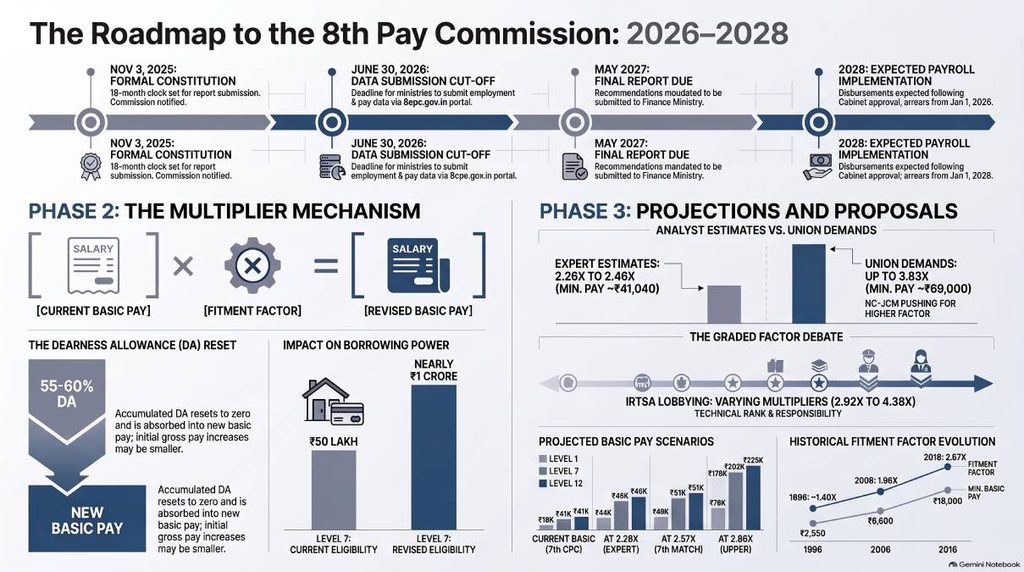
Two dates matter more than any other in this story. One is 3rd November 2025, when the Commission’s composition and Terms of Reference were formally notified. The other is 30th June 2026, the closing date for data submission to the Commission’s own portal. Everything else, the fitment factor, the pay matrix, the arrears, follows from these two dates, not the other way round.
A Pay Commission comes around roughly once a decade, and the 8th CPC follows that pattern almost to the year: the 7th CPC was implemented in 2016, the 6th in 2006, the 5th in 1996. For a serving employee, the number that eventually lands on a revised payslip is really the product of a decade of accumulated Dearness Allowance, inflation data, and fiscal negotiation, all compressed into one multiplier. How that multiplier gets built, and where the process currently stands, matters more to a household budget than any rumoured figure doing the rounds on social media.
At A Glance: 8th Pay Commission 2026
- Implementation Timeline: The Commission’s final report is not due until May 2027. Consequently, the actual payroll rollout and disbursement are highly likely to happen in 2028, even if the government sets a retrospective effective date of January 1, 2026 for arrears.
- Expected Fitment Factor: While no official multiplier has been announced, conservative expert estimates project a fitment factor between 2.28x and 2.46x, which would push the minimum basic pay from ₹18,000 to between ₹41,040 and ₹44,280.
- Union Demands: Employee associations are pushing for much higher revisions. The NC-JCM is demanding a 3.83x multiplier (minimum pay of ₹69,000), while the IRTSA is lobbying for a graded fitment factor (ranging from 2.92x to 4.38x) based on technical ranks rather than a flat rate.
- DA Merger & Gross Salary: The fitment factor applies only to Basic Pay. Upon implementation, accumulated Dearness Allowance (DA) will reset to zero. This means while your basic pay will jump significantly, your immediate gross take-home salary increase will be smaller due to the DA reset.
- Current Status: As confirmed by the Finance Ministry in August 2026, no recommendations have been submitted yet. The Commission has just closed its internal data-collection portals and is actively reviewing stakeholder memoranda.
What Are the Latest Info on the 8th Pay Commission?
Commission Composition and Terms of Reference
The Commission carries the name of its chairperson, Justice Ranjana Prakash Desai, a former judge of the Supreme Court of India. Prof. Pulak Ghosh is the part-time member, and Shri Pankaj Jain holds the post of Member-Secretary. It is headquartered in Delhi. Answering an unstarred question from Dr. Manna Lal Rawat in the Lok Sabha, Minister of State for Finance Shri Pankaj Chaudhary confirmed on 10th August 2026 that the Commission had not yet submitted any recommendations to the government.
The Terms of Reference cover a wide net: industrial and non-industrial central government staff, All India Services officers, Defence Forces personnel, Union Territory employees, the Indian Audit and Accounts Department, regulatory bodies other than the RBI, and court staff, including judicial officers in Union Territories, where a special carve-out preserves the principle from the All India Judges’ Association case that judicial service conditions must stay separate from the administrative executive.
How the Memorandum and Data Submission Process Works
Since that Resolution, the Commission has run a nationwide data-collection exercise rather than sitting only in Delhi. Employees, pensioners, and recognised service associations were invited to submit memoranda through a dedicated online system, and the Commission made clear that hard copies, PDFs, emails, or post would not be entertained. Only the portal counted. Applicants had to pick their category on 8cpc.gov.in and clear an OTP check before their suggestions on pay revision, the fitment factor, allowances, and pension structure were logged with a unique memo ID.
The Commission’s procedural powers go further than a reader might assume. It can devise its own working method, appoint outside advisors and consultants, and call for information directly from any Ministry or Department, and the Terms of Reference specifically expect State Governments, service associations, and other stakeholders to cooperate fully with such requests . That is part of why the regional consultation calendar grew as long as it did through the first half of 2026. A Commission with the power to summon data from every Ministry, and a mandate covering categories as varied as Defence Forces personnel and subordinate court staff in Union Territories, was always going to need months of state-by-state meetings before it could even begin drafting.
That submission window moved twice in public reporting. An early closing date slid to 31st May 2026, then again to 15th June 2026, as more employee bodies asked for time. The Commission’s own website, last updated on 16th June 2026, now lists a final cut-off of 30th June 2026 for the separate data-collection portal used by ministries, departments, and organisations. Read the two deadlines carefully: one is the memorandum window for suggestions from unions and pensioners, the other is the harder data-submission deadline for government offices supplying the Commission with employment and pay figures. Both had shifted by the middle of 2026.
Also Read: PM Viksit Bharat Rozgar Yojana (PMVBRY) 2026: The Complete Guide
Regional Consultations and Stakeholder Meetings
Regional hearings ran alongside the paperwork. Jammu and Kashmir stakeholders met the Commission in Srinagar from 1st to 4th June 2026, followed by a Ladakh session on 8th June. Uttar Pradesh representatives were called to Lucknow on 22nd and 23rd June, and appointment requests for that leg closed on 10th June. Odisha’s turn came in Bhubaneswar on 6th and 7th July, with West Bengal’s stakeholders meeting the Commission in Kolkata on 9th and 10th July; both cities required appointment requests by 15th June. Hyderabad hosted at least two separate Railways-focused sittings, on 19th May and again on 29th May 2026, where the Indian Railways Technical Supervisors’ Association pressed its case directly.
What Employee Unions Are Demanding on Minimum Pay and Fitment Factor
Three employee bodies have staked out very different positions on the minimum pay question. The National Council-Joint Consultative Machinery wants a uniform fitment factor of 3.83, which would push minimum basic pay to Rs. 69,000. The Bharatiya Pratiraksha Mazdoor Sangh wants a higher floor still, Rs. 72,000. IRTSA, meanwhile, has broken from the flat-multiplier tradition altogether: it wants a graded fitment factor of 2.92 for Level 1, 3.50 for Levels 6 to 8, and 3.80 for Levels 9 to 12, arguing that risk and technical responsibility rise faster than a single multiplier can capture. IRTSA’s own separate memorandum sets minimum pay at Rs. 52,600, well below what NC-JCM or BPMS are seeking, which shows how far apart even the unions are from each other before the Commission has said a word.
IRTSA’s Hyderabad presentations went further than a fitment number. The association wants half of the current Dearness Allowance folded into basic pay before the new pay matrix is calculated, the annual increment rate raised from 3% to 5%, and the Modified Assured Career Progression scheme rebuilt to guarantee five financial upgrades across a 30-year career, landing at years 6, 12, 18, 24, and 30. It has also asked the Commission to reclassify the Senior Section Engineer post as Group-B gazetted, and to fix long-standing anomalies in how Junior Engineers and Senior Section Engineers sit in the pay matrix relative to other technical cadres.
The presentation itself, delivered at Hyderabad on 29th May 2026 after an earlier memorandum on 19th May, raised a long list of grievances specific to the railway technical cadre: disturbed vertical relativities and horizontal parities against comparable categories, an insufficient number of sanctioned Group-B posts relative to Group-A and Group-C, career stagnation among Senior Section Engineers, and unresolved questions about how the training period counts toward MACP eligibility, an issue tangled up with court judgments still shaping how the scheme has been implemented since 1st January 2006.
IRTSA also pressed for allowances specific to technical staff, including night duty allowance, overtime allowance, and a Production Control Organisation allowance, to be reviewed alongside the headline fitment number. None of this changes the basic salary maths above, but it does explain why a single body can submit both a fitment-factor table and a multi-page list of career-progression demands in the same memorandum. The fitment factor decides the topline number; everything else in the memorandum decides how fairly that number gets distributed across a single cadre’s career.
How the Fitment Factor Will Affect Pensioners
Separately, the wider pensioner community has its own stake in these numbers, beyond the 33.76 lakh figure already confirmed to Parliament. Because the fitment factor applies identically to pension and to salary, and because the rule extends even to employees who retired before the 7th CPC came into force, a change agreed today reaches back to decades of past retirees, not just the currently serving workforce. That is one reason pensioner associations submitted memoranda alongside the serving-employee unions during the same June 2026 window, rather than waiting for a separate pension-specific consultation.
Will the 8th Pay Commission Be Implemented in 2026?
No. The Commission itself has 18 months from its 3rd November 2025 constitution to submit its report, which puts the deadline at May 2027. As of the Lok Sabha answer in August 2026, no recommendations had reached the government. A pay commission cannot be rolled out before its report exists, and the report itself is not due for close to a year after the data portal even closes on 30th June 2026. Anyone expecting a revised salary slip before the end of calendar year 2026 is working from a timeline the Commission has not confirmed.
Some online calculators and explainer pages carry a line suggesting the eventual pay revision “would normally be expected to take effect from 1st January 2026,” language borrowed from how the 7th CPC’s effective date was fixed after the fact. That is a retrospective effective date, not a rollout date, and the source carrying it is careful to add that no such date has actually been confirmed by the government this time. The two should not be confused when reading 8th CPC news.
The confusion has a real precedent, because it happened before. When the 7th CPC’s report was finally accepted, the government set 1st January 2016 as the effective date for pay purposes, even though the actual notification and the first revised payslips only arrived months later, with the difference paid out as arrears. If the 8th CPC eventually follows a similar pattern, an effective date fixed early in 2026 could still sit alongside a physical rollout that happens much later. A single “implementation year” answer misleads more than it informs, because two different dates, an effective date for calculation purposes and an actual disbursement date, can both be true at once without contradicting each other.
Also Read: EPF Wage Limit ₹ 15,000 to ₹25,000: What’s Approved and What’s Still Pending (2026)
Is the 8th Pay Commission Expected to Be Implemented in 2028?
This is the more realistic window, though even here nothing is fixed. Work backward from the numbers on record: data submission from ministries and departments runs to 30th June 2026, and regional consultations were still being scheduled for cities such as Visakhapatnam and further Uttar Pradesh towns well past the middle of. Only after that does drafting, internal review, and the Commission’s own 18-month clock run out, placing the report on the Finance Ministry’s desk by May 2027 at the latest.
A report is not a pay cheque. Cabinet approval, the drafting of the actual pay matrix, ministry notifications, and payroll system updates all follow the report, and none of that happens overnight. One industry tracker following the Commission’s Hyderabad sessions put the final report at “mid-2027,” with pay and pension changes “rolled out progressively thereafter”. Stack a Cabinet approval cycle and payroll rollout on top of a mid-2027 report, and a 2028 rollout for many employees becomes a plausible, if unconfirmed, outcome. Arrears, when they come, typically bridge the gap between the notional effective date and the date pay actually starts reflecting the new matrix, which is how the 7th CPC’s own rollout played out after 2016.
A second reason the 2028 window looks more realistic than 2026 is the sheer scale of what the Commission is covering. Roughly 35.77 lakh civilian employees, 33.76 lakh pensioners excluding Defence, and an even larger number once Defence Forces personnel and All India Services officers are counted in, all sit inside the same report. A tracker following the consultation process put the combined figure affected by the Commission’s eventual recommendations at over 1.1 crore active employees and pensioners. Restructuring pay, allowances, bonus schemes, and pension rules across a population that large, spread across industrial and non-industrial cadres, the judiciary, and regulatory bodies, is not something that compresses into a few weeks of Cabinet review once the report lands. Anyone planning household finances around a specific month would do better to track the Commission’s own confirmed milestones, the data portal deadline and the 18-month report deadline, than to anchor on a calendar year picked up from a headline.
8th Pay Commission Fitment Factor
What Is the Fitment Factor and How Is It Calculated?
The fitment factor is a single multiplier: it takes existing basic pay and turns it into revised basic pay, so Revised Basic Pay equals Current Basic Pay multiplied by the Fitment Factor. The 7th CPC introduced this method in place of the older 6th CPC system, which required placing an employee in a pay band and then adding a separate grade-pay figure. A single multiplier is simpler to apply, and easier for an employee to check against their own payslip.
The factor touches basic pay only. Allowances such as House Rent Allowance and Transport Allowance get worked out afresh as a percentage of the new basic pay once it is fixed, not multiplied directly. Dearness Allowance resets to zero on implementation and starts accruing again from the new, higher base.
Fitment Factor Across Pay Commissions: 5th to 8th CPC Compared
| Pay Commission | Year Implemented | Fitment Factor | Minimum Basic Pay Created |
| 5th CPC | 1996 | approximately 1.40x | Rs. 2,550 |
| 6th CPC | 2006 | 1.86x | Rs. 6,600 |
| 7th CPC | 2016 | 2.57x | Rs. 18,000 |
| 8th CPC (expected) | 2026-28 | 1.92x to 2.86x (estimated) | Rs. 34,560 to Rs. 51,480 |
Each Commission has pushed the multiplier higher than the last one, largely because a rising factor has to absorb whatever Dearness Allowance had built up since the previous revision. The 7th CPC’s 2.57x baked in roughly 125% of accumulated DA. Reporting from mid-2026 put the starting DA base for the 8th CPC calculation somewhere between 55% and 60% of basic pay, depending on which point in the year the figure was quoted, a smaller cushion than 2016 had. A lower embedded DA suggests the eventual multiplier could land below 2.57x on a pure inflation-adjustment basis, even before fiscal capacity gets weighed in.
Fitment Factor Estimates and Demands for the 8th CPC
No fitment factor has been announced yet. What exists instead is a spread of estimates and demands pulling in different directions.
| Source | Fitment Factor Proposed | Resulting Minimum Basic Pay |
| Conservative analyst estimate | 1.82x to 1.92x | Rs. 32,760 to Rs. 34,560 |
| Expert central estimate | 2.28x to 2.46x | Rs. 41,040 to Rs. 44,280 |
| NC-JCM (union demand) | 3.83x | Rs. 69,000 |
| BPMS (union demand) | not separately specified, pay floor only | Rs. 72,000 |
| IRTSA (graded, Level 1) | 2.92x | Rs. 52,600 (IRTSA’s own separately stated floor) |
The government’s own analysts appear to be working in a materially lower range than the loudest union demands. Bajaj Finserv’s tracker, updated through August 2026, frames 2.28x to 2.46x as the more realistic central estimate, with the wider possible band running from 1.92x to 2.86x. IRTSA’s own graded proposal, covered above, runs higher for mid and senior technical grades, up to 3.80x for Levels 9 to 12, precisely because it rejects the idea of one number fitting every grade.
Will Dearness Allowance Be Merged Into Basic Pay?
Whether Dearness Allowance gets merged into basic pay before the fitment factor is applied remains an open question, not a settled rule. No Finance Ministry statement has confirmed a DA merger, and none has ruled it out either. Claims that DA will automatically fold into the new basic pay, followed by an automatic reset to zero, describe an assumption some commentators are making, not a decision anyone has taken. IRTSA’s memorandum specifically asks for half the current DA to be merged before the calculation runs, which is itself proof that the question is still open: if the answer had already been settled, a union would have nothing left to lobby for on this point.
Factors That Will Decide the Final Fitment Factor
Five factors, taken together, are expected to shape whatever number the Commission eventually lands on. Consumer Price Index movement since the 7th CPC’s January 2016 baseline sets the inflation floor that any credible fitment factor has to clear. The Central Government’s fiscal capacity, what its budget can sustainably absorb in additional salary and pension expenditure, pulls in the opposite direction, capping how far the multiplier can rise regardless of inflation data. Private-sector wage benchmarks come into play too, since government service has to stay competitive against organised private employment for the same skills. The DA already accumulated matters on its own terms too, since it represents purchasing power already granted, and the fitment factor has to preserve that at minimum, not erode it. Political timing, general elections and administrative cycles among them, has historically shaped when a revision is announced and how generous it turns out to be.
No government has yet implemented a factor below what its own unions flagged as an unacceptable minimum, but no government has matched a union’s maximum demand either. That pattern, repeated across the 5th, 6th, and 7th Pay Commissions, is the best available guide to where the 8th CPC will likely land: somewhere between the analyst-side estimate of 2.28x to 2.46x and the louder union figures clustered near 3.83x, rather than at either extreme.
How Much Salary Will Increase in 8th Pay Commission?
How Much Salary Increase in 8th Pay Commission (Gross vs. Basic Pay)
A jump in basic pay and a jump in gross, take-home pay are not the same number, and mixing them up is where a lot of salary-hike headlines go wrong. The fitment factor multiplies basic pay only. Everything layered on top, Dearness Allowance, House Rent Allowance, Transport Allowance, gets recalculated afterward, and one of those layers, DA, resets to zero the moment the new basic pay takes effect.
Picture an employee whose basic pay currently carries Dearness Allowance running near 55% to 60% on top of it, depending on which 2026 update is being read. Before revision, that DA component is already inflating gross pay well above the bare basic figure. After revision, at say 2.28x fitment, the basic pay itself rises sharply, but DA restarts from zero and takes months, sometimes years, of fresh accumulation to rebuild what was lost in the reset. Basic pay can end up showing a jump of well over 100%, while gross monthly pay, in the very first pay cycle after rollout, rises by a noticeably smaller percentage, because the DA cushion that used to sit on top has just been zeroed out and folded into the new base instead.
This is exactly why unions keep pushing for allowances and increments to move in step with the fitment factor rather than lag behind it. IRTSA’s push to raise the annual increment rate from 3% to 5%, and its request to guarantee five career-progression upgrades over 30 years, both address the same worry: a one-time jump in basic pay means little if gross pay growth then flattens out for years afterward while DA rebuilds from scratch.
8th Pay Commission Salary Increase 2026 Projections
Numbers help more than description here, so take a Level 7 employee currently drawing Rs. 44,900 in basic pay as a working example, using the pay-matrix scenarios published by Bajaj Finserv :
- At 1.92x fitment, basic pay would move to roughly Rs. 86,208.
- At 2.28x fitment, basic pay would move to roughly Rs. 1,02,372.
- At 2.57x fitment, matching the 7th CPC’s own multiplier, basic pay would move to roughly Rs. 1,15,393.
- At 2.86x fitment, the top of the commonly cited range, basic pay would move to roughly Rs. 1,28,414.
Pension and Union-Specific Salary Projections
Pensioners see the identical arithmetic applied to their basic pension rather than basic pay, and the rule covers everyone, including those who retired before the 7th CPC came into force. Their pension is first notionally converted to its 7th CPC equivalent, and only then is the 8th CPC factor applied on top. A pensioner drawing Rs. 20,000 in basic pension today would move to about Rs. 45,600 at 2.28x, Rs. 51,400 at 2.57x, or Rs. 57,200 at 2.86x.
IRTSA’s own projections, built around its graded proposal rather than a flat factor, run considerably steeper for the cadres it represents. Under its 3.50x figure for Levels 6 to 8, a mid-level technical basic pay of Rs. 45,000 would rise to Rs. 1,57,500. Under its 4.09x figure for Levels 13 to 16, a basic pay of Rs. 1,20,000 would climb to Rs. 4,90,800. At the very top of its scale, a Level 17-18 basic pay of Rs. 2,50,000 would reach Rs. 10,95,000 under a 4.38x multiplier, a gross rise the association itself describes as exceeding 400%. None of these IRTSA figures are official; they are the numbers one union body has asked the Commission to adopt, and the gap between them and the analyst-side estimates above is the clearest sign of how unsettled the final figure still is.
8th Pay Commission Salary Calculator
Working out a projected salary by hand needs three inputs: current basic pay under the 7th CPC, a chosen fitment-factor scenario, and the current Dearness Allowance percentage, if the goal is also to estimate gross pay rather than basic pay alone.
- Step one is the easiest: Revised Basic Pay equals Current Basic Pay multiplied by the Fitment Factor. Anyone can run this on a phone calculator once a factor is picked from the estimate ranges above.
- Step two brings in allowances. House Rent Allowance and Transport Allowance are not multiplied along with basic pay. They get recalculated as their own percentages of the new basic figure, and those percentages have historically been reviewed and adjusted separately by each Pay Commission, so a calculator built purely around the fitment multiplier will understate the true gross change unless it also carries updated allowance percentages once the Commission publishes them.
- Step three accounts for the DA reset. Because DA resets to zero at implementation, a calculator comparing “current gross pay” to “day-one gross pay after revision” will often show a smaller jump than one comparing basic pay alone. A calculator that only compares basic-to-basic figures is measuring the headline number. One comparing full gross-to-gross figures on the first post-revision payslip is measuring what actually lands in a bank account, and the two answers can look very different from the same fitment factor.
Worked Example: Calculating Your Revised Salary
A worked example pulls all three steps together. Take a Level 4 employee on Rs. 25,500 basic pay: at a 2.28x fitment factor, the pay-matrix table published by Bajaj Finserv puts revised basic pay at Rs. 58,140. If HRA is later set at, say, 27% of the new basic figure for a metro posting, and Transport Allowance is added on top, gross pay before DA even starts accruing again would already sit well above the Rs. 58,140 basic figure alone. None of the specific post-revision allowance percentages have been notified yet, so any calculator in circulation before the Commission’s report is, by definition, an estimate built on the last known set of allowance rules layered onto a projected fitment factor. Treat every online calculator, including this one, as a planning tool, not a guarantee.
How Pensioners Can Calculate Their New Pension
Pensioners run the same two-step process but starting from basic pension instead of basic pay: New Basic Pension equals Current Basic Pension multiplied by the Fitment Factor. A pre-2016 retiree has one extra step first: their pension has to be notionally converted to its 7th CPC equivalent before the new multiplier is applied on top of that converted figure, rather than on whatever pension amount they happen to be drawing today under an older scale. Dearness Relief, the pension equivalent of DA, resets to zero on the new basic pension exactly the way DA resets on salary, and starts accruing again from the higher post-revision base.
How the Fitment Factor Affects Home Loan Eligibility
The fitment factor also reshapes household financial planning that has nothing directly to do with government payslips, and home loan eligibility is the clearest example. Lenders typically assess eligible loan amount against a Fixed Obligation to Income Ratio calculated on monthly take-home pay, so a jump in basic pay that flows through to gross salary directly raises how much an employee can responsibly borrow.
One illustrative comparison put a Level 7 employee’s current eligible home loan amount, at roughly Rs. 65,000 to Rs. 70,000 monthly take-home, near Rs. 45 to 50 lakh. The same employee’s take-home under a 2.57x fitment, once revised basic pay of roughly Rs. 1,15,400 feeds through the calculation, could push the eligible loan figure closer to Rs. 90 to 100 lakh. Anyone weighing a major purchase against an expected pay revision should treat that gap as a reason to weigh financing now against financing after implementation, rather than assume the fitment factor only matters for the payslip itself.
8th Pay Commission Salary Structure and Pay Matrix
The pay matrix itself has kept the same basic shape since the 7th CPC introduced it: 18 horizontal Levels, running from Level 1 at the bottom to Level 18 at the top, plus vertical cells within each Level that represent annual increments. What changes with a new Commission is the pay figure sitting in each cell, driven by whichever fitment factor is finally adopted, and, this time, potentially by whether the Commission accepts a graded system rather than one flat multiplier across all 18 Levels.
Flat vs Graded Fitment Factor: The Debate Over Pay Matrix Levels
That graded question is not a minor technical footnote. IRTSA has explicitly asked the Commission to abandon the single-multiplier model the 7th CPC used and instead apply five different fitment factors, rising with each Level band, to reflect what it calls uneven operational risk and technical responsibility across the matrix . If the Commission agrees even in part, the “complete salary list” below could end up looking nothing like a simple multiplication table.
Why Pay Matrix Placement Matters as Much as the Number
A pay matrix cell is more than a rupee figure. It also fixes where an employee sits relative to every other post in the same Ministry or cadre, which is why unions fight as hard over relative placement as they do over the absolute number. IRTSA’s complaint about “disturbed vertical relativities and horizontal parities,” raised repeatedly through its 2026 memoranda, is really a complaint about matrix placement: two posts with comparable qualifications and duties can end up several Levels apart purely because of how an earlier Commission drew the grid.
A flat fitment factor leaves those placement disputes exactly where they were before revision, since multiplying every cell by the same number changes scale without changing relative position. A graded factor could narrow or widen those gaps depending on which Levels get the higher multiplier, and that is precisely the lever IRTSA is trying to pull with its 2.92x to 3.80x proposal.
House Rent and Transport Allowance Under the New Matrix
Allowances sit outside the matrix itself but move in lockstep with whichever basic pay figure the matrix eventually fixes. House Rent Allowance has historically been set as a percentage of basic pay that varies by city classification, with X, Y, and Z category towns carrying different rates, and Transport Allowance follows a comparable city-tiered structure. Both were reviewed and revised by the 7th CPC alongside the fitment factor itself, and both sit within the current Terms of Reference for the 8th CPC too, since allowance rationalisation is explicitly listed among the Commission’s mandated tasks. Until those specific percentages are notified, the tables below should be read as basic pay projections only, not as a complete picture of gross monthly pay.
Complete 8th Pay Commission Salary List
The table below sets out current 7th CPC basic pay at six representative Levels against four different possible flat fitment factors, using the scenarios published by Bajaj Finserv. Figures are in rupees per month.
| Pay Level | Current Basic Pay | At 1.92x | At 2.28x | At 2.57x | At 2.86x |
| Level 1 (minimum) | 18,000 | 34,560 | 41,040 | 46,260 | 51,480 |
| Level 4 | 25,500 | 48,960 | 58,140 | 65,535 | 72,930 |
| Level 6 | 35,400 | 67,968 | 80,712 | 90,978 | 1,01,244 |
| Level 7 | 44,900 | 86,208 | 1,02,372 | 1,15,393 | 1,28,414 |
| Level 10 | 56,100 | 1,07,712 | 1,27,908 | 1,44,177 | 1,60,446 |
| Level 12 | 78,800 | 1,51,296 | 1,79,664 | 2,02,516 | 2,25,368 |
IRTSA’s Proposed Salary Figures for Railway Technical Posts
Set beside this is what IRTSA’s own memorandum has separately proposed for specific Railways posts, which reads as a floor demand rather than a factor-based projection, and sits well above anything the flat-multiplier table above would generate even at the highest 2.86x scenario.
The association’s memorandum lists starting salaries of Rs. 1,57,400 for a Junior Engineer at Level 7, Rs. 1,66,800 for a Senior Section Engineer at Level 8 (which it wants classified as Group-B gazetted), Rs. 2,01,600 for an Assistant Manager at Level 9, Rs. 2,13,000 for a Manager at Level 10, and Rs. 2,57,000 for a Senior Manager at Level 11. Compared with the Level 10 figure of Rs. 1,60,446 in the flat-factor table above, IRTSA’s own Level 10 ask of Rs. 2,13,000 shows just how wide the gap is between an analyst projection and a union’s opening position.
Here is the SEO-optimized FAQ section designed to capture voice search queries, People Also Ask (PAA) boxes, and Featured Snippets.
FAQ: 8th Pay Commission 2026
The 8th Central Pay Commission was formally constituted with an effective retrospective date of January 1, 2026. However, because the Commission’s final report is not due until mid-2027, the actual salary adjustments and arrears payouts are highly likely to be disbursed in 2028.
While employee unions are demanding a multiplier up to 3.83x, current expert estimates project a fitment factor between 2.28x and 2.46x. If the government approves a 2.28x multiplier, the minimum basic pay will increase from ₹18,000 to approximately ₹41,040.
Yes. Upon the implementation of a new pay matrix, the accumulated Dearness Allowance resets to zero. The DA accrued up to January 2026 will be absorbed into the revised basic pay. As a result, while your basic salary will jump significantly, the immediate increase in your gross take-home pay will be smaller.
Pensioners will receive revisions based on the identical fitment factor applied to active employees. Applying the expected 2.28x multiplier, the minimum basic pension is projected to rise from ₹9,000 to roughly ₹20,500 per month.
The 8th CPC mandate strictly covers Central Government employees and pensioners, including defense personnel. State governments usually constitute their own pay commissions to adopt similar fitment formulas shortly after the central government’s rollout.
Key Takeaways: What to Track Before the 8th CPC Report Arrives
None of the figures in either table carry government approval. The Commission has told Parliament, as recently as August 2026, that it had not submitted any recommendations at all. Every rupee amount above sits somewhere on a spectrum running from a pure mathematical projection at one end to an aggressive union opening bid at the other, with a report not due until May 2027 standing between today’s numbers and whatever the Commission and the Cabinet eventually settle on.
For a serving employee or a pensioner trying to plan around this process, the practical takeaway is less about picking a favourite fitment factor and more about tracking three concrete checkpoints: the 30th June 2026 data-submission deadline, the May 2027 report deadline the Commission itself is bound by, and whatever Cabinet notification eventually follows. Everything printed in a calculator or a news headline before those three milestones pass is, at best, an informed projection built on the historical pattern of five previous Pay Commissions, and at worst a union’s opening position mistaken for a government decision.
Disclaimer
The information provided in this article regarding the 8th Central Pay Commission (CPC), including projected fitment factors, revised basic pay matrix tables, allowance restructuring, Dearness Allowance (DA) mergers, and tentative implementation timelines (2026–2028), is published for general informational, educational, and analytical purposes only. All calculations, salary projections, and arrear estimates presented herein are derived from historical pay commission precedents, public stakeholder memoranda, and independent financial analysis. They do not constitute official government notifications, legal advice, or binding administrative commitments. The Cabinet, Ministry of Finance, and Department of Expenditure have not issued final approved recommendations. Government employees, pensioners, and readers should not rely on these speculative scenarios for formal financial, taxation, or retirement planning. For authoritative, verified policy updates and official salary schedules, always refer directly to official gazette notifications issued by the Government of India and the Department of Expenditure.




Leave a Reply