
Form 67 for NRIs: Who must file and how to claim foreign tax credit (AY 2026-27)
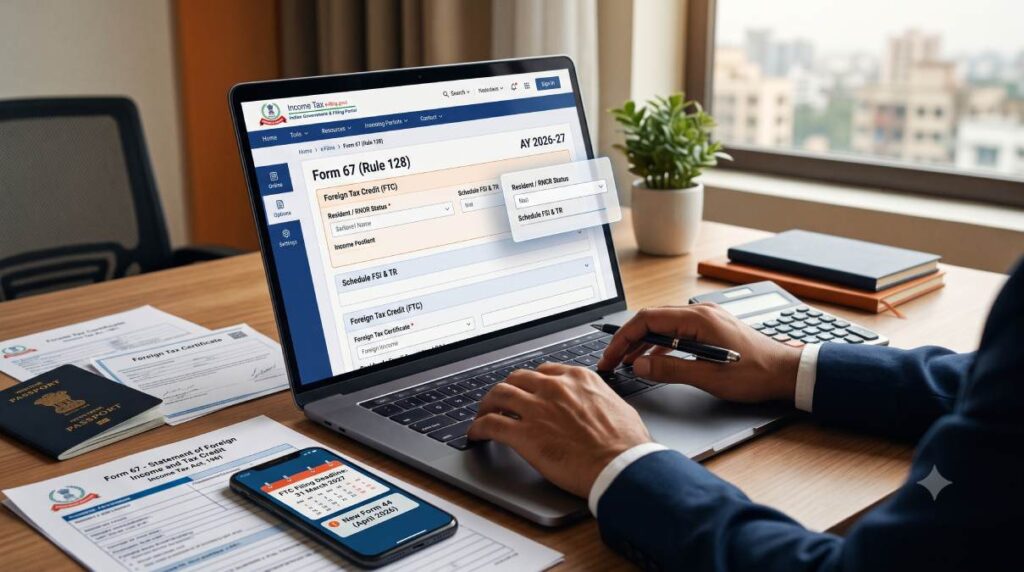
A non-resident NRI does not file Form 67. The form belongs to residents. Rule 128 of the Income-tax Rules, 1962 lets a resident assessee claim credit for tax paid in another country, and the Income Tax Department describes the form as the one a resident assessee files for that claim. Foreign income that never enters the Indian tax net leaves nothing to claim credit against.
The tidy answer breaks down in the year an NRI becomes a resident, or lands in resident but not ordinarily resident (RNOR) status with foreign income that India still taxes. From then on Form 67, Schedule FSI and Schedule TR apply, and a missed filing costs real rupees.
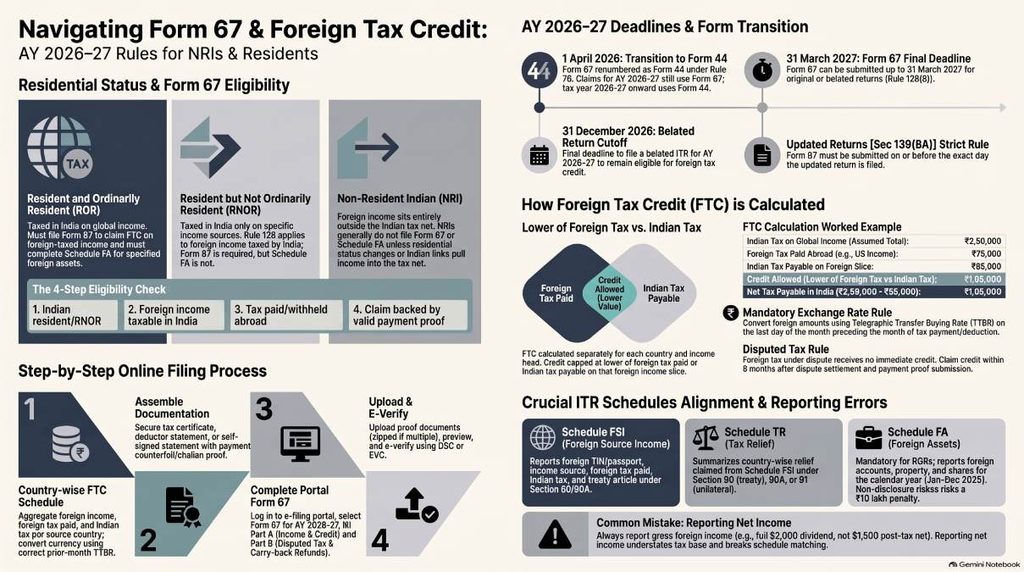
Two dates shape AY 2026-27. The assessment year ends on 31 March 2027, and that is the outer limit for Form 67 under amended Rule 128. On 1 April 2026 the form also took a new number, Form 44, under the Income Tax Act 2025. Claims for AY 2026-27 still go on Form 67.
| Question | Short answer |
| Who files Form 67? | A resident assessee claiming credit for foreign tax under Rule 128. |
| Does a non-resident NRI file it? | No. Foreign income of a non-resident sits outside the Indian tax net. |
| Which year does it cover? | AY 2026-27, which means income of FY 2025-26. |
| Last date to furnish it? | 31 March 2027 for original and belated returns filed in time. For an updated return, the date that return is filed. |
| Which form applies from 1 April 2026? | Form 44, under the Income Tax Act 2025. |
Form 67 For NRIs At A Glance
Form 67 is what a resident taxpayer files to claim foreign tax credit under Rule 128. A non-resident NRI whose foreign income stays outside the Indian tax net has no credit to claim and no form to file. An NRI who turns resident, or resident but not ordinarily resident (RNOR), and has foreign income that India taxes, does need it.
- Resident and RNOR taxpayers with foreign income taxed in India file Form 67. A non-resident NRI generally does not.
- AY 2026-27 covers FY 2025-26 income. The cutoff is 31 March 2027 for original returns and for belated returns filed by 31 December 2026. For an updated return, file the form on or before the day you file the return.
- The credit is the lower of the foreign tax paid and the Indian tax on that income, worked out by country and income source. You report it in Schedule FSI and Schedule TR.
- Keep a foreign tax certificate or signed statement with proof of payment. From 1 April 2026, Form 44 takes over under the Income Tax Act 2025, but claims for AY 2026-27 still go on Form 67.
Who can claim foreign tax credit in India, and where NRIs fit
The credit exists so that one stream of income does not pay tax twice. A resident taxpayer owes Indian tax on global income, and when the country where that income arose has already taxed it, Rule 128 gives a credit against the Indian bill.
Everything turns on one word, resident.
Also Read: The Complete Guide to the Section 80-IAC Income Tax Exemption for Startups (2026–2030)
Residential status check: NRI, RNOR or resident
Residence turns on days spent in India, not on passports or visas. A person is resident for a year with 182 days or more in India, or with 60 days in the year plus 365 days across the four years before it. Statutory modifications apply to certain categories. Stay under the thresholds and the person is non-resident.
Resident status then splits in two. A resident and ordinarily resident (ROR) pays Indian tax on global income. An RNOR is still a resident, so Rule 128 applies. The sources cited here do not spell out the RNOR charging rules, and the working rule is that credit follows any foreign income India taxes.
| Status | What India taxes | Form 67 and credit | Schedule FA |
| Resident and ordinarily resident | Global income | Yes, where foreign tax was paid on income India taxes | Required when specified foreign assets are held |
| RNOR | Resident, so Rule 128 applies to foreign income India taxes | Yes, only where India taxes the foreign income | Not required |
| NRI | Income earned or accrued in India | No credit arises on foreign income outside the Indian net | Not required |
The table follows the department’s schedule instructions and Tax2win’s treatment of the three schedules.
When a person is resident in both India and another country, the treaty decides which country gets to treat the person as its resident. The India-US treaty runs through a sequence of tests: permanent home first, then the centre of personal and economic ties, then habitual abode, then nationality, and finally mutual agreement between the two governments.
When an NRI’s foreign income is taxable in India
For a non-resident, Indian tax follows the source of the income. Only income earned or accrued in India is taxable. In a December 2024 ruling on Tungsten Network Ltd, a UK-resident company, the Delhi tribunal placed the charge in Section 5(2) read with Section 9.
Salary shows how this works. In June 2026 the Delhi ITAT directed an assessing officer to drop an assessee’s Australian salary from total income. The services were performed in Australia, and Article 15 of the India-Australia treaty taxes such salary only there.
The assessee had already filed Form 67 for the Australian tax, and the Revenue had rejected a rectification request. A Taxsutra headline on a separate ruling says the foreign salary of a non-resident does not become taxable in India merely because an Indian employer pays it.
What pulls an NRI in is a change in status or an Indian link. Return to India and cross the day-count tests, and global income enters the return. Keep an Indian source such as rent or interest, and that income stays taxable regardless.
One commercial guide says an NRI must fill Schedule FSI and Schedule TR when foreign income is taxable in both countries and relief is claimed. The department’s own page ties Schedule FSI to resident assessees, and this post follows the department.
Also Read: ITR 2026 Filing: Investment Taxation Under the Income Tax Act 2025 Guide
When an NRI does not need Form 67
Form 67 applies only when tax was deducted or paid abroad. Skip it in these cases:
- The person is non-resident for the year and the foreign income stays out of the Indian return.
- No tax was withheld or paid abroad on income that India taxes.
- The foreign income is exempt or not taxable in India. Schedule FSI may not apply either.
- The taxpayer reports the foreign income but claims no relief. Schedules FSI and TR can stay blank, though the income itself still goes into the main schedules.
Four questions settle most cases:
- Did the person count as a resident in India for FY 2025-26 under the day-count tests?
- Is the foreign income taxable in India under the Act, or does a treaty give the other country the sole right to tax it?
- Was tax actually paid or withheld abroad on that income?
- Is the claim backed by a certificate or signed statement and proof of payment?
A “no” at the first or third question ends the matter. A “yes” to all four means Form 67 is due.
Filing as a resident by mistake has a price too. Tax2win reports that India receives overseas account data from more than 100 countries under CRS, and that NRIs who filed as residents have drawn foreign-asset disclosure notices.
Form 67 or Form 44: which form applies to which year
The return for AY 2026-27 reports income of FY 2025-26, which falls under the Income-tax Act, 1961, and the form follows the law that governs the income. This post treats Form 67 as the form for FY 2025-26 and earlier, and Form 44 as the form from tax year 2026-27. The portal keeps the two Acts apart the same way.
Form 67 under Rule 128 for FY 2025-26 and earlier
Rule 128 came into force on 1 April 2017 and still governs credit claims for years under the 1961 Act. The e-filing portal is the only route for Form 67, and filing is online.
The department’s Form 67 page, carrying an admin date of 15 May 2026, still describes the form as the one a resident uses for a claim under Rule 128. On the portal, it sits under the tab for forms as per the Income Tax Act 1961.
Form 44 under Rule 76 of the Income-tax Rules, 2026
Tax2win reports that Form 67 has been renumbered Form 44 under the Income Tax Act 2025, and the revised form is effective from 1 April 2026. The department’s site now lists the Income-tax Rules, 2026 and a separate set of 2026 forms alongside the older rules and forms.
The sources cited here confirm the number and the start date but do not print the text of Rule 76. Read the rule and the form on the portal before filing a claim for tax year 2026-27.
Also Read: How the New Income Tax Law Impacts Salaried Employees in 2026
| Point | Form 67 | Form 44 |
| Governing law | Income-tax Rules, 1962 (Rule 128) | Income Tax Act 2025 and Income-tax Rules, 2026 (Rule 76) |
| Income covered | FY 2025-26 and earlier years | Tax year 2026-27 onward |
| Start date | 1 April 2017 | 1 April 2026 |
| Where filed | e-filing portal, online only, e-verified | e-filing portal; confirm the steps on the portal |
What Form 44 and Form 45 change in practice
On the available sources, the change is a renumbering. Nothing cited here describes Form 45 or any new field in Form 44, so this post makes no claim about either.
In practice, a claim for AY 2026-27 or an earlier year goes on Form 67, and a claim on income from 1 April 2026 goes on Form 44.
The two Acts already run side by side in the 2026 compliance calendar. ICAI’s Visakhapatnam branch, in its August 2026 newsletter, lists TDS items under sections 395(4) and 393(1) of the 2025 Act in the same calendar that lists FY 2025-26 returns. None of the rulings cited in this post concerns Form 44.
Also Read: Tax Year in Income Tax Act 2025: Definition & Key Changes Explained
Form 67 last date and deadline for AY 2026-27
Rule 128(9): end of the assessment year, with a timely return
Rule 128 originally asked for Form 67 on or before the due date of the original return. That caused hardship where foreign tax was settled after the Indian due date, especially for countries on a calendar tax year, which assess January to March income after the Indian date has passed.
CBDT Notification No. 100 of 2022, dated 18 August 2022, amended sub-rule (9). Form 67 can now be furnished on or before the end of the assessment year, as long as the return was filed within the time allowed under Section 139(1) or Section 139(4). The amendment took effect from 1 April 2022.
An updated return under Section 139(8A) gets a tighter rule: Form 67 for the foreign income in that return must be furnished on or before the day the updated return is filed.
| Return type | Filing window for AY 2026-27 | Form 67 cutoff |
| Original, Section 139(1) | By the due date for the taxpayer category | 31 March 2027 |
| Belated, Section 139(4) | Up to 31 December 2026 | 31 March 2027 |
| Updated, Section 139(8A) | Within the time Section 139(8A) allows | On or before the day the updated return is filed |
EY’s illustration for the 2022-23 tax year puts the belated return limit at 31 December 2023. The same pattern gives 31 December 2026 for AY 2026-27, a date Tax2win also names.
Where the AY 2026-27 return deadlines stand today
ICAI’s Visakhapatnam branch, in its August 2026 compliance calendar, lists 31 August 2026 as the date for FY 2025-26 returns of individuals, HUFs, firms, LLPs and AOPs with business or professional income (ITR-3 and ITR-4). That date has passed.
The calendar gives no date for ITR-2 filers, and ITR-2 is the form most NRIs use. Confirm the date on the e-filing calendar on the portal.
A taxpayer who has not yet filed has a clear path. File the return before 31 December 2026, and use the open window to collect the foreign tax paperwork. Form 67 then goes in before 31 March 2027.
Someone who has already filed can still add Form 67 in that window, as long as the return was filed in time.
The sources do settle one thing, the belated window. A return for AY 2026-27 can still be filed until 31 December 2026, and a belated return filed in that window counts as timely for Rule 128(9). Form 67 can then follow, up to 31 March 2027.
Also Read: Revised vs. Updated Return (ITR-U): How to Correct Your Tax Errors After the Deadline
| Date | What it marks |
| 1 April 2026 | Form 44 takes effect under the Income Tax Act 2025 |
| 31 August 2026 | Calendar date for ITR-3 and ITR-4 returns of individuals and others with business or professional income |
| 31 December 2026 | Limit for a belated return for AY 2026-27 |
| 31 March 2027 | End of AY 2026-27 and the Form 67 cutoff for original and belated returns |
What happens if Form 67 is late
Rule 128(9) sets the cutoff, and Tax2win reads it strictly: furnish Form 67 after the assessment year ends and the credit is lost, with a condonation request to the department as the only recourse.
Tribunals have been kinder, but those outcomes come from litigation. They are not an entitlement.
- In Brinda Ramakrishna v. ITO [2022] 135 taxmann.com 358, the Bangalore tribunal faced an assessee who filed Form 67 after the return, with CPC disallowing the credit at processing. The tribunal restored it, holding that credit is a vested right under the treaty read with Section 90 and that Rule 128(9) nowhere says late filing defeats it.
- In Vivek Singhal v. DCIT (6 January 2025, AY 2017-18), the Bangalore tribunal called filing Form 67 before the return directory and not mandatory.
- A Taxsutra headline reports a High Court holding that delayed Form 67 cannot defeat the claim and that the PCIT can condone the delay.
- iVentures reports that ITAT Chennai, in Rajiv Ramesh Lulla (April 2026), held that delayed Form 67 should not deny credit automatically.
Taxmann headlines carry further tribunal rulings that filing within time is not a mandatory condition. The same publisher records a tribunal going the other way and calling Form 67 with the return mandatory. It also has experts’ opinion on the old Rule 128 and belated filing.
Treat the favourable rulings as a fallback. Do not plan around them.
How foreign tax credit works under Sections 90, 90A and 91
Treaty relief under Sections 90 and 90A versus unilateral relief under Section 91
Where India has a treaty with the other country, relief flows from Section 90. Where there is no treaty, Section 91 gives unilateral relief.
Schedule FSI treats Sections 90 and 90A alike, and a taxpayer claiming under either must name the relevant treaty article. Schedule TR then records which of Sections 90, 90A or 91 each country’s claim rests on.
A treaty caps what the source country may withhold and fixes how the residence country gives credit. Take the India-US treaty, signed on 12 September 1989 and in force from 18 December 1990. It limits US tax on dividends and interest paid to Indian residents as follows:
| Income | Treaty cap on source-country tax |
| Dividends to a company holding at least 10% of the voting stock | 15% |
| Other dividends | 25% |
| Interest on a loan from a bank or financial institution | 10% |
| Other interest | 15% |
To claim those rates at source, the taxpayer needs a Tax Residency Certificate, which Section 90(4) makes mandatory, along with Form 10F. The treaty never forces a higher tax than domestic law, so the taxpayer applies whichever rate is lower.
US citizens and green card holders run into the Saving Clause, which lets the US tax them as if the treaty had not come into force. Articles 25 and 26 are among the protected provisions. Taxmann keeps a roundup of other treaty rulings reported in June 2026.
How Rule 128 caps the credit
Several conditions set the cap on foreign tax credit under Rule 128.
- Credit goes only to a resident assessee, and only in the year the underlying income is taxed in India.
- The amount is the lower of the foreign tax paid and the Indian tax on that income, worked out separately for each country and each income source, then added up.
- It applies against income tax and the surcharge and cess on it, never against interest, fees, penalties or other charges, and it reaches tax payable under the minimum alternate tax in Section 115JB.
- Where a treaty exists, only the taxes it covers qualify.
- Disputed foreign tax earns no credit until the dispute settles. The assessee must then produce evidence of settlement within six months, with no unpaid foreign liability and no deduction claimed for the tax.
Tax2win’s worked example puts numbers on the cap. A resident has ₹10,00,000 of Indian income and ₹5,00,000 earned in the USA, on which ₹75,000 was paid abroad. Indian tax on the global ₹15,00,000 is taken as ₹2,50,000, and Indian tax on the US slice as ₹65,000.
| Step | Amount (₹) |
| Indian tax on global income | 2,50,000 |
| Foreign tax paid | 75,000 |
| Indian tax on the foreign income | 65,000 |
| Credit allowed (lower of the two figures above) | 65,000 |
| Net tax payable in India (2,50,000 less 65,000) | 1,85,000 |
Schedule TR does not refund the ₹10,000 of foreign tax above the cap. Any claim for it belongs under the foreign country’s law.
How to file Form 67 online, step by step
The form needs a registered e-filing account and an active PAN, and linking PAN with Aadhaar is recommended. Verification uses a Digital Signature Certificate or an Electronic Verification Code. Filing is online only, and the AY 2026-27 form takes FY 2025-26 figures.
Step 1: Work out the credit by country and income source
Start with a table by country and income source. For each line, record the foreign income, the tax paid or withheld abroad, and the Indian tax on that income. The credit is the lower of the two tax figures.
Convert foreign amounts into rupees at the telegraphic transfer buying rate (TTBR) on the last day of the month before the month in which the tax was paid or deducted.
Watch the foreign tax year. Countries on a calendar year assess January to March income after the Indian return date has passed, so the final foreign figure may not exist when the return goes in. Amended Rule 128 leaves time to catch up.
Step 2: Gather the foreign tax certificate and proof of payment
Rule 128 asks for a certificate or statement naming the nature of the income and the tax deducted or paid. The foreign tax authority, the person who deducted the tax or the assessee can issue it. A statement signed by the assessee counts only with a payment acknowledgment, a bank counterfoil, a challan, or proof of deduction where tax was withheld.
| Document | Use |
| Foreign tax authority certificate | Best evidence of the income and the tax charged |
| Deductor statement or payslip tax summary | Shows tax withheld at source |
| Assessee-signed statement | Valid only with proof of payment or deduction |
| Payment acknowledgment, bank counterfoil or challan | Proof that the assessee paid the tax |
Strictness varies. In Suntec Business Solutions (P.) Ltd., the Chennai tribunal held that Rule 128(8) does not demand a tax authority certificate, and a self-certified statement with proof of payment was enough for the claim to be considered. Still collect the foreign authority’s certificate where one exists.
Step 3: Open Form 67 on the e-filing portal and choose the year
The portal path goes like this.
- Log in to the e-filing portal with the user ID and password.
- Go to e-File, then Income Tax Forms, then File Income Tax Forms.
- Find Form 67 under the tab for forms as per the Income Tax Act 1961, or search for it.
- Select the assessment year (AY 2026-27 for FY 2025-26 income), click Continue, then start the form from the get-started prompt.
Step 4: Fill Part A with income and credit details
Part A starts with name, PAN or Aadhaar, address and assessment year. It then takes the receipt details of income from each country or specified territory outside India, with the foreign tax credit claimed against each line. Add lines one at a time with the Add Details button. A taxpayer with more than 50 records can download the CSV template, fill it in, upload it with Attach CSV File, and save.
Step 5: Fill Part B on disputed tax and refunds
Part B asks two questions on foreign tax. One covers a refund of foreign tax that follows from carrying back a current-year loss, a situation that also triggers Form 67 for credit claimed in earlier years. The other covers credit claimed on disputed tax. Answer both and save.
Next comes the Verification tab, which holds a self-declaration drafted to Rule 128.
Step 6: Attach proof and e-verify
The Attachments tab takes the certificate or statement and the proof of payment or deduction. Several files go in as one zip. Preview the form and choose Proceed to e-Verify, where any mode of verification works.
On success, the portal shows a transaction ID and an acknowledgment number and sends a confirmation to the registered email and mobile. Keep both numbers. Filed forms sit under e-File, Income Tax Forms, View Filed Forms.
Verification can snag returning NRIs. In 2022 EY flagged that Notification No. 9 of 19 September 2017 requires electronic furnishing and e-verification, and that some expatriates lack access to the prescribed e-verification routes. Sort out an EVC route well before the last week.
Reporting the credit in your ITR: Schedule FSI, TR and FA
Schedule FSI and Schedule TR
Schedule FSI applies to resident assessees with income from outside India. For each country and income head, it takes the country code, the taxpayer identification number issued abroad, the income earned outside India, the tax paid there and the tax payable in India. Relief is the lower of foreign tax paid and Indian tax on that income.
| Schedule | What goes in |
| FSI | ISD country code; foreign TIN, or passport number where no TIN was allotted; head of income; income, foreign tax paid, Indian tax on it, relief claimed; the treaty article where Section 90 or 90A is used |
| TR | Country-wise summary of FSI: tax paid abroad, relief available, and the section relied on (90, 90A or 91) |
The same foreign income must also appear in the head-wise computation of total income. Foreign losses are not reported in FSI. Schedule TR fills from FSI automatically.
The department adds one instruction that links the return to the form: the foreign tax credit and income details must be reported in Form 67 as well.
Schedule FA is for residents only
Schedule FA is the foreign asset disclosure, and only residents who are ordinarily resident need it. An RNOR or a non-resident need not fill it. The schedule covers foreign bank accounts, shares, insurance contracts, property, trusts and other foreign-source income.
The reporting period is the calendar year ending 31 December, so the AY 2026-27 return covers 1 January to 31 December 2025. Peak balance, closing balance, gross income and sale proceeds are converted at the TTBR.
Skipping it costs money. Tax2win cites a penalty of ₹10 lakh under the Black Money Act for undisclosed foreign assets.
It also lists Budget 2026 relief for small taxpayers: a one-time six-month disclosure scheme, and immunity from prosecution for non-immovable foreign assets below ₹20 lakh. Tax2win says these apply to ITR filing for FY 2026-27, so check their reach before relying on them for this return.
Which ITR form carries these schedules
The department’s Schedule FSI page ties the schedule to ITR-2, ITR-3, ITR-5, ITR-6 and ITR-7. For most individuals with foreign income, that means ITR-2, and ITR-1 does not carry the schedule. ITR-3 is the route where business or professional income is also present, as the ICAI calendar groups it.
Form 67 mistakes that get a foreign tax credit claim adjusted
Run a short check before submitting either filing:
- Every foreign income line in Schedule FSI has a corresponding line in the head-wise computation of income.
- The credit on each line is the lower of foreign tax paid and Indian tax on that income.
- Each conversion uses the TTBR for the month before payment or deduction.
- The country, TIN and treaty article are filled in, and the passport number stands in only where no TIN exists.
- Part B of Form 67 answers the disputed tax and loss carry-back questions.
- Proof of payment sits in the attachments, zipped where there are several files.
Adjustments usually arise at processing, when the Centralised Processing Centre checks the return against the forms. In Brinda Ramakrishna, CPC denied the credit because Form 67 reached the portal after the return. Readers who want the processing background can find Taxmann’s experts’ opinion on the genesis of intimations under Section 143(1)(a).
Reporting income net of foreign tax
A dividend of $2,000 with 25% US tax leaves $1,500 in the bank. The Indian return still reports the full $2,000, and the $500 withheld becomes the credit claim.
Report only the $1,500 and the income is understated, so the credit has nothing to attach to and Schedule FSI will not agree with the foreign tax statement.
Using the wrong exchange rate
Rule 128 fixes the rate: the TTBR on the last day of the month before the month in which the foreign tax was paid or deducted. Tax2win gives a similar rule for capital gains from foreign shares: the month before the transfer. Schedule FA runs on different dates: the date of peak balance, the date of investment, or the last day of the calendar year.
Mix the rules and the credit cannot be rebuilt from the rate table, and the return disagrees with its own schedules.
Claiming credit on disputed tax
Tax under dispute in the foreign country earns no credit until the dispute ends. Once it settles, the assessee can claim by furnishing evidence of settlement within six months, provided no foreign liability remains unpaid and no deduction was claimed for the tax. Part B of Form 67 asks the question directly.
Letting Form 67 and Schedule TR disagree
Form 67 can now arrive after the return, and that opens a gap. EY warned that the credit claimed in the return and the credit documented by later filings may differ, and that the claim may be capped at the lower figure. A revised return can close the gap, but EY said to watch whether processing accepts a revised credit.
Fix the form first. Tax2win advises filing a rectified Form 67 before the revised return. For an updated return under Section 139(8A), the fresh Form 67 must reach the portal on or before the day the updated return is filed.
Foreign tax credit on common income types
Foreign salary and RSUs or ESOPs
For a resident, foreign salary joins global income in the return. The tax withheld abroad is claimed as credit, with payslips and the employer’s tax statement as proof.
Treaties settle where salary is taxable. Under the India-US treaty, wages are taxable where the work is physically done. The short-stay exception applies only if the stay is 183 days or less and the employer is not resident in the host state. A third condition bars cost that falls on a permanent establishment there.
The Delhi bench ruling on Australian salary took another route. Where the treaty gives the country of work the exclusive right to tax, the salary can come out of Indian income altogether. Credit is the fallback when India keeps a right to tax.
None of the cited material mentions RSUs or ESOPs by name. Where the foreign tax statement treats vesting or sale as wages or gains, the Rule 128 mechanics for the withheld tax stay the same, but the Indian value and timing of the benefit need a separate check.
Foreign dividends and capital gains
Dividends are reported at the gross amount. Tax2win’s worked case uses a US dividend of $2,000 at ₹83, US tax of 25% under the treaty and Indian tax at 31.2%.
| Particulars | Amount (₹) |
| Gross dividend ($2,000 at ₹83) | 1,66,000 |
| Indian tax at 31.2% | 51,792 |
| Less: foreign tax credit ($500 at ₹83) | 41,500 |
| Net Indian tax | 10,292 |
Dividends go in Schedule OS and gains from sale in Schedule CG, while the shares themselves go in Schedule FA. Foreign shares held for more than 24 months give long-term gains, and shorter holdings give short-term gains. Check the current Indian rate for each before computing tax, because the credit is capped by it.
To claim treaty benefits, the investor holds a TRC, files Form 67 with the return and keeps proof of tax paid abroad, such as broker tax statements.
Rent from overseas property
Under the India-US treaty, income from immovable property is taxed in the country where the property sits, and that includes letting income. A resident owner still reports it in India as part of global income and claims credit for the tax paid where the property is. The property itself goes in Table C of Schedule FA.
A Taxsutra headline records a tribunal granting credit on rental income and holding that a procedural lapse cannot wipe out treaty relief. Read it as a pointer. It is no licence to skip the form.
Form 67 FAQs for NRIs on foreign tax credit
Form 67 is how you claim foreign tax credit under Rule 128. It records tax paid abroad on income that India also taxes, so the same income is not taxed twice. Only resident assessees, RNORs included, can claim it.
Most individuals with foreign income use ITR-2. ITR-1 has no Schedule FSI or Schedule TR, and ITR-3 is the route when business or professional income is also present. A non-resident whose foreign income stays outside the Indian return has no Schedule FSI to fill.
Form 67 is filed online only, through the e-filing portal. Log in, go to e-File, then Income Tax Forms, then File Income Tax Forms, and look under the tab for forms as per the Income Tax Act 1961. Select AY 2026-27 for FY 2025-26 income.
Part A takes income and credit claimed for each country. Part B asks about disputed tax and loss carry-back refunds. Attach a foreign tax certificate or signed statement with proof of payment, then e-verify and keep the acknowledgment number.
Under the 2025 Act the form is numbered 44, effective 1 April 2026. Form 67 still covers AY 2026-27 and earlier years, and Form 44 applies from tax year 2026-27. The sources cited in this post describe a renumbering and nothing more.
Treaty relief flows from Section 90, and Section 91 gives relief where no treaty exists. Schedule FSI asks you to name the treaty article. Treaty rates need a Tax Residency Certificate and Form 10F, but neither is a Form 67 attachment.
Disclaimer
This article is an educational explainer on ration card e-KYC, published for general information only. India Policy Hub is not affiliated with, endorsed by, or acting for the Department of Food and Public Distribution, UIDAI, NIC, or any state food and civil supplies department. Nothing here is legal or professional advice.
Deadlines, portals, apps, and procedures differ by state and change without notice. Details reflect sources available at publication and may be outdated when you read them. Confirm every requirement on your state’s official PDS portal, with your local food office, or at your Fair Price Shop before you act.
Links to third-party websites and apps are provided for convenience, and we do not control or endorse their content. To the fullest extent permitted by law, India Policy Hub and its authors accept no liability for any loss, denial of benefits, or damage arising from reliance on this article.
I wrote it for this post: it names the agencies the article cites and covers the state-by-state date changes. I’m not a lawyer, so have yours review it if you want it vetted for your jurisdiction.




Leave a Reply