
PMAY-G Apply Online 2026-27: How the Awaas+ Survey Works and How to Check Your Status
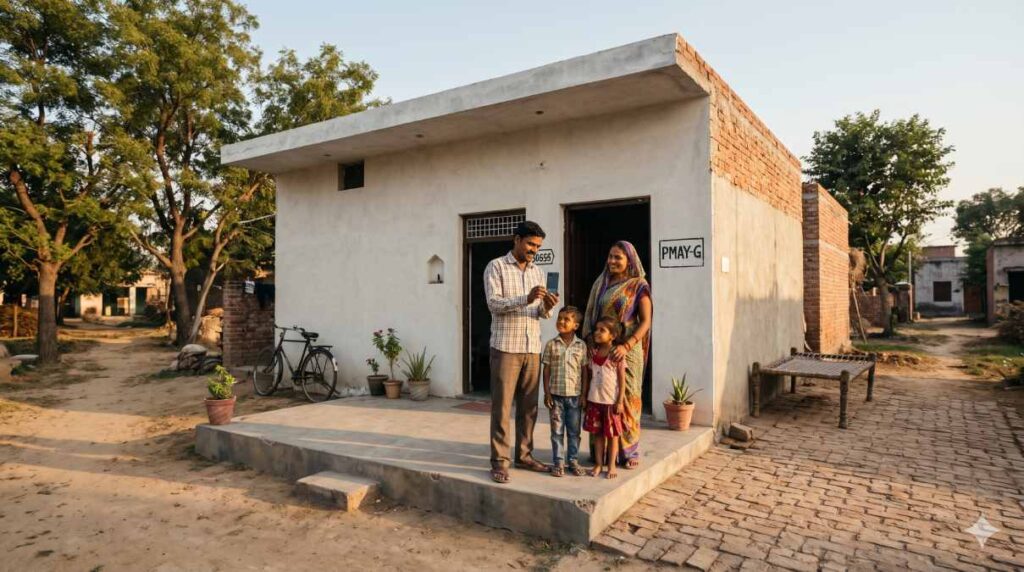
You cannot apply for a Pradhan Mantri Awas Yojana-Gramin (PMAY-G) house with an individual online form. A rural family enters through the Awaas+ 2024 survey, run on its own phone or by a gram panchayat enumerator, and then tracks its name and instalments on the PMAY-G beneficiary search page. Search for “apply online” anyway and the results point you to a form, usually on a page that never says the form does not exist.
A household gets in by one of two routes. The first is the existing list drawn from the Socio-Economic and Caste Census 2011, which states have worked through for years. The second is the Awaas+ survey, a household survey that picks up eligible families the earlier list missed. A family either sits on a list already or gets surveyed so that it can.
Qualifying comes down to a short set of tests. The survey itself runs either on your own phone through the AwaasPlus 2024 app or with an enumerator from the gram panchayat. Once the scheme takes you in, your name sits on a public list and your installments sit on a status page, and if either goes missing it can be traced.
The rules changed in August 2024, and older articles disagree with this one on income limits, two-wheelers, the portal address and the number of exclusion criteria. The income line now sits at Rs 15,000 a month, and a motorbike no longer counts against a family. Where a figure varies by state, the gram panchayat holds your number.
PMAY-G Apply Online 2026-27 at a glance
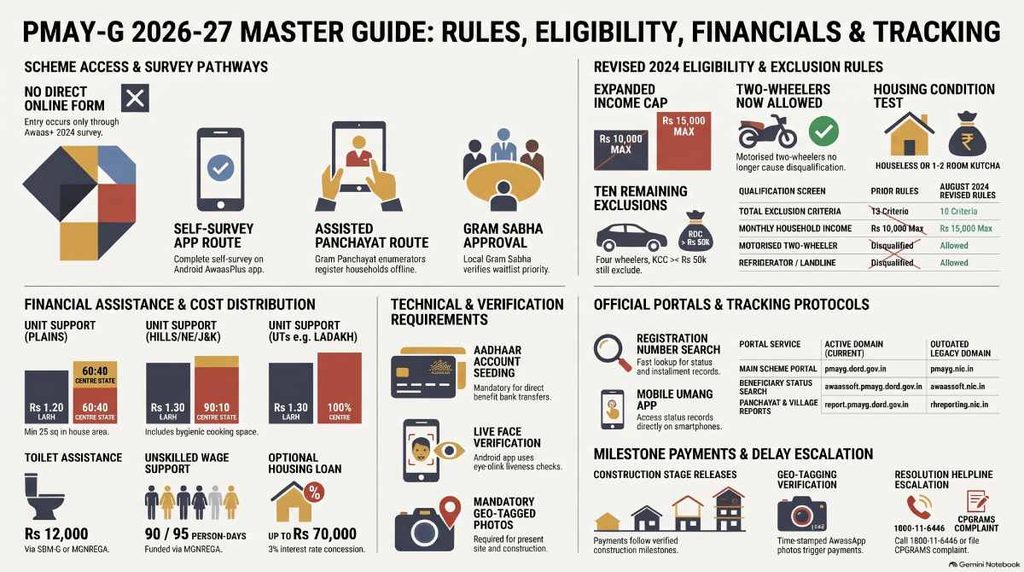
- You cannot apply for PMAY-G online with an individual form. A rural family enters through the Awaas+ 2024 survey, on the AwaasPlus 2024 app (Android only) or with a gram panchayat enumerator.
- A household qualifies if it has no house or a kutcha house of up to two rooms and no exclusion criterion applies. The income ceiling is Rs 15,000 a month, and a motorised two-wheeler no longer disqualifies a family.
- Unit assistance is Rs 1.20 lakh in plain areas and Rs 1.30 lakh in hill and northeastern areas, for a house of at least 25 square metres.
- Check your beneficiary status and the village list on the official portal, pmayg.dord.gov.in. The old pmayg.nic.in address is out of date.
- Payments go by DBT into a bank or post office account seeded with Aadhaar, follow construction stages and wait for a geo-tagged photograph. For a late installment, call the helpline 1800-11-6446 or file a CPGRAMS complaint.
PM Awas Yojana Gramin in 2026-27: What the scheme offers
The scheme runs from 2024-25 to 2028-29 for 2 crore additional houses, which takes the cumulative target to 4.95 crore.
For 2026-27 the Centre first released a mother sanction of Rs 11,121 crore, then another Rs 10,021.42 crore to 12 states on 28 May 2026. PIB’s note for 26 March 2026 counts 4.15 crore houses allocated and 3.90 crore sanctioned, with 2.99 crore completed. By May, approvals stood at 3.91 crore and completions had passed 3.05 crore.
Also Read: Dearness Allowance Hike July 2026: Cabinet Approves DA Increase to 63%
Awaas+ 2024 adds to the SECC 2011 list, it does not replace it
The SECC-based Permanent Waiting List stays in force. PIB’s November 2024 factsheet says the SECC 2011 waiting list has been saturated, and that more than 20 states have also finished their Awaas+ 2018 lists. If your household sat on those lists, the later sections show you where to find your name and installments. If it never did, the newer survey is the way in.
The Awaas+ survey launched on 17 September 2024 through the Awaas+ 2024 mobile app. It enrols eligible families the earlier list missed, and it screens them against the revised exclusion criteria, so a household that failed the 2011 tests can pass today.
The government told the Lok Sabha in December 2024 that the app has provisions for both a self-survey and an assisted survey through pre-registered surveyors. Gram Sabhas then verify the names, as Bajaj Finserv’s explainer sets out.
Unit assistance: Rs 1.20 lakh in plains, Rs 1.30 lakh in hill and northeastern areas
A family in the plains receives Rs 1.20 lakh for each house. In hill and northeastern areas the figure is Rs 1.30 lakh.
PIB’s November 2024 factsheet names the places that get the higher amount: the northeastern states, Himachal Pradesh, Uttarakhand, and the Union Territories of Jammu and Kashmir and Ladakh. Bajaj Finserv adds the Integrated Action Plan districts, which are selected Left-Wing Extremism-affected districts.
The amount has not changed since 2016. The Cabinet approved the 2024-29 phase at the existing unit assistance, so the 2 crore extra houses carry no increase. Cash for the wall and roof is only part of what a family receives.
Also Read: Viksit Bharat 2047: Analyzing the Strategic Policy Roadmap for a $30 Trillion Economy
| Component | What the family gets |
| Unit assistance, plain areas | Rs 1.20 lakh |
| Unit assistance, hill and northeastern areas | Rs 1.30 lakh |
| Toilet | Rs 12,000 through SBM-G, MGNREGA or another dedicated source |
| Wage days | 90/95 person-days of unskilled wages on the house |
| Loan | Up to Rs 70,000 from an institution at a 3% reduced interest rate |
What the house must look like: 25 square metres and a cooking area
The minimum house is 25 square metres, and that area includes a dedicated space for hygienic cooking, PIB’s November 2024 factsheet states. The size rose from 20 square metres.
The house goes up on the beneficiary’s own land. Families with no plot are a separate problem, and the Rural Development Minister asked states in May 2026 to provide land to eligible landless families.
Who pays: 60:40, 90:10 and 100% Centre
The Centre and the states split the cost by region.
| Region | Centre : State | Per house |
| Plain areas | 60:40 | Rs 72,000 from the Centre, Rs 48,000 from the state |
| Hill states (Himachal Pradesh, Uttarakhand) | 90:10 | Rs 1.17 lakh from the Centre, Rs 13,000 from the state |
| Northeastern states | 90:10 | Rs 1.17 lakh from the Centre, Rs 13,000 from the state |
| Union Territory of Jammu and Kashmir | 90:10 | Rs 1.17 lakh from the Centre, Rs 13,000 from the state |
| Union Territories such as Ladakh | 100% Centre | The Centre pays the full amount |
A state’s own top-up changes the family’s total. Under 60:40 a plain-area state owes Rs 48,000 of the Rs 1.20 lakh. If it adds money of its own, the extra comes from the state budget and the family receives more than the central unit assistance. If it adds nothing, the family stays at Rs 1.20 lakh or Rs 1.30 lakh, so ask the gram panchayat which figure your state follows.
The Cabinet’s outlay for 2024-29 is Rs 3,06,137 crore, of which Rs 2,05,856 crore is central share and Rs 1,00,281 crore is state share. The cost split by region comes from the cost-sharing table on Bajaj Finserv’s page.
PMAY-G eligibility criteria and the revised exclusion criteria
You qualify if your household has no house, or lives in a kutcha house with no more than two rooms, and no exclusion criterion applies to you. Since August 2024 only ten criteria can rule a family out, and a two-wheeler is no longer one of them. Some groups also get a reserved share of the targets, and a few skip the housing test altogether.
Core eligibility criteria: houseless families and kutcha houses of up to two rooms
Two kinds of household pass the housing test. The first has no shelter at all. The second lives in a house where both the walls and the roof are kutcha, and where the house has zero, one or two rooms, as PIB states. A kutcha house is one made of temporary materials such as mud or bamboo, not brick and cement.
The room count refers to the house the family lives in today, so a two-room kutcha house passes and a three-room one does not. PIB words the test as kutcha walls and a kutcha roof together, which puts a house with a pucca wall and a thatched roof outside it.
Destitute families and those living on alms, manual scavengers, Primitive Tribal Groups and legally released bonded labourers skip the test and go on the list automatically.
Among eligible households, deprivation sets the order. Houseless families come first, then families with fewer rooms. Cumulative scores add weight for these conditions:
- no adult member aged 16 to 59
- a female-headed household with no adult male member
- no literate adult above 25
- a disabled member and no able-bodied adult
- landless dependence on manual casual labour
What the 2024 revision changed
The change dates to the Union Cabinet’s August 2024 decision on the second phase. PIB and Bajaj Finserv put the exclusion list at 10 criteria where it once held 13, and the monthly income ceiling at Rs 15,000 where it was Rs 10,000. Four conditions stopped being disqualifiers on their own.
| Test | Before | Now |
| Exclusion criteria | 13 | 10 |
| Monthly income ceiling | Rs 10,000 | Rs 15,000 |
| Owning a motorised two-wheeler | Excluded | Not a disqualifier |
| Owning a fishing boat | Excluded | Not a disqualifier |
| Owning a refrigerator | Excluded | Not a disqualifier |
| Having a landline phone | Excluded | Not a disqualifier |
Two groups gain most from the revision. Families struck off the 2011 list over a motorbike or a landline can come back through the Awaas+ survey, and families whose earner brings in between Rs 10,000 and Rs 15,000 a month now clear the income screen that once stopped them. Articles that still list the two-wheeler as a disqualifier, or quote the Rs 10,000 ceiling, predate the revision.
What still excludes a household
The ten surviving criteria include these seven, which PIB’s exclusion-criteria release and its November 2024 factsheet set out:
- a motorised three-wheeler or four-wheeler
- mechanised farm equipment
- a Kisan Credit Card limit of Rs 50,000 or more
- a government employee in the household
- a household member who pays income tax or professional tax
- a member earning above Rs 15,000 a month
- land above the set limits
The Kisan Credit Card test looks at the credit limit sanctioned on the card, not the balance drawn, so a limit of Rs 49,999 passes and a limit of Rs 50,000 does not.
Because the income test applies to any member, one earner above Rs 15,000 a month excludes the household even when everyone else earns nothing.
Two cases show how the screen works. In the first, a household of five lives in a two-room mud house. A son rides a motorbike and the father holds a Kisan Credit Card with a Rs 40,000 limit. Neither fact excludes the family, but raise the card limit to Rs 60,000 and the household drops out at the screen.
In the second case a widow lives with two children in a one-room thatched hut. She clears the housing test and earns extra weight as a female-headed household with no adult male member.
For land, the Ministry rationalised the rules in the same revision. PIB’s November 2024 factsheet mentions irrigated land above 2.5 acres, so confirm the limit that applies to you with the gram panchayat before ruling yourself out. The system also screens survey entries against these criteria, and a Ministry letter of 24 November 2025 sets guidelines for deleting ineligible households from the Awaas 2024 survey data.
Also Read: PM Viksit Bharat Rozgar Yojana (PMVBRY) 2026: The Complete Guide
Reserved shares for SC/ST, minorities and persons with disabilities
PMAY-G earmarks at least 60% of its targets for SC and ST households. PIB’s tally for 19 November 2024 counted 59.58 lakh SC houses and 58.57 lakh ST houses completed.
Another 15% of funds at the national level goes to minority households, and state targets follow each state’s share of the minority rural population in Census 2011. Persons with disabilities get 5% of the target. A further 5% is set aside for families hit by natural disasters.
These shares are allocation targets, so they do not change how a household gets surveyed. Every family enters through the same survey and meets the same exclusion screen.
PMAY-G documents required before the Awaas+ survey
Keep the required documents in the table below ready before you open the app or meet the enumerator. Collect the papers in one folder and photograph each one on the phone, so a second trip to the panchayat does not start from zero.
| Item | What to keep ready |
| Aadhaar | Aadhaar number of each family member, and the mobile number linked to it |
| Android phone | Working camera, internet connection and free storage (self-survey only) |
| Bank or post office account | An account seeded with Aadhaar for direct transfer |
| MGNREGA job card | Job card number, if the family holds one |
| SBM-G number | Toilet number under Swachh Bharat Mission-Gramin, if the family has a toilet |
| Photographs | The present house and the site of the new house, taken in the app |
| Plot details | Where the house will stand, and who owns the land |
Aadhaar and face authentication
The self-survey uses Aadhaar face authentication on an Android phone, and the app runs on Android only. PIB’s March 2026 note calls the check AI-based and says it detects liveness through eye-blink and motion, so a photograph of a face will not pass.
Take the scan in daylight with the phone held steady at eye level. Names in the Aadhaar record and the family record should read the same, because a spelling that differs between them can stall the entry at the verification stage.
MGNREGA job card and Swachh Bharat Mission number
The job card carries the wage entitlement. A PMAY-G family receives 90/95 person-days of unskilled wages for work on its own house.
PIB’s March 2026 note calls the wage scheme MGNREGA, now VB: G RAM G, so you may see either name on paper. A family with no card should ask the gram panchayat about getting one early.
The Rs 12,000 toilet assistance comes through SBM-G, MGNREGA or another dedicated source. Keep the SBM-G number if the family already has a toilet.
Aadhaar-seeded bank account for DBT
Payments reach the family through DBT, into a bank or post office account linked to Aadhaar. The most common cause of a failed payment is an account that is not seeded with Aadhaar.
The fix is a branch visit with the Aadhaar card and the passbook, where you ask the bank to seed the account. Do it before the first installment falls due.
How to apply for PMAY-G online: no individual form, only a survey
To apply for PMAY-G online, a household enters through a survey, never through a form of its own. The survey has two modes. In the first you run a self-survey on the AwaasPlus 2024 app, which works on Android phones only.
In the second an enumerator from the gram panchayat runs the same survey for you. Either way the entry lands in one database, the Gram Sabha reviews it, and a family that passes joins the wait list. Any page that promises a PMAY-G application form in minutes is describing something else.
Self-survey on the AwaasPlus 2024 app
The app has a self-survey option and an assisted one, and the steps below cover the first.
Prepare before you sit down with the phone. Charge the phone, then find a spot with a steady signal and mobile data switched on. Keep the Aadhaar number of every family member in front of you, along with the mobile number linked to the head’s Aadhaar, because a hurried session invites spelling slips.
- Download the app. Install AwaasPlus 2024 on an Android phone from the link on the official PMAY-G portal. Do not pay anyone to install it or to enter your details.
- Pass Aadhaar face authentication. The app integrates Aadhaar face authentication with the survey, so expect a face scan before any form opens. Blink when the app asks.
- Fill in the household details. Enter the head of the family and each member, then the present house and its condition. Use the same spellings as the Aadhaar records.
- Photograph the present house and the proposed site. Both photographs are geo-tagged, so switch on location and stand where the house will actually go up.
- Review and submit. Check every entry before you send it, because a wrong entry can cost the household its place on the list.
The app does not issue a sanction. Submission places the household in the survey database, where the exclusion screen and the Gram Sabha take over. Note the date you submitted, so that you can quote it to the panchayat.
Four things most often derail a self-survey:
- Dim light or a shaky hand during the face scan, which can fail the liveness check.
- A member’s name spelled one way in the app and another way on Aadhaar.
- Location switched off, so the geo-tagged photograph carries no usable position.
- A household member left off the list, which changes the room count and the deprivation picture.
PIB adds that the app also carries 3D house designs prepared with CBRI, so families can choose a suitable design.
Apply offline: assisted survey through the gram panchayat
You can also apply offline. Panchayat enumerators run the same survey on the same app. A family without a smartphone, or one that cannot get through the face scan, should take its documents to the panchayat office and ask for the household to be surveyed.
Carry the items from the table above and go with the head of the household, since the head’s Aadhaar is the one that gets verified. If the head cannot travel, ask the panchayat what it will accept before you make the trip.
Ask for the enumerator’s name and the date, and have the entries read back to you before they are submitted. The spelling checks from the self-survey apply here, and an error caught at the doorstep costs nothing to fix.
Come back to the panchayat if the household has not been visited within a few weeks.
The Ministry’s reply in the Lok Sabha says surveyors are registered on the app in advance. Ask to see who is surveying your household and in what capacity. No one needs a fee from you to record a household.
After the survey: Gram Sabha verification and sanction
The entry first runs against the exclusion criteria, and flagged cases pass through the deletion process laid out in the November 2025 guidelines. The Gram Sabha then reviews the list, and PIB describes a three-stage validation: the survey lists, Gram Sabha approval and geo-tagging.
Names that pass go onto the wait list in priority order, which follows the deprivation conditions listed earlier, so a houseless family with no adult earner ranks ahead of a family in a two-room kutcha house. A sanction follows only when the state has a target and funds for you.
The Gram Sabha is the assembly of the panchayat’s voters. Ask the panchayat when it will take up the Awaas+ list and attend that meeting. A name wrongly struck off is easier to raise in the room than on a phone call afterwards.
PMAY-G or PMAY-Urban: which one applies to you
Villages use the PM Awas Yojana Gramin portal, and towns use the urban one at pmaymis.gov.in, where a PMAY-Urban applicant files an application. A rural household does not file a conventional application at all, because PMAY-G identifies beneficiaries through the SECC database and Awaas+ surveys and the Gram Sabha reviews the list.
| Question | PMAY-G | PMAY-Urban |
| Where you live | Village | Town |
| Portal | pmayg.dord.gov.in | pmaymis.gov.in |
| How a household enters | Survey and Gram Sabha review | Application on the urban portal |
How to check your PMAY-G beneficiary status and village list
The addresses come first, since the domain move is where readers get stuck. The official portal is pmayg.dord.gov.in. The beneficiary search is at awaassoft.pmayg.dord.gov.in and village lists are at report.pmayg.dord.gov.in.
Guides that still send you to pmayg.nic.in leave you at the wrong address. UMANG gives a phone route to the same records.
Four routes lead to those records, and each asks for something different.
| Route | You need | Works best for |
| Registration-number search | Registration number | One household’s sanction and installment record |
| Search by location and personal details | State and district, plus personal details | A lost registration number |
| Village list | State, district, block and panchayat | Finding a name, or seeing how neighbours stand |
| UMANG app | Registration number | Checking from a phone |
The portal address: pmayg.nic.in has moved
The Department of Rural Development now runs the portal from the dord.gov.in domain, and PIB’s March 2026 note lists pmayg.dord.gov.in as the Ministry’s reference. Readers still search the old nic.in names, so the table gives both.
| What you want | Current address | Old address |
| Main portal | pmayg.dord.gov.in | pmayg.nic.in |
| Beneficiary search | awaassoft.pmayg.dord.gov.in/netiay/Benificiary.aspx | awaassoft.nic.in |
| Village and panchayat reports | report.pmayg.dord.gov.in/netiay/newreport.aspx | rhreporting.nic.in |
The government spells “Benificiary” with an i in the beneficiary search address, so type it exactly. The system behind all three is AwaasSoft, a bilingual web platform that handles identification, sanction orders, fund release and monitoring. Spell it AwaasSoft when you search for it.
Save the three addresses on the phone you plan to use. Search results can still surface the old nic.in names, and one wrong tap sends you to a page that no longer holds your record.
Check PMAY-G status by registration number
Follow these steps, which Urban Money’s list guide sets out in the same order:
- Open the beneficiary search at the address in the table above, or open the official portal and choose Stakeholders.
- Choose IAY/PMAYG Beneficiary.
- Type the registration number exactly as it reads on the sanction letter.
- Solve the captcha.
- Submit, and read the page that opens.
The page returns the beneficiary’s details and the household’s sanction status and installment record. Read the name and the village against your Aadhaar and the sanction letter. A spelling slip here is worth raising with the panchayat before the next release falls due.
The menu carries both names because PMAY-G replaced the Indira Awas Yojana in 2016, and the two share one set of records.
Without a registration number, use the search by location and personal details on the same page. If that fails, use the village list in the next section, or ask the gram panchayat to read your entry from its copy of the list.
PMAY-G beneficiary list: village-wise and panchayat-wise
The Reports section lists every beneficiary without a login. Go to the reports address, scroll to Social Audit Reports and click Beneficiary Details for Verification. Bajaj Finserv’s guide walks through the filters.
Choose State, District, Block and Panchayat in that order. Pick the scheme and the financial year, enter the captcha and submit. The list for your panchayat opens on screen.
Look for your name against the village and the year of sanction. A name that appears under an earlier year was sanctioned earlier, so scan more than one year before concluding that you are missing. On a computer, the browser’s find function (Ctrl+F) jumps straight to your surname.
Save or print the list when it opens. A dated copy is hard to argue with if your entry changes or disappears later.
Check PMAY-G status on the UMANG app
Save the registration number in the phone’s notes. Install UMANG from the phone’s app store and log in with your mobile number. Open the Services section.
Search for Pradhan Mantri Awaas Yojana (Gramin), which is the scheme’s UMANG listing. Choose Installment Details, enter the registration number and tap Search. The screen shows the funds released and the current payment status, as Bajaj Finserv describes it.
For the panchayat-wise wait list, pick Beneficiary Details for Verification from the same service menu. UMANG saves a trip to a cyber cafe, and it works on iOS as well as Android.
Both routes read the same records. If the portal and UMANG both show nothing for your number, the problem sits with the entry and not the app, and the gram panchayat is the next stop.
Installments, geo-tagging and what to do when payment is late
Installment counts and amounts differ by state, so the figure on a neighbour’s sanction order may not be the figure on yours. The logic is the same everywhere: money follows construction, and every release waits for a geo-tagged photograph and a bank account that accepts the payment. Most delays trace back to one of those two.
How installments follow construction stages
States map installments to construction levels. Three is the usual pattern, though Bajaj Finserv reports that some areas use four. The first release follows the start of work and the last follows completion, with the releases in between tied to levels the state defines.
All payments are electronic. They go straight to a bank or post office account linked to Aadhaar, and PIB’s November 2024 factsheet describes the transfers as construction-linked assistance. That means a family that stops work also stops the money, and a family that finishes a level without a verified photograph waits too.
The schedule that applies to your house sits in your state’s own guidelines. Ask the gram panchayat for it, and ask for the sanction order at the first visit, since that order names the amount and the stages for your house.
A family that takes the loan of up to Rs 70,000 at the reduced rate should time it to the stage at which cash runs short, since each release waits on verification. Keep a note of the level at which each release is due.
The Rs 12,000 toilet assistance and the 90/95 person-days of unskilled wages come on top of the unit assistance. Ask the panchayat how the wage days will be recorded against your job card before work starts.
Geo-tagged photographs through AwaasApp
PIB’s March 2026 note says time-stamped and date-stamped photographs are uploaded at every stage of construction, and that this digital record lets officials monitor progress as it happens. Photographs are taken at registration and at completion, and at every construction stage between. The registration photographs show the beneficiary in front of the present house and the proposed site.
AwaasApp is the Android app for the job. The beneficiary or a representative can upload through it, and officials use it for inspections. Each sanctioned house is tagged to a village-level functionary who follows up with the family.
The checks are strict. Machine-learning tools check each photograph against others from the same locality and raise an alert when two look alike. Officials also inspect a sample of houses at each stage. At completion the system recommends a final photograph for approval.
If an installment is late
Work through these steps in order.
- Check for a pending geo-tag. A photograph that was not uploaded, or was rejected as blurred or wrongly located, holds the release. Ask who uploaded it and when.
- Check the bank seeding. A payment sent to an account that is not seeded with Aadhaar returns unpaid. Visit the branch and ask it to seed the account.
- Ask the gram panchayat. Its staff can see the stage your house has reached and say which step is pending.
- Call the helpline. The PMAY-G number is 1800-11-6446, and the PFMS payment-tracking line is 1800-11-8111.
- File a CPGRAMS complaint at pgportal.gov.in, tagged to the Ministry of Rural Development. Quote your registration number and the date the installment was due.
Keep a log of every contact: the date and the name of the person, plus what they promised. A CPGRAMS complaint with dates and names gives the officer something to trace.
If your name is missing or your status looks stuck
Your name is not on the list
Ask the gram panchayat whether your household was surveyed. If the panchayat has a record of a visit, ask for the entry and check it against the village list.
If the household was never surveyed, use the Awaas+ self-survey on the AwaasPlus 2024 app, and ask the panchayat whether your state is taking new entries.
Keep the date and the name of whoever you spoke to. If the answer is vague, put the question in a short written application to the panchayat and keep the receiving copy. If the panchayat does not respond, take a copy of that application to the block development office.
Gather the Aadhaar numbers and household details, plus any old acknowledgement, before the visit. A household that was surveyed and later dropped may have been flagged under the exclusion criteria, so ask whether a flag exists and on which ground.
Your status shows no progress
A pending geo-tag or a returned bank payment is the usual cause. Open the beneficiary search with your registration number and read the last stage recorded. Write down the stage and the date you looked, and look again a week later to see whether the entry moved.
Then ask the gram panchayat what is pending against your house. If the panchayat cannot move it, lodge a CPGRAMS complaint and quote the stage and registration number, plus the date of the last update.
A house can look finished on site and still show no progress online, if the photograph for that stage was never uploaded.
PMAY-G Apply Online 2026-27:FAQ
Not through a form of your own. The only online route is the self-survey on the AwaasPlus 2024 app, and it records your household for review. It does not apply for a house on your behalf.
A sanction comes only after verification and only when your state has a target for your panchayat. Treat any site that promises a sanction for a fee as a warning sign.
Keep the Aadhaar number of each family member and the mobile number linked to it, plus a bank or post office account seeded with Aadhaar for direct transfer. Add the job card and toilet numbers where the family has them.
Photographs of the present house and the new site are taken in the app. Have the plot details ready as well, meaning where the house will stand and who owns the land.
No. A motorised two-wheeler stopped being a disqualifier with the 2024 revision. Owning one does not guarantee a house either.
The family still has to pass the housing test, stay under the Rs 15,000 monthly ceiling and rank high enough on the priority list for the state’s target. A motorised three-wheeler or four-wheeler is a different matter and still excludes.
It depends on your state. Three is the usual pattern and some areas use four. The state decides the amount of each release, and the gram panchayat can tell you the schedule for your house.
The first release follows the start of work and a verified photograph, so a family that waits for money before laying a foundation can wait a long time.
Yes. The registration number is a shortcut, not a requirement. Your name and panchayat, plus the year of sanction, are enough to find an entry in the village list, and a gram panchayat official can read the same record.
Write the number down once you find it, because every later search, including the one on UMANG, goes faster with it.
Look on the sanction letter first, since the search page asks for the number exactly as it reads there. Without the letter, use the search by location and personal details on the beneficiary search page, or ask the gram panchayat to read your entry from its copy of the list.
The Awaas+ 2024 survey ran against deadlines the Ministry set. By November 2025 states were receiving guidelines for deleting ineligible households from the survey data, which is a clean-up stage and not an enrolment stage. Whether your state accepts new self-survey entries today is a question for the gram panchayat, and the answer can differ from one state to the next.
Ask the gram panchayat to survey the household. The self-survey runs on Android only, but enumerators run the same survey on the same app.
Go with the head of the household, since the head’s Aadhaar is the one that gets verified.
The time varies by state and by panchayat. The sanction follows the survey and the Gram Sabha review, and it waits on your state’s target and funds.
Once it arrives, the sanction order names the amount and the construction stages for your house, so ask the panchayat for a copy at the first visit.
Rule out a pending geo-tag and an account not seeded with Aadhaar first, since most delays trace back to one of the two. Then ask the gram panchayat, which can see the stage your house has reached and say which step is pending.
If that does not move it, call the PMAY-G helpline on 1800-11-6446 or the PFMS payment-tracking line on 1800-11-8111, and file a CPGRAMS complaint at pgportal.gov.in tagged to the Ministry of Rural Development.
No. The Department of Rural Development now runs the portal at pmayg.dord.gov.in, and the beneficiary search sits at awaassoft.pmayg.dord.gov.in.
Guides that point to pmayg.nic.in or awaassoft.nic.in lead to the wrong address.
Disclaimer
India Policy Hub is an independent publication. It is not affiliated with or endorsed by the Government of India, the Ministry of Rural Development, the Department of Rural Development, UMANG or any State Government. This post is published for general information only. It is not legal, financial or professional advice, and it creates no advisory relationship between you and the publisher. Scheme rules, eligibility conditions, amounts, portal addresses, helpline numbers and survey deadlines are set by the competent authorities and can change without notice. They also differ from one State to another. Check every detail against the official PMAY-G portal and with your gram panchayat before you act on it. To the fullest extent permitted by law, India Policy Hub and its authors accept no liability for any loss, damage or expense arising from reliance on this post or on third-party links in it. Sanction rests solely with the authorities.




Leave a Reply