
Digital Rupee Ration: How India’s CBDC Food Subsidy Works
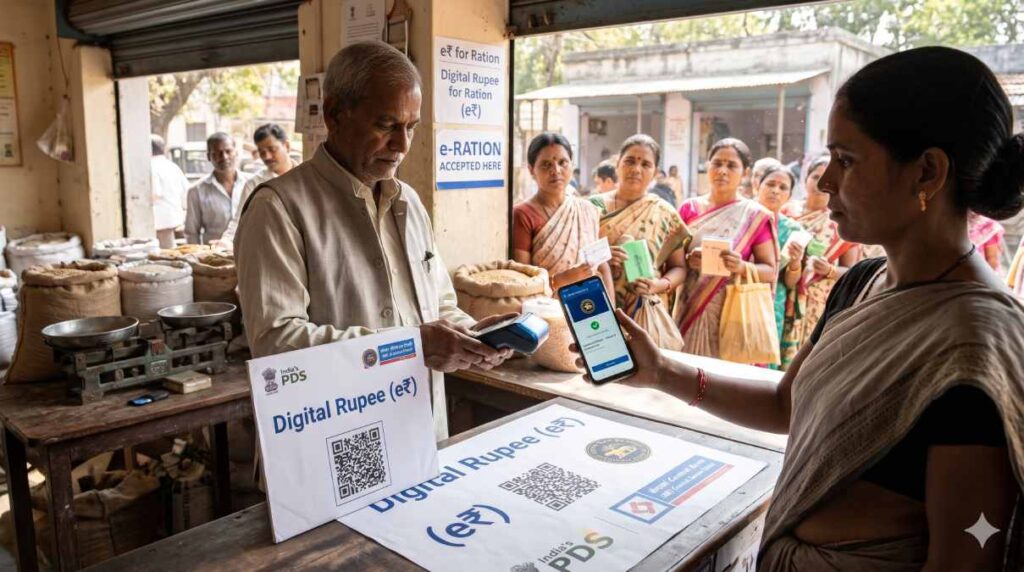
Digital rupee ration is a payment system in which e₹ tokens, the central bank digital currency (CBDC) that RBI issues, carry the food subsidy into a beneficiary’s wallet. The tokens redeem only for entitled foodgrains at authorised shops. It operates in Gujarat, Puducherry, Chandigarh and Dadra & Nagar Haveli, and no other region is confirmed.
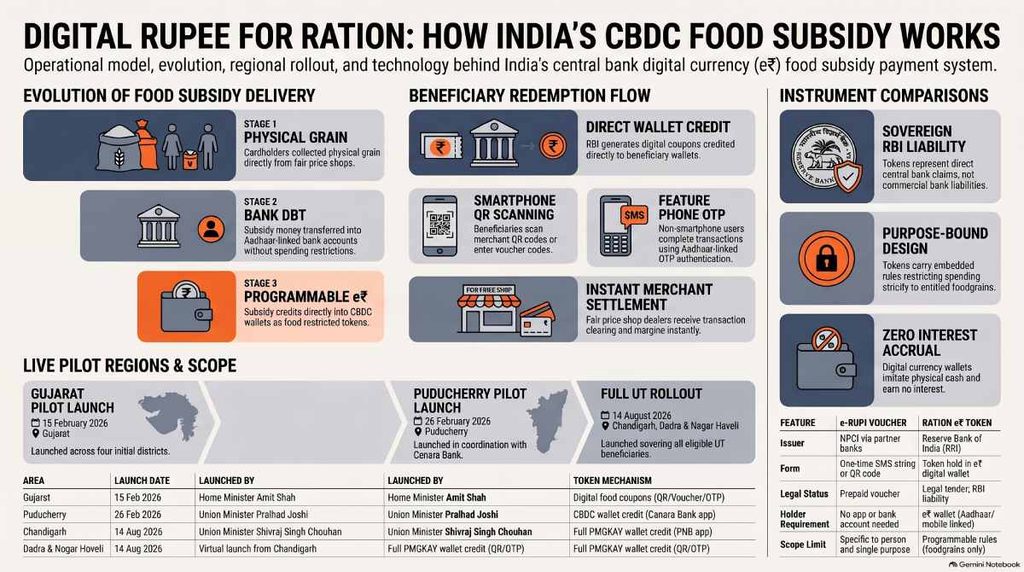
On 15 February 2026, Gujarat began the first pilot to deliver ration entitlement as programmable e₹, the digital rupee that the Reserve Bank of India issues. Beneficiaries get tokens in a wallet instead of money in a bank account, and the tokens buy only foodgrains. As of November 2026 the system is live in four places: Gujarat, Puducherry, Chandigarh and Dadra & Nagar Haveli.
Everywhere else, ration still moves the old way. A cardholder in any other state or Union Territory keeps collecting grain at the fair price shop.
The scheme is narrow today. Pradhan Mantri Garib Kalyan Anna Yojana (PMGKAY) reaches more than 800 million people nationally, and the four live areas hold a small fraction of that number. The Ministry of Consumer Affairs, Food and Public Distribution has said a wider rollout will wait until it has assessed outcomes.
Digital Rupee Ration: At A Glance
- Digital Rupee Ration Is Live in Four Places: Gujarat began the pilot on 15 February 2026 with digital food coupons for PDS entitlement. Puducherry (26 February), then Chandigarh and Dadra & Nagar Haveli (14 August), pay the PMGKAY food subsidy into CBDC wallets. Daman & Diu is named as a planned area, and no official release records a launch there.
- The Subsidy Arrives as Money That Buys Only Foodgrains: RBI-issued e₹ tokens land in the beneficiary’s wallet and redeem only for entitled foodgrains at authorised shops or empanelled merchants. The stated aims are transparent, traceable delivery with no intermediary.
- Coverage Is Still Narrow: PMGKAY reaches more than 80 crore people nationally. Gujarat and Puducherry began with limited groups and published no count, while Chandigarh and Dadra & Nagar Haveli cover all eligible beneficiaries.
- No Results or National Date Yet: The Ministry has published no measured outcome from any rollout. It will decide on wider rollout after assessing outcomes.
What Is the Digital Rupee (e₹) and How Does It Differ From UPI?
e₹, also called the e-rupee, is the digital form of the rupee. The Reserve Bank of India issues it, and one e₹ is worth exactly one rupee. It sits in a mobile wallet and pays for goods the way cash does, with no bank deposit moving behind each payment.
Retail CBDC in Plain Terms
RBI issues e₹ as a digital form of the rupee, at par with notes and coins. The user keeps it in a wallet, an app on a phone that a bank or a non-bank provider opens for them. Like a purse, the wallet takes in money, hands it to another person and pays a merchant.
The public version is e₹-R, where R stands for retail. The wholesale version, e₹-W, is restricted to financial institutions.
RBI set out the design in its concept note of October 2022. The wholesale pilot began on 1 November 2022 and the retail pilot on 1 December 2022.
Because e₹ imitates cash, a wallet balance earns no interest.
e₹ vs UPI vs Bank Balances
UPI moves bank deposits between accounts. e₹ is a claim on RBI held in a wallet. A bank deposit is a liability of the commercial bank that holds it, while e₹ is a direct liability of the central bank.
Take a ₹200 purchase from a grocer. Pay by UPI and ₹200 leaves your bank account and lands in the grocer’s. Pay in e₹ and ₹200 of central bank money moves from your wallet to the grocer’s wallet, and no commercial bank ledger sits in between. Many e₹ apps also read UPI QR codes, so the shopper sees little difference at the counter.
| UPI payment | e₹ payment | |
| What moves | A bank deposit | A digital rupee token |
| Who owes the money | Your bank | RBI |
| Where it is held | Bank account | e₹ wallet |
| Interest | Paid on savings balances | None |
Cryptocurrency is a different thing again: e₹ is sovereign money issued by the central bank, and a private token has no such backer.
The gap matters for ration. Once subsidy money reaches a bank account, the account holder decides how to spend it. A token that RBI issues can carry a condition from the moment it is created, and the ration scheme relies on exactly that.
Also Read: How to Reactivate a Silent Ration Card Under the 2026 SMART-PDS Rules
e₹ Ration vs e-RUPI Vouchers: Two Different Instruments
Prime Minister Narendra Modi launched e-RUPI on 2 August 2021. PIB described it as a prepaid voucher delivered by SMS or QR code, tied to one person and one purpose. The government issues it through a partner bank, and the holder needs no card, payments app or internet banking, and no bank account either.
PIB added that e-RUPI should not be confused with the digital currency RBI was then planning, which is now e₹. RBI’s FAQ defines e₹ as legal tender under Section 26 of the RBI Act and a liability of RBI, held in wallets that banks and non-bank providers open. Programmability, the FAQ adds, lets a sponsoring government restrict use by expiry date or geography, or to certain merchant categories.
The two instruments differ on five points:
| e-RUPI voucher | Ration e₹ token | |
| Issued by | NPCI voucher, issued through a partner bank | RBI |
| Form | One-time SMS string or QR code | Token held in an e₹ wallet |
| Legal status | A voucher that PIB set apart from digital currency | Legal tender, a liability of RBI |
| What the holder needs | No card, app, internet banking or bank account | An e₹ wallet, opened by mobile number or Aadhaar authentication, with no savings account needed |
| Purpose limit | Specific to a person and a purpose | Rules such as expiry, geography and merchant category; foodgrains only in the ration pilots |
No official release records e-RUPI delivering foodgrains. The ration pilots use RBI-issued tokens held in a wallet, so the instrument at the counter is a currency and not a voucher.
Purpose-Bound Money: Why This e₹ Buys Only Foodgrains
Programmability is what separates this scheme from an ordinary transfer. A programmable token carries rules with it, and here the rule concerns what the token can buy and where. The documented design is narrow.
The tokens redeem only for entitled foodgrains, at authorised merchants and fair price shops. The government calls the subsidy purpose-bound. Its Chandigarh material describes e₹ as a secure, instant, traceable and programmable form of digital cash for PMGKAY beneficiaries. A beneficiary cannot spend the tokens on anything else.
Gujarat’s coupons make the rule visible, since each token states the item and the quantity it can buy.
Detail on the token settings is thin. The Gujarat release gives no validity period, transaction limit or foodgrain quantity. Until RBI or the Ministry publishes those settings, the whole documented design is one line: food only, at authorised shops.
Also Read: Ration Card e-KYC 2027: Last Dates by State and How to Complete It
From Ration Card to Programmable Money: How Food Subsidy Delivery Changed
Food subsidy delivery changed twice before e₹ arrived, and each change altered what a household does at the counter. India Policy Hub has covered the first two stages at length, in its pieces on DBT savings and the Welfare Efficiency Index and India Stack and the JAM Trinity.
| Stage | What the household receives | Where the subsidy sits | What it can buy |
| 1. In-kind ration | Grain | At the fair price shop | Grain only |
| 2. DBT to bank account | Money | Aadhaar-linked bank account | Anything |
| 3. Programmable e₹ | Tokens | e₹ wallet | Foodgrains only |
Stage 1: In-Kind Ration at Fair Price Shops
The baseline is the Public Distribution System (PDS), with the National Food Security Act as the legal base for the entitlement. A household took its ration card to a fair price shop, and the dealer handed over grain in kind. The subsidy reached the family as grain, never as money.
Digitisation came in layers. Ration cards were digitised end to end, then Aadhaar-enabled e-POS devices arrived, so a dealer checked the cardholder’s identity on the device before weighing out grain. The household still walked to the shop and carried the grain home.
Stage 2: DBT Into Aadhaar-Linked Bank Accounts
JAM ties Jan Dhan bank accounts to Aadhaar identity and mobile numbers, so the state can pay a named person directly. Food subsidy took that route, as Direct Benefit Transfer, in places that chose cash transfer over grain. In the BlueKraft assessment that India Policy Hub covers, food subsidies make up ₹1.85 lakh crore, about 53 per cent of cumulative DBT savings.
Chandigarh is the worked example. In September 2015 it moved from physical distribution of subsidised foodgrains to direct transfer of the subsidy into the Aadhaar-linked bank accounts of entitled households. Money now arrived in an account, and nothing in the transfer told the household to spend it on grain. The e₹ rollout has since replaced that channel in Chandigarh.
Stage 3: Programmable e₹ Credited to a Wallet
Now the subsidy lands as tokens in a CBDC wallet instead of a bank account. The money arrives already tied to food.
In the three Union Territories, CBDC-based DBT replaced the bank-account channel. In Gujarat, the pilot introduced digital food coupons, tokens that spell out what a household may buy and at what rate.
At the Puducherry launch, the Secretary of the Department of Food and Public Distribution described the step as resting on the Jan Dhan, Aadhaar and mobile base. The household still goes to a shop. What changes is that the shop receives a token with a single use, and the state sees the transaction as it happens.
Also Read: Ration Card E-KYC Mismatch? A Step-by-Step Guide to Correcting Your Data Online
How Digital Rupee Ration Works: How a Beneficiary Receives and Spends It
RBI generates the digital coupons and credits them straight to the beneficiary’s e₹ wallet. The beneficiary redeems them for entitled foodgrains at a shop: a smartphone user scans a QR code or enters a voucher code, and a feature-phone user authenticates with an OTP. The shop is paid in real time.
How to Enrol for Digital Rupee Ration and Which Wallet App It Uses
Enrolment differs across the four areas, and the official record is uneven. RBI’s FAQ describes the general route: a government sponsor can onboard a DBT beneficiary through a mobile number, Aadhaar authentication or both, and no savings account is needed. The wallet providers named so far appear below, each with its source:
| Area | Provider named | Where it is stated |
| Gujarat | Punjab National Bank, as reported | DeshGujarat, 13 February 2026 |
| Puducherry | Canara Bank; no app named | PIB release, 26 February 2026 |
| Chandigarh | PNB Digital Rupee app | Chandigarh Administration press note |
| Dadra & Nagar Haveli | None named | PIB release, 14 August 2026 |
Chandigarh is the only area with an official enrolment notice. The Chandigarh Administration’s press note named the PNB Digital Rupee app as the channel for the foodgrain subsidy from July 2026. Cardholders who had not yet moved their subsidy from a bank account to the app were asked to bring their Aadhaar card and Aadhaar-linked mobile number to daily camps. Enrolment there depended on the household acting, not on an automatic credit.
The 14 August PIB release covers both territories. It says smartphone users pay by QR code and feature-phone users through an OTP-based mechanism, and it names no bank or app and gives no beneficiary count. No official release names the wallet provider for Dadra & Nagar Haveli.
In Puducherry the PIB release names Canara Bank and says the subsidy goes to identified beneficiaries, with no registration step described. In Gujarat the PIB release names no bank. DeshGujarat reported before the launch that Punjab National Bank developed the system, with access through Aadhaar by QR code on smartphones and OTP on feature phones. That is a press report, and no official release says whether Gujarat households had to register.
Behind the Scenes: RBI, Banks and PFMS
Several parties move the money, and each appears in the official releases. The beneficiary sees none of that machinery: the wallet shows a credit, and the shop shows a QR code.
The Gujarat release says RBI generates the digital coupons and credits them as programmable e₹. It names RBI and the Gujarat government as collaborators, and no bank. In Puducherry, the Secretary of the Department of Food and Public Distribution thanked RBI, Canara Bank and the UT government for their help at the launch. The credit goes to identified beneficiaries, so a wallet receives tokens only after a household is on the list.
The Ministry leads. Its Department of Food and Public Distribution runs the pilots, and its Secretary spoke at the Puducherry launch. A pre-launch PIB release adds that the Puducherry pilot runs in coordination with the UT government, RBI, the Public Financial Management System (PFMS), the Union government’s platform for tracking public funds, and Canara Bank. Four institutions sit behind a single wallet credit in Puducherry.
With a Smartphone: Wallet, QR Code or Voucher Code
The subsidy arrives as tokens in the beneficiary’s e₹ wallet, and nothing has to be loaded from a bank account.
At the shop the beneficiary redeems the entitled quantity with a QR code or a voucher code. Gujarat coupons carry the item name, quantity and price, so the token itself states what it buys and at what rate. The voucher code is a second route: a code replaces the scan when a scan is not possible.
The release says the system eliminates repeated biometric authentication. That is the Ministry’s own description of the change, and it targets the biometric authentication and e-POS operational problems that the release names.
None of the PIB releases names a wallet app. The Puducherry application does have one more function: it lets a beneficiary locate nearby authorised merchants, which matters because a wallet that only holds tokens leaves the household to guess which shops accept them.
Without a Smartphone: What Officials Have Confirmed
The Puducherry release says the design gives special emphasis to feature-phone users. Gujarat uses an OTP route for households without a smartphone, with the one-time code tied to Aadhaar. In Chandigarh and Dadra & Nagar Haveli, smartphone users pay by QR code and feature-phone users through OTP-based access.
| Device | Redemption route | Where it is stated |
| Not specified | QR code or voucher code | Gujarat release, 15 February 2026 |
| Feature phone | Aadhaar-linked OTP | Gujarat, via All India Radio |
| Feature phone | OTP-based access | Chandigarh and Dadra & Nagar Haveli release |
| Feature phone | Design emphasis, no route named | Puducherry release, 26 February 2026 |
In an Aadhaar-based OTP check, the code goes to the mobile number linked to the beneficiary’s Aadhaar. So a phone is still needed, but it need not be a smartphone.
At the Fair Price Shop or Grain ATM
The sequence at a shop runs in this order:
- The beneficiary reaches the shop. The Gujarat release says fair price shop, and the Puducherry release says fair price shops or merchant outlets. In Chandigarh and Dadra & Nagar Haveli the wording is empanelled merchant.
- The beneficiary scans the QR code, or gives the voucher code, or enters an OTP from a feature phone.
- The e₹ token for the entitled item is redeemed. Because a Gujarat coupon already states what it buys, the shop has no entitlement to look up, and the sale is captured as a real-time digital transaction.
- The merchant weighs out the entitled quantity of foodgrain. At a Grain ATM the machine does the weighing.
- The merchant’s margin is paid in real time.
On the merchant’s side, the sale appears as a live digital entry. The Gujarat release states that dealers receive margins in real time, so payment follows the sale itself.
The beneficiary needs a phone, the registered mobile number and either the shop’s QR code or a voucher code. A household whose Aadhaar record carries no working mobile number would have to fix that first. The releases do not say whether the ration card is still shown at the counter.
A shop is not the only counter. At the Gujarat launch the Home Minister also opened an Annapurti Grain ATM in Ahmedabad, a machine that dispenses grain around the clock and takes the human hand out of the weighing step. Its details sit in the pilot section below.
How to Check Coverage and Where to Complain After a Failed Redemption
No official source publishes a lookup for e₹ ration status, so where a household lives decides the answer. In Chandigarh and Dadra & Nagar Haveli, the PIB release covers all eligible PMGKAY beneficiaries. Gujarat began with a limited number of beneficiaries in four districts and Puducherry with identified beneficiaries, and neither release publishes a list. The practical place to confirm a household’s status is the fair price shop dealer or the local food office.
No release names a helpline for the e₹ ration pilots. The Gujarat and Puducherry releases both point to Ann Sahayata, the Department of Food and Public Distribution’s strengthened grievance mechanism, but give no number for it. At the Puducherry launch Pralhad Joshi said the Department makes 20 lakh AI-driven calls a month to collect feedback from beneficiaries on how much grain arrived and how good it was. That channel runs outward from the government.
Two existing routes fill the gap. For the ration itself, the National Food Security Act portal lists state helpdesks, and Punjab’s page, for one, carries the national toll-free numbers 1967 and 14445 beside the state line. Complaints can also go to CPGRAMS, the Government of India’s public grievance portal. For a payment that fails inside the wallet, RBI’s FAQ says a user can raise a dispute in the e₹ app or contact the bank’s customer care centre.
What CBDC Changes in the PDS: Leakage, Traceability and Dealer Payments
Four mechanisms carry the leakage argument for e₹ rationing. None has a measured result yet. The releases and ministers’ statements from the four launches give no leakage figure from any pilot.
| Mechanism | Official claim | Evidence published |
| Purpose-bound tokens | Puducherry release, 26 February 2026 | No diversion figure |
| Digital beneficiary records | Joshi, 14 August 2026 | No count of removed entries |
| Real-time trail | Gujarat release, 15 February 2026 | No audit result |
| Real-time dealer margin | Gujarat release and Vikaspedia | No dealer-side data |
Diversion of Subsidy: Why Purpose-Bound Tokens Limit It
A bank transfer can be spent anywhere, on grain or on anything else. A purpose-bound token redeems only for entitled foodgrains at authorised shops, so the money has one exit.
The Puducherry release ties exclusive redemption for entitled foodgrains to purpose-bound use of the subsidy. The political framing came earlier, on 15 February 2026 at the Gujarat launch, when Food Minister Pralhad Joshi called the reform a milestone and gave it a slogan: “Har Dana, Har Rupiya, Har Adhikar.” The same day, Home Minister Amit Shah credited the effort with making the system more corruption-free and leak-proof.
The claim has a limit. Tokens stop diversion of money, but they do not stop diversion of grain, which happens at the shop, between the godown and the scale. The real-time trail and the weighing step are meant to cover that gap, and no pilot has yet published results on either.
Ineligible Beneficiaries: What CBDC Adds to Aadhaar Seeding
Duplicate and ghost cards were weeded out by earlier work, namely ration card digitisation and Aadhaar seeding, years before any wallet existed. The Gujarat release also lists the Rightful Targeting Dashboard, which validates beneficiary data. The e₹ layer adds a record of redemption on top of that list. It does not clean the list.
At the Chandigarh launch on 14 August 2026, Pralhad Joshi said digitalisation helps deliver benefits transparently and helps detect ineligible beneficiaries. He added that no eligible beneficiary will be excluded, called the system “rightful targeting” and said wrongful beneficiaries would be deleted automatically. In February, Puducherry’s Lieutenant Governor K. Kailashnathan named the same goal of excluding ineligible entries.
No official release gives a count of ineligible entries removed in any e₹ area, so the claim that e₹ removed ghost cards has no evidence behind it.
Real-Time Traceability for Government Monitoring
A token follows a fixed path, from RBI to the wallet to the shop that redeems it, and each step leaves a record.
The Gujarat release says every transaction creates a real-time digital trail for monitoring and accountability. The same release places the CBDC layer beside Ann Chakra, the Department’s digital supply-chain optimisation system.
One system follows the money and the other handles the grain, and neither release says the two share a ledger.
Instant Settlement for Empanelled Merchants and FPS Dealers
The government’s Vikaspedia page on CBDC in the PDS says dealers receive their margins in real time.
The margin is paid as part of the same digital flow that records the sale, so it no longer waits for the state to settle on its own schedule afterwards. In the Chandigarh and Dadra & Nagar Haveli wording, the party paid is an empanelled merchant, and the same instant-payment principle applies.
The claim rests on the Ministry’s own release and its explainer, and no dealer-side data on payment delays, before or after, has been published.
Digital Rupee Ration Pilots: Gujarat, Puducherry, Chandigarh and Dadra & Nagar Haveli
The Core Objective: Pay the Subsidy as Money That Buys Only Foodgrains
The Ministry of Consumer Affairs, Food and Public Distribution keeps returning to the same four terms for its aim: transparent, traceable, purpose-bound and free of intermediaries. The Gujarat release promises traceable, real-time transactions and simpler access for beneficiaries. The Chandigarh and Dadra & Nagar Haveli release describes a subsidy that can buy only foodgrains. Speakers at the Puducherry launch came back to the fourth term, a transfer with no agency or person in between.
These are stated objectives, and the Ministry has published no measured result from any of the four rollouts.
Who Is Eligible and Covered: PMGKAY Beneficiaries and Fair Price Shops
PMGKAY reaches more than 80 crore people nationally. The live areas cover a thin slice of them.
In Gujarat, the release says the pilot began with a limited number of beneficiaries in four districts and gives no count, though All India Radio reported 26,000-plus families. Puducherry began with a limited number of beneficiaries and no count was published. For Chandigarh and Dadra & Nagar Haveli the government says all eligible PMGKAY beneficiaries, again with no number attached.
On the shop side, the Gujarat release says fair price shops, the Puducherry release says fair price shops and authorised merchants, and the Chandigarh and Dadra & Nagar Haveli release says empanelled merchants.
Where It Is Live: Gujarat, Puducherry, Chandigarh and Dadra & Nagar Haveli
Four launches, in date order:
| Area | Date | Launched by | Coverage |
| Gujarat | 15 February 2026 | Home Minister Amit Shah | Four districts, limited first group |
| Puducherry | 26 February 2026 | Union Minister Pralhad Joshi | Limited starting group |
| Chandigarh | 14 August 2026 | Union Minister Shivraj Singh Chouhan | All eligible PMGKAY beneficiaries |
| Dadra & Nagar Haveli | 14 August 2026 | Launched virtually from Chandigarh | All eligible PMGKAY beneficiaries |
Chandigarh and Dadra & Nagar Haveli mark the first full-scale rollout of CBDC-based DBT. Gujarat and Puducherry were trials with limited groups, and Daman & Diu is not live.
The mechanisms differ more than the dates do.
| Gujarat | Puducherry | Chandigarh and DNH | |
| Token | Digital food coupon | Subsidy tokens in wallet | Subsidy tokens in wallet |
| Bank named in PIB release | None | Canara Bank | None |
| Redemption | QR, voucher code, OTP | Merchant app, feature-phone design | QR or OTP, empanelled merchants |
Gujarat, 15 February 2026: Digital Food Coupons in Four Districts
Gujarat went first. On 15 February 2026, Home Minister Amit Shah launched the system at Mahatma Mandir in Gandhinagar, with Chief Minister Bhupendra Patel, Deputy Chief Minister Harsh Sanghvi, Pralhad Joshi, Minister of State Nimuben Bambhaniya and senior officials from RBI present. Shah described the pilot as an extension of the Digital India vision into the Public Distribution System, tied it to the government’s “Minimum Government, Maximum Governance” vision and urged other states and Union Territories to adopt it. Joshi called the PDS the largest food distribution system in the world, with more than 80 crore beneficiaries.
The pilot covers four districts: Ahmedabad, Surat, Anand and Valsad. The release says it began with a limited number of beneficiaries and gives no count, and All India Radio reported 26,000-plus families.
RBI generates the digital coupons, and they arrive in beneficiaries’ wallets as programmable e₹. Each coupon carries an item name, a quantity and a price. The beneficiary redeems it at a fair price shop by QR code or voucher code, and a feature-phone user can use an OTP instead.
The release says the system eliminates repeated biometric authentication. Every redemption leaves a real-time trail, and the dealer’s margin is paid in real time.
The PIB release named Chandigarh, Puducherry, and Dadra & Nagar Haveli and Daman & Diu as planned expansion areas. Chandigarh, Puducherry and Dadra & Nagar Haveli are now live. Daman & Diu is not.
Annapurti Grain ATM in Ahmedabad
At the launch the Home Minister also opened an Annapurti Grain ATM in Ahmedabad’s Sabarmati zone. The machine dispenses up to 25 kg of grain in about 35 seconds and runs round the clock, which works out to roughly 0.7 kg a second.
The technology is older than the pilot. WFP India developed Annapurti with the Department of Food and Public Distribution, and the first unit opened in Bhubaneswar in August 2024, about eighteen months before the Gujarat launch. The Ahmedabad machine sits beside the e₹ system, and official material does not describe it as part of the token design.
Puducherry, 26 February 2026: Subsidy Credited to CBDC Wallets
Puducherry followed eleven days after Gujarat, on 26 February 2026. Pralhad Joshi launched the CBDC-based Digital Food Currency pilot with Lieutenant Governor K. Kailashnathan and Chief Minister N. Rangasamy present. Unlike Gujarat’s food coupons, this pilot sits inside direct benefit transfer under PMGKAY, and the food subsidy is credited as programmable CBDC tokens directly into beneficiaries’ wallets in place of a credit to a bank account.
The pilot starts with a limited group of identified beneficiaries, and the release gives no count. The Secretary of the Department of Food and Public Distribution told the launch that the step brings an instant, transparent transfer of benefits directly to beneficiaries.
Canara Bank is the bank named for the pilot, which runs in coordination with the Puducherry government, RBI, PFMS and Canara Bank. The design gives special emphasis to feature-phone users, and the app helps beneficiaries find authorised merchants.
At the launch, Joshi said the pilot would soon expand to three or four states and Union Territories, and that a decision on further rollout would follow a deep analysis of outcomes.
Chandigarh and Dadra & Nagar Haveli, 14 August 2026: First Full-Scale Rollout
The third launch came on 14 August 2026, a day before Independence Day. Union Agriculture Minister Shivraj Singh Chouhan launched the CBDC-based DBT system in Chandigarh, with Dadra & Nagar Haveli joining virtually. Pralhad Joshi and Punjab Governor Gulab Chand Kataria, who is also Chandigarh’s Administrator, attended. Chouhan called the system a step toward greater transparency and security in the PDS, and described PMGKAY as free foodgrains for more than 800 million people, one of the country’s major social security measures.
What sets this launch apart is scope. Chandigarh and Dadra & Nagar Haveli are the first Union Territories to pay food subsidy to all eligible PMGKAY beneficiaries as programmable CBDC tokens, which makes this the first full-scale rollout.
Chandigarh’s 2015 DBT was the base. Beneficiaries who used to receive money in Aadhaar-linked bank accounts now receive it in e₹ wallets, and they spend it at empanelled merchants by QR code, or through an OTP on a feature phone. Government statements describe the model as one that should inform wider adoption across welfare programmes.
“First” refers to the scale of coverage, not to the first appearance of e₹ in Chandigarh.
The Technology Behind the Digital Rupee Ration System
The e₹ layer sits on systems that the Department of Food and Public Distribution already runs, and its launch releases name each one. Those older layers handle identity checks and beneficiary records, while the e₹ layer moves the money.
Aadhaar, e-POS and Ann Chakra: The Layers Already in Place
PIB lists the existing layers in the Gujarat release:
- End-to-end digitisation of ration cards.
- Aadhaar-enabled e-POS devices, for authentication and real-time capture of each transaction.
- The Rightful Targeting Dashboard, for data-driven validation of beneficiaries.
- Ann Chakra, for digital supply-chain optimisation.
- ONORC, covered in the next section.
The release describes the CBDC pilot as a programmable sovereign digital payment layer added on top of these. It also states the aim of easing biometric and e-POS problems and says the system eliminates repeated biometric authentication. What it does not say is how Ann Chakra or the dashboard interact with the wallet, so the list shows what stands beside the e₹ layer and not how the parts connect.
One Nation One Ration Card and the CBDC Layer
One Nation One Ration Card, or ONORC, is the portability layer. It lets a cardholder collect entitlement outside the home area, and the Gujarat release names it among the existing systems, under the heading of nationwide portability.
Migrant workers are the obvious test case, and the launch releases do not say how an e₹ coupon behaves when a cardholder is away from home. A household that lives in Surat for work and holds a card from elsewhere would need a rule. None is published.
Security and Privacy of the Digital Ledger
RBI’s own concept note treats privacy and data protection as design problems, and it calls the right degree of anonymity a political and social question, not a narrow technical one. The note leans toward anonymity for small-value payments and traceability for large ones. It also concedes that anonymity is hard to guarantee in a digital currency, because every digital transaction leaves a trail.
That note dates from October 2022, before any ration pilot, so it describes the general design of e₹ and not the ration tokens. The traceability benefit is documented in the Ministry’s releases: a real-time trail from issuance to redemption, meant for government monitoring and accountability.
The worry runs the other way too. ORF’s Sauradeep Bag notes that critics of China’s digital yuan say programmability and traceability together widen a central bank’s capacity for financial surveillance. Commentators apply the same worry to welfare tokens, which would expose how poorer households spend.
That is a concern raised by commentators, not an established finding, and no official release reports a case of misuse.
Programmable Money Abroad: China’s e-CNY Vouchers
China offers the best-documented live example of central bank money with rules attached. The People’s Bank of China’s July 2021 e-CNY paper says its pilots used smart contracts to make the currency programmable, without impairing its role as money.
The clearest case is a consumption voucher. In October 2020 the Shenzhen government and the PBOC drew lots for 50,000 red packets of 200 yuan each, worth 10 million yuan, to be spent at 3,389 designated merchants in Luohu district within a fixed window. Local government figures reported by NFCW put spending at 8.764 million yuan, across 62,788 transactions by 47,573 winners. Reuters reporting carried by Asia Times found that some recipients preferred Alipay and other apps they already used.
The design goals differ from India’s. China’s vouchers were a stimulus handed out by lottery and limited by merchant and time window. India’s tokens carry a PMGKAY food entitlement and limit the item bought, which is foodgrains at an authorised shop. China’s evidence comes from local government counts, and India has published no outcome data.
The IMF’s October 2025 working paper on CBDCs and social safety nets by Nikitin, Schmalholz and Bloch sets out the argument. It says a CBDC used only to move payments adds limited benefit, and that the larger gain lies in programmability, which would let agencies automate and monitor conditional transfers. It adds that this brings privacy and compliance risks as well as demands on the underlying systems, and that conventional payment systems can deliver similar settlement gains. The Ministry has published no result that shows what the ration token adds over a bank transfer.
Challenges and Open Questions Before a National Rollout
The gap between four live regions and 80 crore beneficiaries is wide.
| Concern | Raised by | Data today |
| Households without phones or app habits | Commentators | No redemption-failure figure |
| Shop devices and connectivity | The Gujarat release, by implication | No dealer-side data |
| Scale from a small user base | Press reports of RBI figures | A user count, dated |
| Spending autonomy and surveillance | ORF | None |
Digital Exclusion and Financial Literacy
The government’s answer is documented as design: feature-phone provisions in Puducherry, OTP routes in Gujarat and in the two territories that launched on 14 August, and Joshi’s statement on 14 August 2026 that no eligible beneficiary will be excluded.
Commentators raise the opposite worry: households without phones, data plans or the habit of using apps will struggle to redeem. ORF’s analysis adds that technology-led welfare reform in India has a record of both gains and implementation failures, and that programmable money can limit a beneficiary’s say over their own needs.
Neither claim has data behind it today. No release publishes a figure for households that failed to redeem, or for feature-phone users enrolled. The government’s answer is a design promise, and the exclusion concern is a forecast.
Shop-Side Devices, Connectivity and Dealer Readiness
Start from the government’s own statement: the Gujarat release says the new system should address biometric authentication and e-POS operational problems. The fair price shop is where those problems occur today.
The releases name two things a dealer needs to receive tokens. One is empanelment as an authorised merchant, in the Chandigarh and Dadra & Nagar Haveli wording. The other is a QR code at the counter, since beneficiaries scan the code to complete the sale.
Empanelment works as a gate: a merchant outside the list cannot take the tokens. The releases name no device specification and no connectivity standard, and they mention no training programme. A dealer in a low-signal village has no published answer on what happens when the network drops.
Can the Retail CBDC Network Handle 80 Crore People?
Three of the four live areas are Union Territories, and the one state pilot covers four districts. The Public Distribution System counts more than 80 crore beneficiaries, while a press report of RBI’s annual report for 2024-25 puts retail e₹ users above 60 lakh. On that figure the PDS population is about 130 times the e₹ user base.
Officials describe a phased path. At Puducherry on 26 February 2026, Pralhad Joshi said the pilot would expand to three or four states and Union Territories and that further rollout would follow outcome assessment. The Secretary added that plans call for gradual expansion across the country. Press reports of the Gujarat launch carried an estimate from Amit Shah that the model could reach the whole country in three to four years.
No national date has been notified.
Digital Rupee Ration: FAQs
Is the digital rupee the same as cryptocurrency?
No. The digital rupee, e₹, is sovereign money issued by the Reserve Bank of India and worth the same as notes and coins. Cryptocurrencies are private tokens with no central bank behind them. A ration e₹ token is also restricted to foodgrains, which no cryptocurrency is.
Can ration e₹ be spent on other goods?
No. The tokens are purpose-bound: they redeem only for entitled foodgrains at authorised shops or empanelled merchants. A beneficiary cannot use them for other purchases. Gujarat’s coupons also state what each token buys and at what price, so each token carries its own use.
Do I need a smartphone to get digital rupee ration?
No. In Gujarat, Chandigarh and Dadra & Nagar Haveli, a feature-phone user redeems with an OTP, while a smartphone user scans a QR code. The Gujarat code is tied to Aadhaar and goes to the linked mobile number, so a phone is still needed. Puducherry’s release gives special emphasis to feature-phone users and names no route.
Does digital rupee ration replace the ration card?
No official release says so. The Gujarat release describes the pilot as a payment layer added to existing systems, and those include digitised ration cards. The releases do not say whether the card is still shown at the counter.
Is digital rupee ration the same as e-RUPI?
No. e-RUPI is an NPCI prepaid voucher that reaches the holder as an SMS string or QR code and is issued through a partner bank. A ration e₹ token is RBI-issued legal tender and a liability of RBI, held in an e₹ wallet. PIB set e-RUPI apart from RBI’s digital currency when it launched in August 2021.
Where do I complain if a digital rupee ration payment fails?
No official release names a helpline for the pilots. RBI’s FAQ says to raise a wallet dispute in the e₹ app or with the bank’s customer care centre. Ration complaints can go to the state food helpline, the national numbers 1967 and 14445 listed on the NFSA portal, or CPGRAMS.
Which states and Union Territories have digital rupee ration?
Gujarat (Ahmedabad, Surat, Anand and Valsad), Puducherry, Chandigarh and Dadra & Nagar Haveli. Chandigarh and Dadra & Nagar Haveli cover all eligible PMGKAY beneficiaries, while Gujarat and Puducherry began with limited groups. No other state or Union Territory has a confirmed launch.
Who launched each rollout?
Home Minister Amit Shah launched Gujarat on 15 February 2026. Food Minister Pralhad Joshi launched Puducherry on 26 February 2026. Agriculture Minister Shivraj Singh Chouhan launched Chandigarh on 14 August 2026, with Dadra & Nagar Haveli launched virtually from Chandigarh the same day.
Will digital rupee ration reach other states?
The government says it will decide after assessing outcomes. At Puducherry on 26 February 2026, Pralhad Joshi said the pilot would expand to three or four states and Union Territories, with further rollout decided after deep analysis. Chandigarh and Dadra & Nagar Haveli have since followed. No national date exists.
What Comes Next for Welfare Delivery in India
The open decision belongs to the Centre: whether to widen the rollout after assessing Gujarat, Puducherry, Chandigarh and Dadra & Nagar Haveli. The Ministry has tied that choice to outcomes.
The earlier steps came 11 days and then 169 days apart, and the gap since 14 August stands at 91 days as of 13 November 2026. The Gujarat release already names Daman & Diu among the planned areas, so the next region may be one the government has named before. Until then, a cardholder outside the four areas has no digital rupee entitlement to claim.
As of November 2026, no outcome assessment and no date for a fifth region appear in any official release.
Disclaimer
This article is published by India Policy Hub for general information only. It is not legal, financial, tax or professional advice, and no adviser-client relationship arises from reading it. India Policy Hub is an independent publication. It has no affiliation with the Government of India, the Reserve Bank of India, the Ministry of Consumer Affairs, Food and Public Distribution, or any bank named here. The content draws on official releases and press reports available as of 13 November 2026. Pilot terms, eligibility, wallet providers and rollout areas may change without notice, and readers should confirm details with the relevant authority or the local food office before acting. Third-party links are provided for reference, and India Policy Hub does not control or endorse their content. To the fullest extent permitted by law, India Policy Hub and its authors disclaim liability for any loss or damage arising from reliance on this article.



Discussion (1)
Leave a Reply