
Consumer Protection (E-Commerce) Rules 2027: Your Complete Guide to New Shopping Rights

The Consumer Protection (E-Commerce) Rules 2027 apply from 1 January 2027, and the problems they target are familiar to anyone who shops online.
Picture a shopper who opens an app on a festival weekend and finds a jacket marked “60% off”. The crossed-out price of ₹4,999 looks generous until a screenshot from the week before shows the same jacket at ₹1,999. She orders anyway. The jacket arrives torn, she files a complaint, and the platform replies with an automated message and then goes quiet. She has no copy of what she reported and no clear name to chase.
Those gaps are what the Consumer Protection (E-Commerce) (Amendment) Rules, 2026 target. The Department of Consumer Affairs notified them on 9 September 2026, and they apply from 1 January 2027, which is why most people search for them as the Consumer Protection (E-Commerce) Rules 2027. The scale of the problem is on the record. The ministry’s own release puts National Consumer Helpline grievances in 2025 at 17,71,622, and about 29 per cent of them, 5,11,196, related to e-commerce.
This guide walks through each change for online shoppers in the Consumer Protection (E-Commerce) Rules 2027 in plain terms: discount pricing, search results, dark patterns, seller and product disclosures, invoices, fees, data use and complaints. It also marks where the rules stop short.
Consumer Protection (E-Commerce) Rules 2027 At a Glance
- The Consumer Protection (E-Commerce) Rules 2027 apply from 1 January 2027. Their official name is the Consumer Protection (E-Commerce) (Amendment) Rules, 2026, notified as G.S.R. 789(E) on 9 September 2026.
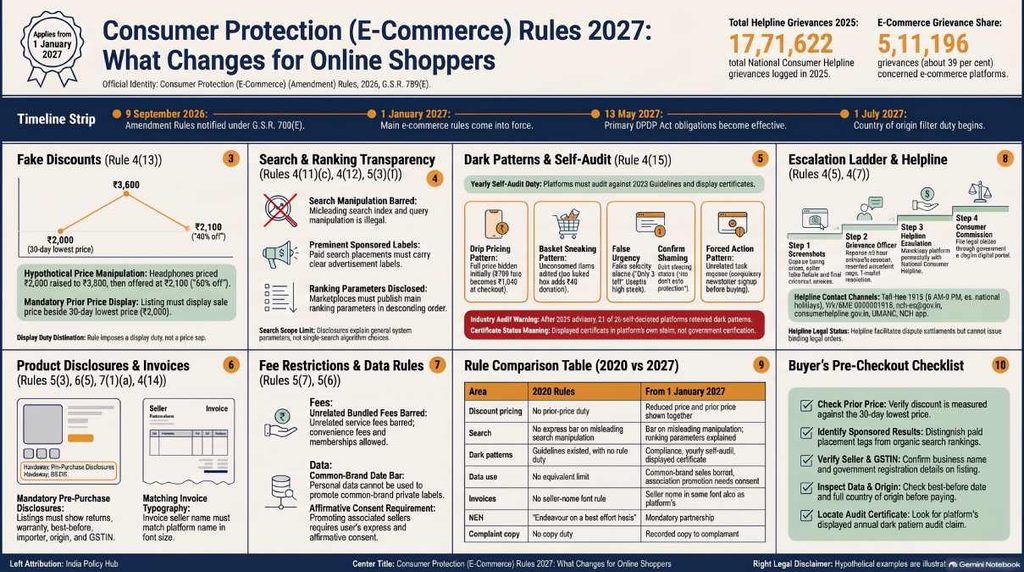
- Fake discounts end as a safe habit. Any announced price cut must show the reduced price beside the prior price, the lowest price in the 30 days before the announcement. It is a display duty, not a price cap.
- Sponsored listings need a clear label. Misleading search manipulation is barred, and marketplaces must explain their main ranking parameters.
- Every e-commerce entity must follow the 2023 guidelines on dark patterns, run a yearly self-audit and display a certificate. Treat it as the platform’s own claim.
- The seller’s name must appear in the same font size as the platform’s on invoices. Marketplaces may not charge bundled fees for unrelated services.
- Your grievance officer must acknowledge a complaint within 48 hours, give you a recorded copy and resolve it within one month. Participation in the National Consumer Helpline (1915) is now mandatory for every e-commerce entity.
What the Consumer Protection (E-Commerce) Rules 2027 Are
Official Name, Notification Date and Legal Basis
The name on the Gazette is the Consumer Protection (E-Commerce) (Amendment) Rules, 2026. The Department of Consumer Affairs notified it on 9 September 2026 as G.S.R. 789(E). It was made under clause (zg) of section 101(2) of the Consumer Protection Act, 2019, and the Ministry of Consumer Affairs, Food and Public Distribution issued its press release a day later. There was no public draft first, as the Internet Freedom Foundation notes, so the notified text is all anyone has to go on. The ministry’s release says the aim is to strengthen consumer protection while keeping the approach transparent and balanced, with ease of doing business in mind and no unnecessary burden on platforms.
The word “Amendment” matters. These rules do not replace the Consumer Protection (E-Commerce) Rules, 2020, which were notified on 23 July 2020. They edit them. Some sub-rules are substituted and new ones are inserted. The rest of the 2020 text stays in force. A shopper has to read the two documents together.
“Rules 2027” is not an official title. It is the label people use for the version that starts applying in 2027, and it is what many readers type into a search bar. In this guide, “the 2020 Rules” means the original text, “the Amendment Rules” means the 2026 notification, and “Rules 2027” means the combined position from 1 January 2027.
Consumer Protection Laws and Consumer Rights Behind the Rules
The Amendment Rules sit inside a wider body of consumer protection laws and guidelines, with the Consumer Protection Act, 2019 as their parent. Two neighbours touch the same purchase: the 2023 Dark Patterns Guidelines, which cover checkout tricks, and the Digital Personal Data Protection Act, which covers consent for personal data.
Section 2(9) of the 2019 Act lists six consumer rights: safety, information, choice, being heard, redressal and consumer awareness. The Amendment Rules leave that list as it is. They attach platform duties to parts of it: the prior price display covers the right to be informed about price, and the recorded complaint copy covers the right to seek redressal.
Effective Date and Who Must Comply
The rules come into force on January 1, 2027, as the commencement clause states. Fox Mandal reports that contraventions on or after that date fall under the Consumer Protection Act, 2019. That gives e-commerce platforms about four months from notification, and it gives shoppers a clean date to watch for.
Law firms expect enforcement to pick up once the new e-commerce rules apply. Khaitan & Co points to the Central Consumer Protection Authority’s record of penalising platforms and issuing sector-wide advisories on dark patterns.
Four dates are worth keeping straight:
- 9 September 2026: the Amendment Rules are notified.
- 1 January 2027: they come into force.
- 13 May 2027: the main obligations of the DPDP Act begin.
- 1 July 2027: a separate Legal Metrology duty on country-of-origin filters begins.
Two kinds of business sit under the rules, and some duties bind only one of them.
A marketplace e-commerce entity runs a platform where independent sellers list goods, as a shopping app does with third-party stores. An inventory e-commerce entity owns the stock and sells it to you directly, as AZB Partners describes the two models. Rule 4 covers every e-commerce entity: grievance officers, price-reduction display, sponsored labels, invoices and dark patterns. Rule 5 binds marketplaces alone. It carries the ranking explanation, the bundled-fee bar, the limits on using consumer data and the seller-information list. Rule 6 sets duties for sellers on marketplaces, and Rule 7 does the same for inventory entities.
Foreign e-commerce platforms are covered too. Rule 2(2) of the 2020 Rules applies them to an entity that is not established in India but “systematically offers goods or services to consumers in India”. The Amendment Rules edit Rules 3 to 7 and leave that scope clause alone.
Also Read: PM Viksit Bharat Rozgar Yojana (PMVBRY) 2026: The Complete Guide
End of Fake Discounts: The 30-Day Prior Price Rule
How the Prior Price Is Defined and Displayed
New Rule 4(13) says that when an e-commerce entity or a seller announces a price reduction, the listing must show two figures: the reduced price and the prior price. A strike-through number alone no longer does the job.
The duty falls on whoever announces the cut. On a marketplace, a seller’s own price drop counts as much as the platform’s sitewide sale. The rule prescribes no wording, so a label such as “Now ₹2,100, prior price ₹2,000” may read differently from one site to the next.
The Explanation to the rule defines the prior price by reference to the lowest price of the good or service “thirty days prior to the announcement” of the cut. The ministry’s release puts it in plain words: the lowest price at which the goods or services were offered during the 30 days preceding the announcement. It is the low point of the window, not the price immediately before the sale. Law firms read the Explanation the same way. Bar & Bench adds the caveat that the text is silent on newly listed products and on personalised or layered discounts.
Verification is the weak spot. The Internet Freedom Foundation notes that the rules impose no duty to keep price histories, so a shopper has no easy way to confirm that a stated 30-day low is real.
What Changes for Sales and Reference Prices
A worked example shows the effect. The numbers below are hypothetical, not taken from any listing.
- Day 45 to Day 31 before the sale announcement: a pair of headphones sells at ₹2,000.
- Day 30 to Day 21: the price is still ₹2,000, and these days fall inside the 30-day window.
- Day 20 to Day 1: the seller lifts the price to ₹3,500.
- Day 0: the sale is announced at ₹2,100, advertised as “40% off” the ₹3,500 reference price.
The old display would carry the ₹3,500 figure and the 40 per cent badge. Under Rule 4(13), the prior price is the lowest price in the 30 days before the announcement, which here is ₹2,000 (it fell inside the window on Days 30 to 21). The listing must show ₹2,100 beside ₹2,000. The shopper can see that the “sale” price sits ₹100 above what the item cost three weeks earlier.
That is how the rule goes after fake discounts. The inflated reference price stays legal to print, but it can no longer be the only anchor.
One limit follows from the arithmetic. The window is 30 days. A price lifted 35 days before an announcement and held there becomes the lowest price in the window, and so becomes the prior price. The rule catches a last-minute lift like the one above. A slow one slips past it.
The rule does not ban dynamic pricing. A seller can still move prices through the day and run lightning deals. What the rule fixes is the reference point at the moment a cut is advertised. Festive sales that ran before 2027 sit outside it entirely, so the first real test comes with the sale events of 2027.
Also Read: Viksit Bharat 2047: Analyzing the Strategic Policy Roadmap for a $30 Trillion Economy
Search Ranking Transparency and Sponsored Listings
Ban on Misleading Search Manipulation and Ranking Parameter Disclosure
Rule 4(11)(c) adds a new bar. An e-commerce entity may not mislead users by manipulating search results or search indexes in light of the user’s search query. The ministry’s release frames the bar as manipulation that misleads users or hurts the relevance of results to their query. Type “wired headphones under ₹1,000” and the results page cannot be tilted in ways that mislead you about what fits.
The definition of “ranking” in Rule 3 was widened as well. It now covers the relative prominence or relevance given to sellers, goods or services irrespective of the technological means used. Whatever produces the ranking, an algorithm or a manual override, falls inside it.
Marketplaces also owe shoppers an explanation. Rule 5(3)(f) requires them to describe the main parameters that decide ranking, in descending order, with their relative importance, in plain and intelligible language that is publicly available. The duty covers explaining those factors. It does not require a platform to disclose its algorithm or source code. The rule asks only for an “easily and publicly available description”, so look for it on a platform’s policy or help pages.
A compliant explanation might read like this (an invented illustration, not any platform’s text):
- Relevance of the product to your search words.
- Price relative to similar listings.
- Delivery speed to your pincode.
- Customer ratings.
- Recent sales volume.
Read such a page for what it is. The parameters describe the general system. They do not promise that a given product ranks where its price or rating alone would put it, since sponsored placements sit alongside organic ones.
Sponsored Listing Labels and What You Can Verify
Rule 4(12) requires every e-commerce entity to make sure that sponsored listings are distinctly identified with clear and prominent disclosures. In practice, paid advertisements must be separable from organic search results at a glance. The rule states a standard, not a design specification, so a platform decides the label’s look and a regulator decides later whether it was clear enough.
Be plain about the limits. You can read the general ranking parameters. You cannot see why one brand sits at the top of one particular search. Nothing in the rules gives a per-search explanation, and a platform’s published parameters describe the system, not your results page.
So the label is the part you can check on the spot. Anything tagged as sponsored is paid placement. Anything untagged is ranked by the platform’s own stated factors, which you can read but cannot test. A quick audit costs a minute: scroll one results page and note any paid-looking placement that carries no label. That is worth a screenshot.
Dark Patterns and the Annual Self-Audit Certificate
From 2023 Guidelines to a Binding Rule
The Central Consumer Protection Authority issued the Guidelines for Prevention and Regulation of Dark Patterns on 30 November 2023. They name 13 patterns and, until now, sat outside the e-commerce rulebook. A June 2025 advisory only asked platforms to audit themselves.
New Rule 4(15) changes that. It reaches marketplaces and inventory entities alike, since Rule 4 binds every e-commerce entity, and it requires each one to comply with the 2023 Guidelines, to run a yearly self-audit to confirm its platform is free of dark patterns, and to display a certificate prominently, and the ministry’s release lists the same duties. Argus Partners and Bar & Bench both read this as a recurring duty, not a one-time exercise.
The Guidelines name 13 patterns, including these five that shoppers meet at checkout:
- Drip pricing: the full price is hidden or disclosed late. A ₹799 fare becomes ₹1,046 after a handling fee appears on the payment page.
- Basket sneaking: items or charges are added at checkout without your consent. A pre-ticked box adds a ₹49 donation or an extended warranty to your cart.
- False urgency: pressure is created by scarcity or popularity claims that are not true. A banner reads “Only 2 left, 30 people are viewing this” for an item with ample stock.
- Confirm shaming: guilt or ridicule is used to steer your choice. The button to decline insurance reads “No thanks, I don’t care about protecting my order”.
- Forced action: you must do something unrelated before you can buy. Checkout will not complete until you subscribe to a newsletter.
The shopper’s side matters here. If you meet any of these patterns, you have a ground for complaint under the 2023 Guidelines, now reinforced by Rule 4(15). Others on the list include subscription traps and disguised advertisements. Definitions and examples for these patterns appear in JSA’s summary and in AZB’s note on the Guidelines.
What the Self-Audit Certificate Does and Does Not Tell You
The amendment does not specify an audit methodology, a reporting format or who must carry the audit out, as India Briefing notes. Verification is left to the entity, through its own self-audit and its own certificate. The Internet Freedom Foundation adds that the text names no independent auditor and requires no published findings.
The recent record is not reassuring. After the June 2025 advisory, 26 platforms declared themselves free of dark patterns, and LocalCircles found that 21 of them still used at least one.
Treat the certificate as a claim by the platform, not a government finding. It tells you the company says it checked itself. It does not tell you that the checkout in front of you is clean. The rule says only that the certificate be displayed prominently and names no page for it. If you cannot find it within a minute, note that too. Look as well for a date and the name of whoever carried out the audit. The rule requires neither, so a certificate without them is not a breach, and a certificate with them is still only the platform’s word. If you hit a pattern from the list above, screenshot it and complain, because the duty to comply with the 2023 Guidelines applies whatever the certificate says.
Seller, Product and Invoice Disclosure Rules
Pre-Purchase Product and Seller Disclosures
The amendments lengthen the product information and seller details a listing must show before you pay. The ministry’s release calls this key information for informed consumer decisions. Under Rules 5(3), 6(5) and 7(1)(a), the disclosures cover:
- Return, refund and exchange terms.
- Use-before or best-before dates, and warranty terms.
- Delivery terms and the cost of return shipping.
- Accepted payment modes.
- How to reach the grievance redressal mechanism.
- For imported goods, the importer’s name and details and the full country of origin, as the Legal Metrology (Packaged Commodities) Rules, 2011 require.
- From marketplace sellers, any Central Government identification number, such as a GSTIN or MSME registration number, under the new Rule 6(5)(j).
An invented listing that meets these duties might carry lines like these near the price:
- Returns: 7 days, free pickup, refund to the original payment mode.
- Warranty: 12 months from delivery.
- Best before: 14 March 2027.
- Importer: a named company and address. Country of origin: the full country name.
- Seller: business name, address and GSTIN.
Rule 6(5) sets the list for sellers on marketplaces, and Rule 7(1)(a) sets a parallel list for inventory entities. Rule 5(3)(a) covers what a marketplace must show about its sellers: business name, registration status, address, contact details and ratings, among other pre-purchase information, as the notification summary lists them.
These are disclosure duties. They create no new refund right. A listing that clearly says “no returns” has met the disclosure duty, and your remedies for a defective product still come from the Consumer Protection Act, 2019, not from these rules. A separate Legal Metrology duty to offer a searchable, sortable country-of-origin filter applies only from 1 July 2027, so do not expect that filter on 1 January.
Seller Name in the Same Font Size on Invoices
Rule 4(14) says an invoice must show the seller’s name clearly and prominently, in the same font size as the e-commerce entity’s name.
On a marketplace, the platform’s brand tends to dominate the invoice while the actual seller hides in small print. The new rule closes that gap. The invoice becomes the quickest way to identify who sold you the item, which matters for a complaint, a warranty claim, a refund dispute or a delivery problem.
It does not change who is liable. It makes the seller easier to find. Check it on arrival: open the invoice, find the seller’s name, and judge the type size by eye against the platform’s name. If you need more, the marketplace must give additional seller information on a written request after purchase when that information is necessary to resolve a dispute, per SCC Online’s summary.
Bundled Fees and Hidden Checkout Charges
Rule 5(7) bars a marketplace from collecting bundled fees for services unrelated to the platform. A proviso excludes loyalty and membership programmes from the bar.
Picture an order where an ₹89 charge for a separate service the platform does not itself provide is added to your total. That is the kind of line the rule is aimed at.
The rule does not ban convenience fees or platform fees. A charge for the platform’s own service falls outside what Rule 5(7) targets, and a paid membership programme falls outside it by the proviso. A membership that waives delivery charges, for instance, stays clear of the bar. Anyone reading the sub-rule as a general cap on checkout charges will be disappointed.
A simple test works at checkout. Add one item to your cart and walk to the payment page without paying. Note every line that appears. Then ask what each fee buys. Under Rule 5(7), the question that matters is whether the fee pays for something the platform itself provides.
Hidden charges that appear only at the last screen are a different problem. That is drip pricing, covered in the dark patterns section above, and it is the stronger tool for shoppers who feel misled about the final total. Check the price on the product page against the price on the payment page. If they differ and the difference was not shown earlier, screenshot both.
Your Data and Private Label Promotions
Common-Brand Sales and Consent for Associated Sellers
Rule 5(6) restricts how a marketplace may use the information it collects about you. It has two limbs, and they work differently.
The first limb bars a marketplace from using collected information to sell, directly or indirectly, goods or services of a seller whose brand or name is common with the marketplace’s. It applies whether or not that seller is related to the marketplace, as Bar & Bench reads it. This limb has no consent route. A tick-box does not unlock it. For private labels and related-party sellers, your browsing and order history cannot feed the shelf that carries the marketplace’s own name. “Common brand or name” is the test. A marketplace’s own label and a seller trading under a similar name both fall in, and the relationship between them does not matter.
The second limb bars using collected information to promote or advertise any seller as being associated with the marketplace. Only here is there a way through: the marketplace may do it with the consumer’s “express and affirmative consent”.
Neither limb bans private labels. A marketplace can still stock its own brands. The restriction is on using your data to push them.
You will most likely meet the second limb as a consent prompt. If an app asks whether it may recommend sellers associated with it, a yes is a real grant, so read the prompt before you tap.
How Rule 5(6) Sits Beside the DPDP Act
Timing decides which law bites first. The Digital Personal Data Protection Act’s main compliance obligations become effective from 13 May 2027, and they include the notice and consent standards. That is about four and a half months after the e-commerce amendment starts. Until then, consent under Rule 5(6) is judged by that rule’s own words.
The two consent standards are not the same. AMLEGALS describes the e-commerce requirement as narrower and tied to a specific purpose, set beside the general consent structure of the DPDP Act and Rules. Once the DPDP Act applies, consent must also be free, specific, informed, unconditional and unambiguous, a standard the Amendment Rules do not spell out themselves. The Internet Freedom Foundation adds that they also do not say consent must be as easy to withdraw as to give, which the DPDP Act requires.
Bar & Bench warns that general consumer consent should not be assumed to cover these uses. A single “I agree to the terms” box ticked at sign-up is exactly that kind of general consent. If a marketplace wants to promote an associated seller using your data, it needs a separate, express and affirmative yes for that use.
Grievance Redressal and the National Consumer Helpline
Grievance Officer Timelines and the Complaint Copy
Under Rule 4(5), the grievance officer must acknowledge your complaint within forty-eight hours, give you a copy of the complaint as recorded, and redress it within one month, as Fox Mandal summarises. The ministry’s release lists the recorded copy among its key amendments.
Every platform must also display its grievance officer’s contact details prominently under Rule 4(2), so you can write to the officer directly instead of the general customer-care inbox. A written complaint to that address starts the clocks.
Separate the old duties from the new one. The 2020 Rules already set the 48-hour acknowledgement and the one-month redressal period. Those timelines are unchanged. The new right is the recorded copy.
The copy matters because it fixes what the platform wrote down: the category of your complaint, the facts, the date and the remedy. If a platform later claims you only asked about delivery when you reported a defect, the copy settles it. Include the order number, the seller’s name, the dates, and the remedy you want in your first message, so the recorded version has no room to shrink.
Gaps remain. The Internet Freedom Foundation observes that the rules do not say what happens when a timeline is missed and offer no escalation route beyond the grievance officer. That is why the next step exists.
National Consumer Helpline Integration and Escalation
Under the 2020 Rules, joining the National Consumer Helpline’s convergence process was an “endeavour on a best effort basis”. Rule 4(7) now makes participation mandatory for every e-commerce entity, and the ministry’s release calls it a key provision. The helpline describes itself as the single point of access for consumers at the pre-litigation stage.
You can file a complaint through any of these channels:
- WhatsApp or SMS on 8800001915.
- Email at nch-ca@gov.in.
- The NCH app.
- The web portal at consumerhelpline.gov.in.
- The UMANG app.
- The toll-free number 1915, open from 8 AM to 8 PM every day except national holidays, per a Lok Sabha reply.
The channels follow the helpline’s own listing and its contact page.
Once a company has partnered with NCH, it receives grievances in real time and is expected to respond within 30 days, per the convergence page. Complaints can be lodged in 17 languages. Keep the complaint number the helpline gives you, because you will want to quote it if the matter reaches a commission.
NCH does not pass legally binding orders. It forwards your grievance to the company and works toward a settlement. If that fails, the next step is a claim before a consumer commission. Filing now runs through e-Jagriti, which the government launched on 1 January 2025 to fold in e-Daakhil and three other systems, and which the helpline’s own site map lists under consumer commissions.
Consumer Protection (E-Commerce) Rules 2020 vs. the 2027 Changes
The table gives the short version. The paragraphs below it spell out each item.
| Area | 2020 Rules | From 1 January 2027 |
| Discount pricing | No prior-price duty | Reduced price and prior price shown together |
| Search | No express bar on misleading search manipulation | Bar on misleading manipulation; ranking parameters explained |
| Dark patterns | Guidelines existed, with no rule duty | Compliance, yearly self-audit, displayed certificate |
| Data use | No equivalent limit | Common-brand sales barred; association promotion needs consent |
| Invoices | No seller-name font rule | Seller name in same font size as platform’s |
| NCH | “Endeavour on a best effort basis” | Mandatory partnership |
| Complaint copy | No copy duty | Recorded copy to complainant |
Pricing. In 2020 there was no rule on how a price cut had to be shown. From 2027, a cut must carry the prior price, the lowest price in the 30 days before the announcement.
Search. The 2020 Rules had no express bar on misleading search manipulation and no duty to explain ranking in descending order. The Amendment Rules add both, plus a wider definition of ranking.
Dark patterns. The 2023 Guidelines were a hitherto voluntary reference point. In 2027 compliance becomes a rule duty, with a yearly self-audit and a displayed certificate.
Data use. The 2020 Rules carried no equivalent of Rule 5(6). From 2027, marketplaces cannot use collected information for common-brand sales, and promoting an associated seller needs express and affirmative consent.
Invoices. The 2020 Rules said nothing on seller-name prominence. In 2027 the seller’s name must be as large as the platform’s name.
National Consumer Helpline. Participation was a best-effort endeavour. It is now mandatory.
Grievance officer. The 48-hour acknowledgement and one-month redressal timelines are the same in both versions. Only the recorded copy is new.
Buyer’s Checklist for the Consumer Protection (E-Commerce) Rules 2027
Before Checkout
Run these five checks in the minute before you pay. Each ties to a specific rule.
- Prior price (Rule 4(13)). Find the prior price beside any discount. If the sale price is above it, the badge overstates the saving.
- Sponsored label (Rule 4(12)). Note which results carry the label and treat them as paid placement.
- Seller name and GSTIN (Rules 6(5)(j) and 5(3)). Open the seller details and look for the business name and the GSTIN or MSME number.
- Use-before date and country of origin (Rules 4(6) and 6(5)). For packaged and imported goods, read both on the listing before paying.
- The platform’s certificate (Rule 4(15)). Look for the displayed dark pattern certificate, and remember it is the platform’s own claim.
After Purchase and Escalation
Evidence comes first, because every later step leans on it. Then the escalation runs in a fixed order.
- Screenshots. Save the product page with the reduced and prior prices, the sponsored label if any, the seller details and the payment page, with date and time visible.
- Invoice check. Confirm the seller’s name appears in the same font size as the platform’s. If it does not, note it and keep the file. If the invoice still leaves you unsure who sold the item, ask the marketplace in writing for further seller information under Rule 5(3)(a).
- Grievance officer. Complain in writing and ask for the recorded copy. Start two clocks: 48 hours for acknowledgement and one month for redressal.
- National Consumer Helpline. If the 48 hours pass without acknowledgement, or the month ends without redressal, take the complaint to NCH on 1915, WhatsApp or SMS 8800001915, the app or the portal.
- Consumer commission. If NCH does not resolve it, file a claim through e-Jagriti with your screenshots, invoice, recorded copy and NCH complaint number.
Consumer Protection (E-Commerce) Rules 2027 FAQ
When do the new e-commerce rules start?
The Consumer Protection (E-Commerce) (Amendment) Rules, 2026 take effect on January 1, 2027. The Department of Consumer Affairs notified them on 9 September 2026, and the commencement clause names no separate transition period. Contraventions on or after 1 January 2027 fall under the Consumer Protection Act, 2019.
What is the official name of the Consumer Protection (E-Commerce) Rules 2027?
No instrument carries that exact title. The official name is the Consumer Protection (E-Commerce) (Amendment) Rules, 2026, notified as G.S.R. 789(E) on 9 September 2026. They amend the 2020 Rules, and “Rules 2027” is the common label for the version that applies from 2027.
What are the main consumer rights of online shoppers under the Consumer Protection (E-Commerce) Rules 2027?
Shoppers keep the six consumer rights in Section 2(9) of the Consumer Protection Act, 2019: safety, information, choice, being heard, redressal and consumer awareness. The Consumer Protection (E-Commerce) Rules 2027 add platform duties around them, such as the prior price display and the recorded copy of your complaint.
What is prior price?
Prior price is the reference figure that must appear beside a reduced price whenever a platform or seller announces a price cut. The Explanation to Rule 4(13) ties it to the lowest price in the 30 days before the announcement. It stops a sale price from being measured against an inflated one.
What does the dark pattern compliance certificate mean?
Under Rule 4(15), each e-commerce entity must run a yearly self-audit against the 2023 Dark Patterns Guidelines and display a certificate prominently. The amendment sets no audit method, and no outside body verifies the result. Read the certificate as the platform’s own claim, not a government finding.
Are convenience fees banned?
No. Rule 5(7) bars a marketplace from collecting bundled fees for services unrelated to the platform, and it excludes loyalty or membership programmes. A convenience or platform fee for the platform’s own service is not banned by that rule. A fee shown only at the last checkout step can still be drip pricing.
Where can I complain about an e-commerce platform?
Start with the platform’s grievance officer and ask for the recorded copy. If the 48-hour acknowledgement or one-month redressal is missed, go to the National Consumer Helpline on 1915, WhatsApp or SMS 8800001915, the NCH app, the web portal or UMANG. For a binding order, file a claim with a consumer commission through e-Jagriti.
What are some examples of consumer protection laws for online shopping in India?
The Consumer Protection Act, 2019 is the parent law. The Consumer Protection (E-Commerce) Rules, 2020, as edited by the 2026 Amendment Rules from 1 January 2027, and the 2023 Dark Patterns Guidelines sit under it. Two separate laws touch the same purchase: the Legal Metrology (Packaged Commodities) Rules, 2011, which cover importer details and country of origin, and the Digital Personal Data Protection Act, whose main obligations begin on 13 May 2027.
Who enforces consumer protection laws for online shopping?
Two tracks run side by side. The Central Consumer Protection Authority, set up under Section 10 of the Consumer Protection Act, 2019, acts against unfair trade practices that harm consumers as a group. A complaint under the Consumer Protection (E-Commerce) Rules 2027 travels from the platform’s grievance officer to the National Consumer Helpline and then to a consumer commission at district, state or national level.
On 1 January 2027, pick any product with a discount tag, open the listing and look for the prior price beside the reduced price. If it is missing, take a dated screenshot of the page and keep it.
That one image is the first piece of evidence in any complaint described above, from the grievance officer’s inbox to a consumer commission. Bookmark this guide for that day and test the first sale you see.
Disclaimer
This post is published by India Policy Hub for general information only. It is not legal advice, and reading it creates no lawyer-client relationship with the publisher or author. It summarises the Consumer Protection (E-Commerce) (Amendment) Rules, 2026 and related laws from public sources, as on the date of publication. Rules, guidelines and official interpretations may be amended, withdrawn or clarified later. Some provisions remain untested before consumer commissions and courts. Examples and price illustrations are hypothetical unless a source is cited. Links to third-party websites are given for reference only. India Policy Hub does not control or endorse them and accepts no responsibility for their content. Check the notified text of the law and consult a qualified advocate before acting on anything here. To the fullest extent permitted by law, India Policy Hub and the author disclaim liability for any loss or damage arising from reliance on this post.




Leave a Reply