
Advance Tax Calculator FY 2026-27: Due Dates, Formula and Worked Examples

An advance tax calculator for FY 2026-27 fills the gap TDS leaves, because the TDS in your Form 16, or Form 130 from Tax Year 2026-27, covers your salary and nothing else. Freelance fees, FD interest, rent and capital gains sit outside it. That income builds up tax through the year with nothing paid against it, and the Income Tax Department charges 1% interest a month on the shortfall once the year closes.
Advance tax for FY 2026-27 is the tax liability on your estimated income for the year, less TDS and TCS. It falls due once that balance reaches ₹10,000, and most taxpayers pay it in cumulative instalments of 15%, 45%, 75% and 100% on 15 June, 15 September, 15 December and 15 March. The free advance tax calculator on this page does the arithmetic for each date.
The next instalment, 75% of the year’s tax, falls due on 15 December 2026. The 15 June and 15 September dates have already passed. A taxpayer who skipped both can still close most of the gap in one payment, and the sections below put a rupee figure on it.
Confusion has a second source. The Income-tax Act, 2025 replaced the old assessment-year vocabulary with a single Tax Year and renumbered the sections, so Section 211 is now Section 408 and Section 234C is now Section 425. Many pages in search results still use the old labels.
The calculator and the Section 405 formula behind it come first, followed by four worked cases: a salaried employee with freelance and FD income, a consultant, an investor with a mid-year gain and a domestic company.
Advance Tax Calculator FY 2026-27: At a Glance
- Who pays: anyone whose estimated tax after TDS and TCS reaches ₹10,000 under Section 404. Resident senior citizens aged 60 or older with no business income are exempt under Section 403(3).
- Dates still open: 15 December 2026 (75% of the year’s tax) and 15 March 2027 (100%) for FY 2026-27. Presumptive taxpayers pay once, by 15 March.
- Advance tax calculator formula: A = B minus C under Section 405, where B is the tax on your estimated income and C is the TDS and TCS already covered. The due dates sit in Section 408, the new number for Section 211.
- Cost of missing a date: 3% on a June, September or December shortfall and 1% on a March shortfall under Section 425. Section 424 adds 1% a month if you finish below 90% of assessed tax.
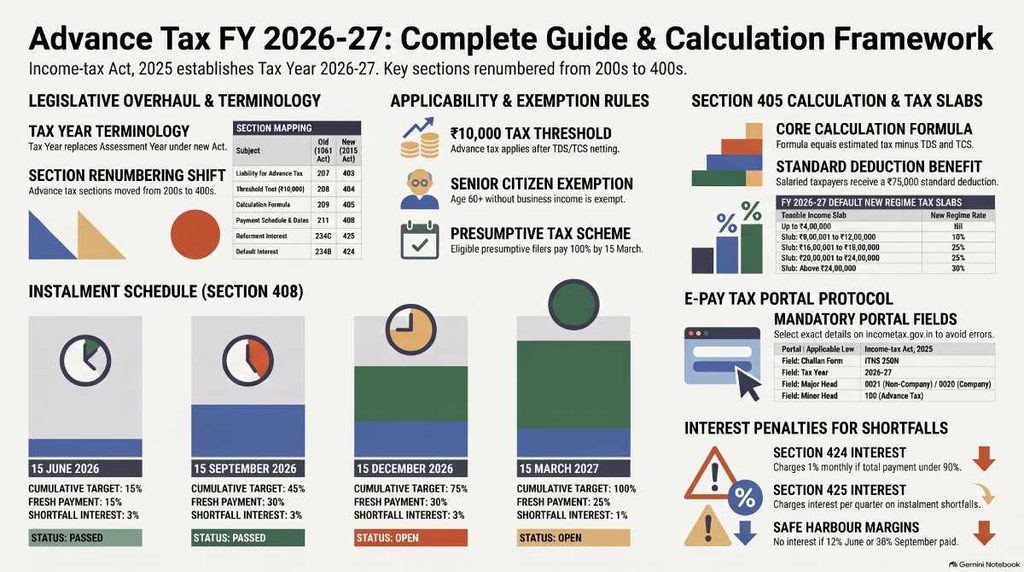
What is advance tax and how is it calculated under the Income-tax Act, 2025?
Advance tax is pay-as-you-earn income tax, paid in instalments during the year on income you are still earning, instead of in one lump after the year ends. Sections 403 to 410 of the Income-tax Act, 2025 govern it, and Sections 424 and 425 set the interest when instalments fall short. The amount is your estimated tax liability less TDS and TCS, and the Section 405 formula below sets it out line by line.
From Section 211 to Section 408: what changed on 1 April 2026
The 2025 Act renumbered advance tax and left its substance alone. Instalment percentages, due dates, interest rates and the ₹10,000 trigger carry over, so a rule you learned under Section 211 still holds under Section 408. The Income Tax Department’s advance tax FAQ is written around the new numbers.
| Old section (1961 Act) | New section (2025 Act) | Subject |
| 207 | 403 | Liability for advance tax |
| 208 | 404 | Conditions of liability, the ₹10,000 test |
| 209 | 405 | Computation of advance tax |
| 210 | 406 and 407 | Payment on your own accord; payment on an Assessing Officer’s order |
| 211 | 408 | Instalments and due dates |
| 219 | 410 | Credit for advance tax |
| 234B | 424 | Interest for default in payment |
| 234C | 425 | Interest for deferment of instalments |
Tax Year 2026-27, FY 2026-27 and AY 2026-27: which one applies to you
AY 2026-27 means the income of FY 2025-26, taxed under the 1961 Act. Its advance tax closed on 31 March 2026, and its returns are filed under the 1961 Act. The advance tax you pay today is for Tax Year 2026-27, the twelve months of the financial year, from 1 April 2026 to 31 March 2027 under the 2025 Act. That Act has no assessment year.
A search for an advance tax calculator for AY 2026-27 in India lands on tools made for the closed year. The same goes for “advance tax for AY 2026-27” and “what will be the assessment year for advance tax”. The answer to the last one is that you pick none. Under the 2025 Act the portal’s challan forms run on Tax Year.
Also Read: Form 67 for NRIs: Who must file and how to claim foreign tax credit (AY 2026-27)
| Label | Income covered | Law | Advance tax status |
| AY 2026-27 | FY 2025-26 | Income-tax Act, 1961 | Closed on 31 March 2026 |
| Tax Year 2026-27 | 1 April 2026 to 31 March 2027 | Income-tax Act, 2025 | Open; 15 December 2026 and 15 March 2027 remain |
| FY 2026-27 | Same period as Tax Year 2026-27 | Everyday label | Informal name for the same twelve months |
| AY 2027-28 | Same period, old vocabulary | Not used under the 2025 Act | Do not select it when paying |
Who must pay advance tax in FY 2026-27?
Advance tax is applicable to anyone whose tax after TDS and TCS reaches ₹10,000. What you pay, and when, depends on who you are.
The ₹10,000 threshold under Section 404
The test runs on estimated tax payable after TDS and TCS, not on gross tax. Section 404 makes advance tax payable where the amount reaches ₹10,000, and the department’s FAQ confirms that TDS is netted off before the test. Take estimated tax of ₹1,40,000 against TDS of ₹1,32,000. The balance is ₹8,000, so nothing is due. At ₹1,50,000 against the same TDS the balance is ₹18,000, and the liability starts.
Salaried employees with other income
Employer TDS is computed on salary alone. Income that never passes through payroll stays untaxed until you add it to your own estimate. Four kinds of income cause most of the gap:
- Rent from house property
- Interest on FDs and savings accounts, where bank TDS may cover only part of the tax
- Capital gains on shares, mutual funds and property
- Freelance or consulting receipts
Add each to the estimate, then subtract the TDS already deducted on salary. That is how to calculate advance tax for an individual with a job. Any income tax calculator for FY 2026-27 built for salaried people follows the same steps.
Freelancers, consultants, businesses, HUFs, firms, LLPs and companies
Entity type decides the schedule. Most follow four instalments, and a few presumptive taxpayers pay once.
- Freelancers and consultants on regular books pay in four instalments. Those on the professional presumptive scheme pay once, by 15 March.
- Businesses pay in four instalments, except those on the business presumptive scheme, who pay once by 15 March.
- A HUF pays in four instalments on its own estimated tax, so an income tax calculator for a HUF works on the HUF’s income alone. HUF slab rates are the same as an individual’s, but the Section 156 rebate is for resident individuals only, so a HUF with ₹12 lakh of taxable income still pays tax.
- A partnership firm pays in four instalments on the tax computed for the firm. An eligible firm on the business presumptive scheme pays once.
- An LLP follows the same four dates as a firm and cannot use the single-instalment route.
- A company pays in four instalments and cannot use the single-instalment route. Any advance tax calculator for a company needs its own Tax Year 2026-27 rate, which Case 4 supplies.
Senior citizen exemption under Section 403(3)
Section 403(3) exempts an individual who is resident in India, is 60 or older at any time during the tax year and has no income under the head profits and gains of business or profession. All three facts must hold together. One rupee of business income removes the exemption, and it removes it for the whole liability, not only the tax on that rupee, as this senior citizen exemption explainer spells out.
Senior citizens who do owe advance tax use the same slabs as everyone else, because the new regime has no separate senior slab. Only the old regime lifts the basic exemption, to ₹3 lakh for ages 60 to 80. An income tax calculator for senior citizens uses the new-regime table by default and the old-regime table only if the senior files under the old regime.
Advance tax due dates for FY 2026-27: Section 408 instalment schedule
Four cumulative dates govern the year. Two have passed and two remain open as of November 2026.
| Due date | Cumulative advance tax | Status in November 2026 |
| 15 June 2026 | 15% | Passed |
| 15 September 2026 | 45% | Passed |
| 15 December 2026 | 75% | Open |
| 15 March 2027 | 100% | Open |
Section 408 sets these percentages for every taxpayer except presumptive filers. The advance tax due dates for FY 2026-27 are identical for an individual, a HUF, a firm and a company.
Quarterly cumulative table under Section 408(1)
The percentages are cumulative minimums. Searches for the advance tax percentage, slab or instalments for AY 2026-27 all point to this one table, which is also the base for interest under Section 425.
| Instalment date | Cumulative share | Fresh payment on the date | Interest rate on shortfall |
| 15 June 2026 | 15% | 15% | 3% |
| 15 September 2026 | 45% | 30% | 3% |
| 15 December 2026 | 75% | 30% | 3% |
| 15 March 2027 | 100% | 25% | 1% |
Cumulative vs per-instalment amounts
Each percentage is a running total, so you subtract what you have already paid.
| Date | Cumulative target | Already paid | Pay on the date |
| 15 June | ₹15,000 | Nil | ₹15,000 |
| 15 September | ₹45,000 | ₹15,000 | ₹30,000 |
| 15 December | ₹75,000 | ₹45,000 | ₹30,000 |
| 15 March | ₹1,00,000 | ₹75,000 | ₹25,000 |
Single instalment under presumptive taxation: Section 408(2)
Section 408(2) gives taxpayers under presumptive taxation one date. An assessee who declares profit under Section 58(2), Table Sl. No. 1 (business, erstwhile Section 44AD) or Sl. No. 3 (profession, erstwhile Section 44ADA), pays 100% of advance tax by 15 March. Sl. No. 2, the goods carriage business of the erstwhile Section 44AE, stays on the four instalments.
A company never gets this route, and a firm gets it only on the business scheme, so how to calculate advance tax for a company or a firm means the four-date schedule. Missing the single date costs 1% simple interest on the shortfall under Section 425(3).
The 31 March window under Section 408(3)
Money paid between 16 and 31 March still counts as advance tax for the year. Section 408(3) treats any amount paid on or before 31 March as advance tax for all purposes of the Act, and that payment counts toward the 90% test under Section 424. The instalment shortfall still carries one month of 1% interest under Section 425, so a late-March payment limits the damage and does not erase it.
How to calculate advance tax for FY 2026-27: calculator inputs and formula
To calculate your advance tax for Tax Year 2026-27, estimate your total income for the year, compute tax at the rates of your chosen regime, add surcharge and 4% cess, subtract the TDS and TCS already deducted or collectible, and pay the result in cumulative instalments of 15%, 45%, 75% and 100% by the four Section 408 dates.
The Section 405 formula
Section 405 reduces the exercise to one line: A = B minus C. B is the tax on your estimated current income at the rates in force. C is the tax deductible or collectible at source during the year from that income. A is the advance tax payable, and it is spread across the Section 408 instalments. The same line answers how to calculate advance tax liability for any taxpayer. Only the rate table changes. To check your advance tax amount before a due date, re-run B and C with the latest figures.
Also Read: Revised vs. Updated Return (ITR-U): How to Correct Your Tax Errors After the Deadline
Documents to keep ready
Six records feed the estimate:
- Form 168, the Tax Year 2026-27 successor to Form 26AS, for TDS, TCS and tax already paid
- The Annual Information Statement (AIS), for interest, dividends and securities sales reported against your PAN
- Salary slips and the TDS certificate your employer issues, which is Form 130 for the new year
- Capital gains statements from brokers and fund houses
- Bank interest certificates for FDs and savings accounts
- Profit-and-loss ledgers for business or professional income
To check how much advance tax you have paid so far, open Form 168 or the e-Pay Tax payment history.
Income tax slabs for FY 2026-27: old vs new regime calculator inputs
Slabs feed the formula, so settle them first. The new regime is the default under Section 202, the new number for Section 115BAC. Budget 2026 left the slabs unchanged, so the table below is the tax table for FY 2026-27 and also answers every “AY 2026-27” slab query, including the income tax rate for FY 2026-27 under the new regime.
| Taxable income | New regime rate |
| Up to ₹4,00,000 | Nil |
| ₹4,00,001 to ₹8,00,000 | 5% |
| ₹8,00,001 to ₹12,00,000 | 10% |
| ₹12,00,001 to ₹16,00,000 | 15% |
| ₹16,00,001 to ₹20,00,000 | 20% |
| ₹20,00,001 to ₹24,00,000 | 25% |
| Above ₹24,00,000 | 30% |
Salaried individuals and pensioners get a ₹75,000 standard deduction. A rebate of ₹60,000 under Section 156, the new number for Section 87A, wipes out tax for taxable income up to ₹12 lakh, and 4% cess sits on top. Marginal relief softens the cliff just above ₹12 lakh and fades out near ₹12.71 lakh.
The old regime keeps its own slabs: nil to ₹2.5 lakh, 5% to ₹5 lakh, 20% to ₹10 lakh and 30% above, with a ₹50,000 standard deduction. The deductions it allows have new numbers. Section 80C is now Section 123 and Section 80D is now Section 126.
A new vs old tax regime calculator does one job: it runs the same income through both slab tables and reports two totals. For advance tax, take the lower total, provided you expect to file under that regime, and use it as B in the formula above. Salaried taxpayers can choose afresh each year, and a mid-year change of mind only means revised instalments under Section 406.
Step-by-step logic to compute each instalment
- Add income under the five heads: salary, house property, business or profession, capital gains and other sources.
- Choose the regime and subtract the deductions it allows.
- Apply slab rates to normal income and the special rates to capital gains taxed separately.
- Subtract the rebate where it applies, with marginal relief near ₹12 lakh.
- Add surcharge, which starts above ₹50 lakh of total income, and 4% cess.
- Subtract TDS and TCS to reach the advance tax payable.
- Multiply by the Section 408 percentage for the date and subtract what you have already paid.
Steps 1 to 5 are how to calculate income tax for FY 2026-27, and step 6 turns it into advance tax. Any online tool that follows this sequence is an advance tax calculator in the proper sense.
Free advance tax calculator and Excel worksheet
The free advance tax calculator and its Excel worksheet take the inputs above: regime, salary, house property income, business or professional profit, capital gains split by rate, interest and other income, old-regime deductions, TDS and TCS deducted so far, and advance tax already paid with dates. They return Tax Year 2026-27 tax with cess, the amount due at each Section 408 date and an estimate of interest under Sections 424 and 425, so it also works as an advance tax interest calculator. The worksheet keeps every formula in an open cell, so the income tax calculator for FY 2026-27 in Excel with formula can be audited line by line.
The same arithmetic works as an advance tax calculator for an individual, a HUF, a firm, an LLP or a company. Only the rate table and the instalment route change.
Also Read: Revised Children’s Education & Hostel Allowance 2026: Tax-Free Limits & Rules
Worked examples: advance tax for FY 2026-27
Each case doubles as an income tax calculator for FY 2026-27 with example, and answers how to calculate advance tax with an example.
Case 1: salaried individual with freelance and FD income
A resident employee earns ₹14,00,000 in salary, ₹4,00,000 of freelance profit and ₹1,50,000 of FD interest. The employer deducts ₹81,900 of TDS on salary, and the bank deducts ₹15,000 on the interest.
| Step | Amount |
| Salary after ₹75,000 standard deduction | ₹13,25,000 |
| Freelance profit | ₹4,00,000 |
| FD interest | ₹1,50,000 |
| Total income | ₹18,75,000 |
| Slab tax | ₹1,75,000 |
| Cess at 4% | ₹7,000 |
| Total tax | ₹1,82,000 |
| Less employer TDS on salary | ₹81,900 |
| Less bank TDS on FD interest | ₹15,000 |
| Advance tax payable | ₹85,100 |
The full-year schedule follows.
| Date | Cumulative target | Pay on the date |
| 15 June 2026 | ₹12,765 | ₹12,765 |
| 15 September 2026 | ₹38,295 | ₹25,530 |
| 15 December 2026 | ₹63,825 | ₹25,530 |
| 15 March 2027 | ₹85,100 | ₹21,275 |
Suppose nothing has been paid. By 15 December 2026 the employee owes the full 75%, which is ₹63,825, and the last ₹21,275 follows by 15 March 2027. The late start costs Section 425 interest at 3% on the June and September shortfalls: ₹381 on ₹12,700 and ₹1,146 on ₹38,200, about ₹1,530 in all. Both bases are the shortfalls rounded down to the nearest ₹100.
Case 2: consultant on regular books vs presumptive scheme
A consultant bills ₹40,00,000 in the year, and clients deduct ₹1,00,000 of TDS. On the presumptive route, 50% of receipts is deemed profit, so ₹20,00,000. Assume actual expenses on the books route also total ₹20,00,000, so both routes give the same profit and only the timetable differs. Tax on ₹20,00,000 is ₹2,00,000, cess is ₹8,000 and advance tax after TDS is ₹1,08,000.
| Date | Regular books, Section 408(1) | Presumptive, Section 408(2) |
| 15 June 2026 | ₹16,200 | Nil |
| 15 September 2026 | ₹32,400 | Nil |
| 15 December 2026 | ₹32,400 | Nil |
| 15 March 2027 | ₹27,000 | ₹1,08,000 |
| Total | ₹1,08,000 | ₹1,08,000 |
Pay ₹1,00,000 on 15 March and the ₹8,000 shortfall draws 1% interest, ₹80, under Section 425(3). An income tax calculator for AY 2026-27 for a business returns the left-hand column once the label is corrected to Tax Year 2026-27.
Case 3: income tax calculator with capital gains booked mid-year
An investor earns a salary of ₹16,75,000, so taxable salary after the standard deduction is ₹16,00,000. On 12 October 2026 the investor books ₹4,00,000 of short-term gains on listed equity and ₹3,25,000 of long-term gains on equity mutual funds. Short-term equity gains are taxed at 20% and long-term gains at 12.5% above ₹1.25 lakh, the rates carried into the 2025 Act under Sections 196 and 198.
| Step | Amount |
| Slab tax on ₹16,00,000 salary | ₹1,20,000 |
| Tax on short-term gain at 20% | ₹80,000 |
| Tax on long-term gain: (₹3,25,000 minus ₹1,25,000) at 12.5% | ₹25,000 |
| Tax before cess | ₹2,25,000 |
| Cess at 4% | ₹9,000 |
| Total tax | ₹2,34,000 |
| Less employer TDS on salary | ₹1,24,800 |
| Advance tax payable | ₹1,09,200 |
The gain landed after 15 September, so the extra tax belongs in the later instalments: ₹81,900 by 15 December (75%) and ₹27,300 by 15 March. No interest runs on the June and September shortfalls. Section 425(4) switches it off where the shortfall comes from capital gains the taxpayer could not estimate, provided the tax on them is paid in a remaining instalment or by 31 March. Without that relief the same shortfalls would have cost about ₹1,960.
The ₹60,000 rebate would not have helped here either. It does not apply to income taxed at special rates, so the ₹1,05,000 of tax on these gains stands even if normal income sat well below ₹12 lakh.
Case 4: how to calculate advance tax for a domestic company
A domestic company had turnover of ₹150 crore in FY 2024-25 and has not opted for Section 200, so it pays the 25% base rate that applies when turnover stays within ₹400 crore. Total income for Tax Year 2026-27 is ₹2,00,00,000. The default regime adds 7% surcharge between ₹1 crore and ₹10 crore of income, then 4% cess, per the Finance Act, 2026 rate schedule. Assume minimum alternate tax does not apply because tax under normal provisions is higher.
| Step | Amount |
| Tax at 25% | ₹50,00,000 |
| Surcharge at 7% | ₹3,50,000 |
| Tax plus surcharge | ₹53,50,000 |
| Cess at 4% | ₹2,14,000 |
| Total tax | ₹55,64,000 |
| Less TDS and TCS | ₹6,00,000 |
| Advance tax payable | ₹49,64,000 |
| Date | Cumulative target | Pay on the date |
| 15 June 2026 | ₹7,44,600 | ₹7,44,600 |
| 15 September 2026 | ₹22,33,800 | ₹14,89,200 |
| 15 December 2026 | ₹37,23,000 | ₹14,89,200 |
| 15 March 2027 | ₹49,64,000 | ₹12,41,000 |
The schedule is the same 15, 45, 75 and 100 as for individuals. A company advance tax worksheet in Excel needs one cell each for total income, rate, surcharge, cess and TDS plus TCS, then four multiplications. A company that opts into Section 200 swaps the 25% rate for 22% and the 7% surcharge for a flat 10%. Those are the income tax rates for FY 2026-27 for domestic companies that matter most.
Also Read: The Complete Guide to the Section 80-IAC Income Tax Exemption for Startups (2026–2030)
How to pay advance tax online on the income tax portal
e-Pay Tax steps, logged in and pre-login
After login:
- Log in to the e-filing portal at incometax.gov.in with your PAN credentials.
- Go to e-File, then e-Pay Tax.
- Select Income Tax Act 2025 when the portal asks which Act applies, and click Continue.
- Click New Payment, then Proceed on the Income Tax tile.
- Choose Tax Year 2026-27 and minor head 100 (Advance Tax).
- Enter the amount, pick a payment mode, review the preview and click Pay Now.
To pay advance tax without logging in, use the e-Pay Tax quick link on the portal home page. Enter your PAN and mobile number, confirm the OTP, then make the same Act selection and follow steps 4 to 6. The portal’s challan guide walks through both routes.
Tax Year 2026-27, ITNS 280N, major head and minor head 100
These fields cause most payment errors.
| Field | Entry for advance tax |
| Act | Income-tax Act, 2025 |
| Challan | ITNS 280N |
| Tax year | 2026-27 |
| Major head | 0021 for non-company taxpayers; 0020 for companies |
| Minor head | 100 (Advance Tax) |
Self-assessment tax, minor head 300, is a different payment. It opens only after the tax year closes, so for Tax Year 2026-27 it is payable from 1 April 2027, and it needs its own challan. Some third-party guides still tell readers to pick AY 2027-28. The portal does not use that label for the 2025 Act. Choose the 1961 Act only for AY 2026-27 and earlier years, such as self-assessment tax on the return now being filed.
Payment modes and the challan receipt
The e-Pay Tax page lists five modes for an advance tax payment:
- Net banking, through authorised banks
- Debit card, with selected banks
- Pay at bank counter, by cash, cheque or demand draft, with cash capped at ₹10,000 and the mode closed to companies and to persons whose accounts need audit under Section 63
- RTGS or NEFT from any bank, using the mandate form generated with the challan
- Payment gateway, by credit card, debit card, UPI or net banking, with transaction charges and 18% GST added
The payment modes guide carries the current bank lists. After paying, open e-Pay Tax and then Payment History. The challan receipt there gives the BSR code and the payment date, and the challan serial number sits inside the CIN.
Fixing a wrong Tax Year or minor head
A wrong entry on an advance tax payment can be fixed online within limits. Reports of the challan correction windows give seven days for the tax year and 30 days for the major and minor head. Each challan gets one online correction, and only unconsumed challans qualify. Minor head 100 is covered, as are 300 and 400. The portal’s correction FAQ repeats the two windows.
Revising estimates and handling Assessing Officer orders
Revising instalments up or down under Section 406
Section 406 is the self-driven route. Every person liable under Section 404 pays on their own accord at the appropriate percentage by each due date. Section 406(2) lets you raise or cut the remaining instalments after you revise the estimate, and nothing is filed with the department. To estimate advance tax mid-year, redo the Section 405 sum with income realised so far plus what you expect for the rest of the year.
Assessing Officer orders under Section 407 and Form 152
An order under Section 407 is for a person already regularly assessed. It can be passed up to the last day of February, as Section 407(2) states, and it is followed by a Section 289 demand notice in Form 151. A taxpayer who thinks the estimate is too high files Form 152 under Rule 223 on or before the instalment date. Skipping that step risks being deemed in default under Section 409. The Form 152 FAQs explain who files it and why it cannot be revised once furnished.
How interest on advance tax is calculated: Sections 424 and 425
Section 424 tests assessed tax against a 90% line, and Section 425 tests each instalment against tax on the returned income.
Section 424 interest (formerly 234B)
Where advance tax paid is less than 90% of assessed tax, Section 424 charges simple interest of 1% a month or part of a month. It runs from 1 April following the tax year, here 1 April 2027, on the shortfall rounded down to the nearest ₹100 under the interest calculation rule.
Take assessed tax of ₹1,00,000 after TDS and advance tax paid of ₹69,450. That is under 90%, so interest applies. The shortfall is ₹30,550, rounded to ₹30,500. If the return is filed and the balance paid on 31 July 2027, four months (April to July) count: ₹30,500 at 1% for four months is ₹1,220. Had the taxpayer paid ₹90,000 by 31 March, Section 424 would charge nothing.
Section 425 interest (formerly 234C)
Each instalment is tested on its own. The table lists the rate on any shortfall against the cumulative target.
| Due date | Cumulative target | Interest on shortfall |
| 15 June | 15% | 3% |
| 15 September | 45% | 3% |
| 15 December | 75% | 3% |
| 15 March | 100% | 1% |
Say the tax due on returned income is ₹1,00,000 and the taxpayer pays ₹10,000 by 15 June. The target is ₹15,000, the shortfall is ₹5,000 and the interest is 3%, which is ₹150.
The 12% and 36% safe-harbour margins under Section 425(2)
No interest arises for 15 June if at least 12% of the tax due on returned income was paid. No interest arises for 15 September if at least 36% was paid. December has no such margin. In the example above, ₹12,000 by 15 June costs nothing, while ₹11,900 leaves a ₹3,100 shortfall against ₹15,000 and costs ₹93.
Relief for unexpected income under Section 425(4)
Section 425(4) removes the instalment interest when the shortfall comes from income the taxpayer could not predict. Capital gains, dividends, first-time business income and certain winnings are the covered cases. The condition is that the full tax on that income is paid in a remaining instalment or by 31 March. Case 3 shows the relief at work, and the same rule answers how to calculate advance tax on capital gains: add the gain to the estimate when it lands and pay in the next instalment.
After payment: verification, credit and common mistakes
Checking credit in Form 168 and the AIS (Section 410)
Section 410 treats advance tax as a payment of tax on the income of the tax year and gives credit for it in the regular assessment. Form 168 replaces Form 26AS for Tax Year 2026-27, and the AIS lists payments against your PAN as well. Claim the credit in the return you file after the tax year ends, with the challan details copied from your receipt.
Six mistakes that trigger interest
Tax computed on gross turnover instead of net profit inflates the estimate and locks up cash.
FD interest gets ignored more than any other item, and the reason is the bank’s TDS. Banks deduct it at a flat rate and only above a threshold, so a taxpayer in the 30% slab who sees ₹10 deducted per ₹100 of interest still owes the other ₹20, plus cess, and that balance belongs in the December and March instalments. Nobody sends a reminder.
Short-term gains from trading are omitted from the estimate, and the shortfall surfaces in the return as a surprise.
Missing the 12% and 36% margins costs 3% on the whole gap between the target and the amount paid, not on the amount below the margin.
A wrong tax year or minor head sends the payment to the wrong bucket, and the credit fails to appear against Tax Year 2026-27.
Income from money given to a spouse, and income of a minor child, is clubbed with yours, so leaving it out of the estimate leaves a hole.
Gifting money to your wife: spouse transfers and clubbing in your estimate
A gift to a spouse is not taxed in the receiver’s hands, as this note on gifts to a spouse confirms. A husband can transfer money to his wife tax-free, and the amount, whether ₹20 lakh or ₹1 crore, does not change that. Income earned on the gift is a different matter. Section 99, the new home of Section 64, clubs it with the giver’s income. If the wife puts the money in an FD, the interest enters the husband’s total income and so enters his advance tax estimate.
Advance Tax Calculator FY 2026-27: FAQs
What is the income tax slab for FY 2026-27?
The new regime charges nil up to ₹4 lakh, 5% to ₹8 lakh, 10% to ₹12 lakh, 15% to ₹16 lakh, 20% to ₹20 lakh, 25% to ₹24 lakh and 30% above ₹24 lakh, plus 4% cess. Budget 2026 changed none of it. The slab table above also lists the old regime and the deductions with their new section numbers.
How is ₹12 lakh income tax-free?
Tax on ₹12 lakh under the new regime is ₹60,000, made up of ₹20,000 at 5% and ₹40,000 at 10%. The ₹60,000 rebate under Section 156 cancels all of it. The limit is a rebate threshold, not an exemption limit, and income taxed at special rates falls outside it.
How much tax do I have to pay on ₹12.75 lakh?
A salaried person pays nil. The ₹75,000 standard deduction brings taxable income to ₹12 lakh, and the rebate cancels the ₹60,000 tax. A non-salaried person pays ₹71,250 plus ₹2,850 cess, which is ₹74,100. Marginal relief under Section 156 does not reduce it, because tax stays below the ₹75,000 earned above ₹12 lakh.
How do I calculate my advance tax for Tax Year 2026-27?
Estimate total income, apply your regime’s slabs, add surcharge and 4% cess, then subtract TDS and TCS. That gives A in the Section 405 formula, A = B minus C. Pay 15% by 15 June, 45% by 15 September, 75% by 15 December and 100% by 15 March, less amounts already paid. The formula section has the steps.
When is advance tax applicable, and who is exempt?
Advance tax is applicable when your estimated tax liability after TDS and TCS reaches ₹10,000 for the year. Resident senior citizens with no business or professional income are exempt under Section 403(3), and presumptive taxpayers pay once, by 15 March.
What are the advance tax due dates for FY 2026-27?
The four dates are 15 June 2026, 15 September 2026, 15 December 2026 and 15 March 2027. By those dates 15%, 45%, 75% and 100% of the year’s tax must be in. As of November 2026 only the last two remain open.
What happens if I miss an advance tax due date?
Missing a date costs interest on the shortfall, at the rates in the next answer. Money paid on or before 31 March still counts as advance tax for the year, which limits the damage and does not erase it.
How is interest calculated on advance tax?
Section 424 charges 1% a month on the shortfall when advance tax paid is below 90% of assessed tax, counted from 1 April after the tax year. Section 425 adds 3% on a shortfall in the June, September or December instalment and 1% on a March shortfall. At least 12% paid by 15 June and 36% by 15 September avoids interest on those two dates.
How do I check how much advance tax I have paid?
Open Form 168 or the e-Pay Tax payment history on the income tax portal. The AIS also lists payments against your PAN.
Is transferring money to my wife taxable?
No. A husband can transfer money to his wife without tax, whether the gift is ₹20 lakh or ₹1 crore, because a gift to a spouse is not taxed in the receiver’s hands. The income the money earns follows a separate rule. Section 99 clubs it with the giver’s income, so FD interest on the gift enters the husband’s total income and his advance tax estimate.
Disclaimer
This post is published by India Policy Hub for general information only. It is not tax, legal, accounting or investment advice and creates no professional relationship with the reader. India Policy Hub is not affiliated with, endorsed by or acting for the Income Tax Department, the Central Board of Direct Taxes or any other government body. The calculator guidance, slab rates, due dates and worked examples reflect the Income-tax Act, 2025 as understood on the date of publication, use assumed figures, and may not fit your situation. Tax law, rules and notifications change without notice. Readers should verify every figure against the official provisions on incometax.gov.in or with a qualified chartered accountant before filing a return or paying advance tax. To the fullest extent permitted by law, India Policy Hub and its authors disclaim all liability for any loss, interest, penalty or damage arising from reliance on this content.




Leave a Reply