PMGKAY Extension 2028: Free Ration Till December 2028, AAY and PHH Entitlements, eKYC and Rules
PMGKAY Extension 2028: What Is Guaranteed Until December 2028
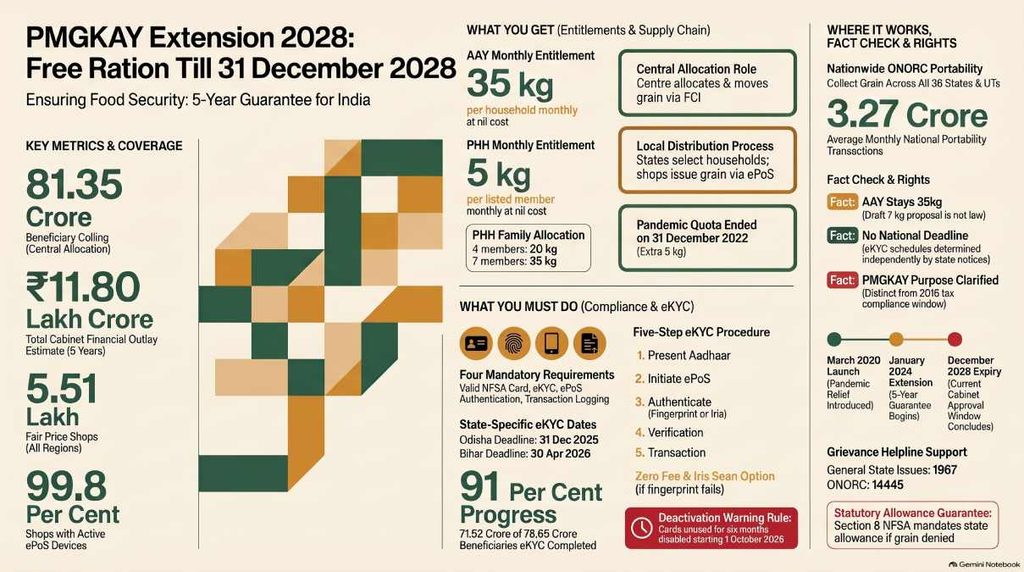
The PMGKAY extension 2028 guarantees free grain from 1 January 2024 to 31 December 2028 at unchanged quotas: 35 kg a month per AAY household and 5 kg a month per PHH member.
Two claims keep reaching cardholders: that rations stop without eKYC, and that AAY quotas are being cut. The AAY per-person formula is a draft bill only. eKYC dates are set by each state, so your state’s notice decides your risk.
The Pradhan Mantri Garib Kalyan Anna Yojana (PMGKAY) is still active. It carries the whole National Food Security Act (NFSA) entitlement, free, to every Antyodaya Anna Yojana (AAY) household and Priority Household (PHH) member, and there is no separate PMGKAY application. The free grain comes through the card you already hold.
Whether grain reaches your kitchen turns on four things: the right card type, eKYC for every listed member, a working authentication at the ePoS machine, and a shop that records what it hands over. Each has a rule behind it and a step you can take this month.
PMGKAY Extension 2028 At a Glance
- What is guaranteed: The PMGKAY extension 2028 gives free grain from 1 January 2024 to 31 December 2028, at unchanged quotas, for about 81.35 crore beneficiaries.
- Who gets what: 35 kg a month per AAY household, whatever its size, and 5 kg a month per PHH member. Only AAY and PHH cards issued under the NFSA carry the right, and there is no separate PMGKAY application.
- eKYC: Every listed member needs eKYC, and there is no single national last date, so your state’s notice decides. It is free and can be done at any fair price shop on the ePoS machine.
- Moving and complaints: Under ONORC, any ePoS fair price shop in all 36 states and UTs can issue your grain. If grain is denied or comes short, call 1967 or your state’s 1800 number.
- Draft versus law: The AAY formula of 7 kg per person is a draft bill, not law. Free grain after 2028 needs a fresh decision, and none had been announced by November 2026.
Decision, Scale and Cost
The Union Cabinet approved a five-year extension of free foodgrains from 1 January 2024, a decision PIB announced on 29 November 2023 after the Cabinet met the previous night. The term ends on 31 December 2028.
DFPD’s PMGKAY page states the terms as 35 kg per AAY household and 5 kg per PHH member each month, for about 81.35 crore beneficiaries. PRS Legislative Research recorded the same decision in its November 2023 review. Nothing about it is new, and as of November 2026 the scheme is in its third year.
The Centre carries the cost. It allocates, procures and moves the grain through the Food Corporation of India, while states pick the households and run the shops. The grain reaches cardholders through 5.51 lakh fair price shops, of which 99.8 per cent run ePoS devices.
Also Read: How to Reactivate a Silent Ration Card Under the 2026 SMART-PDS Rules
81.35 Crore Persons and the ₹11.80 Lakh Crore Estimate
The Cabinet fixed coverage at about 81.35 crore persons and put the five-year food subsidy at about ₹11.80 lakh crore. The first is a ceiling. The second is an estimate. Neither is a count of people served or rupees spent.
DFPD’s PMGKAY page gave the annual subsidy at the time of the November 2023 decision as about ₹2.13 lakh crore, which covers AAY and PHH grain, other welfare schemes and tide-over needs. The ₹11.80 lakh crore figure assumes the economic cost of grain keeps growing, and Union Budget allocations for PMGKAY alone have since risen to about ₹2.27 lakh crore a year.
PRS notes that states had identified 80.6 crore beneficiaries by August 2025, and that the 81.35 crore ceiling equals about 67 per cent of the 2011 Census population. The Department of Food and Public Distribution (DFPD) told PRS there was scope to add 79 lakh more names. Delivery runs a little below the ceiling: PIB’s December 2024 release said 80.67 crore persons were receiving free grain against the intended 81.35 crore, and the World Food Day note of 15 October 2025 gave about 78.90 crore.
| Measure | Figure | Date and source |
| Coverage ceiling under the NFSA | 81.35 crore persons | Cabinet decision, November 2023 (PIB) |
| Beneficiaries identified by states | 80.6 crore (rounded) | August 2025 (PRS) |
| Beneficiaries receiving free grain | 78.90 crore | October 2025 (PIB) |
| Beneficiaries in digitised state databases | 78.65 crore | October 2026 (PIB ONORC factsheet) |
| Beneficiaries with eKYC done | 71.52 crore, or 91 per cent of the 78.65 crore in digitised databases | 30 September 2026 (PIB) |
| Estimated five-year food subsidy | ₹11.80 lakh crore | Cabinet decision, November 2023 (PIB) |
From ₹1 to ₹3 a Kilo to Free
Since 1 January 2023 the whole NFSA entitlement has been free. Before that, cardholders paid ₹3 a kilo for rice, ₹2 for wheat and ₹1 for coarse grains, as PIB recorded when the Cabinet made the grain free in December 2022.
The PMGKAY name now carries that free NFSA grain. The two are not rivals. The NFSA of 2013 fixes who is entitled and how much, and PMGKAY is the central scheme that pays for the grain so the cardholder pays nothing.
So the common question has a plain answer: PMGKAY runs under the NFSA, not beside it. It has no link with the 2016 Pradhan Mantri Garib Kalyan Deposit Scheme, a tax-compliance window announced after demonetisation.
The Centre announced the first PMGKAY in March 2020 as pandemic relief, to shield poor households from food hardship. That history sits near the end of this post, after the rules that apply to you today.
What Happens After December 2028
The Cabinet approval ends on 31 December 2028. The 5 kg and 35 kg quotas sit in the NFSA, which has no end date, but free supply is the Centre’s decision to pay for that grain, so free grain after 2028 needs a fresh decision.
No such decision had been announced by November 2026, so treat any message that promises free grain beyond 2028 as unconfirmed.
Ration Card Entitlements Through 2028: AAY and PHH
An AAY household gets 35 kg a month and a PHH member gets 5 kg a month, at no cost, every month until 31 December 2028.
| Card | Monthly free quota | Counted per | Price |
| Antyodaya Anna Yojana (AAY) | 35 kg | Household, whatever its size | Nil |
| Priority Household (PHH) | 5 kg | Each member listed on the card | Nil |
Antyodaya (AAY) Households: 35 kg Per Household
AAY households get a flat 35 kg a month irrespective of family size. A widow living alone and a family of seven draw the same 35 kg. The quota sits in the NFSA, and the Centre pays for it under PMGKAY. PIB’s July 2024 backgrounder counts over 8.92 crore people in AAY households, more than 2 crore of them women.
A draft amendment proposes to change this to 7 kg per person. It is a draft and has not become law.
Read your card for the category printed on it. The card type, not your income today, decides which quota applies.
Priority Households (PHH): 5 kg Per Person
A PHH member gets 5 kg a month. A family of four gets 20 kg, and a household of seven gets 35 kg. Only members listed on the card count, so a newborn or a new spouse adds to the quota only after the state adds the name.
| Members on a PHH card | PHH monthly quota | AAY household, for contrast |
| 1 | 5 kg | 35 kg |
| 2 | 10 kg | 35 kg |
| 4 | 20 kg | 35 kg |
| 6 | 30 kg | 35 kg |
| 7 | 35 kg | 35 kg |
| 8 | 40 kg | 35 kg |
Some messages say PHH members get 10 kg. That is a pandemic figure. During the 2020 to 2022 phases the Centre paid an extra 5 kg a person on top of the regular quota, and those phases ended on 31 December 2022. PHH members no longer get the extra 5 kg, so the free quantity is 5 kg and not 10 kg.
Rice, Wheat or Coarse Grains: What Your State Issues
The NFSA defines foodgrains as rice, wheat or coarse grains (millets). The kilos are fixed. The mix is not. It differs by state and by month, and a district that gets mostly rice in one month may get wheat in the next.
Your state PDS portal or the notice board at your fair price shop shows what is issued that month. This post carries no state-by-state table, because a mix that is not copied from an official allocation order goes stale within weeks.
Of DFPD’s 2024-25 allocation of 610.28 lakh tonnes across the NFSA and other welfare schemes, 401.88 was rice, 201.83 wheat and only 6.57 coarse grains.
AAY households were allotted 99.48 lakh tonnes and PHH households 429.35 lakh tonnes, together 528.83. The remaining 81.45 went to tide-over needs (26.23), PM POSHAN (22.96), the ICDS wheat-based nutrition programme (25.78), hostels and welfare institutions (4.10), the adolescent girls scheme (0.68) and additional calamity and festival requirements (1.69).
Fortified Rice at Fair Price Shops
Fortified rice is ordinary rice blended with 1 per cent by weight of kernels carrying iron, folic acid and vitamin B12, PIB explains. It reached ration shops in phases from 2021, starting with ICDS and PM POSHAN, then 269 districts in 2022-23 and the rest of the country in 2023-24. The Government said universal coverage was reached by March 2024.
In October 2024 the Cabinet extended universal fortified rice supply to December 2028 at a cost of ₹17,082 crore. About 406 lakh tonnes went through the PDS between 2019-20 and March 2024.
The position changed on 27 February 2026. DFPD decided to temporarily discontinue rice fortification after an IIT Kharagpur shelf-life assessment found that fortified rice loses micronutrients and keeps for less time in long storage. PDS rice sits in godowns for two to three years. For rice received in 2025-26 and pending 2024-25 receipts, states may supply fortified or non-fortified rice at their discretion.
The release states that foodgrain entitlements are not reduced. No end date is given for the pause. So the rice in your bag may or may not carry fortified kernels, and the number of kilos is the same either way.
Also Read: Ration Card E-KYC Mismatch? A Step-by-Step Guide to Correcting Your Data Online
New Ration Card Rules in 2026: What Changes for Cardholders
Six new rules and changes for ration cards landed in 2026. Each carries a status below, and only the AAY formula is a draft.
| Change | Status as of November 2026 | What changes for you |
| Cap of 10 per cent broken grains in raw rice, 5 per cent in parboiled (CCEA, 1 July 2026) | Approved, with procurement phasing in | Rice standards tighten over time. Quota unchanged |
| Temporary halt to rice fortification (27 February 2026) | In force | Rice may be fortified or not. Quota unchanged |
| Advance lifting of April to June 2026 grain (directive of 2 March 2026) | In force for that quarter only | Some shops gave three months’ grain together |
| Temporary disablement of cards unused for six months and of duplicate cards, then a three-month eKYC revalidation window (central system from 1 October 2026) | In force | An unused or duplicate card can be blocked until revalidated |
| Delhi Food Security Rules, 2026 (4 February 2026), amended on 13 July 2026 | In force in Delhi | Income cap for priority household cards is ₹2.50 lakh |
| Draft National Food Security (Amendment) Bill, 2026 (AAY at 7 kg per person) | Draft, not law | Nothing today. AAY stays at 35 kg per household |
A forwarded message earns trust only if it names a Cabinet decision, a PIB release or a state order, carries that document’s date, applies to your state and does not call a draft a rule. Urgent wording changes nothing.
Rice Standards: Broken Grain Cut to 10 Per Cent
The Cabinet Committee on Economic Affairs approved on 1 July 2026 a cap of 10 per cent broken grains for raw rice, down from 25 per cent, and 5 per cent for parboiled rice, down from 16 per cent. PIB’s release of 2 July 2026 calls it the first revision of PDS rice specifications in nearly three decades. Entitlements stay the same.
The reform has two working parts:
- Rice bags carry a QR code for end-to-end traceability, so a batch can be followed from mill to shop.
- Procurement of the new-specification rice starts from the 2026-27 marketing season and spreads state by state. DFPD’s food secretaries’ conference asked states to assess milling capacity and plan upgrades. Full rollout is due by 2027-28.
There is no switch date at the shop. Cleaner rice reaches counters as each state’s milling catches up.
Draft NFSA Amendment: AAY at 7 kg Per Person
DFPD’s draft National Food Security (Amendment) Bill, 2026 proposes to replace the flat 35 kg AAY quota with 7 kg per person, capped at 35 kg per household. It changes Section 3 of the Act. Public comments were invited until 13 July 2026.
The draft’s stated reason is that larger households now get less per head. Down To Earth reports that the draft itself says a large household’s per-person share can fall below the PHH level, and a household of eight gets about 4.4 kg a person. One- to four-member households would receive less than they do now.
| AAY household size | Today | Under the draft |
| 1 member | 35 kg | 7 kg |
| 2 members | 35 kg | 14 kg |
| 3 members | 35 kg | 21 kg |
| 4 members | 35 kg | 28 kg |
| 5 or more members | 35 kg | 35 kg |
If adopted as drafted, no AAY household would get more than today, and households of one to four would get less. Priority households are untouched at 5 kg a person. As of November 2026 this is a draft that has not become law, so the forwarded messages about “cuts” describe a proposal.
Also Read: Ration Card e-KYC 2027: Last Dates by State and How to Complete It
Advance Lifting of April to June 2026 Grain
On 2 March 2026 the Centre directed states to lift April to June 2026 grain in advance and distribute it at once, ahead of the procurement season. The Hitavada reported that the directive set 30 April as the deadline to lift and distribute.
That is why some shops handed over three months of grain together. Entitlements did not change, and a household that took April to June grain in one lift has no extra claim for May or June.
Who Is Eligible for PMGKAY Free Ration
Households holding an AAY or PHH card issued by their state under the NFSA are eligible for free ration under the Pradhan Mantri Garib Kalyan Anna Yojana. Nothing else gives the right.
NFSA Coverage Ceiling and State Lists
The NFSA covers up to 75 per cent of the rural and 50 per cent of the urban population, counted on 2011 Census figures. That produces the national ceiling of 81.35 crore. Each state gets its own quota inside that ceiling, and each state picks the households that fill it.
Three union territories run a different model. Chandigarh and Puducherry (from September 2015) and the urban areas of Dadra and Nagar Haveli (from March 2016) pay the food subsidy as a direct benefit transfer into bank accounts, and PIB’s October 2025 release lists them as exceptions to online grain allocation. The legal basis is the Cash Transfer of Food Subsidy Rules, 2015 (G.S.R. 649(E), 21 August 2015).
A state can use it only in areas the Centre has approved, and the cash is the entitled quantity multiplied by 1.25 times the minimum support price less the central issue price. Households there buy grain on the open market with the money.
Puducherry also began a digital currency pilot on 26 February 2026. So a card is tied to a state quota.
Holding some ration card does not by itself mean AAY or PHH status, since states also issue BPL and other cards under their own schemes, with their own income limits. PRS observes that coverage still rests on 2011 data and that the next Census is set for 2027.
Also Read: Digital Rupee Ration: How India’s CBDC Food Subsidy Works
How States Identify AAY and PHH Households
States identify both kinds of household, but only PHH criteria differ from state to state. One state may weigh occupation and housing, another a deprivation score or an income ceiling.
For AAY, PIB’s October 2025 release says states choose households on criteria set by the Centre. Households headed by widows, terminally ill or disabled people, or elders aged 60 and over with no assured means of subsistence qualify, as do all primitive tribal households, landless labourers, marginal farmers, rural artisans, slum dwellers, informal-sector workers on daily earnings and eligible BPL families of HIV-positive persons.
Under the TPDS (Control) Order, 2015, identification is continuous, and ineligible, fake or duplicate cards are removed. PRS cites a Bihar evaluation that found non-poor households still on the list, which is why states keep revising them. Open your state food department’s site and find the notified guidelines before you apply or contest a decision.
Who Is Not Eligible for a Ration Card: Exclusions and Income Limits Set by States
Delhi makes a useful worked case. The Delhi Food Security Rules, 2026, notified on 4 February, first raised the annual family income cap from ₹1 lakh to ₹1.20 lakh. The Cabinet approved a further rise on 26 May 2026, and the Delhi Food Security (Amendment) Rules, 2026, in force from 13 July 2026, amend Rule 3(1) to treat households with annual income up to ₹2.50 lakh as eligible for the priority household category, according to The Tribune. The rules bar a household from a new card in these situations, as reported:
- it owns land or a building in an A to E category colony
- it pays income tax
- it owns a four-wheeler, other than one commercial vehicle used for livelihood
- a member holds a government or public-sector job
- it has a power connection above 2 kW
- it already receives food subsidy under another scheme
Check the notified text for the exact wording of each bar.
Delhi adds new cards as vacancies arise from death, surrender or migration. The ceiling is 72.78 lakh persons, spread across about 17.78 lakh ration cards, so the quota counts people and not cards.
An audit there removed nearly 7.72 lakh beneficiary names, and the Delhi government’s breakdown lists 6,46,123 persons above the income limit, 95,682 who had lifted no ration for over a year, 6,185 who had died and 23,394 drawing grain from multiple locations, a total of 7,71,384. Those names opened vacancies under the ceiling. Other states set their own limits.
Also Read: Viksit Bharat 2047: Analyzing the Strategic Policy Roadmap for a $30 Trillion Economy
Ration Card eKYC and Aadhaar Seeding
Complete eKYC for every member listed on the card, by the date your state has set. A missing member is the usual reason a card is flagged.
eKYC and Seeding: Two Different Steps
The two terms get mixed up, and the difference decides what you need to do.
| Step | What it means | Who acts | Status as of November 2026 |
| Aadhaar seeding | The Aadhaar number is recorded against the card, counted once at least one member is linked | State food department | 98.8 per cent of 20.51 crore cards seeded in October 2026. Earlier releases quoted about 99.8 per cent |
| eKYC | Each listed member authenticates, so the state confirms the person is real and still in the household | Each member, in person | 91 per cent of beneficiaries (member-level) on 30 September 2026 |
Seeding is mostly done. eKYC is where cards still fall behind. The two percentages use different units, cards for seeding and individual members for eKYC, which is why a card counted as seeded can still be flagged for one missing member. In December 2024 the Department said more than 97 per cent of grain transactions were biometrically or Aadhaar authenticated.
The purpose is clean-up of the lists. The Department reports in its ONORC factsheet that data analytics flagged 5.95 crore suspicious records and led to the deletion of 2.58 crore duplicate or ineligible entries. eKYC is the check that keeps a genuine name from being caught in that sweep.
There is no single national last date for ration card eKYC. The Department’s advisory of 25 June 2024 asks states to reach 100 per cent compliance and gives the method, and each state fixes its date. Odisha moved its cut-off to 31 December 2025, and Bihar extended to 30 April 2026. A date from a forwarded message is real only if your state issued it.
The legal source of most of these rules is the Targeted Public Distribution System (Control) Amendment Order, 2025 (G.S.R. 488(E)), in force from 22 July 2025. It sets eKYC on a five-year cycle under Clause 3(13) and bars anyone below 18 from holding a separate ration card (Clause 3(13a)).
For children below five, Clause 3(13b) asks only that the Aadhaar number is captured if available, with eKYC done within one year after the child turns five. A parent of an infant has no biometric step to chase at the shop.
Two Centre rules sit above the state dates. First, States were advised that no genuine beneficiary should be denied grain for want of Aadhaar or on biometric failure. The footing is Section 7 of the Aadhaar Act, under DFPD’s notification S.O. 371(E) of 8 February 2017, as amended, and the Department’s letters under it allow grain against the physical Aadhaar card and ration card when authentication fails.
Second, Clause 4(22) of the amended Control Order lets a state temporarily disable the card of a household that has not used its entitlement in the last six months, then gives three months for field verification and eKYC.
Duplicate cards, within a state or across states, are disabled the same way, with three months to show eligibility through documents and eKYC. From 1 October 2026 the Department’s central system can disable silent and duplicate cards. One missed month will not trigger any of this, but lift your grain regularly.
How to Complete eKYC at the Fair Price Shop
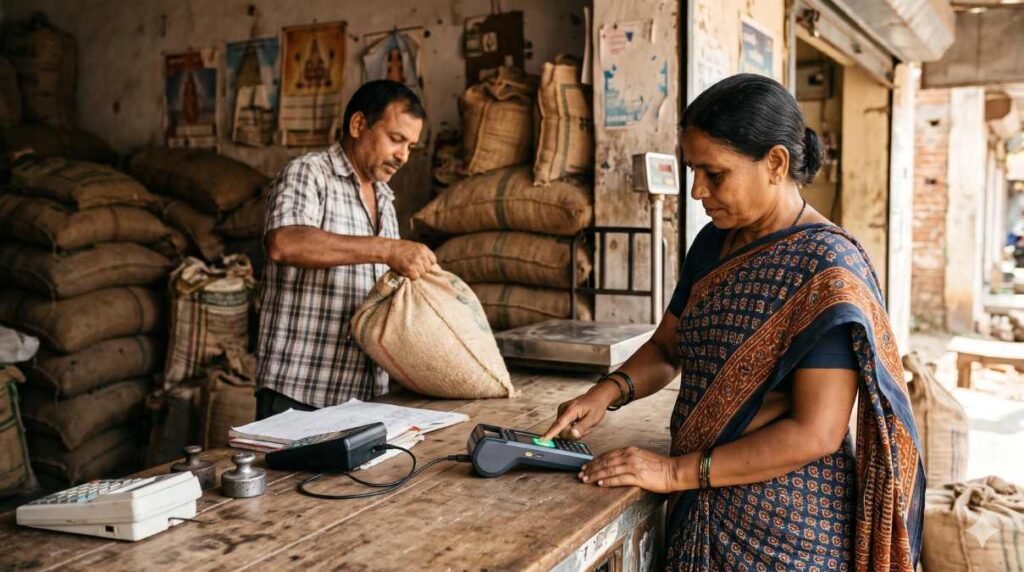
The shop route works in every state, and the Department has made eKYC possible at any fair price shop in the country. The steps:
- Carry the Aadhaar of every member listed on the card.
- Go to a fair price shop and ask the dealer to start eKYC on the ePoS machine.
- Each member authenticates in person, by fingerprint or by iris where the shop has the device.
- Ask the dealer to confirm the status on screen before you leave.
- Check the state portal or the Mera Ration app after a few days to see that each name shows as done.
There is no fee. Online eKYC exists only where your state offers it, through its food department portal or the Mera Ration app, and many states still send everyone to the shop. Ration card eKYC online is a state-by-state option, and the shop is the sure one.
When Fingerprints Fail
Worn fingerprints are common among elderly cardholders and manual labourers. The Department’s eKYC guidelines allow an iris scan alongside the fingerprint, so a member whose print will not read can try the eye instead.
Two workflows run at the machine. Monthly lifting needs one listed, Aadhaar-seeded member to authenticate, and states generally let any such member draw the household’s grain. A Lok Sabha reply says other family members linked to the card may authenticate when one member’s attempt fails, and it describes a nominee facility.
Member eKYC is separate, and each listed member aged five or above completes it once in the five-year cycle. A worn print on one member does not stop the household’s monthly ration if another member can authenticate.
When authentication keeps failing after repeated attempts, the member is flagged for physical verification. A district officer then approves or rejects the eKYC after field verification, with a recorded reason, and a rejected eKYC can be started again. A failed print does not end the matter.
| Situation at the shop | What to do |
| The dealer says eKYC is pending for a member | Ask the dealer to start it on the ePoS machine at that visit |
| A fingerprint will not read | Ask for the iris scan, then for flagging for physical verification |
| The dealer refuses grain citing a failed print | Cite the standing Centre instruction and call 1967 or your state line |
| A member is away from the village | Plan the visit around that member’s return, or ask the food office what your state allows |
Ask the dealer for the iris option at the first visit. Not every shop carries an iris device, as Down To Earth reported from Rajasthan, so ask early and escalate to the district supply officer if the dealer does not know the option.
One Nation One Ration Card (ONORC)
Every NFSA cardholder can collect grain from any fair price shop in India that has an ePoS machine, using the existing card. The system runs in all 36 states and UTs and, per PIB’s ONORC factsheet, handles about 3.27 crore portability transactions a month. The cumulative count reached about 191 crore by October 2025, up from 158.8 crore delivering 315.8 lakh tonnes in December 2024.
Most lifting is still local. PRS reports that in December 2025 only 0.5 per cent of ePoS transactions were inter-state, against 18 per cent intra-state.
Claiming Ration in Another State
A migrant worker needs no new card. At the destination shop, quote the ration card number or the seeded Aadhaar number and authenticate by biometric on the ePoS device. The shop issues the grain against your home state’s quota, and ONORC works across all 36 states and UTs.
Before you travel, confirm that every member you want covered has Aadhaar seeded and eKYC done. A gap shows up at the counter, far from the officer who can fix it. The Department’s ONORC booklet sets out the same procedure.
Mera Ration App
Mera Ration shows your entitlement, your transaction history and the nearest fair price shop, and it lets a migrant register a move. It shows eKYC status where available. You log in with the ration card number or the Aadhaar number.
The app runs in 13 languages, according to the Department’s ONORC booklet, among them Hindi, Tamil, Telugu, Bangla and Urdu. Treat the app as a viewer and a locator. The authentication that releases grain still happens at the shop. The current version, Mera Ration 2.0, launched on 20 August 2024 and has passed 1 crore downloads.
Splitting the Entitlement Between Family Members
A migrant worker can lift part of the quota at the destination while the family back home lifts the balance on the same card. PIB’s ONORC factsheet confirms that the family back home may lift its part of the entitlement.
Take a PHH card with four members and a 20 kg monthly quota. If one member works in another state and lifts 5 kg there, the family at home can lift the remaining 15 kg. Each person who lifts needs Aadhaar seeded on that card, and the grain is recorded against the same card number in both places.
An AAY card works on the same logic against its single 35 kg household balance: a member can draw part at the destination shop and leave the rest for the family at home. That is permitted in principle, and the exact handling depends on your state’s ePoS settings, so confirm with the food office before you travel.
How to Apply for a New NFSA Ration Card
A new AAY or PHH card is issued only when the state has room under its NFSA ceiling, so an application can sit pending for months. Apply anyway, and keep the acknowledgement number.
Documents for a New Card
Lists vary by state. Most portals ask for the Aadhaar of every household member and proof of residence, and some add an income certificate.
In Delhi, the head of household files online with copies of the family’s Aadhaar cards, and officers verify it, sometimes with a field visit.
Online and Offline Application Routes
The online route runs through the state food department portal, often under a food and civil supplies label. The offline route runs through the local food or ration office, which takes the form and the documents and keys them into the same system. The National Food Security Portal links to state ration card pages.
Delhi now accepts applications online only, through its e-District portal, which reopened for new cards on 15 May 2026 after a long gap. Check your own state’s site, since a Delhi rule may not hold elsewhere.
Application Status and Digital Ration Card
After submission, track the application on the state PDS portal using the acknowledgement number. Where the state offers it, the approved card can be downloaded as a digital ration card from the same portal and shown at the shop.
Some states hold lakhs of applications pending because of quota limits. Delhi had 3,89,883 applications pending in January 2026 and over 11.65 lakh people waiting, the first figure counting applications and the second persons.
The amended Control Order requires states to process new applications in first-in, first-out order and to publish a real-time waiting list on their public portals, the Ministry has said. Delhi’s chief minister said in February 2026 that first-come, first-served would give way to district committees that prioritise the neediest applicants, so the rule your state follows is worth checking.
A pending status usually means no vacancy under the ceiling. It is not a rejection, and the application moves when cards are surrendered or cancelled.
Grievance Redressal: Short Weight, Denial and Dealer Fraud
Note the card number, the shop name, the date and the shortfall before you call or file anything. A complaint with those four items gets traced. One without them gets closed.
Free means free. The grain is at no cost to the cardholder, so a demand for money at the counter is itself a ground for complaint.
Where to Complain: 1967, 14445 and State Portals
The Centre asked states to set up 1967 as the common PDS toll-free number. Each state also runs its own 1800-series line. The Department says a 1967 or 1800-series helpline operates in all states and UTs, though which number connects can differ by state. Complaints that reach the Department, including those on corruption and embezzlement, are forwarded to the state or UT concerned for inquiry and action, so the state office is where a case is decided.
| Contact | Use it for | Note |
| 1967 | Short weight, denial of grain, dealer conduct | Common PDS toll-free number. Availability varies by state |
| State 1800 number | The same complaints, through your state’s own line | Printed on the shop notice board and the state portal |
| 14445 | ONORC problems, such as refusal at a shop in another state | Five-digit ONORC helpline, available in most states and UTs |
| State PDS portal | An online complaint with a reference number | Each state and UT runs one |
| District Grievance Redressal Officer | The next step up when the call or portal fails | Officer appointed under the NFSA in every district |
If the district officer does not act, the appeal goes to the State Food Commission under the Act.
The Act also gives a money remedy. Under Section 8 of the NFSA, a cardholder whose entitled grain is not supplied is owed a food security allowance by the state government.
The Food Security Allowance Rules, 2015 (G.S.R. 48(E), 21 January 2015) set the amount at 1.25 times the minimum support price of the grain for that marketing season, less the issue price the cardholder pays, multiplied by the quantity not supplied. With grain free, the deduction is nil.
The state pays it into the beneficiary’s bank account by the end of the third week of the month after the month of non-supply, and no allowance is due if the cardholder did not visit the shop that month. The rules leave payment to the state and carry no uniform claim form, so put the shortfall in writing, cite Section 8 and keep the reference number.
A usable complaint is short and specific: the card number, the shop’s name and code, the date, the quantity due (20 kg for four PHH members) and the quantity received (17 kg). Give the same facts on the phone and in writing, and ask for a reference number each time.
Checking What You Were Given: Transparency Portals and ePoS Records
Every state and UT runs a transparency portal with online grievance registration, and the Department confirms these exist nationwide. Each lift is authenticated on the ePoS machine, so the quantity you received is recorded electronically.
Where your state provides a slip or an SMS, the recorded quantity appears there, and a gap between that figure and what you carried home is your proof of short weight.
Action Against Dealers Who Break the Rules
Dealers operate under the Targeted Public Distribution System (Control) Order, 2015, issued under Section 3 of the Essential Commodities Act, 1955, and under state control orders made under it. A violation can lead to suspension or cancellation of the shop’s authorisation and prosecution under the Act.
Penalties and hearing procedure differ by state, so quote your state’s control order in a written complaint where you can.
From Pandemic Relief to Free NFSA Rations: 2020 to 2028
Phases I to VII: April 2020 to December 2022
Seven phases ran from April 2020 to December 2022, 28 months in all, each adding 5 kg a person above the NFSA quota for about 80 crore beneficiaries, DFPD records. The first covered three months of pandemic relief, and the seventh, from October to December 2022, was the last. The Centre allocated about 1,118 lakh tonnes and spent about ₹3.91 lakh crore. The same page lists 1,015 lakh tonnes actually distributed over the 28 months, with more than 75 crore beneficiaries a month in 2020-21 and 2021-22.
The January 2023 Merger and the 2023 Extension
The extra-grain phases ended on 31 December 2022. The Cabinet decided on 23 December 2022 that from 1 January 2023 the NFSA entitlement itself would be free, for one year. PRS’s December 2022 review put the expected spend at over ₹2 lakh crore. The decision of 29 November 2023 continued free grain for five years from 1 January 2024.
What the Merger Ended: Two Parallel Entitlements
Before 2023 a PHH member received 5 kg at ₹1 to ₹3 a kilo plus 5 kg free, and the two ran as separate channels with separate rules. Now there is one free 5 kg entitlement. The December 2022 merger, not the 2023 extension, ended the two-track arrangement.
Economic and Fiscal Impact
PMGKAY is the Department’s largest line by far. PRS puts it at 97 per cent of the Department’s 2026-27 budget.
Household Savings and Nutrition
PIB’s example from the Cabinet note puts the economic cost of 35 kg of rice for an AAY family at ₹1,371 and of 35 kg of wheat at ₹946 a month, borne by the Centre. At the same per-kilo cost, the 20 kg a PHH family of four draws works out to about ₹783 of rice or ₹541 of wheat. That is arithmetic on PIB’s figures, and it values grain at the economic cost, not at any shop price.
With fortification paused since February 2026, the grain still arrives and the nutrient add-on is uncertain. On delivery, evaluation reports from monitoring institutes in 30 states and UTs found that 98 per cent of surveyed households got their full entitlement under the pandemic-era scheme.
Procurement and MSP Linkage
PDS demand underpins central-pool procurement, and the Centre buys that grain from farmers at the minimum support price. PRS data shows wheat stocks at about twice the norm and rice at about four times on 1 January 2026.
In figures, the central pool held 274.63 lakh tonnes of wheat against a norm of 138.00, and 309.38 lakh tonnes of rice, excluding unmilled paddy, against 76.10. Unmilled paddy in rice equivalent took rice to about 679 lakh tonnes, per FCI data reported by AgriInsite. Norms change by quarter, so a multiple depends on the date.
The surplus is not new. The combined wheat and rice stock was 608.75 lakh tonnes against a combined norm of 411.20 in July 2024, and on 1 July 2025 rice alone stood at 377.83 lakh tonnes against a rice norm of 135.40. Procurement is concentrated: 92 per cent of wheat came from three states and 65 per cent of paddy from five in 2024-25.
Fiscal Outlay
The five-year extension carries an estimate of ₹11.80 lakh crore. Phases I to VII cost about ₹3.91 lakh crore.
| Item | Amount | Source |
| Phases I to VII, April 2020 to December 2022 | ₹3.91 lakh crore | DFPD, via PIB |
| Five-year extension estimate, 2024 to 2028 | ₹11.80 lakh crore | Cabinet decision, PIB |
| PMGKAY, 2024-25 actuals | ₹1,99,500 crore | PRS |
| PMGKAY, 2025-26 revised estimate | ₹2,27,754 crore | PRS |
| PMGKAY, 2026-27 budget estimate | ₹2,27,429 crore | PRS |
The ₹2.13 lakh crore on DFPD’s scheme page was the baseline at the 2023 decision, and budget allocations have risen since as economic costs grew. The 2026-27 figure is 97 per cent of the Department’s ₹2,35,047 crore, and PRS estimates the food subsidy at about 0.6 per cent of GDP. Because the central issue price has been zero since 2023, the subsidy bill now rises with procurement costs. PRS also records that a social audit found about 97 per cent of beneficiaries opposed cash in place of grain.
PMGKAY Extension 2028: FAQ
Is the PMGKAY scheme extended till 2028?
Yes. The Union Cabinet approved free foodgrains from 1 January 2024 to 31 December 2028 for about 81.35 crore beneficiaries, at unchanged quotas.
Do I need to apply separately for PMGKAY free ration?
No. The free grain comes through the AAY or PHH ration card you already hold, and there is no separate PMGKAY application.
How much ration per person does PMGKAY give each month?
A PHH member gets 5 kg a month, and an AAY household gets 35 kg a month whatever its size. The extra 5 kg of the 2020 to 2022 phases ended on 31 December 2022.
Does every ration card get PMGKAY free grain?
No. Only AAY and PHH cards issued under the NFSA qualify. Other cards that states issue under their own schemes, such as BPL cards, do not carry the right by themselves.
Is the ration card KYC date extended?
There is no single national last date for ration card eKYC, because each state fixes its own. Some states have moved theirs, as Odisha and Bihar did. A card is usually flagged when a listed member has not completed eKYC, so finish it for every member before your state’s date.
How do I check my PMGKAY entitlement and eKYC status?
Open your state PDS portal or the Mera Ration app and log in with the ration card number or the Aadhaar number. The app shows your entitlement and, where available, your eKYC status.
Is PMGKAY still active?
Yes. As of November 2026 the scheme is in its third year, and the Cabinet approval runs to 31 December 2028.
What is the latest extension for the Pradhan Mantri Garib Kalyan Anna Yojana?
The latest is the Union Cabinet’s five-year extension, from 1 January 2024 to 31 December 2028. No decision on free grain beyond 2028 had been announced by November 2026.
In which year did the Pradhan Mantri Garib Kalyan Anna Yojana start?
The Centre announced the first PMGKAY in March 2020 as pandemic relief. Free NFSA grain under the scheme began on 1 January 2023, and it was extended for five years from 1 January 2024.
Is PMGKAY under NFSA?
Yes. PMGKAY runs under the NFSA, not beside it, and carries the NFSA entitlement of AAY households and PHH members free of cost.
Are NFSA and PMGKAY the same?
No. The National Food Security Act of 2013 fixes who is entitled and how much. PMGKAY is the central scheme that pays for the grain, so the cardholder pays nothing.
Who is eligible for PMGKAY free ration?
Households holding an AAY or PHH card issued by their state under the NFSA. Nothing else gives the right, and there is no separate application.
What are the new rules for ration cards in 2026?
Six changes landed in 2026. The Cabinet Committee on Economic Affairs capped broken grains in PDS rice, DFPD paused rice fortification, April to June grain was lifted in advance, unused and duplicate cards became liable to temporary disablement from 1 October 2026, Delhi notified its Food Security Rules, and a draft bill proposed a per-person AAY quota. Only that bill is a draft.
Who is not eligible for a ration card?
Each state sets its own exclusions. Delhi bars a household from a new card if it pays income tax, owns a four-wheeler other than one commercial vehicle used for livelihood, has a member in a government or public-sector job, or already receives food subsidy under another scheme, among other bars.
What is BPL eligibility?
States set BPL eligibility under their own schemes, with their own income limits, so a BPL card does not by itself carry the right to PMGKAY free ration. Only AAY and PHH cards issued under the NFSA carry it.
What is the PM Garib Kalyan deposit scheme?
It is a 2016 tax-compliance window announced after demonetisation, and it has no link with PMGKAY free ration.
Check Your Card This Month to Keep Your PMGKAY Free Ration
Open your state PDS portal or the Mera Ration app this week and check that every listed member shows eKYC as done. If a name is missing, take that member’s Aadhaar to a fair price shop and start it on the ePoS machine.
If grain is denied or comes short, note the card number, shop, date and shortfall, then call 1967 or your state’s 1800 number and claim the food security allowance in writing. The step-by-step process is in India Policy Hub’s ration card eKYC guide.
Disclaimer
This post is published for general information only. It is not legal or financial advice, and reading it creates no lawyer-client or advisory relationship. India Policy Hub is an independent publication and has no affiliation with the Government of India or any State Government. The content states the position as of November 2026, drawn from public documents of the Department of Food and Public Distribution, the Press Information Bureau, PRS Legislative Research and other cited sources. Entitlements, eKYC dates, income limits and ration card rules change, and many are fixed by each State. A draft bill is not law until enacted. Confirm your own position with your State food department or the relevant authority before acting. To the fullest extent permitted by law, India Policy Hub and its authors accept no liability for loss arising from reliance on this post or from third-party links, which are not endorsements.



Leave a Reply