
How to Reactivate a Silent Ration Card Under the 2026 SMART-PDS Rules
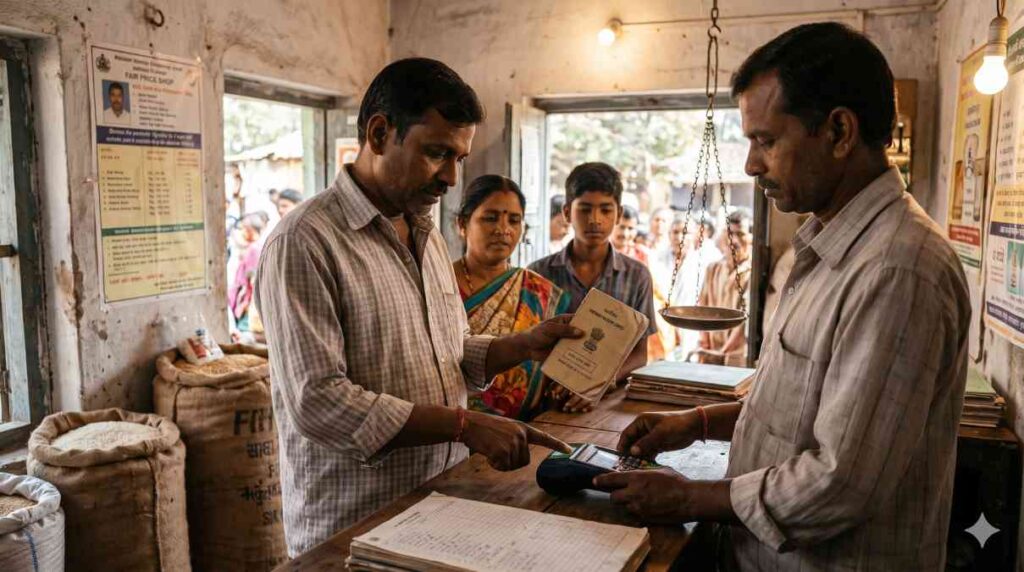
How to reactivate a silent ration card? This is the question that will face a family when it reaches the fair price shop, hands over the card and is told it no longer works. Another family hears that six months without lifting grain is enough to lose a card, and starts counting its own months.
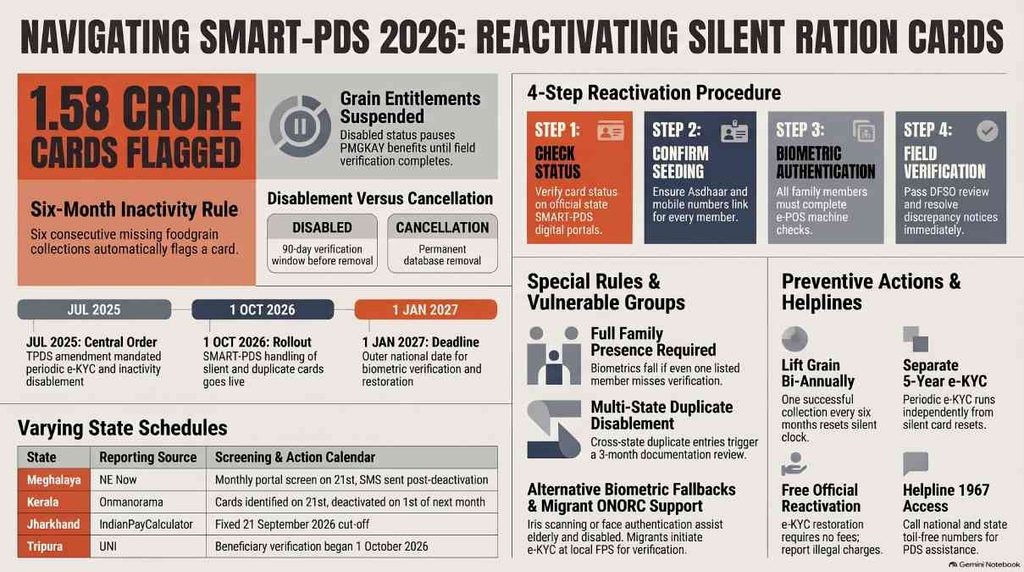
To reactivate a silent ration card, every listed member completes biometric e-KYC, the state field-verifies the household, and the card returns once both finish inside the three-month window. Reports put that window at 1 October 2026 to 1 January 2027, but states set their own dates, so check yours.
Reactivate silent ration card at a glance
- A silent ration card is one with no foodgrain lifted from a fair price shop for six months in a row. Genuine cards get flagged too.
- The card is temporarily disabled, not cancelled. The entitlement stops until the state verifies the household.
- To reactivate it, every listed member completes biometric e-KYC at the fair price shop, and the state finishes field verification within three months.
- National coverage gives the window as 1 October 2026 to 1 January 2027, but each state sets its own dates. Check the closing date on your state food department portal.
- Kerala says cards without e-KYC inside the window are invalidated and removed from the database. Other states set their own consequences, and Tamil Nadu announced it would block none.
- About 1.58 crore cards were reported flagged from 1 October 2026. Treat the figure as an order of magnitude.
- To keep a card active, one successful lift of grain inside six months resets the count, and any household member can do it.
- For help, call the national PDS helpline 1967. Reporting on the rule mentions no fee for e-KYC or reactivation.
What Is a Silent Ration Card and Why Was It Disabled?
A silent ration card is one with no foodgrain lifted from a fair price shop for six months in a row. That is the whole test. A genuine card held by a family well inside the eligibility limits gets flagged all the same, because a missing transaction triggers the flag and no eligibility check does. The government itself uses the label “silent ration cards” for cards against which no foodgrain entitlement has been claimed in that time.
Under the National Food Security Act, every person in an eligible household is entitled to 5 kg of foodgrain a month, and Antyodaya Anna Yojana households receive 35 kg per household. The Centre has provided that grain free of cost since 1 January 2023 under the Pradhan Mantri Garib Kalyan Anna Yojana (PMGKAY). For a family, a disabled card means the entitlement stops until the state verifies the household.
The silent-card rule comes from the Centre’s July 2025 amendment to the Targeted Public Distribution System (Control) Order. The Tribune reported that the amendment makes e-KYC mandatory for eligible households every five years and directs the temporary disabling of cards for inactivity.
What changes on 1 October 2026 is the machinery, since the rule itself is more than a year old. SMART-PDS handling of silent cards and duplicate beneficiaries goes live from that date. The Department of Food and Public Distribution describes SMART-PDS as a scheme with four modules, two of which are ration card and fair price shop management and a biometric grain distribution module that covers e-KYC.
Cleaning up the card rolls is old work too. Under the TPDS Control Order of 2015, identifying beneficiaries is a continuous process led by the states, and it includes removing fake or duplicate cards and cards held by ineligible households. The 2025 amendment adds an inactivity trigger to that standing duty. Not every flagged family is careless. Households that buy grain from the market, or that moved away and kept the card as a backup, can go silent without meaning to give the card up.
The drive targets inactive and duplicate entries and also checks eligibility. It is no nationwide cancellation: the rule is central, but each state runs its own drive and its own dates.
Also Read: Ration Card e-KYC 2027: Last Dates by State and How to Complete It
The 6-Month Inactivity Rule for Silent Ration Cards
A card is marked after six consecutive months without a successful ration-lifting transaction, and consecutive is the word that matters. On an active card, one successful collection resets the silent count.
States run the check on their own schedules. Meghalaya’s PDS portal does it automatically on the 21st of each month. Kerala identifies cards on the 21st too and deactivates them from the first of the following month. Jharkhand fixed 21 September 2026 as the last day to draw ration and keep a card active.
| State | What was reported | Reported by |
| Meghalaya | Portal screens for silent cards on the 21st of every month; the head of family gets an automated SMS right after deactivation | NE Now |
| Kerala | Cards identified on the 21st, deactivated from the first of the next month | Onmanorama |
| Jharkhand | 21 September 2026 cut-off to draw ration and keep the card active | IndianPayCalculator |
| Tripura | Check of beneficiaries began on 1 October 2026; allocations suspended while a card is inactive | UNI |
The table samples what a few states reported, and no national calendar sits behind it. Whether a card gets marked depends on the count on the day the state’s own check runs.
Temporary Deactivation vs. Permanent Cancellation
The card is first disabled, not deleted. Trak.in reports that cards are temporarily disabled and not permanently cancelled, with verification before any final decision. Disablement stops the entitlement but leaves the household record in place. What happens next depends on whether verification finishes inside the window, and states differ on the consequence.
Kerala’s Civil Supplies Commissioner has said that a deactivated card is reactivated only if every listed beneficiary completes e-KYC within three months, and that the state invalidates cards without e-KYC by then and removes them from the database. Kerala Kaumudi puts the same rule in days: biometric e-KYC for all listed members within 90 days, or the state cancels the card.
| Outcome | Trigger | What follows |
| Temporary disablement | Six months with no lift, or a duplicate flag | Entitlement suspended; verification window opens |
| Cancellation | e-KYC and verification not finished in the window (Kerala’s stated rule) | Card invalidated and removed from the database; other states set their own consequences |
The decision sits with the state: the Department of Food and Public Distribution says it does not issue ration cards, and that identifying households, issuing cards and supervising fair price shops rest with each state or UT government. For a flagged card, the state food and civil supplies office is the one to ask.
How a Silent Card Differs From a Surrendered or Cancelled Card
Three outcomes get mixed up because each one stops the grain, and what separates them is who acted. A silent card is switched off by the state and can be restored. A cancelled card is removed by the state, which Kerala says follows when biometric e-KYC is not finished in 90 days. A surrendered card is one the household gives up.
Goa shows how the line blurs in practice. The Goan reported in May 2025 that about 18,000 households had been struck off the roster, a fraction by voluntary surrender and most by cancellation after six straight months of non-use. That predates the July 2025 central amendment, so it describes Goa’s own practice at the time.
Surrender runs on paperwork. In Uttarakhand, a household moving between areas surrenders the card, collects a surrender certificate and submits it with its application for a new card in the new area. A silent card comes with no such certificate, since the household never acted and the missing transaction did.
Also Read: Ration Card E-KYC Mismatch? A Step-by-Step Guide to Correcting Your Data Online
The Scale of the Issue: About 1.58 Crore Inactive Ration Cards Flagged for October 2026
Press reports of the Union Food Ministry’s plan put the number at about 1.58 crore cards flagged for temporary disablement from 1 October 2026. Trak.in and Kerala Kaumudi both carry the figure, and most outlets describe them as cards. The figure comes from a reported plan, with no published tally behind it, so read it as an order of magnitude. State counts will differ as each state runs its own check.
Kerala shows how a state can phase the work. Kerala Kaumudi reported that the state may freeze around 48,000 cards in the first phase, which begins on 1 October, and about six lakh more in later phases.
An earlier exercise should not be confused with this one. The food ministry said in November 2024 that digitisation and de-duplication had removed about 5.8 crore cards. That round removed cards, whereas this one disables them first and gives households a chance to verify.
| Exercise | Reported size | Action on the card |
| Earlier clean-up (ministry statement, November 2024) | About 5.8 crore cards | Removed through digitisation and de-duplication |
| Silent-card and duplicate exercise (from 1 October 2026) | About 1.58 crore cards | Temporarily disabled, then verified |
The 1.58 crore figure should not be set against the beneficiary counts the Centre publishes. 78.90 crore beneficiaries were receiving free foodgrains under the Act as of October 2025, and that number counts people. The 1.58 crore counts inactive ration cards, and a single card can list several members.
The groundwork for a drive this size is already in place. The Centre reports that ration card records are fully digitised and about 99.9% of cards are seeded with Aadhaar numbers. That national figure is not broken down by member, so a household should still confirm every name on its own card. The e-KYC base is large too: Trak.in puts coverage at 90.64% as of 30 July 2026.
Ration Card Reactivation Rules and Deadlines Under SMART-PDS 2026
The central rule is short. After a card is disabled for inactivity, the state must complete field verification and e-KYC within three months to reassess the household’s eligibility. The duty sits with the state, though the state cannot finish it alone: biometric authentication needs the people on the card standing at a machine, so in practice the three months become the household’s deadline too.
| Rule | Who acts | Clock |
| Cards unused for six months are temporarily disabled | State government | Applied through the monthly check |
| Field verification and e-KYC after disablement | State, with the household present for biometrics | Three months |
| Duplicate cards, inside one state or across states, are disabled | State; holder submits valid documents and completes e-KYC | Three months |
| e-KYC of all eligible households | State | Every five years |
The first three rows come from the July 2025 amendment as the Tribune reported it. The fourth runs on its own track, covered below.
The Three-Month Reactivation Window (1 October 2026 to 1 January 2027)
National coverage gives the window to revalidate eligibility as 1 October 2026 to 1 January 2027. Those dates describe the states running the drive, and the same report says state timelines vary. Read 1 January 2027 as the outer date in coverage, with no promise that it holds in every state.
Kerala’s window shows up in days in one place and in months in another. Kerala Kaumudi reports 90 days for biometric e-KYC, while the Commissioner of Civil Supplies speaks of three months. Meghalaya’s notice also gives a 90-day period to finish e-KYC and Aadhaar verification and ask for the card to be switched on again.
The two counts end on different days. If a state counts from 1 October, 90 days runs out on 30 December 2026, two days before the 1 January date, and a household that plans around the earlier day loses nothing. In states that run the check every month, a card disabled later in the cycle may carry a later closing date too. The shop or the state portal can tell a household which date applies to its own card.
| Date | Event | Source |
| July 2025 | Centre amends the TPDS (Control) Order | Tribune |
| 21 September 2026 | Jharkhand cut-off to draw ration and keep a card active | IndianPayCalculator |
| 1 October 2026 | SMART-PDS handling of silent and duplicate cards goes live; cards go inactive in states running the drive | Trak.in |
| 1 January 2027 | Outer date for restoration in national coverage | IndianPayCalculator |
The closing date that counts is the one on the state’s own food department portal, so check it there before planning the visit.
The Ration Card e-KYC Mandate for Every Member Listed on the Card
One member at the machine is not enough. Kerala’s rule is that every member listed on a frozen card completes biometric e-KYC on the e-POS machine at the ration shop, and the Commissioner’s statement says the same of all beneficiaries listed on the card. Kerala Kaumudi also reports that a mobile number must be added for every member on the card records. A grandparent who cannot travel and a young adult working in another city are both on the list, and both need a plan before the shop visit.
The central rule that every eligible household completes e-KYC every five years is a separate obligation, and finishing the silent-card verification does not replace it. For children, Aadhaar numbers are collected where available, and e-KYC follows within a year of the child turning five. Both e-KYC duties also stay apart from lifting grain. Coverage of the drive says the e-KYC exercise runs separately from the silent-card rule, so completing one does not cover the other.
Resolving Duplicate Beneficiary Flags Across States
Inactivity is one trigger for disabling a card, and a duplicate flag is the second. A person found on more than one card, inside one state or across states, has the card disabled for three months to submit valid documents and complete e-KYC. The flag comes from cross-checking records. Meghalaya’s system detects duplicates through Aadhaar-based cross-matching with the Central Repository, and Kerala’s Commissioner says people found on more than one card during Aadhaar-based verification have their cards deactivated.
Kerala spells out the way out. The holder completes e-KYC within three months, selects the card to keep and has the name removed from the other cards. The published reporting does not say how removal works when the other card sits in a different state, so ask the food office of the state that issued the card to be kept. A household should decide which card it wants before the visit, because the answer changes which documents it carries.
Migrants have a route that avoids the problem. Under One Nation One Ration Card (ONORC), there is no need to surrender the home-state card or to apply for a new card in the state of migration, and the Centre says ONORC prevents the duplication of ration cards. A migrant who holds one card and lifts grain through portability has no reason to hold a second. The coverage does not list which documents count as valid, since each state sets its own.
Also Read: The 2026 Guide to PF Contribution Calculation Under New Labour Codes: A Complete Explainer
Documents Required for Ration Card e-KYC and Reactivation
The list is short, and most of it is people. The ration card goes in the bag along with the Aadhaar of every listed member and the mobile numbers to be linked. Every listed member goes to the shop too, because the machine authenticates the person and cannot authenticate a photocopy. Biometric verification on the e-POS machine with the Aadhaar card is the standard offline route.
The documents required vary most in the duplicate case. The central order asks for valid documents to establish eligibility, and each state decides which papers count. A household flagged as a duplicate should ask its food office for the list before travelling.
Identity and Biometric Proofs
Each listed member attends in person for fingerprint or Aadhaar-based authentication, and the Aadhaar has to be linked to the ration card. Aadhaar verification sits at the centre of ration card e-KYC, so a member whose Aadhaar is not yet seeded cannot complete it. Step 2 below covers the check.
A fingerprint can fail to read. The central e-KYC guidelines deal with this directly: finger as well as iris based e-KYC may be offered to raise the success rate. The Department’s FAQ adds that states have been advised to integrate iris scanners with the e-POS device, and that Aadhaar-OTP or PDS-OTP may also be used to authenticate beneficiaries at the shop. That guidance is written for distribution of grain, and each state decides whether an OTP works for silent-card e-KYC, so ask the dealer before relying on it.
A second identity document is worth carrying. The FAQ says states have been advised not to deny grain to genuine beneficiaries when biometric authentication fails or Aadhaar seeding is missing, and also when the device or network is down. Those beneficiaries can then authenticate through any of the 8 alternative identity documents in the Department’s notification dated 8 February 2017. The FAQ does not list the eight documents, so ask the dealer which ones the state accepts. It speaks of genuine beneficiaries with an active card and says nothing about a card already disabled.
Extra Documents for Cross-State Migrants
Families working away from the home state have the hardest version of this. The central advisory on e-KYC under ONORC sets out a route for them: the migrant starts e-KYC at a fair price shop in the state where grain is drawn, and the Aadhaar data captured there is sent to the home state, which verifies it in the field and updates its own records.
| Term | Meaning in the advisory |
| Home state | The state where the ration card was issued |
| Sale state | The state where the migrant draws grain and starts e-KYC |
| Field verification | The home state’s check of the data sent from the sale state |
| Discrepancy notice | Sent by the home state’s district officer if verification finds a mismatch, with a set period to fix it |
The advisory covers e-KYC, and it is for the home state to say whether a migrant’s silent-card verification can go through the same route. The home state also sets the documents a migrant needs, so confirm the list with the home-state food office before leaving for the shop. A call to the state helpline, covered in the prevention section, is one way to ask.
The Department’s rules for lifting grain are more forgiving. A migrant whose card is with the family back home can produce a copy of the ration card or the Aadhaar card, or quote either number at any e-POS shop and authenticate on the machine. That rule governs portability of an active card and does not revive a disabled one.
Also Read: Dearness Allowance Hike July 2026: Cabinet Approves DA Increase to 63%
Elderly, Bedridden or Unable to Reach the Shop
Every listed member must finish e-KYC, and some cannot travel. The published silent-card reporting names no exemption and no home-visit route for this drive. The options below come from other programmes, so ask the district food office which one your state accepts.
Face-based e-KYC on the Mera KYC app is the first option to ask about. Goa’s department describes it as an Android app for cardholders who find it hard to reach a fair price shop, and it works only in states that allow face authentication. In Gujarat, the Department of Posts did e-KYC at homes during the 2025 drive, free of charge, and those it targeted included the elderly and persons with disabilities, along with the sick.
Uttar Pradesh’s food department says OTP authentication has been available since 2017 for persons with disabilities and the seriously ill, along with the very elderly, when they cannot pass a biometric or iris check. That option covers grain distribution. Whether any of these routes counts for silent-card e-KYC is for each state to decide, and Kerala’s published rule names the e-POS machine at the shop, so a Kerala family should ask its supply office first.
Step-by-Step Procedure to Reactivate Your Silent Ration Card
The process has four steps, and each depends on the one before it.
- Check the card’s status on the state portal.
- Confirm Aadhaar seeding and mobile number linking for every listed member.
- Complete biometric authentication at the fair price shop or a CSC.
- Pass field verification and wait for the district officer’s approval.
Step 1: Check Your Ration Card Status on Your State Portal
Start on the state’s own SMART-PDS or food department portal, not on a central site. The reason is recent: Goa’s department of civil supplies announced on 19 June 2026 that online ration card services once reached through nfsa.gov.in had been discontinued after the move to the new SMART-PDS ration card management module, and that citizens should use the new state portal instead. Other states are on their own migration schedules, so the page that worked last year may no longer carry the services.
nfsa.gov.in still works as a directory. Its page for each state lists the department’s website and helpdesk numbers, and the portal keeps a directory of state and UT ration card portals. Use it to find the right address, then do the actual work on the state site.
On the state portal, look for the card’s current status and any notice about the silent-card or duplicate check. Coverage of the drive tells households to check the state food department portal or ask the ration dealer, and gives no single screen that every state shares. Where the portal does not display a status, the dealer or the district supply office can say whether the card is flagged. In Meghalaya, the registered head of family also gets an SMS the moment a card is deactivated, so the registered mobile is worth checking too.
The Centre’s Mera Ration app makes a useful second check. The Department describes it as an Android app that lets a beneficiary see entitlements, view the last few months of transactions, find nearby ration shops and check Aadhaar seeding status. It is built for foodgrain distribution, and nothing published says it displays a silent-card flag, but its transaction history is the quickest way to see when the card last lifted grain, which is the date the six-month count runs from.
Step 2: Confirm Aadhaar Seeding and Mobile Number Linking
Ration card e-KYC depends on two prerequisites, and both are cheaper to fix before the visit than at the counter. Every listed member’s Aadhaar has to be seeded to the card, and a mobile number has to be added too. Kerala asks for mobile numbers for all members on the card records, and in Meghalaya the SMS alert goes to the number registered for the head of family.
A member whose Aadhaar is not seeded, or whose number is missing, holds up the whole card, since the rule needs every listed member to finish. The Mera Ration app’s seeding check in Step 1 gives a first answer. Ask the dealer or the district food office how your state handles seeding and number updates, and have them done first. A household with a member living elsewhere should settle now how that member will authenticate, and the migrant route in the documents section applies.
The member list needs a check too. A committee review of Jammu and Kashmir, released through the Press Information Bureau, notes state measures such as separate ration cards for eligible widows and divorcees and the inclusion of left-out children. Those are examples from one Union Territory, and they show that the list of names on a card can be corrected through the state. A card that still lists a member who has died or moved away cannot finish e-KYC.
Step 3: Complete Biometric Authentication at Your FPS or CSC
The core of the process is a short visit. At the fair price shop, the e-POS machine checks each member’s identity by fingerprint with the Aadhaar card or by iris scan where the shop offers it. Kerala’s rule puts the check at the e-POS machines at ration shops. Go with every listed member on one day if the household can manage it, so the card is not left half done. A successful check ends with a confirmation of completed e-KYC.
Some states also route ration card e-KYC through Common Service Centres, and general guides describe offline e-KYC at an FPS or a CSC. The CSC route exists only in states that offer it, so ask the food department before trusting a centre that claims to do it. In Meghalaya, households are told to visit the nearest fair price shop or the Deputy Commissioner (Supply) office during working hours.
If the machine rejects a fingerprint, ask for iris authentication. If neither works, ask the dealer what the state’s fallback is, and whether the alternative-document route described earlier applies to e-KYC in your state. Do not leave without a clear answer, because the window keeps running.
Step 4: Pass Field Verification and Wait for DFSO Approval
The visit is not the end. After the machine check, the state’s officer approves the e-KYC once documents are validated and, where the records do not fully agree, after a household visit. Coverage of the restoration process describes field verification as the step that confirms the household is a genuine beneficiary. If the officer finds a discrepancy, the beneficiary is told: the central e-KYC guidelines say that a discrepancy notice goes to the beneficiary, who is given a specified period to resolve it. Reply to such a notice at once and keep proof of what was submitted.
The officer’s title varies by state. The central guidelines refer to the District Supply Officer, Meghalaya’s notice names the Deputy Commissioner (Supply), and other states use titles such as District Food Supply Officer (DFSO). The role is the same under each title: the officer who approves the verified record.
The Department’s release on food security describes an Anna Mitra app for shop dealers and field officers such as food inspectors and DFSOs, live in 15 states that include Goa and Meghalaya, with inspection modules and beneficiary management. It does not say the app is used for silent-card checks. No source gives a turnaround time for this step, so ask the officer’s office when the household can expect a decision, and note the date asked.
How to Check Your Ration Card e-KYC Status After the Visit
Do not leave the shop on the machine’s word alone. The Mera Ration and Mera KYC apps show the e-KYC status: log in with your location, Aadhaar number, captcha and the OTP sent to the registered mobile, and Lokmat Times reports that Y means e-KYC is complete and N means it is pending. Check every member, because each is verified separately, and a Y against one name says nothing about the others.
A Y shows e-KYC is complete. It does not show the card is back, because reactivation still waits on field verification. Check the card’s status on the state portal or ask the dealer. Reporting on the drive describes no standard receipt or SMS for a finished e-KYC, so note the date, the member’s name and the e-KYC status the screen showed.
Using the SMART-PDS 2.0 Citizen Portal for Your Ration Card
SMART-PDS is the Centre’s Scheme for Modernisation and Reforms through Technology in Public Distribution System, and Kerala signed its memorandum of understanding for it in 2024, as Kerala Kaumudi reported. The citizen portal is the state-facing side of it. Migration dates and menus differ from one state to the next, so this section sticks to what a live state portal or a state notice confirms.
Two other portals appear in the Centre’s material, and neither is for a household. The Department monitors distribution on the Annavitran portal, and tracks inter-state portability on the IM-PDS portal. Households deal with the state portal and the shop, and with the district office when a card is stuck.
Logging In to Your State’s SMART-PDS Portal
Login methods depend on the state, and the published material describes none that applies everywhere, so this section gives no login steps. The portal’s own sign-in page says what it accepts, whether that is a card number or an Aadhaar-based check. Where a state has not yet migrated, the old state site or a taluka or district office may still be the route.
An OTP has two separate uses here. The Aadhaar-OTP and PDS-OTP options in the Department’s FAQ concern authenticating a beneficiary at the shop, and the FAQ does not describe portal sign-in. Treat any one-time password as private, and do not hand it to a dealer or an agent.
Goa gives a working example of the fallback. Its June 2026 notice sends citizens to the new portal and adds that anyone needing help with online ration card services can approach the civil supplies taluka office in their area.
Updating Family Details and Correcting Application Errors
The e-KYC rule works on the members listed on the card, so an out-of-date list causes trouble of its own. Where a state offers self-service corrections, they help here. Goa’s portal is the one that confirms its menu in a published notice, and its family-detail services are:
- add member
- delete member
- change of head of family
- change of scheme
The same notice also lists new ration card, separate ration card, deletion of a card, surrender of a card and transfer of a card among its services. Expect the same menu only in states that have migrated to the new module. Elsewhere the options may be fewer or sit under different names, and some corrections may need a visit to the office.
State-Specific Portals: Uttar Pradesh, Tamil Nadu, Goa and Bihar
Addresses change when a state migrates, so confirm any address against the state food department’s latest notice before relying on it.
| State | Portal | Note |
| Uttar Pradesh | fcs.up.gov.in | State food and civil supplies portal |
| Tamil Nadu | tnpds.gov.in | State public distribution system portal |
| Goa | ga.smartpds.nic.in | Services moved here from nfsa.gov.in after migration, per the 19 June 2026 notice |
| Bihar | epds.bihar.gov.in | Food and Consumer Protection Department’s ePDS portal |
A state missing from the table can be found through the NFSA state and UT portal directory, which lists the department’s own link.
Silent Ration Cards in Uttar Pradesh and Tamil Nadu
Uttar Pradesh follows the monthly cycle seen in Kerala and Meghalaya. Amar Ujala reported in August 2026 that Lucknow’s District Supply Officer, Vijay Pratap Singh, said cards unused for six months are flagged on the 21st of each month and deactivated from the 1st of the next. The card still shows online, but allocation and distribution stop. The report adds that the head of the family gets an SMS, and the household has three months to complete e-KYC for every member. A person found on more than one card in Aadhaar cross-checking has that card deactivated as well, and a card that misses the window can be removed from the system.
Tamil Nadu has declined to block cards. DT Next reported that the state announced, the day before the 1 October start, that none would be blocked. It cited the welfare of 1.18 crore Priority Household and Antyodaya cardholders. The report does not say what happens to an inactive ration card. The e-KYC request still stands: Priority Household and Antyodaya cardholders are asked to complete it when they buy from ration shops, and the state puts completion at 96.96 per cent.
Keeping Your Ration Card Active After Reactivation
This section is for cards that are active today. A card that has already been switched off goes back to the four steps above, and nothing here revives it.
Lift Your Monthly Foodgrain Quota Before Six Months Pass
A successful transaction at the fair price shop is the one action that keeps a card from going silent. On an active card, one successful lift before the state’s cut-off resets the six-month count. The count restarts from the last successful lift, and the card is marked only when six months pass with none.
Timing matters because states run their checks on fixed days. Where a state checks on the 21st, as Meghalaya and Kerala report, a lift before that date is the safe habit. Jharkhand’s cut-off for the October 2026 round was 21 September.
Any one person can do it. The Department’s FAQ says that any member of the household can lift the foodgrains on behalf of the entire household. A family with one member near the shop can keep the card alive for everyone on it. The published reports do not say whether a lift made at a shop in another state under portability resets the count, so a migrant family should ask the home state before relying on it.
A family that has stopped needing the grain still has a decision to make. Coverage of the drive says that a genuine family that simply stopped collecting can be caught, whether it buys grain from the market or has moved away and kept the card as a backup. To keep the card, someone has to draw at least some of the quota inside the six months. To give it up, surrender it through the state’s process and do not let it lapse into a flag.
Frequency of PDS Transactions and e-KYC Renewals
Two obligations run on different clocks, and they are easy to confuse. The first is transactions: a household has to complete at least one successful transaction in every six-month stretch. The entitlement arrives monthly and can be drawn every month, but only six months with nothing drawn triggers the flag.
The second is e-KYC. The July 2025 amendment requires states to run e-KYC for eligible households every five years. This duty is separate from the silent-card rule, and finishing one does not satisfy the other.
| Obligation | How often | Who triggers it |
| Silent-card check on the card | Monthly in states such as Meghalaya and Kerala | The state |
| Successful lift of foodgrain | At least once in every six months; the entitlement itself is monthly | The household |
| e-KYC of eligible households | Every five years | The state |
| e-KYC for a child who has turned five | Within a year of the fifth birthday, with Aadhaar collected earlier where available | The state, with the family |
Keep the confirmation message or receipt from each ration card e-KYC, since it is the household’s proof if the record later fails to update.
Using the National Helpline (1967) and Avoiding Fraudulent Fees
The national toll-free PDS helpline is 1967. The Centre says a helpline in the form 1967 or 1800 plus a state series number is operational in every State and UT for complaints about the public distribution system, and that it sends the complaints it receives, corruption and embezzlement among them, to the state or UT government concerned for inquiry. Add the state’s own number, taken from the state’s official page. West Bengal’s food portal lists 1800-345-5505 beside 1967, and Delhi’s food department lists 1800-11-0841 beside 1967 for ration card queries.
| Helpline | Number | Where it is published |
| National PDS helpline | 1967 | Delhi food department contact page |
| West Bengal | 1800-345-5505 | West Bengal PDS portal |
| Delhi | 1800-11-0841 | Delhi food department contact page |
| Goa | 1800-233-0022 | NFSA page for Goa |
A formal route sits behind the helpline. The Department’s FAQ says that every state must have an internal grievance mechanism, which can include call centres and helplines, and must designate a District Grievance Redressal Officer in each district. A person unhappy with the officer’s order can appeal to the State Food Commission, and a public servant who wilfully ignores the officer’s recommendation can be penalised up to Rs 5,000. That machinery is written around the distribution of entitled grain, and the FAQ does not say whether a dispute over a disabled card goes through it, so ask the helpline which office takes the complaint.
On fees, the reporting on the central rule mentions none for e-KYC or reactivation. Treat reactivation as free only where a state food department notice says so. A dealer, agent or online service that asks for money to “restore” a card without such a notice is a case for the helpline. Note which shop asked and how much it wanted, and pass the card number only to the official line or office.
Reactivate silent ration card FAQs
Will My Silent Ration Card Be Cancelled If I Miss the Window?
In Kerala, yes. The Commissioner of Civil Supplies has said that cards without e-KYC inside the period will be invalidated and removed from the database, and Kerala Kaumudi reports the cards are cancelled if biometric e-KYC does not finish in 90 days. Other states set their own consequences, so check the food department portal or ask the district office before the date passes.
Can I Collect Ration While My Card Is Disabled?
No. Tripura says ration allocations for cards made inactive are suspended while they stay inactive, and Kerala’s deactivation makes a card ineligible for ration benefits until verification finishes. Grain resumes only after the state restores the card. The Department’s no-denial advice covers genuine beneficiaries whose authentication fails at the shop and gives no way around a disabled card.
How Long Does Ration Card Reactivation Take After Verification?
The state reactivates the card once e-KYC and field verification are complete, according to reports on the restoration process. No processing time has been published, so a household should not assume a figure. The district food office can say what stage a file has reached, and Meghalaya directs households to the Deputy Commissioner (Supply) office during working hours.
Is the Silent Ration Card Deadline the Same in Every State?
No. The central rule gives three months, and each state sets its own start and closing dates. Meghalaya speaks of 90 days and national coverage carries 1 October 2026 to 1 January 2027, but the closing date that applies to a card is the one on the state’s own portal.
What Documents Are Needed for Ration Card e-KYC?
The ration card, the Aadhaar of every listed member and the mobile numbers to be linked. Every listed member also goes to the shop, because the machine authenticates the person and cannot authenticate a photocopy. Each state decides which papers count, so a household flagged as a duplicate should ask its food office for the list before travelling.
Is Ration Card e-KYC Mandatory?
Yes. The July 2025 amendment requires states to run e-KYC for eligible households every five years, and a disabled card comes back only after e-KYC and field verification are done. Kerala asks every member listed on the card to complete e-KYC within the window. The two duties are separate, and finishing one does not satisfy the other.
Does Free Grain Under PMGKAY Resume After Reactivation?
Yes, once the card is live again. Reports say a card is reactivated as soon as verification is complete, and Kerala Kaumudi says ration can be bought again once every listed member finishes e-KYC within three months. The grain stays free, because the Cabinet continued PMGKAY for five years from 1 January 2024. No reporting says whether grain missed while the card was disabled is paid later, so plan for the entitlement to restart and do not count on arrears.
As of 11 November 2026, about 51 days remain until 1 January 2027, the outer date national coverage gives for restoring a disabled card. In a state that counts 90 days from 1 October, the last day is 30 December, and the margin is thin for a household still chasing an Aadhaar update or a family member working in another city.
Check the card’s status on the state portal this week. If it is flagged, book the fair price shop visit for every listed member before the state’s closing date. If it is not, lift the next monthly quota before the cut-off and keep doing that. The status page takes minutes, and every other step depends on what it says.
Disclaimer
This article is published by India Policy Hub for general information only. It does not constitute legal, administrative or professional advice. India Policy Hub is an independent publication and is not affiliated with, authorised by or acting for the Government of India or any State or Union Territory government. The content draws on press reports and government publications available as of 11 November 2026. Ration card rules, deadlines and procedures are set by individual state governments and may change without notice. India Policy Hub gives no warranty, express or implied, as to the accuracy, completeness or timeliness of the information. Readers should confirm the applicable position with their State Food and Civil Supplies Department before acting. Third-party links are provided for reference only and are not endorsed. To the fullest extent permitted by law, India Policy Hub accepts no liability for any loss arising from reliance on this article.




Leave a Reply