
The Industrial Relations Rules 2026: Impact on Hiring, Social Security, and Hire & Fire

Decoding the 2026 Industrial Relations Rules: Strategic Compliance and Employer Impact
India’s labour law framework has finally moved from years of discussion and delay into something much more immediate: enforcement, with the introduction of the Industrial Relations Rules 2026.
On May 8, 2026, the Union Ministry of Labour and Employment officially notified the Industrial Relations (Central) Rules, 2026, bringing the Industrial Relations Code, 2020, into practical effect, more than five years after Parliament first passed it. For employers, HR leaders, payroll teams, and compliance officers, this isn’t just another policy announcement that can sit in a folder for later review. It changes how businesses hire, structure contracts, handle disputes, calculate retrenchment obligations, and manage workforce records from this point forward.
The road here has been long. Between 2019 and 2020, Parliament passed four major Labour Codes—the Industrial Relations Code, 2020; the Code on Wages, 2019; the Code on Social Security, 2020; and the Occupational Safety, Health and Working Conditions Code, 2020. Together, these laws were designed to replace 29 older central labour laws with a single, more streamlined framework.
But legislation alone wasn’t enough. Without supporting rules from both central and state governments, the codes remained largely dormant. That changed when draft central rules were published in December 2025, followed by a wave of final notifications in May 2026. More than 30 Gazette notifications were issued within a single week, effectively shifting India’s labour reforms from policy intent to operational reality.
For businesses, that shift matters now, not six months from now, not after another consultation cycle. If your organisation employs fixed-term staff, manages payroll, handles workforce restructuring, or operates across multiple states, these rules already affect your compliance exposure.
This guide breaks down what the new framework actually means in practice: what has changed, what remains the same, and what employers need to do immediately to stay compliant in 2026.
At a Glance: 2026 Industrial Relations & Labour Code Updates
- 50% Wage Restructuring: Under the new wage definitions, an employee’s basic pay must now constitute a minimum of 50% of their total Cost to Company (CTC), fundamentally altering salary structures and impacting take-home pay due to increased Provident Fund (PF) deductions.
- Pro-Rata Gratuity for Fixed-Term Staff: Fixed-Term Employees (FTEs) are now legally entitled to receive pro-rata gratuity after completing just one year of service, bypassing the traditional five-year continuous service threshold required for regular permanent employees.
- Mandatory Worker Re-skilling Fund: In a major shift for hire-and-fire protocols, employers must now contribute an amount equal to 15 days of a retrenched worker’s last drawn wages into a government-maintained re-skilling fund within 10 days of their termination.
- 48-Hour Full & Final Settlements: When an employee exits an organization through either resignation or termination, the employer is now legally obligated to process and clear their full and final (F&F) financial settlement within 48 hours.
- The 300-Employee Layoff & Standing Order Threshold: Industrial establishments that employ 300 or more workers are now required to evaluate and align their workplace policies with the newly notified Model Standing Orders for the manufacturing, mining, and service sectors.
- First-Time Social Security for Gig Workers: Digital aggregators and platform companies are now statutorily required to contribute to a dedicated Social Security Fund, which extends life insurance, disability coverage, healthcare, and maternity benefits to gig and platform workers.
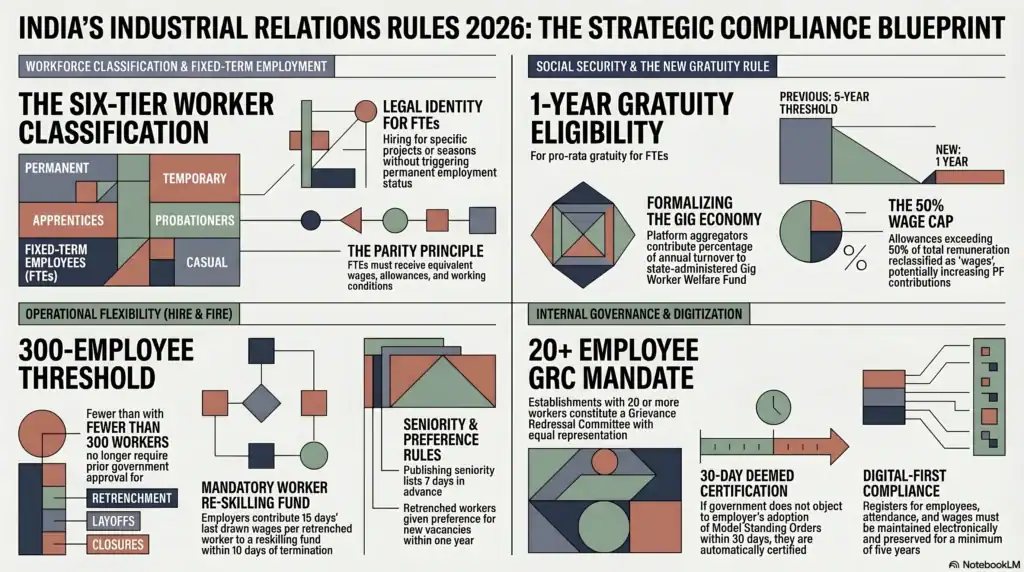
Understanding the Industrial Relations (Central) Rules 2026
The Industrial Relations (Central) Rules, 2026, commonly referred to as the IR Rules, are the operational rules that bring the Industrial Relations Code, 2020, to life.
Alongside the rules issued under the Code on Wages, 2019, the Code on Social Security, 2020, and the Occupational Safety, Health and Working Conditions Code, 2020, they now form the backbone of India’s restructured labour law system. In practical terms, this means 29 older central labour laws are being folded into a single legislative framework, something the government has positioned as one of the most significant labour law simplifications in decades. You can read the full explanatory analysis here.
The IR Rules set out how some of the most important parts of the Code will actually function in day-to-day business life. That includes how negotiating unions are recognised, how fixed-term employment contracts are structured, how workplace grievances must be handled, what procedures apply during retrenchment, and how employers are expected to operate inside a more digital-first compliance ecosystem.
For employers who assumed these codes would remain stuck in implementation limbo, that assumption no longer holds. The effective date is now fixed: May 8, 2026.
And with that, the compliance clock has already started.
Key Objectives of the New Labour Codes
At the heart of India’s labour reforms are three closely connected policy goals. On paper, they sound straightforward. In practice, they could reshape how businesses hire, manage, and scale their workforce over the next decade.
First objective is simplification
For years, India’s labour law system was often described as fragmented, with 29 separate central laws, overlapping definitions, different compliance thresholds, and procedures that sometimes contradicted each other. For employers, especially those operating across states or sectors, compliance could feel less like policy management and more like navigating a maze. The new Labour Codes attempt to change that by replacing those scattered statutes with four consolidated codes built around a shared legal vocabulary.
Second objective is formalization
A huge share of India’s workforce still operates outside formal employment structures—gig workers, platform workers, fixed-term staff, contract labour, seasonal workers. The new framework tries to bring more of these workers into a statutory system where wages, benefits, and social protections are clearer and more enforceable. In other words, the state isn’t just regulating traditional employer-employee relationships anymore; it’s trying to catch up with how work actually looks in 2026.
Third objective is flexibility
This is where much of the debate begins.
The government’s position is that employers, especially in manufacturing, technology, logistics, and services, need greater workforce flexibility if India wants to compete globally and encourage long-term formal hiring. The argument is simple: if hiring and restructuring become less legally unpredictable, businesses may be less hesitant to grow headcount in the first place.
Industry bodies including FICCI and NASSCOM have broadly welcomed the reforms, arguing that a clearer and more predictable labour framework is essential if India wants to scale both its manufacturing base and its global services sector.
Critics, though, see it differently.
Trade union groups and labour-rights commentators argue that several provisions, particularly around retrenchment thresholds and the formalisation of fixed-term employment, shift bargaining power toward employers. A detailed critique appears here.
Whether these reforms ultimately create more secure employment, or simply more flexible employment, will depend less on the text of the law, and more on how consistently it’s enforced across states, sectors, and industries.
Implementation Date and Immediate Employer Obligations
One of the biggest misconceptions around India’s Labour Codes was that implementation would keep getting pushed further into the future.
That window has now closed.
The Industrial Relations (Central) Rules, 2026 officially came into force on May 8, 2026, the date they were notified in the Official Gazette. That’s a critical distinction. The codes themselves were passed years ago, but without supporting rules, they remained largely inactive. That changed after the draft IR Rules were published on December 30, 2025, inviting stakeholder comments before the final rules were notified in May 2026, as reported here.
For employers, the first question isn’t what do the rules say?
It’s do these rules apply directly to us?
That depends on who the “appropriate government” is under the Code.
The central rules directly govern sectors such as banking, insurance, telecommunications, civil aviation, railways, mines, oil fields, major ports, and central public sector undertakings.
For most private businesses, IT companies, manufacturers, retailers, startups, and service providers, the relevant authority will usually be the state government. That means employers operating across multiple states may soon face different implementation timelines or procedural requirements depending on where they operate.
Which makes one thing urgent: jurisdictional clarity.
Businesses need to identify where they fall under the framework now—not after an inspection notice arrives.
At a minimum, employers should already be reviewing:
- Existing standing orders
- Payroll systems and wage structures
- Fixed-term employment contracts
- Worker grievance mechanisms
- Employee recordkeeping and digital compliance processes
Because as of May 2026, non-compliance isn’t theoretical anymore. It carries both civil and, in certain cases, criminal consequences under the consolidated framework.
Impact on Hiring Strategies and Fixed-Term Employment
Of all the reforms introduced under the Industrial Relations Rules, this may be the one HR teams and business leaders will feel first, and perhaps most directly.
The new framework fundamentally changes how employers can structure flexible hiring.
For years, businesses across India relied on a patchwork of temporary arrangements, project contracts, third-party staffing models, and informal workarounds to meet fluctuating workforce demands. Some of those arrangements worked. Some ended in labour disputes. Many sat in a grey zone.
The IR Rules attempt to bring structure to that uncertainty.
For the first time at the central level, India now has a clearly defined legal framework for fixed-term employment, one that gives employers more flexibility in workforce planning, but also places much tighter obligations around pay parity, benefits, and compliance.
For businesses, that’s both an opportunity and a warning.
Done correctly, fixed-term employment can create a lawful, commercially efficient staffing model. Done casually, or treated as a cheaper substitute for permanent hiring, it could create significant legal exposure.
The Formal Recognition of Fixed-Term Employees (FTEs)
The Model Standing Orders, notified alongside the IR Rules, formally classify workers into six categories:
- Permanent workers
- Temporary workers
- Apprentices
- Probationers
- Fixed-term employees (FTEs)
- Casual workers
This classification now applies across manufacturing, mining, and services, giving fixed-term employees a distinct legal identity under central labour law for the first time.
You can read the Business Standard coverage of the Model Standing Orders.
That legal recognition matters more than it might appear at first glance.
Historically, one of the biggest sources of labour litigation in India came from “temporary” arrangements that didn’t look temporary in practice. Workers hired for defined periods were often retained continuously, renewed repeatedly, or assigned roles indistinguishable from permanent staff. Courts, understandably, sometimes treated those arrangements as disguised permanent employment relationships.
The new FTE framework creates a cleaner legal pathway.
Employers can now engage workers for a specific project, business cycle, seasonal requirement, or defined duration, without automatically triggering permanent employment classification, provided the contract genuinely complies with the framework.
That last part matters. The law offers flexibility, yes, but not a loophole.
What Are the New Rules for Contract Workers in 2026?
This is one of the most searched HR questions right now, and the confusion is understandable because two categories often get mixed together: fixed-term employees and contract labour.
They are not the same.
A fixed-term employee is hired directly by the employer for a clearly defined period or project duration. There’s a direct employment relationship.
Contract labour, on the other hand, typically works through a licensed contractor or staffing intermediary, with the worker supplied to a principal employer.
That distinction isn’t just technical, but it affects compliance obligations.
Under the new framework, FTEs fall directly under the IR Rules and the Model Standing Orders, while contract labour continues to be regulated through a combination of the Social Security Code and the Occupational Safety, Health and Working Conditions framework.
And there’s an important guardrail built into the FTE structure:
Employers cannot use fixed-term contracts as a long-term mechanism to avoid permanent employment obligations.
The rules are explicit. FTEs must receive statutory benefits, including wages, allowances, gratuity, and social security contributions, on a pro-rata basis. The role must also have a legitimate fixed-term character, whether project-based, seasonal, or operationally time-bound.
Employers who continuously rotate workers through back-to-back short-term contracts simply to avoid permanent classification may face enforcement action and, as legal commentators have noted, substantial labour court exposure.
That’s where many organisations may get caught, not in hiring FTEs, but in misusing them.
Parity in Wages and Working Hours
This is where fixed-term employment becomes commercially very different from informal staffing.
And frankly, more expensive than some employers may expect.
The IR Rules make the parity principle unmistakably clear:
A fixed-term employee must receive wages, allowances, statutory benefits, and working conditions equivalent to a permanent worker performing similar or comparable work.
That means if an FTE joins on a three-month project assignment, they are not entitled to “project pay” or reduced benefits simply because the contract is shorter.
They may still be temporary in duration.
But under the law, they cannot be treated as second-tier employees.
In practice, this means an FTE may be entitled to:
- Equivalent basic salary
- Dearness allowance
- Provident Fund contributions
- ESIC benefits
- Leave accruals
- Pro-rata gratuity where applicable
The Code on Wages rules also reinforce working-hour protections.
Normal working hours remain capped at 48 hours per week, while the traditional eight-hour daily standard remains in place for daily wage structures. Overtime beyond those limits must still be paid at twice the regular rate.
As Business Standard noted, this flexibility in weekly scheduling may even support four-day workweek arrangements in certain sectors.
For HR and payroll teams, the implication is immediate:
Every fixed-term compensation structure now needs to be audited—not just for legal compliance on paper, but for actual parity in practice.
Because under the new framework, hiring flexibly does not mean hiring cheaply.
The Social Security Code 2026: Expanding the Safety Net
If the Industrial Relations Rules reshape how businesses hire and manage workers, the Social Security Code reshapes something just as important—how those workers are protected once they’re inside the system.
This is the second major pillar of India’s 2026 labour reforms, and for payroll teams, HR leaders, finance departments, and platform businesses, its impact could be immediate.
At its core, the Social Security Code deals with the formal safety net of employment: provident fund contributions, ESIC coverage, gratuity payments, welfare schemes, and statutory benefits that workers rely on when employment becomes uncertain, interrupted, or long-term.
The central rules notified in May 2026 significantly expand both who gets covered and when those benefits start applying.
For employers who previously built workforce models around short-term hiring or non-traditional labour structures, that expansion matters. A lot.
Gratuity Changes: The One-Year Rule for Fixed-Term Staff
One of the biggest practical changes under the 2026 framework involves gratuity eligibility for fixed-term employees.
Under the old Payment of Gratuity Act, 1972, the rule was simple: an employee generally became eligible for gratuity only after completing five continuous years with the same employer.
That five-year threshold shaped workforce planning for decades.
Some viewed it as a reward for long service. Others argued it quietly discouraged retrenchment of long-serving employees because the financial obligation became harder to ignore over time.
The new framework changes that—at least for fixed-term employees.
Under the IR Code and the rules notified in May 2026, a fixed-term employee who completes the full term of their contract can become eligible for pro-rata gratuity, even if that contract lasts only a single year.
That’s a significant departure from the old regime.
The Economic Times provides a detailed analysis of the practical impact of this provision.
For payroll teams, this isn’t a theoretical policy update—it changes financial provisioning from day one.
Gratuity can no longer be treated as a long-term liability reserved for permanent staff. If an organisation hires FTEs, that liability needs to be built into payroll planning from the beginning of the contract.
The formula for pro-rata gratuity remains:
(Last Drawn Wage ÷ 26) × 15 × Number of Years Served
Any completed six-month period is typically treated as a full year for calculation purposes.
The Khaitan & Co. Employment Law Bulletin provides a detailed legal analysis of gratuity calculation methodology.
For employers still using legacy payroll assumptions, this is one of the areas most likely to trigger compliance gaps.
Extending Coverage to Gig and Platform Workers
This may be one of the most politically significant parts of the Social Security Code.
And arguably one of the most overdue.
For years, India’s gig economy expanded faster than labour law could keep up. App-based drivers, food delivery workers, freelance platform professionals, warehouse partners, hyperlocal service workers—millions of people built livelihoods through digital platforms while sitting outside the traditional social protection system.
No provident fund.
No structured welfare coverage.
Often no clear employer-employee classification at all.
The Social Security Code changes that, at least partially.
For the first time, the law creates a dedicated framework for gig workers and platform workers, requiring aggregators—the companies operating these platforms—to contribute a prescribed percentage of annual turnover toward a Gig Worker Welfare Fund, administered by state governments.
The rules notified in May 2026 now add operational detail: registration processes, contribution schedules, and benefit categories including life insurance, disability protection, maternity benefits, healthcare support, and provident fund-style savings structures.
As The India Forum’s analysis notes, one major legal tension remains unresolved:
The Code extends welfare benefits to gig workers without fully classifying them as employees.
That means they may gain access to certain protections while still remaining outside other rights traditionally tied to employment, including trade union protections or unfair dismissal remedies.
Business observers at Ius Laboris have characterised this as a carefully calibrated political compromise that satisfies neither the full demands of the gig worker rights movement nor the demands of platform companies for total regulatory exemption.
For platform companies operating across India, the immediate obligations are practical:
- Register as a covered aggregator
- Determine turnover-linked contribution liability
- Track state-level implementation rules
- Begin making welfare contributions on the prescribed schedule
And that last part may get complicated fast.
Because several states are still finalising their own implementation frameworks, businesses operating across multiple jurisdictions may face a patchwork of overlapping obligations in the months ahead.
The broader significance, though, goes beyond compliance.
India’s platform economy now employs tens of millions of workers. Estimates from NITI Aayog suggest that India’s services sector, which includes a large share of gig labour, accounts for nearly 30% of the country’s workforce.
Even partial inclusion of that workforce into formal social protection could reshape labour economics in India for years to come.
How Will the New Wage Code Affect Take-Home Salary?
This is easily one of the most searched labour-law questions among Indian employees in 2026, and honestly, it makes sense.
Whenever wage laws change, people usually want to know one thing first:
Will I take home more money… or less?
The answer, frustratingly, isn’t universal. It depends on how your salary is currently structured.
Under the new Code on Wages rules, the government has tightened the legal definition of “wages.” Certain salary components, such as house rent allowance, conveyance allowance, bonuses, and other special allowances, can still sit outside the wage calculation. But there’s now an important limit:
If the total value of these excluded components crosses 50% of total remuneration, the excess amount must be reclassified as “wages” for statutory purposes.
And that’s where the real impact begins.
For many employees in sectors like IT, ITES, BFSI, consulting, and professional services, salary structures have historically been designed with a lower basic salary and a heavier allocation toward allowances. It wasn’t unusual to see basic pay sitting at 30–35% of total CTC.
That structure often helped keep statutory contributions, especially Provident Fund obligations, relatively lower.
Under the new rules, that may no longer work.
If an employer’s compensation structure exceeds the new exclusion limits, part of those allowances may now need to be folded back into wages. In practical terms, that often means a higher basic salary.
And a higher basic salary usually means:
- Higher employee PF deductions
- Higher employer PF contributions
- Potentially lower immediate take-home pay
- Higher long-term retirement savings accumulation
So yes, some employees may notice a short-term dip in monthly in-hand salary.
But that doesn’t automatically mean they’re losing value. In many cases, it’s a shift from immediate liquidity toward stronger long-term social security accumulation.
That’s why this reform has generated such mixed reactions.
Employees focused on monthly cash flow may feel the pinch.
Employees thinking in terms of retirement corpus, gratuity, and statutory protection may see it differently.
Managing Director at EY India’s People Advisory noted in coverage that the new rules bring “clearer structure to core areas,” including wage fixation and payroll deductions.
For employers, though, this isn’t just an employee communication issue.
It’s a payroll architecture issue.
CTC models, salary templates, PF provisioning logic, payroll software configurations—everything may need review.
Because under the 2026 framework, wage structuring is no longer just about compensation strategy.
It’s compliance strategy too.
“Hire and Fire” Policies: Retrenchment, Layoffs, and Dispute Resolution
Few parts of the 2026 labour reforms have generated as much debate, or as many headlines, as the provisions dealing with layoffs, retrenchment, and business closures.
Supporters call it long-overdue modernization.
Critics call it the beginning of a “hire and fire” era.
The truth, as usual, sits somewhere in the middle.
What the new framework does is not eliminate worker protections. It does, however, significantly change when the government steps in, and when employers can make workforce decisions without prior approval.
For businesses, particularly in manufacturing, logistics, infrastructure, and labour-intensive services, this could materially change hiring strategy.
Because in many cases, the ability to hire at scale has always been linked to one uncomfortable question:
If the market turns, how hard is it to restructure?
The new Code changes that calculation.
The 300-Employee Threshold for Layoffs and Closures
This is arguably the single most commercially significant reform under the Industrial Relations Code.
Under the old Industrial Disputes Act, 1947, establishments employing 100 or more workers generally needed prior government approval before carrying out retrenchment, layoffs, or closure.
That threshold shaped business behaviour for decades.
In fact, many employers, especially mid-sized businesses, were accused of deliberately keeping headcount below 100 simply to avoid entering a more restrictive compliance regime.
The new IR Code changes that threshold from 100 workers to 300 workers at the central level.
That means establishments employing fewer than 300 workers can now carry out retrenchment or closure without first obtaining government approval—though they must still comply with notice periods, compensation obligations, and procedural safeguards under the Code.
For many businesses, that creates significantly more operational flexibility.
As Atul Gupta, Partner at Trilegal, explained in The Economic Times, state governments may even choose to prescribe thresholds higher than 300.
That creates an interesting competitive dynamic.
States looking to attract investment may choose more employer-friendly thresholds, potentially influencing where businesses expand, hire, or establish new industrial operations.
For employers currently operating at or above 300 employees, however, the procedural obligations remain serious.
According to this guide, employers retrenching workers with at least one year of continuous service must notify the central government and the deputy chief labour commissioner within three days of issuing a retrenchment notice.
There are additional procedural requirements too:
- Seniority lists must be published at least seven days before retrenchment
- If vacancies arise within one year, preference must be given to eligible retrenched workers
- Vacancy notices must be published at least fifteen days before those positions are filled
And closures carry their own compliance burden.
Closure notices must generally be issued at least 60 days before closure, with formal approval applications submitted at least 90 days before the proposed closure date.
So yes, the threshold has shifted.
But procedural compliance certainly hasn’t disappeared.
Mandatory Grievance Redressal Committees (GRCs)
One of the quieter, but potentially more operationally significant, changes under the IR Rules is the introduction of mandatory Grievance Redressal Committees (GRCs).
And unlike some other provisions that affect only large employers, this one reaches much further.
Every industrial establishment employing 20 or more workers must now constitute a GRC.
That threshold is low enough to capture a large share of India’s formal employers, including many businesses that may never have operated a structured internal grievance mechanism before.
The committee structure itself is specific:
- Equal representation from employers and workers
- Maximum of ten members
- Adequate representation of women workers, based on the actual proportion of women employed in the establishment
That last requirement matters.
It embeds diversity and workplace representation directly into compliance obligations, not as a policy aspiration, but as a statutory expectation.
The GRC also formalizes grievance escalation.
Workers can now file complaints electronically, and unresolved disputes may escalate to conciliation officers if internal resolution fails within prescribed timelines.
The India Briefing compliance checklist notes that this will push businesses toward stronger internal documentation, more structured dispute handling, and clearer employee communication channels.
And there’s one compliance trap many organisations may miss:
If your company already operates an Internal Complaints Committee (ICC) under workplace harassment laws, that does not replace the GRC.
The two serve different legal purposes.
They cannot be merged.
Separate constitution, records, escalation processes, and documentation requirements must be maintained for both.
The BDO India compliance alert provides a consolidated summary of committee obligations under all four codes.
The New Worker Re-skilling Fund Explained
This is one of the genuinely new concepts introduced under the IR Code, and one that many employers are only beginning to factor into workforce restructuring costs.
The Worker Reskilling Fund, established under Section 83, has no true equivalent in India’s older labour law framework.
And its purpose is clear:
If employers are being given greater flexibility to retrench workers, the system must also create support mechanisms for workers being displaced.
Under the new rules, employers retrenching workers must contribute an amount equal to 15 days’ last drawn wages for each retrenched worker into the Worker Reskilling Fund.
And that contribution must be made within 10 days of retrenchment.
That’s not a recommendation.
It’s a statutory obligation.
Importantly, this contribution is in addition to any retrenchment compensation already payable under the law.
So, for HR and finance teams, retrenchment costs now need to be recalculated.
The Worker Reskilling Fund is designed to support:
- Skill development
- Vocational retraining
- Employment transition support
- Job placement assistance
As India Briefing’s analysis points out, the provision reflects a broader policy attempt to balance labour flexibility with worker transition support, especially in sectors increasingly shaped by automation and digital transformation.
For employers planning restructuring in 2026 or beyond, this is no longer an optional budgeting assumption.
It’s a real line item.
Can a Company Fire You Without Notice Under the New Labour Laws?
This is probably one of the most emotionally charged questions surrounding the new labour codes.
The short answer?
No.
Despite all the “hire and fire” headlines, the new framework does not remove protections against arbitrary dismissal.
Workers covered under the Code still cannot be terminated without due process.
That process continues to include:
- Notice of charges or grounds for termination
- A proper domestic enquiry where misconduct is alleged
- A fair opportunity for the worker to respond
- Payment of statutory dues, including gratuity or retrenchment compensation where applicable
So, what changed?
Not the worker’s right to procedural fairness.
What changed is the government approval threshold for large-scale retrenchment decisions, particularly the 300-worker threshold discussed earlier.
For individual disciplinary terminations, the legal safeguards remain largely intact.
The Model Standing Orders now provide more detailed sector-specific guidance around misconduct categories, enquiry procedures, disciplinary actions, and appeal structures.
Workers aggrieved by termination decisions may still approach the Industrial Tribunal, a forum whose continuity was upheld by the Kerala High Court in April 2026, in a ruling as discussed here.
So, while the framework may be more flexible for employers at scale…
It’s not a free pass for arbitrary dismissal.
Transitioning Your Business: A 2026 Compliance Checklist
Understanding the law is one thing.
Actually, implementing it inside a business? That’s where things usually get messy.
Policies need rewriting. Payroll systems need reconfiguring. Managers need training. Legal teams need to interpret grey areas. HR teams, already carrying half the operational weight in most organisations, suddenly become the front line of compliance.
That’s the real challenge of the 2026 labour reforms.
The Industrial Relations Rules don’t just introduce new obligations. They demand operational discipline—across documentation, internal governance, payroll, worker communications, and digital recordkeeping.
For many businesses, especially those that haven’t updated employment systems in years, this isn’t a minor compliance refresh.
It’s a structural transition.
Updating Model Standing Orders via Deemed Certification
One of the more practical changes under the new framework relates to Model Standing Orders (MSOs).
Under the IR Rules, separate MSOs now apply across:
- Manufacturing
- Mining
- Services
That’s a notable shift from the older framework under the Industrial Employment (Standing Orders) Act, 1946, where a single model framework often had to stretch across industries that looked nothing alike.
And honestly, it showed.
A labour framework built in the 1940s was never designed for platform work, hybrid teams, project staffing, or modern service-sector employment.
The new rules attempt to fix that.
Employers who choose to adopt the government’s prescribed Model Standing Orders, instead of drafting their own customised certified standing orders, must notify the certifying officer of their intention to adopt them.
That notification can now be submitted:
- Electronically
- Physically
- Through speed post
But the real procedural change lies in what happens next.
The IR Rules introduce something called deemed certification.
If the certifying officer does not raise objections within 30 days of receiving the employer’s notification, the standing orders are automatically treated as certified.
That may sound procedural, but it removes one of the most frustrating bottlenecks in India’s labour administration system.
Under the old regime, employers could wait months, sometimes longer, for formal approval.
That delay now has a deadline.
The full compliance blueprint is available here.
For businesses with existing certified standing orders, the job isn’t simply to adopt new templates.
It’s to review whether existing service conditions align with the new framework.
And in many cases, they probably won’t.
The new MSOs include provisions that older frameworks often lacked entirely, including:
- Formal recognition of fixed-term employment
- Electronic notices and digital recordkeeping
- Internal Complaints Committee references
- Grievance Redressal Committee obligations
Organisations adopting the new MSOs must also communicate these service conditions to workers in the language understood by the majority of the workforce.
Which makes sense. Compliance that workers can’t actually understand isn’t much of a compliance system.
The Cyril Amarchand Mangaldas client alert provides detailed guidance on the MSO adoption process and deemed certification timelines.
Digitizing Payroll and Employee Records
If there’s one theme running through the 2026 reforms, it’s this:
Paper-based compliance is slowly dying.
The IR Rules push employers toward a fully digitised compliance environment—one where registers, notices, payroll records, attendance logs, statutory filings, and employment documentation increasingly live inside integrated digital systems.
Under the new framework, employers may electronically maintain:
- Employee registers
- Salary registers
- Attendance records
- Overtime logs
- Wage slips
- Statutory notices and filings
And these records must generally be preserved for at least five years.
For some organisations, this will feel natural.
For others—especially businesses still running legacy HRMS platforms, spreadsheets stitched together over a decade, or semi-manual payroll workflows—this could be one of the most expensive parts of the transition.
Because digitisation here isn’t just about storage.
It’s about data completeness.
The new Model Standing Orders now require worker records to include details that many employers historically treated as optional, including:
- Mobile phone number
- Email address
- ESI number
- Gratuity nominee information
- Training history
That reflects a broader government push toward a unified employer compliance portal, where filings involving PF, ESIC, gratuity nominations, standing orders, and grievance committee records may eventually sit inside one integrated ecosystem.
The NASSCOM policy brief outlines how the technology sector is engaging with the Ministry of Labour on this unified portal design.
For organisations still operating outdated payroll systems, the checklist now gets longer.
Your systems may need to handle:
- Pro-rata gratuity calculations for FTEs from day one
- 48-hour weekly working-hour tracking
- Overtime trigger automation
- Wage slip generation in prescribed formats
- Worker Reskilling Fund calculations
- Seniority list maintenance
- Electronic filing of statutory forms and notices
That’s not a cosmetic upgrade.
That’s infrastructure.
Businesses should strongly consider appointing a dedicated labour-code compliance lead—or working with specialist employment counsel—to run a gap analysis across existing HR, payroll, and governance systems.
The LKS law firm’s Employment Law recent updates tracker is a useful resource for tracking ongoing state-level developments as additional rules are notified.
Frequently Asked Questions: Industrial Relations Rules 2026
Under the 2026 rules, fixed-term employees (FTEs) are legally entitled to receive pro-rata gratuity after completing just one year of continuous service. This entirely bypasses the traditional five-year eligibility threshold required for regular permanent staff.
The Industrial Relations Rules 2026 raise the threshold to 300 employees. Establishments employing fewer than 300 workers can execute lay-offs, retrenchments, or closures without seeking prior government permission, provided they notify the government within 3 days of notice.
When retrenching a worker, employers are statutorily obligated to contribute an amount equivalent to 15 days’ wages of that employee into the government’s Worker Reskilling Fund. This contribution must be paid within 10 days of the retrenchment.
A formal Grievance Redressal Committee is mandatory for any establishment employing 20 or more workers. The committee must have equal representation of employers and workers, a maximum cap of 10 members, and proportional representation of women.
All covered industrial establishments must maintain statutory registers (including employee records, attendance logs, and wages) electronically for a minimum of 5 years. These digital databases must explicitly capture employee mobile numbers, emails, and ESI numbers.
| Provision Category | Key Regulation & Core Keywords | Applicability Threshold | Employer Obligation | Worker Benefits & Protections | Compliance & Execution Requirements |
| Hiring & Contracts | Fixed-Term Employment (FTE) Parity: Formal legal recognition of FTEs with statutory wage and benefit parity. | Manufacturing, mining, and services sectors. | Provide wages, allowances, and statutory benefits equivalent to permanent staff; pay pro-rata gratuity after 1 year. | Full legal identity; complete parity in working conditions; pro-rata eligibility for PF, ESIC, and statutory leaves. | • Update employment contract templates. • Audit compensation structures for parity. • Maintain digital registers with mobile/email fields. |
| Statutory Benefits | Fixed-Term Gratuity Reduction: Lowering of the gratuity eligibility threshold specifically for contract-bound fixed-term staff. | Fixed-term employees completing a contract of at least one year. | Pay pro-rata gratuity using the mandatory statutory formula: (Last Drawn Wage / 26) × 15 × Years Served. | Direct entitlement to gratuity payouts after just 1 year instead of the traditional 5-year permanent threshold. | • Incorporate pro-rata gratuity liabilities into active payroll planning from day one of the contract. |
| Social Security | Gig Worker Welfare Fund: Statutory establishment of a centralized welfare ecosystem for non-traditional workforces. | Digital aggregators and on-demand platforms. | Contribute a prescribed percentage of annual turnover directly to the designated Gig Worker Welfare Fund. | Access to state-backed life/disability insurance, healthcare support, and maternity benefits. | • Register enterprise as a covered aggregator. • Set up internal tracking for state-by-state contribution schedules. |
| Operational Policies | Retrenchment & Layoff Thresholds: Increase in baseline limits required for prior government permission regarding closures. | Industrial establishments employing fewer than 300 workers. | Notify government within 3 days of notice; contribute 15 days’ wages per worker to the Worker Reskilling Fund. | 15 days’ paid wages for upskilling; strict seniority-based preference (last-in, first-out) for future vacancies. | • Publish company seniority lists 7 days prior to action. • Remit reskilling contributions within 10 days of retrenchment. |
| Dispute Resolution | Grievance Redressal Committees (GRC): Mandated internal machinery for formal workplace dispute resolution. | Establishments employing 20 or more workers. | Constitute GRC with equal employer-worker representation (max 10 members) and proportional women representation. | Highly structured internal forum for swift dispute resolution; right to file complaints electronically. | • Maintain GRC records entirely separate from Internal Complaints Committee (ICC) files. • Implement digital escalation workflows. |
| Digital Compliance | Electronic Recordkeeping: Shift from physical ledgers to mandatory electronic maintenance of statutory files. | All industrial establishments falling under Central Rules jurisdiction. | Maintain secure digital registers for employees, wages, and attendance; retain records for at least 5 years. | High transparency; accurate tracking of employment history; streamlined digital delivery of itemized wage slips. | • Ensure digital databases capture mobile numbers, emails, and ESI/UAN codes. • Adopt Model Standing Orders electronically. |
The Road Ahead: Balancing Flexibility, Fairness, and Formalization
The Industrial Relations Rules 2026 are bigger than a compliance update.
They represent a deeper shift in how India thinks about work, labour protections, investment, and economic scale.
At one level, the reforms clearly aim to make business operations more flexible.
At another, they attempt to extend protections to categories of workers who were historically excluded from formal labour law.
And somewhere in the middle sits the real test:
Can India build a labour system that is flexible enough for growth without becoming fragile for workers?
That answer won’t come from legislation alone.
It will depend on three things:
1) State-Level Implementation
The central rules directly govern only a portion of India’s workforce. For millions of workers and thousands of employers, the real operational impact will depend on how state governments draft and notify their own rules.
As Puneet Gupta of EY India noted in Business Standard, alignment between central and state frameworks will be critical because divergence could create very different compliance expectations for businesses operating across multiple states.
2) Enforcement Infrastructure
Laws only matter if institutions can enforce them.
That means labour inspectors, conciliation officers, industrial tribunals, digital filing portals, and dispute-resolution systems all need to function—not just exist on paper.
Trade union bodies cited here remain sceptical that enforcement will be equally accessible to the most vulnerable workers, especially in informal manufacturing and platform-based employment.
3) How Seriously Businesses Treat This Transition
Because May 2026 isn’t the start of another consultation cycle.
It’s the start of enforcement.
The Grievance Redressal Committee must be constituted.
Worker Reskilling Fund liabilities must be budgeted.
Standing Orders need review.
Payroll systems need updating.
Employment records need digitisation.
And internal governance systems need to catch up—fast.
The Daily Pioneer’s legal commentary offers a useful counterpoint between the government’s optimism and the legal caution many businesses are still feeling.
The real question now isn’t whether India’s labour reforms are coming.
They’re here.
The real question is whether your business is genuinely ready for what comes next.




Discussion (2)
Leave a Reply