
Not Receiving Gratuity? How to Calculate Your Due and File a Form N Grievance in 2026
Employer Not Paying Gratuity? Understanding Your Statutory Rights
Every year, thousands of employees leave jobs they have invested years of effort into, only to discover that their gratuity payment is delayed, reduced, or ignored altogether. Some are told the company is facing cash flow issues. Others receive only a portion of what they believe they are owed, with little or no explanation. Many hear nothing at all. This is where you need to file Form N for unpaid gratuity.
If you are in that position, there is one thing you should know from the outset: gratuity is not a goodwill gesture or an optional payout. It is a statutory right protected under the Payment of Gratuity Act, 1972. Employers who fail to pay gratuity, or who delay payment beyond the legally prescribed timeline, are not simply acting unfairly. They may be violating the law and exposing themselves to legal consequences.
This guide explains the process from start to finish. You’ll learn how to confirm your eligibility, calculate the exact gratuity amount due, submit a formal claim through Form I, seek statutory interest for delayed payments under Section 7, and, if necessary, file a Form N application before the Controlling Authority. Throughout the guide, the information is supported by primary legal sources and official government references so you can approach your claim with confidence.
At a Glance: File Form N For Unpaid Gratuity
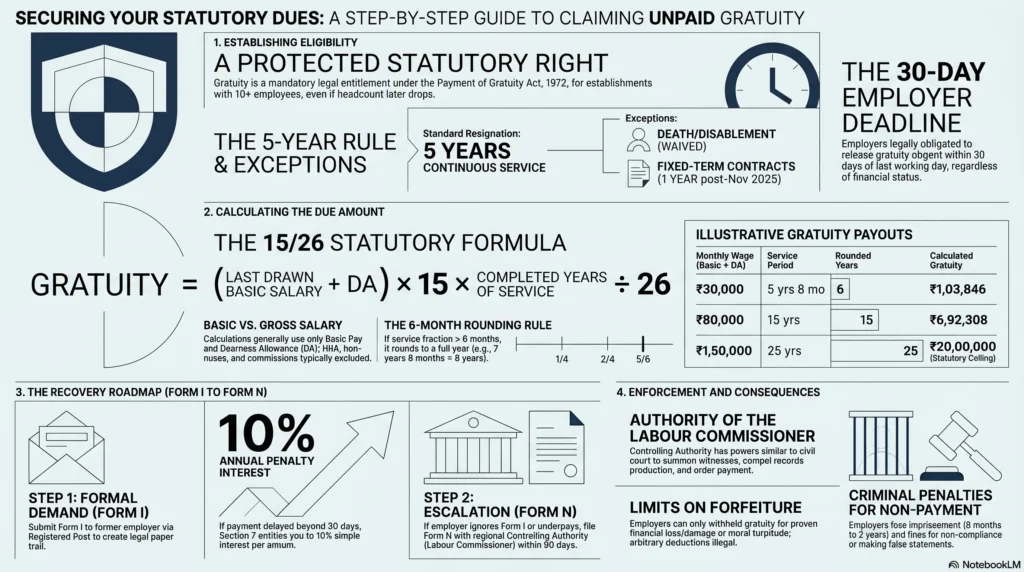
A Protected Legal Entitlement: Gratuity is not an optional bonus; it is a strict statutory right under the Payment of Gratuity Act, 1972 for employees who complete five years of continuous service (with exceptions for fixed-term contracts, death, or disablement).
The 30-Day Employer Deadline: By law, your employer must calculate and release your gratuity payout within 30 days of your last working day, regardless of the company’s financial status.
The 15/26 Manual Calculation Formula: For private sector employees, the exact due is calculated as: (Last Drawn Basic Salary + DA) × 15 × Completed Years of Service ÷ 26. Gross salary is generally not used for this calculation.
Entitlement to 10% Penalty Interest: If your employer fails to pay within the 30-day statutory window, Section 7 of the Act entitles you to claim 10% simple interest per annum on the delayed amount.
Prerequisite Action (Form I): Before escalating to authorities, you must formally demand your dues by submitting Form I to your former employer via registered post with acknowledgment due.
Escalation via Form N: If the employer ignores Form I, rejects the claim, or underpays, you have 90 days to file a Form N grievance with your regional Controlling Authority (Labour Commissioner) to legally compel payment.
Understanding Your Rights Under the Payment of Gratuity Act, 1972
The Payment of Gratuity Act, 1972 is the law that gives eligible employees the right to receive gratuity after completing a qualifying period of service. It applies to a wide range of establishments, including factories, mines, oilfields, plantations, ports, railways, shops, and commercial establishments. In practical terms, this means a large portion of India’s organised workforce falls within its scope. You can read the full text of the Act on India Code.
One of the most important aspects of the Act is its coverage threshold. Any establishment that employs ten or more people becomes subject to the Act. What many employees do not realise is that once an organisation comes under the Act, it generally remains covered even if its workforce later drops below ten employees. In other words, an employer cannot avoid gratuity obligations simply because the business has downsized. The Puducherry government’s overview of the Act confirms this position.
The Act is enforced through authorities specifically appointed under Section 3, known as Controlling Authorities. Depending on your jurisdiction, this is usually the District Labour Officer, Assistant Labour Commissioner, or Regional Labour Commissioner. This distinction matters because gratuity disputes are not ordinarily handled through Labour Courts under the Industrial Disputes Act. Employees often waste valuable time pursuing the wrong forum after receiving incorrect advice. If your dispute relates specifically to unpaid gratuity, your primary remedy lies before the Controlling Authority designated under the Payment of Gratuity Act.
Understanding this framework is important because it establishes a simple but powerful principle: gratuity is a legal right backed by a dedicated enforcement mechanism. If an employer refuses to honour that right, the law provides a direct path for employees to seek recovery.
Minimum Tenure and Eligibility Requirements
Many employees assume gratuity eligibility is straightforward: complete five years of service and you qualify. In reality, the rules are a little more nuanced, and in several situations, they work in the employee’s favour.
The Five-Year Rule
For most employees, gratuity becomes payable after completing at least five years of continuous service. The key phrase here is continuous service. Under Section 2A of the Act, available at India Code, continuous service is broader than simply showing up for work every day.
Periods of authorised leave, sickness, accidents, and other approved absences are generally counted as part of continuous service. Courts have repeatedly recognised that temporary interruptions which are sanctioned by the employer do not automatically break continuity.
The five-year requirement typically applies when gratuity becomes payable because of:
- Superannuation, meaning you reach the retirement age specified by your employer
- Retirement or resignation from service
- Retrenchment or termination that falls within the legal definition of retrenchment
Death and Permanent Disablement: An Important Exception
The law takes a different approach when employment ends because of death or permanent disablement resulting from an accident or disease.
In these cases, the five-year minimum service requirement does not apply at all. Even an employee with a relatively short period of service may be entitled to gratuity. Where the employee has passed away, the amount becomes payable to the nominee named by the employee, or to the legal heirs if no nomination exists.
The Kerala Labour Department’s FAQ makes this position clear.
Fixed-Term Employees
A significant change came with the Code on Social Security, 2020, which was operationalised from November 2025.
Fixed-term employees are now eligible for gratuity on a pro-rata basis after completing just one year of continuous service. This is a major shift from the traditional framework and extends gratuity protection to many contractual employees who previously struggled to qualify because their contracts ended before reaching the five-year mark.
Additional details on this development can be found here.
What Counts as Continuous Service?
This is an area where employees often underestimate their rights.
Many people believe that any gap in employment automatically resets the clock for gratuity purposes. That is not always true. Section 2A specifically includes several situations within the definition of continuous service, including periods affected by:
- Approved leave
- Lay-offs
- Lockouts
- Strikes that are not illegal
The reality of modern employment can be complicated. Businesses merge, divisions are transferred, companies are acquired, and employees are moved between entities. In some of these situations, service with a predecessor organisation may still count toward gratuity eligibility with the successor employer.
For discussions and examples relating to mergers and acquisitions, see this guide..
What About Establishments with Fewer Than Ten Employees?
The Payment of Gratuity Act generally applies to establishments employing ten or more people. However, employees working in smaller organisations should not automatically assume they have no entitlement.
Some employers voluntarily provide gratuity through employment contracts, company policies, or service agreements. In addition, certain state-specific notifications may create obligations beyond the central framework. Reviewing your appointment letter and any applicable state regulations is always worthwhile before concluding that gratuity is unavailable.
Eligibility at a Glance
| Reason for Separation | Minimum Service Required | Payable To |
| Superannuation | 5 years continuous service | Employee |
| Retirement or Resignation | 5 years continuous service | Employee |
| Retrenchment | 5 years continuous service | Employee |
| Death | No minimum service requirement | Nominee / Legal Heir |
| Permanent Disablement | No minimum service requirement | Employee |
| Fixed-Term Contract End (post-Nov 2025) | 1 year continuous service | Employee |
Understanding these eligibility rules before filing a claim can save considerable time and frustration. Many gratuity disputes arise not because employees are ineligible, but because they are unaware of exceptions and protections that the law already provides.
The 30-Day Rule for Employer Payouts
Once gratuity becomes payable, whether because of retirement, resignation, retrenchment, superannuation, or another qualifying event, the law does not allow employers to delay indefinitely. The Payment of Gratuity Act imposes a clear timeline for payment, and that timeline is far stricter than many employees realise.
The process usually begins when the employee submits a written gratuity claim through Form I. After receiving this application, the employer is expected to process the claim and make payment within the period prescribed under Section 7 of the Act.
This 30-day period is not merely a guideline or administrative recommendation. It is a statutory obligation. If the employer fails to release the gratuity amount within the prescribed timeframe, legal consequences follow.
What Happens After You Submit Form I?
Once your Form I application reaches the employer, the clock starts ticking.
The employer is expected to examine the claim, determine the gratuity payable, and arrange payment within 30 days. If the claim is accepted, the gratuity amount should be released without unnecessary delay. If the employer disputes the claim, they are expected to communicate their position formally rather than simply ignoring the request.
Many disputes begin because employers do exactly that: they remain silent. No payment. No explanation. No rejection letter. Just delay.
From a legal perspective, silence does not erase your entitlement.
Delayed Payment Triggers Interest
One of the strongest protections built into the Act is the requirement to pay interest on delayed gratuity.
If the employer fails to pay within the statutory period, simple interest at 10% per annum begins accruing on the unpaid amount. This interest is intended to compensate employees for being deprived of money that should have been paid on time.
Importantly, the employer cannot simply decide not to pay interest because the delay was inconvenient or because the company is facing financial pressure. The obligation arises from the statute itself.
Does Missing the Form I Deadline Affect Your Rights?
Employees sometimes panic when they discover they did not submit Form I within 30 days of leaving employment.
While it is always best to file promptly, a delayed application does not automatically extinguish your gratuity rights. Courts and authorities have repeatedly recognised that employees may have valid reasons for filing late. The core entitlement to gratuity remains intact, provided the claim itself is otherwise legitimate.
What the application does accomplish is formally trigger the employer’s responsibility to process and pay the amount due. Once the claim is submitted, the employer’s legal obligations become much harder to avoid.
Why This Deadline Matters
The 30-day rule is more than a procedural requirement. It is one of the key enforcement mechanisms within the Act.
Without a defined deadline, employers could postpone payment for months or even years with little consequence. By attaching statutory interest to delayed payments, the law creates a financial cost for non-compliance and encourages timely settlement of gratuity claims.
The Puducherry government’s overview of the Act confirms that interest becomes payable when gratuity is not released within the prescribed period.
For employees pursuing unpaid gratuity, this means your claim may ultimately include not only the original gratuity amount but also the interest that accumulated because of the employer’s delay.
How to Calculate Your Exact Gratuity Amount
Knowing that you’re entitled to gratuity is only part of the equation. The real challenge often begins when you try to determine exactly how much you’re owed.
Many employers calculate gratuity correctly. Some do not. Others provide a figure without explaining how they arrived at it. If you understand the calculation yourself, you’ll be in a much stronger position to verify the amount, challenge discrepancies, and pursue recovery if necessary.
The Standard 15/26 Formula for Private Sector Employees
For monthly-rated employees in the private sector, gratuity is calculated using the formula prescribed under Section 4 of the Payment of Gratuity Act:
Gratuity = (Last Drawn Wages × 15 × Number of Completed Years of Service) ÷ 26
Although the formula looks simple, each component has a specific meaning.
Last Drawn Wages
This refers to the wages you were receiving when your employment ended. The law converts monthly wages into a daily rate by dividing them by 26, which represents the average number of working days in a month after excluding weekly rest days.
The Puducherry government’s overview explains this calculation.
Why Multiply by 15?
The Act grants employees the equivalent of fifteen days’ wages for every completed year of service. Put another way, gratuity rewards long service by providing roughly half a month’s salary for each qualifying year worked.
Why Divide by 26?
The denominator of 26 reflects the standard number of working days used for gratuity calculations. It is a long-established statutory convention and remains the basis for determining the daily wage component.
Completed Years of Service
This is where many employees underestimate their entitlement.
A completed year is counted in full, but the law also applies an important rounding rule. If the remaining fraction of a year exceeds six months, it is treated as a full year for gratuity purposes.
For example:
- 7 years and 5 months = 7 years
- 7 years and 6 months = 7 years
- 7 years and 8 months = 8 years
This seemingly small detail can significantly increase the gratuity amount payable.
Labour Law Reporter confirms that the formula continues to apply under the Code on Social Security, 2020:
Example Calculation
Suppose:
- Last drawn monthly wage: ₹60,000
- Length of service: 9 years and 7 months
Because the additional seven months exceed six months, the service period is rounded up to 10 years.
Calculation:
Gratuity = (₹60,000 × 15 × 10) ÷ 26
= ₹90,00,000 ÷ 26
≈ ₹3,46,154
This would be the approximate gratuity payable under the standard formula.
Maximum Gratuity Payable
The law currently prescribes a gratuity ceiling of ₹20 lakh.
Even if the formula produces a higher figure, employers covered by the Payment of Gratuity Act are generally not required to pay more than this statutory limit.
Labour Law Reporter confirms the current ceiling.
Special Rule for Seasonal Employees
Employees working in seasonal establishments are subject to a different calculation method.
Instead of receiving fifteen days’ wages for each completed year of service, eligible seasonal workers are generally entitled to gratuity at the rate of seven days’ wages per season worked. Details of this provision are available here.
Illustrative Gratuity Calculations
| Monthly Wages (₹) | Service Period | Rounded Service (Years) | Gratuity (₹) |
| 30,000 | 5 years 3 months | 5 | 86,538 |
| 30,000 | 5 years 8 months | 6 | 1,03,846 |
| 50,000 | 10 years 7 months | 11 | 3,17,308 |
| 80,000 | 15 years | 15 | 6,92,308 |
| 1,20,000 | 20 years | 20 | 13,84,615 |
| 1,50,000 | 25 years | 25 | 20,00,000 (ceiling) |
Basic Salary vs. Gross Salary in Gratuity Calculations
This is arguably the most misunderstood aspect of gratuity calculations, and it often comes as an unpleasant surprise to employees.
Many people assume gratuity is calculated using their gross monthly salary. In most cases, that is incorrect.
Under the Act, wages for gratuity purposes generally include:
- Basic Pay
- Dearness Allowance (DA)
- Retaining Allowance (where applicable)
The following components are typically excluded:
- House Rent Allowance (HRA)
- Overtime
- Bonus
- Commission
- Travelling Allowance
- Special Allowances
- Other similar allowances
The statutory position is outlined here.
Consider the following salary structure:
- Basic Pay: ₹25,000
- HRA: ₹15,000
- Travel Allowance: ₹5,000
- Special Allowance: ₹10,000
- LTA: ₹5,000
- Gross Salary: ₹60,000
In this example, gratuity would generally be calculated on ₹25,000, not on the gross salary of ₹60,000.
This distinction explains why employees often calculate a much higher gratuity amount than the one ultimately payable under the law.
Impact of the Labour Codes
The Code on Wages, 2019 introduced an important safeguard against artificially low basic salaries.
Under the wage structure rules operationalised from November 2025, wages are generally required to constitute at least 50% of total remuneration. If allowances exceed the permissible threshold, a portion of those allowances may be added back into wages for statutory calculations.
Labour Law Reporter explains the framework in detail.
The practical impact is significant. Employers can no longer rely on heavily allowance-based salary structures to reduce gratuity and provident fund liabilities beyond the limits permitted by law.
A Practical Tip Before Filing Your Claim
Before calculating your gratuity entitlement, gather your most recent payslips and identify:
- Basic Pay
- Dearness Allowance (if applicable)
- Total length of service
- Date of joining
- Date of separation
If your employment contract was entered into or revised after November 2025 and your basic pay appears unusually low compared to your overall remuneration, it may be worth examining whether the wage structure complies with the current legal requirements.
The more accurately you calculate your gratuity at the outset, the easier it becomes to challenge underpayments and present a strong claim before the Controlling Authority if a dispute arises.
Step-by-Step Guide: What to Do If Your Employer Refuses to Pay
When an employer refuses to pay gratuity, delays responding, or simply stops communicating, many employees are unsure what to do next. The good news is that the law provides a clear process. Following that process carefully is important because each step creates evidence that strengthens your case if the dispute eventually reaches the Controlling Authority.
Step 1: Submitting Form I to Your Employer
Form I is the formal application used by an employee to claim gratuity from an employer. In cases involving a deceased employee, the nominee files Form J, while legal heirs use Form K.
Think of Form I as the official starting point of the gratuity claim process. Once it is submitted, the employer is expected to act.
The procedure is outlined in both the Puducherry government overview and the Kerala Labour Department FAQ.
Key Points to Remember
Who files it?
- Employee (Form I)
- Nominee of a deceased employee (Form J)
- Legal heir of a deceased employee (Form K)
Who receives it?
- The employer
When should it be filed?
- Ideally within 30 days from the date gratuity becomes payable
Although delays can sometimes be condoned, there is little benefit in waiting. Filing early helps start the statutory timeline and avoids unnecessary procedural disputes.
How should it be submitted?
Always submit the claim in a way that creates proof of delivery. Suitable methods include:
- Hand delivery with acknowledgement
- Registered Post with Acknowledgement Due
- Speed Post with delivery confirmation
- Official company email where appropriate
The most important objective is simple: create a paper trail.
What Information Should Form I Contain?
Your application should clearly state:
- Your name and employee details
- Date of joining
- Date of separation
- Length of service
- Last drawn wages
- The gratuity amount you believe is payable
Perfection is not the goal. Clarity is.
The employer should be able to understand exactly who is making the claim, what amount is being sought, and the basis for that claim.
How the Employer Is Expected to Respond
Once Form I is received, the employer cannot simply ignore it.
The law expects the employer to either:
- Accept the claim and issue Form L, confirming the gratuity payable, or
- Reject the claim through Form M, setting out the reasons for rejection
The employer is generally expected to communicate its decision within 15 days of receiving the application.
If the claim is accepted, payment should follow within the statutory timeframe.
What If the Employer Does Not Respond at All?
This happens more often than many employees expect.
The employer neither pays nor formally rejects the claim. Calls go unanswered. Emails receive no response. HR stops replying.
While frustrating, this silence can actually become valuable evidence later.
An employer’s failure to acknowledge, process, or respond to Form I may support your subsequent application before the Controlling Authority. The absence of a response does not weaken your claim. If anything, it often demonstrates non-compliance.
Why Documentation Matters
A surprisingly large number of gratuity disputes come down to one question:
Can the employee prove that the claim was submitted?
If the answer is yes, the case becomes much stronger.
If the answer is no, the employer may simply argue that no application was ever received.
For that reason:
- Keep a signed copy of Form I
- Retain postal receipts
- Save delivery confirmations
- Preserve email records
- Store screenshots of communications where relevant
These documents may seem routine today, but they can become critical evidence months later.
Step 2: Claiming Statutory Interest Under Section 7
Many employees focus exclusively on recovering the gratuity amount itself and overlook another important entitlement: statutory interest.
Once the employer fails to make payment within the legally prescribed period, interest begins accruing automatically on the outstanding gratuity amount.
This right flows directly from Section 7 of the Payment of Gratuity Act.
You do not need a separate agreement with the employer. You do not need the employer’s approval. The obligation arises by operation of law.
What you do need to do is specifically claim the interest when you later approach the Controlling Authority through Form N.
Recent Court Decisions Reinforcing Employee Rights
Courts have repeatedly affirmed that delayed gratuity payments attract interest.
One notable example came from the Bombay High Court in September 2025. The court dealt with a case involving a retired teacher who waited approximately two years for gratuity and pension benefits after retirement. The court directed payment of the dues along with 10% annual interest for the period of delay.
The case is discussed here.
Similarly, the Jharkhand High Court reaffirmed that employers remain liable for statutory interest on delayed gratuity payments, including in disputes involving large corporate employers.
Calculating the Interest Owed
The calculation itself is straightforward.
Suppose:
- Outstanding gratuity: ₹3,00,000
- Delay after the statutory deadline: 18 months
- Interest rate: 10% per annum (simple interest)
The calculation would be:
Interest = ₹3,00,000 × 10% × 1.5
= ₹45,000
Total claim = ₹3,45,000
This means the employer’s delay has increased the amount recoverable by ₹45,000.
For longer delays, the difference can become substantial.
A Common Mistake to Avoid
Many employees calculate the gratuity amount correctly but forget to include the accrued interest when filing their grievance.
Do not make that mistake.
When you eventually file Form N before the Controlling Authority, clearly state:
- The gratuity amount due
- The period of delay
- The statutory interest claimed
- The total amount recoverable
A properly documented claim not only improves clarity but also ensures that every component of your legal entitlement is placed before the authority for consideration.
How to File a Form N Grievance with the Controlling Authority
If your employer has refused to pay gratuity, paid less than what you believe is due, or formally rejected your claim, the next step is to move the dispute beyond the company and place it before the appropriate government authority. This is where Form N becomes important.
Form N is the official application used to initiate proceedings before the Controlling Authority under the Payment of Gratuity Act. Once filed, the matter stops being an internal disagreement and becomes a formal legal dispute that can be examined and decided by a statutory authority.
The official Form N prescribed under Rule 10(1) of the Payment of Gratuity (Central) Rules, 1972 can be accessed here.
Who Can File Form N?
The right to file Form N is not limited to employees alone.
The following individuals may file an application:
- The employee whose gratuity claim has been denied or underpaid
- The nominee of a deceased employee
- The legal heir of a deceased employee
In each case, the application is intended to resolve a dispute relating to gratuity entitlement, gratuity calculation, delayed payment, or outright refusal by the employer.
Where Should Form N Be Filed?
Form N must be submitted to the Controlling Authority having jurisdiction over the establishment where you worked.
Depending on the nature of the establishment and the applicable jurisdiction, this authority is usually:
- District Labour Officer (DLO)
- Assistant Labour Commissioner
- Regional Labour Commissioner
- Other designated labour authority under the Payment of Gratuity Act
For example, in Puducherry, the Labour Officer (Enforcement) functions as the Controlling Authority. State labour departments maintain jurisdiction-specific information regarding the appropriate office.
For establishments falling under the Andhra Pradesh administration, reference material can be found here.
One important point often overlooked is that jurisdiction is generally determined by the location of the establishment, not by the employee’s current residence. If you worked in Bengaluru and later moved to Chennai, the claim would ordinarily be filed where the establishment was located.
When Should Form N Be Filed?
Timing matters.
As a general rule, Form N should be filed within 90 days from the date the dispute arose. This could be:
- The date the employer rejected your claim
- The date the employer paid a lower amount than expected
- The date the employer failed to pay despite the statutory timeline having expired
The Puducherry government’s overview of the Act notes that delays beyond 90 days may be condoned if sufficient cause is shown.
That said, relying on condonation should be the exception rather than the strategy. Filing within the prescribed period avoids unnecessary procedural arguments and keeps the focus on the merits of your claim.
Required Documents and Evidence for Form N
The strength of a gratuity claim often depends on documentation.
The Controlling Authority will examine evidence from both sides before issuing a decision. The more organised your records are, the easier it becomes to establish your entitlement.
Identity and Employment Records
Gather documents that establish your relationship with the employer, such as:
- Appointment letter or offer letter
- Employee identity card
- Joining reports
- Service certificates
- Confirmation letters
These documents help establish that the employment relationship existed and provide a starting point for determining your tenure.
Proof of Length of Service
Because gratuity is directly linked to years of service, evidence of tenure is particularly important.
Useful records include:
- Salary slips
- Form 16
- Income tax records
- EPF passbooks and contribution statements
- Relieving letters
- Promotion letters
- Transfer orders
EPF records are especially valuable because they provide an independent record of employment history that is difficult for employers to dispute.
Proof of Last Drawn Wages
Since gratuity calculations depend on wages, keep records showing your final salary structure.
Examples include:
- Recent payslips
- Salary revision letters
- Bank statements reflecting salary credits
The stronger your evidence regarding wages, the easier it becomes to challenge incorrect calculations made by the employer.
Evidence of the Dispute
You should also collect every document connected to your gratuity claim itself.
This may include:
- Form I and proof of submission
- Postal receipts
- Acknowledgement cards
- Email communications
- Form M rejection notices
- Letters offering a reduced gratuity amount
- WhatsApp messages or written responses relating to the dispute
Many employees underestimate the value of these records. In practice, they often become the most persuasive evidence in proceedings.
Completing the Form N Annexure
The annexure attached to Form N requires specific details about both the employee and the employer.
According to the official form available here.
you will generally need to provide:
- Full name and address
- Employer’s name and address
- Department or branch where employed
- Designation held
- Employee number, if any
- Date of appointment
- Date and reason for separation
- Total period of service
- Last drawn wages
- Gratuity amount claimed
Take your time while completing these details.
Small mistakes in dates, salary figures, or service periods can create avoidable complications later. Accuracy at this stage makes the entire process smoother.
Submitting Your Application to the Labour Commissioner
Once Form N and the supporting documents are ready, the filing process is relatively straightforward.
Step 1: Confirm Jurisdiction
Identify the correct Controlling Authority based on the location of the establishment where you worked.
Submitting the application to the wrong office can result in delays and transfers.
Step 2: Prepare Copies
Create at least two complete sets of your application.
- One set for filing
- One set for your personal records
Submit photocopies of supporting documents and retain originals safely with you.
Step 3: File the Application
You may:
- Submit it personally at the labour office
- Send it through registered post with acknowledgement due
In-person filing is often preferable because it allows you to obtain a dated acknowledgement immediately.
Step 4: Notice to the Employer
After receiving your application, the Controlling Authority typically issues a notice in Form Q to the employer.
The employer is then required to appear and explain why gratuity has not been paid or why the amount claimed is disputed.
Step 5: Inquiry Proceedings
The matter then moves into an inquiry stage.
During this process:
- Both parties present documents
- Witnesses may be examined
- Evidence may be recorded
- Clarifications may be sought by the authority
The Payment of Gratuity Act grants the Controlling Authority powers similar to those of a civil court for purposes such as summoning witnesses and requiring production of documents.
This framework is discussed here.
Step 6: Final Order
After reviewing the evidence, the Controlling Authority issues a written decision.
The order may:
- Direct payment of gratuity
- Direct payment of gratuity plus interest
- Determine a revised amount
- Reject the claim if it lacks merit
The order becomes legally binding on the employer.
Why Form N Is Often More Effective Than Employees Expect
Many workers assume legal action automatically means expensive litigation and years of delay.
The gratuity mechanism is different.
Proceedings before the Controlling Authority are designed to be accessible, specialised, and considerably less formal than civil court litigation. There are generally no court fees, legal representation is optional, and the authority is specifically empowered to handle gratuity disputes.
For employees dealing with an unresponsive employer, Form N is often the step that transforms a stalled claim into an enforceable legal proceeding.
What Happens After You File Form N?
Filing Form N is a significant step, but it is not the end of the process. Once your application reaches the Controlling Authority, a formal dispute resolution procedure begins. Understanding what comes next can help you prepare realistically and avoid unnecessary anxiety as the case progresses.
The Employer’s Response
After the Controlling Authority receives your application, a notice is typically issued to the employer, requiring them to appear and respond to your claim.
At this stage, many employers engage legal counsel or labour consultants and begin formally presenting their defence. The arguments raised tend to follow familiar patterns.
Employers may:
- Dispute the length of your service
- Challenge whether your service was continuous
- Argue that you were engaged on a contractual basis
- Contest the wage figure used in your gratuity calculation
- Raise allegations relating to misconduct or forfeiture
Not every defence succeeds. In many cases, the dispute comes down to documentary evidence and whether the employer can substantiate its claims.
Understanding Forfeiture of Gratuity
One area that often causes confusion is the concept of forfeiture.
Employees sometimes assume gratuity can never be withheld under any circumstances. That is not entirely correct.
Section 4(6) of the Payment of Gratuity Act allows forfeiture in limited and specific situations. According to the provisions discussed in the Puducherry government’s overview gratuity may be forfeited where an employee’s services are terminated for:
- Wilful damage or loss caused to the employer’s property, to the extent of the damage suffered
- Riotous or disorderly conduct
- Violent acts committed during employment
- Offences involving moral turpitude committed in the course of employment
A crucial point is often overlooked here.
Where the allegation relates to financial loss or property damage, forfeiture is generally limited to the amount of the proven loss. The law does not automatically permit an employer to withhold the entire gratuity amount simply because damage is alleged.
The Controlling Authority’s Decision
Once both sides have had an opportunity to present their evidence and arguments, the Controlling Authority evaluates the material on record and issues a written order.
The order may:
- Allow the claim in full
- Allow the claim in part
- Award gratuity together with interest
- Reject the claim if it is not legally sustainable
Where the decision is in your favour, the order will usually specify:
- The gratuity amount payable
- The interest payable, where applicable
- Directions regarding compliance by the employer
This order is not merely advisory. It carries legal force.
What If the Employer Still Refuses to Pay?
Most employers comply once an adverse order is issued. However, some continue to resist payment.
The Act provides a mechanism for dealing with this situation.
If the employer fails to comply, recovery proceedings can be initiated. The Controlling Authority may take steps to recover the amount as arrears of land revenue, a process that gives the claim far greater enforcement power than an ordinary private demand.
Information regarding recovery mechanisms can be found here.
For employers, recovery proceedings can create substantial pressure because the matter moves beyond a simple employment dispute and enters the realm of statutory enforcement.
The Right to Appeal
Neither side is required to accept the Controlling Authority’s decision without question.
The Act provides a right of appeal to the Appellate Authority.
Generally, an appeal must be filed within 60 days of receiving the order.
The Kerala Labour Department FAQ confirms this position.
One important safeguard exists for employees.
Where an employer wishes to challenge an order directing payment, the employer is typically required to deposit the disputed amount before the appeal can proceed. This helps prevent appeals from being used purely as a delaying tactic.
Criminal Consequences for Non-Payment
Many employees are surprised to learn that the Payment of Gratuity Act contains criminal penalties.
The legislation does not treat gratuity violations as minor administrative issues. Certain breaches can result in prosecution and imprisonment.
According to the resources published by the Puducherry government and the Kerala Labour Department the penalties may include:
| Offence | Penalty |
| Avoiding payment or making false statements | Imprisonment up to 6 months, fine up to ₹10,000, or both |
| Contravention of the Act or Rules | Imprisonment from 3 months to 1 year, fine from ₹10,000 to ₹20,000, or both |
| Non-payment of gratuity | Imprisonment from 6 months to 2 years |
The offence relating to non-payment carries particularly serious consequences, including a statutory minimum period of imprisonment in certain circumstances.
In practice, criminal proceedings are usually considered after other enforcement mechanisms have failed. Nevertheless, their existence reinforces the importance the law places on gratuity obligations.
What If the Company Was Acquired or Merged?
Corporate restructuring is increasingly common, and employees often worry that mergers or acquisitions may affect their gratuity rights.
Generally, a change in ownership does not eliminate gratuity obligations.
Where a business is acquired, merged, or transferred, courts have repeatedly recognised that gratuity liabilities may pass to the successor entity. Employees should not assume their entitlement disappears simply because the company they originally joined no longer exists in its previous form.
Discussions and judicial references on this issue can be found here
What Employees Should Take Away from This Stage
Once Form N is filed, the matter enters a structured legal process designed specifically for gratuity disputes.
The employer must answer the claim. Evidence is examined. A reasoned decision is issued. If necessary, recovery mechanisms and appellate remedies become available.
For many employees, simply reaching this stage changes the dynamic completely. What began as unanswered emails and ignored requests becomes a dispute overseen by a statutory authority with the power to compel compliance.
That shift alone is often enough to bring long-delayed gratuity claims much closer to resolution.
A Checklist Before You File
Before submitting Form N, take a few minutes to review your claim carefully. A well-prepared application not only improves your chances of success but can also help avoid delays, requests for additional documents, and disputes over basic facts.
Think of this checklist as a final review before formally placing the matter before the Controlling Authority.
Eligibility and Coverage
Make sure you’ve confirmed that your employer falls within the scope of the Payment of Gratuity Act.
1) The establishment currently employs, or previously employed, at least 10 employees and is therefore covered by the Act.
2) You have completed the required period of continuous service, or your case falls under a recognised exception such as death, permanent disablement, or the fixed-term employee provisions applicable after November 2025.
Form I Submission
Before approaching the Controlling Authority, ensure you’ve completed the initial claim process with your employer.
1) Form I has been submitted to the employer.
2) You have proof of submission, such as:
- Postal acknowledgement
- Registered post receipt
- Speed Post tracking confirmation
- Email records
- Signed receiving copy
Without proof that the claim was made, disputes can quickly become more complicated than they need to be.
Payment Deadline
Confirm that the employer has had sufficient opportunity to comply.
1) The statutory 30-day period has expired.
2) Full gratuity has not been paid.
3) Any partial payment received has been verified against your own calculations.
Gratuity Calculation
Before filing, make sure you know exactly what amount you are claiming.
1) Gratuity has been calculated using the 15/26 formula.
2) The calculation is based on your last drawn eligible wages, including basic pay and dearness allowance where applicable.
3) Your total years of service have been calculated correctly, including any rounding rules for service exceeding six months in the final year.
Having a clear and defensible calculation helps prevent confusion during proceedings.
Interest Calculation
Many employees overlook this step.
1)Statutory simple interest at 10% per annum has been calculated on the unpaid gratuity amount.
2) The interest period has been determined based on the employer’s delay beyond the prescribed payment period.
3) The total claim amount includes both gratuity and accrued interest.
Supporting Documents
Strong documentation often determines how smoothly a claim progresses.
1) Appointment letter or offer letter available.
2) Payslips collected, especially recent payslips.
3) EPF statement or passbook obtained.
4) Relieving letter, resignation acceptance, or other separation documents available.
5) Salary records and bank statements retained where relevant.
6) Copies of communications with the employer preserved.
The more evidence you can provide, the easier it becomes to establish both entitlement and quantum.
Jurisdiction
Before filing, verify that you’re approaching the correct authority.
1) The appropriate Controlling Authority has been identified.
2) Jurisdiction has been determined based on the location of the establishment where you worked.
3) Contact details and filing procedures have been confirmed where possible.
Submitting to the wrong office can lead to avoidable delays.
Form N Preparation
Finally, review the application itself.
1) All sections of Form N have been completed accurately.
2) Dates of joining and separation have been verified.
3) Wage figures and gratuity calculations have been checked.
4) Annexures and supporting documents have been attached.
5) Two complete copies of the application have been prepared, one for filing and one for your records.
Final Thought Before Filing
A gratuity claim is often won or lost on preparation rather than argument.
Taking the time to organise your documents, verify your calculations, and maintain a clear record of communications can significantly strengthen your position. Once Form N is filed, you’ll want the focus to remain on your entitlement, not on avoidable procedural gaps.
A carefully prepared application sends a clear message: you understand your rights, you’ve documented your claim, and you’re ready to pursue the matter through the proper legal channels.
Frequently Asked Questions: File Form N For Unpaid Gratuity
If your employer ignores your initial Form I application or refuses payment, you must file Form N with your regional Controlling Authority (usually the Assistant Labour Commissioner). The authority will summon the employer, evaluate the evidence, and issue a legally binding order directing the company to pay your principal amount along with statutory penalty interest under Section 7.
Legally, you should file your Form N grievance within 90 days of the dispute arising. This 90-day clock typically starts after the 30-day statutory deadline for the employer to process your payment has expired. While the Labour Commissioner can condone delayed filings if a valid reason is provided, applying within the 90-day window avoids unnecessary legal and procedural hurdles.
Under the Payment of Gratuity Act, 5 years of continuous service is mandatory for standard resignation or retirement. However, major exceptions apply. In the event of an employee’s death or permanent disablement, the 5-year requirement is entirely waived. Furthermore, for fixed-term contract employees, recent labour regulations mandate that gratuity becomes payable on a pro-rata basis after just 1 year of continuous service.
For employees covered under the Act, gratuity payouts remain 100% tax-free up to a lifetime limit of ₹20 Lakhs. If your employer pays out an amount exceeding this statutory ₹20 Lakh ceiling, the surplus amount is added to your income and taxed according to your applicable income tax slab.
Employers cannot arbitrarily withhold your funds. Section 4(6) of the Act strictly limits deductions to scenarios involving willful damage to company property, violent workplace behavior, or offences involving moral turpitude. Furthermore, any deduction is legally capped at the exact quantifiable financial loss suffered by the employer; they cannot simply forfeit your entire gratuity balance.
Secure Your Entitlement: Final Steps to Enforce Your Unpaid Gratuity Claim
Gratuity is not a discretionary payment that an employer can choose to release when convenient. It is a statutory right earned through years of service and protected by the Payment of Gratuity Act, 1972. The law does not merely recognise that right on paper. It provides a dedicated mechanism for enforcing it, including recovery proceedings, interest on delayed payments, and penalties for employers who fail to comply.
If your gratuity remains unpaid, the most effective approach is usually the simplest one: follow the process methodically.
Start by confirming your eligibility and calculating the exact amount due. Submit Form I to your employer and keep clear proof that the claim was made. If payment is delayed beyond the statutory period, calculate the interest that has accrued and include it in your claim. Where the employer refuses to pay, ignores your application, or disputes the amount owed, file Form N before the appropriate Controlling Authority within the prescribed timeframe.
The legal framework surrounding gratuity exists for a reason. Employees should not have to negotiate endlessly for a benefit that the law has already recognised as theirs. Courts and labour authorities across India have repeatedly reinforced this principle, holding employers accountable not only for the gratuity itself but also for the financial consequences of delaying payment.
Many employees lose valuable time because they assume the process is complicated, expensive, or beyond their reach. In reality, the system is designed to be accessible. With the right documentation, accurate calculations, and a clear understanding of the procedure, you can pursue your claim without being overwhelmed by legal formalities.
At its core, gratuity represents recognition of long service and contribution. If you have earned that entitlement, do not allow uncertainty about the process to prevent you from enforcing it. The law has already provided the roadmap. Your task is simply to follow it.




Leave a Reply