
Mera Ration 2.0 App e-KYC Guide: Face Authentication and Aadhaar Mismatch Fixes
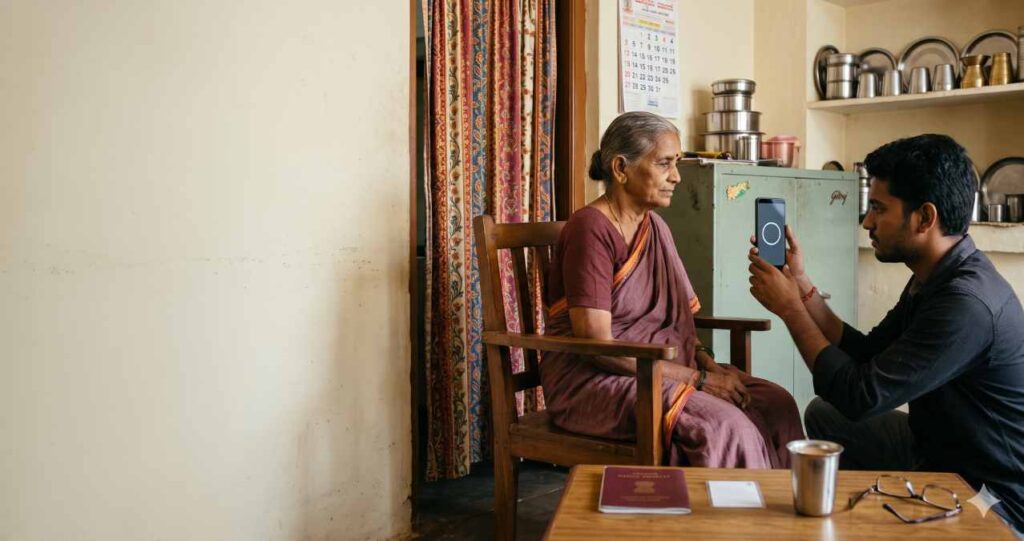
The Mera Ration 2.0 app shows each family member’s entitlement and Aadhaar-seeding status. The face scan for Mera Ration 2.0 App e-KYC runs in a separate NIC app, Mera eKYC, which calls UIDAI’s Aadhaar FaceRD app in the background. An Android phone with a working front camera can do it online from home, and any fair price shop can run fingerprint e-KYC if the phone route fails.
If you have been told to finish ration card e-KYC before 31 December, check that date against your state’s notice before you plan around it. The Department of Food and Public Distribution has not notified a national 31 December 2026 deadline.
Your state food department sets the date that decides whether a member of your family keeps getting foodgrains, and some of those dates fall earlier. Daijiworld reports that Karnataka’s food department will not extend its 30 November 2026 deadline again. Do not wait for 31 December.
What the Centre has fixed is a standing rule.
The Targeted Public Distribution System (Control) Amendment Order, 2025 requires states to carry out e-KYC of every member on a National Food Security Act (NFSA) ration card, and to repeat it every five years. As on 30 September 2026, 71.52 crore beneficiaries, or 91 per cent, had completed e-KYC. The same PIB backgrounder puts the full digitised list at 78.65 crore beneficiaries, so about 7.13 crore people are still unverified.
Mera Ration 2.0 App e-KYC At a Glance
- No national 31 December 2026 cut-off has been notified. The Centre requires ration card e-KYC every five years and each state fixes its own date, so the date that matters is the one on your state food department’s notice.
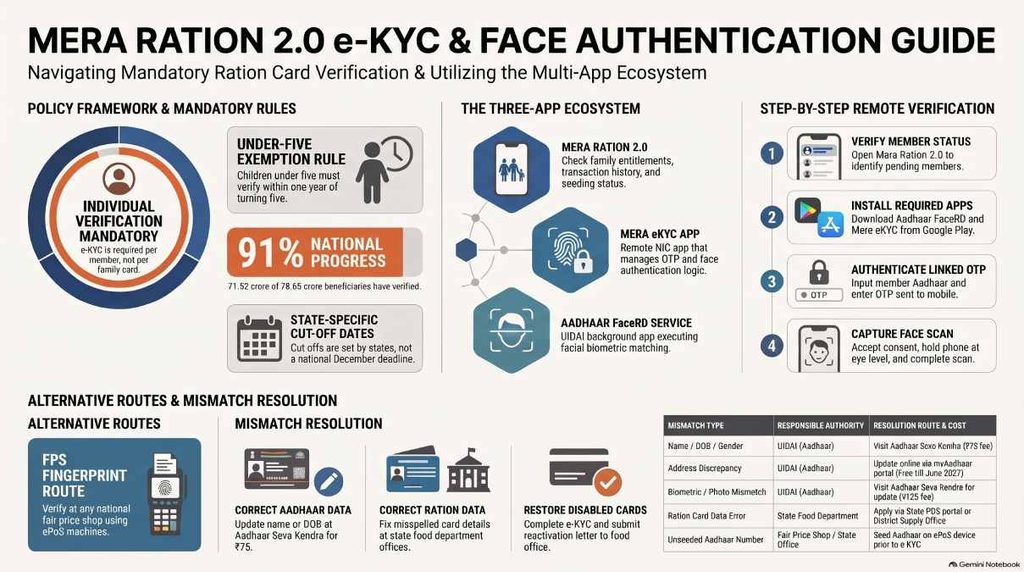
- Mera Ration 2.0 shows entitlements and Aadhaar-seeding status. The face scan runs through NIC’s Mera eKYC app, which calls UIDAI’s Aadhaar FaceRD app in the background.
- Every member listed on an NFSA ration card must verify. Children below five are the exception: their e-KYC falls due within one year after turning five.
- UIDAI corrects wrong Aadhaar details. Your state food department corrects wrong ration card details. Name and date of birth changes in Aadhaar need a centre visit and cost ₹75 when done on their own.
- Any fair price shop in India can run fingerprint e-KYC on its ePoS machine. Migrants living away from their home state can use this route too.
- You can get a suspended name back. Complete e-KYC for that member, then write to the food office that issued the card and ask it to reactivate the name.
What Mera Ration 2.0 Is and What Changed From Version 1
Mera Ration is the central government’s citizen app for ration card holders in the public distribution system (PDS). The National Informatics Centre (NIC) makes and publishes it for the Department of Food and Public Distribution (DFPD), which sits in the Ministry of Consumer Affairs, Food and Public Distribution. Your state still issues and manages your ration card.
The app reads from the national and state databases.
Version 1: a portability tool
The first Mera Ration app arrived in March 2021, when the Centre launched it under the One Nation One Ration Card programme.
Its job was narrow. A migrant worker could check whether the family card was portable and find a ration shop in a new city. They could then collect NFSA foodgrains there after Aadhaar authentication, while relatives back home collected the rest on the same card.
Version 2.0: launched 20 August 2024
Union Minister Pralhad Joshi launched Mera Ration App 2.0 on 20 August 2024. On the same day he launched the FPS Sahay financing app and a pilot to convert 60 fair price shops into Jan Poshan Kendras.
DFPD’s account of its 100-day plan says the upgraded app gives PMGKAY beneficiaries real-time information on entitlements, withdrawals and the nearest fair price shop, with a set of new features for citizens. Central and state officials also got access to ration card data through it. Version 1 had no official side at all.
The PIB backgrounder on One Nation One Ration Card dated 12 November 2026 lists what the citizen side does today. The app runs in 13 languages. You can use it to:
- check the monthly entitlement
- view past transactions
- verify Aadhaar-seeding status
- check eligibility for portability
- register voluntarily for One Nation One Ration Card
- find nearby fair price shops by GPS
That list does not include ration card e-KYC.
Most of the confusion around Mera Ration 2.0 e-KYC starts here. You use the Mera Ration 2.0 app to check which family members are seeded and what the card is entitled to. The face scan itself runs through a separate NIC app called Mera eKYC.
In a reply to Parliament, DFPD named it as the remote route for Aadhaar-based face authentication without visiting a fair price shop. Two apps. Two jobs.
Where to download the Mera Ration 2.0 app
On Google Play the listing appears as Mera Ration App by National Informatics Centre.
It has more than 10 million downloads, with impds.nic.in as the developer website and pds@nic.in as the helpdesk address. Its latest “What’s new” note adds notifications for beneficiaries and the status of requests they have submitted. Check the developer name before you tap install, because lookalike listings and APK download sites use the same name and logo.
Also Read: How to Reactivate a Silent Ration Card Under the 2026 SMART-PDS Rules
Why Ration Card e-KYC Is Compulsory and What the Deadline Really Is
Ration card e-KYC checks that the person named on the card is the real holder of the Aadhaar number seeded against that name. Seeding and e-KYC are different steps. Seeding records your Aadhaar number on the card. e-KYC proves, by fingerprint or face, that you are that person, and that you are alive.
The legal basis
The Ministry notified the TPDS (Control) Amendment Order, 2025 on 22 July 2025, and it took effect the same day. It makes the following rules:
- State governments must review their beneficiary lists and carry out mandatory e-KYC every five years.
- Nobody below 18 can hold a separate ration card.
- Young children follow a separate e-KYC timeline.
- States can temporarily disable cards that have not drawn grain for six months.
States have written these rules into their own orders. West Bengal’s food department issued a control order memo dated 11 August 2025 on mandatory e-KYC every five years. The memo also requires at least one adult member on each card.
The national drive has moved in steps. In November 2024 the Centre said 64 per cent of all PDS beneficiaries had completed e-KYC, across 20.4 crore household ration cards covering 80.6 crore people.
In March 2025, Minister Pralhad Joshi told the Rajya Sabha that 60 crore beneficiaries, or 74 per cent, had completed eKYC. He said some states, including Delhi, had not carried out eKYC verification and the Centre had reminded them. He also cited 31 lakh duplicate ration cards and nearly 2.2 crore silent ration cards.
By 30 September 2026 the figure stood at 71.52 crore, as DD News reported from the official factsheet. 20.27 crore of 20.51 crore ration cards were seeded with Aadhaar.
Why “31 December” keeps circulating
States have used it before.
Telangana extended its ration card e-KYC deadline to 31 December in October 2024. Odisha set a 31 December 2025 cut-off.
On that day its Food Supplies Minister, Krushna Chandra Patra, extended it to the end of February 2026. He said about 96 per cent of eligible beneficiaries had already finished. A forwarded message drops the year and the state name, and a local deadline from a past cycle turns into a national rumour.
The Department of Food and Public Distribution has not notified a single national ration card e-KYC deadline for 2026. In Parliament, the Centre has said that the e-KYC process is carried out by states and Union Territories. The date on your state food department’s notice is the only one that binds you.
What non-compliance costs
States set and enforce the consequences, and they can be harsh. Odisha extended its first deadline several times. In June 2025 it then announced that it would suspend ration cards of 20.58 lakh people who had not completed e-KYC verification.
Earlier that year its food minister told the Assembly that the drive had detected 4,08,107 death cases and removed 4,95,951 dead and ineligible beneficiaries from the PDS list. Those numbers explain why the Centre pushes e-KYC. They also show how many living, eligible people can lose their ration too if they do nothing.
The Centre has told states to check before they cut.
In a December 2024 written reply, the Minister of State said all states and Union Territories had been advised to undertake field verification of each identified case so that ration cards of genuine beneficiaries are not deleted or suspended. Keep that reply in mind. It is your strongest argument if a genuine member is removed from the card.
Who Must Complete Ration Card e-KYC, and Who Is Handled Differently
Every member on the card
Ration card e-KYC is per person, not per card.
If your card lists six people, six people must authenticate. If the head of the family finishes e-KYC, that does not cover a spouse, a parent or the children. Mera Ration 2.0 will keep showing each person’s record separately.
Children below five
The 2025 amendment says a child’s Aadhaar number is recorded if available, and e-KYC is performed within one year after the child turns five. A toddler does not need to face the scanner. Note the child’s fifth birthday.
Migrant workers
You do not have to travel home.
In an August 11 reply to Parliament, DFPD said NFSA beneficiaries can complete Aadhaar-based e-KYC at a fair price shop of their choice anywhere in India. The change helps workers who previously had to return to their home state for it. The same reply named Mera eKYC as the option that needs no shop visit at all.
Elderly members and anyone whose fingerprints fail
Face authentication was designed for this group.
UIDAI describes face authentication as an additional mode of authentication that anyone with a valid Aadhaar can use. It checks the person’s live face against the photograph taken when their Aadhaar was made.
Fingerprints worn down by farm work, construction or age do not affect a camera. A bedridden grandparent can be verified at home on any Android phone in the house. The grandparent’s Aadhaar-linked mobile must receive the OTP, or a family member with that phone must read it out.
Members of inactive or flagged cards
If your card has drawn nothing for six months, the state can temporarily disable it.
The amendment then gives the state three months to conduct e-KYC through field verification and decide whether the card stays. Cards flagged as duplicates go through similar checks. In both cases ration card e-KYC is part of getting the card switched back on, so do it early instead of waiting for the officer’s visit.
Documents Required for Ration Card e-KYC and Other Prerequisites
The scan itself needs no paper forms. You need the right information in hand and the right person in front of the camera:
- The 12-digit Aadhaar number of every member who is pending.
- The ration card number.
- The mobile number linked to each pending member’s Aadhaar. Mera eKYC sends an OTP to it before the face scan.
- An Android phone with a working front camera and mobile data, with Mera eKYC and Aadhaar FaceRD installed from Google Play.
- Even light, a plain background, and the member physically present.
The Aadhaar-linked mobile number may be switched off or belong to someone who has moved away.
If so, fix that first. UIDAI’s Aadhaar Seva Kendra page lists mobile number update among its services, and the same page notes that UIDAI’s Aadhaar app now offers it too. Without a working OTP, the phone route stops at step five below and you will need to go to the fair price shop.
Mera Ration 2.0 App e-KYC Step by Step: Face Authentication on Your Phone
UIDAI’s rule is simple.
To use face authentication you need two applications, one from the service provider and the other Aadhaar Face RD from UIDAI. For ration cards, the service provider’s app is Mera eKYC. Start with Mera Ration 2.0 to find out who is pending, then switch apps for the scan.
- Open Mera Ration 2.0, sign in, and look at the family member list and each member’s Aadhaar-seeding status. Write down every member who is unseeded or still pending.
- Install Aadhaar FaceRD from UIDAI’s official Google Play listing. It runs in the background with no icon, so you cannot open it from the app drawer. Other apps start it when they need a face scan. Do not uninstall it thinking the install failed.
- Install Mera eKYC from Google Play and confirm that the developer shown is the National Informatics Centre.
- Open Mera eKYC and enter the Aadhaar number of the member being verified, along with any card details the app asks for.
- Enter the OTP sent to that member’s Aadhaar-linked mobile number.
- Check the member’s name and card details on screen, choose the face e-KYC option and accept the consent screen. UIDAI states that face authentication is consent based, so you cannot skip this screen.
- Hold the phone steady at eye level, face the camera in even light, and follow the FaceRD prompts until the capture finishes.
- Wait for the success message, then repeat steps 4 to 7 for every other pending member, one person at a time.
- Recheck each member’s status at the fair price shop or on your state portal before your state’s deadline.
The phone does not have to belong to the member.
The face does, and so does the OTP. One family member can run everyone’s e-KYC on a single phone in an evening. Each member must sit in front of the camera, and each OTP must reach the right person.
Also Read: Ration Card E-KYC Mismatch? A Step-by-Step Guide to Correcting Your Data Online
If the Mera eKYC App Fails: Other Routes
Face authentication is the convenient route, not the only one. If the scan keeps failing or the OTP never arrives, switch to a route that does not need your phone.
Fair price shop and the ePoS fingerprint scan
Fair price shops are in almost every village and ward. Of the country’s 5.51 lakh fair price shops, 5.50 lakh, or 99.8 per cent, run electronic Point of Sale devices. These are the same machines that check your Aadhaar fingerprint when you collect grain.
- Take every pending member to the shop, with their Aadhaar numbers.
- Ask the dealer to run ration card e-KYC on the ePoS machine. Under One Nation One Ration Card, a migrant can do this at any shop in the country, even one far from the shop the card is linked to.
- Before you leave, ask for the transaction slip or a confirmation on screen.
- If the dealer refuses or says the server is down, note the date and time. You will need them for a complaint.
Your state’s food portal
Each state runs its own PDS portal, and Business Today’s summary of the DFPD reply to Parliament says the NFSA portal links to state and Union Territory ration card reports. Reach your state site through that link, not a search engine result, because lookalike sites copy state branding. Each state’s portal looks different and offers different services.
Common Service Centres
Common Service Centres (CSCs) handle many Aadhaar-linked services.
Ration e-KYC runs on the state’s PDS system, so a CSC can do it only if your state has allowed it. Before paying anyone, call your state’s PDS helpline, which your state food department lists on its website. Ask whether CSCs in your district can complete it.
How to Check Ration Card e-KYC Status and Aadhaar Seeding
Begin with the Mera Ration 2.0 app.
PIB lists verifying Aadhaar-seeding status among its core features, and the current version on Google Play also shows the status of requests you have submitted. Seeding status is not e-KYC status, though. A member can be seeded and still pending e-KYC.
To see e-KYC status itself, you have two options:
- Ask the fair price shop dealer to open your card on the ePoS machine and read out each member’s status.
- Open your state portal through the NFSA links and look for each member’s record.
Check by name. Even if four of five members are verified, the fifth person’s foodgrains are still at risk. The total for the card will not tell you who that is.
Aadhaar Mismatch With Your Ration Card: What to Fix and Where
A mismatch means the ration card record and the Aadhaar record describe the same person differently. The face scan never looks at those records. It checks your live face against your Aadhaar photograph.
A mismatch causes trouble at two other points:
- Before e-KYC: your Aadhaar number has to be seeded against your name on the card.
- After e-KYC: an officer doing field verification may read the two records side by side and find they disagree.
The same rule fixes every Aadhaar and ration card mismatch: correct whichever record is wrong. If Aadhaar is wrong, the fix runs through UIDAI. If the ration card is wrong, it runs through your state’s food department.
On the Aadhaar side, UIDAI’s enrolment and update page says the online myAadhaar service handles address updates and document updates.
Name, gender and date of birth corrections need an Aadhaar enrolment centre or Aadhaar Seva Kendra. The UIDAI fee schedule charges ₹75 for a demographic update done on its own, and nothing when it is done along with a biometric update. UIDAI also caps how often you can change certain fields, and the caps sit on that same update rules page.
Name mismatch
Names are often spelled differently on the two records.
One may say “Laxmi” and the other “Lakshmi”. One may spell out a name the other shortens to an initial. Aadhaar may show a married surname while the card shows a maiden name.
When Aadhaar is wrong
Visit an Aadhaar Seva Kendra or enrolment centre with a proof of identity document in the correct name and pay ₹75. UIDAI allows a name to be updated twice in a lifetime. If you have used both chances, apply to the UIDAI regional office with papers such as a gazette notification or court order.
When the ration card is wrong
Apply for a correction to your state’s Food and Civil Supplies department. Use its portal if it accepts online corrections, or go to the food office that issued your card, such as the district supply office. Carry the Aadhaar card and one other document in the correct spelling.
Keep the acknowledgement number.
Date of birth mismatch
Date of birth errors are most common for elderly members, whose cards were often filled in from memory. UIDAI allows date of birth to be updated once in a lifetime, and only at a centre, so choose the document carefully before you go. If the ration card has the wrong date and Aadhaar has the right one, leave Aadhaar alone and correct the card at the state food office.
Gender mismatch
Gender errors are usually typing mistakes on one of the two records. On Aadhaar, gender can also be updated once in a lifetime, at a centre. On the card, ask the state food department for a correction.
Address mismatch
Address is the one field you can fix on Aadhaar from home.
The myAadhaar portal takes online address updates. The document update service on myAadhaar stays free until 14 June 2027, against ₹75 at a centre. Migrants often have different addresses on Aadhaar and the ration card, and One Nation One Ration Card allows for this. e-KYC does not need the two addresses to be identical, so update a record only if it is out of date.
Relationship mismatch
The relationship to the head of family is a ration card field, so UIDAI cannot fix it.
A daughter-in-law recorded as a daughter is one common error. A widow still shown as wife after the head of family’s death is another. Ask your state food department to correct these, with the document your state requires, such as a marriage or death certificate.
Not seeded, or seeded against the wrong person
Sometimes the problem is not spelling but linking. A member’s Aadhaar may be missing from the card, or one sibling’s Aadhaar number may be recorded against another sibling’s name.
Mera Ration 2.0 shows seeding status per member. Get it corrected at the fair price shop or the state food office before attempting e-KYC. A face scan against the wrong Aadhaar number will fail every time.
When the mismatch is the face itself
The camera may not link your face to an Aadhaar photograph taken a decade ago, before a stroke, a beard or old age.
The fix is a biometric update at an Aadhaar Seva Kendra. UIDAI charges ₹125, free for children between 7 and 15 until 30 September 2027. Any demographic correction made at the same visit costs nothing extra.
Also Read: Ration Card e-KYC 2027: Last Dates by State and How to Complete It
Mera Ration 2.0 e-KYC Not Working: Common Errors and Fixes
Face scan failure
Retry once or twice in better conditions:
- daylight from a window in front of you
- glasses off
- hair away from your face
- the phone held still at eye level
If it still fails, stop. Retrying will not help if the app is checking you against an old photograph. Go to the fair price shop for fingerprint e-KYC now, and book a biometric update for later.
OTP not arriving
The OTP goes only to the mobile number linked with that member’s Aadhaar.
If someone else now has that SIM, nothing you do in the app will help. Update the number at an Aadhaar Seva Kendra or through the Aadhaar app. Use fingerprint e-KYC at the fair price shop in the meantime.
Camera or lighting problems
In your phone’s settings, allow Mera eKYC and Aadhaar FaceRD to use the camera. Clean the lens. Avoid sitting with a bright window behind your head, because the camera will see only a dark outline of your face.
Device compatibility
Mera eKYC and Aadhaar FaceRD are distributed through Google Play, so the face route needs an Android phone. iPhone users should borrow an Android phone from someone in the household or go to the fair price shop. If the scan screen never opens, update Aadhaar FaceRD from Google Play. The app has no icon, so it is easy to forget that it needs updates too.
Aadhaar not seeded
Ration card e-KYC cannot run until the member’s Aadhaar number is on the card. Check seeding status in Mera Ration 2.0, then ask the dealer or the state food office to seed the number first.
Member not found
If a member does not appear at all, either the member was never added to the card or was removed after verification, or the state has disabled the card after six months without collecting grain. Look up the card on your state’s transparency portal through the NFSA links and call the state helpline with the card number. Do not keep retrying the app.
“Something went wrong” at sign-in
Recent Google Play reviews of Mera Ration, dated 20 and 22 November 2026, report repeated “Something went wrong” errors at login.
That is a server-side problem, not something on your phone. Try again at a different time of day. If your state’s deadline is close, skip the app and go to the shop.
State-Wise Ration Card e-KYC Last Date: Karnataka, Telangana, Odisha and More
States set different deadlines, extend them at different rates, and send people either to shops or to phones. The examples below show how much the rules vary.
Karnataka
Karnataka has moved its date three times in 2026. The Department of Food, Civil Supplies and Consumer Affairs first shifted it from 30 September to 20 October, then extended it to 10 November.
On 11 November it extended the deadline again, to 30 November 2026. Daijiworld reported that the department will not extend it again under any circumstances. As of 3 November, 41,33,529 of the state’s 2,67,64,276 beneficiaries were still pending.
Karnataka sends ration card holders to its own Anna Seve app or to fair price shops, not to Mera eKYC. If you live there, your deadline is this week.
Telangana
Telangana set 31 July 2026 as its deadline.
It then extended the date to 31 August 2026, citing heavy rains and the Special Intensive Revision of electoral rolls. During August it also let beneficiaries collect three months of rice in one go. Confirm the current date with the Telangana Civil Supplies Department before relying on any older notice.
Odisha
Odisha shows what can happen when a deadline finally passes.
Its drive began in August and September 2024. By March 2025 it had reached 3.01 crore of 3.30 crore beneficiaries, or 91 per cent. That round ended with the June 2025 suspension of 20.58 lakh people.
Nagaland and district-level dates
Deadlines are not always statewide.
In December 2025, the District Civil Supply officer in Dimapur set a district deadline of 10 December for PHH and AAY beneficiaries. People could use either fair price shops or the Mera e-KYC app. Watch district notices as well as state ones.
West Bengal
West Bengal has written the five-year e-KYC cycle into its own control order memo of 11 August 2025. This state order applies on top of the central amendment, so check both when you look up the rules.
Also Read: Digital Rupee Ration: How India’s CBDC Food Subsidy Works
After the Deadline: How to Restore a Suspended Entitlement
Missing the date is not the end. A suspension can be reversed once the member is verified.
Two rules help you. The Centre has told states not to delete genuine beneficiaries without field verification. The 2025 amendment also gives states three months to verify a disabled card.
Work through it in this order:
- Find out exactly which member is suspended and why. Ask the dealer, check the state portal or call the helpline. The usual reasons are e-KYC pending, card unused for six months, or flagged as a duplicate.
- Complete ration card e-KYC for that member, by fingerprint at any fair price shop or by face through Mera eKYC.
- If a mismatch caused the failure, fix the wrong record first, at UIDAI or the state food office, and keep the acknowledgement.
- Write to the food office that issued the card, such as the district supply office, asking for reactivation. Attach proof of e-KYC and any correction.
- If nothing happens, complain through your state’s grievance channel. PIB confirms that transparency portals, online grievance systems and toll-free helplines operate across all states and Union Territories.
Restoration takes time. States differ on whether they give back the grain you missed, so ask the food office directly.
Privacy and Safe Use
Face authentication uses your biometric data, so use only the official apps.
Two publishers make the three apps in this process. The National Informatics Centre makes Mera Ration and Mera eKYC, and UIDAI makes Aadhaar FaceRD. In the Google Play data safety section, Mera Ration’s developer states that the app collects no user data and shares none with third parties.
The process asks for your consent each time.
UIDAI says face authentication is consent based and works as a one-to-one match against your own enrolment photo, which is why the consent screen appears before every scan. Read it. Do not accept it on behalf of a member who has not agreed.
Keep these rules in mind:
- Never share your OTP. No dealer, food department official or caller needs it.
- The government apps are free on Google Play.
- Ignore SMS or WhatsApp messages that warn of a “last date” and ask you to install an app from a website.
- Do not hand your phone to anyone at a roadside stall who offers to “finish e-KYC for ₹100”.
Your Next Move
- Open Mera Ration 2.0 and list every member who is unseeded or pending.
- Find your state’s current deadline on the state portal linked from the NFSA site.
- Make sure Aadhaar FaceRD is installed, then run the face scan for each pending member in Mera eKYC.
- If any member fails twice, take that person and their Aadhaar number to the nearest fair price shop the next morning and finish Mera Ration 2.0 e-KYC on the ePoS machine.
Then send this Mera Ration 2.0 App e-KYC guide to the family member who handles the card back home. It could keep a parent’s ration flowing for the next five years.
Mera Ration 2.0 App e-KYC: Frequently Asked Questions
Is 31 December 2026 the last date for ration card e-KYC?
No. The Centre has notified no national deadline for 2026, and each state sets its own. Daijiworld reports Karnataka has ruled out extending beyond 30 November 2026.
Can I do face authentication e-KYC inside the Mera Ration 2.0 app?
No. The app shows entitlements and Aadhaar-seeding status. The face scan runs in the Mera eKYC app, which works with UIDAI’s Aadhaar FaceRD app.
Who needs to complete ration card e-KYC?
Every member on an NFSA ration card, repeated every five years. Children below five are due within one year after turning five.
What happens if a family member misses the e-KYC deadline?
The state can suspend that member’s name, as Odisha announced in June 2025 for the ration cards of 20.58 lakh people. Complete e-KYC, then ask the state food department to reactivate it.
How do I fix a name or date of birth mismatch between Aadhaar and my ration card?
UIDAI fixes Aadhaar errors. Your state food department fixes ration card errors. Aadhaar name and date of birth changes need a centre visit and cost ₹75 when done separately.
Why does face authentication fail during e-KYC?
Poor lighting or an old photo can stop the app verifying your live face against your Aadhaar enrolment photo. Use fingerprint e-KYC at a fair price shop, or book a biometric update.
Can migrant workers complete e-KYC outside their home state?
Yes. At any fair price shop in India, as the Department of Food and Public Distribution told Parliament. The Mera eKYC app needs no shop visit.
How can I check whether my Aadhaar is seeded with my ration card?
Mera Ration 2.0 shows Aadhaar-seeding status, and your state’s transparency portal shows card records. Seeding and e-KYC are separate, so confirm both.
Disclaimer
India Policy Hub is an independent publication. It has no affiliation with the Department of Food and Public Distribution, the National Informatics Centre, UIDAI or any state or Union Territory food department, and it does not operate Mera Ration, Mera eKYC, Aadhaar FaceRD or any other app named here. This post gives general information as of 27 November 2026. It is not legal advice, and reading it creates no lawyer-client relationship. Deadlines and procedures change often and differ from state to state, so check your state food department’s official notice or portal before you act. To the fullest extent permitted by law, India Policy Hub gives no warranty, express or implied, that this content is complete, current or free of error. It accepts no liability for any loss, ration card suspension or missed deadline arising from reliance on it. Third-party links are for reference only and are not endorsed.




Leave a Reply