
8th Pay Commission DA Merger Policy Explained: Demand vs Decision
A 23 October 2025 report and later headlines have presented a 50% DA merger as on the way for central government employees. The Finance Ministry told the Lok Sabha on 1 December 2025 that no proposal to merge existing dearness allowance with basic pay is under consideration at present. The 8th Pay Commission DA merger policy explained below rests on orders and replies. It keeps what unions have asked for apart from what the government has decided.
8th Pay Commission DA merger policy explained At a Glance
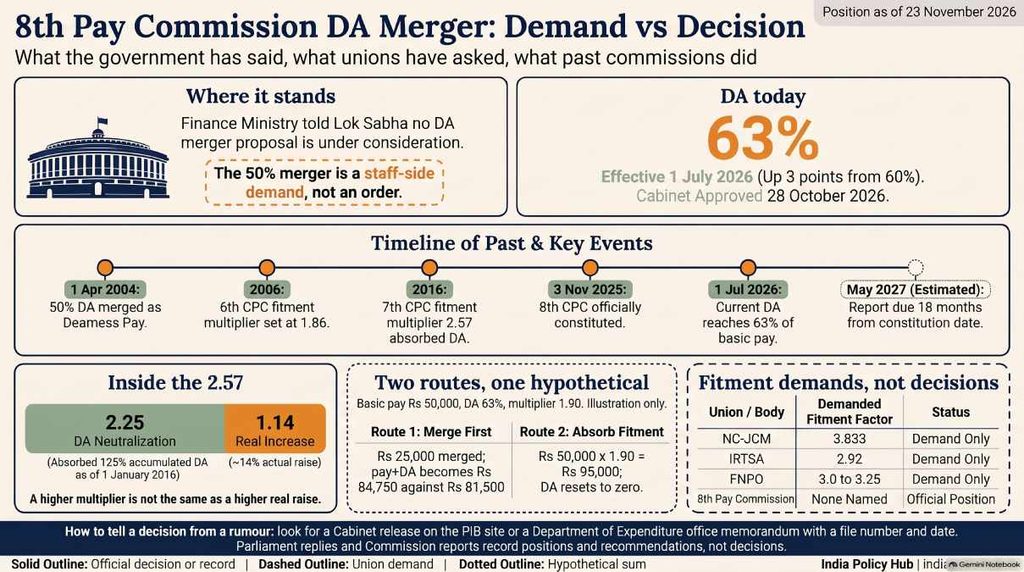
- Official merger position: The Finance Ministry’s written Lok Sabha reply of 1 December 2025 says no proposal to merge existing DA with basic pay is under consideration at present. The 50% merger is a staff-side demand. Only a Cabinet release or a Department of Expenditure order would change that.
- Commission status: The 8th Central Pay Commission was constituted by a resolution dated 3 November 2025 and has 18 months to report, which points to about May 2027. Justice Ranjana Prakash Desai chairs it. A Lok Sabha reply of 10 August 2026 says no recommendations have been submitted.
- DA today: DA stands at 63% of basic pay from 1 July 2026, a 3-point rise over 60% that the Union Cabinet approved on 28 October 2026. DR for pensioners moves to the same rate. Any 8th CPC sum that starts from that rate is a hypothetical.
- The 7th CPC precedent: The fitment factor of 2.57 was 2.25 (a DA of 125% folded into pay) multiplied by about 1.14, a real raise of roughly 14 per cent. DA was absorbed at fitment, with no separate merger.
- Still undecided: The effective date, the fitment factor, interim relief, and whether existing DA would be merged first or absorbed at fitment. No official source has settled any of them, and every union figure in this post is labelled as a demand.
8th Pay Commission DA Merger Policy Explained: Where It Stands
A DA merger with basic pay is an order that treats part of dearness allowance as basic pay, so the merged amount becomes the base for later DA, allowances, increments and retirement benefits.
No order merges DA with basic pay today. The 50% merger now circulating is a staff-side demand. It is not a notified policy. The documents closest to this question are the written Lok Sabha reply of 1 December 2025, the resolution of 3 November 2025 that constituted the Commission, and the Cabinet release of 28 October 2025 on its Terms of Reference. None of them decides a merger.
Also Read: Dearness Allowance Hike July 2026: Cabinet Approves DA Increase to 63%
What does DA merger mean? DA, DR and basic pay
Dearness allowance (DA) is a cost-of-living payment added to basic pay for serving central government employees. Dearness relief (DR) is the same payment for pensioners, worked on basic pension. Both are percentages revised every six months to offset inflation, and both rise when the base they are worked on rises.
A merger changes that base. Part of DA is declared to be pay, and every later amount that is a percentage of basic pay is worked on the larger figure. The 2004 order, covered below, merged DA equal to 50% of basic pay. It did not merge half of whatever DA stood at on the day, and the two readings differ at today’s rate: one published worked example halves a 63% DA and arrives at 31.5 points, not 50.
A hypothetical shows the mechanics. Take a basic pay of Rs 50,000. If DA equal to 50% of basic pay were merged, Rs 25,000 would become pay and the base would rise to Rs 75,000. The DA rate would fall by the 50 points merged, and later DA would be worked on the new base. No order proposes these figures.
Pension follows the same logic, with DR merged into basic pension.
The December 2025 Lok Sabha reply on merger proposals
The question was Unstarred Question No. 212, put to the Ministry of Finance by Anand Bhadauria, MP. It asked whether the government had notified the 8th Central Pay Commission and whether it proposed to merge DA and DR with basic pay as immediate relief. Pankaj Chaudhary, Minister of State for Finance, answered in writing on 1 December 2025.
The reply made two points. The government had notified a resolution dated 3 November 2025 constituting the Commission. And no proposal to merge the existing DA with basic pay was under consideration at present. It added that DA and DR are revised every six months on the All India Consumer Price Index for Industrial Workers, released by the Labour Bureau, to adjust for the cost of living and protect basic pay and pension from inflation (text of the reply).
The scope is narrow. The reply describes the position on that date. It does not bind what the Commission recommends, and it does not say a merger could never come up.
Union demand versus government decision
A decision leaves a paper trail. A Cabinet decision appears as a release on the Press Information Bureau site, as the DA approvals of 18 April 2026 and 28 October 2026 did. A Department of Expenditure office memorandum carries a file number, a date, a department and a signing officer, as the 2004 order did. Parliament replies sit in the Lok Sabha and Rajya Sabha records.
A demand looks different. A staff-side memorandum is a request to the Commission or the government. BPMS, in a letter dated 18 November 2026 for its second round of interaction, asked that 50% of existing DA be merged with basic pay and pension before revised structures are set (BPMS views). FNPO asked the 8th CPC in a letter of 27 February 2026 to merge 50% of existing DA with basic pay from 1 January 2026 as interim relief, as reported on 2 March 2026. Its full memorandum separately proposes merging DA/DR with basic pay whenever it crosses 25%. The Confederation of Central Government Employees and Workers lists a 50% DA/DR merger and 20% interim relief in its charter of demands. None of these documents is an order.
Then come forwards and headlines. A report of 23 October 2025 said indications suggested a merger. Indications are not orders, and the reply of 1 December came after that report.
The test is short: find the file number or release ID, then the date and office behind it.
Also Read: 8th Pay Commission Salary Increase 2026: Calculator, Fitment Factor & Pay Structure
How Earlier Pay Commissions Handled DA Before Revising Pay
The record runs through four documents. Each is reported in date order, with no verdict attached.
The 5th CPC rule and the 1 April 2004 Dearness Pay order
The 5th CPC reported in 1997. In paragraph 105.11 it recommended that DA be converted into Dearness Pay each time the price index rose 50% over the base used by the Commission. Its reasoning, as reported later, was that DA would normally rise by 50% in about five years.
The 5th CPC wanted the next commission in place by 2003, so that its report would arrive by 2006. The government did not appoint one by then, and it did not wait. A Department of Expenditure office memorandum dated 1 March 2004 (F.No. 105/1/2004-IC) decided that from 1 April 2004, DA equal to 50% of existing basic pay would be merged with basic pay and shown separately as Dearness Pay. The merged amount was deducted from the existing DA rate.
Dearness Pay counted for allowances, transfer grant, retirement benefits, GPF contributions, licence fee, the CGHS contribution and advances. Leave travel concession, tour TA and DA, transfer TA and entitlement to government accommodation stayed on basic pay alone. For existing pensioners, DR equal to 50% of pension was merged from the same date as Dearness Pension, and the pension compendium records Dearness Pay as counting toward emoluments for pension from 1 April 2004.
Public sector bodies followed with their own orders. On 20 June 2008 the Shipping Ministry approved a merger of DA equal to 50% of basic pay for Shipping Corporation of India shore staff from 1 January 2007. A second Shipping Ministry announcement, made on 15 July 2008, extended a 50% merger from 1 January 2007 to port and dock workers and left room for review if government policy on the date of effect changed. On 5 July 2016 the Cabinet revised pension for BSNL pensioners who retired before 10 June 2013, and the 50% DA/DR merger it allowed works out to 78.2% for fitment. None of these orders covers central civil employees.
6th and 7th CPC: no new merger, DA absorbed at fitment
The 6th CPC advised against merging DA at any stage. Its stated reasoning, as summarised by Upstox, was that a merger would logically come with a revision of the base index, and that such a conversion was unnecessary in the pay structure it recommended. The government accepted that advice by a resolution dated 29 August 2008, and a later Lok Sabha reply said so. Staff bodies had asked for the trigger to come down to 25%, and the Commission declined.
The 6th CPC fitment of 2006 ran on that merged base. The Government fixed the multiplier at 1.86 for pay and, in its pension order, for pension as well: basic pension and Dearness Pension together, with DR of 24% as on 1 January 2006 added. The Commission had recommended 1.74, and the Government raised it. The working is 1.00 plus 0.50 plus 24% of 1.50, which gives 1.86, or 1.50 times 1.24. On the merged base the multiplier absorbed only the remaining 24% DA, and grade pay was added on top.
The 7th CPC submitted its report on 19 November 2015, and its pay took effect from 1 January 2016, the 7th Central Pay Commission implementation date. It fixed pay through one multiplier, 2.57, which absorbed the DA accumulated by 1 January 2016. Its executive summary carries 2.57 as a uniform factor for all employees and contains no separate merger step. On DA itself, the Commission recommended continuing the existing formula and methodology (paragraph 8.17.37 of its report).
Some secondary accounts say the 7th CPC revived the 5th CPC rule. The report does not. Its DA paragraphs, 8.17.35 to 8.17.37, make no merger recommendation and set no trigger at 50 per cent. The 25 per cent steps it ties to each 50 per cent rise in DA apply to certain allowances, such as the briefcase and canteen allowances, and not to basic pay. The government accepted the DA recommendation in its resolution of 25 July 2016. DA now stands at 63%, and no merger order has followed.
Also Read: Viksit Bharat 2047: India’s $30 Trillion Roadmap Explained
How the 7th CPC Fitment Factor of 2.57 Absorbed DA
The 7th CPC fitment factor of 2.57 is the number any 8th CPC figure will be read against. It is 2.25 multiplied by about 1.14. The first part absorbed a DA of 125% on 1 January 2016. The second part was the real raise. The 8th CPC has set no figure. In 2016 the government accepted the Commission’s recommendations on minimum pay, fitment factor, the index of rationalisation and pay matrices without material change, with exceptions only in defence pay.
| Item | Figure | Role |
| DA on 1 January 2016 | 125% | Rate absorbed |
| Absorption multiple | 2.25 | 1 plus 1.25 |
| Stated real raise | 14.29% | Increase in pay |
| Fitment factor | 2.57 | Applied to existing pay |
The 2.25 part: neutralising 125 per cent DA
DA stood at 125% of basic pay on 1 January 2016. An employee on Rs 100 of basic pay drew Rs 125 of DA, a total of Rs 225. To fold that DA into new basic pay without cutting anyone’s income, new basic had to be 2.25 times the old. The sum is 1 plus 1.25 equals 2.25.
This part adds no purchasing power. It repackages DA already paid and resets the DA counter to zero when the new pay starts. The Commission’s own text describes the 2.25 factor as accounting for DA neutralisation on an assumed rate of 125% when the new pay began.
The remaining part: a real increase of about 14 per cent
What remains after absorption is the raise. The 7th CPC stated it as 14.29 per cent.
A Rs 7,000 basic pay drew Rs 8,750 of DA at 125%, so pay plus DA was Rs 15,750. Multiplying 7,000 by 2.25 gives the same Rs 15,750. Multiplying by 2.57 gives Rs 17,990, which is Rs 2,240 more.
Dividing 2.57 by 2.25 gives about 14.22 per cent, because 2.57 is itself rounded.
On paper, the 7th Pay Commission salary increase was 157 per cent. In purchasing terms the raise was about 14.
From Rs 7,000 to Rs 18,000 minimum pay
The salary hike readers remember is minimum pay going from Rs 7,000 to Rs 18,000. The multiplier gets close: 7,000 times 2.57 is 17,990.
It does not get there. The matrix starts at Rs 18,000, which is Rs 10 higher. That start came from wage norms (the 15th Indian Labour Conference norms and the Aykroyd formula), and the executive summary recommends Rs 18,000 on that basis. Multiplier and matrix start are linked, since 2.57 lands near the norm for a Rs 7,000 base. They are not the same number. Staff bodies still cite the same norms: the BPMS submission asks for minimum pay set from family consumption needs, ILC norms, the Aykroyd formula and market prices (73 demands).
Why a higher fitment factor is not a higher real raise
Any 8th CPC fitment factor, the multiplier applied to existing pay, will carry two things: absorption of the DA rate the Commission assumes, and a raise. The split depends on that rate, and the date is undecided. A given multiplier carries a smaller raise the higher the assumed DA.
The sum is plain. Divide the multiplier by 1 plus the DA rate. At 125% DA, a multiplier of 2.57 holds a raise of about 14 per cent. At 63% DA, absorption alone needs 1.63, so a multiplier of 1.63 would carry no raise at all, and a multiplier of 1.90 would carry about 16.6 per cent.
The same sum can be run on a demand. The staff-side 3.833 divided by 1.63 is about 2.35, so at 63% DA that demand would hold absorption of 1.63 and a raise of about 135 per cent. This is arithmetic on a request, not an estimate of any outcome.
Whether salary will be doubled after the 8th Pay Commission turns on which figure is meant. At 63% DA, basic pay plus DA is 1.63 times basic pay, so doubling that total takes a multiplier of 3.26. A multiplier of 2.00 would double basic pay alone and lift pay plus DA by about 23 per cent.
The same sums at 60% DA, the rate on 1 January 2026, give different figures. Absorption alone needs 1.60, so a multiplier of 1.90 would carry a raise of 18.75 per cent. The staff-side 3.833 divided by 1.60 is about 2.40, a raise of about 140 per cent. Doubling pay plus DA would take a multiplier of 3.20, and a multiplier of 2.00 would lift pay plus DA by 25 per cent.
Every 63% and 60% figure here is a hypothetical, not a forecast. The DA rate the Commission assumes will set the absorption share. It was 60% on 1 January 2026, the date the Cabinet release expects, and is 63% from 1 July 2026. The 7th CPC assumed the rate expected at implementation, which was 125%.
How DA Merges With Basic Pay or Gets Absorbed at Fitment: Worked Numbers
Every number in this section is hypothetical: the basic pay is Rs 50,000, DA is 63%, and the multiplier is 1.90. None is official or forecast, and the results are arithmetic, not advice. The 63% rate is today’s DA and the 50% merger is the 2004 share. The 1.90 is a round number chosen to keep the sums readable.
The starting point: DA at 63% is Rs 31,500, so pay plus DA is Rs 81,500.
Route one: merge 50% DA, then apply the fitment factor
The 2004 order is the template. It merged DA equal to 50% of basic pay, showed the amount as Dearness Pay and deducted it from the DA rate. It counted Dearness Pay for the payment of allowances. This sum takes the remaining DA as worked on basic pay plus Dearness Pay, the base that the 6th CPC multiplier of 1.86 implies.
- Dearness Pay is 50% of 50,000, which is Rs 25,000, so the base becomes Rs 75,000.
- The remaining DA rate is 63% minus 50%, which is 13%, or Rs 9,750 on Rs 75,000.
- Pay plus DA after the merger is Rs 84,750, against Rs 81,500 before.
- The merger alone adds Rs 3,250 a month: the 13% rate applied to the Rs 25,000 moved into the base.
If the 1.90 multiplier were then applied to the merged base of Rs 75,000, new basic pay would be Rs 142,500. Route two gives Rs 95,000 from the same 1.90. The difference of Rs 47,500 is the effect of running one multiplier over a base that already holds Rs 25,000 of DA.
The same merger works for a pension. On a hypothetical basic pension of Rs 25,000, DR at 63% is Rs 15,750, a total of Rs 40,750. Merging DR equal to 50% of pension makes Rs 12,500 Dearness Pension and a base of Rs 37,500. The remaining 13% DR is Rs 4,875, so the total becomes Rs 42,375, which is Rs 1,625 more.
A Commission that merged first would choose its multiplier after choosing the base, so holding 1.90 fixed is what opens the gap above. The 6th CPC did this: its 1.86 on unmerged basic pay was 1.24 on the merged base. To land the merged base on Rs 95,000, the multiplier would be 95,000 divided by 75,000, about 1.27.
Route two: absorb all DA inside the fitment factor
The 2016 method has no merger step. DA resets at the effective date, and one multiplier carries both the absorption and the real raise.
The sum: 50,000 times 1.90 is Rs 95,000 as new basic pay, with DA at zero on that day. Against Rs 81,500 before, that is Rs 13,500 more, a rise of 16.6 per cent.
The multiplier splits the way 2.57 did. At 63% DA, absorption is 1.63. The raise is 1.90 divided by 1.63, about 1.166. DA then restarts from zero and rises with each index reading, and pensioners’ DR resets the same way.
| Step | Route one: merge first | Route two: absorb at fitment |
| Start | Rs 50,000 basic, 63% DA, Rs 81,500 in all | Same |
| First move | Rs 25,000 into the base, DA at 13%, Rs 84,750 in all | None |
| 1.90 applied | On Rs 75,000, which gives Rs 142,500 | On Rs 50,000, which gives Rs 95,000 |
| Multiplier that reaches Rs 95,000 | About 1.27 | 1.90 |
Where take-home differs before the new pay is notified
Only mechanics here. An early merger lifts the base for allowances in the months before any 8th CPC order. In the sum above the lift is Rs 3,250 a month on a Rs 50,000 basic pay, plus whatever allowances are counted on the merged amount.
Route two has no such step. Pay and DA run on the old base until a new pay is notified, and any difference arrives as arrears from the effective date, if the order sets one.
The 2004 order was dated 1 March and took effect on 1 April of that year, a gap of one month between order and effect. Any future order would set its own dates.
Either order would be a government decision. The Commission recommends, and the government accepts, changes or declines. No amounts are forecast.
What a DA Merger Would Change in the 8th Pay Commission Pay Matrix
A pay matrix cell is an output. It comes from a base and a multiplier, and a merger moves one or both. If the base rises by the merged amount and the multiplier stays, every entry cell rises with it. If the multiplier falls to compensate, cells can land where they would have landed anyway. Which happens is undecided.
The full pay matrix by level, the salary calculator walkthrough and the 2026 versus 2028 debate sit in 8th Pay Commission Salary Increase 2026. Those tables are not repeated here.
A hypothetical shows how a cell moves. Take a Level 1 entry pay of Rs 18,000 and the 1.90 multiplier used earlier. Absorbing DA at fitment gives 18,000 times 1.90, or Rs 34,200. Merging DA equal to 50% of basic pay first lifts the base to Rs 27,000, and 1.90 on that base gives Rs 51,300. A multiplier of about 1.27 on Rs 27,000 would bring the cell back to Rs 34,200. These are sums, not matrix cells.
Level 1 and Level 10 entry pay at 63 per cent DA
Two current figures set the scale. They are 7th CPC figures, not 8th CPC figures.
| Level | Entry pay (7th CPC) | DA at 63% |
| Level 1 | Rs 18,000 | Rs 11,340 |
| Level 10 | Rs 56,100 | Rs 35,343 |
DA today is worked on basic pay alone. A merger or an absorption would change which figure carries the percentage. The two levels sit far apart in rupees. A merger of 50% of basic pay would move Rs 9,000 into the Level 1 base and Rs 28,050 into the Level 10 base.
Where matrix cells and the fitment factor meet
The 7th CPC took existing pay, applied one fitment factor of 2.57 to all employees, rationalised the steps between levels with an index (SCC Online) and set the starting pay from wage norms (executive summary). Each cell is old pay run through that method, so a shift in the base would reach every level at once.
Whether the 8th CPC keeps that method, varies the multiplier by level or sets a new start is open. The Commission has said nothing on it. Staff bodies have asked for different things. IRTSA wants higher factors for safety-related railway categories from Level 6, and the NC-JCM staff side has asked for a unified matrix up to Level 13. Both are demands.
Arrears, Allowances and Pension Under a Merged or Absorbed DA
Each item below gives the mechanical change first and then what is undecided.
DA arrears and pay revision arrears are separate
On the mechanics, DA arrears follow the formula in force now. The Union Cabinet approved the July 2026 DA hike on 28 October 2026, taking DA to 63% from 1 July 2026, an increase of 3 points over 60% (PIB). The earlier DA hike for central government employees, 2 points over 58% from 1 January 2026, was approved on 18 April 2026. Arrears cover the gap between the effective date and the first payment. The Department of Expenditure’s office memorandum of 29 October 2026 and the pension department’s DR order of 4 November 2026 do not name the month of payment.
On a basic pay of Rs 50,000, the 3-point step is Rs 1,500 a month, so the four months from July to October come to Rs 6,000. The 1 January 2026 step covered about 50.46 lakh central government employees and 68.27 lakh pensioners.
Once a merger is in force, a later DA step is worked on the larger base: on the Rs 75,000 base in the worked sums, a 3-point step is Rs 2,250 a month, against Rs 1,500 on Rs 50,000.
Pay revision arrears are another thing. They would be the difference between old and new pay from an effective date, and that date is undecided. The Cabinet release on the Terms of Reference says the effect of the Commission’s recommendations “would normally be expected from 01.01.2026”, which is an expectation and not an order. If that date held, arrears would run for the months between it and the first payment at revised rates. That is a condition, and no order says so.
Will pensioners get an 8th Pay Commission? Dearness Relief and pension revision
Pensioners draw DR at the same 63% from 1 July 2026, with about 68.71 lakh pensioners covered (PIB). In 2004, DR equal to 50% of pension was merged into basic pension as Dearness Pension, and later DR was worked on the larger figure. The BSNL decision of 5 July 2016 is a variant: pensioners who retired before 10 June 2013 got the 50% merger counted as 78.2% for fitment, with DCRG and leave encashment not increased on that account, nor commutation of pension.
Whether pensioners will get an 8th Pay Commission revision of pension is the undecided part. The Cabinet release describes pay commissions as examining retirement benefits and other service conditions, and its one explicit pension line concerns the unfunded cost of non-contributory schemes. Two Rajya Sabha members listed a question for 2 December 2025 asking why pension revision was not proposed under the 8th CPC.
A PIB Fact Check rebuttal, first reported on 14 November 2025 and again on 13 December 2025, called fake a viral claim that retirees lose DA hikes and pay commission benefits under the Finance Act 2025. The one rule change concerned absorbed PSU employees dismissed for misconduct.
No figure for a pension increase has been announced.
HRA, travel and other allowances tied to basic pay
House rent allowance (HRA) and several other allowances are percentages of basic pay, so a larger base lifts them. An allowance fixed at a set percentage of basic pay rises by half if the base goes from Rs 50,000 to Rs 75,000. The 2004 order is the precedent: it counted Dearness Pay for the payment of allowances and kept tour TA and DA, transfer TA, leave travel concession and government accommodation entitlement on basic pay alone (order).
Present-day treatment is unconfirmed. The 7th CPC tied HRA revisions and the gratuity ceiling to DA crossing set levels (executive summary), so how those triggers would count after a merger or reset is not settled.
GPF, CGHS and licence fee deductions
The 2004 order counted Dearness Pay for GPF contributions, the CGHS monthly contribution, licence fee and advances. So a higher base changes what is deducted as well as what is paid. That is precedent, nothing more.
How these deductions would apply today is unconfirmed. No order on a merged DA exists, and the rules in force for each deduction would have to be read when one does.
What the Terms of Reference Ask the Commission to Weigh on Cost
The Union Cabinet approved the Terms of Reference on 28 October 2025. The Commission is a temporary body with three posts. The release notes that pay commission recommendations are usually taken up about once in ten years. It lists considerations for the Commission to keep in view. Paraphrased:
- The economic conditions of the country and the need for fiscal prudence.
- The need for adequate resources for development and welfare spending.
- The unfunded cost of non-contributory pension schemes.
- The likely effect on the finances of State Governments.
- The prevailing pay structure, benefits and working conditions in central public sector undertakings and the private sector.
These are criteria, not a forecast. None says whether DA would be merged, and none sets an amount. The release adds that the Commission may send interim reports on matters as it finalises them.
Fiscal prudence and unfunded non-contributory pension cost
Non-contributory pensions are the old defined-benefit pensions paid from government revenue, with no contribution from the employee during service. Unfunded means no corpus has been set aside, so each year’s pension bill is met from that year’s budget.
When pay and DA rise, pension rises with them, so the cost of a revision flows into a bill already being paid without a fund behind it. The Terms of Reference ask the Commission to weigh that cost against fiscal prudence. They set a criterion, not an amount.
Fiscal prudence could be read as a limit on any merger. That reading is an inference. The Terms of Reference do not say it.
State finances and the cost of one DA step
The Terms of Reference release notes that States usually adopt central recommendations with some changes, so a central decision spreads into State budgets.
For scale, the 3-point DA rise from 1 July 2026 costs Rs 10,016.10 crore a year, across about 48.54 lakh central government employees and 68.71 lakh pensioners (PIB). The 2-point rise from 1 January 2026 cost Rs 6,791.24 crore (PIB). A merger or a new multiplier works on the whole base and not on one step. Neither the Terms of Reference nor the Lok Sabha replies carry a costing for a merger.
Open Questions: Effective Date, Fitment Factor and Interim Relief
Five questions remain open. Each starts with the official position.
8th Pay Commission implementation date: what the government has and has not said
The Cabinet release on the Terms of Reference said the effect of the Commission’s recommendations “would normally be expected from 01.01.2026”. The Lok Sabha reply of 10 August 2026 says the Commission has not submitted its recommendations, so no date of effect or fitment factor is finalised.
The release gives the usual ten-year cycle as the reason for that expectation. It is not a decision. What stays open is the date itself. The government has announced no date, and 1 January 2026 is widely cited but unconfirmed.
8th Pay Commission in 2026 or 2027: the 18-month report timeline
The report deadline falls in 2027, whatever the effective date turns out to be. The Commission, chaired by Justice Ranjana Prakash Desai, has 18 months from its constitution on 3 November 2025, which points to about May 2027. It may send interim reports on specific matters. The 10 August 2026 reply said no report had been submitted. On 28 July 2026, in the Rajya Sabha, the Minister said the Terms of Reference do not require the Commission to give the government progress updates, as Angel One reported.
Open: whether the full report comes at the limit or earlier, and whether interim reports precede it.
Union fitment demands versus an official figure
Officially, the Commission has named no figure. Everything below is a demand or a projection. The NC-JCM staff side asked for 3.833 and a minimum pay of Rs 69,000 in its April 2026 memorandum. IRTSA proposed 2.92 with Rs 52,600, and FNPO proposed a range of 3.0 to 3.25.
BPMS has asked for an “appropriate” factor without a number (BPMS views). A media estimate of Rs 51,480 for Level 1, which implies 2.86, circulates as well. Upstox notes that no staff union has asked the Commission to repeat the 7th CPC fitment factor of 2.57.
Interim relief: what the Finance Ministry has said
On 1 December 2025, Pankaj Chaudhary, Minister of State for Finance, told the Lok Sabha in a written reply that no proposal to merge DA with basic pay as immediate relief is under consideration at present. An IANS report carried by Lokmat Times described the position as no proposal at present for any interim relief. The answer’s own text addresses the merger.
The position is dated. It describes 1 December 2025 and says nothing about later months.
Treatment of existing DA in the revised pay
Not finalised. The earlier record is one sequence, not two separate routes. In 2004, DA equal to 50% of basic pay was merged first and the rest carried on. The 6th CPC fitment of 2006 then absorbed that Dearness Pay and the remaining 24% DA through 1.86. In 2016, all accumulated DA was absorbed at fitment through 2.57. A public sector variant, the 2016 BSNL pension decision, counted a 50% merger as 78.2% for fitment (PIB). BPMS has asked for the first step in that sequence: its letter wants the merger done before revised pay and pension structures are determined. That is a demand. Which route the 8th CPC recommends, and which the government accepts, is open.
8th Pay Commission DA merger policy explained : FAQs
Will DA merge with basic pay under the 8th Pay Commission?
Not at present. The Finance Ministry told the Lok Sabha on 1 December 2025 that no proposal to merge existing DA with basic pay is under consideration, and only a Cabinet release or a Department of Expenditure order would change that. The 50% merger is a staff-side demand, not an order. DA is 63% from 1 July 2026.
Will the 8th Pay Commission take effect in 2026 or 2027?
The government has announced no implementation date. The Commission, constituted on 3 November 2025, has 18 months to report, which points to about May 2027. The Cabinet release says effect would normally be expected from 1 January 2026, an expectation and not an order.
What will the 8th CPC fitment factor be?
The Commission has named no figure. The 7th CPC’s 2.57 was 2.25, absorbing a DA of 125%, multiplied by about 1.14, a real raise of roughly 14 per cent. The NC-JCM staff side has asked for 3.833. That is a demand.
Will salary be doubled after the 8th Pay Commission?
It turns on which figure is meant. At 63% DA, doubling basic pay plus DA takes a multiplier of 3.26. A multiplier of 2.00 doubles basic pay alone and lifts pay plus DA by about 23 per cent. Both are hypotheticals.
Will pensioners get a pension increase after the 8th Pay Commission?
Undecided. Pensioners draw dearness relief at the same 63% from 1 July 2026, and no figure for a pension increase has been announced.
What Employees and Pensioners Should Track Next
Two things can be watched without waiting for the Commission.
How DA is calculated and when the next revision is due
DA moves twice a year, from 1 January and 1 July, on the 12-month average of the AICPI-IW released monthly by the Labour Bureau. The 7th CPC asked for the existing formula to continue (paragraph 8.17.37), and the government accepted that in its resolution of 25 July 2016. The rate is worked as the 12-month average multiplied by 2.88, less 261.42, divided by 261.42, times 100, on the 2016 base series. The 2.88 is the linking factor the Labour Ministry published in October 2020 to join the 2016 series to the 2001 series, and 261.42 is the 2015 average on the 2001 series. The twice-yearly timing runs independently of the Commission. The base figure in the formula does not: it is re-set when a new pay structure starts, as it was for the 7th CPC in 2016.
The 1 January 2026 DA hike took DA from 58% to 60% and the 1 July 2026 hike took it to 63%, each approved by the Cabinet months after its effective date: 18 April 2026 and 28 October 2026. The Department of Expenditure’s office memoranda followed on 22 April 2026 and 29 October 2026.
The next revision falls due from 1 January 2027. Its rate will follow the index readings for the months before it, and its approval date is not fixed. A merger alone would leave that formula as it is, lower the DA rate by the merged points and change the base the rate is applied to. A fresh pay structure would also re-set the formula’s base figure. Pensioners’ DR moves on the same dates, so the same revision matters to both groups.
Official channels that will confirm any decision
A decision on DA, merger, fitment or pension will appear in one of two places:
- A Cabinet release on the PIB website.
- A Department of Expenditure office memorandum or notified resolution.
Anything without one of these two is unconfirmed, whatever the forward says. A repost of a reply on a staff portal should carry the question number and the date, as the 1 December 2025 reply does (Unstarred Question No. 212). A post without them is a paraphrase.
Parliament replies, the Commission’s report and Commission notices record positions and recommendations. They are worth watching, but none is a decision. The reply of 1 December 2025 states a position, and the Commission’s consultation visits, in cities including Chennai on 8 September and Puducherry on 9 September 2026, say nothing on DA, merger or fitment. The Commission’s report is a recommendation until the government accepts it.
The next date on the calendar is the DA revision due from 1 January 2027, and the 8th Pay Commission Salary Increase 2026 guide and the weekly India Policy Hub newsletter carry each confirmed update.
Disclaimer
This post is published by India Policy Hub for general information only. It is not legal, financial, tax or investment advice, and creates no professional relationship with India Policy Hub or its authors. The post reports positions taken in government orders, Cabinet releases and Parliament replies as they stood on the date of publication. The 8th Central Pay Commission has made no recommendation, and nothing here forecasts a decision, a fitment factor, a DA rate or any amount payable. Calculations are hypothetical and illustrative only. Figures attributed to employee bodies are demands, not government positions. Policies change without notice. Readers should verify every detail against the original order, release or reply, and consult a qualified adviser or the competent authority before acting. India Policy Hub accepts no liability for any loss or action arising from reliance on this post. External links are for reference only and are not endorsed.




Leave a Reply