
India DBT Reforms: ₹3.48 Lakh Crore Savings and 0.91 WEI Score Explained (2026)
India’s DBT Reforms: The ₹3.48 Lakh Crore Digital Dividend
When the Union Government rolled out the Direct Benefit Transfer (DBT) programme in 2013, India’s welfare system was often compared to a “leaking bucket.” Billions were allocated for the poor, but by the time funds passed through layers of intermediaries, paperwork, and weak oversight, a significant portion never reached the intended beneficiary.
Over the next decade, that narrative began to change and dramatically so.
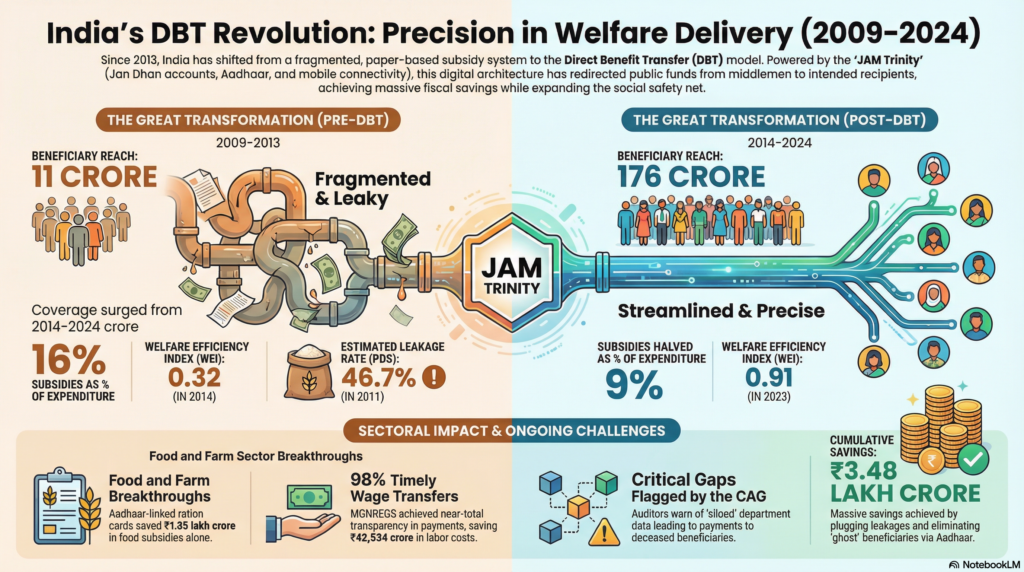
By April 2025, India’s DBT ecosystem had transferred Rs.43.35 lakh crore directly into the bank accounts of verified beneficiaries. More importantly, the system had prevented leakages amounting to Rs.3.48 lakh crore, funds that would previously have been lost to duplicate records, fake identities, and ghost beneficiaries.
To put that in perspective, this recovered amount equals roughly 1.5% of India’s nominal GDP. That is money that can now fund classrooms, hospitals, rural roads, and subsidised food grains instead of being lost to systemic inefficiencies.
According to the Ministry of Finance, more than 10 crore duplicate, ineligible, or fictitious beneficiaries have been weeded out of welfare rolls. Each removal doesn’t just create a one-time saving but permanently reduces future fiscal burden. With every payment cycle, those gains compound.
In essence, DBT has shifted the conversation from “how much is allocated” to “how much actually reaches people.”
At a Glance: India’s DBT Reforms (2026)
- How much has India saved through DBT?
₹3.48 lakh crore saved by 2026, primarily by eliminating 5.2 crore ghost beneficiaries and plugging leakages across 450+ schemes.- What is India’s WEI Score in 2026?
The score hit 0.91 (up from 0.32 in 2014)—this nearly 3x improvement means 91 paise of every rupee now reaches citizens directly.- How many people are covered under DBT?
Coverage reached 176.4 crore cumulative beneficiaries by 2025, a massive 16x jump from the 10.8 crore recorded in 2013.- Which schemes saw the most savings?
PDS (Food) saved ₹1.85 lakh crore via biometric cleanup, MGNREGS achieved 98% on-time payments, and PM-KISAN removed 2.1 crore ineligible farmers.- What is the “DBT 2.0” reform?
The 2026 phase introduces AI-driven fraud detection and a unified Citizen Account to manage all central and state benefits in one interface.
The JAM Trinity: Aadhaar, Jan Dhan and Mobile as DBT Infrastructure
At the heart of this transformation lies the JAM Trinity: Jan Dhan accounts, Aadhaar biometric identification, and Mobile connectivity.
Together, these three pillars created the infrastructure needed to deliver welfare at scale and with accountability.
Aadhaar has now been issued to over 138 crore residents, giving India a unified, de-duplicated digital identity framework. Unlike earlier identity systems, Aadhaar prevents the same individual from registering multiple times across districts or states.
Meanwhile, more than 53.7 crore Jan Dhan accounts have brought banking access to millions who were previously excluded from formal finance, particularly women and rural households. For many families, DBT credits were their first interaction with the banking system.
Mobile connectivity completes the loop. With UPI now processing billions of transactions every month, beneficiaries are not only receiving funds digitally but are increasingly using digital channels to spend, transfer, and manage money.
As the Economic Survey 2016-17 observed:
“The JAM Trinity has transformed welfare delivery from an aspiration into an architecture, one where the identity of every beneficiary is authenticated, every rupee is traceable, and every leakage point is visible in real time.”
— Economic Survey 2016-17, Chapter 9
Today, DBT 2.0 represents the next evolution. The system is integrating AI-driven seeding verification and real-time account health checks to plug smaller, more technical gaps that surfaced over time. Instead of simply transferring money efficiently, the focus is now on predictive corrections such as identifying mismatches, inactive accounts, or authentication errors before payments fail.
What began as a digital reform has gradually matured into a governance overhaul, one that blends identity, banking, and technology to make welfare delivery faster, cleaner, and more transparent.
Fiscal Impact of DBT Reforms: Subsidy Rationalization and WEI Score in 2026
Subsidy Rationalization in Union Budget 2026-27
For decades, rising subsidy bills were seen as an unavoidable cost of supporting a large and diverse population. But the Union Budget 2026-27 tells a different story.
The budget projects a 3.1% decline in major subsidy outlays compared with the revised estimates for FY26. This continues a clear downward trend: major subsidies have fallen from 1.9% of GDP in FY22 to an estimated 1.2% in FY25.
What makes this decline significant is how it has been achieved. These reductions are not the result of cutting benefits or shrinking entitlements. Instead, they stem from something more structural: eliminating leakages that previously inflated subsidy bills. When ghost beneficiaries are removed, and duplicate claims are blocked, the expenditure baseline automatically resets lower, and that too permanently.
A detailed analysis of the Union Budget 2026 confirms that the three historically heavy fiscal components– food, fertilizer, and fuel subsidies- have each undergone DBT-linked authentication reforms. The impact is cumulative. Each fraudulent or duplicate record removed today reduces fiscal pressure for every future year.
In simple terms, the government is spending smarter and not necessarily less.
What Is the Welfare Efficiency Index (WEI) Score in 2026?
Among the many indicators used to measure DBT’s impact, the Welfare Efficiency Index (WEI) stands out as particularly telling.
The WEI is a composite metric that evaluates how much genuine welfare outcome is delivered per rupee of public expenditure. It essentially asks: Of every rupee spent, how much actually reaches the intended beneficiary in a meaningful way?
India’s WEI score has risen sharply from 0.32 in 2014 to 0.91 in 2026, which represents nearly a threefold improvement in welfare delivery efficiency.
WEI Score Progression:
- 2014: 0.32
- 2016: 0.51
- 2018: 0.62
- 2020: 0.72
- 2022: 0.80
- 2024: 0.87
- 2026: 0.91
A WEI score of 0.91 implies that approximately 91 paise of every rupee disbursed through the DBT ecosystem now translates into a measurable welfare outcome.
To understand the scale of change, it helps to recall earlier estimates. Before DBT reforms gained momentum, assessments by the World Bank and the IMF suggested that in certain subsidy chains, particularly food and fuel, as little as 16-20 paise per rupee actually reached intended beneficiaries.
That gap between allocation and outcome defined India’s welfare challenge for decades.
The WEI reframes that conversation. Instead of focusing only on how much money is spent, it measures how efficiently that money is translated into impact and by that metric, India’s welfare architecture has undergone one of the most significant structural improvements in its post-liberalization history.
Sector-Wise DBT Savings: Where the ₹3.48 Lakh Crore Accrued
The headline figure of Rs.3.48 lakh crore in savings can sound abstract. But this amount did not emerge from a single reform or a one-time audit. It is the cumulative result of targeted interventions across multiple sectors, each with its own operational challenges, technology upgrades, and beneficiary databases.
In other words, DBT savings are layered. They reflect years of cleaning up beneficiary lists, strengthening identity verification, and tightening last-mile authentication.
Sector-wise Savings Summary:
• Aadhaar-linked PDS / Food Subsidy: Rs.1.85 Lakh Crore — Biometric de-duplication of ration cards
• MGNREGS Wage Payments: Rs.42,534 Crore — 98% on-time bank transfer; removed bogus job cards
• Fertilizer Subsidy (PoS Authentication): Rs.18,699.8 Crore — Point-of-Sale soil-health linked disbursement
• PM-KISAN (Ineligible Beneficiary Removal): Rs.22,106 Crore — 2.1 crore ineligible recipients deleted
• LPG (PAHAL Scheme): Rs.50,000 Crore+ — Voluntary give-up and Aadhaar seeding of gas connections
• Scholarships / Social Sector DBT: Residual balance — Single-window PFMS routing; eliminated middlemen
Each category tells a different story, but together, they show how digitisation reshaped subsidy governance at scale.
Food Subsidy Reforms: Aadhaar-Linked PDS and Biometric De-duplication
Food subsidy reforms alone account for Rs.1.85 lakh crore, roughly 53% of total DBT savings.
Before Aadhaar seeding became mandatory under the National Food Security Act framework, loopholes were widespread. The same household could potentially draw rations from multiple fair-price shops across districts. In some cases, ration cards remained active long after a beneficiary’s death.
Biometric authentication at point-of-sale (PoS) machines changed this dynamic. Now, grain distribution requires fingerprint or Aadhaar-based authentication at the shop itself. This single intervention simultaneously blocked duplicate cards and eliminated “ghost” beneficiaries.
The result? The food subsidy pipeline, once considered the most leakage-prone, became the largest contributor to DBT savings.
PM-KISAN DBT Cleanup: 2.1 Crore Ineligible Beneficiaries Removed
The PM-KISAN scheme offers another clear example of DBT’s governance impact.
Through Aadhaar-linked cross-verification with income-tax and land records, 2.1 crore ineligible beneficiaries, including income-tax filers, government employees, and institutional landowners were identified and removed. This cleanup generated savings of Rs.22,106 crore.
Beyond the fiscal impact, this exercise demonstrated something equally important: DBT is not just a transfer mechanism. It creates a data intelligence layer. Cross-linking identity, tax, and land records allows authorities to detect inconsistencies that would have previously gone unnoticed.
That intelligence strengthens the credibility of welfare delivery.
MGNREGS DBT Payments: 98% Timeliness and ₹42,534 Crore Savings
MGNREGS wage payments were once plagued by long delays, sometimes stretching to 60-90 days. Such delays often forced rural workers to rely on informal credit while waiting for payments.
Today, 98% of MGNREGS wage payments are processed on time, thanks to direct routing from the central government to beneficiary accounts via the Aadhaar Payments Bridge.
This bypasses multiple administrative layers, including state treasuries and district intermediaries, that previously slowed the process.
The Rs.42,534 crore in savings reflects two factors: the elimination of fake or inflated job cards and the reduction in financial inefficiencies tied to delayed payments.
For workers dependent on daily wages, speed is not just administrative efficiency but economic security.
Fertilizer Subsidy DBT: PoS Authentication and Diversion Control
The fertilizer sector presented a different type of challenge. Subsidised agricultural fertilizers were often diverted to industrial or commercial buyers, who exploited price differentials.
To counter this, point-of-sale machines were installed at 2.77 lakh fertilizer retail outlets nationwide. Farmers must now authenticate via Aadhaar before purchasing subsidised fertilizer.
This measure significantly reduced diversion and misuse, a concern repeatedly flagged in prior audit cycles by oversight authorities.
Unlike food or wage payments, fertilizer reform focused on retail-level authentication. It demonstrates how DBT reforms adapt to sector-specific vulnerabilities rather than applying a one-size-fits-all approach.
Taken together, these sectoral interventions reveal something critical: the Rs.3.48 lakh crore saving is not a theoretical estimate. It is the outcome of dozens of incremental system corrections across welfare pipelines that were historically prone to distortion.
Governance Gaps in DBT: Audits, Payment Rejections and System Maturity
No reform of this scale is without friction.
While DBT’s headline achievements are substantial, a complete assessment must also acknowledge its vulnerabilities. Even as savings accumulate, oversight bodies, particularly the Comptroller and Auditor General (CAG), have highlighted what they describe as “maturity gaps” within the system.
These include weaknesses in database management, limited real-time coordination between ministries, and inconsistencies in biometric authentication handling. In simple terms, the infrastructure is strong but not yet flawless.
The existence of these gaps does not negate DBT’s impact. Instead, it signals that large digital ecosystems evolve in phases, with governance mechanisms catching up to technological deployment.
CAG Audit Findings: Payments to Deceased Beneficiaries
Among the most sensitive findings was uncovered during an audit of the National Social Assistance Programme (NSAP). The CAG identified Rs.2 crore paid to 2,103 deceased beneficiaries.
In absolute fiscal terms, Rs. 2 crore is small relative to the total DBT outlay. But symbolically, it matters.
The issue highlights a systemic limitation: the absence of seamless, real-time synchronization between the DBT beneficiary database and civil registration systems that record deaths. When those systems do not automatically communicate, payments may continue until manual updates are made.
The takeaway is clear: identity authentication works effectively at the entry stage, but lifecycle events (like death records) must also be fully integrated into the ecosystem.
Database Silos, Aadhaar Seeding Errors and Biometric Failures
The CAG has also flagged structural coordination issues that reveal the complexity of managing welfare across dozens of ministries and hundreds of schemes.
- Unsynchronized departmental databases:
Different departments and sometimes even different divisions within the same ministry maintain separate beneficiary lists. Without real-time reconciliation, there is room for duplication across overlapping sub-schemes. This fragmentation creates temporary blind spots in what is otherwise a centralized architecture. - Biometric authentication failures:
For elderly beneficiaries or manual labourers with worn fingerprints, biometric authentication can fail. In such cases, manual override procedures are used. While necessary, these overrides partially reintroduce intermediary discretion, the very bottleneck DBT aimed to remove. - Aadhaar-bank seeding errors:
Minor spelling mismatches between Aadhaar records and bank documents can result in rejected transactions. For vulnerable households, resolving such mismatches may require repeated visits to a rural Common Service Centre, delaying access to entitlements. - Dormant account closures:
Some banks have levied minimum-balance penalties on PMJDY accounts, occasionally rendering them inactive. When DBT credits are routed to inoperative accounts, payments bounce back, causing delays that disproportionately affect economically fragile households.
These findings illustrate that while DBT has significantly reduced corruption and leakages, operational precision at the margins still requires refinement.
DBT 2.0 is designed to address precisely these concerns. The next phase introduces federated database architecture, AI-driven mismatch detection, and a streamlined grievance redressal protocol that routes rejected payments into human-review queues within 48 hours.
The reform journey, therefore, is not static. It is iterative, identifying weaknesses, correcting them, and strengthening the system over time.
How to Check DBT Payment Status in 2026: Operational Guide for Beneficiaries
For more than 110 crore Indians interacting with the DBT ecosystem, the system isn’t just policy but it’s personal. It determines whether a farmer receives income support on time, whether a worker gets wages without delay, or whether a student’s scholarship reaches their bank account.
Yet for many beneficiaries, navigating the digital infrastructure can feel overwhelming. Portals, OTPs, Aadhaar linking, rejection codes-these steps can become barriers if not clearly understood.
This section answers the most common practical questions about checking DBT status, resolving payment issues, and ensuring Aadhaar linkage.
Where to Check DBT Payment Status: DBT Bharat, PFMS and UMANG
The primary official portal for tracking DBT payments is DBT Bharat which consolidates payment information across 316+ central schemes into a unified dashboard.
Beneficiaries can log in using their Aadhaar number or the mobile number linked to their Jan Dhan account to view scheme-wise payment history.
For more detailed transaction-level tracking, the Public Financial Management System (PFMS) allows users to check the exact date, credited amount, and payment status of each transfer.
Additionally, the UMANG app brings together scheme-specific services in 13 regional languages, supported by the Bhashini language platform. This multilingual support is especially valuable for beneficiaries in rural and non-English-speaking regions.
The goal is simple: transparency. Every payment leaves a digital footprint that beneficiaries can independently verify.
Step-by-Step Guide to Check Your DBT Payment Status
- Visit dbtbharat.gov.in or open the UMANG app on your mobile device.
- Select the scheme (e.g., PM-KISAN, MGNREGS, PMJAY) from the dropdown menu.
- Enter your Aadhaar number or the registered mobile number linked to your Jan Dhan account.
- Complete OTP verification sent to your registered mobile number.
- View your payment history, pending amounts, and last-transaction date on the dashboard.
- For failed or rejected payments, note the rejection reason code and visit the nearest Common Service Centre (CSC) or bank branch for resolution.
If a payment fails, the reason code often points directly to the issue whether it’s an Aadhaar mismatch, inactive bank account, or seeding error. Acting quickly can prevent prolonged delays.
How to Link Aadhaar with Bank Account for DBT Payments
All DBT credits in India flow through the Aadhaar Payments Bridge (APB), a system operated by NPCI. The APB maps each Aadhaar number to a designated bank account.
When a government department initiates payment, the APB identifies the linked bank account and routes funds electronically, often in near real time.
To ensure smooth transfers:
• Visit your bank branch with your original Aadhaar card and request Aadhaar seeding.
• Use internet banking or mobile banking platforms that offer self-service Aadhaar linking (if available).
• For PMJDY account holders in rural areas, Aadhaar can be linked through a Business Correspondent (BC) agent operating in the village.
Once seeded successfully, future DBT payments will automatically flow into the mapped account unless the linkage is changed.
Is Aadhaar Mandatory for DBT Schemes in 2026?
Official Position (2026): Under Section 7 of the Aadhaar Act, 2016, the Government of India has notified Aadhaar as mandatory for the receipt of subsidies, benefits, and services financed from the Consolidated Fund of India. As of 2026, Aadhaar remains the “single source of truth” for identity verification across all major central DBT schemes.
Individuals who have not yet enrolled can do so at the nearest Aadhaar enrolment centre. For beneficiaries facing biometric challenges, the Unique Identification Authority of India (UIDAI) provides exception-handling and grievance redressal mechanisms to prevent exclusion.
In practice, Aadhaar linkage is not just a compliance requirement but is the gateway that ensures faster, traceable, and accountable delivery of welfare benefits.
DBT 2.0 and the Road to Poverty Eradication: What Comes Next?
The headline numbers -Rs.3.48 lakh crore in cumulative savings and a 0.91 WEI score – are powerful indicators of progress. But they are not the final destination. They represent proof of concept.
India’s broader Viksit Bharat 2047 vision calls for something more ambitious: a welfare system that not only prevents leakages but actively strengthens citizens’ economic capabilities.
The next phase of reform shifts the focus from efficiency alone to empowerment. Instead of simply ensuring money reaches the right person, the goal is to anticipate needs, personalise support, and integrate welfare across sectors-health, nutrition, education, and financial inclusion into a cohesive social protection architecture.
DBT, in that sense, is evolving from a transfer mechanism into a foundational digital infrastructure for governance.
AI, Digital Public Infrastructure and Predictive Oversight in DBT
India’s Digital Public Infrastructure (DPI) stack is already incorporating AI-driven anomaly detection systems that can flag irregular payment patterns in real time.
For example, if MGNREGS wage claims spike unusually in a particular district, algorithms can trigger alerts for review. Instead of relying solely on retrospective audits, the system is gradually moving toward predictive oversight.
Research by ICRIER on Digital Public Infrastructure suggests that the next efficiency gains will emerge from deepening this intelligence layer.
Potential advancements include:
• Predictive targeting of households at risk of slipping below the poverty line
• Dynamic recalibration of transfer amounts based on real-time cost-of-living data
• AI-powered grievance redressal in local languages
The emphasis is no longer just on speed but on smart delivery.
Common Questions: India’s ₹3.48 Lakh Crore DBT Savings (2026)
India saved a massive ₹3.48 lakh crore by 2026 by eliminating ghost beneficiaries. The largest impact came from PDS (Food Security), where ₹1.85 lakh crore was saved after deleting 5.2 crore fake or duplicate ration cards using biometric de-duplication—the biggest subsidy cleanup in India’s history.
The Welfare Efficiency Index (WEI) has surged from 0.32 in 2014 to 0.91 in 2026, meaning 91 paise per rupee now reaches citizens directly. This near 3x improvement is driven by DBT removing intermediaries and improving targeting accuracy at scale.
DBT coverage expanded from ~11 crore in 2013 to over 176.4 crore cumulative beneficiaries by 2025, spanning 450+ central and state schemes. This makes India’s DBT ecosystem one of the largest digital welfare delivery systems globally.
AI-driven data validation identified 2.1 crore ineligible farmers in the PM-KISAN database. These included income-tax payers and non-eligible landholders, leading to savings of approximately ₹22,000 crore.
DBT 2.0 introduces a Unified “Citizen Account”, enabling individuals to track benefits across 450+ schemes through a single interface, powered by real-time AI fraud detection.
Yes. Major subsidies declined from 1.9% of GDP (FY22) to 1.2% (FY25), reflecting improved efficiency and better targeting—contributing directly to India’s fiscal consolidation.
The “Citizen Account” Proposal: Integrating over 450 DBT Schemes
One of the most discussed reform ideas in policy circles is the consolidation of India’s over 450 central DBT schemes into a single unified “Citizen Account.”
Under this model, every entitlement, whether related to agriculture, education, healthcare, or social protection, would flow into one Aadhaar-linked digital wallet. Instead of navigating dozens of scheme portals, beneficiaries would view all their entitlements in one place.
Proponents argue that consolidating schemes would eliminate administrative duplication across 450 beneficiary databases, audit trails, and grievance channels. It would also create a clearer, citizen-centric interface where individuals could monitor benefits, file complaints, and potentially even leverage their welfare history for formal credit access.
While still conceptual, the proposal reflects a broader shift: from fragmented scheme management to integrated welfare architecture.
The Economic Survey 2025-26 also engaged with the global debate between unconditional cash transfers and targeted in-kind transfers. India’s DBT framework occupies a distinctive middle ground — identity-targeted but delivery-flexible.
Through the same infrastructure, the state can provide:
• In-kind benefits such as food grains or fertilisers
• Direct cash transfers like PM-KISAN income support or MGNREGS wages
This dual capability strengthens policy agility.
With the DBT Mission coordinating across 56 ministries and more than 316 schemes, the administrative backbone for deeper transformation already exists.
The real question now is the speed of evolution. Can the system move from preventing leakages to building long-term economic resilience? Can it transition from efficient payments to capability creation?
As ORF India aptly notes:
“The true measure of DBT’s success is not the money saved by the government, but the money that actually reaches the hands of the farmer, the widow, the daily-wage worker — on time, in full, with dignity.”
— ORF India: Cash Transfers as an Instrument for Poverty Alleviation
The next chapter will be defined not just by how much is delivered but by how deeply it transforms lives.
Check Your DBT Payment Status: https://dbtbharat.gov.in
Disclaimer
The views and opinions expressed in this article are solely those of the author and do not necessarily reflect the official policy or position of India Policy Hub. This content is provided for general information and entertainment purposes only. While we endeavor to provide accurate and helpful insights, the information here is provided “as is” and should not be treated as professional advice. Readers are encouraged to use their own judgment and discretion before applying any tips, strategies, or recommendations found in this post to their personal or professional lives.


Discussion (6)
Leave a Reply